
Your best marketing hire might not be a person. It could be an algorithm that works 24/7, understands every ad channel, and refines strategy with real-time data. This is exactly what Google Performance Max campaigns do. As a goal-based campaign type, it uses AI to be your automated marketing expert. You give it your objectives and creative assets, and it finds customers across Google’s network. This is the kind of technology that AI-powered agents, like our own Erle, are built to manage, making sophisticated advertising accessible to everyone.
Key Takeaways
- Use one campaign to reach customers everywhere: Performance Max simplifies advertising by running your ads across Google's entire network—from Search to YouTube—within a single campaign. This allows the AI to automatically find the most effective placements and optimize your budget.
- Steer the AI with high-quality inputs: The success of your campaign depends on the assets and data you provide. Use clear conversion goals, diverse creative, and your own customer lists as audience signals to help the AI find your ideal customers more efficiently.
- Organize asset groups for better performance: Structure your campaign by creating separate asset groups for each product, service, or theme. This helps the AI deliver more relevant ads and provides clearer insights into which messages resonate with different audiences.
What Are Google Performance Max Campaigns?
Think of Google Performance Max (PMax) as your all-in-one campaign manager. It’s a goal-based campaign type that uses artificial intelligence to find new customers and drive conversions across all of Google’s advertising channels. Instead of you having to create and manage separate campaigns for Search, YouTube, and Display, PMax does the heavy lifting from a single, unified setup. You provide the strategy and creative assets—like headlines, images, and videos—and Google’s AI takes it from there.
Performance Max campaigns essentially take the guesswork out of ad placement. The system automatically tests different combinations of your assets and shows them to the right people at the right time, whether they’re watching a video, checking their email, or searching for a product. For small business owners, this is a powerful way to get the benefits of a full-funnel advertising strategy without needing a large marketing team. It’s the kind of technology that AI-powered tools, like MEGA’s Paid Ads agent, are designed to manage, making sophisticated advertising accessible to everyone.
Where Do Your PMax Ads Actually Appear?
The biggest advantage of PMax is its reach. A single campaign can place your ads across Google's entire network, including YouTube, Display, Search, Discover, Gmail, and Maps. You simply upload your creative components, and the AI assembles them into responsive ads that fit the format of each channel. This means your brand can appear as a video pre-roll, a banner on a partner website, or a product listing in search results, all managed from one central campaign.
This approach ensures your business is visible wherever your potential customers spend their time online. Understanding where your audience is and meeting them there is fundamental to growth. By leveraging a tool like Performance Max, you can effectively scale your presence within Google's ecosystem, creating a consistent and recognizable brand experience that reaches people at every stage of their buying journey.
What's AI's Role in Your PMax Campaign?
The real power behind Performance Max is its AI-driven optimization. The system processes billions of user signals in real time to figure out exactly when and where someone is most likely to convert. It analyzes everything from search queries and websites visited to videos watched to predict user intent and serve the most relevant ad at the perfect moment. This automated bidding and targeting helps you get the most value from your ad spend.
For the AI to work its magic, it needs good data. Google’s AI models perform best when they learn from your own business information. By providing audience signals, such as customer lists or website visitor data, you give the AI a clear picture of your ideal customer. This helps it find new audiences with similar characteristics, continuously refining its targeting to improve campaign performance over time.
How Does the AI Behind PMax Actually Work?
Google Performance Max isn't just about running ads everywhere at once. Its real power comes from the AI working behind the scenes to make thousands of decisions every second. Think of it as having a dedicated analyst who never sleeps, constantly refining your campaigns for better results. The system uses machine learning to automate three core areas: bidding, creative testing, and audience targeting. By processing billions of data points, the AI learns what works for your specific business goals and adjusts its strategy in real time.
This automated approach is designed to find the most efficient path to conversion, whether that’s a sale, a lead, or a store visit. It analyzes user behavior, market trends, and the performance of your ad assets to make informed choices. This is similar to how MEGA AI's Paid Ads agent, Erle, autonomously manages and optimizes campaigns. Understanding how PMax uses AI helps you provide the right inputs so the system can deliver the best possible outcomes for your business.
How Machine Learning Adjusts Bids for You
Performance Max campaigns remove the guesswork from bidding. Instead of you manually setting bids for clicks, the AI handles it through a process called Smart Bidding. The system processes billions of user interactions and contextual signals—like the time of day, the user's device, and their past search behavior—to determine the ideal bid for each individual ad auction.
This means the AI can bid more aggressively for a user it identifies as highly likely to convert and less for someone who is just browsing. It’s all about spending your budget more effectively by focusing on the moments that matter most. The goal is to maximize your return on ad spend by predicting which clicks will lead to valuable actions for your business.
Targeting Audiences and Testing Ads in Real Time
PMax excels at finding new customers by looking beyond the initial audience signals you provide. The AI continuously tests different combinations of your ad assets—your headlines, descriptions, images, and videos—to see which versions resonate most with different types of users. It learns which message connects with which audience segment and then automatically serves the winning combination more often.
This real-time testing and optimization cycle allows your campaign to adapt and improve over time. The system works to understand where your potential customers are across Google's channels and what messaging will prompt them to act. This ensures you’re always showing the most compelling version of your ad to the right person at the right moment, helping you scale your reach effectively.
Using Your Own Data for Smarter Targeting
First-party data is information you've collected directly from your customers, such as an email list or website visitor data. Providing this information to Performance Max gives the AI a powerful head start. By uploading a Customer Match list, you give the AI a clear picture of what your ideal customer looks like.
The system uses this high-quality data as a strong signal to find new users who share similar characteristics and behaviors with your existing customers. This makes the campaign's targeting more precise right from the beginning. Brands that use their own data often see higher conversion rates and a better return on ad spend because the AI can more quickly identify and reach high-intent audiences.
Which Google Platforms Does PMax Cover?
One of the biggest advantages of Performance Max is its reach. Instead of creating separate campaigns for Search, Display, and YouTube, PMax consolidates your efforts into a single, goal-oriented campaign that runs across Google’s entire advertising inventory. This means your ads can appear wherever your customers are, without you needing to manually manage each channel.
Think of it as giving Google the keys to your creative assets and your business goals. The AI then finds the most effective combination of platform and ad format to connect with potential customers. This approach is ideal for small businesses that need to make an impact across multiple touchpoints but may not have the resources for complex, multi-campaign strategies. The system automatically places your ads across Search, YouTube, the Display Network, Discover, Gmail, and Google Maps. This comprehensive coverage ensures you have an omnichannel presence, meeting your audience at various stages of their buying journey. Managing this process is where an AI-powered tool like MEGA AI’s Paid Ads agent can simplify your workflow even further.
Reaching Users on Search, Shopping, and YouTube
Performance Max integrates your ads into Google’s most powerful platforms for intent and engagement. On Google Search, your ads can appear above or below search results when users look for keywords related to your business. For ecommerce brands, PMax automatically serves product listings on the Shopping tab, putting your items directly in front of active buyers. This is a huge part of how PMax runs your ads at the exact right moment. On YouTube, your video assets can be shown as in-stream ads before or during videos, in-feed ads on the homepage, or as YouTube Shorts, capturing attention on the world’s largest video platform.
Expanding Your Reach with Gmail, Discovery, and Display
Beyond the core platforms, Performance Max extends your reach to places where users browse and discover new things. Your ads can appear in Gmail, showing up in the Promotions and Social tabs of a user's inbox. On the Discovery feed, which appears on the Google app homepage and YouTube, your ads are shown to people based on their interests and online behavior. Finally, the Google Display Network places your visual ads across millions of websites, news pages, and blogs. This broad network allows you to reach their audience with visually compelling ads, building brand awareness and driving traffic from relevant third-party sites.
Why Should You Use Google Performance Max?
Performance Max campaigns are a powerful tool for small businesses because they use AI to automate three key areas that often require significant time and expertise: budget allocation, multi-channel reach, and performance analysis. Instead of managing separate campaigns for Search, Display, and YouTube, PMax combines them into a single, goal-oriented campaign. This streamlined approach helps you find more converting customers across all of Google's channels, using a process that is both efficient and data-driven. By handing over the complex decisions to Google's AI, you can focus on running your business while your ads work smarter to achieve your goals.
How AI Optimizes Your Ad Spend
One of the biggest challenges in digital advertising is knowing where to spend your money. Performance Max removes the guesswork by using AI to automatically allocate your budget across Google’s entire ad inventory. The system analyzes billions of data points in real time to determine where and when your ads are most likely to drive conversions. If YouTube is delivering better results one day, the AI shifts more of the budget there. If Search queries show higher intent the next, it adjusts accordingly. This dynamic budget optimization ensures your ad spend is always directed toward the most promising opportunities, helping you get more value from every dollar without constant manual adjustments.
Be Everywhere Your Customers Are
To be effective, your marketing needs to reach customers wherever they are. Performance Max acts as an omnipresence engine, placing your ads across Search, YouTube, Gmail, Maps, and the Display Network from a single campaign. This creates a consistent and cohesive brand experience for potential customers. They might see your video ad on YouTube, discover your business on Google Maps, and then see a text ad when they search for a related product. This multi-touchpoint approach builds brand recognition and trust, guiding customers through their buying journey more effectively than a single-channel campaign ever could. It ensures your message is seen at the critical moments of consideration and decision.
Tailoring PMax for Different Business Models
Performance Max is flexible enough to support various business goals, but its real strength is revealed when you tailor it to your specific model. Whether you run a local shop, an online store, or a hotel, you can configure your campaign to focus on the outcomes that matter most to you. By setting the right conversion goals and providing the appropriate data feeds, you guide the AI to optimize for your unique objectives. This ensures the system isn't just running ads, but actively working to grow your specific type of business.
Driving Local Store Visits
If you have a brick-and-mortar location, Performance Max can be a key tool to get more local store visits. By setting "store visits" as your primary conversion goal, you tell the AI to prioritize showing your ads to people who are physically near your business and likely to stop by. The campaign will then leverage channels like Google Maps and local search results to capture the attention of potential customers in your area. This is especially effective for local businesses like cafes, boutiques, and service providers who depend on foot traffic to drive revenue. The system optimizes for in-person visits, turning online searches into real-world customers.
E-commerce and Google Merchant Center Integration
For online retailers, the most critical step is integrating your Google Merchant Center (GMC) account with your Performance Max campaign. This connection allows the AI to pull your entire product catalog—including images, prices, and descriptions—to create dynamic Shopping ads. While PMax can generate some assets automatically, providing a well-maintained product feed is essential for success. Make sure your GMC account is set up correctly and linked to Google Ads. This ensures your products are displayed accurately and compellingly to users who are actively searching for items you sell, turning your campaign into a powerful sales engine.
Reaching Travelers with PMax for Hotels
Hotels can use a specialized version of Performance Max designed specifically for the travel industry. PMax for Hotels helps you advertise across all of Google's platforms, reaching potential guests at every stage of their travel planning journey. By connecting to your hotel's booking engine or a connectivity partner, the campaign can show real-time availability and pricing to users searching for accommodations in your area. This allows you to capture direct bookings and compete effectively for travelers' attention, whether they are just starting their research on YouTube or ready to book through Google Search and Maps.
Getting Actionable Insights from Your Reports
While Performance Max is highly automated, it doesn’t operate in a black box. Google has continuously improved reporting to provide more transparency into campaign performance. You can see insights on which audience segments are responding best and which creative assets—like images, headlines, and videos—are driving the most engagement. This data helps you understand what resonates with your customers. By analyzing these reports, you can refine your marketing message and provide the AI with better assets over time, creating a cycle of continuous improvement. Platforms like MEGA AI further simplify this by consolidating these insights, making it easier to track what our Paid Ads agent is doing to hit your goals.
Integrating with Google Analytics for Deeper Insights
While Performance Max reports tell you what’s working, Google Analytics tells you why. By connecting your campaigns, you can see the full customer journey, from the initial ad click to their final action on your website. This integration allows you to track how users behave after they arrive. Do they visit multiple pages, or do they leave immediately? Which content do they engage with most? This information is crucial for understanding the quality of the traffic PMax is sending you. By analyzing this data, you can refine your website experience and even your ad creative to better match user expectations, creating a powerful cycle of continuous improvement.
PMax vs. Traditional Google Ads: What's the Difference?
The main distinction between Performance Max and traditional Google Ads campaigns comes down to automation and scope. Traditional campaigns, like Search and Display, are managed separately, giving you direct control over specific channels. You manually set bids, choose keywords, and select placements for each one. It’s a hands-on approach that requires you to manage each platform individually, which can be time-consuming for small business owners who wear many hats.
Performance Max works differently. It’s a goal-based campaign type that consolidates all of Google's advertising channels into a single, unified campaign. Instead of managing multiple campaigns, you provide the strategic inputs—your goals, budget, and creative assets—and let AI handle the optimization. This approach is designed to find more converting customers across all of Google's channels, saving you the time and effort of manual management. It represents a shift from micromanaging campaign details to guiding a powerful automated system, letting you focus on your business while the technology finds your next customer.
Automation vs. Manual Control
With traditional Google Ads campaigns, you are in the driver's seat for every decision. You conduct keyword research, set bids for ad groups, write ad copy for specific formats, and decide which websites to target or exclude. This manual process offers a high degree of control but requires significant time and expertise to manage effectively.
Performance Max campaigns, on the other hand, take away much of the guesswork. You supply the components: ad copy, images, videos, logos, and audience signals. Google’s AI then assembles these assets into ads and automatically determines the bidding, targeting, and placements most likely to achieve your conversion goals. Your role shifts from a hands-on manager to a strategic director, focusing on providing the best possible inputs to guide the AI-powered system.
Wider Reach, Greater Efficiency
One of the biggest advantages of PMax is its reach. If you run a traditional Search campaign, your ads only appear on Google Search. If you run a YouTube campaign, your ads are limited to YouTube. To get full coverage, you would need to create and manage separate campaigns for each channel. This can be a complex and time-consuming process for any business, especially small ones.
Performance Max streamlines this by giving you access to the entire Google Ads inventory from one place. A single PMax campaign can serve ads across Search, YouTube, Display, Discover, Gmail, and Maps. This unified approach allows you to connect with customers at various touchpoints in their journey without building separate campaigns, making your advertising efforts far more efficient and scalable.
How Much Control Do You Really Have?
The trade-off for PMax’s automation and reach is a reduction in granular control. In a traditional campaign, you can pause a single low-performing keyword or block a specific website from showing your display ads. PMax does not offer this level of direct control over placements or keyword targeting. Instead, control is exercised through the quality of your inputs.
Optimization in PMax is about guiding the AI. You influence its performance by providing high-quality creative assets, setting clear conversion goals, and feeding it valuable first-party data through audience signals. Google’s AI models perform best when they learn from your data and can tell a connected story across platforms. The better your inputs, the more effectively the system can find your ideal customers and drive results. This is where an AI-powered paid ads agent can help, ensuring your campaign is always guided by the best possible strategic direction.
How PMax Interacts with Your Search Campaigns
A common question is whether Performance Max will compete with your existing Search campaigns. The short answer is no; they are designed to work together. If a user searches for an exact keyword you are already bidding on in a standard Search campaign, that campaign’s ad will typically be shown. However, PMax may step in if your Search campaign is limited by a tight budget or if its targeting is very narrow. Think of PMax as a smart assistant that fills in the gaps, ensuring you don't miss an opportunity just because your primary campaign has hit its daily limit. This allows you to work with your existing campaigns to capture as much relevant traffic as possible.
Using Brand Exclusions to Find New Customers
If your main goal is to find new customers, you don't want to spend your budget on people who are already searching for your brand by name. This is where brand exclusions come in. By telling PMax to exclude your brand terms, you direct the AI to focus its efforts on net-new customer acquisition. This prevents the campaign from taking credit for conversions from users who were already on their way to your site. It’s a crucial step to ensure your ad spend is truly driving growth and expanding your reach, rather than just capturing demand you already owned. This simple setting helps you get a clearer picture of how effectively PMax is finding new audiences for your business.
Applying Negative Keywords and Placement Exclusions
While Performance Max is highly automated, you still have tools to protect your brand. If you're worried about your ads showing up next to irrelevant or inappropriate content, you can use campaign-level controls. Negative keywords prevent your ads from appearing for specific search terms that aren't a good fit for your business. Similarly, placement exclusions allow you to block your ads from running on specific websites, YouTube channels, or apps that don't align with your brand values. Using these features gives you important guardrails, allowing you to maintain brand safety while still benefiting from the broad reach of PMax.
Controlling Final URL Expansion
By default, Performance Max can use its "Final URL expansion" feature to send traffic to pages on your website other than the specific URL you provided. The AI does this when it believes a different landing page is more relevant to a user's search and more likely to convert. While this can uncover valuable new conversion paths, you might want to limit it. For example, you probably don't want ad traffic going to your "About Us" or "Careers" page. You can turn this feature off entirely or create rules to exclude certain URLs, ensuring that your ad budget is only spent driving traffic to pages designed to generate leads or sales. This helps you control where users land after clicking your ad.
How to Set Up a Performance Max Campaign
Setting up a Performance Max campaign involves giving Google’s AI the right building blocks to work with. Think of it as providing a recipe: you supply the ingredients (your ads, audience info, and goals), and the AI does the cooking, finding the best way to combine them to reach your customers. While AI agents like MEGA AI’s Erle can manage this entire process for you, understanding the core components helps you appreciate what’s happening behind the scenes.
The setup process focuses on three key areas: providing creative assets, defining your business goals, and guiding the AI with audience signals. Getting these elements right from the start is the foundation for a successful campaign. It ensures the AI has a clear direction and the creative flexibility it needs to test what resonates with your audience across all of Google’s channels.
What Creative Assets Do You Need?
Your creative assets are the raw materials for your ads—headlines, descriptions, images, and videos. Because Performance Max places ads across the entire Google network, providing a diverse mix of high-quality assets is essential. The AI automatically combines these elements to create the best-performing ads for each channel. Upload multiple options for each asset type, including different headlines, high-resolution images in various orientations, and at least one video. This gives the algorithm more material to work with, leading to better testing and optimization across Search, YouTube, and Gmail.
Set Clear Goals and Track What Matters
Before you launch, you need to tell Google’s AI what a successful outcome looks like for your business. You do this by setting clear campaign objectives and implementing accurate conversion tracking. A conversion is any valuable action a customer takes, like making a purchase, filling out a form, or calling your business. By tracking these conversions, you give the AI the data it needs to learn which ads and audiences are driving real results. This feedback loop allows the system to automatically optimize your campaigns toward the goals that matter most, ensuring your budget is spent effectively.
Adding Audience Signals and Your Own Data
Audience signals are hints you give the AI about who your ideal customers are. While PMax finds new audiences on its own, you can speed up the learning process by providing starting points. These can include your website visitor data, custom audiences based on interests, or demographic information. The most powerful signal you can provide is your own first-party data, such as a customer email list. Using first-party data helps the AI find new customers who share characteristics with your existing ones, improving targeting accuracy and campaign performance right from the start.
How to Get the Most Out of Your PMax Campaigns
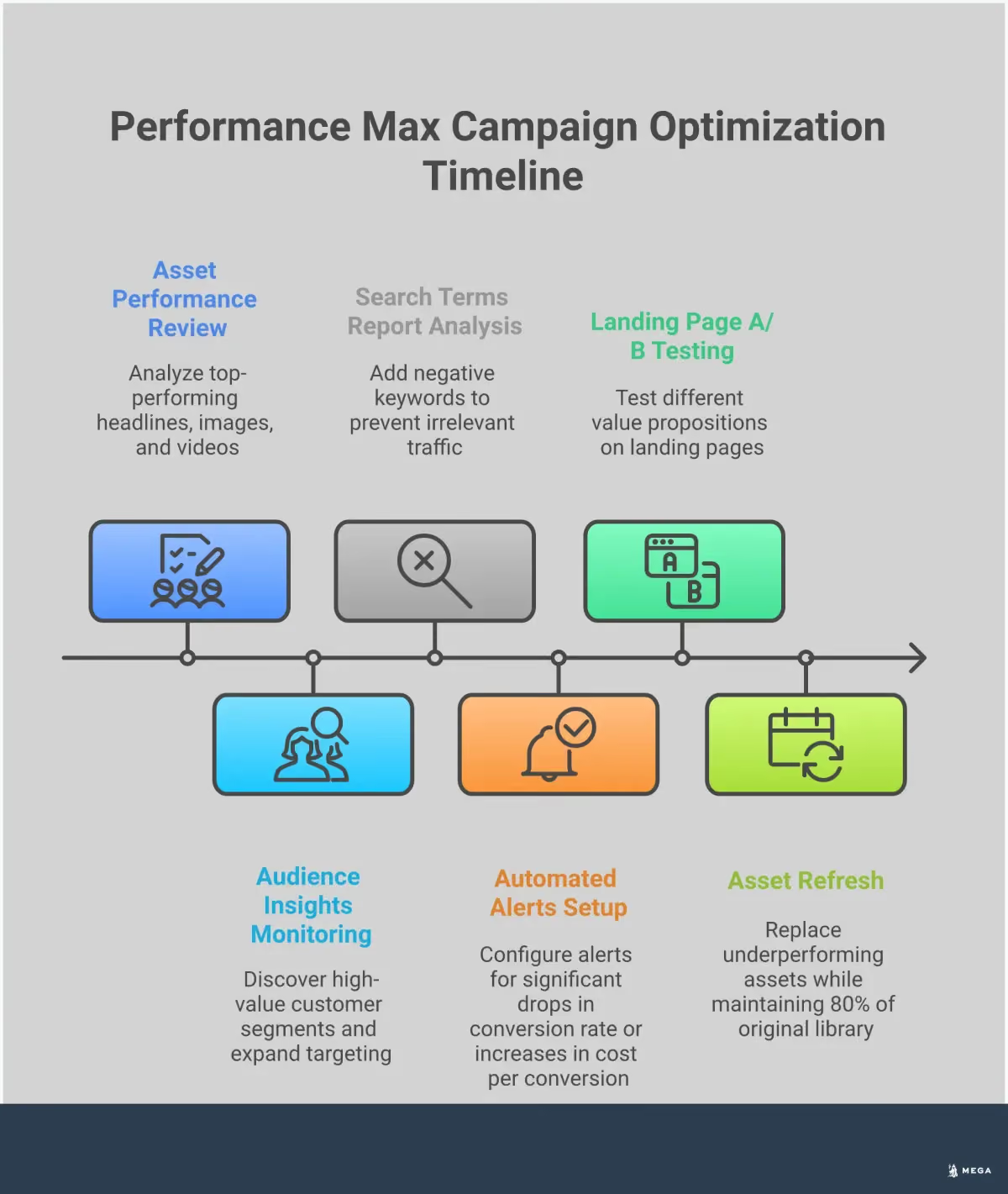
Once your Performance Max campaign is live, your work isn’t over. While the AI does much of the heavy lifting, you can guide its performance with a few key strategies. Think of it less like a "set it and forget it" tool and more like a partnership. You provide the strategic direction, and the AI executes at a scale that would be impossible to manage manually. By giving the AI the right inputs and monitoring its outputs, you can get much better results from your ad spend.
Guide the AI with Your Customer Data
Google's AI models perform best when they learn from your own business data. Your first-party data—like customer email lists or past purchase information—provides high-quality audience signals that generic targeting can’t match. When you upload a Customer Match list, you're giving the PMax algorithm a clear picture of what your ideal customer looks like. This helps it find new audiences who share similar characteristics. This data creates a connected story for the AI, ensuring your message is consistent across your website, ads, and other marketing channels. Brands that use their own data often see much higher conversion rates and return on ad spend (ROAS).
Structuring and Testing Your Asset Groups
A common mistake with PMax is dumping all your creative assets into a single group. For the best results, you should organize your asset groups by theme, product category, or specific audience. For example, if you run a local bakery, you might create separate asset groups for wedding cakes, birthday parties, and morning pastries. This structure helps the AI deliver more relevant ads. It also allows you to test which messages and visuals resonate with different customer segments. Avoid mixing too many products or brand messages in one group, as this can confuse the algorithm and dilute your ad performance. Following asset group best practices gives the AI the clarity it needs to find your best customers.
Making Data-Driven Adjustments to Your Campaign
While PMax automates many adjustments, you still need to monitor its performance. Keep an eye on key metrics like conversion value, cost per acquisition (CPA), and ROAS. Google provides insights into which asset combinations are performing best, so you can swap out low-performing images or headlines for new variations. Understanding where your customers are coming from is essential for scaling your business. Making small, data-driven adjustments and giving the campaign time to learn is more effective than making frequent, drastic changes. This approach allows you to steadily refine your campaign and improve its efficiency over time.
Integrating PMax with Your Existing Ad Strategy
You don’t need to pause your existing campaigns to run Performance Max. In fact, PMax is designed to work alongside your standard Search campaigns. If a user searches for an exact keyword you're already bidding on, your Search campaign ad will typically take priority. PMax acts as a smart supplement, filling in the gaps where your Search campaign might be limited by budget or has very narrow targeting. This ensures you capture additional opportunities without disrupting what’s already working. You can even use brand exclusions to prevent PMax from bidding on your brand name, giving you more control over how your brand is represented in search results.
When to Keep Campaigns Separate
While consolidating campaigns into PMax can give the AI more data to optimize with, there are strategic reasons to keep some campaigns separate. If you need very specific control over budget, messaging, or targeting, a separate campaign is often the better choice. This is especially true for short-term promotions, like a holiday sale, or when you need to target different countries with unique messaging. Keeping these initiatives in their own campaigns allows you to manage their performance and budget with precision, ensuring your most critical marketing efforts have the direct oversight they require without being blended into a broader automated strategy.
Common PMax Hurdles and How to Clear Them
Performance Max campaigns are powerful, but they aren't a magic wand. Like any advanced tool, they come with a learning curve and a unique set of challenges. Understanding these potential hurdles ahead of time is the best way to prepare your strategy and set realistic expectations. The main trade-off with PMax is giving up some manual control in exchange for automated reach and efficiency, which can be a significant shift for hands-on advertisers.
For small business owners, this can feel like a big leap of faith. You're trusting an algorithm to make smart decisions with your ad budget across multiple channels. While the AI is incredibly sophisticated, its performance depends heavily on the quality of the inputs you provide and your initial setup. Common issues often stem from a lack of transparency into the campaign's inner workings, poor asset quality, or simple setup errors that can have a big impact on your results. Getting the most out of PMax means learning to guide the automation rather than control every single variable. Let's walk through the most frequent challenges so you can sidestep them from the start and build a campaign that truly works for your business.
Making the Most of Limited Campaign Control
One of the first things you'll notice about Performance Max is that it operates as a bit of a "black box." You provide the inputs—your goals, budget, and creative assets—and Google's AI handles the rest, deciding where and when to show your ads. This means you have less direct control over things like keyword bidding, channel placements, or specific audience targeting compared to traditional campaigns. While Google has been improving its reporting and insights, you still have to be comfortable with a higher level of automation. The key is to focus on the strategic inputs you can control, like your creative assets and audience signals, to steer the campaign in the right direction.
Understanding PMax Reporting Limitations
Many advertisers feel that PMax reports don't provide enough detail to truly understand campaign performance. While Google has added insights on top-performing creative assets and audience segments, you still can't see granular data like which specific keyword or YouTube placement led to a sale. This lack of transparency can be frustrating. The best approach is to focus on what you can learn. Use the asset reports to double down on the types of images and headlines that resonate with your audience. These insights are your primary tool for refining your strategy and giving the AI better creative to work with over time.
Dealing with Inconsistent Results and Budget Spend
It can be unsettling to watch your budget get spent without knowing exactly where it’s going. Performance Max uses Smart Bidding to automatically adjust your spend across channels, which can lead to fluctuating results, especially in the first few weeks. The AI needs time and data to learn what works for your business. Avoid making frequent, drastic changes to your budget or targets, as this can reset the learning phase. Instead, set realistic ROAS or CPA goals from the start and give the campaign at least four to six weeks to stabilize and gather enough conversion data to optimize effectively.
Filtering Out Low-Quality Leads
A common complaint about PMax is that it can generate a high volume of low-quality leads. This often happens because the AI prioritizes the easiest and cheapest conversions, which may come from less-qualified traffic on the Display Network. To combat this, you need to teach the AI what a good lead looks like. The most effective way to do this is by implementing value-based bidding and importing offline conversion data. This shows the system which leads actually turn into paying customers, allowing it to optimize for lead quality, not just quantity. You can also use negative keyword lists and brand exclusions to add another layer of filtering.
Meeting the Bar for Asset Quality
The success of your PMax campaign is directly tied to the quality of the creative assets you provide. The AI needs a strong library of images, videos, headlines, and descriptions to test and combine for different placements. A common pitfall is providing too few assets or assets that aren't distinct enough from one another. Your goal should be to give the system a diverse range of high-quality creative that clearly communicates your value. Avoid mixing different products or services into a single asset group, as this can confuse the algorithm and dilute your messaging. Think of it as giving a chef the best possible ingredients to work with.
Don't Make These Common Setup Mistakes
A few simple setup errors can hinder your PMax campaign before it even gets going. One frequent mistake is including your brand name as a keyword signal in a campaign meant to find new customers. This can artificially inflate your performance data by capturing users who were already looking for you. Another issue is setting a bidding strategy that conflicts with your other campaigns, causing them to compete against each other. Taking the time to configure your campaign correctly from the beginning is critical for getting clean data and achieving your goals, ensuring your budget is spent effectively on reaching new audiences.
PMax and the Broader Google AI Ecosystem
Performance Max isn't just a standalone feature; it's a core part of Google's larger strategy to infuse AI into every aspect of its advertising platform. From the way search results are generated to how ad budgets are optimized, AI is becoming the new foundation. Understanding this ecosystem helps you see Performance Max not as an isolated tool, but as a powerful engine that connects with other AI-driven features. This integrated approach allows for a more cohesive and intelligent marketing strategy, where different AI components work together to help you achieve your business goals more efficiently.
PMax vs. AI-Powered Search Features
It's easy to get confused with all the AI features Google is rolling out, but Performance Max is fundamentally different from AI enhancements in traditional campaigns. While a standard Search campaign might use AI for bidding or responsive ad creation, you are still managing that channel directly. Performance Max is a holistic, goal-based campaign type that operates across all channels from the start. You provide the strategic direction—your goals, budget, and creative assets—and the AI handles the optimization across Search, YouTube, Display, and more. It’s a shift from managing channels to guiding an automated system that finds the most efficient path to your customers.
Using AI Tools like Ask Advisor
To help you partner with this powerful automation, Google is introducing conversational AI tools right into the Ads interface. A great example is the "Ask Advisor" feature, which uses Google's Gemini AI to act as your personal campaign consultant. You can ask it questions in plain language about your account's performance, and it can analyze your data to offer suggestions for improvement or even help you brainstorm new ad ideas. This kind of tool demystifies the AI's decisions, making it easier for you to provide better inputs and refine your strategy without needing to be a data scientist.
Understanding PMax for Marketplaces
Google is also tailoring PMax for specific business models, which is great news for small businesses that sell through third-party sites. Performance Max for Marketplaces is designed to help you find and reach potential customers across Google's channels and send that traffic directly to your product listings on a marketplace like Amazon or Etsy. This is a significant development because it allows you to leverage the full power of PMax's audience-finding capabilities without needing your own ecommerce store. It bridges the gap between Google's vast advertising network and the platforms where many small businesses get their start, helping you drive targeted traffic right where you sell.
How MEGA AI Simplifies Performance Max Management
Performance Max campaigns are powerful, but managing them still requires a strategic eye and a clear understanding of your assets and goals. This is where an AI-powered platform can make a significant difference, handling the complex details so you can focus on your business. MEGA AI is designed to work with PMax, simplifying the entire process from setup to optimization. Our platform acts as your dedicated marketing agent, ensuring your campaigns are not just running, but are constantly learning and improving.
With our Paid Ads agent, Erle, you can get all the benefits of Google's advanced AI without getting lost in the technical weeds. Think of Erle as your all-in-one paid ads agency, but without the high costs or slow turnaround times. Erle manages the campaign creation, launch, and ongoing optimization across all of Google's channels, making enterprise-level advertising accessible for small and local businesses. Instead of you needing to become a PMax expert, our AI agent takes on that role, using data from over a billion online advertising data points to inform its strategy. This allows you to stay focused on what you do best—running your business—while we handle the growth.
Automate Campaign Setup and Optimization with Erle
Setting up a Performance Max campaign involves gathering creative assets, defining audience signals, and setting conversion goals. Our Paid Ads agent, Erle, automates this entire setup process for you. You provide the inputs about your business, and Erle handles the technical configuration to get your campaign live. This automation removes the guesswork and potential for common setup errors. Instead of spending hours learning the platform, you can focus on your core strategy. Erle continuously optimizes your campaigns, testing different ad creatives and adjusting targeting to find the most profitable combinations. This ensures your ads are always shown to the right people at the right time, across Google's entire network.
Use Autopilot for Hands-Off Success
Once your campaign is live, you can put it on Autopilot. This feature allows our AI agents to make real-time decisions and execute tasks without needing your manual approval for every change. It’s a hands-off approach that lets the system work for you. In fact, 85% of our customers use Autopilot because it delivers results twice as fast. Google’s AI performs best when it learns from a consistent story across all your marketing channels. MEGA AI ensures this happens by aligning your ad campaigns with your overall online presence. You can book a demo to see how our agents create a connected ecosystem for your brand, allowing you to achieve consistent messaging and better performance without constant oversight.
Optimize Budgets and Reporting Across Platforms
One of the biggest challenges for small businesses is knowing where to allocate a limited ad budget. Erle takes care of this by autonomously optimizing your budget across different channels and campaigns. It shifts spending toward what’s working and away from what isn’t, maximizing your return on ad spend. We believe in complete transparency, which is why our platform provides clear, automated reporting and insights. You can track everything our agents are working on in one place. By leveraging your first-party data, Erle helps the PMax algorithm find higher-value customers, leading to better conversion rates and a more efficient use of your marketing dollars.