
Your customers are getting answers without ever clicking a link. This is the new reality of AI-powered search, and it means your old traffic metrics don't tell the whole story. If you're not cited in an AI response, you're invisible. This is where a strong AI SEO GEO strategy becomes essential. Generative Engine Optimization (GEO) is about making your content the direct answer, not just another link on a page. But you need the right tools to get there. We'll compare the top platforms designed to make your content the go-to source for AI.
Key Takeaways
- Shift your content strategy for AI search: Success in GEO comes from creating clear, factual content that establishes your authority, rather than just targeting keywords for traditional search rankings.
- Focus on tools that provide actionable insights: The best GEO platforms do more than track mentions; they analyze your content and provide specific recommendations to improve your visibility in AI-generated answers.
- Select a tool based on your team's resources: Evaluate whether you need a hands-on analytics platform for a dedicated team or an autonomous solution that manages the entire GEO process for you.
What is Generative Engine Optimization (GEO)?
Generative Engine Optimization (GEO) is the practice of optimizing your content so it appears as a source in AI-generated responses. When someone asks a question to a tool like ChatGPT, Perplexity, or Google AI Overviews, the goal of GEO is to have your website’s information used and cited in the answer that the AI provides. It’s the next step in the evolution of search, moving beyond a simple list of links to becoming the authority behind the direct answer.
While it sounds similar to traditional search engine optimization (SEO), there’s a key difference. SEO focuses on signals like keywords and backlinks to help your website rank higher in search results. GEO, however, prioritizes creating clear, factual, and well-structured content that AI engines can easily understand, process, and summarize. The focus shifts from just being visible to being a trusted source of information for the AI itself.
As large language models (LLMs) change how people find information and discover brands, GEO ensures your business shows up where your customers are looking for answers. A modern SEO strategy must now account for both traditional search rankings and placement within these new AI-powered engines. If your content isn't optimized for AI, you risk becoming invisible to a growing audience that relies on generative search for their daily queries. It’s about making sure your brand is part of the conversation, even when that conversation is being led by an AI.
The Changing Search Landscape: Why GEO Matters Now
The way people look for information online is undergoing a fundamental change. Instead of typing short phrases into a search bar, they are having full conversations with AI. This shift directly impacts how your business gets discovered. If your online strategy is still focused solely on traditional search engine rankings, you're likely missing a growing segment of your audience. Understanding these new behaviors is the first step to making sure your business remains visible and relevant in an AI-driven world. The data shows a clear trend toward conversational, direct-answer searches, which requires a new approach to how you present your information online.
This evolution isn't just about changing habits; it's about a new expectation for immediate, summarized answers. Users want information delivered to them, not a list of links to sift through. This has led to a significant drop in website clicks from search results, as AI overviews and chatbots often provide a sufficient answer on their own. For small and local businesses, this means the digital front door is moving. It's no longer just your website's homepage; it's the answer box in an AI chat. Adapting to this reality is essential for future growth and customer acquisition.
How User Search Behavior is Evolving with AI
The most significant change in search behavior is the move toward natural language and conversational queries. People are treating AI search tools less like a database and more like a knowledgeable assistant. They ask detailed, multi-part questions and expect comprehensive answers in return. This means the old method of optimizing for short, specific keywords is becoming less effective. Your content now needs to be structured to answer complex questions thoroughly. It must be clear, factual, and authoritative to be picked up and trusted by AI models as a reliable source for generating answers for users.
From Four-Word Queries to 23-Word Conversations
The difference in query length is one of the clearest indicators of this behavioral shift. Traditional search queries average around four words. In contrast, conversational queries directed at AI engines are much longer, averaging about 23 words. This isn't just a longer way of asking the same thing; it reflects a search for more nuanced, specific, and comprehensive information. Users are providing more context and expecting a tailored response. For your business, this means your content needs to address these detailed inquiries, covering topics in-depth and anticipating the follow-up questions a potential customer might have.
The Shift from Links to Language
In traditional SEO, the goal is to earn a high-ranking link that a user will click. With GEO, the goal is to have your information become the answer itself. The focus moves from optimizing for clicks to optimizing for comprehension by a large language model. The AI needs to be able to understand your content, verify its accuracy, and synthesize it into a concise answer for the user. This means your brand or product gets mentioned directly within the AI's response. Visibility is no longer about being on a list; it's about being the trusted source the AI relies on.
The Impact of AI on Website Traffic and Clicks
The rise of AI-powered search is directly reshaping website traffic patterns. Because AI engines are designed to provide direct answers, users have fewer reasons to click through to individual websites. This creates a new challenge for businesses that have long relied on organic search traffic to attract customers. When an AI provides a complete summary, the user's journey often ends right there on the results page. This makes it more important than ever to ensure your business information is what the AI uses to construct its answers, as that may be your only touchpoint with a potential customer.
How AI Overviews Affect Click-Through Rates
When Google displays an AI Overview at the top of its results, it has a dramatic effect on user behavior. Data shows that the appearance of these summaries can cause clicks on the top organic search results to drop by as much as 35%. In these instances, the click-through rate for traditional results falls to just 8%. This means that even if you hold the number one ranking, the vast majority of users may get their answer from the AI summary without ever visiting your page. Your content must be optimized to be featured within that summary to capture the user's attention.
The Rise of Zero-Click Searches
The trend of zero-click searches, where a user's query is answered directly on the search results page, predates the latest AI advancements but has been accelerated by them. Currently, nearly 60% of searches on traditional engines end without a click to any website. This happens because of features like featured snippets, knowledge panels, and now, AI-generated answers. For a small business, this means a significant portion of brand impressions and customer interactions are happening on the search engine results page itself, making your presence in these direct-answer formats critical for visibility.
Future Predictions for AI in Search
Industry experts and analysts agree that the influence of AI on search is not a temporary trend but a long-term transformation. The technology is rapidly improving, and user adoption is growing faster than anticipated. Projections indicate that a substantial portion of what we currently consider organic search traffic will be handled by AI chatbots and generative engines within the next few years. For businesses, this means that preparing for an AI-first search landscape is not just forward-thinking; it's a necessary step to ensure you remain competitive and accessible to your customers in the near future.
Gartner's Forecast on Search Traffic
Leading research firm Gartner has made a bold prediction about the future of search. The firm forecasts that by 2026, traditional search engines will see a 25% reduction in search volume as users increasingly turn to AI chatbots and other virtual agents for information. This projection underscores the urgency for businesses to adapt their digital strategies. A quarter of your potential organic traffic could soon be interacting with AI instead of landing directly on your website, making your GEO strategy a vital component of your marketing efforts.
The Growth of AI as a Primary Search Tool
The adoption rate of generative AI for search is accelerating. It is predicted that by 2027, nearly 90 million people in the U.S. alone will use generative AI as their first choice for online search. This represents a massive shift in the digital landscape, where AI becomes the primary gateway to information for a significant portion of the population. Businesses that fail to optimize for these platforms risk becoming invisible to this large and growing user base, effectively cutting themselves off from millions of potential customers who have adopted a new way to search.
GEO, AEO, LLMO: Understanding Key AI Optimization Terms
As the world of search evolves, so does the language used to describe it. You'll likely encounter a host of new acronyms like GEO, AEO, and LLMO. While they all relate to optimizing for AI, they each have a slightly different focus. Understanding these terms can help you clarify your strategy and choose the right tools for your business. Think of them as different facets of a broader movement toward making content more accessible and useful for automated systems. Getting familiar with this terminology is the first step toward mastering your presence in the new era of AI-driven search.
AEO (Answer Engine Optimization)
Answer Engine Optimization (AEO) is about structuring your content to provide direct answers to questions. This practice has been relevant for years, helping content appear in Google's featured snippets and powering voice search answers on devices like Alexa and Siri. AEO focuses on clarity, using natural language, and formatting content with clear headings and lists so that a machine can easily pull out a specific piece of information. It’s the foundation for GEO, as providing clear answers is a prerequisite for being a trusted source for more complex AI-generated summaries.
LLMO (Large Language Model Optimization)
Large Language Model Optimization (LLMO) is a more specific discipline focused exclusively on making your content visible and valuable to large language models like those behind ChatGPT, Gemini, and Claude. This involves ensuring your content is easily discoverable, factually accurate, and written in a way that an AI can parse and understand. LLMO is less concerned with traditional ranking signals and more focused on the quality and structure of the information itself. The goal is to become a preferred source when an LLM is trained or when it pulls real-time information to answer a user's query.
AI SEO: The Umbrella Term
AI SEO is the broadest of these terms, encompassing any SEO strategy that either uses AI tools or is designed to optimize content for AI systems. It includes GEO, AEO, and LLMO as sub-disciplines. For example, using an AI platform to conduct keyword research, generate content outlines, or analyze competitor strategies falls under the umbrella of AI SEO. Similarly, optimizing your website to be understood by AI crawlers and featured in generative answers is also part of AI SEO. It represents the overall integration of artificial intelligence into the practice of search optimization.
Navigating New and Evolving Terminology
It's important to recognize that many of these terms are new and their definitions are still solidifying. Most, including GEO, only entered the marketing lexicon in late 2023. As a result, you may see them used interchangeably or defined slightly differently depending on the source. The key takeaway is not to get bogged down in the specific acronyms but to understand the underlying principle: you need to create high-quality, factual, and well-structured content that is valuable to both humans and AI. The terminology will continue to evolve, but this core principle will remain constant.
How Different AI Search Engines Work
Not all AI search engines operate in the same way. They can be broadly categorized based on how they access and process information. Some rely on a fixed set of training data, while others can browse the live internet to gather the most current information. Understanding these differences is key to developing an effective GEO strategy, as the approach to optimizing your content may vary depending on which type of engine you're targeting. Knowing how an AI finds its answers helps you position your content to be found in the first place.
Training-Based AI Models
Training-based models, like the earlier versions of ChatGPT, operate on a static dataset. They have been "trained" on a massive but finite snapshot of the internet from a specific point in time. These models cannot access new information beyond their training cut-off date. To influence these models, your content needed to be part of that original training data. While this model type is becoming less common for public-facing search tools, it highlights the importance of establishing a long-term, authoritative presence online so your content is included in future training sets.
Hybrid AI Models
Hybrid models combine a static training base with the ability to perform live web searches. Tools like ChatGPT with browsing capabilities, Google's Gemini, and Bing Chat fall into this category. They use their foundational knowledge but can also access current information to provide more timely and accurate answers. For these models, traditional SEO signals like authority and relevance still matter, as the AI often uses a search engine to find reliable sources. Your content needs to be both high-quality for the AI to understand and well-optimized to rank in the underlying search results.
Real-Time AI Models
Real-time AI models, such as Perplexity AI and Google's AI Overviews, are designed to actively crawl and synthesize information from the web in real time to answer a query. These engines are less reliant on static training data and function more like an advanced, conversational search engine. For these platforms, having up-to-date, accurate, and clearly structured content is paramount. They prioritize sources that directly and authoritatively answer the user's question. This is where a strong GEO strategy becomes most critical, as visibility depends entirely on the AI's real-time assessment of your content's quality and relevance.
Why Your Business Needs a GEO Tool
The way your customers find information is changing. Instead of sifting through pages of search results, they are increasingly turning to AI answer engines like ChatGPT and Google's AI Overviews for direct, conversational answers. If your business isn't optimized for these platforms, you risk becoming invisible to a growing segment of your audience. This is where Generative Engine Optimization (GEO) becomes essential.
GEO is about making sure your brand, products, and services are visible and favorably mentioned in AI-generated responses. When a potential customer asks a question relevant to your industry, you want the AI to include your business in its answer. This goes beyond traditional website traffic; it’s about building brand authority and being presented as a trusted solution. A well-executed GEO strategy can directly influence purchasing decisions, with some companies seeing a significant increase in new sales leads from AI-generated mentions.
While traditional SEO is still vital for driving traffic and building your website's authority, GEO addresses the new reality of zero-click searches where users get their answer without ever leaving the results page. The best approach is to combine both. You need a strong SEO foundation to establish credibility and a focused GEO strategy to ensure that credibility translates into visibility within AI tools.
Implementing GEO requires a strategic shift in how you create and structure content. It’s not just about keywords; it’s about providing clear, authoritative, and easily digestible information that AI models can understand and trust. A dedicated GEO tool helps you adapt to this new landscape, giving you the insights and capabilities needed to compete effectively and ensure your business remains relevant as search technology continues to evolve.
What Makes a Great GEO Tool?
Generative Engine Optimization is still a new frontier, and the tools designed for it are evolving quickly. When you start comparing options, it’s easy to get lost in flashy features. The key is to focus on the core functionalities that will actually help you adapt your strategy for AI-driven search. A great GEO tool does more than just track data; it provides a clear path forward, helping you understand where you stand and what to do next. It should translate complex information into simple, direct actions.
To find the right fit for your business, look for a platform that offers a comprehensive suite of features. The best tools combine visibility tracking with deep content analysis and actionable recommendations. They should help you monitor your presence across various AI platforms, understand how your brand is perceived, and optimize your content to be a go-to source for AI engines. For small businesses without a dedicated team, an autonomous SEO agent can be a great option, as it often bundles these capabilities and handles the complex tasks of tracking and optimization for you. Below are the four essential features every effective GEO tool should have.
Track Your Visibility in AI Search
Traditional SEO is about tracking your rank on a search engine results page. AI visibility tracking is the next evolution. This feature measures how often and how prominently your brand, products, or content appear within the answers generated by AI models like Google's AI Overviews and ChatGPT. It goes beyond a simple ranking to show you if you're being cited as a source, mentioned as a solution, or included in a comparison. According to one guide on GEO, this requires specialized analytics that can parse AI-generated text to give you a clear picture of your digital footprint.
Understand How AI Portrays Your Brand
Simply knowing you were mentioned isn't enough. Context is everything. A powerful GEO tool will analyze the sentiment and context of every brand mention. Is the AI portraying your brand in a positive, negative, or neutral light? Is it recommending you as a top choice or just one of many options? This feature helps you understand your brand's reputation in the AI ecosystem. The most useful tools take it a step further by providing actionable recommendations based on this analysis, suggesting specific content updates or strategic changes to improve how your brand is perceived.
Optimize Your Content for AI Engines
AI engines prioritize content that is factual, well-structured, and easy to verify. This is a shift from traditional SEO, which often focuses more on keywords and backlinks. A crucial feature of any GEO tool is its ability to provide concrete recommendations for optimizing your content. The tool should analyze your existing articles, product pages, and other assets to identify gaps. It might suggest adding specific data points, clarifying ambiguous language, or restructuring information to be more easily digestible for an AI. This helps position your content as a reliable source that generative AI is more likely to cite.
Integrate with Your Existing Tools
The world of generative AI is not a monolith. Your audience might be getting answers from Google's AI Overviews, ChatGPT, Perplexity, or another emerging platform. If your GEO tool only tracks one of these, you're only seeing a small piece of the puzzle. Look for a tool that offers broad, multi-platform integrations. This ensures you have a complete view of your brand's visibility across the different AI engines your customers are using. A comprehensive GEO software should give you a centralized dashboard to monitor your presence everywhere, so you can build a strategy that covers all your bases.
What Are the Best Generative Engine Optimization Tools?
The market for Generative Engine Optimization tools is expanding quickly, with new platforms emerging to meet the demand for visibility in AI-powered search. Choosing the right one depends on your business goals, budget, and how hands-on you want to be. Some tools offer comprehensive, automated solutions that manage your entire SEO and GEO strategy, while others provide specialized features for monitoring brand mentions or tracking visibility on specific AI platforms.
To help you find the best fit, we’ve reviewed the top GEO tools available. This list covers a range of options, from established SEO platforms that are adding GEO capabilities to new, specialized tools built specifically for the AI search landscape. We'll look at what makes each tool unique, who it's best for, and what core features it offers. Whether you're a small business looking for an all-in-one solution or a marketing team that needs granular data on AI performance, you'll find a tool here that can help you adapt your strategy for the next generation of search.
MEGA AI: The Autonomous SEO & GEO Agent
MEGA AI is an end-to-end platform that acts as your autonomous SEO and GEO team. It's designed for small and local businesses that need expert results without the complexity or cost of a traditional agency. The platform’s AI agent, Lindsay, handles everything from keyword research and content creation to technical fixes and backlink acquisition. What makes it stand out is its focus on optimizing for both traditional search engines and modern LLMs like ChatGPT and Google's AI Overviews. This isn't just a monitoring tool; it's a full-service solution that actively works to improve your online presence across all search formats.
Profound: Comprehensive AI Visibility Tracking
Profound is widely recognized as a leader in the GEO space, focusing on comprehensive AI visibility tracking. It helps you understand exactly how and where your brand appears in AI-generated answers across various platforms. The platform is known for its robust feature set and is a strong choice for businesses that want deep, actionable insights into their performance within generative engines. If your primary goal is to monitor, analyze, and report on your AI visibility with a high degree of accuracy, Profound offers the specialized tools to do it effectively.
Semrush: Established SEO with GEO Features
For marketing teams already invested in a robust SEO ecosystem, Semrush is a familiar name. This established platform has started to integrate GEO capabilities into its extensive suite of tools. You can use it to track your visibility in AI-generated results and get recommendations for optimizing your content. The main advantage of Semrush is convenience. If you already use it for keyword research, site audits, and competitor analysis, you can add GEO monitoring to your existing workflow without needing to adopt an entirely new platform. It’s a practical choice for teams looking to centralize their search optimization efforts.
AthenaHQ: Real-Time AI Response Monitoring
AthenaHQ specializes in providing real-time visibility into how your brand is represented on generative AI platforms like ChatGPT and Perplexity. Its core strength is its ability to monitor AI responses as they happen, giving you an up-to-the-minute understanding of your brand’s presence. This is particularly useful for tracking brand mentions, identifying potential misinformation, and seeing which of your content pieces are being cited by AI. For businesses that need to react quickly to how they are portrayed in AI conversations, AthenaHQ offers the necessary speed and focus.
Goodie AI: Focused on AI Search Visibility
Goodie AI offers a dedicated suite of tools designed specifically for Generative Engine Optimization. Its platform is built around three key functions: monitoring your visibility in AI search, optimizing your content to improve that visibility, and tracking brand mentions within AI-generated responses. Unlike broader SEO platforms, Goodie AI is hyper-focused on the unique challenges and opportunities of AI search. This makes it a great option for marketers who want a specialized tool that excels at GEO without the extra features of a traditional SEO suite that they may not need.
Peec AI: Competitive Brand Analysis
Peec AI stands out with its strong focus on competitive analysis and international tracking. The platform allows you to monitor not only your own brand mentions but also those of your competitors across different AI engines. It also supports various countries and languages, making it a valuable tool for global brands. With Peec AI, you can choose which specific AI models you want to track, giving you granular control over your monitoring strategy. It’s an ideal solution for businesses that need to understand the competitive landscape within AI search on a global scale.
Otterly: Automated Brand Monitoring
Otterly is designed for simplicity and automation. The tool automatically tracks your brand mentions and links across major AI platforms, including ChatGPT and Google AI Overviews, and delivers a summary directly to your inbox in a weekly report. This "set it and forget it" approach is perfect for busy founders or small marketing teams who need to stay informed about their AI presence without dedicating hours to manual tracking. If you want a straightforward, automated way to keep tabs on how your brand is being mentioned by AI, Otterly is an efficient and user-friendly choice.
Scrunch AI: Content Readability Optimization
Scrunch AI takes a proactive approach to GEO by focusing on optimizing your content for AI readability and citation potential. The platform helps you refine your articles to make them more easily understood and referenced by Large Language Models. Its features include content tuning to improve clarity and even hallucination detection to ensure the information being pulled is accurate. By improving the fundamental quality and structure of your content for an AI audience, Scrunch AI helps you build a foundation for long-term success in generative search results.
How Much Do GEO Tools Cost?
The cost of GEO tools can range from less than a hundred dollars a month to thousands, depending on the features you need and the scale of your business. Understanding the different pricing tiers can help you find a solution that fits your budget and your goals. Most tools are priced based on factors like the number of keywords you track, the volume of content you analyze, or the number of user seats you require.
Options for Smaller Budgets
For startups and small businesses just starting to explore GEO, several affordable tools offer core functionalities without a significant financial commitment. Otterly AI, with plans starting at $39 per month, is a straightforward option for tracking brand mentions in AI-generated answers. Similarly, Peec AI starts at around €89 per month and focuses on competitive analysis, showing you how your brand stacks up against others across different AI models. These tools are great for gaining initial visibility into your AI search performance and are designed for teams with limited resources who need a simple, easy-to-use platform.
Solutions for Growing Teams
As your business grows, you may need more advanced features. Mid-range tools often provide a balance of robust capabilities and reasonable pricing. AthenaHQ starts at $49 per month and helps brands with large content libraries automate their optimization process for AI. For teams already invested in a broader marketing ecosystem, Semrush offers a GEO add-on for $99 per month.
For businesses that need execution, not just another dashboard, MEGA AI’s SEO & GEO Agent offers a fully managed service. While the investment is higher, it replaces the cost of an entire marketing team or agency by autonomously handling everything from keyword research and content creation to technical fixes and LLM placement. This approach is ideal for businesses that lack the internal bandwidth to manage a GEO strategy themselves.
Platforms for Enterprise Needs
Large companies, agencies, and businesses in regulated industries often require enterprise-grade solutions with extensive features and support. Profound, with plans starting at $499 per month, is built for this segment, offering deep analytics and comprehensive AI visibility tracking for retailers and healthcare companies. Goodie AI is another platform focused on enterprise needs, providing a full suite of monitoring and optimization tools. Pricing for these platforms is often customized based on specific requirements, so you’ll typically need to contact their sales team for a quote.
How to Find Discounts and Deals
Before committing to a paid plan, it’s always a good idea to see what a tool can do for your business. Many GEO software providers offer free trials or limited free audits to help you get started. This allows you to test the platform’s capabilities and see if it’s a good fit for your workflow. Taking advantage of these offers is a smart way to assess different tools and make an informed decision. For a more personalized look, you can also Schedule a demo to see how an autonomous agent could manage your GEO strategy for you.
Weighing the Pros and Cons of GEO Tools
Generative Engine Optimization is a new frontier, and the tools built for it come with their own set of advantages and challenges. While they offer a direct path to getting your brand noticed in AI-powered search results, they also require a shift in how you approach content. Understanding these trade-offs will help you decide which tool, if any, is the right fit for your business.
What These Tools Do Well
The primary benefit of any GEO tool is its ability to increase your visibility within AI-generated answers. These tools help you structure your content to be factual, clear, and easily digestible for large language models (LLMs). When an AI like ChatGPT or Google’s AI Overviews needs a source, optimized content is more likely to be chosen and cited. This not only positions your brand as an authority but also makes your information more relevant and accessible to human readers. By focusing on clarity and factual accuracy, you create content that serves both algorithms and potential customers, building trust with each AI-powered mention.
Potential Downsides to Consider
Adopting a GEO strategy isn't always a simple switch. One of the main challenges is that it requires a different mindset than traditional SEO. You might optimize a page perfectly for an AI citation but still see low traffic or a dip in keyword rankings initially. This is because GEO prioritizes getting cited over driving clicks directly from a search results page. Furthermore, implementing a successful GEO strategy often demands a foundational shift in how you create and distribute content. For small businesses with limited resources, overhauling an existing content plan can be a significant undertaking that requires careful planning and execution.
How Easy Are They to Use?
Success with GEO is measured differently. The main goal is to have your content and brand show up in AI-generated answers, establishing your authority on a topic. The learning curve for achieving this can vary widely between tools. Some platforms require you to manually analyze data and implement changes, which demands time and expertise. Others, like MEGA AI's autonomous SEO agent, are designed to handle the strategy and execution for you. This approach significantly shortens the learning curve, allowing you to see results without becoming a GEO expert yourself. When evaluating tools, consider how much hands-on work you're prepared to do.
Overcoming Common GEO Implementation Hurdles
Adopting a generative engine optimization tool can feel like a major step forward, but it’s not always a simple plug-and-play process. While these tools offer powerful capabilities, they also introduce new complexities that can be daunting for small businesses. Many find that getting the most out of their GEO platform requires a significant shift in strategy, technical know-how, and a new way of thinking about performance. The biggest hurdles often appear during the initial setup and continue through the long-term management of your content and analytics.
From integrating the tool with your existing website to completely rethinking your content creation process, the learning curve can be steep. It's not just about buying software; it's about committing to a new approach to search visibility. Understanding these common challenges ahead of time can help you choose a tool that fits your team’s resources and capabilities, ensuring you’re set up for success from day one. For businesses that lack the time or technical staff to handle these hurdles, an autonomous platform like MEGA AI can be a practical solution, as it manages these complexities for you. This allows you to gain the benefits of GEO without getting bogged down in the implementation details.
Getting Through the Technical Setup
One of the first challenges you'll face is the technical implementation. Getting your website ready for generative AI isn't just about installing a piece of software. It often involves a deep dive into your site’s backend to implement structured data and schema markup. This code helps AI platforms efficiently parse and understand your content, but it requires technical expertise to set up correctly and maintain over time. For businesses without a dedicated developer, this can be a significant barrier. An improper setup can limit the tool's effectiveness, meaning you won't see the visibility improvements you're paying for.
Adjusting Your Content Strategy for AI SEO
Generative AI is changing the rules of content. Traditional keyword targeting is becoming less important than optimizing your content to directly answer user questions in a conversational way. This means businesses need to rethink their entire content strategy. The focus must shift from simply including keywords to establishing authority and providing clear, citable information that an AI would trust. This requires a deeper understanding of your audience’s intent and the ability to create comprehensive content that positions your brand as a reliable source. For small marketing teams, this strategic lift can be a major undertaking that requires new skills and a different creative process.
How to Measure GEO Success
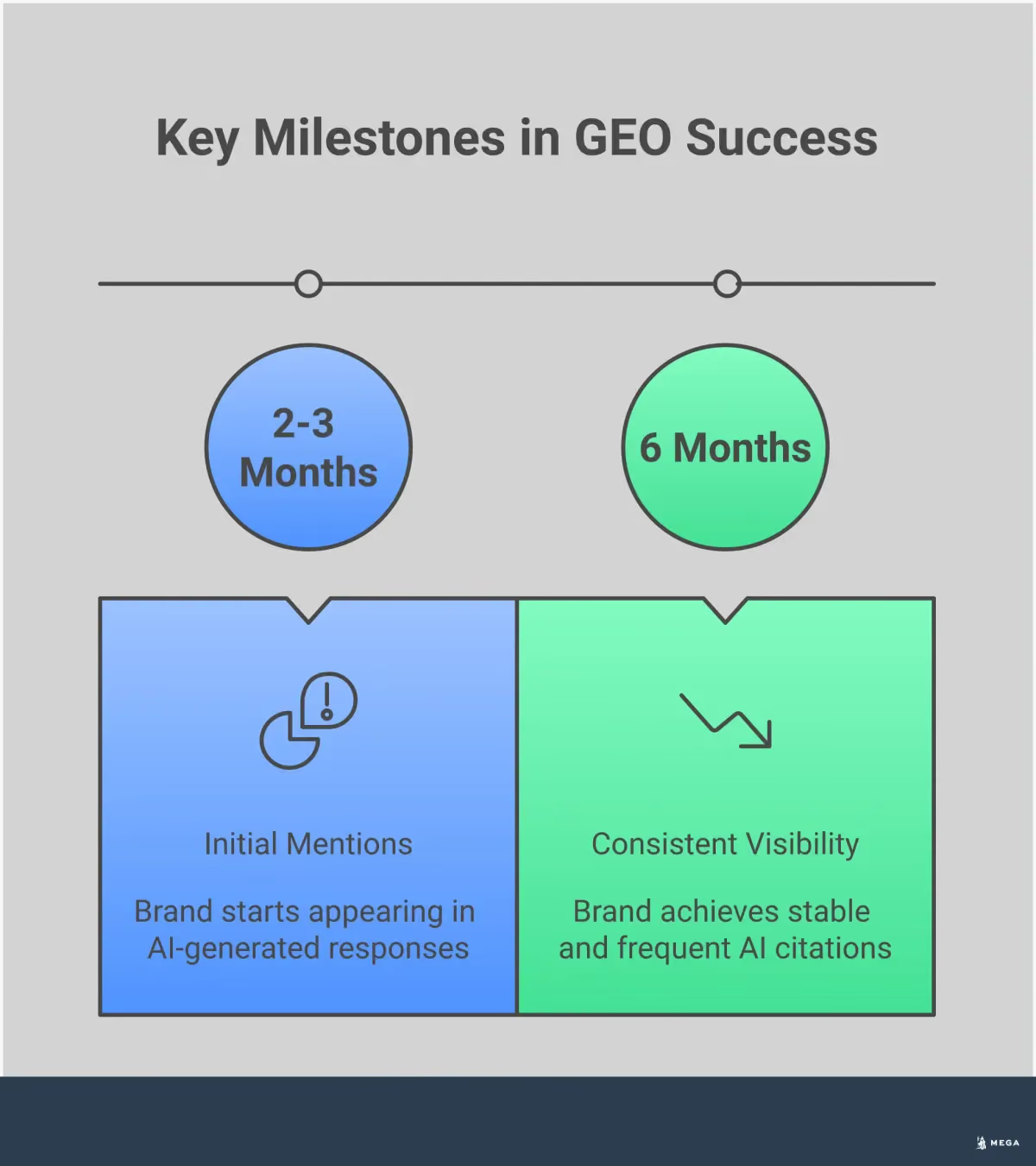
Figuring out if your GEO efforts are working is another common challenge. Traditional SEO metrics like keyword rankings don't tell the whole story. Success in GEO is often measured by things like brand mentions, content citations in AI-generated answers, and overall visibility across different AI platforms. Tracking these new data points requires specialized analytics capabilities that go beyond what tools like Google Analytics can offer. Without the right measurement framework, it’s difficult to prove ROI and understand how long it will take to see meaningful results from your investment. This ambiguity can make it hard to justify the continued expense and effort.
Core Strategies for Generative Engine Optimization
Adapting to generative AI search requires more than just a new tool; it demands a new strategy. While the core principles of creating valuable content remain, the execution needs to be refined for an AI audience. The goal is to make your website a trusted, go-to source that AI engines feel confident citing in their answers. This involves a multi-faceted approach that combines content quality, brand authority, and technical excellence. By focusing on these core strategies, you can build a strong foundation that serves both traditional search engines and the new wave of generative AI, ensuring your business remains visible no matter how users search.
Research AI Responses Before Creating Content
To succeed on any search platform, your website needs to be seen as an authority. This means creating clear, direct content that answers specific questions. Before you write a single word, it's important to understand what AI engines are already saying about your topic. Treat tools like ChatGPT and Google AI Overviews as a focus group. Ask them the questions your customers would ask and analyze the answers they provide. This research will reveal content gaps, common misconceptions, and the sources the AI currently trusts. By understanding the existing conversation, you can create content that is not only more comprehensive but also directly addresses the information AI models are looking for.
Build Your Brand's Authority and Trust
Generative AI prioritizes information from trustworthy brands. To become a reliable source, you need to build your brand's authority both on and off your website. Focus on becoming "quotable" by publishing original research, unique insights, and expert commentary that others will want to reference. You can also work to get your brand mentioned in industry news, reputable blogs, and other trusted online publications. Each high-quality mention serves as a vote of confidence, signaling to AI engines that your brand is a credible and authoritative voice in your field. This process is similar to traditional link building but with a greater emphasis on the quality and context of the mention.
Create Content for the AI-Powered Customer Journey
In the age of AI, your content has a dual purpose. It needs to be optimized to rank in traditional search results while also being structured to teach AI models about your brand and industry. This means creating content that is not only engaging for human readers but also easy for an AI to parse and understand. Use clear headings, concise language, and factual data to make your content easily citable. Think of every article or blog post as a potential source for an AI-generated answer. Your content should be so clear and authoritative that an AI would confidently feature your brand in its response to a user's query.
Improve Your Website’s Technical Foundations
A strong technical foundation is crucial for both traditional SEO and GEO. AI engines, much like their predecessors, favor websites that provide a seamless user experience. This means your site must be fast, secure, and easy to use on any device. By ensuring your website is technically sound, you make it easier for AI crawlers to access, understand, and index your content. For small businesses that may not have a dedicated developer, an autonomous platform like MEGA AI can handle these technical improvements, ensuring your site is always optimized for performance and visibility without requiring you to manage the complex details.
Website Speed and Mobile-Friendliness
Your website's loading speed and mobile performance are critical signals of quality. A slow-loading site can frustrate users and signal to search engines that your site offers a poor experience. Ensure your pages load quickly and are fully functional on mobile devices, as a significant portion of searches happen on phones. Use clear headings and well-organized page structures to help both users and AI crawlers find information efficiently. These technical elements are foundational to building a site that both people and algorithms trust.
Site Accessibility
Making your website accessible to everyone, including people with disabilities, is not just good practice—it's also a positive signal for search engines. An accessible website demonstrates a commitment to user experience, which can contribute to your site's overall authority. This includes using descriptive alt text for images, providing transcripts for videos, and ensuring your site can be used with screen readers. These features make your content available to a wider audience and show AI engines that your site is a high-quality, user-focused resource.
How to Measure GEO Success
As search evolves, so must the way we measure success. Traditional metrics like click-through rates and keyword rankings are no longer sufficient on their own. In a world of zero-click searches, where users get their answers directly from the AI, the goal shifts from driving traffic to being the source of the answer itself. This requires a new set of metrics that focus on visibility, influence, and brand presence within AI-generated responses. Understanding these new key performance indicators is essential for evaluating the effectiveness of your GEO strategy and demonstrating its return on investment.
Introducing New Metrics: The 'Reference Rate'
One of the most important new metrics in the GEO landscape is the "reference rate." Coined by venture capital firm Andreessen Horowitz, this metric measures how often your brand or content is mentioned or used as a source in an AI's answer. Unlike the click-through rate, which tracks how many people click a link to your site, the reference rate focuses on your influence within the AI's response itself. A high reference rate indicates that your content is seen as authoritative and trustworthy by AI models, making it a powerful indicator of your brand's visibility and credibility in this new search environment.
Key Questions to Evaluate Your Performance
To get a complete picture of your GEO performance, you need to ask the right questions. Go beyond simple mention counts and analyze the quality and impact of your visibility. How often is your content actually referenced by AI engines when users ask relevant questions? When your brand is mentioned, how accurately does the AI describe what you do? Finally, how do users interact with the AI's mentions of your brand? Answering these questions will help you understand not just if you are visible, but if that visibility is translating into positive brand perception and authority in your market.
Evaluating GEO Services and Agencies
As Generative Engine Optimization becomes more critical, many businesses will look for outside help. Choosing the right partner, whether it's a specialized agency or an autonomous platform, is key to achieving your goals. However, because GEO is a new and rapidly evolving field, it can be difficult to distinguish credible experts from those making empty promises. A knowledgeable partner will be transparent about their methods, set realistic expectations, and provide a clear strategy tailored to your business. Knowing what to look for—and what to avoid—will help you make an informed decision and find a partner who can deliver real results.
Red Flags to Watch For in a GEO Provider
When evaluating a potential GEO partner, be cautious of certain red flags. Be wary of anyone who uses complex terms without explaining what they mean for your business or how their work will impact your goals. Another major warning sign is a promise of guaranteed AI citations. No one can guarantee placement in an AI-generated answer, as the algorithms are constantly changing and outside of anyone's direct control. A trustworthy provider will focus on a sustainable strategy built on creating high-quality content and building authority, not on shortcuts or guaranteed outcomes. They should be able to explain their process clearly and set realistic expectations.
Key Questions to Ask a Potential Partner
To properly vet a potential GEO service, you need to ask specific, insightful questions. Start by asking which AI systems they optimize for, such as ChatGPT, Google AI Overviews, or Perplexity, and how their strategy changes for each platform. A one-size-fits-all approach is rarely effective. You should also ask how they measure success and what kind of reporting you can expect. A reliable partner will have a clear answer that goes beyond traditional metrics and includes things like reference rates and sentiment analysis. Their answers will reveal their depth of expertise and help you determine if they are the right fit for your business.
How to Choose the Right GEO Tool for Your Business
Selecting the right generative engine optimization tool isn't about finding a single "best" option. It's about matching a tool's capabilities to your business's size, budget, and goals. A startup with a small team has different needs than a large enterprise managing thousands of pages of content. The key is to identify what you need most right now—whether that's simple brand monitoring, in-depth competitive analysis, or a fully autonomous system that handles the work for you.
As you evaluate your options, consider your current resources. Do you have a dedicated team member who can manage a new tool and implement its recommendations, or do you need a solution that automates the entire process? Some platforms provide data and insights, leaving the execution up to you. Others, like MEGA AI's autonomous SEO agent, are designed to function like a full-service team, handling strategy, content creation, and optimization without requiring your constant input. Understanding this distinction will help you narrow down the choices and find a tool that fits seamlessly into your workflow.
What to Look for as a Small Business
If you're just starting, your focus should be on tools that are easy to use, affordable, and provide clear, actionable insights. You don't need a platform with every possible feature; you need one that helps you track brand mentions in AI answers and understand your initial visibility. Tools like Otterly AI are great for this, offering a simple way to monitor when your brand appears without a steep learning curve.
For startups that want to be more hands-on but still need guidance, options like Scrunch or Athena can help you get started with GEO without requiring deep technical knowledge. However, if your team lacks the bandwidth to manage another tool, a fully managed service is a more practical choice. MEGA AI is built for this scenario, providing an AI-powered solution that handles all your SEO and GEO tasks for you. It’s a way to get expert-level results without hiring an in-house team or an expensive agency.
What to Look for as a Growing Company
As your company grows, your GEO needs become more complex. You'll want to move beyond basic monitoring to detailed competitive analysis and performance tracking across different AI models. This is where you need a tool that provides deeper data to inform your content strategy. Platforms like Peec AI are designed for this, offering insights into how your content stacks up against competitors in various AI engines.
If you already have an established SEO workflow, you might consider tools that integrate with your existing software. For example, if your team already uses Ahrefs or Semrush, you can explore their GEO add-ons to start tracking AI visibility without disrupting your current processes. The goal at this stage is to find a solution that scales with you, providing the granular data needed to make strategic decisions and maintain a competitive edge in generative search results.
What to Look for as an Enterprise Team
Large companies and those in regulated industries like finance or healthcare have a unique set of requirements. For these organizations, security, compliance, and the ability to track performance across a vast amount of content are critical. Enterprise-level tools like Profound are built to meet these needs, offering detailed tracking, robust security features like HIPAA compliance, and dedicated expert support.
Another strong option for large brands is AthenaHQ, which excels at automating content optimization at scale and providing real-time visibility tracking. These platforms are designed to handle the complexity and volume that come with managing a large digital presence. For any business curious about how an autonomous approach can simplify these complex tasks, you can book a demo to see how an AI agent can manage your entire SEO and GEO strategy from end to end.