
With the rise of Google’s AI Overviews and other AI-powered search tools, the way customers find information is fundamentally changing. These systems don't just provide a list of links; they synthesize information from the most credible sources to generate a direct answer. This raises a critical question for any business: how do you ensure your content is the source AI chooses to cite? The answer lies in semantic density. By creating content that is rich in context, data, and related concepts, you provide AI with the clear, authoritative information it needs to see you as a trusted expert on a topic.
Key Takeaways
- Cover topics, not just keywords: Create comprehensive content that fully explores a subject to satisfy user intent and signal authority to search engines.
- Prepare your content for AI search: Semantically dense articles provide the thorough, authoritative information that AI Overviews and other language models need to generate answers, increasing your chances of being cited.
- Analyze gaps and structure content logically: Measure your content's depth by comparing it to top-ranking pages, then organize the information with clear headings and a natural flow to improve user experience and search engine comprehension.
What is Semantic Density in SEO?
Semantic density is a measure of how thoroughly your content covers a topic. Think of it less as a technical metric and more as a quality standard. Content with high semantic density is comprehensive, exploring a subject from multiple angles and using a rich, relevant vocabulary. It signals to search engines that your page is an authoritative and complete resource on that subject. This goes far beyond simply repeating keywords. Instead, it focuses on building a web of related concepts, entities, and information that fully satisfies a user's query.
As search engines become more sophisticated, they are moving away from basic keyword matching and toward a deeper understanding of content. High semantic density shows that you've done the work to create a valuable asset, not just a page designed to rank for a single term. This approach helps build topical authority, which is crucial for earning trust from both your audience and search algorithms. For small businesses, focusing on semantic density is a powerful way to compete by creating genuinely helpful content that stands out. An effective SEO strategy now requires this level of depth to succeed in a crowded digital landscape.
Semantic Density vs. Semantic Search
It's easy to mix up semantic density and semantic search, but they refer to two different sides of the SEO coin. As one expert puts it, "When you hear somebody say semantic density and you hear them talking about semantic search, those are two entirely different things."
Semantic search is the technology that search engines use to understand the meaning and intent behind a query. It’s how Google can figure out what you’re really looking for, even if your phrasing is ambiguous. It analyzes the relationships between words and concepts to deliver more accurate results. Semantic density, on the other hand, is a quality of your content. It’s the practice of creating comprehensive content that aligns with how semantic search works. In short, semantic search is the system, and semantic density is how you optimize for it.
Why It Matters for AI Search
Semantic density is becoming even more critical with the rise of AI-powered search, including Google's AI Overviews and other large language models (LLMs). These tools don't just list links; they synthesize information from the best sources to generate a direct, conversational answer. To do this, they need content that is clear, authoritative, and incredibly thorough.
By creating semantically rich content, you provide AI systems with the detailed information they need to classify and use your content. Finding and using relevant semantic terms helps improve your content's relevance, making it easier for search engines to understand and rank it effectively. This increases the likelihood that your brand will be cited or featured in AI-generated responses, a key goal of modern LLM optimization. Ultimately, dense content builds authority and gives search engines exactly what they need to promote your work.
Moving Beyond Keywords: What AI Search Looks For
Search engine optimization used to be a straightforward game of matching keywords. If you wanted to rank for "local coffee shops," you made sure that exact phrase appeared on your page multiple times. Today, AI-powered search engines have completely changed the rules. They no longer just match words; they understand meaning, context, and user intent. This shift means your content strategy needs to evolve from targeting keywords to satisfying user needs comprehensively.
AI search, including generative experiences like Google's AI Overviews, aims to provide direct, complete answers. To do this, it pulls information from sources it deems thorough, accurate, and trustworthy. Instead of just looking for a keyword, AI evaluates how well your content covers a topic in its entirety. It assesses the relationships between different concepts on your page and determines if you are a true authority on the subject. This is why a deep, context-rich article will almost always outperform a shallow one. For small businesses, creating this type of content consistently can be a major challenge, which is why tools that handle LLM optimization are becoming essential for staying competitive.
From Keyword Rankings to User Satisfaction
The primary goal of modern search engines is to deliver a satisfying experience. They want users to find what they’re looking for on the first try without having to click back and refine their search. This is where the focus shifts from keyword rankings to user intent. Semantic search allows engines to grasp the meaning behind a query. For example, when someone searches "best way to fix a leaky faucet," the AI understands they need step-by-step instructions, a list of tools, and maybe even a video tutorial, not just a page that repeats the phrase "leaky faucet." Your content succeeds when it anticipates and addresses these underlying needs, providing a complete solution to the user's problem.
How AI Evaluates Content Quality
AI doesn't just read your content; it evaluates it against several quality signals. Simply targeting a few keywords is no longer enough. Instead, AI looks for content that is rich in context and provides genuinely valuable information. It assesses quality based on comprehensiveness, accuracy, and authority. This is where the concept of E-E-A-T (Experience, Expertise, Authoritativeness, and Trustworthiness) becomes critical. To rank well in an AI-driven world, your content must demonstrate that you are a credible source. Creating semantically rich content helps you build authority in your field, which in turn signals to search engines that your information is reliable and worthy of being shown to users.
How Semantic Density Works in Practice
Understanding semantic density is one thing, but putting it into action is what gets results. It’s about shifting your content strategy from a keyword-first mindset to a topic-first approach. Instead of just targeting a single phrase, you aim to create the most comprehensive resource on a subject. This satisfies your readers and gives modern search engines, including AI-powered ones, exactly what they’re looking for: clear, authoritative, and well-connected information.
Delivering Knowledge in Chunks
Think of your content as a complete lesson on a topic, delivered in easy-to-understand pieces. High semantic density means your content is comprehensive and thoroughly addresses a subject, using a wide range of related vocabulary to signal its authority. Instead of creating a single, shallow article, you build a resource that covers the core topic and its essential sub-topics. This structure makes complex information more digestible for your audience and clearly demonstrates your expertise to search engines. It shows you’ve done the work to provide a complete answer.
Connecting Topics and Entities
Modern search engines don't just read words; they understand relationships. Semantic depth matters for SEO because it helps search engines see if your content provides the best answer for a query. They assess this by how well your content connects different entities (like people, products, or concepts) to their knowledge graph. When you clearly link related ideas, you help search engines map out the context of your topic. This proves your content is not just a collection of keywords but a well-reasoned piece that understands the bigger picture.
Finding the Right Balance: Depth vs. Breadth
Creating semantically dense content doesn't mean you have to write an encyclopedia. The goal is to find the sweet spot between depth and breadth. Your content will perform best when you provide thorough information that matches what users want and uses multiple related topics to deliver better results. This means going deep enough on the main subject to be truly helpful while also covering the related questions your audience might have. It’s about anticipating their next query and answering it within the same piece.
What Makes Content Semantically Dense?
Semantically dense content is not about hitting a specific word count or repeating a keyword a certain number of times. Instead, it’s about creating a resource that is thorough, authoritative, and genuinely useful. Think of it as the difference between a shallow puddle and a deep well. A shallow article might define a term, but a semantically dense one explores its nuances, connections, and practical applications. It fully answers the user's initial question and anticipates their next one, leaving them with a complete understanding.
This shift is crucial because modern search engines, especially those powered by AI, are designed to understand context and intent, not just keywords. They reward content that demonstrates true expertise and provides comprehensive value. Creating this type of content involves three main practices: covering your topic from every angle, weaving in related concepts and data, and writing in clear, natural language that speaks directly to your audience. By focusing on these areas, you signal to search engines that your page is a high-quality, reliable source of information. This makes it more likely to be featured in AI-driven search results and builds trust with your readers. For small businesses with limited resources, focusing on density over sheer volume is a smarter way to compete.
Cover Your Topic Completely
High semantic density means your content is comprehensive and thoroughly addresses a given topic. It uses a wide range of vocabulary related to the subject, which signals its authority and relevance to search engines. Instead of just scratching the surface, aim to create a definitive resource. For example, an article on "email marketing for small businesses" should cover platforms, list building, copywriting, automation, and analytics. By addressing all the key subtopics, you show that your content is a one-stop shop for the user's needs. This completeness is a powerful signal that your page deserves a high ranking, and it's a core focus of automated SEO tools.
Include Related Concepts and Data
To make your content richer, you need to connect your main topic to related ideas and entities. Finding and using relevant semantic keywords helps improve content relevance, making it easier for search engines to understand your page. This goes beyond simple synonyms. If you’re writing about project management, you should also mention methodologies like Agile or Scrum, tools like Asana or Trello, and concepts like Gantt charts. Including specific data, statistics, or quotes from experts also adds layers of depth and credibility. This network of related information helps AI search understand the broader context of your content.
Write in Natural Language
Ultimately, you are writing for a person, not a machine. Creating multiple thin pages that target slight keyword variations signals low-quality content to search engines. Modern AI is sophisticated enough to recognize and reward clear, natural writing. Focus on a logical flow and a conversational tone that is easy to understand. This approach aligns with Google's emphasis on Experience, Expertise, Authoritativeness, and Trustworthiness (E-E-A-T), which has become increasingly important as semantic search gets better at evaluating content quality. When you write clearly and helpfully, you build trust with your audience and demonstrate your expertise to search engines at the same time.
How to Measure Semantic Density
Measuring semantic density isn't about hitting a specific score. It’s about assessing how well your content covers a topic and satisfies user intent. Instead of getting lost in complex metrics, you can focus on a few practical methods to see if your content is comprehensive enough for both users and AI search engines. These approaches help you move from guessing to making data-informed decisions about what your content needs.
Think of it as a quality check. Is your article answering all the related questions a reader might have? Does it connect the dots between different concepts? By regularly evaluating your content through this lens, you can find opportunities to make it more valuable, which is exactly what modern search algorithms are designed to reward.
Analyze Topic Gaps
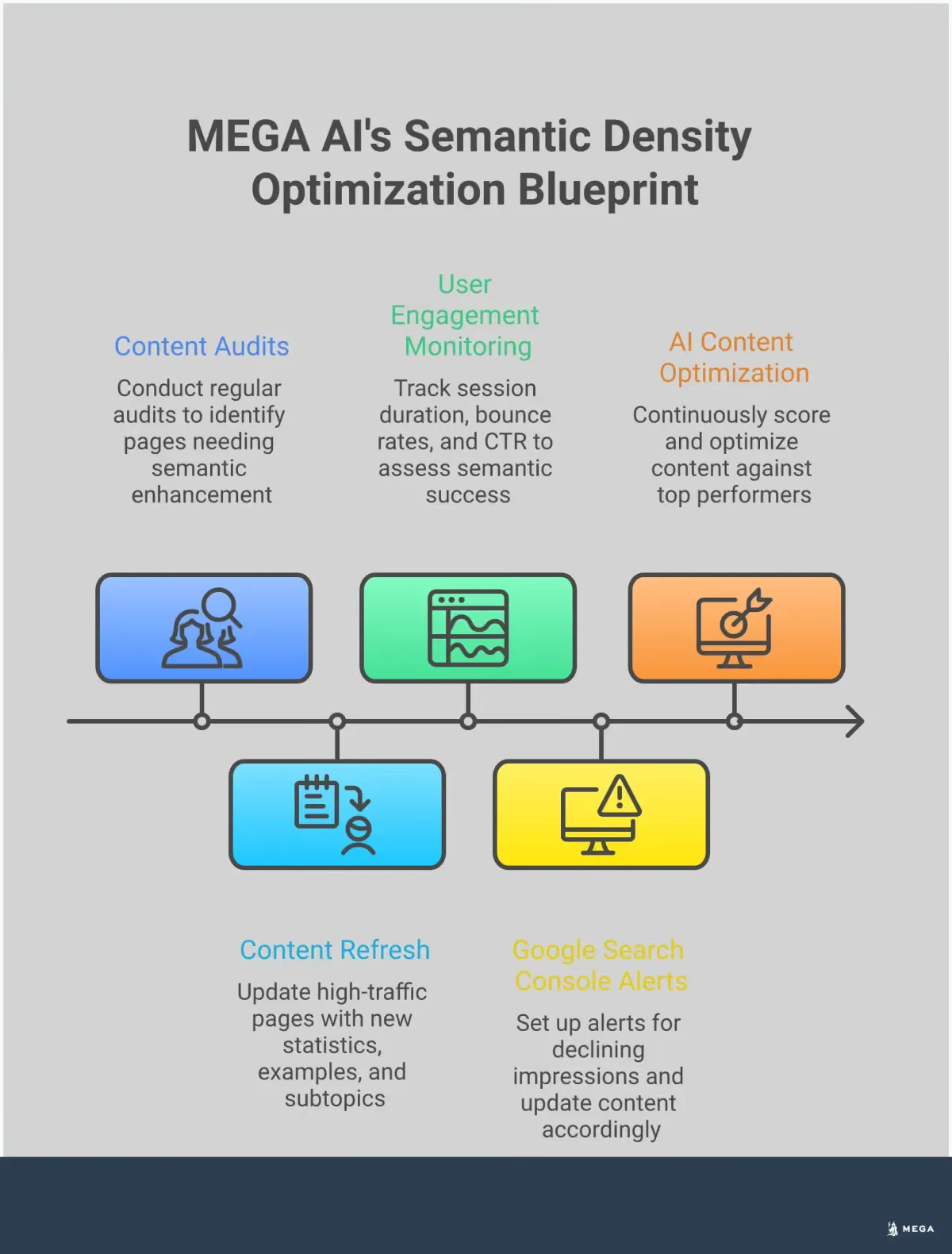
One of the most direct ways to measure semantic density is to find out what you’re missing. A topic gap analysis involves comparing your content against the top-ranking pages for your target query to see what concepts, subtopics, and related questions they cover that you don’t. This process helps you identify the information users expect to find but is currently absent from your page.
Many SEO tools can help by analyzing competitor content and suggesting words, phrases, and entities you should add to make your text more complete. For small businesses, this can feel like a lot of manual work. This is where automation comes in. MEGA AI’s SEO Agent continuously identifies new content to add to existing articles, helping you fill those gaps without spending hours on research.
Track User Engagement Signals
How users interact with your content provides strong clues about its semantic richness. If your page thoroughly answers a user's query and related follow-up questions, they are more likely to stay on the page longer, read more, and interact with your site. High engagement is a positive signal to search engines that your content is valuable.
Key signals to watch include:
- Time on page: Longer times suggest readers are finding the content useful.
- Bounce rate: A lower bounce rate means users are exploring more of your site after landing on the page.
- Click-through rate (CTR): A compelling title and meta description that accurately reflect deep content can lead to a higher CTR from search results.
Improving these metrics is a core part of content maintenance. When you increase engagement, you send a clear message that your content is satisfying user needs.
Use the Right Assessment Tools
You don’t have to measure semantic density on your own. Several content optimization platforms are designed to help you with this. These tools analyze your content against top-performing competitors and provide specific, actionable recommendations for improvement. They can highlight missing topics, suggest related keywords, and score your content’s overall quality and depth.
These platforms are great for getting a clear diagnosis of your content’s health. They can help you perform a content analysis to assess its readiness and identify areas for improvement. For businesses looking for an end-to-end solution, MEGA AI not only analyzes content but also autonomously implements the recommended changes, ensuring your pages are always optimized for depth and relevance.
Key Components of Semantically Rich Content
Creating semantically rich content isn't about hitting a certain word count or keyword ratio. It’s about building a comprehensive resource that fully addresses a user's needs. When you get it right, your content becomes more valuable to both your audience and AI-powered search engines. The process comes down to three key components.
Establish Context and Entity Relationships
Modern search engines think in terms of entities, which are the people, places, concepts, and things your content discusses. Semantically strong content doesn't just mention these entities; it clarifies the relationships between them. This helps search engines understand your content on a deeper level and see it as an authoritative source. For example, an article about a local bakery should connect entities like its address, its signature sourdough bread, and its positive customer reviews. This context shows how different pieces of information relate, helping search engines confidently map your content to their knowledge base and present it as the best answer.
Build Out Supporting Subtopics
A single piece of content should aim to be the final destination for a user's query. This means anticipating their next questions and building out supporting subtopics that provide complete answers. Think of your main topic as a central pillar and the related questions as cluster pages that support it. If you’re writing about "container gardening," you should also include sections on choosing the right pots, the best soil mixes, and watering schedules. Covering these related subtopics demonstrates expertise and satisfies a wider range of user intents in one place. Tools like MEGA AI’s SEO Agent can help by identifying new content sections to add to existing articles, ensuring they remain comprehensive over time.
Create a Logical Information Flow
The most detailed content in the world won't perform well if it's difficult to read. A logical information flow is crucial for both user experience and search engine comprehension. Use clear, descriptive headings and subheadings to structure your article and guide readers through the information. Break up long paragraphs and use bullet points or numbered lists to make complex topics more digestible. This clear organization helps readers stay engaged, which sends positive signals to search engines. It also makes it easier for AI to crawl and classify your content, ensuring it understands the hierarchy of your ideas and the main points you want to convey.
How Semantic Density Affects Different Content Types
Semantic density isn’t a one-size-fits-all metric. The right level of depth and topical coverage depends entirely on the goal of the page. A comprehensive guide needs a different approach than a product description or a local service page. Understanding how to apply this concept to different formats is key to creating content that both users and search engines will value.
For example, a long-form article aims for exhaustive coverage to establish authority, while a sales page needs just enough semantic context to answer a buyer's immediate questions and rank for relevant commercial queries. Tailoring your approach ensures each piece of content is optimized for its specific purpose and audience. Let's look at how this works for three common content types.
For Long-Form Guides
When you're writing a long-form guide or a pillar blog post, your goal is to be the most comprehensive resource on the topic. High semantic density is crucial here. It means you’re not just answering the main question but also addressing all the related subtopics, follow-up questions, and niche concepts a reader might have. This thoroughness signals to search engines that your content has authority and relevance. By creating semantically rich content, you build expertise in your field and give search algorithms exactly what they need to understand and rank your page. Instead of just repeating keywords, you’re using a wide and natural vocabulary that covers the topic from every angle, which keeps users engaged and on your page longer.
For Product and Sales Pages
Product and sales pages have a different job. They need to be persuasive and clear, not encyclopedic. Here, semantic density is about providing context around the product. You should incorporate your main keyword alongside related semantic terms that describe the product’s features, benefits, and use cases. This helps search engines understand what your product is and who it’s for. Finding and using relevant semantic keywords makes your content more relevant for commercial searches. Think about the problems your product solves and the questions a potential buyer might ask. Answering these directly on the page adds valuable semantic information that can help you rank for queries beyond just your product’s name, capturing customers who are still exploring their options.
For Local Business Content
For local businesses, semantic density helps connect your services to your specific geographic area. Your content should be rich with local context. This means mentioning specific neighborhoods, nearby landmarks, local events, or issues unique to your community. This approach makes your content highly relevant to local users and signals your geographic focus to search engines. A well-optimized page can lead to higher customer satisfaction and better conversion rates because a semantic search is better at matching a user in a specific city with a business that clearly serves that area. By weaving in local entities and topics, you prove that you are an active part of that community, which builds trust with both customers and search engines.
Tools to Help Optimize for Semantic Density
Creating semantically dense content requires a strategic approach that goes beyond simple guesswork. Manually analyzing search results, identifying topic gaps, and structuring your articles can be incredibly time-consuming, especially for small teams. Fortunately, several tools can help streamline this process, providing the data you need to build comprehensive content that satisfies both users and search engines. These tools help you understand what topics to cover and how to structure your information for the greatest impact, turning a complex task into a manageable part of your content strategy.
Topic Research Tools
Modern topic research tools offer much more than basic keyword suggestions. These platforms analyze top-performing content for a given query and provide a detailed blueprint of what you need to cover to compete effectively. Instead of just giving you a list of keywords, they help you understand the entire topic cluster, including essential subtopics, related questions, and important entities. To build semantically rich content, you first need to perform a content analysis to assess what you’ve already covered and identify gaps. These tools are excellent for this initial planning phase, as they show you the full scope of a subject from the perspective of a search engine.
AI Content Optimization Platforms
While research tools tell you what to write about, AI content optimization platforms help you with the writing itself. These systems analyze your draft in real time, comparing it to top-ranking pages and providing specific recommendations to improve its topical coverage and depth. They offer a unified, business-friendly view of complex data, translating SEO requirements into clear, actionable steps. Platforms like MEGA AI take this a step further by automating the entire workflow. Our SEO Agent not only generates semantically rich articles from the start but also uses a Maintenance Agent to continuously add new, relevant information to your existing content. This ensures your pages stay comprehensive and up-to-date, giving you the power of sophisticated analytics tools without the manual effort.
Common Semantic Density Mistakes to Avoid
Optimizing for semantic density is a smart move, but it's easy to misstep if you're still thinking in terms of old-school SEO. To get the best results, you need to avoid a few common pitfalls that can hold your content back. Focusing on quality and user experience will keep you on the right track and help you create content that AI-driven search engines favor. By steering clear of these errors, you can ensure your efforts contribute to meaningful, long-term growth.
Creating Surface-Level Content
One of the biggest mistakes is creating content that only scratches the surface of a topic. High semantic density means your content is comprehensive and thoroughly addresses a subject. It should use a wide range of related vocabulary, which signals its authority and relevance to search engines. Surface-level articles might answer one simple question but fail to address the natural follow-up questions a reader might have. This leaves the user unsatisfied and tells search engines that your page isn't the best resource. Instead, aim to create a one-stop resource that covers a topic from multiple angles, providing genuine depth and value.
Confusing It with Keyword Density
It's crucial to understand that semantic density is not the same as keyword density. The goal isn't to stuff your primary keyword into the text as many times as possible. In fact, over-optimizing for keyword density instead of focusing on semantic relevance is a common pitfall. Modern search engines are sophisticated enough to understand synonyms, related concepts, and the overall context of a page. Forcing keywords into your content creates an unnatural reading experience and can even get your page penalized. The focus should be on covering a topic comprehensively using natural language, not hitting an arbitrary keyword count.
Ignoring User Intent
Even the most in-depth, well-written content will fall flat if it doesn't match user intent. Your content will perform best when it provides thorough information that aligns with what users want to find. Before you write a single word, ask yourself what the searcher is trying to accomplish. Are they looking for a definition, a step-by-step guide, a product comparison, or a local service provider? Answering this question correctly shapes the entire piece, from the title and introduction to the specific subtopics you cover. When you align your content with user intent, you create a more satisfying experience that search engines are designed to reward.
How to Add Semantic Density to Your SEO Strategy
Making your content semantically dense isn’t a one-time fix. It’s a strategic shift in how you approach content creation and optimization. Instead of focusing narrowly on a single keyword, you’ll start thinking about topics in their entirety. This means building a content plan that covers a subject from all angles, answering the questions your audience has before they even ask them.
Integrating this approach into your strategy helps you create content that both users and search engines find valuable. It positions your brand as a credible authority and prepares your site for the continued evolution of AI-driven search. The key is to make it a consistent part of your workflow, from initial research to ongoing maintenance. By fitting it into your process, measuring its impact, and staying aware of search trends, you can create a powerful and sustainable SEO advantage. MEGA AI’s SEO Agent is designed to automate this entire process, compressing the work of a full agency into a single platform.
Fit It Into Your Content Workflow
To make semantic density work for you, build it directly into your content creation process. Think of it less as an extra step and more as the foundation of your planning. High semantic density means your content is comprehensive and thoroughly explores a topic, signaling to search engines that you are an authority on the subject. This starts with how you structure your ideas.
A great way to build semantic depth is to organize your content around entities and user intents. Use pillar pages to cover broad topics, then create cluster pages that dive into specific attributes, relationships, and related questions. This model not only helps you cover a topic completely but also creates a logical site structure that’s easy for both users and search engine crawlers to follow. This approach turns content creation from a guessing game into a systematic process.
Measure Success and Keep Optimizing
Creating semantically rich content is only half the battle; you also need to measure its performance and continuously refine it. Start by analyzing your existing content for topic gaps. Tools that analyze competitor content can help you identify missing entities and related phrases you should add to increase your content’s semantic density. This process helps you see what your audience is looking for and where your content falls short.
Finding and using relevant semantic keywords is crucial for improving content relevance, making it easier for search engines to understand and rank your pages. This is an ongoing task, not a one-and-done activity. Platforms like MEGA AI automate this with features like the Content Maintenance agent, which continuously identifies new content to add to existing articles, ensuring they stay fresh, relevant, and optimized over time.
Stay Ahead of AI Search Updates
The digital landscape is constantly changing, and semantic SEO is at the heart of modern search. Semantic search is how engines like Google understand what people are actually looking for, moving far beyond simple keyword matching. Creating semantically dense content is fundamental to performing well in this environment, especially with the rise of AI Overviews and voice search.
Because AI search prioritizes natural language, conversational content tends to perform better. Your goal is to create content that reads like an expert answering a question directly and thoroughly. This is the core of LLM Optimization (LLMO), the practice of optimizing your content to appear in AI-generated responses. By focusing on semantic density, you’re not just optimizing for today’s search engine, you’re preparing your content for the future of how people will find information online.