
Tired of chasing marketing trends that don't deliver? It’s time for a data-driven approach with AI marketing models. These intelligent tools use data to offer clear insights into customer behavior, personalize your marketing messages, and optimize campaigns for maximum impact. This guide is your practical roadmap for integrating AI into your strategy. We’ll explore the different types of models, discuss their benefits, and provide actionable steps for selecting and implementing the right ones for your business. We’ll also cover the ethical considerations, ensuring you use these powerful tools responsibly and effectively.
Key Takeaways
- AI marketing models automate tasks and personalize customer experiences. Use them strategically, focusing on data quality and ethical implications for best results.
- Select the right AI model for each task. Sometimes, less expensive models outperform pricier options for basic marketing automation. Balance AI’s power with your team’s creativity.
- The future of AI marketing involves real-time data analysis and adaptation. Stay informed about the evolving AI landscape and prioritize ethical considerations to build customer trust.
The Rise of AI in Marketing
How Big Brands Are Using AI
It’s not just a future concept; major companies are already integrating AI into their daily marketing efforts. Brands like Shopify, Instacart, and Airbnb use AI marketing tools to operate at a scale that would be impossible for a human team. They use AI to quickly understand customer behavior, watch competitor moves, generate content, and refine their ad campaigns. This allows them to connect with their audiences in a more personalized and effective way. The rise of generative AI and autonomous agents is making these tools even more powerful, automating complex processes and providing deeper insights that were previously out of reach for most businesses.
Expert Endorsements and Industry Adoption
The shift toward AI isn't just happening at the team level; it's being championed by industry leaders. For instance, Shopify's CEO has encouraged all employees to incorporate AI into their work, signaling its importance. Modern marketing teams now see AI as essential for saving time and making campaigns more effective. These tools help teams work faster by automating tedious tasks like writing ad copy or compiling performance reports. This automation frees up marketers and small business owners to focus on strategy and creativity, ultimately leading to better results like lower customer acquisition costs and a shorter sales cycle. It’s about working smarter, not just harder.
What Are AI Marketing Models?
AI marketing models use machine learning algorithms and data analytics to predict customer behavior, personalize marketing messages, and optimize marketing strategies. These models analyze massive amounts of data, finding patterns and trends that humans might miss. Think of them as tireless assistants, uncovering hidden insights that can improve your marketing efforts.
By using AI marketing models, businesses automate repetitive tasks, improve customer segmentation, and increase targeting accuracy. This leads to more effective campaigns and a better return on investment. These models help you understand customer preferences and create tailored experiences that resonate with individual consumers, increasing engagement and conversion rates. There are various types of AI marketing models, including predictive analytics, customer segmentation, and recommendation systems. Each type has a unique role in improving your marketing and driving sales. Learn more about how MEGA SEO uses these models.
It’s important to remember that AI in marketing isn’t just about the technology itself. It also requires a strategic approach to data management and ethical considerations. Make sure you’re using these powerful models responsibly and effectively. MEGA SEO helps you do just that, providing a platform for responsible and effective AI-driven marketing. Book a demo to see how MEGA SEO can transform your marketing strategy.
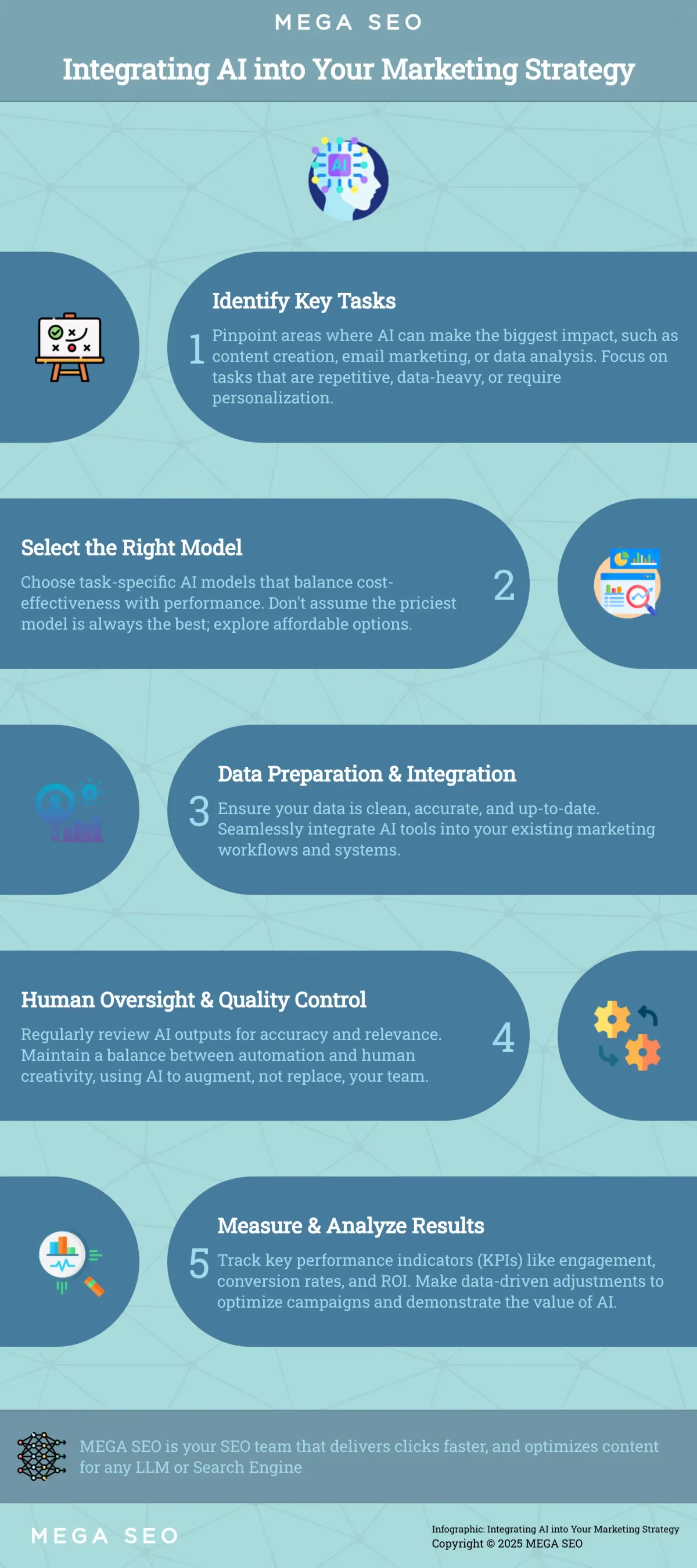
How to Choose the Right AI Model for Your Marketing
Picking the right AI model is key for successful marketing. This section covers balancing cost and performance, selecting task-specific models, and ultimately improving your marketing outcomes.
Balance Cost with Performance
Don’t assume the priciest AI models are the best. Often, more affordable options deliver comparable or even superior results, especially for routine automation. As discussed on the Authority Hacker podcast, some surprisingly cheap models excel at basic tasks for a fraction of the cost of bigger names. This can lead to significant savings without sacrificing performance. Focus on value, not just price, when exploring AI marketing tools. Book a demo to see how MEGA SEO can provide cost-effective solutions for your marketing needs.
Match the AI Model to the Marketing Task
Different AI models have different strengths. Using a general-purpose model for everything might be tempting, but specialized models often perform better for specific tasks. Authority Hacker’s testing found that choosing the right model for the job drastically improves results and can save you money. Think about what you need the AI to do – write product descriptions, generate ad copy, or analyze customer data – and then find a model tailored to that purpose. MEGA SEO offers features like automated keyword research and content generation that leverage task-specific AI models for optimal results. Explore our free tools and customized posts to learn more.
Assess Scalability and Integrations
When you select an AI marketing tool, think about where your business will be in a year, or even five. Scalability is essential because the right tool should grow with you, not hold you back. It needs to handle an increasing volume of data, campaigns, and users without a drop in performance. Equally important are integrations. An AI solution that can’t connect with the platforms you already use, like your CMS or social media schedulers, will only create data silos and extra work for your team. A seamless connection is vital for a smooth and efficient marketing workflow, ensuring all your efforts are aligned.
Consider Ease of Use and Your Budget
The most advanced AI tool is ineffective if your team finds it too complicated to use. For small businesses, time is a precious resource, and you can't afford a tool with a steep learning curve. Look for a platform with an intuitive interface that makes complex tasks feel straightforward. Budget is another critical factor. Your goal should be to find a tool that offers the best value, fitting within your financial plans while still delivering the features you need. Platforms like MEGA AI are designed to make sophisticated SEO and Paid Ads strategies accessible, regardless of your team's technical expertise.
Prioritize Security and Customization
Handing over your business and customer data to a third-party tool requires trust. Security should be a top priority. Ensure any AI marketing tool you consider has robust data protection measures and complies with privacy regulations like GDPR or CCPA. Beyond security, look for customization options. Every business has unique marketing goals, and a one-size-fits-all approach rarely works. The ability to tailor features, reports, and workflows to your specific needs allows you to create a marketing strategy that is truly your own and helps you get the most out of your investment.
Use AI to Get Better Marketing Results
AI can transform your marketing, but it’s not a magic bullet. Data quality is crucial. If you feed an AI bad data, you’ll get bad results. Make sure your data is clean, accurate, and up-to-date before using it with any AI model. Solid data management and security are essential, protecting both your customer information and the integrity of your AI systems. When used effectively, AI can streamline operations, particularly in customer experience. By automating tasks and providing data-driven insights, AI frees up your team to focus on strategy and creativity. Check out our resources for more information on effectively integrating AI into your marketing strategy.
Which Marketing Tasks Can AI Handle?
Deciding where to apply AI in your marketing strategy is crucial. Some tasks are better suited to AI’s strengths than others. Let’s explore some key areas where AI can shine.
Use AI to Write Content and Copy
AI excels at generating various content formats, from catchy ad copy and engaging social media posts to informative blog articles and compelling product descriptions. Tools like MEGA SEO offer customized posts tailored to your specific needs. However, be mindful of data quality. As highlighted in a CourseHorse blog post, inaccurate or outdated data can negatively impact AI performance, leading to ineffective content. Always review and refine AI-generated content to ensure it aligns with your brand voice and resonates with your target audience. Think of AI as your tireless assistant, drafting initial versions that you then polish and perfect.
Use AI to Generate Marketing Ideas
AI can be a powerful brainstorming partner. By analyzing market trends, competitor activities, and customer data, AI can uncover hidden opportunities and suggest innovative marketing campaigns. Need fresh ideas for a product launch or a seasonal promotion? AI can help. However, effective AI implementation requires robust data management. A key challenge for marketers is the ability to process and analyze data in real-time to respond quickly to market changes and customer behavior. This real-time data analysis is essential for generating relevant and timely marketing ideas. Explore MEGA SEO’s free tools to see how AI can enhance your brainstorming sessions.
Use AI for Email Automation
AI can personalize and automate your email marketing efforts. From crafting subject lines that grab attention to segmenting your audience for targeted messaging, AI can streamline your email workflows. This frees up your time to focus on strategic initiatives. But, remember the importance of customer trust. Maintaining robust data security measures is critical to protecting customer information and the integrity of AI systems used in marketing. Transparency about how you use AI in your email communications can further build trust with your audience.
Use AI to Analyze Data and Find Insights
AI’s analytical capabilities are invaluable for understanding your marketing performance. AI can sift through mountains of data to identify patterns, trends, and correlations that would be impossible for humans to spot. This data-driven insight can inform your marketing strategies and help you make better decisions. However, integrating AI solutions presents technical, financial, and ethical considerations. Successfully implementing AI requires a thoughtful approach that addresses these complexities. Consider exploring MEGA SEO’s resources to learn more about practical applications of AI in marketing.
Customer Service and CRM
AI marketing tools help marketing teams work faster, make campaigns more personal, and handle routine tasks automatically. In customer service, this means using AI-powered chatbots to provide instant answers to common questions, freeing up your team to handle more complex issues. AI can also integrate with your Customer Relationship Management (CRM) system to analyze customer interactions and predict future needs. By understanding past purchases and browsing behavior, AI helps you send personalized follow-ups and product recommendations. This not only improves the customer experience but also builds loyalty by showing customers you understand their specific needs, which is a huge advantage for any small business looking to build a strong client base.
Social Media Analysis and Cross-Channel Advertising
AI tools can help with many marketing tasks, including understanding customer feelings through sentiment analysis and keeping an eye on what competitors are doing. By analyzing conversations on social media, AI can tell you how people feel about your brand and identify emerging trends in your industry. This insight is invaluable for refining your messaging. For advertising, AI simplifies running campaigns across multiple platforms. Instead of manually managing ads on Google, Meta, and LinkedIn, AI can do the heavy lifting. Platforms like MEGA AI allow you to upload ad content once and distribute it everywhere, automatically remixing variations and moving your budget to the best-performing channels to ensure your ad spend is always optimized.
A/B Testing and Website Experiments
A/B testing, or comparing two versions of a webpage or ad to see which performs better, is a cornerstone of digital marketing. AI takes this process to the next level by running complex experiments at scale. Instead of just testing one headline against another, AI can simultaneously test hundreds of combinations of headlines, images, button colors, and calls to action. This allows you to quickly identify the most effective design and copy for your audience. The goal is to improve key metrics like click-through rates (CTR) and conversions. Tools like MEGA AI’s Maintenance Agent use these principles to automatically update your existing content, helping to improve its performance in search results over time.
Examples of AI Marketing Tools
AI marketing tools are essential for modern marketing teams to save time, make campaigns more effective, and get better results. These tools are not one-size-fits-all; they are specialized to handle different aspects of a marketing strategy. From generating creative content and optimizing it for search engines to automating research and producing visual assets, there is an AI tool designed for the task. For small businesses, using these specialized tools means you can compete with larger companies without needing a massive team. The key is to identify which parts of your workflow can benefit most from AI and then select the right tools for the job.
Tools for Content and SEO
AI excels at generating various content formats, from catchy ad copy and engaging social media posts to informative blog articles and compelling product descriptions. For small businesses, this means you can create high-quality content consistently without hiring a large writing team. When it comes to SEO, AI tools can perform automated keyword research to find what your customers are searching for. Platforms like MEGA AI go a step further by not only generating new articles but also maintaining your existing content. They can identify opportunities to add new information to old posts or re-optimize them after a search engine update, helping your content rank higher and attract more traffic.
Tools for Automation and Research
One of the biggest benefits of AI is its ability to handle tasks that would be incredibly time-consuming for a person. AI helps marketers by doing things quickly and on a large scale that would be hard for people to do manually. This includes conducting market research by analyzing thousands of articles and reports to identify trends, or automating performance reports by pulling data from various sources into one clear dashboard. By automating these repetitive but necessary tasks, AI frees you and your team to focus on strategy, creative thinking, and building relationships with your customers. It handles the data crunching so you can focus on the big picture.
Tools for Audio and Visuals
Creating compelling visuals and audio used to require specialized skills and expensive software, but AI has made it much more accessible. AI tools can generate unique images from a simple text description, create professional-looking videos for social media, and even produce realistic voiceovers for advertisements. As many marketers have found, AI tools made specifically for marketers can be more efficient than general ones. For example, MEGA AI’s paid ads platform can automatically remix your video content into hundreds of variations and translate voiceovers and captions into different languages, allowing you to create customized ads for diverse audiences with minimal effort.
How to Get More from AI for Less
Getting the most from AI marketing models involves finding the sweet spot between powerful results and budget-friendly solutions. This isn’t always about chasing the latest, most expensive tools. Strategic model selection and a balanced approach are key to maximizing your return on investment.
When to Choose a Cheaper AI Model
Research shows that sometimes, the most hyped-up AI models don’t always deliver the best results, especially compared to their more affordable counterparts. For many standard marketing automation tasks, like generating short ad copy variations or pulling basic data insights, less expensive models can be surprisingly effective. The Authority Hacker team found this to be true in their AI model testing, where cheaper options often outperformed pricier ones for basic tasks. This means you can potentially achieve significant cost savings by exploring a range of AI tools and not assuming that higher cost automatically means better results.
Pick the Best AI Model for Each Task
Different marketing tasks have different requirements. A model that excels at generating creative content might not be the best choice for analyzing large datasets or personalizing email campaigns. Evaluate the specific needs of each task and choose a model that aligns with those requirements. This targeted approach improves results and helps you avoid overspending on features you don’t need. Choosing the right model can drastically improve your outcomes while saving you money. MEGA SEO helps streamline this process by offering a suite of tools designed for specific SEO tasks, from keyword research and content generation to technical SEO improvements and content maintenance. You can explore these features and more by booking a demo.
Balance AI Automation with Human Creativity
AI is a powerful tool for automating repetitive tasks and streamlining workflows. However, it shouldn’t completely replace human input. Think of AI as augmenting your team’s capabilities, not replacing team members entirely. While AI can handle tasks like data analysis and content generation, human creativity is still essential for developing overall marketing strategies, crafting compelling narratives, and connecting with your audience. Maintaining this balance ensures that you leverage the efficiency of AI while preserving the human element that makes marketing truly effective. Learn more about how MEGA SEO combines automation with customized options to give you the best of both worlds.
Provide Detailed Background Information
To get the best results from any AI model, you need to provide it with clear and detailed context. Think of it as briefing a new team member; the more information they have, the better they can perform the task. AI marketing models work by analyzing data to predict customer behavior and personalize your messaging. When you provide comprehensive background information—like your target audience demographics, brand voice guidelines, and specific campaign goals—the AI can generate more relevant and effective outputs. This strategic approach to data management ensures the AI's work aligns perfectly with your marketing objectives, leading to more accurate customer segmentation and better campaign performance.
Follow the 30% Rule for Content Creation
When using AI for content, a helpful guideline is the "30% rule." This principle suggests that AI should contribute no more than 30% of the final piece, with the remaining 70% coming from your unique expertise and creativity. AI is an incredible tool for generating initial drafts, brainstorming ideas, or overcoming writer's block, but it shouldn't be the sole author. This approach ensures your content maintains an authentic brand voice and benefits from human oversight. Think of AI as a supportive tool that assists your process, rather than replacing your critical thinking and industry knowledge, which are essential for creating content that truly connects with your audience.
Working Through Common AI Marketing Challenges
Integrating AI into your marketing strategies offers incredible potential, but it also presents unique challenges. Successfully adopting AI requires careful planning, the right tools, and a willingness to adapt. Let’s explore some common hurdles and how to overcome them.
How to Keep Up with AI Changes
The AI landscape is constantly evolving. Staying ahead requires a commitment to continuous learning and a flexible approach. What works today might not be the best solution tomorrow. For instance, real-time data analysis is becoming increasingly crucial for responding to rapidly changing market conditions and customer behavior. Your AI tools should be able to process and analyze data quickly, allowing you to make informed decisions in the moment. MEGA SEO helps you stay adaptable with automated updates and optimization features, ensuring your content remains relevant and effective regardless of algorithm changes. Book a demo to see how we can help you future-proof your marketing efforts.
Is AI Right for This Task?
Not all AI models are created equal. Different tasks require different tools. Choosing the right AI model for each specific marketing task is essential for maximizing efficiency and achieving desired outcomes. Consider whether you need AI for content creation, email marketing, data analysis, or other tasks. Ensure your chosen AI applications have robust APIs that integrate seamlessly with your existing marketing automation platforms, CRM systems, and data analytics tools. MEGA SEO offers a suite of integrated tools designed to work together, streamlining your workflow and maximizing the impact of your AI investments. Explore our free tools to get a taste of what’s possible.
How to Filter AI-Generated Ideas
AI can generate a wealth of ideas, but not all of them will be winners. Developing a system for effectively filtering and selecting the best ideas is crucial. This involves considering not only the technical and financial aspects but also the ethical implications of your AI initiatives. AI reflects societal complexities, and a thoughtful approach is necessary to ensure responsible and effective use. MEGA SEO’s content generation tools are designed to produce high-quality, relevant content, making the filtering process more efficient. Learn more about our customized post options to see how we can help you generate and refine winning marketing ideas.
How to Add AI to Your Current Workflow
Successfully integrating AI requires more than just choosing the right tools. It’s about weaving AI seamlessly into your existing marketing workflows. This often involves addressing data quality issues, as inaccurate or outdated data can negatively impact AI performance. Ensure your data is clean, accurate, and up-to-date before feeding it to your AI models. MEGA SEO integrates with popular CMS platforms, making it easy to incorporate AI into your current processes. Explore our resources to learn more about seamless AI integration.
Why You Still Need a Human in the Loop
AI can transform marketing, but it’s not a set-it-and-forget-it solution. Think of AI as a powerful tool that needs a skilled operator. Human oversight is essential for success and to avoid potential pitfalls. One common challenge with AI-driven marketing is data quality. Inaccurate or outdated data can lead to poor AI performance and misguided marketing efforts, as highlighted in this article on the challenges of implementing AI. Maintaining high-quality data is crucial for reliable AI insights. MEGA SEO helps address this by providing accurate, up-to-date keyword research and content optimization recommendations. Learn more about how we can help improve your data quality by exploring our free tools.
Use AI to Assist, Not Replace, Creativity
AI excels at tasks like data analysis and automation, freeing up human marketers to focus on strategy and creative thinking. Use AI tools to generate customized posts and handle repetitive tasks, but don’t let them stifle your team’s creativity. The human touch is still essential for crafting compelling narratives, understanding nuanced customer emotions, and developing innovative campaigns. AI should augment human creativity, not replace it. This approach allows you to combine the strengths of both AI and human intelligence. Robust data security is also paramount when implementing AI, protecting customer information and the integrity of your systems, as discussed in this piece on challenges in implementing AI. MEGA SEO prioritizes data security, ensuring your information is protected while you leverage the power of AI. Contact us to learn more about our security measures.
Ensure Quality and Make Better Decisions
While AI can process vast amounts of data and offer recommendations, humans should retain control over decision-making. Regularly review AI outputs to ensure they align with your brand’s voice and messaging. Establish quality control checks to catch any errors or biases that might creep into AI-generated content or strategies. AI can provide valuable data-driven insights, but human judgment is crucial for interpreting those insights and making informed decisions. This article on AI integration challenges emphasizes the importance of a thoughtful approach to ensure beneficial AI integration. With MEGA SEO, you maintain control while leveraging AI’s analytical power. Book a demo to see how our platform facilitates this balance.
How to Train Your Team on AI Tools
Equipping your team with the skills to use AI marketing tools effectively is essential. Provide training on how to operate the tools, interpret AI-generated data, and integrate AI insights into their workflows. When teams understand how to use AI effectively, they can leverage its power to improve their work and achieve better results. This article on AI challenges for marketers discusses how proper training can empower marketing leaders to implement AI safely and effectively. MEGA SEO offers a range of resources to help your team get started with AI-powered SEO. You can also book a demo to see how our platform can simplify your SEO processes.
The Limitations of AI in Marketing
While AI is a game-changer for marketing, it's important to understand its limitations. AI isn't a magic wand that can create a perfect marketing plan from scratch. It's a powerful assistant that needs human guidance to be truly effective. Understanding where AI excels and where it falls short helps you use it more strategically. Let's look at a few key areas where human expertise is still irreplaceable.
AI's Lack of Real-World Data and Context
While AI is great at processing information, it often operates in a vacuum. Most AI models are trained on vast but historical datasets, meaning they lack real-time information about your specific business. They can't access your internal sales data, see what your local competitor just launched, or understand a sudden shift in customer sentiment. This is why a plan generated solely by AI can feel generic or disconnected from reality. It might mix different planning methods or produce a structure that isn't logical for your company. Human experience is essential to provide the necessary context, ensuring your marketing plan is grounded in the here and now, not just based on what worked for others in the past.
AI's Inability to Set Realistic Goals
AI can suggest general objectives, but it struggles to set truly realistic goals for your business. It can't create specific, measurable, achievable, relevant, and time-bound (SMART) goals because it lacks the real-world experience to know what's feasible for your team and budget. For example, an AI might suggest you "increase social media engagement," but it won't know that a 10% increase in local followers on Instagram within the next quarter is a more practical and impactful target. Setting achievable milestones requires an understanding of your company's resources, market position, and past performance—a level of insight that currently requires human judgment and strategic oversight.
AI vs. True Strategic Thinking
There's a big difference between a list of tactics and a cohesive strategy, and this is where AI often falls short. AI is excellent at generating a list of potential marketing actions, like "start a blog" or "run Facebook ads." However, it lacks the ability to perform true strategic thinking. Strategy involves making tough choices: prioritizing the most impactful actions, deciding how to position your brand against competitors, and selecting the right customer segments to target. AI can execute the tasks you assign, but the overarching vision and the critical decisions that connect those tasks to your business objectives must come from you.
How to Measure Your AI Marketing Performance
AI marketing models offer exciting possibilities, but measuring their impact is crucial for optimizing campaigns and demonstrating ROI. This involves carefully reviewing AI outputs and tracking relevant key performance indicators (KPIs).
Set a Process for Reviewing AI Outputs
Before deploying any AI-generated content or acting on insights, review the outputs for accuracy and relevance. Inaccurate data from AI tools can misdirect your marketing efforts. For example, if your AI tool generates content based on outdated information or misinterprets search trends, your content may not resonate with your target audience. Thoroughly check facts, data, and the overall quality of AI-generated content before publishing or implementing it. This ensures your marketing campaigns remain effective and aligned with your goals.
Track the Right KPIs for AI Marketing
Establish clear KPIs that align with your AI-driven marketing strategies. These metrics provide quantifiable data to track the performance of your AI initiatives. Essential KPIs include customer engagement rates, conversion rates, and return on investment (ROI). Real-time data analysis is also critical. Continuously monitor these metrics and adjust your strategies based on immediate feedback. This allows you to optimize campaigns on the fly and maximize the effectiveness of your AI marketing tools. By analyzing real-time data, you can identify what’s working, what’s not, and make necessary adjustments to improve your results.
How to Use AI Marketing Models Ethically
AI marketing offers incredible opportunities, but it also presents ethical considerations. Responsible AI use is crucial for maintaining trust and ensuring fairness. As AI evolves, marketers must prioritize ethical practices and adapt to the changing landscape.
What About Copyright and AI Content?
AI-generated content has raised copyright concerns. It’s often unclear who owns content created by AI. Marketers must understand these legal complexities to ensure they’re not infringing on existing copyrights while using AI content generation tools. Establish clear guidelines for using AI to avoid copyright issues and ensure content aligns with your brand values. MEGA SEO’s content generation tools help address these concerns by providing transparency and control over the content creation process.
Be Transparent and Responsible with AI
Transparency in AI is essential for building trust with customers. Clearly communicate how you’re using AI in your marketing strategies, including data collection and analysis methods. This builds accountability and demonstrates your commitment to ethical practices. Responsible AI use also involves fairness and inclusivity in algorithms. Actively work to eliminate biases in AI systems to ensure equitable outcomes for all consumers. MEGA SEO prioritizes responsible AI use by offering tools that are transparent and designed to minimize bias. Learn more about building a responsible AI strategy with our resources.
What's Next for AI in Marketing?
AI is rapidly changing the marketing landscape. As AI models become more sophisticated, they offer exciting possibilities. These advancements will likely transform how businesses connect with their customers, analyze data, and optimize campaigns. Let’s explore some potential future developments:
Data-driven Decisions: AI’s ability to process massive datasets in real time will revolutionize marketing decision-making. Imagine crafting personalized marketing strategies based on up-to-the-minute consumer behavior. This data-driven approach will enable marketers to understand customer preferences and tailor campaigns for maximum impact, ultimately driving higher ROI. AI-powered predictive analytics can also forecast future trends, helping businesses proactively adapt their strategies.
Enhanced Customer Experiences: AI has the potential to create highly personalized and engaging customer experiences. By analyzing individual preferences and behaviors, AI can anticipate customer needs and deliver tailored content, offers, and recommendations. This personalization can foster stronger customer relationships and increase brand loyalty. Think hyper-personalized website experiences, customized product suggestions, and proactive customer service, all powered by AI. This will free up human agents to focus on more complex customer issues.
Real-Time Adaptation: The future of AI-driven marketing involves real-time adaptation to dynamic market conditions and evolving consumer behavior. AI algorithms can monitor market trends, competitor activities, and customer feedback, allowing brands to respond quickly and effectively. This agility will be crucial for staying competitive. Imagine automatically adjusting ad spend based on real-time performance data or dynamically changing website content to reflect current events. AI can also personalize website content in real time based on user behavior and preferences.
Ethical Considerations: As AI becomes more deeply integrated into marketing, ethical considerations will become increasingly important. Marketers will need to address issues like data privacy, algorithmic bias, and transparency to maintain consumer trust. Developing responsible AI practices and ensuring ethical data usage will be essential for building sustainable and trustworthy marketing strategies. This includes being transparent with customers about how their data is being used and ensuring that AI-powered marketing activities are not discriminatory.
Strategic Investment: Investing in AI marketing technology is a long-term strategy that requires careful planning. Businesses need to identify the right AI tools for their specific needs and integrate them effectively into their existing workflows. Ongoing training will also be crucial for ensuring teams can leverage AI’s full potential. While the initial investment may seem significant, the potential returns in terms of efficiency, ROI, and customer engagement make AI a worthwhile investment. Consider exploring MEGA SEO’s resources to learn more about how AI can enhance your marketing efforts.
Generative AI
Generative AI acts as a creative partner for your marketing team. It specializes in producing new content, from blog posts and social media updates to ad copy and product descriptions. These tools analyze existing data to learn patterns and then generate original content that aligns with your brand's voice. For small businesses, this means you can produce high-quality, relevant, and engaging material much faster. Generative AI tools help marketing teams create content that is optimized for various channels and customer personas. Platforms like MEGA AI use this technology to offer automated content generation, helping you fill your content calendar with SEO-friendly articles that attract your target audience.
Autonomous AI Agents
Think of autonomous AI agents as the project managers of your marketing campaigns. They don't just create content or analyze data; they take action. You can set goals and parameters, and these agents will work independently to achieve them. This could involve automatically adjusting ad spend, updating website content to improve click-through rates, or personalizing user experiences in real time. Using these agents can accelerate lead conversion and reduce sales cycle times. For example, MEGA AI’s Maintenance Agent automatically identifies and adds new content to existing articles, while our Paid Ads tool can shift budget between campaigns to ensure optimal performance.
Causal AI
Causal AI goes a step beyond predicting what will happen by helping you understand why it happens. While other AI models might find correlations—like customers who buy product A also buy product B—Causal AI identifies the cause-and-effect relationships driving those behaviors. This deeper understanding allows for more accurate predictions and more effective marketing strategies. It empowers marketers to create impactful campaigns that resonate with their audiences and deliver measurable results. By understanding these underlying drivers, platforms like MEGA AI can make smarter recommendations for your SEO and paid ad strategies, leading to better outcomes.