
Want to use ChatGPT efficiently but worried about AI detection? You're in the right place. This guide provides practical strategies to use ChatGPT undetected, helping you leverage its power while maintaining authenticity. We'll break down how AI detection tools work, exposing the signs of AI-generated text and showing you how to avoid them. We'll also cover ethical considerations and best practices for responsible AI usage, so you can create engaging, ethically sound content. Let's get started.
Key Takeaways
- Refine AI-generated content with thoughtful editing and rewriting: Incorporate varied sentence structures, informal language, and personal anecdotes for a natural, engaging voice.
- Use AI as a starting point, then add your own unique perspective: AI can assist with research and brainstorming, but original thought and human insight are essential for creating high-quality content.
- MEGA SEO automates the entire SEO process, from keyword research to content optimization: Our platform helps you create and maintain content that ranks, freeing you to focus on other aspects of your business.
What is AI Detection? Why Is My ChatGPT Content Flagged?
AI detection tools are like digital detectives, analyzing your writing for clues that it was created by artificial intelligence. They scrutinize sentence structures, word usage, and other linguistic features to identify the telltale signs of AI-generated content. These tools aren’t foolproof and can sometimes flag human-written content as AI-generated (false positives). However, understanding how these tools work can help you refine your AI content strategy.
Telltale Signs of AI-Generated Text
AI detectors look for patterns common in AI-generated text but rare in human writing. AI tends to write in a very predictable way, often using repetitive phrasing and sentence structures. It also struggles with emotional nuance and personal voice, resulting in text that feels flat and impersonal. Fast response times, while impressive, can also be a giveaway. Humans simply can’t generate polished text as quickly as AI.
Perplexity and Burstiness
AI detection tools often rely on two key metrics: perplexity and burstiness. Perplexity measures how predictable text is. Think of it as a gauge of randomness. Human writing tends to be less predictable, full of surprising turns of phrase and unexpected ideas. AI, on the other hand, often falls into predictable patterns. Burstiness analyzes the variation in sentence structure. Humans naturally mix short, punchy sentences with longer, more complex ones. AI tends to be more uniform, often sticking to a similar sentence length and style. By analyzing these two factors, AI detectors try to determine whether text has the natural rhythm and flow of human language or the more predictable cadence of a machine.
Common AI Phrases and Words
While AI language models are constantly evolving, certain phrases and words still pop up frequently in AI-generated text, tipping off detection tools. These often include overly formal or academic terms like “realm,” “delve,” or “embark.” Similarly, phrases like “a testament to” or “the landscape of” often appear in AI-generated content. Avoiding these common phrases and opting for more natural, conversational language can help your content pass as human-written. Another tell is the lack of personal voice and emotion. AI struggles to replicate the nuances of human expression, often producing text that feels flat and impersonal. Injecting personality, humor, and personal anecdotes into your writing can make it feel more authentic. Think about how you’d speak to a friend and try to bring that same natural tone to your AI-assisted writing. Open-ended questions and emotional depth are key to making your content sound more human. Consider using MEGA SEO's Customized Posts feature to ensure your content has a unique, human touch.
How AI Detection Works
Just as AI writing tools are constantly improving, so are the tools designed to detect them. The landscape is constantly shifting, so completely avoiding detection might be a challenge. The goal is to make AI-generated content less detectable, not entirely undetectable. Focus on refining your approach and adapting to new detection methods as they emerge. Think of it as an ongoing game of cat and mouse.
Writing Human-Like Content with ChatGPT
ChatGPT is a powerful tool, but its output can sometimes sound a bit robotic. Here’s how to inject some personality and make your AI-generated content sound more human:
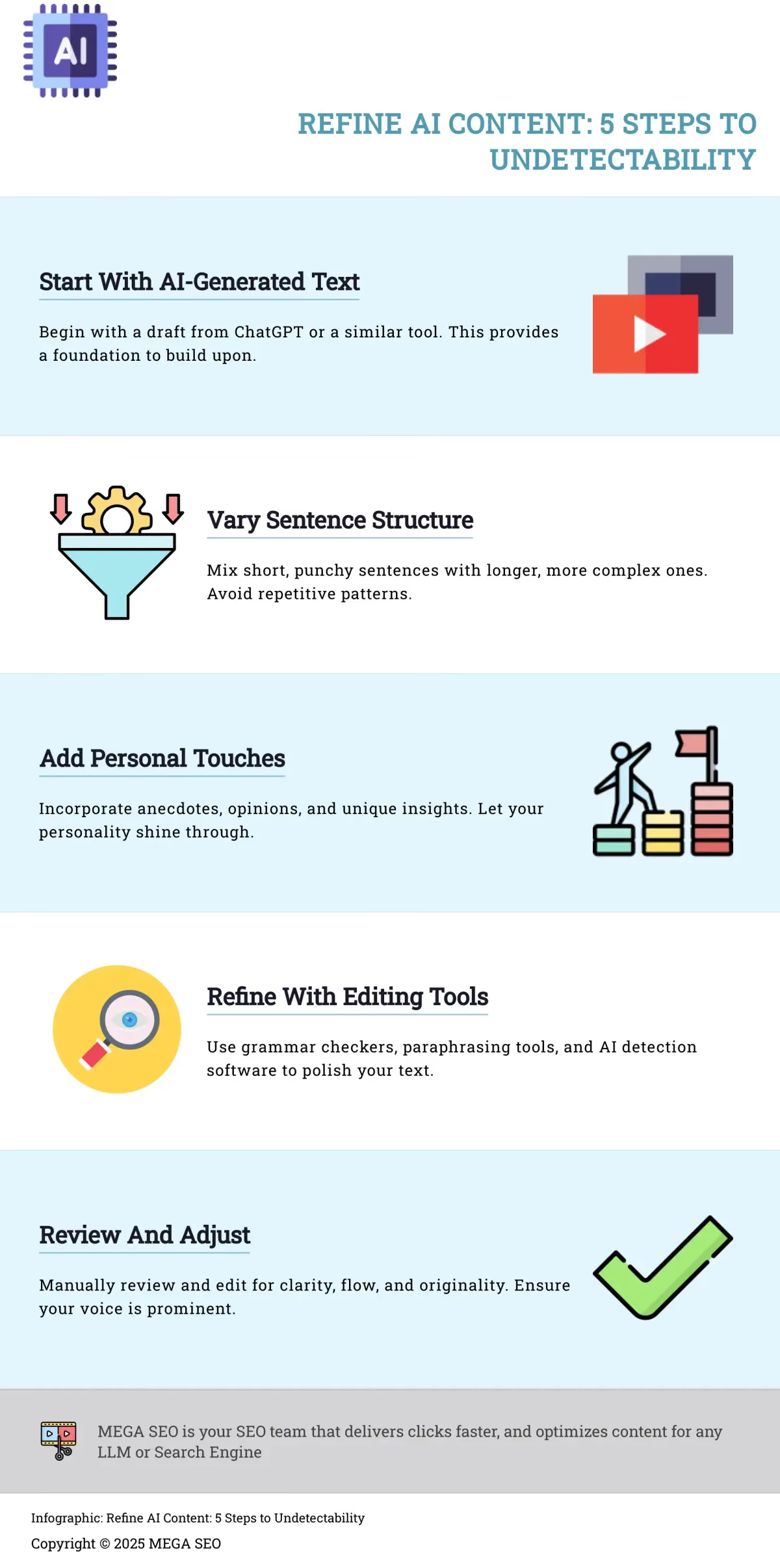
Mix Up Sentence Length and Structure
One telltale sign of AI-generated content is its uniformity. Sentences are often similar in length and structure. To break this pattern, mix things up. Use short, punchy sentences for emphasis, followed by longer, more complex sentences to add detail. This variety creates a natural rhythm that mimics human writing.
Use Casual Language and Idioms
Formal language can sound stiff and unnatural, especially in casual contexts like blog posts or social media. Don’t be afraid to loosen up your language. Use contractions, incorporate everyday language, and add relevant idioms and colloquialisms to give your writing a more conversational tone. Just be sure to use them appropriately and avoid clichés.
Share Personal Stories and Opinions
Sharing personal experiences and perspectives is a great way to make your content stand out. Adding personal anecdotes, opinions, and even a touch of humor can make your writing more engaging and relatable. This also helps differentiate your content, as AI models typically lack personal experiences.
Find Your Voice: Add Emotional Depth
While AI can generate text, it often struggles with emotional depth. To humanize your ChatGPT content, infuse it with emotion. Use evocative language, vary your tone, and let your personality shine through your writing. This creates a stronger connection with your audience and makes your content more memorable.
Understanding Information Sources
AI writing detection tools, often called “AI detectors,” are designed to identify content generated by artificial intelligence. These tools act like digital detectives, analyzing your writing for clues that suggest AI authorship. They scrutinize various linguistic features, including sentence structures, word usage, and patterns, to identify the telltale signs of AI-generated content. Essentially, they are linguistic algorithms trained to spot the subtle fingerprints of AI.
AI detectors work by searching for patterns common in AI-generated text but rare in human writing. AI tends to write predictably, often using repetitive phrasing and sentence structures, which become red flags. The lack of emotional nuance and personal voice, typical of AI, further contributes to its detectability. Even the speed at which AI produces polished text, while impressive, can be a giveaway, as humans generally write more slowly.
The landscape of AI writing and detection is constantly evolving. AI writing tools are continuously improving, and so are the tools designed to detect them. This creates a dynamic environment where completely avoiding detection is an ongoing challenge. The goal, then, should be to make AI-generated content less detectable, not entirely undetectable. This means refining your approach to AI content creation and adapting to new detection methods as they appear.
One effective strategy is to humanize your AI content by incorporating elements that AI typically struggles with, such as emotional depth and personal perspective. Using evocative language, varying your tone, and letting your personality come through can create a stronger connection with your audience and make your content less likely to be flagged. Adding personal anecdotes, opinions, and even a bit of humor can further enhance authenticity and relatability.
Paraphrasing and Editing for Undetectable Content
Once you have your AI-generated content, refining it with smart editing is key. Think of AI as a first draft assistant—it gets the ball rolling, but you’re the editor who polishes it into a masterpiece. These strategies will help you create content that’s both engaging and undetectable.
Rewrite ChatGPT Output in Your Own Words
This is the most effective way to make AI content truly yours. Read through the text, understand the core message, and then rewrite it as if you were explaining it to a friend. This not only helps avoid detection by tools looking for AI-generated patterns, but also injects your personality and style into the writing. It’s like translating a technical manual into plain English—you’re making it more accessible and relatable. This rewriting process takes time, but it’s worth it for creating authentic, engaging content. Remember, you’re aiming for originality, not just rearranging words.
Combining AI and Human Input
Think of AI as a collaborator, not a ghostwriter. Its strength lies in generating text quickly, but it needs your human touch to make that text truly shine. Use AI tools like ChatGPT for brainstorming, outlining, and even drafting initial paragraphs. Then, step in with your expertise and creativity. Refine the AI’s output, adding your own insights, personal experiences, and unique voice. As one expert suggests, rewriting AI-generated text in your own words is the most reliable way to avoid detection and create something authentic (OpenAI Community). It’s the perfect blend of efficiency and originality.
Another helpful strategy is to use ChatGPT for specific tasks, like rephrasing sentences or generating different versions of a paragraph (Reddit discussion). Always rewrite these suggestions in your own words, ensuring you understand the underlying concepts and aren’t just shuffling words around. This demonstrates true comprehension and helps you create content that resonates with your audience. Remember, AI can be a powerful assistant, but it’s your understanding and creative input that elevates the content.
Experiment with different prompts and techniques to find what works best for you. Some users find success by combining multiple strategies, blending AI capabilities with human editing for optimal results (Twixify article). Don’t be afraid to try new things and refine your approach as AI detection methods evolve. The key is to find a balance that allows you to leverage AI’s speed while maintaining your unique voice and perspective. Consider using MEGA SEO's customized posts to streamline this process.
When using AI for conversational content, like chatbot scripts, focus on making the interactions feel natural and engaging. Ask open-ended questions, inject personality and emotion into the prompts, and adapt to how the user responds (Powell Software blog). This human touch is crucial for creating a positive user experience and building genuine connections. AI can handle the mechanics of the conversation, but it’s your human input that makes it feel real.
Spice Up Your Text with Synonyms
Think about how you talk naturally. You probably don’t use the same words over and over again. The same goes for writing. Using synonyms keeps your content fresh and interesting. Instead of relying on the first word that comes to mind, explore different ways to express the same idea. A thesaurus can be a helpful tool, but don’t go overboard with overly complex vocabulary. The goal is to sound natural, not like you swallowed a dictionary. Aim for clear, concise language that resonates with your readers.
Restructure Sentences for Better Flow
AI often generates text in predictable patterns. One way to break these patterns is to vary your sentence structure. Mix short, punchy sentences with longer, more complex ones. Experiment with different sentence beginnings. Sometimes starting a sentence with a preposition or a dependent clause can add variety and rhythm. This makes your content more dynamic and less robotic. Read your work aloud to get a feel for the rhythm and flow.
Show Off Your Expertise with Unique Examples
This is where you really make the content your own. Share your personal experiences, add your own opinions, and include specific examples that are relevant to your audience. Think about what you bring to the table that AI can’t—your unique perspective, your sense of humor, or your ability to connect with readers on an emotional level. Adding these personal touches not only makes your content more engaging but also makes it much harder for AI detectors to flag it as machine-generated. Consider adding case studies, anecdotes, or real-world examples to illustrate your points.
Tools to Make Your ChatGPT Content Undetectable
Ensuring your content reads naturally and avoids detection as AI-generated involves using a combination of tools and your own editorial judgment. Here’s a breakdown of resources and strategies to help refine AI-generated text:
AI Content Detection Tools
Ironically, some of the best tools for improving undetectability are AI content detectors themselves. Services like Originality.ai and Content at Scale analyze text for patterns common in AI-generated content. By using these detectors, you can identify areas needing revision. Keep in mind that some tools like Undetectable AI claim to make AI text undetectable, but their effectiveness isn’t guaranteed. Think of these tools as part of an ongoing process of refinement, not a magic bullet.
Specific Tools and Their Inconsistent Results
Several tools are available for detecting AI-generated content, but their accuracy varies. Testing reveals inconsistencies, with some tools correctly identifying AI-generated text while others mislabel human-written text as AI-produced. No single tool consistently provides accurate results. A recent SEO.ai blog post evaluated several tools, including Copyleaks, GPTZero, GPT-2 Output Detector, PoemOfQuotes, Corrector, Content at Scale, Roberta OpenAI Detector, ChatGPT Detector (Huggingface), GLTR, and Writer. The analysis found varying degrees of accuracy across these platforms, highlighting the challenge of relying solely on AI detection tools.
AI Detection Bypass Tools (with Caveats)
Several tools, such as Undetectable AI, HIX Bypass, BypassGPT, and AIHumanizer.ai, claim to make AI-generated text undetectable. These tools often rephrase or restructure sentences to break common AI patterns. However, their effectiveness isn't guaranteed, and they may come with a cost. The best approach is to combine AI writing with human oversight. Use AI as a starting point, then refine and personalize the content to create high-quality, original work. This combination of AI assistance and human creativity offers the most reliable path to producing engaging, undetectable content. MEGA SEO helps you create original content through its automated content generation features.
Readability and Style Checkers
Grammarly and ProWritingAid are invaluable for improving clarity, style, and overall readability. While not specifically designed for AI detection, they can help identify and correct issues like repetitive sentence structure or unusual word choices that might flag text as AI-generated. Using a plagiarism checker can also be helpful for ensuring originality. Manually comparing your work to other sources is always good practice.
Paraphrasing and Editing Assistants
Paraphrasing tools such as QuillBot can help rephrase sentences and suggest alternative wording. SurferSEO’s Content Editor offers similar capabilities within the context of SEO optimization. These tools can be useful for breaking up patterns and adding variety to your writing, but it’s crucial to review the suggested changes carefully. Remember, the goal is to enhance, not simply change, the original meaning.
Using ChatGPT Ethically
Using AI writing tools like ChatGPT can feel like unlocking a superpower. Suddenly, you can produce content at speeds you never thought possible. But with great power comes great responsibility. Let’s talk about using these tools ethically.
Transparency with Your Audience
Transparency is key when using AI-generated content. Consider disclosing to your audience that AI played a role in creating the content they’re reading. This builds trust and allows readers to make informed decisions about how they interpret and engage with your work. As discussions around AI-generated content evolve, being upfront about its use becomes even more critical.
Balancing AI and Your Own Ideas
Think of AI as a helpful assistant, not a ghostwriter. Leaning too heavily on AI-generated content can stifle your own creativity and critical thinking skills. Use ChatGPT to jumpstart your writing process, generate ideas, or overcome writer’s block, but always infuse your work with original thought and your unique perspective. AI should enhance, not replace, your own efforts.
ChatGPT for Research and Brainstorming
ChatGPT excels at research and brainstorming. Use it to gather information quickly, explore different angles on a topic, or outline your content. It can be a powerful tool for generating initial drafts or overcoming creative hurdles. Think of it as a digital brainstorming partner, helping you refine your ideas and develop a strong foundation for your writing.
Always Fact-Check
While ChatGPT can be a valuable tool, it’s important to remember that it’s not infallible. Always double-check any facts, figures, or claims generated by the tool. Verify information using reliable sources and ensure accuracy before publishing. Maintaining credibility with your audience depends on providing accurate and trustworthy information. MEGA SEO’s content optimization features can help you ensure your content is accurate and up-to-date.
Legal and Academic Uses of ChatGPT
Using AI writing tools like ChatGPT can raise some legal and academic questions. It’s important to understand these issues to use these powerful tools responsibly and ethically.
Ethical Concerns and Risks in Academia
Using AI tools like ChatGPT for academic work raises serious ethical questions. It's tempting to lean on AI for assignments, but academic integrity is essential. Many educators and institutions are actively working to detect AI-generated content. Consequences for using AI unethically can range from failing an assignment to expulsion, impacting your academic record and future opportunities.
Consequences of Unethical Use
Submitting AI-generated work as your own can have significant repercussions. Consider the potential fallout: a failing grade on the assignment, a failing grade in the course, or even expulsion from school. These consequences can have a lasting impact on your academic record and future opportunities. A Reddit discussion highlights these penalties and the increasing efforts to detect AI-generated content in academic settings. It’s best to avoid the risk altogether.
Using AI Tools Responsibly in Academia
AI can be a valuable tool in academia when used responsibly. Instead of relying on it to complete assignments, consider using AI for brainstorming, research, or refining your writing. MEGA SEO suggests focusing on how AI can support your learning and critical thinking skills, not replace them. Think of AI as a helpful assistant, not a ghostwriter. Use it to gather research, explore different perspectives, or overcome writer's block. Transparency is also important. Disclosing the use of AI in your work builds trust with your readers and promotes open conversation about AI's role in education.
Copyright and Ownership
AI-generated content brings up interesting questions about copyright. Who owns the copyright—the person using the AI tool or the company that created it? Currently, copyright law protects works created by humans. This makes it tricky to determine ownership when AI is involved. Some argue that AI-generated content should be considered public domain, while others believe that the user of the AI tool holds the copyright. Additionally, using AI to create content and trying to hide that fact is ethically questionable and may violate rules at schools, colleges, and in professional settings. It’s a complex area of law that is still evolving.
Avoiding Plagiarism
In academic settings, using ChatGPT without proper attribution can be considered plagiarism. Many universities and schools have updated their policies to address AI-generated content. Submitting AI-generated text as your own can have serious consequences, including failing the assignment, failing the course, or even expulsion. Simply paraphrasing is not a reliable method for avoiding detection, as several commenters in this discussion point out. Many AI detectors can identify patterns and similarities that indicate AI involvement, even after paraphrasing. It’s crucial to check your institution’s academic integrity policies and use AI writing tools responsibly. Using these tools for research and brainstorming is generally acceptable, but submitting AI-generated content as original work is not.
Staying Ahead of AI Detection
AI detection is a moving target. As detection technology improves, so do content generation tools. Staying informed about the latest advancements in both areas is key to making your content less detectable.
Keep Up with AI News
AI detection tools are constantly improving, so completely avoiding detection might be impossible. The goal is to make the AI’s writing less detectable, not undetectable. Keep up with the latest AI news by subscribing to industry blogs and following AI researchers and developers on social media. Understanding how these tools work—what they look for and how they evolve—can give you valuable insights into refining your content creation strategies.
Adapting to New Detection Methods
The effectiveness of AI-detection bypass tools is questionable and should be approached with caution. Improving the quality and style of AI-generated text through careful prompting is a more reliable approach than solely relying on post-processing tools. Creating undetectable AI-generated text is an ongoing process that requires continuous improvement and adaptation. Experiment with different prompting techniques and editing strategies to find what works best for you. Be prepared to adjust your methods as AI detection technologies become more sophisticated. Continuously testing and refining your content is crucial for staying ahead of the curve.
The Future of AI Content and Detection
AI writing tools are constantly evolving, and so are the methods used to detect AI-generated content. This creates a dynamic environment where both content creators and detection tools adapt and improve.
Emerging Trends in AI
AI detection tools analyze writing patterns, sentence structures, and word usage to identify AI-generated content. These tools look for the statistical fingerprints of large language models. However, current AI detectors aren’t perfect and can produce false positives, sometimes flagging human-written text as AI-generated. As AI writing gets more sophisticated, these tools are also improving and learning to recognize more nuanced patterns and textual characteristics. This makes completely avoiding detection a challenge. It’s also worth noting that tools designed to bypass AI detection have questionable effectiveness and should be approached with caution. AI detection tools are constantly improving, so completely avoiding detection might be impossible.
Preparing for the Future of AI
The increasing use of AI in writing has raised questions about academic integrity and responsible AI use. Simply paraphrasing AI-generated text isn’t a reliable method for avoiding detection, as many tools can identify reworded AI content. Creating undetectable AI-generated text is an ongoing process, requiring continuous improvement and adaptation. Staying informed about developments in AI and detection technology is crucial for anyone using AI writing tools. This includes following AI development news and adapting your approach as new detection methods emerge. The future likely holds a continuous back-and-forth between AI writing tools and detection methods, with both sides constantly evolving.
Google's Stance on AI Content
Let’s clear the air: Google isn’t waging war on AI content. Their focus is on quality, not origin. Think of it like this: Google wants to serve up the best, most helpful search results, whether written by a human or an AI. Their priority is combating spammy, low-quality content that doesn’t provide value to users. So, if your AI-generated content is genuinely helpful and well-written, you’re not breaking any rules. Quality is key.
Google's algorithms are designed to prioritize user experience. This means your content, regardless of its creator, needs to be relevant, useful, and meet certain quality standards to rank well. It's about providing value to the searcher. So, whether you're using keyword research tools or AI writing assistants, the ultimate goal remains the same: create content that people actually want to read.
The world of AI is constantly evolving, and Google is keeping pace. They’re continually refining their algorithms to ensure that high-quality content rises to the top, no matter how it’s created. This means staying informed and adapting your content strategy is crucial. As AI-generated content becomes more prevalent, Google's algorithms will likely become even more sophisticated at identifying and rewarding truly valuable content. Think of it as a continuous evolution.
Of course, using AI to create content raises important ethical considerations, especially around transparency and originality. Google encourages creators to maintain integrity and provide authentic value to their audience. While AI can be a powerful tool, it’s essential to use it responsibly. This includes being mindful of potential biases, ensuring accuracy, and avoiding plagiarism. Ethical considerations are key.
Optimizing AI Content with MEGA SEO
MEGA SEO isn’t just about generating content; it’s about crafting content that ranks. We combine the speed of AI with the finesse of a seasoned SEO expert. Here’s how:
Automated Content Creation with MEGA SEO
Before we write a single word, MEGA SEO performs comprehensive keyword research. We identify the terms your target audience is searching for, ensuring your content aligns with what people want to know. This foundational step, as highlighted by SEO expert Beckie Brown, is crucial for attracting the right audience and maximizing your content’s visibility. We don’t just find keywords; we analyze search intent, competition, and relevance to select the most impactful terms for your business. This ensures your AI-generated content is both readable and discoverable.
Once we understand what your audience wants, our AI gets to work, generating high-quality, SEO-friendly content. MEGA SEO then refines and optimizes the content, ensuring it flows naturally while incorporating targeted keywords seamlessly. This process guarantees your content is engaging, informative, and provides real value to your readers. Explore our free SEO tools to get started.
Content Optimization with MEGA SEO
Creating content is just the first step. Maintaining and optimizing existing content is crucial for long-term SEO success. Our Maintenance Agent takes the hassle out of this ongoing process.
First, we analyze your existing content, identifying opportunities to improve click-through rates. We optimize titles, meta descriptions, and headings to make your content more enticing in search results. This is key for attracting more clicks and driving traffic to your site, as emphasized by Strikingly. Access valuable SEO resources to learn more.
Next, MEGA SEO identifies areas where you can expand existing content with fresh, relevant information. We analyze search trends and user behavior to determine what your audience wants to know, then suggest targeted additions to your articles. This helps keep your content current, comprehensive, and highly ranked.
Finally, MEGA SEO offers unparalleled flexibility in content re-optimization. Whether you’re adapting to a Google algorithm update, optimizing for a different search engine, or tailoring your content for a specific platform, our tools can help. We can even optimize your content for LLMs, ensuring it’s both human-friendly and AI-friendly. Book a demo to see how MEGA SEO can transform your content strategy.
Customizing Your Chatbot for MEGA SEO
MEGA SEO leverages the power of AI, but we understand that a personal touch is essential for creating truly engaging content. That’s why we’ve designed our platform to be highly customizable. You’re not just using AI; you’re training it to write like you. Think of it as teaching your chatbot to speak with your unique voice and perspective. Here’s how you can customize your chatbot with MEGA SEO:
First, refine AI-generated content with thoughtful editing and rewriting. Incorporate varied sentence structures, informal language, and personal anecdotes for a natural, engaging voice. This is where your human insight comes into play. AI can assist with research and brainstorming, but original thought is essential for creating high-quality content. Use AI as a starting point, then add your own unique perspective.
Next, read through the text and understand the core message. Then, rewrite the output as if you were explaining it to a friend. This not only helps avoid detection by AI tools, but also injects your personality and style into the writing. This makes it more engaging for readers. One telltale sign of AI-generated content is its uniformity. Sentences are often similar in length and structure. Mix things up to break this pattern. Variety creates a more dynamic and engaging reading experience, which is beneficial for SEO.
Finally, sharing personal experiences and perspectives is a great way to make your content stand out. This enhances engagement and differentiates your content from AI-generated text, which often lacks personal touch. Consider disclosing to your audience that AI played a role in creating the content. This builds trust and allows readers to engage more meaningfully with your work.