
You are an expert in your field, but does your website prove it? Simply having a few blog posts on a topic isn't enough to convince search engines of your authority. To stand out, you need to demonstrate comprehensive knowledge through a strategy called topical depth. This approach involves creating an interconnected library of content that covers your core subjects from every angle. It’s how you show Google that you are the most credible and helpful resource for your audience. This article will walk you through the steps to structure your content, prove your expertise, and turn your authority into organic traffic.
Key Takeaways
- Prioritize comprehensive coverage over keyword density: Modern SEO success comes from proving your expertise on a subject. Fix declining traffic by creating a deep, interconnected web of content that answers every related user question.
- Organize your expertise with pillar pages and topic clusters: Create a broad pillar page for each main service or topic. Then, build out clusters of more specific articles that link back to that pillar, creating a clear content hierarchy for search engines.
- Be strategic and patient with your content: Start with a content audit to see where you stand. Then, prioritize high-impact topics and create a roadmap to build out your content clusters over time, as results typically appear within three to nine months.
What Is Topical Depth in SEO?
If you’ve noticed your website traffic dipping, the reason might be a shift in how search engines like Google rank content. The old approach of targeting individual keywords on separate pages is no longer enough. Today, the key to consistent organic traffic is building topical depth, which means proving to search engines that you are a genuine expert on a specific subject.
Think of it like writing a comprehensive book on a topic instead of just a single, standalone chapter. A book covers the main subject from every angle, with chapters dedicated to all the important subtopics. This complete coverage signals true expertise. Similarly, a website with strong topical depth has a central "pillar" page for a broad topic and many supporting articles that explore related subtopics in detail. This interconnected web of content shows Google that your site is a reliable and thorough resource for users. By covering a subject completely, you create a go-to destination that search engines are more likely to recommend.
From Keywords to Concepts: How Search Has Changed
In the past, SEO was often a game of repetition. You’d pick a keyword and try to use it as many times as possible on a page. Search engines have grown much more sophisticated since then. They no longer just scan for keywords; they understand concepts and the relationships between them. This is the core idea behind topical authority.
Instead of seeing your website as a collection of disconnected pages, search engines see your site as an expert on a subject when you cover it comprehensively. For example, if you run a local bakery, an article about "sourdough bread" is a good start. But to build authority, you also need content about "sourdough starters," "baking techniques for beginners," and "best flour for sourdough." This cluster of related content proves your expertise in the broader topic of "baking."
How Google Judges Your Content's Authority
Google’s goal is to provide users with the most helpful and complete answers to their questions. To do this, it evaluates your content’s depth and authority. It looks for signals that you’ve covered a topic thoroughly, not just skimmed the surface. This means providing information that answers all the related questions a user might have on the subject.
When you build topical authority correctly, you create a durable SEO asset that can withstand algorithm updates. Google assesses this by looking at the comprehensiveness of your content, how well your articles are linked together to guide users through the topic, and whether your site provides more value than a competitor who only has one or two basic articles. A deep, well-structured content library shows Google that you are a credible source worthy of a top ranking.
Why Your Traffic Is Declining (And How Topical Depth Can Help)
If you’ve noticed your website traffic dropping even though you’re consistently publishing content, you’re not alone. The old rules of SEO, which focused heavily on targeting individual keywords, are no longer enough. Search engines like Google have become much more sophisticated. They don't just scan for keywords; they aim to understand the meaning and context behind a search query to deliver the most authoritative and comprehensive results.
This is where topical depth comes in. Instead of creating scattered, one-off articles, this strategy involves building a deep and interconnected library of content around a specific subject. Think of it as becoming the go-to expert in your niche. When search engines see your site as a reliable authority on a topic, they are more likely to rank your pages higher for a wide range of related searches. According to SEO expert Neil Patel, Google's AI is looking for pages that demonstrate real understanding of how ideas connect. This approach is more resilient to algorithm updates and can create a sustainable source of organic traffic for your business.
Why Google Rewards In-Depth Content
Google’s primary goal is to satisfy the user. When someone searches for something, Google wants to provide them with the most complete and helpful answer possible. In-depth content achieves this by covering a subject from multiple angles, answering follow-up questions before the user even thinks to ask them. This signals to Google that your website is a high-quality resource that can be trusted.
This focus on quality is why 76% of SEO professionals now see content depth as a key priority for ranking success. A website with deep, well-researched content is more likely to earn backlinks, keep visitors engaged for longer, and establish the expertise, authoritativeness, and trustworthiness (E-E-A-T) that Google values.
How Deeper Content Leads to Higher Rankings
Building deeper content directly impacts several factors that contribute to higher search rankings. When you create a cluster of articles around a central topic, you create natural opportunities for internal linking. This helps search engines discover all of your related content and understand the relationships between your pages, distributing authority across your site.
Comprehensive content also improves user engagement signals. Visitors who find everything they need on your site are less likely to bounce back to the search results. They spend more time on your pages, which indicates to Google that your content is valuable. Over time, this doesn't just help you rank for one or two keywords; it helps you capture a larger share of traffic for an entire topic, solidifying your position as an industry leader.
The Building Blocks of Topical Authority
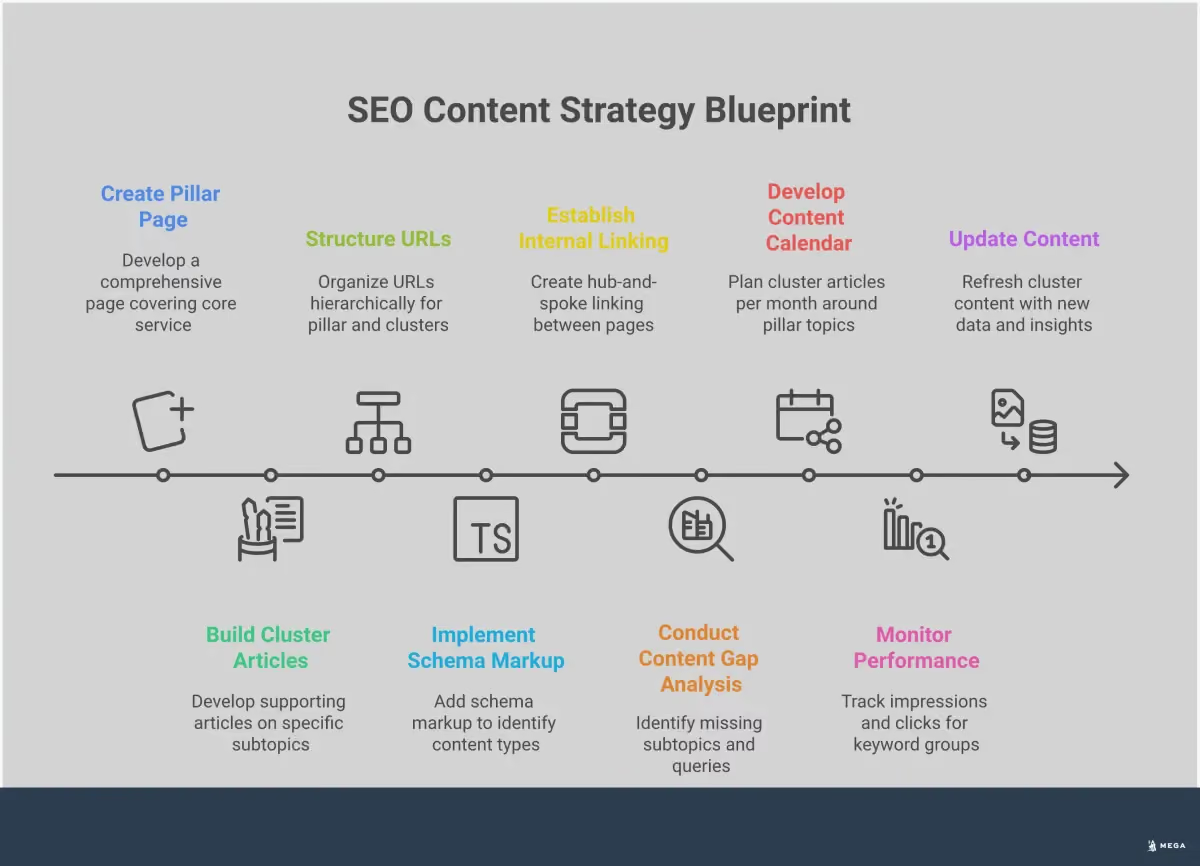
Building topical authority requires a deliberate structure that shows search engines you have deep expertise. Think of it like building a library on a specific subject: you need a main reference book, detailed chapters, and a clear index connecting everything. In SEO, this structure is built with three key components: pillar pages, topic clusters, and a smart internal linking strategy. Getting this foundation right is the first step toward creating content that ranks consistently.
Understanding Pillar Pages and Topic Clusters
The best way to organize your content is with the pillar-cluster model. A pillar page is a broad piece of content covering a core topic from end to end, like "The Ultimate Guide to Custom Wedding Cakes" for a bakery. Supporting this pillar are topic clusters—groups of detailed articles on subtopics like "Top 10 Wedding Cake Flavors" or "How to Choose a Cake Design." Each cluster post links back to the main pillar page, signaling to Google that you have a wealth of related, in-depth information.
How to Map Content and Develop Subtopics
To map your content, start with your core services. These are your pillar topics. Brainstorm subtopics for your cluster content by thinking about the questions your customers ask. What are their pain points related to your pillar topic? Each question is a potential blog post. From there, you can perform keyword research to validate your ideas and find the exact phrases people are using in search. This process helps you discover content gaps and ensures you’re creating articles that directly address user needs, covering every angle of your core topic.
Building a Smart Internal Linking Structure
Internal links are the threads that weave your pillar page and topic clusters together. The strategy is simple: every cluster article must link back up to its corresponding pillar page. This sends a strong signal to search engines that your pillar page is the most authoritative resource on that topic. Your pillar page should also link out to important cluster pages. For local businesses, this is especially powerful. A well-planned internal linking strategy can create clear relationships between your core service pages and location-specific content, helping you establish relevance in competitive local markets.
How to Build Your Topical Authority, Step-by-Step
Building topical authority isn't about a single blog post. It’s about creating a thoughtful, interconnected web of content that proves your expertise to search engines and users alike. This process involves weaving individual articles together, structuring them logically, and shifting your focus from single keywords to comprehensive topics. By following these steps, you can create a content ecosystem that establishes your site as a go-to resource in your field. Let's break down how to put this strategy into action.
Weave Your Content Pieces Together
Think of your content like a spiderweb. Each strand connects to another, making the entire structure stronger. The same principle applies to your articles. Instead of publishing standalone posts, you need to connect them with a smart internal linking strategy. For example, if you have a comprehensive guide to "small business accounting," you should link out from that main page to more specific articles like "choosing accounting software," "understanding cash flow," and "quarterly tax tips." Each of those specific articles should then link back to the main guide. This interlinking signals to Google that you have a deep understanding of the entire subject, not just isolated parts of it.
Structure Your Content Hierarchy
To organize your content effectively, you need to use a pillar page and topic cluster model. A pillar page is a broad, foundational piece of content that covers a core topic extensively. The cluster pages are the more specific articles that dive deeper into subtopics related to that pillar. According to Backlinko, pillar pages target broad keywords, while cluster pages target more specific, long-tail keywords. This structure creates a clear hierarchy, making it easy for search engines to crawl your site and understand the relationship between your content pieces. It also provides a better user experience by guiding visitors to the information they need.
Write for Topics, Not Just Keywords
The old way of doing SEO was to pick a keyword and repeat it as many times as possible. That approach no longer works. Today, search engines prioritize content that demonstrates a deep, holistic understanding of a subject. This means you need to write for topics, not just keywords. When you create an article, think about all the related questions and concepts a reader might have. Cover the "who, what, where, when, why, and how" of the subject. By creating comprehensive content that fully explores a topic, you show search engines that your site is an authoritative source of information, which is key to improving your rankings.
Best Practices for Internal Linking
Once you have your pillar pages and topic clusters mapped out, the next step is to connect them all. This is where internal linking comes in. Think of internal links as the hallways and doorways of your website. They guide visitors and search engines from one room (or page) to another, showing them how everything is related. A strong internal linking structure doesn't just help people find information; it tells Google how your content fits together, passing authority from your stronger pages to your newer ones. This process is what turns a collection of individual articles into a cohesive library of expertise.
For local businesses, this is especially powerful. You can use internal links to create semantic relationships between your core service pages and your location-specific content, reinforcing your expertise in a particular geographic area. For example, a plumber in Austin could link from their main "leak repair" service page to blog posts about "common plumbing issues in Austin homes" and "winterizing pipes in Central Texas." When done correctly, your internal links form a web of context that signals to search engines that you are a comprehensive resource on your topic. This is a critical piece of building the topical authority that leads to higher rankings and more stable traffic. It’s a detailed process, but getting the fundamentals right can make a significant difference in how Google perceives your site's value.
Simple Linking Strategies That Work
You don’t need a complicated strategy to get started with internal linking. The most effective approach is often the most logical one. Start by linking from your main pillar page out to each of your supporting cluster pages. Then, make sure each of those cluster pages links back to the main pillar. This simple hub-and-spoke model immediately establishes a clear content hierarchy. From there, look for opportunities to link between related cluster pages. If you have a blog post about "The Best Soil for Roses" and another about "How to Prune Roses," it makes perfect sense to link between them. The key is to use descriptive anchor text—the clickable words in the link—that tells the reader and Google what the destination page is about. Grouping similar keywords and building content around them creates a natural path for users to follow.
How to Structure URLs for Topic Clusters
Your website's URL structure is another way to signal your content hierarchy to search engines. A clean, logical structure acts like a digital filing system, making it easy for Google to understand how your pages are organized. A good practice is to use subdirectories in your URLs. For example, your pillar page might live at yourwebsite.com/roses, while a supporting cluster article could be yourwebsite.com/roses/how-to-prune. This structure mirrors the pillar-and-cluster relationship. As a general rule, pillar pages should target broader keywords, while the cluster pages in that subdirectory can target more specific, long-tail keywords. Keeping your URLs short, descriptive, and organized this way provides another layer of context that supports your topical authority goals.
Using Schema to Show Content Relationships
To give search engines an even clearer roadmap of your content, you can use schema markup. Schema is a type of structured data that you can add to your website's code. You don't see it on the page, but search engines read it to better understand what your content is about and how it relates to other pages. For example, you can use schema to explicitly identify a page as an "Article," a "HowTo" guide, or an "FAQPage." This helps Google categorize your content correctly and can even help you earn rich snippets in search results. While it sounds technical, structured data is a key signal that Google uses to measure your site's authority. It’s one more tool you can use to make sure your expertise is being fully recognized.
How to Find and Develop Supporting Subtopics
Once you understand the "what" and "why" of topical authority, it's time to get practical. Building authority isn’t about guessing what your audience wants. It’s a strategic process of identifying core subjects for your business and systematically covering all related questions. This is how you become the go-to resource in your field. The goal is to create a comprehensive web of content that answers every potential question a user might have about your area of expertise.
How to Research Your Core Topics
Your core topics are the foundational pillars of your content strategy. For a local plumber, these might be "emergency plumbing services" or "water heater maintenance." As Backlinko notes, "Pillar pages target the topic cluster’s broader primary keyword, while cluster pages target the topic cluster’s long-tail, secondary keywords." Start by brainstorming the big-picture subjects that define your business. These become your pillar pages. From there, identify specific, long-tail keywords for your cluster content, creating an organized content structure that search engines can easily understand.
Find Content Gaps with Keyword Research
A content gap is any question your audience is asking that you haven’t answered. Finding these gaps is your biggest opportunity. Use keyword research tools to find queries related to your core topics, especially those starting with "how to" or "what is." Each one is a potential blog post. According to Clearscope, "The easiest way to measure topical authority is by analyzing the share of traffic a site garners from a specific topic." By filling these gaps, you capture more of that traffic share and signal to Google that you are a thorough, helpful resource.
Analyze Your Competitors' Content
Your competitors can be a great source for content ideas. Analyze the top-ranking websites for your core topics to see what they’re covering and how deep they go. This isn't about copying; it's about understanding the standard for expertise in your niche and then exceeding it. As Hike SEO explains, "Building topical authority requires focused and high-quality content that covers every aspect of a niche." For local businesses, this is key. You can build more authority by creating content about how a service applies to specific neighborhoods or local regulations.
Common Topical Authority Mistakes to Avoid
Building topical authority is a powerful strategy, but a few common missteps can hold you back. Many small businesses make these mistakes without realizing the impact they have on their search rankings. The good news is that they are all fixable. By understanding these pitfalls, you can adjust your approach and ensure your hard work pays off, establishing your site as a trusted resource.
Creating Surface-Level Content
One of the most frequent mistakes is producing thin content that just scratches the surface of a topic. It's easy to fall into the trap of writing short articles stuffed with keywords, hoping to rank quickly. However, this approach often backfires. This kind of low-quality content fails to truly help your reader and signals to search engines that you lack deep expertise. Instead of demonstrating authority, it can damage your site's credibility. The goal should be to create comprehensive pieces that fully answer a user's questions and provide real value.
Neglecting Your Internal Links
You can write the best articles in the world, but if they aren't connected, they exist in isolation. Neglecting your internal linking structure is like building a library without a card catalog. Internal links act as pathways that guide users and search engines through your site, showing the relationships between your content. A well-planned internal linking strategy helps distribute authority across your pages and solidifies your expertise on a topic. Each link reinforces the relevance of the connected pages, helping Google understand that you've covered a subject thoroughly.
Forgetting to Update Old Content
SEO isn't a "set it and forget it" task. Another common error is publishing content and never looking at it again. Over time, information becomes outdated and your once-relevant article can start to feel stale, causing rankings to drop. Regularly updating old content is essential for maintaining its value and authority. Refreshing articles with new information and current data signals to search engines that your site is an active, reliable resource. This ongoing maintenance is crucial for long-term success and sustained traffic.
How to Measure Your Success
Building topical authority is a strategic investment, not a quick fix. Once you commit to creating in-depth content clusters, you need a clear way to see if your efforts are paying off. Measuring success isn't about watching a single number go up. Instead, you'll look at a collection of indicators that show both search engines and users are starting to recognize your expertise. Tracking the right things helps you understand what's working and where to focus your energy next. It turns SEO from a guessing game into a predictable process for growth.
What Metrics Actually Matter
To measure topical authority effectively, you need to look beyond simple page views. Focus on metrics that show how search engines perceive your site's expertise on a whole subject. The goal is to see growth across a topic, not just for a single keyword. A key indicator is your share of traffic for a specific topic cluster. Are you getting more visitors from a wide range of related search terms? Also, monitor your keyword rankings for groups of related terms. When you see an entire cluster of keywords rising in the search results, it’s a strong signal that Google views your site as a comprehensive resource on that subject.
How Long Does It Take to See Results?
Patience is key. SEO is a continuous process, and building true authority doesn't happen overnight. Unlike paid ads that stop working the moment you turn them off, a topical authority strategy builds a long-term, sustainable asset for your business. For most small businesses, it takes time for search engines to crawl, index, and re-evaluate your site's content in the context of your new, deeper coverage. Based on our data, most businesses that consistently execute an SEO strategy see meaningful organic traffic growth within three to nine months. This timeline can vary based on your industry's competitiveness and your starting point, but the results are built to last.
Tools to Track Your Progress
You don’t need expensive software to get started. The best tools for tracking your progress are free and likely already familiar to you. Google Search Console is essential for this. Use it to see which specific queries are bringing people to your pillar and cluster pages. It also helps you monitor click-through rates and your average ranking position for your target topics. Google Analytics is your go-to for understanding user behavior. You can track organic traffic to your content clusters and see how long people are staying on your pages. A longer time on page often indicates that your in-depth content is engaging and valuable to readers.
Start Building Your Topical Authority Today
Transitioning your SEO strategy to focus on topical depth is a deliberate process, but it's one of the most effective ways to build lasting authority and reverse a downward traffic trend. Instead of chasing individual keywords, you'll be creating a comprehensive resource that search engines and users trust. The process begins with understanding what you have, identifying your core areas of expertise, and creating a clear plan of action. Here are the first three steps to get you started.
Step 1: Audit Your Existing Content
Before you can build, you need a blueprint of your current foundation. A content audit helps you take stock of what you've already published and how it's performing. Start by cataloging your blog posts, articles, and landing pages. For each piece, look at key metrics like organic traffic, time on page, and the keywords it currently ranks for. This initial review helps you identify which topics already resonate with your audience and where you have gaps. To measure how well your content is performing, track metrics that show both user engagement and search engine response. This data will inform which pieces you can update and strengthen, and which new topics you need to cover.
Step 2: Prioritize High-Impact Topics
Once you know what content you have, the next step is to focus your efforts on the topics that matter most to your business and your audience. Your core topics should be directly tied to the products or services you offer. For example, a local accounting firm might have core topics like "small business bookkeeping," "payroll services," and "tax preparation." These broad subjects will become the foundation for your pillar pages. Choosing the right pillar page keyword is often straightforward because it aligns so closely with your main business offerings. By prioritizing these high-impact areas, you ensure that the authority you build is directly connected to revenue.
Step 3: Create Your Content Roadmap
With your audit complete and your priorities set, it's time to create a content roadmap. This is your strategic plan for building out your topic clusters. For each pillar topic you identified, brainstorm a list of related subtopics that answer specific questions your audience might have. For the "small business bookkeeping" pillar, subtopics could include "how to choose bookkeeping software," "common bookkeeping mistakes," and "quarterly financial reporting for startups." Structuring your content this way shows search engines that you have a deep and cohesive understanding of your niche. A clear content strategy ensures every piece you create serves a purpose in establishing you as the go-to expert.