
Getting the right output from an AI model is like trying to give directions in a language you barely speak. You know what you want to say, but the message gets lost in translation, leading to confusing results. A prompt optimization tool acts as your expert translator. It takes your simple ideas and rephrases them into clear, detailed instructions that AI understands perfectly. This guide explores the best tools that help you bridge that communication gap. We'll cover options that refine your text, generate new ideas, and ensure your final content is consistently high-quality and aligned with your brand voice.
Key Takeaways
- Specificity drives quality: To get AI-generated content that sounds like your business, include specific details in your prompts like your target audience, brand voice, and goals. This avoids generic results and reduces editing time.
- View prompting as a conversation: Don't expect perfect results on the first try. Use the initial AI output as a starting point and provide feedback to refine it, guiding the AI toward your desired outcome through iteration.
- Choose between a tool and an agent: Decide if you want a tool to help you write better prompts (hands-on) or an autonomous agent to manage your entire marketing strategy and execution for you (hands-off).
What Are Prompt Optimization Tools?
Think of a prompt optimization tool as a translator or a coach for communicating with artificial intelligence. You have an idea for a marketing email or a social media post, but getting an AI model like ChatGPT or Gemini to produce exactly what’s in your head can be tricky. These tools take your simple request and refine it into a detailed, structured instruction that the AI can understand and execute effectively. The goal is to bridge the gap between your intent and the AI’s output.
Instead of just writing "write a blog post about home organization," a prompt optimizer helps you build a more specific command. It might add details about the target audience (e.g., busy parents in small apartments), the desired tone (e.g., friendly and encouraging), and the format (e.g., include a numbered list of five tips). By improving the quality of your input, these tools help you generate higher-quality, more consistent content for your business, saving you from endless rounds of edits. They are a key part of working with the large language models that power modern content creation.
How Do They Work?
At their core, prompt optimization tools apply the principles of effective AI communication to your requests. You start by entering your basic idea into the tool. The software then analyzes your input and automatically rewrites it based on proven techniques. It might add clarifying phrases, suggest a specific structure, or incorporate keywords to guide the AI’s response more precisely.
Many tools also allow you to use variables or placeholders, like [product name] or [customer pain point]. This feature is incredibly useful for small businesses, as it lets you create reusable prompt templates for recurring tasks. You can craft a perfect prompt for generating customer testimonials once, then quickly adapt it for different products or services. This automates the process of creating high-quality, on-brand content at scale.
What Is Prompt Engineering?
Prompt engineering is the skill of crafting effective instructions to get a desired response from an AI. It’s less about coding and more about creative problem-solving and clear communication. The quality of the AI’s output is directly tied to the quality of the prompt you provide. A vague prompt will almost always lead to a generic or unhelpful answer.
The process often involves iteration—you start with an initial prompt, review the AI’s response, and then refine your prompt to get closer to your goal. You might add more context, specify constraints, or even provide examples of what you’re looking for. Prompt optimization tools help by automating much of this refinement process. They essentially act as your expert prompt engineer, applying best practices so you can achieve better results without needing to master the skill yourself.
Why Your Small Business Needs Prompt Optimization
If you’re running a small business, you’re likely wearing multiple hats. Using AI to generate content or ideas can feel like a huge win, but generic outputs often create more editing work than they save. This is where prompt optimization comes in. It’s the process of refining your instructions for AI to get more accurate, relevant, and on-brand results from the start.
Instead of just asking an AI to "write a blog post about local SEO," you learn to provide specific context, tone, and audience details. This simple shift turns a basic AI tool into a powerful assistant that understands your business's unique needs. For small and local businesses, mastering this skill means creating better marketing materials faster, connecting more effectively with your community, and competing with larger companies without needing a huge budget. It’s about working smarter, not harder, to achieve your growth goals.
Solve Common AI Challenges
One of the biggest hurdles with AI is getting content that sounds like it came from your business, not a robot. Generic prompts lead to generic content that misses your unique selling points and local flavor. By optimizing your prompts, you can guide the AI to produce content that speaks directly to your customers' needs. For example, a local bakery can use prompts that specify its neighborhood, signature products, and community involvement.
This is especially important as AI search increasingly uses local data to deliver results. Developing a library of company-specific prompts helps you create content that’s not only on-brand but also optimized for how people in your area are searching.
Save Time and Money
As a small business owner, your most valuable resources are time and money. Prompt optimization directly helps you save both. When you give an AI a clear, detailed prompt, you get a much better first draft. This drastically cuts down on the hours spent editing and rewriting, allowing you to publish content and launch campaigns faster.
This efficiency means you can accomplish more without expanding your team or your budget. Instead of spending money on freelance writers for every social media post or email, you can use AI tools to handle more of the initial creation. This frees up your marketing spend for other critical activities, like running paid ads or improving your website, giving you a better return on your investment.
Keep Your Brand Voice Consistent
Your brand voice is what makes your business recognizable and helps you build a relationship with your audience. Leaving it up to an AI without clear direction can result in inconsistent messaging that confuses customers. Prompt optimization is the key to maintaining consistency across all your AI-generated content.
By including instructions about your tone, style, and target audience in every prompt, you ensure everything from your website copy to your social media updates sounds distinctly like you. Creating a detailed target audience persona and referencing it in your prompts is a great way to start. This practice ensures the AI isn't just writing for a general audience but for the specific people you want to reach.
The Best Prompt Optimization Tools for Small Businesses
Finding the right prompt optimization tool depends on your specific goals, technical comfort level, and how hands-on you want to be. Some businesses need a simple helper to refine their ideas, while others are looking for a solution that handles the entire process from start to finish. This list covers a range of options to help you find the perfect fit for your small business, whether you want to fine-tune your own prompts or delegate the work to an automated system.
We'll look at tools designed for specific tasks like refining text or generating new ideas, as well as a more comprehensive agent that takes marketing tasks completely off your plate.
MEGA AI: For Full Marketing Automation
If your goal is to get marketing results without becoming a prompt engineering expert, an AI agent is the way to go. MEGA AI isn't a tool you use to write better prompts; it's an autonomous agent that handles your entire marketing strategy. You provide the business goals, and the agent does the work. This is ideal for small business owners who don't have time to manage campaigns. For example, MEGA AI’s SEO agent can create and optimize content for search engines and new AI-driven platforms like Google's AI Overviews. It handles the complex work of keyword research, content generation, and technical optimization so you can focus on running your business.
PromptPerfect: For Refining Prompts Across Models
When you’re already using AI for tasks like writing ad copy or creating images, getting the prompt right is key. PromptPerfect is a tool designed to refine and improve your prompts to get better outputs from models like GPT-4 and Midjourney. Think of it as a proofreader for your AI instructions. You input your initial idea, and the tool rephrases it for clarity, detail, and efficiency. This is particularly useful for small businesses that rely on AI-generated content for their blogs or social media and want to ensure the quality is consistently high without endless trial and error.
Promptify: For Generating New Prompt Ideas
Sometimes the biggest challenge is knowing where to start. If you have a general idea but struggle to turn it into a detailed prompt, a tool like Promptify can help. It’s designed to take a complex or messy concept and organize it into a clear, concise prompt that an AI model can easily understand. For a local business, this could mean turning a list of weekly specials and events into a structured prompt for generating a social media calendar. By cleaning up your input, the tool helps you get more accurate and relevant results from your AI, saving you the time you would have spent on revisions.
Hero Page: For Easy Prompt Creation
If you're new to using AI and find the process of writing prompts intimidating, Hero Page offers a more user-friendly approach. The platform simplifies prompt creation, making it accessible even if you don't have a technical background. It provides a structured way to build effective prompts for different applications, from customer service emails to marketing copy. This is a great starting point for small business owners who want to incorporate AI into their workflow but need a little guidance. It lowers the barrier to entry and helps you create useful prompts without needing to learn complex engineering techniques first.
Other Tools to Check Out
For businesses on a tight budget, free tools can be a great way to improve your AI outputs without any financial commitment. For instance, there are free online optimizers that help you enhance your prompts for large language models like ChatGPT. These tools often apply established prompt engineering principles to your text, adding clarity and context to get you a better result. A free prompt optimizer can be a valuable resource for quick, one-off tasks or for learning the fundamentals of what makes a good prompt.
Key Features to Look For in a Prompt Optimization Tool
When you start looking at prompt optimization tools, the options can feel overwhelming. They all promise better AI outputs, but their features can vary widely. To find the right fit for your business, you need to look past the marketing hype and focus on the core functionalities that will actually make a difference in your workflow. Here are the key features to consider.
An Easy-to-Use Interface
Your prompt optimization tool should simplify your work, not add another complex system to learn. A clean, intuitive interface is non-negotiable. You should be able to start refining prompts and generating content without spending hours on tutorials. Look for features like drag-and-drop builders, clear navigation, and helpful templates. The goal is to find a tool that can accelerate your content workflow, allowing you to brainstorm, outline, and create high-quality content much faster than you could on your own. If a tool feels clunky or confusing during the trial period, it will likely only cause frustration down the line.
Integrations with Your Current Tools
A great prompt tool doesn't operate on an island. It should connect seamlessly with the software you already rely on every day. Before you commit, check if the tool integrates with your content management system (like WordPress or Shopify), your social media platforms, and your project management software. The best tools also work across major AI platforms like ChatGPT and Gemini, allowing you to track how your brand appears consistently. Strong integrations eliminate the tedious process of copying and pasting, creating a smoother, more efficient workflow from prompt creation to final publication. This connectivity is what turns a simple tool into a central part of your marketing engine.
Customization for Your Business
Generic prompts produce generic content. To get results that truly reflect your brand, you need a tool that allows for deep customization. This means going beyond basic prompt refinement. Look for the ability to build a company-specific prompt library that incorporates your unique brand voice, target audience personas, and product details. A good tool will let you save custom templates and variables, ensuring that every piece of AI-generated content is aligned with your business's specific goals and messaging. This level of personalization is what separates forgettable content from content that connects with your customers and drives action.
Analytics to Track Performance
How do you know if your optimized prompts are actually better? The only way is through data. A valuable prompt optimization tool should offer analytics to help you measure the performance of your outputs. This could include tracking the quality of AI responses, A/B testing different prompt variations, or even monitoring engagement on the content generated from those prompts. Having access to this data is the key to creating scalable, reliable AI processes. It allows you to move beyond guesswork and make informed decisions to continuously improve your prompts and, ultimately, your marketing results.
How Much Do Prompt Optimization Tools Cost?
Investing in a new tool can feel like a big step, especially when you're managing a small business budget. The good news is that prompt optimization tools are designed to be accessible, with a range of pricing plans to fit different needs. The cost often depends on the complexity of the features, the number of users, and the level of support provided. Instead of viewing it as just another expense, think of it as an investment in efficiency and content quality. The right tool can save you hours of work each week, which directly translates to more time you can spend on growing your business.
Finding an Option That Fits Your Budget
You don't need a massive budget to get started with prompt optimization. Many developers understand the financial constraints of startups and small businesses, offering a variety of budget-friendly AI tools to help you operate more efficiently. Look for platforms that offer free trials or freemium plans. These are great ways to test a tool’s features and see if it fits your workflow before committing to a paid subscription. This approach lets you experiment with different options and find the one that provides the most value for your specific needs without any upfront financial risk.
Understanding Subscription Models
Most prompt optimization tools operate on a subscription basis, typically with monthly or annual payment options. Monthly plans offer flexibility, while annual plans usually come with a discount. For a solo entrepreneur or a small team, you can often find powerful AI optimization tools in the range of $20 to $99 per month. Some tools might also use a credit-based or usage-based system, where you pay for the number of prompts you generate or refine. This model can be cost-effective if your usage varies from month to month, as you only pay for what you actually use.
Calculating Your Potential ROI
The real value of a prompt optimization tool isn't just its price tag; it's the return on investment (ROI) it delivers. Think about the time you currently spend brainstorming, writing, and revising AI-generated content. By streamlining these routine tasks, you free up valuable hours that can be redirected toward strategy, customer service, or sales. A majority of small business owners using AI report significant time savings and deeper business insights. To calculate your potential ROI, estimate the monetary value of the time you'll save and weigh it against the tool's monthly cost.
Common Prompt Optimization Mistakes to Avoid
Getting the hang of writing prompts can feel like learning a new skill. While it's incredibly powerful, a few common habits can lead to frustrating or generic results. Understanding these pitfalls is the first step to writing prompts that deliver exactly what you need for your business. By avoiding these simple mistakes, you can get more accurate, on-brand content from your AI tools and spend less time editing. Let's look at the most common errors and how to fix them.
Mistake 1: Using a One-Size-Fits-All Prompt
It’s tempting to find a prompt that works and reuse it for everything, but this approach often produces bland results. A prompt designed to generate a professional LinkedIn article won't create a fun, engaging Instagram caption. Each task requires specific context. Think of it like giving instructions to a new employee; you’d provide different details for writing an email versus designing a flyer. Effective prompt engineering involves tailoring your request to the specific format, platform, and goal. Before you write your prompt, ask yourself: What is the exact output I need, and what unique details does the AI need to know to create it successfully? This small step makes a huge difference.
Mistake 2: Expecting Perfect Results Instantly
One of the biggest misconceptions is that a well-written prompt will deliver a perfect final product on the first try. In reality, getting the best output from an AI is an iterative process. Your first prompt is a starting point, not the finish line. Treat it as the beginning of a conversation. The AI’s initial response gives you something to react to. You can then refine your instructions, ask for changes, or provide feedback to guide it closer to your vision. Expecting immediate perfection leads to frustration, but viewing it as a collaborative cycle of continuous refinement helps you shape the AI’s output into something truly useful for your business.
Mistake 3: Writing Vague or Overly Complex Prompts
Clarity is king when it comes to prompts. If your instructions are vague, the AI has to guess your intent, which often leads to generic or irrelevant content. Instead of asking for "a blog post about marketing," specify the topic, target audience, tone, and word count. On the other hand, a prompt crammed with too many conflicting commands can be just as ineffective. Avoid creating a “priming problem” where the AI gets confused. The goal is to be specific, not convoluted. Provide clear, direct instructions and break down complex requests into smaller, more manageable steps to guide the AI toward the desired outcome.
Mistake 4: Forgetting to Refine and Update
Finding a great prompt that works for a specific task is a win, but don't set it and forget it. The digital landscape changes, your business goals evolve, and the AI models themselves are constantly updated. A prompt that generated perfect social media posts six months ago might need a tune-up today. The real power of prompt engineering comes from iteration and ongoing improvement. Make it a habit to periodically review your go-to prompts. Ask yourself if they still align with your brand voice and current marketing objectives. This practice of regularly updating your approach ensures your AI-generated content remains effective and relevant over time.
Prompt Optimization Tools vs. AI Marketing Agents
Choosing the right AI solution for your business goes beyond comparing features. It’s about deciding how involved you want to be in your marketing operations. The main difference between a prompt optimization tool and an AI marketing agent comes down to this: one is a tool you use, and the other is a service that works for you.
A prompt optimization tool helps you get better at talking to AI. You write a prompt, the tool refines it, and you use that improved prompt to generate content, images, or code. You are still in the driver's seat, responsible for the strategy, the inputs, and what you do with the outputs.
An AI marketing agent, on the other hand, is designed for autonomous execution. Instead of helping you write a better prompt, an agent takes on the entire task. For example, you wouldn't use an agent to generate a blog post idea; you'd task it with increasing your organic traffic, and it would handle the keyword research, content creation, and technical SEO to achieve that goal. The choice depends on your time, expertise, and business goals.
When to Choose a Standalone Tool
A standalone prompt optimization tool is a great fit if you or your team have the time and desire to manage your AI content creation directly. If you enjoy the creative process and want to maintain granular control over every piece of content, these tools can make your workflow more efficient. They help you master effective prompt engineering so you can get more precise and consistent results from models like ChatGPT or Midjourney. Think of it as a way to sharpen your own skills and make your existing AI tools work better for you.
The Benefits of a Fully Managed AI Agent
A fully managed AI agent is built for business owners who need marketing results without becoming marketing experts. This solution is less about refining prompts and more about outsourcing the entire strategy and execution. This isn't another AI chat interface you need to wrestle with. These are real agents that develop a strategy and execute the tasks needed to hit your goals. For small businesses, this means you can get a full-service SEO or Paid Ads strategy running on autopilot, with human experts in the loop to ensure quality. It saves you time and lets you focus on running your business.
How to Decide What's Right for You
The right choice depends entirely on your business needs and resources. Ask yourself a few key questions: How much time can I realistically dedicate to creating and managing marketing campaigns? Do I have the in-house expertise to guide an AI content strategy? Am I looking for a tool to help me do the work, or a service to do the work for me? The goal is to find a right-sized AI solution that matches your operational capacity. If you want to be hands-on, a tool is your best bet. If you need to delegate, an agent is the more effective path.
How to Choose the Right Prompt Optimization Solution
With several options available, finding the right prompt optimization solution comes down to your specific goals and resources. The best choice for a local service business will be different from that of a fast-growing startup. To make the right decision, you can break down the process into three simple steps: assessing your needs, considering the implementation, and defining what success looks like for you.
Assess Your Business Needs
Before you start comparing features, take a step back and clarify what you want to achieve. Are you trying to create blog posts faster, write more engaging social media captions, or generate product descriptions at scale? Your primary goal will determine which tool is the best fit. Think about creating a company-specific prompt library that helps your AI generate content that speaks directly to your customers and highlights your unique selling points. Consider the volume of content you need and who on your team will be using the tool. This initial assessment will give you a clear checklist to measure different solutions against.
Consider the Implementation Process
A powerful tool is only useful if you can actually use it. As a small business owner, you need a solution that simplifies your workflow, not complicates it. Look for a tool with an intuitive interface that doesn't require a steep learning curve. Also, consider how it will fit into your existing processes. Does it integrate with the tools you already use every day, like your CMS or email marketing platform? Thanks to advancements in technology, many powerful AI tools are affordable and easy to set up, so you can find an option that works with your budget and technical comfort level.
Define How You'll Measure Success
To know if a prompt optimization tool is working, you need to define what success means for your business. Is your main goal to save time, improve content quality, or maintain a consistent brand voice across all channels? Clear, well-crafted prompts are what take an AI tool's output to the next level, saving marketers tons of time and making their lives easier. Set specific key performance indicators (KPIs) before you commit to a tool. For example, you could aim to reduce the time spent on first drafts by 30% or increase the click-through rate on your social media posts by 15%. Tracking these metrics will show you the real return on your investment.
Start Optimizing Your Prompts Today
Getting started with prompt optimization is less about becoming a technical expert and more about learning to communicate clearly. Think of it as briefing a new assistant—the better your instructions, the better the result. For a small business, mastering this skill means you can produce high-quality, on-brand content more efficiently, freeing you up to focus on growth. By building a solid foundation and following a few key practices, you can turn any AI model into a valuable partner for your marketing efforts. The goal is to create a repeatable process that saves you time and generates content that genuinely connects with your customers.
Your First Steps
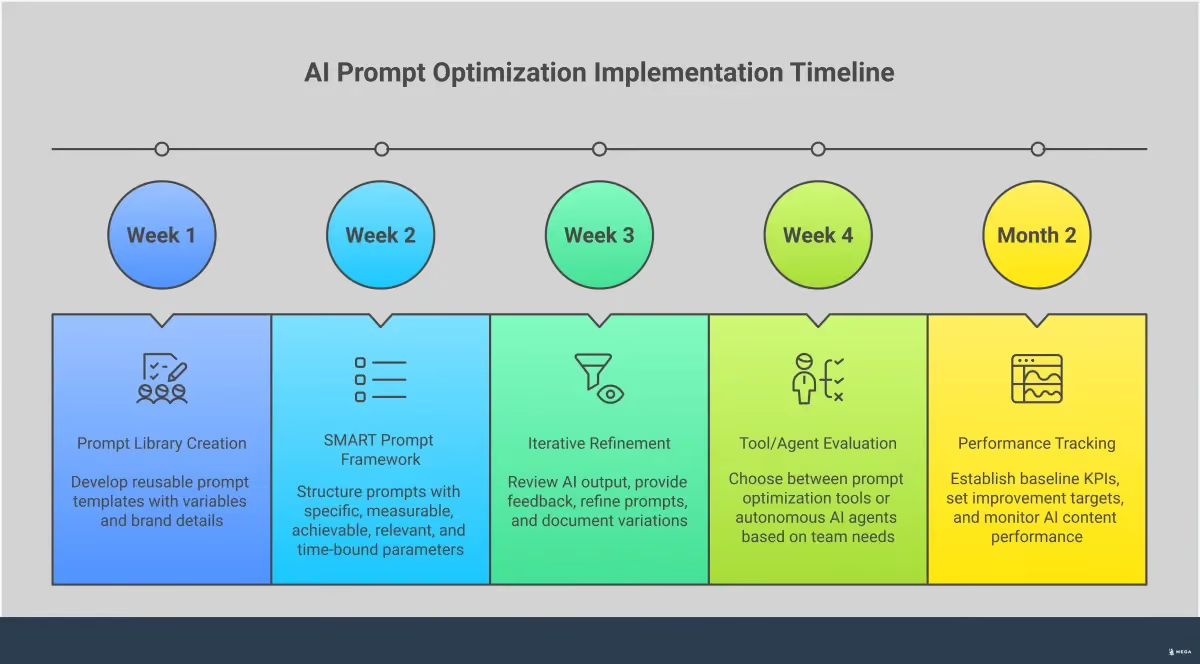
Before you start writing prompts, it helps to have a plan. The first step is to identify exactly what you need AI to do for your business. This involves developing a company-specific prompt library that focuses on your unique selling points and common content needs. Think about your most frequent tasks, like writing product descriptions or social media posts. From there, you can find AI tools that help accelerate your workflow. Don’t try to build a massive library overnight. Start small by perfecting a prompt for a single, repetitive task. Once you have that down, you can expand to other areas.
Best Practices for a Smooth Rollout
To get the most out of your prompts, treat them as living documents that evolve with your business. Just as software requires updates, your prompts will need iterative improvement to stay effective. Always provide clear, specific instructions, as vague requests lead to generic output. For example, instead of asking for "a blog post about social media," try "Write a 500-word blog post for local coffee shop owners explaining how to use Instagram Reels to promote daily specials." Most importantly, always define your target audience in the prompt. This ensures the AI creates content that speaks directly to your ideal customers, rather than a general, undefined audience.