
Your relationship with search engines now runs on trust. AI models are designed to find the most reliable, authoritative answers for users, and they look for signals that prove your content is credible. Simply having the right keywords on a page is no longer enough to earn a top spot. You have to prove your content is worthy of being presented as a definitive answer. This guide will show you how to optimize for content AI search by building that digital trust. We will explore how to demonstrate your expertise, back up your claims, and use technical signals to show AI you are a legitimate authority.
Key Takeaways
- Become a Citable Source for AI: Shift your focus from simply ranking to being a primary source for AI-generated answers. You can achieve this by creating comprehensive, expert-driven content, backing up all claims with data, and using question-based headers that directly address user queries.
- Structure Your Content for Machine Readability: Organize your pages so that AI models can easily parse and understand the information. This involves using a clear heading hierarchy (H1, H2, H3), implementing schema markup to provide context, and breaking up text with lists and short paragraphs.
- Commit to a Cycle of Continuous Improvement: A successful AI SEO strategy is never finished. Regularly review and update your existing articles to keep them accurate, adapt your content for new environments like AI Overviews, and use automated tools to maintain your site's technical health and topical authority.
What is AI Engine Optimization (AEO)?
AI Engine Optimization, or AEO, is the process of preparing your content to be a primary source for AI-generated search answers. It’s the next evolution of traditional SEO. Instead of just trying to rank at the top of a results page, the goal of AEO is to have your content featured directly in AI-powered summaries, like Google’s AI Overviews. This means shifting your strategy from focusing only on keywords to building genuine digital trust. For an AI model to cite your business as an authority, it must see your content as credible, accurate, and the most complete answer to a user's question.
AEO is all about demonstrating your expertise in a way that both people and machines can easily understand. This involves creating in-depth articles that solve your audience's problems, while also backing up your claims with verifiable data and sources. It also means structuring your content for machine readability. Using clear headings, bulleted lists, and implementing structured data helps AI systems process your information more effectively. When an AI can quickly grasp the context and key points of your content, it's more likely to treat it as a reliable source for its answers.
What Does AI Search Look for in Your Content?
AI search engines have moved far beyond simple keyword-matching. Instead of just scanning for terms, they now perform a sophisticated analysis to understand the true meaning, quality, and trustworthiness of your content. To rank well in this new environment, you need to think like an AI, focusing on providing clear, authoritative, and genuinely helpful information that directly answers a user's query. This means shifting your strategy from just targeting keywords to building a library of content that establishes you as a credible expert.
Focus on User Intent, Not Just Keywords
The biggest shift in AI-driven search is the focus on user intent. AI models are designed to understand what a user is truly looking for, even if their search query is vague. Simply stuffing your page with keywords is no longer effective. Instead, you need to perform a user intent analysis to understand the goal behind the search. Is the user looking for information, trying to find a specific website, or ready to make a purchase? Tailoring your content to meet that specific need is critical. By aligning your content with the user's goal, you provide a better experience and signal to AI that your page is a relevant result.
Show AI You're a Trusted Source
In an environment filled with AI-generated content, trust is the most valuable currency. AI search engines are actively looking for signals that prove your content is credible and comes from a reliable source. As marketing expert Neil Patel puts it, what matters now is whether an AI trusts you enough to pull your content for an answer. This is where concepts like E-E-A-T (Experience, Expertise, Authoritativeness, and Trustworthiness) come into play. You can build this trust by showcasing author expertise, securing backlinks from reputable websites, and consistently publishing accurate, well-researched content. These signals tell AI that you are a legitimate authority whose information can be featured in search results.
What Does Quality Content Mean to AI?
Beyond trust, AI models evaluate the intrinsic quality and structure of your content. A wall of text is difficult for both humans and AI to parse. Well-structured content that uses clear headings, subheadings, lists, and bold text is easier for AI to process and extract key information from. This organization helps an AI understand the hierarchy and importance of different points, making it more likely to use your content as a source for generated answers. You need to structure information for AI search by prioritizing clarity and readability. Comprehensive, well-organized articles that cover a topic in depth are seen as high-quality resources worth ranking.
How to Build Trust with AI Search
Building trust with an AI is a lot like building trust with a person. It’s not about a single action but a consistent pattern of reliability and credibility. For your content to be featured in AI-generated answers, the search engine needs to see it as a trustworthy, authoritative source. This means moving beyond old-school SEO tactics and focusing on creating content that is genuinely helpful, well-supported, and transparent. When an AI can verify your claims and recognize your expertise, it's more likely to present your content as a definitive answer.
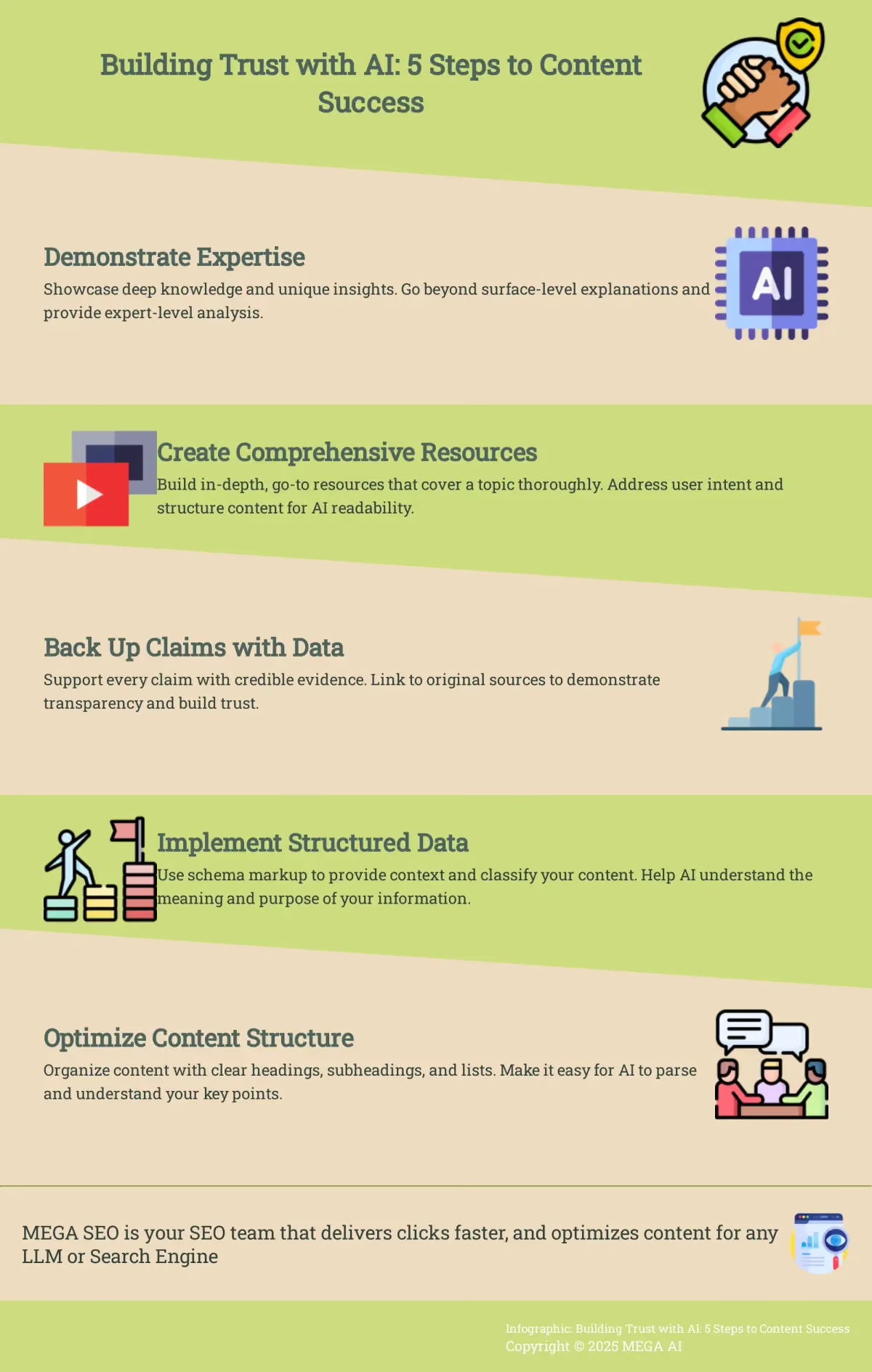
This process involves demonstrating your authority, backing up your statements, and using technical signals to make your content easy for machines to understand and trust. It's a shift from simply matching keywords to proving your content's worthiness on a much deeper level. The following steps will show you how to build that foundational trust and make your content a go-to source for AI search. Think of it as building a digital reputation that both people and algorithms can respect. By consistently delivering high-quality, verifiable information, you signal to AI systems that your website is a hub of knowledge, making it a prime candidate for inclusion in search results and generative summaries.
Write Like the Expert You Are
AI search engines are designed to find the most reliable answers for users. This means they prioritize content from sources that demonstrate real expertise. Think of it this way: if you have a specific legal question, you want an answer from a lawyer, not a random blogger. AI models try to replicate this logic. As marketing expert Neil Patel puts it, "Your brand isn't judged by its keyword optimization or backlinking profile alone. It's judged by how well you answer the question." To build this authority, focus on creating content that showcases your deep knowledge. Go beyond surface-level explanations and provide unique insights that only an expert could offer. This aligns with Google’s emphasis on E-E-A-T (Experience, Expertise, Authoritativeness, and Trustworthiness), which is just as important for AI as it is for traditional search.
Become the Go-To Resource on Your Topic
AI models are tasked with synthesizing information to provide a complete answer. If your content covers a topic comprehensively, you make the AI's job easier and increase the chances of being used as a primary source. Instead of creating several small articles on related subtopics, build a single, go-to resource that covers the subject in depth. This approach positions your content as a definitive guide. By creating a resource that addresses user intent and is structured for AI readability, you can "position your content to excel in both classic search and the new AI-driven search experiences." Tools like MEGA AI's Maintenance Agent can help by identifying content gaps and suggesting new sections to add, ensuring your articles remain thorough and up-to-date.
Support Your Claims with Data and Sources
Unsupported claims are a red flag for both human readers and AI algorithms. To establish your content as credible, it's essential to back up your statements with evidence. Whenever you present a statistic, fact, or significant claim, link to the original source. This could be a research paper, a government report, or a study from a reputable institution. Citing your sources demonstrates transparency and shows that your information is well-researched. This practice not only builds trust but also helps AI models verify the accuracy of your content. When an AI can easily trace your claims back to authoritative sources, it validates your content as a reliable piece of information worth sharing with users.
Leverage Third-Party Reviews and Mentions
What others say about your business carries significant weight with AI search engines. Think of it as a digital form of word-of-mouth. AI models don't just take your website's content at face value; they actively scan the web for external signals that verify your credibility. Positive reviews on third-party sites, mentions in industry blogs, and discussions in online forums all act as independent endorsements. These signals tell an AI that you are a legitimate, respected entity within your field. Building this off-site reputation is just as important as optimizing your own content, as it provides the social proof that algorithms need to trust you as an authoritative source.
Get Featured on Review Sites
One of the most direct ways to build external trust is by getting featured on reputable review sites. For local businesses, this could mean platforms like Yelp or Google Business Profile; for others, it might be industry-specific sites like Capterra or Trustpilot. Actively encourage your happy customers to share their experiences by sending a follow-up email or adding a link to your website. It's also important to engage with the reviews you receive, both positive and negative. A thoughtful response shows that you value customer feedback. These profiles not only influence potential customers but also create powerful backlinks and citations that signal your business's legitimacy to AI search engines.
Participate in Relevant Online Communities
Establishing your expertise within online communities is a powerful way to build organic trust signals. Find out where your target audience asks questions and shares information, whether it's on Reddit, Quora, Facebook groups, or specialized industry forums. The goal is not to promote your business directly but to contribute genuinely to the conversation. Answer questions thoroughly, offer valuable advice, and share your knowledge without expecting anything in return. This consistent, helpful presence establishes you as a go-to expert. Over time, this can lead to organic mentions and recommendations from other members, which are authentic endorsements that AI algorithms recognize as strong indicators of topical authority.
Use Structured Data to Clarify Your Content
Structured data, or schema markup, is a standardized format for providing information about a page and classifying its content. It’s essentially a way to speak the search engine's language, giving it explicit clues about what your content means. For AI, this is incredibly valuable. According to Search Engine Journal, you should "structure content for AI search so it's easy for LLMs to cite." Using schema for elements like FAQs, how-to guides, articles, and author information helps AI models parse your content more effectively. This clarity makes it easier for them to pull your information for rich results and include it in AI-generated summaries, often with a direct citation back to your site.
What Content Formats Does AI Search Prefer?
Creating high-quality content is only half the battle. How you package and present that information is just as important, especially when your audience includes AI search engines. Think of it like organizing a library. If the books are just thrown in a pile, finding what you need is nearly impossible. But if they’re neatly categorized and labeled, the process is simple. AI systems work similarly; they need clear signals to understand what your content is about and why it’s valuable.
Certain content formats make it much easier for AI to parse, interpret, and surface your information in search results. By adopting these formats, you’re not just optimizing for a machine; you’re also creating a better, more intuitive experience for your human readers. The best part is that these adjustments are often simple to implement and can have a significant impact on your visibility. It’s about working smarter, not harder, to ensure your expertise gets the attention it deserves. This means focusing on structure, clarity, and credibility in a way that directly appeals to how AI evaluates information. The principles that make content easy for a person to read—like logical organization and clear headings—are the same principles that help an AI understand it.
Ask and Answer Questions in Your Headings
One of the most effective ways to structure your content for AI is to use question-based headers. AI models, particularly large language models, are designed to understand and answer questions. Formatting your headers as direct questions—like "How Do I Improve My Website's SEO?" instead of "Improving Website SEO"—mirrors the way users search for information. This approach makes your content a direct match for conversational queries.
This structure is the foundation of effective Q&A-formatted pages, such as FAQs and help desk articles, which perform very well in AI-driven search. By anticipating the questions your audience is asking, you can frame your content as the definitive answer, making it easier for AI to recognize its relevance and present it to users.
Write with Clear and Direct Language
Clarity is king in the world of AI SEO. AI systems can process text more efficiently when it is clearly structured and uses straightforward language. Avoid overly complex sentences, industry jargon, and abstract concepts whenever possible. The goal is to make your key points easy for both AI and human readers to extract and understand without ambiguity.
This doesn’t mean you have to dumb down your content. Instead, focus on creating a logical flow from one point to the next. Use simple sentence structures and a direct, active voice. When your writing is clear and concise, you remove the guesswork for AI, ensuring your message is interpreted exactly as you intended. This improves readability and helps your content get recognized for its substance.
How Deep Should Your Content Go?
AI search engines prioritize content that thoroughly addresses a user's query. This means finding the sweet spot between being comprehensive and being concise. Superficial articles that only scratch the surface won't satisfy user needs, but overly long, unfocused content can be just as unhelpful. The key is understanding user intent and creating a resource that provides a complete and authoritative answer to a specific topic.
Think of your article as the go-to resource for that subject. Cover all the essential subtopics, answer related questions, and provide enough detail to demonstrate true expertise. This shows AI that your content is a high-value asset capable of resolving a searcher's problem in a single visit, making it more likely to rank highly.
Incorporate Supporting Evidence and Media
To build trust with both users and AI, you need to back up your claims with credible evidence. Just as you would cite sources in a research paper, your content should link to authoritative studies, data, and expert opinions. This practice demonstrates that your information is well-researched and trustworthy, which are strong positive signals for AI algorithms.
When you structure your content with clear claims followed by supporting proof, you also make it easy for language models to cite your work in their generated answers. This can directly increase your visibility and establish your site as an authority in its niche. A well-defined content hierarchy with clear formatting is crucial for helping AI interpret and reference your content correctly.
How to Structure Your Content for AI Search
Beyond the words you write, the way you structure your content is a critical signal for AI search engines. A well-organized page acts like a roadmap, guiding algorithms to quickly understand your main points, how ideas relate to each other, and the overall topic. Think of it as setting the stage for your content to be understood correctly. By focusing on a clear and logical structure, you make it easier for AI to see the value in what you’ve created and present it to users.
Create a Clear and Logical Flow
Think of AI search engines as speed readers. They don't read every word sequentially; instead, they scan pages for structural clues to quickly grasp the core message. This is why a logical content hierarchy is so important. Use header tags (H1, H2, H3) to create a clear outline for your article. Your H1 is the main title, H2s are major sections, and H3s are subsections that support them. This approach creates a scannable flow that helps algorithms—and human readers—follow your train of thought from one point to the next. A clear structure signals a well-thought-out piece of content, making it more likely to be valued by search engines.
Make Your Content Easy to Read
AI can process text more efficiently when it’s formatted for readability. Large, unbroken walls of text are difficult for both people and algorithms to parse. Break up your content into short, digestible paragraphs of just a few sentences each. Use bullet points and numbered lists to present information in a structured way that’s easy to scan. Bolding key terms can also help draw attention to important concepts. This type of formatting makes your content more approachable for readers and helps AI systems easily identify and extract key information for use in summaries and direct answers.
Connect Your Content with Smart Internal Links
Internal links are the threads that connect your content, weaving individual pages into a cohesive web of expertise on your site. A smart linking strategy does more than just send users to other pages; it establishes a content hierarchy that demonstrates the relationship between your articles. Use descriptive anchor text that clearly states what the linked page is about, rather than generic phrases like "click here." This gives context to both users and AI crawlers, helping them understand your site's structure and reinforcing your topical authority. Platforms like MEGA AI can even automate your internal and external linking to build these connections for you.
Keep Your Content Fresh and Updated
The digital world moves fast, and content can become outdated quickly. Establishing a protocol for regularly updating your articles is essential for maintaining trust with AI search engines. Stale content can be seen as less reliable. Schedule periodic reviews of your existing posts to refresh statistics, add new information, and ensure all information is still accurate. This process of continuously refining your content shows search engines that your site is an active and authoritative resource. With a tool like MEGA AI's Maintenance Agent, you can automate this process by identifying new content to add and re-optimizing articles to keep them ranking highly.
Technical SEO for AI Search: What You Need to Know
Beyond the content itself, the technical foundation of your website plays a huge role in how AI search engines perceive and rank your pages. Think of it as setting the stage for a performance. If the stage is cluttered, poorly lit, or hard to access, even the best performance will go unnoticed. A technically sound website ensures that AI models can easily access, crawl, and understand your content without hitting any roadblocks.
This means paying attention to the backend details that create a seamless experience for both human users and AI crawlers. From the code that structures your data to the design that adapts to different devices, every technical element sends a signal about your site’s quality and reliability. Getting these details right is a critical step as you position your content to excel in both classic search and the new AI-driven search experiences.
Implement Schema Markup
Schema markup is a form of microdata that creates a rich description of your content for search engines to understand. In simple terms, it’s a shared vocabulary that you add to your site's code to tell an AI exactly what your content is about—whether it's a product, a recipe, an article, or a local business. This structured data removes ambiguity and helps AI models process your information with greater accuracy. For example, using schema can clarify that "Avatar" refers to the movie, not a user profile picture. By providing this explicit context, you make it easier for AI to feature your content accurately in rich snippets and conversational answers, directly improving your visibility.
Prioritize a Seamless User Experience
A positive user experience (UX) is a powerful signal of a high-quality website, and AI search engines are paying close attention. Factors like fast page load times, intuitive navigation, and a clean, uncluttered design all contribute to good UX. When users can find what they need quickly and without frustration, they tend to stay on your site longer, which indicates to AI that your content is valuable. Understanding user intent is key, because tailoring your strategy accordingly means you’re not just improving your SEO—you’re creating a better user experience. A site that is difficult to use or slow to load sends the opposite signal, suggesting the content may not be trustworthy or helpful, regardless of how well-written it is.
Ensure Your Site is Mobile-Friendly
With the majority of searches happening on mobile devices, having a mobile-friendly website is non-negotiable. AI search engines prioritize mobile-first indexing, meaning they primarily use the mobile version of your site for ranking and indexing. A responsive design that adapts seamlessly to any screen size ensures your content is accessible to everyone. This approach also encourages clear formatting, which is beneficial for AI readability. A clean mobile layout with legible fonts, ample spacing, and easily tappable buttons creates a better experience for users and a more digestible structure for AI.
Organize Your Website for Easy Navigation
A well-organized website helps both users and AI models understand the hierarchy and relationship between your pages. A logical site structure, often visualized as a pyramid with your homepage at the top and more specific pages branching out below, makes your content more discoverable. Features like clear navigation menus and breadcrumbs help AI crawlers map your site and identify your most important content. This clarity is essential because you need to structure content for AI search so it's easy for large language models to cite. When an AI can easily understand how your content is organized, it can more effectively pull information and present it to users, increasing your chances of being featured in AI-generated results.
Advanced Strategies for AI Engine Optimization
Once you have the fundamentals in place, you can start exploring more advanced tactics to stay ahead. As AI search continues to evolve, the strategies that set you apart will move beyond on-page content and technical basics. It’s about understanding the competitive landscape in this new environment, digging deeper into the psychology of user prompts, and tailoring your approach for specific search features like e-commerce. These strategies require a more nuanced view of SEO, focusing on how AI models interpret and use information to construct answers for users.
Conduct Competitor Analysis for AI Search
Understanding how your competitors appear in AI-generated results is a critical next step. This goes beyond traditional rank tracking. You need to analyze which competitors are being cited as sources in AI Overviews and conversational answers, and more importantly, why. Look at the specific snippets of content being pulled. Are they concise definitions, data points, or step-by-step instructions? This analysis helps you identify the types of content that AI models value. By seeing what works for others, you can find gaps in your own strategy and create content designed to gain visibility in AI-generated answers and become a preferred source.
Analyze User Prompts vs. Search Queries
The way people search is changing. Instead of typing short keyword phrases, users are increasingly entering full questions and conversational prompts into search bars. AI models are built to handle this nuance. To optimize for this behavior, you must shift your focus from keywords to the underlying intent of the user's prompt. A simple keyword might have multiple meanings, but a detailed question provides much more context. You need to perform a user intent analysis to understand the specific goal behind a search, whether it's to learn, compare, or buy. Creating content that directly addresses these detailed prompts will make you a more relevant result for AI-driven search.
Optimize for E-commerce and Shopping Features
AI is changing how people shop online, with search engines providing direct product comparisons, summaries of reviews, and buying guides in their results. For small businesses, this presents a huge opportunity. To capitalize on it, make sure your product pages are rich with detailed information. Use high-quality images, write unique and descriptive product descriptions, and implement product schema markup. This structured data helps AI models understand key details like price, availability, and ratings. It's also wise to monitor how AI talks about your brand and products, ensuring the information being surfaced is accurate and positive, as this can directly influence a customer's purchasing decision.
Tools and Tech for Your AI SEO Strategy
Adapting your strategy for AI search doesn't mean you have to do everything manually. The right technology can streamline your workflow, provide deeper insights, and automate repetitive tasks, freeing you up to focus on strategy. Different tools serve different purposes, from analyzing content quality to tracking performance and automating your entire SEO process. By integrating these tools into your operations, you can effectively manage the demands of AI-powered search and stay ahead of the curve. Understanding the main categories of tools available is the first step toward building a more efficient and effective SEO toolkit.
Key AI Search and Answer Engines
While the core principles of AI optimization apply across the board, it's helpful to understand the specific characteristics of the major AI search and answer engines. Each model has its own nuances in how it processes and prioritizes information, but they all share a common goal: to deliver the most accurate and helpful answers to users. Knowing what each platform values can help you fine-tune your content to be a more effective source. Think of it less as optimizing for individual engines and more as understanding the common threads of quality, structure, and expertise they all reward. This approach ensures your content is well-positioned no matter which AI is doing the searching.
ChatGPT
ChatGPT is designed to find the most reliable answers for users, which means it prioritizes content from sources that demonstrate real expertise. To be seen as a credible source by this model, your content must do more than just include the right keywords. It needs to provide clear, authoritative, and genuinely helpful information that directly answers user queries. This means going beyond surface-level explanations to offer unique insights, data, or perspectives that establish you as an expert. When ChatGPT can identify your content as a definitive resource, it's more likely to use it as a foundation for its generated answers, establishing your site as a go-to authority.
Perplexity
Perplexity operates as an AI search engine that synthesizes information from multiple sources to provide users with a single, complete answer. To increase the chances of your content being used as a primary source, it's essential to create comprehensive, expert-driven articles. Your content should thoroughly address user intent and be structured for AI readability. By covering a topic in depth and organizing it logically with clear headings and subheadings, you make it easy for Perplexity to identify your page as a high-value resource worth including in its synthesized results. Think of your article as the definitive guide that leaves no stone unturned.
Claude
Claude, like other advanced AI models, evaluates the intrinsic quality and structure of your content. A well-organized page is much easier for the AI to process and understand, so clear formatting is a must. Using headings, subheadings, lists, and bold text helps Claude extract key information and recognize the hierarchy of your points. This clean structure signals that your content is well-thought-out and authoritative. When your information is easy for the model to parse, it's more likely to be featured in search results and used as a citable source, which is a major win for your brand's visibility.
Gemini
As part of the new wave of AI search, Gemini prioritizes user intent and the quality of the information it presents. To be recognized as a valuable source by Gemini, your content must be exceptionally well-organized and provide a thorough exploration of its topic. This means going beyond surface-level answers to meet the needs of users seeking reliable and comprehensive information. By creating in-depth resources that are logically structured, you signal to Gemini that your content is a high-quality asset that can be trusted to satisfy user queries from start to finish, making it a prime candidate for being featured.
Content Analysis Tools
To optimize for AI, you first need to see your content the way an AI does. Content analysis tools help you do just that. They go beyond simple keyword counts to evaluate topic depth, semantic relevance, and readability. The goal is to ensure your content fully addresses what a user is looking for. As one source notes, understanding user intent helps you create content that resonates, ranks, and converts. These tools analyze top-ranking pages to identify the key themes and questions you need to cover, helping you find content gaps and build articles that are truly comprehensive and helpful for your audience.
Performance Tracking Platforms
Once you’ve optimized your content, you need to measure its impact. Performance tracking platforms use AI to monitor your site’s performance with a high degree of precision. They track keyword rankings, organic traffic, and user engagement signals like click-through rates and time on page. These platforms are essential for connecting your optimization efforts to tangible results. AI-powered SEO tools provide valuable insights that can show you what’s working and where you need to adjust your approach. This data-driven feedback loop is critical for refining your strategy over time and demonstrating the return on your SEO investment.
Key Metrics to Track
While traditional metrics like organic traffic and keyword rankings still matter, the rise of AI search calls for a new set of performance indicators. To succeed, you need to measure how AI models perceive and interact with your content. Tracking these new metrics will help you understand if you are building trust, demonstrating authority, and effectively answering the conversational queries that drive AI-powered search. These insights are essential for adapting your strategy and proving the value of your efforts in this new landscape.
Visibility and Position
In AI search, visibility is about more than just your rank on a results page. It’s about how often your content is featured in AI-generated answers, summaries, and conversational results. The ultimate goal is to become a primary, citable source that AI trusts. AI search engines are actively looking for signals that prove your content is credible, so tracking your presence in these new formats is a direct measure of your authority. You can monitor this by looking for mentions of your brand in AI Overviews and tracking how often your pages appear as sources in chatbot responses. This shows your SEO AI adaptation is working.
Sentiment Analysis
AI models are designed to understand what a user is truly looking for, even if their search query is vague. This means they can interpret the sentiment and intent behind a search. As a result, you need to track how well your content’s tone and substance align with the user’s likely emotional state. For example, a user searching for "how to fix a leaking pipe" is likely feeling stressed and needs a direct, calm, and actionable guide. Analyzing whether your content matches the underlying user intent is a qualitative metric that helps you create content that truly resonates and is seen as helpful by AI.
Source Citation Tracking
Getting cited by an AI is one of the strongest indicators that your content is considered authoritative. When an AI model references your website as the source for a piece of information, it’s a direct signal of trust. This metric is a tangible outcome of a strong E-E-A-T (Experience, Expertise, Authoritativeness, and Trustworthiness) profile. You can track these citations by using brand monitoring tools or by periodically querying AI chatbots about topics you cover to see if your site is mentioned. Each citation validates your expertise and reinforces your position as a reliable source, making it a critical metric for long-term success.
Prompt Effectiveness
As search becomes more conversational, you need to understand how users are asking questions. Prompt effectiveness is the measure of how well your content answers the specific prompts users are giving to AI models. This involves analyzing the types of questions that lead AI to your content. Are they simple, fact-based queries or complex, multi-part prompts? By understanding which prompts your content effectively answers, you can refine your strategy to better align with conversational search patterns. This helps you optimize your brand's visibility in AI search and create content that serves as a ready-made answer for user queries.
Automated SEO Platforms
Automated SEO platforms bring together multiple functions into a single, cohesive system. These tools are designed to manage the entire SEO lifecycle, from initial research and content creation to technical optimization and ongoing maintenance. In a changing digital landscape, they create new opportunities for marketers by making sophisticated SEO strategies accessible to teams of any size. By handling tasks like generating content briefs, building internal links, and running technical audits automatically, these platforms allow you to scale your efforts efficiently and adapt quickly to changes in search engine algorithms and user behavior.
How the MEGA AI Platform Can Help
MEGA AI is designed as the comprehensive solution that puts these principles into practice. Our platform provides end-to-end automation for your entire SEO strategy. We help you understand user intent, structure content for AI readability, and ensure technical accessibility. Our Maintenance Agent continuously refines your articles by improving click-through rates and adding new, relevant information to increase content depth. By implementing these strategies, from demonstrating authority to continuous refinement, you can position your content to excel in both classic and AI-driven search environments, ensuring your site is set up for sustained success.
How to Future-Proof Your Content for AI Search
The world of search is changing faster than ever, with AI at the helm. A successful SEO strategy is no longer about finding a formula and sticking to it. Instead, it requires a forward-thinking approach that embraces change, anticipates trends, and prioritizes continuous improvement. Building a future-proof strategy means creating a resilient process that can adapt to new algorithms, platforms, and user behaviors without requiring a complete overhaul every few months. It’s about building a strong foundation that will serve you well, no matter what comes next.
Stay Informed on Emerging Search Trends
To stay competitive, you need to look beyond current keywords and anticipate what your audience will search for tomorrow. User behavior is constantly evolving, and AI is accelerating these shifts by enabling more complex, conversational queries. AI-powered SEO tools can help you make sense of this by analyzing data to predict future search trends and identify opportunities before they become saturated. By understanding where search is headed, you can create content that meets emerging needs, positioning your brand as a forward-thinking leader in your space. This proactive approach helps you capture traffic from new search patterns as they develop.
Adapt as Search Engines Evolve
Google’s algorithms are in a constant state of flux, and the rise of AI-powered search is only adding to the complexity. What works today might be less effective after the next core update. This is why adaptability is critical. Instead of relying on rigid tactics, focus on building a flexible strategy that can pivot when needed. AI-powered search engines are disrupting traditional models, creating a more fragmented digital landscape. An automated platform can help you adapt quickly, re-optimizing content to align with new ranking signals or platform requirements, ensuring your content remains visible and effective through every change.
Think Beyond Traditional Search
Your content no longer lives just on a traditional search results page. It needs to perform in AI Overviews, chatbot responses, and other generative AI environments. To do this, you must structure content for AI search so it’s easy for large language models to parse, understand, and cite. This means using clear headings, direct language, and logical hierarchies. Think of your content as a source for an AI to quote. When you make your information easy to digest, you increase the chances of being featured as a trusted source in AI-generated results. Platforms like MEGA AI can help re-optimize existing articles specifically for these new environments.
Generative AI for Content Creation
This is the technology that powers many of the new tools designed to help businesses create content. Generative AI models can understand complex topics, search for information, and produce original text with what some providers call human-level accuracy at machine-level efficiency. For small businesses, this is a game-changer. Instead of spending hours writing a single blog post, you can use AI to generate outlines, drafts, and even complete articles in minutes. Platforms like MEGA AI use this technology for automated content generation, allowing you to scale your content strategy and establish topical authority without needing a large in-house writing team.
Content Moderation and Brand Protection
Beyond creating content, AI is also a powerful tool to protect your brand's reputation online. AI-powered moderation systems can automatically scan for and remove harmful content from your platforms, such as hate speech or violent imagery, ensuring your community remains a safe space. This same technology can be used for brand protection, constantly monitoring the web to find unauthorized uses of your logo, intellectual property, or media. By identifying these issues quickly, you can protect your brand's integrity and maintain the trust you've built with your audience and with search engines, which is a critical component of your overall digital presence.
Fraud Detection
Maintaining a secure and trustworthy website is fundamental to good SEO, and AI plays a crucial role in this area. AI-driven fraud detection systems can identify and flag suspicious activities that could harm your users and damage your reputation. This includes spotting phishing attempts hidden in comments, identifying fake user profiles or reviews, and even detecting counterfeit products being sold under your brand name. By proactively identifying these threats, you protect your customers and send strong signals to search engines that your website is a credible and safe resource, which can positively influence your rankings and online authority.
Commit to Testing and Improving
Future-proofing your SEO is not a one-and-done project; it’s an ongoing commitment to refinement. This means regularly revisiting your content to ensure it still meets user intent, demonstrates expertise, and is technically sound. A successful strategy involves a cycle of analyzing performance, identifying areas for improvement, and making iterative changes. By continuously refining your approach, you can maintain and grow your rankings over time. Using automated tools to update articles, improve click-through rates, and add new, relevant information helps streamline this process, allowing you to focus on strategy while the system handles the tactical execution.