
For years, the goal of SEO has been simple: get clicks to your website. But what happens when the search engine starts giving the answers directly? With the rise of AI Overviews and chatbots, fewer clicks are going to websites for certain types of questions. The new goal is to be the trusted source the AI cites in its response. This shift requires a new approach to your content strategy. Learning how to optimize content for LLMs is the key to staying relevant and building your brand’s authority directly within these new search experiences. This guide explains how to adapt your content to be featured by AI, ensuring potential customers see your business as the expert.
Key Takeaways
- Build Trust with Clear Structure and Proven Expertise: Organize your content with a logical hierarchy, descriptive headers, and lists to make it easy for AI to process. Back this up by showcasing author credentials, citing your sources, and ensuring every fact is accurate to establish your credibility.
- Expand Your SEO Strategy for AI Search: LLM optimization builds on the SEO principles you already use. Continue to focus on demonstrating expertise, using semantic keywords, and implementing technical elements like schema markup to improve your visibility in AI-generated answers.
- Automate Your LLM Optimization to Save Time: Manually updating articles and implementing technical changes for multiple AI platforms is not sustainable. Use an AI agent to handle the work, ensuring your content stays fresh and optimized without adding to your workload.
What Are Large Language Models (LLMs)?
Large language models, or LLMs, are advanced AI systems trained on vast amounts of text data from across the internet. You have likely already used them, perhaps in tools like ChatGPT, Google’s AI Overviews, or Perplexity. These systems are designed to understand and generate human-like text in response to questions and commands.
At their core, LLMs are powerful pattern-recognition systems. They learn the statistical relationships between words, sentences, and concepts, allowing them to answer complex questions, summarize articles, and even write original content. As more people turn to these AI tools for information, understanding how they work has become essential for anyone creating content online. Optimizing your content for LLMs is the next step in ensuring your business stays visible in this new landscape of search.
How LLM Technology Works
LLM technology functions by processing massive datasets to identify statistical patterns. Using complex algorithms, these models learn the probability of one word following another, which allows them to construct coherent sentences and paragraphs. They don't just memorize information; they learn the underlying structures of language itself. This training enables them to generate new, original text that aligns with the patterns they have observed.
The quality of an LLM's output often depends on the quality of the input, or "prompt." The practice of prompt engineering involves structuring questions and providing clear context to guide the model toward a more accurate and relevant response.
How LLMs Understand and Create Content
It is helpful to remember that LLMs do not "understand" content in the same way humans do. They do not have beliefs, consciousness, or intent. Instead, they are sophisticated tools designed to assist and enhance human creativity by processing and regenerating information based on learned patterns. Their ability to create content comes from predicting the most logical sequence of words based on a given prompt and their training data.
This process has its limitations. For example, research shows that LLMs often struggle to recall information located in the middle of a long document—a problem known as being "lost in the middle." This means they give more weight to information at the beginning and end of a text. For content creators, this highlights the importance of structuring articles with key takeaways placed in prominent positions.
Why You Need to Optimize Content for LLMs
If you’ve spent years getting your business to show up on the first page of Google, the idea of a new type of search can feel daunting. But the way people find information is changing. Large language models are powering a new kind of search experience, from Google’s AI Overviews to direct queries in ChatGPT. This shift means you need to think differently about how customers find you.
Optimizing for LLMs, sometimes called LLMO, is the practice of making your content visible and credible to these AI systems. It’s not about replacing your current SEO strategy but expanding it. By adapting your content, you ensure your business appears in AI-generated responses, positioning your brand as a trusted authority right when potential customers are looking for answers.
The Rise of AI-Powered Search
The shift toward AI-driven search isn't a distant future—it's happening now. A growing number of people are using generative AI as their main search engine to get direct answers instead of a list of links. This means fewer clicks to websites for certain types of queries, as the AI summarizes information directly for the user. For small and local businesses, this trend is critical. If your content isn't optimized to be picked up and cited by these AI models, you risk becoming invisible to a significant and growing segment of your audience.
Key Benefits of Optimizing for LLMs
The primary goal of LLM optimization is to have your brand mentioned and cited within AI-generated answers. While traditional SEO focuses on driving traffic to your website, LLMO builds your brand’s authority and visibility directly within the search experience. When an AI model cites your business as a source, it acts as a powerful endorsement. Content that includes unique data, expert quotes, and clear, factual information is more likely to be featured. The more your brand is mentioned and cited on trusted websites, the more AI systems will view you as an expert, leading to more frequent inclusion in relevant search results.
How to Structure Your Content for LLMs
Think of your content like a well-organized recipe. If the steps are out of order or the ingredients are buried in a long paragraph, it’s hard to follow. Large language models feel the same way. They are designed to find and present information efficiently, and a clear, logical structure makes their job much easier. When an LLM can easily understand the layout and key points of your article, it’s more likely to trust your content and use it as a source for its answers.
Structuring your content for LLMs isn’t about writing for robots; it’s about applying the principles of good writing and clear communication. A logical flow, scannable formatting, and a clear hierarchy help both human readers and AI models digest your information. By organizing your content thoughtfully, you make it simple for LLMs to identify the most important ideas, understand the relationships between different concepts, and pull direct quotes or summaries to answer user questions. This ultimately increases your visibility in an AI-powered search landscape.
Create a Clear Hierarchy
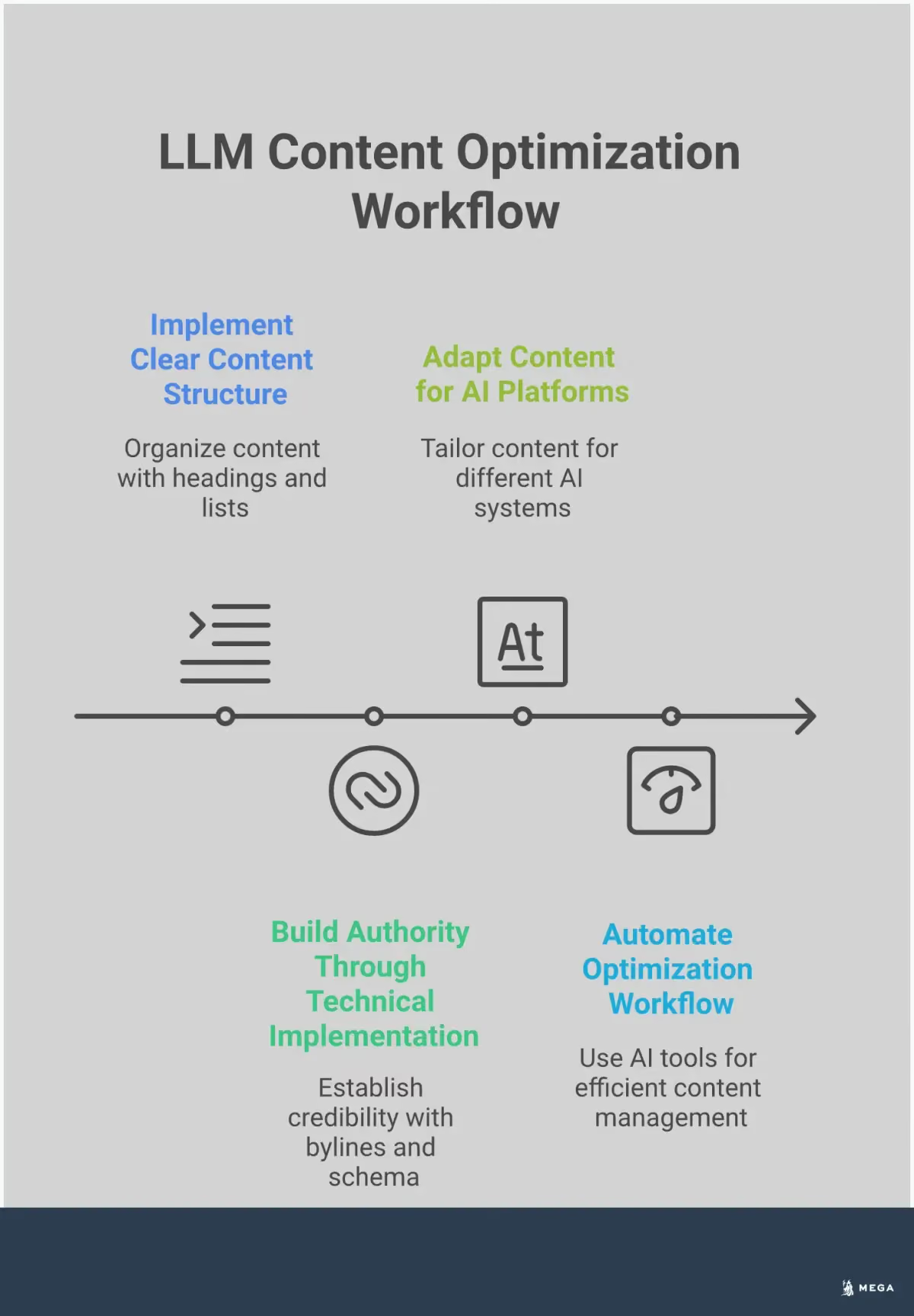
A clear hierarchy is the backbone of any well-structured article. It’s essentially an outline that uses heading tags (H1 for the title, H2 for main sections, H3 for subsections) to signal importance. This structure acts as a roadmap for AI, helping it understand the main topic and how all the supporting points relate to it. According to research, well-structured content can improve visibility, and AI tools like ChatGPT are nearly three times more likely to cite content that uses a clear heading structure. Think of your H1 as the book title, H2s as chapter titles, and H3s as the key sections within each chapter. This simple organization makes your content significantly easier for an LLM to parse and reference.
Use Headers and Subheadings
Your headers should do more than just break up text; they should be descriptive and answer potential questions. Vague headings like “Benefits” or “Process” are less effective than specific, question-based ones like “What Are the Key Benefits of Optimizing for LLMs?” or “How Do You Structure Content for AI?” Using clear, descriptive headings helps LLMs quickly identify the content of each section. Since many users interact with AI by asking questions, formatting your headers to match those queries makes your content a perfect match for citation. This simple change helps an LLM see your page as a direct and relevant answer to a user’s prompt.
Format with Bullet Points and Lists
LLMs love scannable content, and lists are one of the best ways to make your information easy to digest. In fact, data shows that nearly 80% of articles cited by ChatGPT use lists, and they tend to have far more lists than typical Google search results. Bullet points and numbered lists break down complex ideas, steps, or features into simple, distinct points. This format is ideal for AI models that need to generate concise summaries or step-by-step instructions. Whenever you find yourself explaining a process, listing examples, or comparing options, consider turning that information into a list. It makes the content more readable for your audience and more useful for AI.
Add an FAQ Section
Including a Frequently Asked Questions (FAQ) section is one of the most effective ways to optimize for LLMs. This format directly mirrors the conversational, question-and-answer nature of AI chatbots. By including common questions and providing clear, concise answers in a natural style, you are essentially creating pre-packaged content that an LLM can easily pull from. You can source these questions from your customer service team, online forums like Reddit, or by looking at the "People Also Ask" section on Google. An FAQ section not only helps with LLM optimization but also provides immense value to human readers looking for quick answers.
How to Build Authority and Trust for LLMs
Just like people, large language models are more likely to trust and reference sources they consider credible. Building authority is about showing these AI systems that your content is reliable, accurate, and written by experts. Think of it as building a strong online reputation that extends beyond human readers. When an LLM scans your website, it’s looking for signals that prove your information is trustworthy enough to be included in its answers. If your content lacks these signals, it's likely to be overlooked in favor of a competitor who has established their credibility more effectively.
This process is very similar to the principles behind Google’s E-E-A-T (Experience, Expertise, Authoritativeness, and Trustworthiness), which has long been a cornerstone of good SEO. By focusing on these core elements, you not only improve your standing with LLMs but also build deeper trust with your human audience, which can lead to better engagement and conversions. Demonstrating expertise, citing your sources, and ensuring every piece of information is accurate are the foundational pillars for making your content a go-to resource for both people and AI. It’s a strategy that pays off across all forms of search.
Showcase Author Expertise
To establish credibility, you need to show that real, qualified people are behind your content. LLMs look for signals of human expertise to verify that the information is trustworthy. Start by creating clear author bylines for your articles, complete with short bios that highlight relevant experience and credentials. Don't be shy about your qualifications; if you're a plumber with 20 years of experience writing about pipe maintenance, make that clear.
Your website’s "About Us" page is another powerful tool. Use it to tell your story and introduce your team, detailing their expertise and background. Linking author names to their social media profiles, like LinkedIn, can further solidify their credentials. These steps help an LLM connect your content to a real person with demonstrable knowledge in your field.
Cite Your Sources
When you make a claim or share a statistic, you should always back it up. Citing your sources by linking to the original study, report, or article is one of the clearest signals of trustworthiness you can send to an LLM. This practice shows that you’ve done your research and that your content is based on verifiable facts, not just opinions. Think of it as showing your work; it proves your answer is well-founded.
For an AI, a piece of content with clear citations and links to authoritative sources is more valuable than one without. It helps the model understand the context of your information and verify its accuracy. This simple habit of linking to your sources can significantly improve how AI perceives your content’s reliability, making it more likely to be featured in AI-generated responses.
Prioritize Factual Accuracy
Factual accuracy is non-negotiable when optimizing for LLMs. These models are designed to synthesize and present correct information, so they actively learn to disregard sources that contain errors or outdated facts. Consistently publishing accurate content helps establish your website as a reliable authority in your niche. Before you publish, take the time to double-check all data points, names, and statements.
It’s also important to review and update your existing content regularly. If information becomes outdated, correct it. This ongoing maintenance ensures your site remains a trustworthy resource over time. An AI-powered tool like MEGA AI’s Lindsay SEO agent can help by automatically identifying and performing article updates, ensuring your content stays fresh, accurate, and optimized for performance.
Technical Tips to Improve LLM Visibility
Beyond the words you write, a few technical adjustments can significantly improve how LLMs see and interpret your content. Think of these tips as a way to speak the AI’s language directly, making it easier for models to understand your expertise and feature your information in their responses. These small changes can have a big impact on your visibility in AI-driven search.
Implement Schema Markup
Schema markup is a type of code you add to your website to help search engines and LLMs understand your content on a deeper level. It’s like adding labels to your information that explicitly state what it is—for example, this is a business address, this is a product review, or this is an FAQ. By using schema markup, you can clearly define your business, its services, and its expertise. This helps AI systems confidently recognize you as an authority on a topic, making it more likely they will cite your website as a trusted source in their answers.
Follow Formatting Best Practices
How you organize your content matters just as much as what you write. LLMs prefer information that is structured logically because it’s easier to parse and pull key points from. Research shows that content with clear headings (H1s, H2s, etc.) is cited far more often in AI-generated responses. To put this into practice, break up your text with descriptive subheadings, use bullet points for lists, and keep your paragraphs short and focused. This not only improves the reader experience but also makes your content more accessible for AI to understand and use, boosting your chances of being featured.
Integrate Semantic Keywords
Gone are the days of repeating the same keyword over and over. Modern AI understands context and the relationship between words. Integrating semantic keywords means using synonyms, related terms, and concepts that are topically relevant to your main subject. For example, if you’re writing about a "local bakery," you should also include terms like "fresh bread," "sourdough starter," "custom cakes," and "morning pastries." This approach demonstrates a comprehensive understanding of the topic, signaling to LLMs that your content is thorough and authoritative. It shows you’re an expert, not just someone targeting a keyword.
How to Automate LLM Optimization
Optimizing your content for LLMs sounds like another time-consuming task to add to your already full plate. For small business owners and startup founders, manually updating every article, implementing schema, and tracking performance is often unrealistic. The good news is that you don’t have to do it all by hand. Automation is the key to implementing a strong LLM optimization strategy without draining your resources.
By using AI-powered tools, you can handle the complex, repetitive tasks involved in LLM optimization efficiently. This approach allows you to focus on running your business while an automated system works in the background to improve your visibility in AI-driven search. It’s about working smarter, not harder, to ensure your content gets seen by the right audience.
The Role of AI in Automation
AI is uniquely suited to handle the demands of LLM optimization because it can process vast amounts of data, identify patterns, and execute tasks at a scale that humans can't match. Instead of manually sifting through data or updating articles one by one, AI can analyze your entire content library and make targeted improvements. Effective implementation requires treating these models as sophisticated tools with specific use cases. By delegating the tactical work to AI, you free yourself up to focus on high-level strategy and creative thinking. This allows you to leverage automation for what it does best: executing precise, data-driven tasks consistently and efficiently.
Automate Your Implementation
The first step is to automate the core tasks of content creation and optimization. An AI agent can handle everything from keyword research to writing and publishing articles. For example, MEGA AI’s SEO agent, Lindsay, automates keyword discovery to find low-competition, high-impact opportunities tailored for LLM visibility. It then generates high-quality, structured content designed to answer user questions directly. This process ensures your content strategy is not only efficient but also perfectly aligned with how LLMs source information. By automating implementation, you can consistently produce optimized content without the manual effort, giving you a competitive edge.
Integrate With Your CMS
A major bottleneck in content strategy is the manual process of getting content from a document into your content management system (CMS). Automating this step is a game-changer. An effective AI platform integrates directly with your CMS—whether it’s WordPress, Webflow, Shopify, or another popular system. This connection allows for seamless content posting and updates, eliminating the need to copy, paste, and reformat articles. When your AI agent can publish directly to your site, it ensures that optimized content goes live instantly and without formatting errors, keeping your site fresh and relevant for both users and LLMs.
Automate Content Updates
LLMs prioritize content that is current, accurate, and authoritative. This means your existing articles can't just sit there; they need regular updates. An AI-powered maintenance agent can handle this for you. It can re-optimize existing content for LLMs by updating facts, improving click-through rates (CTR), and adding new, relevant information to keep articles comprehensive. For instance, MEGA AI’s Maintenance Agent product ensures your content remains a top resource over time. This continuous optimization cycle is crucial for maintaining your rankings and visibility in AI-generated search results, turning your content library into a long-term asset that keeps performing.
How to Track LLM Content Performance
Optimizing for LLMs is one thing, but how do you know if your efforts are paying off? Traditional SEO metrics don't tell the whole story. To measure your success in AI-powered search, you need to focus on new performance indicators that show how these models use your content.
Key Performance Indicators (KPIs) to Watch
To measure your content's performance with LLMs, look beyond standard traffic reports. The most important metrics are mentions and citations. A mention is when an AI response names your brand. A citation is when an LLM uses your content as a source, sometimes with a direct link. According to Adobe, you should track these metrics to measure your brand's visibility in this new landscape. Watching these KPIs helps you understand if AI models see your business as a credible source of information.
Monitor Brand Mentions and Citations
Regularly monitoring your brand mentions and citations is key to understanding your authority. The more your brand is named and your content is cited on reputable websites, the more likely an AI will recognize you as an expert. This is a core principle of Large Language Model Optimization (LLMO). It’s also helpful to analyze what percentage of AI-driven mentions in your field go to your brand versus your competitors. This analysis gives you a clear picture of your market position and shows where you have opportunities to grow your influence.
Analyze Engagement and Traffic
While mentions and citations show your visibility, you also need to track what happens when users click through to your website. Visitors from AI-generated sources can be highly valuable. You can use tools like Google Analytics 4 (GA4) to segment and analyze this traffic. Pay attention to how many visitors come from AI-powered search and what actions they take on your site. Do they spend more time on pages or fill out contact forms? Understanding this behavior helps you refine your content strategy and confirm your efforts are attracting an engaged audience.
Common LLM Optimization Mistakes to Avoid
Optimizing for large language models is a new practice, and it’s easy to make a few missteps along the way. While focusing on what to do is important, it’s equally critical to understand what not to do. Avoiding common mistakes can be the difference between your content being featured in an AI-generated answer and being completely overlooked. Many of these errors happen when content is difficult for an AI to read, understand, or trust. Let’s look at three of the most frequent issues and how you can steer clear of them.
Poor Content Structure
One of the quickest ways to get ignored by an LLM is with poorly structured content. AI models prefer information that is well-organized and easy to process. A giant wall of text without clear breaks or signposts is confusing for both humans and AI. LLMs look for logical flow and hierarchy to understand the main points of your article. Research shows that content with clear headings is cited far more often in AI-generated responses.
To fix this, break your content into smaller, digestible sections using descriptive headers and subheadings (H1, H2, H3). Use bullet points and numbered lists to present information clearly. This not only improves content readability but also helps LLMs quickly identify and pull key information to answer user queries.
Lack of Authority and Trust
LLMs are designed to provide users with accurate and reliable answers. To do this, they prioritize content from sources they deem trustworthy. If your website lacks signals of authority, an AI model is less likely to use your information. This means failing to demonstrate expertise, not citing sources, or publishing content without clear authorship can hurt your visibility. Your goal is to show that your content is credible and written by experts.
Build trust by including author names and bios, adding publication dates, and linking to other reliable sources to support your claims. Fact-checking every piece of information is essential. The more your brand is mentioned and cited on other trusted websites, the more an AI will view you as an authority in your field, which is a core part of establishing your brand’s expertise.
Technical Errors
Even perfectly written content will fail to rank if an LLM can’t access it. Technical errors on your website can prevent AI crawlers from reading and indexing your pages. A common mistake is accidentally blocking these crawlers in your website’s robots.txt file, which is like putting up a "do not enter" sign. Over-reliance on complex JavaScript to display content can also make it difficult for some AI agents to understand what’s on the page.
Ensure your website is technically accessible by checking your robots.txt settings and using clean, standard HTML. Implementing Schema markup is another powerful way to help AI understand your content’s context by labeling things like products, articles, or events in a language that search engines easily recognize.
How to Optimize for Multiple AI Platforms
Optimizing your content for one large language model doesn't guarantee visibility across all of them. Platforms like ChatGPT, Google's AI Overviews, and Perplexity all process information differently. You can think of them as distinct search environments, each with its own preferences for how content is structured, sourced, and presented. A strategy that works well for one might not be as effective on another, which is why a one-size-fits-all approach falls short.
To stay visible, you need a flexible strategy that accounts for these differences. This doesn't mean creating entirely separate content for each platform. Instead, it's about understanding the nuances of how each AI works and making strategic adjustments to your core content. The goal is to create a foundational piece of content that can be easily adapted to meet the specific requirements of different AI-powered search tools. This ensures your brand message remains consistent while maximizing your reach in this evolving landscape. An automated tool like MEGA AI's SEO agent can handle this complex task, ensuring your content is properly formatted for placement across all major AI tools without adding more work to your plate.
Adapt Content for Each Platform
Each AI platform has a unique purpose and user base, which influences how it surfaces information. For example, a conversational tool like ChatGPT often pulls direct, concise answers, making FAQ sections and clear definitions incredibly valuable. On the other hand, Google’s AI Overviews still rely heavily on traditional SEO signals like authority and well-structured articles. To be effective, you need to treat each model as a sophisticated tool with a specific use case. This means understanding how they process information and structuring your inputs to match their patterns. Learning the basics of prompt engineering can give you insight into how these models think, helping you tailor your content more effectively for each one.
Maintain Cross-Platform Consistency
While you adapt your content's format, your core message, brand voice, and factual information must remain consistent everywhere. LLMs generate responses based on patterns in existing data; they don't create truly original ideas or verify facts on their own. It's your responsibility to provide accurate, authoritative information that establishes your expertise. A strong and consistent brand voice helps AI models recognize your content as a reliable source, no matter where it appears. This consistency builds trust with both the AI and the end-user, ensuring your business is represented accurately and professionally across all platforms.