
When AI models answer local search queries, about 60% of the information they use comes directly from the businesses themselves. This single fact changes everything for local SEO. It means you have more control than you think over how you appear in AI-generated answers from tools like Google Overviews and ChatGPT. Your online presence—your website, your Google Business Profile, your customer reviews—is the raw material AI uses to form its recommendations. This guide will teach you how to provide clear, consistent, and authoritative information so that AI systems trust your business and feature you as the primary solution.
Key Takeaways
- Focus on Being the Answer, Not Just a Link: AI search prioritizes providing direct answers. Your goal is to supply the clear, authoritative information that gets your business featured in these summaries, winning the customer's attention before they need to click.
- Create a Consistent Digital Footprint: AI relies on consistent data to trust your business. Ensure your name, address, and phone number (NAP) are identical everywhere online, from your Google Business Profile to local directories, and use schema markup to label this information clearly on your site.
- Translate Local Reputation into Digital Signals: Your real-world community involvement and customer reputation are powerful SEO signals for AI. Actively manage reviews, create content that answers local questions, and participate in community events to build a trustworthy profile that AI algorithms will recognize.
What is AI Search and Why Does it Matter for Local Businesses?
The way customers find local businesses is changing. For years, success meant ranking high in Google’s list of blue links or appearing in the local map pack. While that’s still important, a new layer has been added: AI search. This refers to the conversational, direct answers generated by tools like Google’s AI Overviews, ChatGPT, and Perplexity. Instead of just getting a list of websites, users now get a summarized answer to questions like, "Where can I find the best deep-dish pizza near me that’s open late?"
For a local business, this shift is critical. Your online presence—from your Google Business Profile to your website's content—is now the raw material these AI models use to form their answers. In fact, research shows that about 60% of the information AI uses for local queries comes directly from the businesses themselves. This means you have a significant opportunity to influence how you’re presented.
The goal is no longer just to get a click. With the rise of AI-generated answers, many users find what they need without ever visiting a website. This is why optimizing for AI search is essential. Your business needs to be the one mentioned in that summary. It’s about ensuring your services, hours, and unique selling points are so clear and authoritative that AI models choose to feature you in their direct responses, a process known as LLM Placement.
How AI Search Changes the Way Customers Find You
The familiar list of blue links on a search results page is changing. AI search, powered by large language models (LLMs), delivers direct, conversational answers instead of just a list of websites. Tools like Google’s AI Overviews and ChatGPT synthesize information from across the web to give users a single, comprehensive response. For a local business, this is a fundamental shift. Your goal is no longer just to rank number one; it’s to become a primary source for the AI’s answer.
This new landscape is often called "zero-click search" because users get what they need without ever leaving the results page. While that might sound intimidating, it’s a huge opportunity. When a potential customer asks an AI for "the best deep dish pizza near me" or "an emergency plumber in Brooklyn," you want your business information, reviews, and services to be featured directly in that generated response. Optimizing for this requires a specific strategy that focuses on providing clear, authoritative, and easily digestible information for AI to find and trust. This is the core of what LLM Placement is all about—ensuring your business shows up where customers are looking now. The focus moves from simply winning a click to winning the AI's trust, so your business becomes the default recommendation.
Traditional Search vs. AI Overviews
In traditional search, success meant getting your website into the top few results or the local map pack. A user would see your listing, click on it, and visit your site to get more information. AI Overviews work differently. They pull key details from your Google Business Profile, website, and third-party review sites to construct a summary answer.
While a strong Google Business Profile is still essential and heavily influences what appears in Google’s AI-powered results, it may not be enough for other platforms. An AI chatbot like ChatGPT might prioritize different signals, such as mentions in local blogs or well-structured data on your website. This means your strategy must be broader, aiming to establish your business as a trusted entity across the entire web, not just on Google.
The Impact of Zero-Click Searches
Zero-click searches happen when a user’s question is answered directly on the search results page, eliminating the need to click any links. AI Overviews are making this behavior more common. Instead of driving traffic to your website, the immediate goal is to have your business name, phone number, or key services featured in the AI's answer. Your online presence becomes the source material for the search engine.
The good news is that local businesses are frequently the most relevant sources for these queries. One study found that in local searches, about 60% of the information AI models use comes directly from the businesses themselves. This means your own website and profiles are your most powerful tools. By providing clear, accurate, and comprehensive information, you can directly influence the answers AI gives to your future customers.
What's Different About Local SEO for AI?
Optimizing for AI search isn't just a small tweak to your current SEO strategy. It requires a shift in how you think about your online presence. Traditional search engines crawl the web and present a list of links for you to explore. AI search, on the other hand, aims to answer questions directly by synthesizing information from many different sources into a single, conversational response.
Instead of just trying to rank your website for "plumber in Brooklyn," you now need to ensure your business information is so clear, consistent, and authoritative that an AI would confidently recommend you as the best answer. This means the AI needs to understand not just what your website says, but what the entire digital ecosystem says about you. This includes your Google Business Profile, customer reviews, and listings in local directories. It’s less about winning a spot on a list of links and more about becoming the definitive answer. The focus moves from pure keyword ranking to building a comprehensive and trustworthy digital identity that an AI can easily understand and verify.
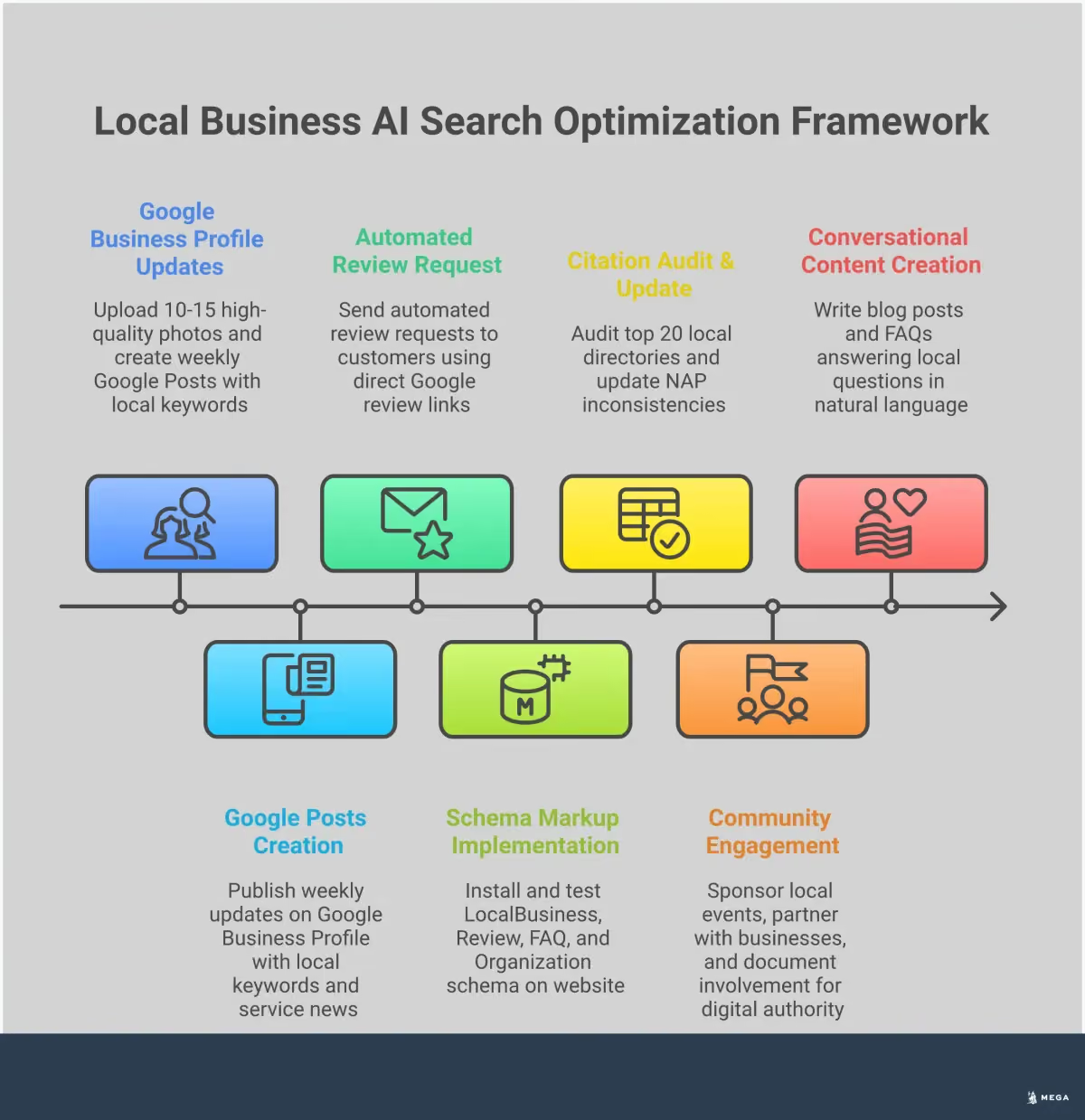
How AI Gathers Local Information
AI doesn't just "read" your website. It acts like a detective, gathering clues from all over the web to build a complete profile of your business. It pulls data from your Google Business Profile, online directories like Yelp, customer reviews, and mentions in local news articles. It then pieces all this information together to understand who you are, what you do, and how trustworthy you are.
This is why having consistent information everywhere is so important. If your address is different on your website than it is in a local directory, it creates confusion for the AI. Your goal is to make it incredibly easy for AI systems to verify your details. The more consistent and positive signals you send from various authoritative sources, the more likely an AI is to trust your information and feature you in its answers.
The Critical Role of Structured Data
To help AI make sense of all the information it finds, you need to speak its language. That language is structured data, also known as schema markup. Think of it as adding labels to the information on your website. Instead of just having your address listed as plain text, structured data explicitly tells the AI, "This string of text is a street address," and "This set of numbers is a phone number."
This labeling helps AI understand the context behind your data. It can identify your business hours, service areas, customer ratings, and more. By clearly defining these "entities"—like people, places, and things—you remove any guesswork for the AI. Implementing structured data is a foundational step for LLM Placement, as it ensures AI models can accurately interpret and use your business information when generating answers for local search queries.
Optimize Your Google Business Profile for AI
Your Google Business Profile (GBP) is one of the most important data sources for AI search engines. Think of it as your digital storefront. When AI models like Google's AI Overviews need a quick, reliable answer about a local service, they look to complete and accurate GBP listings first. A well-maintained profile isn't just a suggestion; it's a foundational requirement for showing up in local AI-powered search results. Keeping this profile updated with your latest hours, services, and photos ensures AI has the correct information to recommend your business to potential customers.
Key Profile Elements AI Looks For
AI thrives on clean, structured data. The most critical elements in your profile are your business name, address, and phone number (NAP). This information must be perfectly consistent everywhere it appears online. Beyond that, ensure your hours, website, and service areas are filled out completely. A complete Google Business Profile can significantly improve your local search rankings because it gives AI models a clear and trustworthy snapshot of your business. When a user asks an AI assistant for "a coffee shop near me that's open now," the AI pulls directly from this structured data to provide a confident answer.
Select the Right Categories and Descriptions
Specificity is your best friend when it comes to GBP categories. AI uses these to understand exactly what your business does. Avoid broad terms; instead of "Business Services," choose a precise category like "HVAC Contractor." You can also add secondary categories to cover all your offerings. Your business description should be a clear, helpful summary of what you do and who you serve. Write for a human first, and naturally include terms your customers would use. This helps AI accurately match your business to relevant search queries, ensuring you appear in front of the right audience.
Use Photos and Posts to Your Advantage
AI doesn't just read text; it also analyzes images and recent activity to determine your relevance. Regularly upload high-quality, recent photos of your storefront, products, team, and completed work. This visually confirms that you are an active, legitimate business. Use Google Posts to share updates, promotions, and news. Each post creates a fresh piece of content that signals to AI that your business is current and engaged with its community. This consistent activity shows that you are not only open for business but are also an active participant in your local market.
Build an AI-Friendly Website Foundation
Think of your website as your digital storefront. For AI search engines to understand what you offer, that storefront needs a solid, well-labeled foundation. AI agents and crawlers don't "see" your website the same way a human does. They read the underlying code and structure to gather information. If that structure is messy or confusing, they might miss crucial details about your business, like your location, services, or hours.
Building an AI-friendly foundation means prioritizing clarity and simplicity in your site’s technical setup. This ensures that when AI models like Google’s AI Overviews or ChatGPT are looking for local solutions, they can easily find, understand, and trust the information on your site. While this might sound technical, the core principles are straightforward. It’s about making your website’s information as clear and accessible as possible for machines. An AI-powered SEO agent can automate these technical fixes, but understanding the "why" behind them helps you create a more effective long-term strategy.
Focus on Clean HTML, Not Complex Scripts
When it comes to AI, simpler is often better. AI crawlers are excellent at reading and interpreting standard HTML, the basic building block of web pages. However, they can struggle with complex JavaScript, which is often used for fancy animations or dynamic content. As one expert notes, "AI doesn't render JavaScript." This means if your essential business information—like your address or services—is loaded using a complex script, the AI might never see it.
Focus on building your site with clean, semantic HTML. This ensures that your core content is always accessible. A straightforward, well-structured website is far more valuable for AI search visibility than one loaded with complicated scripts that might hinder an AI's ability to understand what your business does.
Use Schema Markup for Local Businesses
Schema markup is a type of code that acts as a translator for search engines. It explicitly tells AI what different pieces of information on your site mean. For a local business, you can use it to label your business name, address, phone number (NAP), hours of operation, and services offered. This removes any guesswork for the AI.
Consistency is key. As local search experts advise, "ambiguity is the enemy of search visibility." Using schema markup for local businesses helps create a consistent, unambiguous profile that AI can trust. By clearly defining your business details in the code, you make it much easier for AI to accurately feature your business in local search results and AI-generated answers.
Improve Crawlability and Indexing
Before an AI can recommend your business, it first has to find your website and add it to its knowledge base. This involves two steps: crawling and indexing. Crawling is the process of discovering the pages on your site, and indexing is the process of storing and organizing that information. If an AI crawler can't access your pages, your business effectively becomes invisible.
To improve this, ensure your website has a logical structure, a clean sitemap, and no broken links that could stop a crawler in its tracks. Your site needs to be "crawable, indexable, and retrievable by search crawlers and AI platforms." Regularly running technical audits can identify issues that prevent proper indexing. This is a foundational step that ensures all your other SEO efforts can actually be seen by AI.
Develop a Winning Review Strategy
In the world of AI search, your online reputation is more important than ever. AI models like Google's AI Overviews and ChatGPT synthesize information from across the web to form a picture of your business. Customer reviews are one of the most powerful sources they use to gauge trustworthiness, quality, and customer satisfaction. A strong review profile sends a clear signal that you are a legitimate, respected local business that people in the community rely on.
This isn't just about having a five-star rating. AI also looks at the volume of your reviews, how frequently you receive them, and the specific language customers use in their comments. A steady stream of recent, detailed feedback tells AI that your business is active and consistently delivering value. This data helps AI confidently recommend your business in conversational answers. Building a winning review strategy involves creating a system to encourage feedback, engaging with what customers have to say, and making the entire process as simple as possible. An AI agent like MEGA AI's SEO Agent can help manage your online reputation as part of a comprehensive local SEO plan.
Create a System for Getting More Reviews
Getting more reviews starts with making it a core part of your business operations. Don't leave it to chance; build a repeatable process for asking customers for their feedback. The best time to ask is right after a positive experience, when their satisfaction is highest. Train your team to mention leaving a review after a successful sale or service call. You can also automate the process by sending a follow-up email or text message a day or two after their purchase. The key is to be consistent. A business that actively cultivates a culture of review generation will build a much stronger profile over time than one that passively waits for feedback.
Respond to All Customer Feedback
Engaging with reviews is just as important as collecting them. When you respond to customer feedback, you show both customers and AI that you are an active, attentive business owner. For positive reviews, a simple and personal thank you can go a long way in reinforcing a customer's loyalty. For negative reviews, a timely and professional response can turn a bad experience into a demonstration of great customer service. These public interactions provide valuable context for AI, helping it understand how you handle customer relationships. Responding to feedback is a simple way to build trust and manage your brand's narrative online.
Make it Easy for Customers to Leave a Review
If you want more reviews, you need to make the process frictionless. A happy customer might be willing to share their experience, but they won't spend ten minutes trying to figure out how. Start by getting the direct review link from your Google Business Profile. You can share this link directly with customers or use it to create a simple QR code to display in your store, on your receipts, or on your business cards. Adding the review link to your website footer and email signature also provides easy access. By removing as many steps as possible, you significantly increase the likelihood that a satisfied customer will take a moment to leave you a positive review.
Master Your Local Citations and Directories
Local citations are mentions of your business's name, address, and phone number (NAP) on other websites, like Yelp, industry-specific directories, and local chamber of commerce sites. Think of them as digital breadcrumbs that lead back to you. For AI search, these citations are more than just listings; they are data points that build a consensus about who you are, what you do, and where you operate. A strong and consistent citation profile signals to AI models that your business is legitimate and authoritative, making it more likely to be featured in AI-generated answers for local queries.
Find the Most Important Local Directories
Not all directories are created equal. Your goal is to be listed on the platforms that matter most in your industry and location. As SEO expert Nathan Gotch explains, "The domains that show up the most are your must-win directories." For a law firm, this might be sites like Avvo and Justia; for a restaurant, it could be Yelp and TripAdvisor. Start by searching for your services locally and see which directories rank on the first page. These are the platforms that both customers and AI trust. Focusing your efforts on these high-impact sites ensures your information is seen where it counts, building a strong foundation for your local SEO strategy.
Keep Your Business Information Consistent
Consistency is the cornerstone of a successful citation strategy. Your business name, address, phone number, and website must be identical across every single listing. Even small variations, like using "St." instead of "Street," can create confusion for search engines and AI models. This ambiguity can dilute your authority and hurt your visibility in local search results. Create a master document with your official business information and use it for every directory you submit to. Manually managing this can be tedious, which is why many businesses use an AI-powered SEO agent to ensure every citation is accurate and consistent across the web.
Understand How Citations Feed AI Answers
Your presence in local directories and on your Google Business Profile directly influences whether you appear in AI-generated results. When an AI model like Google's AI Overviews formulates an answer for a local query, it pulls information from sources it trusts. Strong, consistent citations build that trust. For example, a business that ranks well in Google's local pack is often a top recommendation in AI-generated answers. This happens because the AI has verified the business's credibility through multiple consistent data points across the web. By mastering your citations, you are essentially feeding AI the right information to recommend your business to potential customers.
Get Involved in Your Community to Gain Visibility
Optimizing for AI search isn't just about what you do online. AI models are designed to understand the real world, which means your offline reputation and community involvement have a direct impact on your digital visibility. When an AI like Google's AI Overviews or ChatGPT formulates an answer, it looks for signals that a business is a legitimate, trusted, and active part of its local area. Being present in your community creates these signals that are difficult to fake and carry significant weight.
Think of it as building a web of local relevance. Sponsoring a little league team, hosting a charity drive, or partnering with a neighboring shop generates online chatter—mentions on local news sites, posts in community Facebook groups, and listings on event calendars. AI algorithms are excellent at connecting these dots. They see your business name associated with local institutions and events, which reinforces your geographic authority and trustworthiness. This real-world engagement provides the context AI needs to confidently recommend your business for local queries. It’s a powerful way to show that you’re not just located in a community, but that you are a vital part of it. This approach builds a durable competitive advantage that goes beyond simple keyword optimization.
Join Local Events and Sponsorships
Engaging with your community through events is one of the most effective ways to build local authority. When you sponsor a local festival or set up a booth at a farmers market, you’re doing more than just traditional marketing. These activities create digital footprints that AI search engines can easily find and interpret. Your business name and link often appear on the event’s website, in social media posts from organizers, and on local news sites covering the event. Each mention serves as a valuable local citation. These community engagement efforts signal to AI that your business is active and established, making it a more reliable choice for local recommendations.
Get Mentions from Local Media
Local news outlets, blogs, and radio stations are highly trusted sources for both people and AI algorithms. Getting your business mentioned on these platforms is a strong signal of local relevance. Participating in community events or supporting local initiatives often leads to this kind of valuable media coverage. You can also be proactive by sending out a press release for a grand opening, a company milestone, or a special event. When a local news site links to your website, it acts as a powerful endorsement. AI sees this as a high-quality backlink from an authoritative local source, which can significantly improve how you appear in AI-generated answers for local searches.
Partner with Local Organizations
Collaborating with other non-competing local businesses or non-profits strengthens your community ties and expands your digital reach. Consider co-hosting a workshop, running a joint promotion, or partnering on a charity initiative. These partnerships create opportunities for cross-promotion on websites, email newsletters, and social media channels. When AI crawlers see your business associated with other reputable local entities, it reinforces your position within the local ecosystem. These relationships demonstrate a level of integration and trust that algorithms are designed to recognize. This strategy not only helps your small business visibility but also builds genuine goodwill with potential customers in your area.
Create Local Content That AI Loves
AI search models are designed to find and synthesize the most helpful, relevant information to answer a user's query. For local businesses, this means your website content is more important than ever. Creating high-quality content that is deeply rooted in your specific location is one of the strongest signals you can send to AI systems. It demonstrates your expertise and establishes you as an authority in your community. This helps AI models confidently recommend your business for local searches, from Google's AI Overviews to ChatGPT.
When an AI has to generate a single, authoritative answer, it will look for sources that are not just accurate, but also highly relevant to the user's context, which often includes their location. Think of it this way: traditional SEO often felt like a numbers game of keywords and backlinks. AI search, however, is more about building a reputation for expertise. Your content serves as your digital resume, proving you understand the unique needs and challenges of your local customers. By becoming the go-to digital resource for your neighborhood or city, you directly feed these systems the information they need to feature you in their summarized, conversational answers. This is a fundamental shift from simply ranking for keywords to becoming a trusted source of information.
Write About Topics Relevant to Your Area
To establish your local authority, create content that focuses on topics, events, and issues specific to your service area. A roofing company in Denver could write about choosing the best roofing materials for Colorado's hail season, while a cafe in New Orleans could create a guide to local Mardi Gras traditions. This type of content shows AI that you have specialized knowledge relevant to a particular place. It moves beyond generic service descriptions and proves you are an active, knowledgeable member of the community you serve, making you a more trustworthy source for AI-generated answers.
Answer Your Customers' Local Questions
AI is fundamentally a question-answering machine. The best way to appear in its answers is to provide the information it needs. Think about the specific questions your local customers ask. A potential client might search, "how much does it cost to fix a furnace in Minneapolis in the winter?" or "where can I find a family-friendly dentist in Austin?" Create dedicated pages or blog posts that directly answer these questions. Our SEO agent can help identify these local queries and generate content that directly addresses them, positioning your site as the go-to resource for local customers.
Write for How People Actually Talk
People interact with AI search differently than they do with traditional search engines. They often use full sentences and conversational language, as if they were talking to a person. Frame your content to match this natural style. Use headings that are phrased as questions, like "What Are the Signs of a Leaking Pipe?" instead of just "Leaking Pipes." This makes it easier for AI to match your content to conversational queries. This approach also makes your writing more accessible and engaging for human readers, which is always a win for user experience and SEO.
How to Measure Your AI Search Performance
Measuring your success in AI search looks a little different than what you might be used to with traditional SEO. Since AI often provides direct answers, the old model of tracking clicks to your website doesn't tell the full story. Instead, the focus shifts to visibility and influence. Are potential customers seeing your business name mentioned in AI-generated summaries? Is your website being cited as an authoritative source for local information?
This new landscape requires a shift in how we think about performance. It’s less about getting a click and more about becoming the go-to answer. Tracking these new data points is the first step to building a strategy that works for AI search. Below, we’ll cover the key metrics you should watch and some tools that can help you monitor your progress.
The Metrics That Matter
To gauge your performance, you’ll need to focus on metrics that reflect your brand’s presence within AI-generated content. Clicks still matter, but they are part of a bigger picture that now includes brand exposure and influence. Key indicators of success include tracking how often your brand is mentioned in AI Overviews, as this shows your brand authority is growing.
Other important metrics are attribution frequency—how often your content is cited as a source—and snippet retrieval, which measures how often your content is pulled directly into an answer. Finally, consider sentiment analysis to understand the tone associated with your brand when it appears in AI responses.
Helpful Tools for Tracking Your Progress
You don't have to track all these new data points manually. A growing number of tools are designed to help you monitor your visibility in AI search. Platforms like Semrush and Mangools are developing features that allow you to see how frequently your content is cited and track your overall performance on different AI platforms. These tools can provide strategic insights into your brand's presence and help you understand where to focus your optimization efforts.
Using these tools can help you measure your progress over time and see how your strategic changes impact your visibility. They simplify the process of gathering data so you can focus on making informed decisions for your business.