
For over a decade, marketers have focused on Search Engine Optimization (SEO) to get found on Google. Now, a new frontier is emerging: LLM Optimization (LLMO). When a potential customer asks an AI for a recommendation or gets an AI-generated summary at the top of their search results, LLMO determines if your business gets mentioned. If your content isn’t structured for AI to find and understand, you risk becoming invisible. This guide explains what LLMO is, why it matters for your business, and how you can start optimizing your content to be the answer your customers are looking for.
Key Takeaways
- Go Beyond Content Generation: Use autonomous AI agents to manage your entire marketing workflow, from planning SEO strategies and fixing technical issues to launching and optimizing paid ad campaigns.
- Optimize for AI Search (LLMO): Ensure your business is found in AI-powered search results like ChatGPT and Google Overviews by creating content that directly answers customer questions and establishes your authority.
- Balance Automation with Oversight: Choose a platform that offers both a fully autonomous mode and the option for manual approval, giving you the power to scale quickly while maintaining final say over your brand.
What Are Large Language Models (and Why Should Marketers Care)?
Large language models, or LLMs, are advanced AI systems trained on massive amounts of text data. Think of them as incredibly sophisticated prediction engines for language. They can understand, summarize, translate, and generate human-like text based on the patterns they’ve learned. While the technology is complex, the reason you should care as a marketer is simple: LLMs can handle tasks that used to require significant time, a big budget, or a dedicated team.
It’s easy to find articles that make LLMs sound like a magic wand—just type a request and get a perfect, ready-to-publish blog post or ad campaign. The reality is more practical. These models are powerful tools that can help you generate content faster, analyze customer feedback, and personalize your messaging at a scale that was once out of reach for small businesses. For founders and local business owners who are already wearing multiple hats, LLMs offer a way to execute a professional marketing strategy without needing to become a marketing expert yourself. They help you get found by more customers and compete with larger companies, all while saving you time. This isn’t about replacing your judgment; it’s about giving you the capabilities of a full marketing agency without the high cost, letting you focus on running your business.
LLMs vs. Traditional Marketing Tools: What’s the Difference?
Traditional marketing software often operates on a system of fixed rules and templates. You might use a template for an email campaign or a tool that schedules social media posts based on a predefined calendar. These tools are helpful for organization but lack flexibility.
LLMs are different because they don’t just follow rules; they generate new, original content. Unlike tools that rely on templates, an LLM can produce text that is nuanced and contextually relevant to your specific audience or goal. This is because they are built with millions or even billions of parameters, which allow them to recognize complex patterns in language. This means they can adapt their output to fit your brand voice, a specific customer segment, or the unique requirements of a new ad campaign.
How LLMs Are Used in Marketing
In practice, LLMs can streamline many of your day-to-day marketing activities. Whether you’re writing blog posts, improving your website’s SEO, or drafting ad copy, these models can help you get the work done faster and more effectively. For example, you can use an LLM to brainstorm a month’s worth of content ideas in minutes or generate five different versions of ad copy to test on Facebook.
Beyond content creation, LLMs are also used for personalization. They can help you craft tailored follow-up emails, interactive website copy, and chatbot greetings that keep conversations with customers relevant. Some businesses even use them to analyze product reviews and customer feedback, turning raw data into actionable insights that can inform your next paid ads strategy or product update.
Use LLMs to Transform Your Content Strategy
A strong content strategy is essential for growth, but for most small businesses, it’s a constant struggle against the clock. Creating high-quality content consistently feels like a full-time job because it often is. This is where Large Language Models (LLMs) change the game. They act as a force multiplier, allowing you to build a content engine that would otherwise require a dedicated team.
Using LLMs isn’t just about writing blog posts faster. It’s about creating a smarter, more responsive content plan that works for your business around the clock. From generating initial ideas and drafting articles to personalizing messages and adapting content for different channels, LLMs handle the heavy lifting. This frees you up to focus on the bigger picture: connecting with your customers and growing your business. Platforms with AI agents, like MEGA AI, can autonomously plan and execute these tasks, turning strategy into action without constant manual input.
Automate Content Generation at Scale
The most immediate benefit of using LLMs is their ability to produce high-quality content at an incredible speed. Whether you need a series of blog posts to build your site’s authority, social media updates to engage your audience, or even video scripts, LLMs can generate drafts in minutes, not days. This allows you to scale your content output without scaling your budget or your workload. For example, an AI agent can generate content to build out an entire blog from scratch or create dozens of city-specific landing pages to attract local customers, tasks that would take a human writer weeks to complete.
Personalize Content Beyond Demographics
Effective marketing speaks to the individual, not the crowd. LLMs allow you to move beyond basic personalization, like using a customer’s first name in an email. By analyzing user history and on-site behavior, these models can help you generate content that is genuinely tailored to each person’s interests and needs. This could mean creating interactive website copy that changes based on a visitor’s journey or sending follow-up emails with information relevant to what a customer just viewed. Employing effective data management strategies is key to making sure the AI has quality information to work with, leading to a more relevant and engaging customer experience.
Adapt Your Content for Any Channel
Your message needs to fit the platform. A blog post isn’t a tweet, and a tweet isn’t a LinkedIn ad. LLMs excel at repurposing a single piece of content for multiple channels, ensuring your brand voice remains consistent while adapting the format and tone for each audience. You can take a deep-dive article and have an LLM summarize it into key takeaways for an email newsletter, pull out a compelling quote for social media, and create several ad variations for a paid campaign. AI tools can even remix your best-performing creative automatically, helping you test and find what resonates most with your customers on every platform.
What Is LLM Optimization (LLMO) and Why Do You Need It?
You’ve likely spent years thinking about Search Engine Optimization (SEO) for Google. Now, it’s time to consider a new frontier: LLM Optimization (LLMO). Think of it as SEO for AI. When a potential customer asks ChatGPT for a recommendation or gets an AI-generated summary at the top of their Google search, LLMO is what determines if your business gets mentioned. These AI tools are becoming the new search engines, pulling information from across the web to provide direct answers. If your content isn’t structured for them to find and understand, you become invisible.
For small and local businesses, this is a massive opportunity. You no longer have to compete just on traditional ranking factors. By creating high-quality, authoritative content that directly answers your customers’ questions, you can become a primary source for these AI models. This is how you get your business recommended by name in AI-powered search results. Platforms like MEGA AI are built for this shift, with features specifically designed for LLM Placement that improve how your business appears in ChatGPT, Google’s AI Overviews, and other AI-driven tools. It’s about making sure your business is the answer, wherever your customers are asking the questions.
Optimize for AI-Powered Search
Optimizing for AI-powered search means creating content that is clear, factual, and structured for easy comprehension by a machine. AI tools comb through websites looking for trustworthy information to synthesize into answers. Your goal is to make your website the most reliable source in your niche. This involves producing in-depth articles, guides, and FAQs that thoroughly address common customer pain points and queries.
Using AI can help you streamline this process, from identifying relevant topics to generating well-organized drafts. Instead of just targeting keywords, you’re building a library of expertise that positions your brand as an authority. When AI search tools are looking for the best information to share with a user, they will turn to your content first.
Get Found in ChatGPT, Google Overview, and Voice Search
Unlike a traditional search results page with ten blue links, AI-powered search often provides a single, definitive answer. Getting your business included in that answer is the ultimate goal. To do this, your content needs to be conversational and answer questions directly. Think about how people speak when they use voice search or chat with an AI assistant. They ask full questions, not just a few keywords.
Your content should mirror this by using natural language and clearly stating answers. Structuring your articles with clear headings and subheadings helps AI models parse the information quickly. By creating content specifically for these platforms, you increase the likelihood that your brand will be cited as a source. You can see how an AI agent handles this by planning and executing a content strategy designed for modern search.
How Agentic AI Works in Marketing
Large language models are powerful, but their true potential in marketing is realized when they move from simply responding to prompts to actively working on your behalf. This is the core idea behind agentic AI. Instead of you having to constantly generate ideas and commands, an AI agent can understand a high-level goal, create a strategy, and execute the necessary tasks to achieve it. Think of it as the difference between a calculator that waits for your input and an accountant who manages your books for you.
This approach moves beyond simple automation. An AI agent can plan, launch, and optimize entire campaigns. For example, MEGA AI’s platform centers on two specialized agents: the SEO Agent for organic search and the Ads Agent for paid advertising. These agents don’t just write a blog post when you ask; they identify keyword opportunities, write a series of articles, build internal links, and monitor performance over time. This shift from a reactive tool to a proactive partner is what makes agentic AI a significant step forward for marketers, especially for small businesses that need to accomplish more with fewer resources.
What Are Autonomous Marketing Agents?
An autonomous marketing agent is an AI system designed to handle complex marketing functions with minimal human direction. While an LLM-powered chatbot can answer customer questions, an autonomous agent can manage your entire SEO strategy or paid ad campaigns. These agents connect different tools and data sources to make informed decisions. For instance, an SEO agent might analyze your Google Search Console data, perform a competitive analysis, identify content gaps, and then generate and publish optimized articles directly to your CMS. This is a system that doesn’t just create content; it executes a complete, goal-oriented marketing plan.
Choose Between Full Automation and Human Oversight
Handing over control to an AI can feel daunting, especially when it comes to your brand’s voice and budget. Many business owners worry about the quality of AI-generated content or an AI making a costly mistake in an ad campaign. That’s why the best platforms offer a choice between full automation and human oversight. At MEGA AI, you can use Autopilot Mode, where the agent operates autonomously to deliver results quickly. In fact, 85% of customers use this mode and see results twice as fast. However, you always have the option to review and approve every task before it’s executed, ensuring you maintain final say over your marketing activities.
How Autopilot and Email-to-Task Workflows Function
Autopilot is designed to let the AI agent work independently in the background. Once you set your goals, the agent gets to work planning and executing tasks, from fixing technical SEO issues to launching new ad creative. But what if you have a specific, one-off request? This is where simple workflows come in. For example, MEGA AI’s email-to-task functionality allows you to send a simple email, like “Write a blog post about our new product,” and the agent will add it to its queue. This creates a seamless way to collaborate with your AI agent without needing to learn a complex interface, making it easy to request specific tasks on the fly.
Improve Your SEO with LLMs
Search engine optimization is a long-term game that requires consistent effort across content creation, technical maintenance, and strategic updates. For small business owners, it can feel like a full-time job. This is where LLMs change the equation. Instead of just providing keyword ideas or grammar checks, modern AI can function as an autonomous agent, handling the entire SEO lifecycle for you.
AI-powered platforms can plan a content strategy based on what your customers are searching for, write and publish optimized articles, and fix the technical issues that hold your site back. They can build your blog from scratch, add location-specific pages to attract local customers, and continuously update your content to keep it relevant. This end-to-end approach means you get the benefits of a sophisticated SEO strategy without needing to become an expert yourself or hire a costly agency. It’s about turning a complex, time-consuming process into an automated asset that works for your business around the clock.
Generate and Maintain SEO Content
Content is the foundation of any good SEO strategy, but creating a steady stream of high-quality articles is a major challenge. LLMs can automate this entire workflow. They start by conducting keyword research to find topics your audience cares about and then generate well-structured, informative blog posts optimized to rank on search engines. Whether you’re writing new content or improving existing pages, large language models can help you get the job done faster and smarter. An AI agent like Mega’s SEO Agent can maintain your content calendar, ensuring your site stays fresh with relevant information, which is a key signal to search engines like Google.
Automate Your Technical SEO
Technical SEO refers to the behind-the-scenes optimizations that help search engines crawl and index your website effectively. These tasks, like fixing broken links or correcting canonical tag issues, are critical for ranking but are often complex and tedious. AI tools can streamline technical SEO by automatically auditing your site, identifying problems, and implementing fixes. This means you don’t have to worry about the technical details. An autonomous agent can work in the background to ensure your website’s foundation is solid, allowing your content to perform at its best without you ever having to look at a line of code.
Re-Optimize Content for Any Platform
The digital landscape is always changing. A Google algorithm update can shift ranking factors overnight, and new platforms like ChatGPT create different ways for people to find information. LLMs are built to adapt to these changes. They can re-optimize your existing articles after a Google update to align with new best practices. More importantly, they can repurpose your content for different discovery engines. This includes optimizing for LLM-based search, ensuring your business appears in AI-generated answers. By keeping your conversations fresh and relevant, AI ensures your content works for you on today’s search engines and tomorrow’s.
Change Your Paid Advertising Strategy with LLMs
Paid advertising often feels like a balancing act between creative, budget, and performance analysis. For small businesses, the resources to manage this effectively across multiple platforms are limited. Large language models can change this by automating the most complex parts of paid media. Instead of spending hours writing copy or analyzing spreadsheets, you can use AI to handle the heavy lifting. This approach allows you to execute a sophisticated ad strategy that was once only possible for large companies with dedicated teams.
An AI-powered system like Mega’s Ads Agent acts as your dedicated paid ads specialist. It doesn’t just automate simple tasks; it handles the entire workflow from strategy to execution. This means you can focus on running your business while the AI works to generate leads and sales. It levels the playing field, giving you access to advanced testing, multi-platform management, and real-time budget optimization without the high cost of a traditional agency. It’s about getting better results, faster, and with less manual work.
Generate and Test Ad Creative at Scale
Coming up with fresh ad creative is a major hurdle for any marketing team. LLMs act as a tireless creative partner, helping you generate ad content much faster. You can produce dozens of variations of headlines, descriptions, and even video scripts in minutes, allowing you to move beyond testing just one or two ideas. With an AI agent like the Ads Agent, you can automatically create and test hundreds of creative variations, including translating voiceovers for different markets. This high-volume testing process quickly identifies the messages that connect with your audience, leading to better campaign performance without the manual effort.
Manage Campaigns Across Multiple Platforms
Running campaigns on Google, Meta, and LinkedIn requires tailoring your approach for each. An AI-powered system simplifies this by acting as a central command for your paid advertising. You can upload creative once and have an agent deploy it across every platform, formatted correctly for each channel. LLMs help keep your messaging consistent yet adapted, making sure your brand voice is clear everywhere you advertise. This removes the tedious work of manually setting up individual campaigns, saving you time and reducing the chance of errors.
Optimize Budgets and Analyze Performance in Real Time
Deciding where to allocate your ad spend is critical for getting the best return. LLMs can analyze performance data from all your campaigns in real time, identifying which ads deliver the best results. Based on this analysis, an AI agent can automatically shift your budget toward top performers and away from those that are underperforming. This data-driven approach removes guesswork from budget management and ensures your money is always working to achieve your goals. It improves your return on ad spend (ROAS) without requiring constant monitoring, which is a key part of the value of an automated system.
How to Measure Success with LLM Marketing Tools
Using LLM-powered tools is one thing; knowing if they’re actually working for your business is another. To justify the investment, you need a clear way to measure your return. This means looking beyond vanity metrics and focusing on the numbers that directly impact your bottom line. The right approach involves setting a baseline before you start, tracking the right key performance indicators (KPIs), and understanding what a realistic timeline for results looks like.
By analyzing data from different sources, AI tools can help you identify trends and measure the effectiveness of your marketing efforts. The key is to know what to look for and how to translate those data points into a clear picture of success.
Track These Key Performance Metrics
Before you integrate any new tool, document your current performance. A solid measurement framework starts with knowing your sales figures, average conversion time, and typical deal size. This baseline will be your point of comparison. Once your LLM tools are running, track these core metrics:
- Organic Traffic and Keyword Rankings: For SEO, monitor the increase in website visitors from search engines and your position for target keywords.
- Lead Quality: Are the leads coming in more qualified? Track the percentage of leads that convert to sales. A tool like MEGA AI can help filter out unqualified leads, saving your sales team valuable time.
- Conversion Rate: Measure the percentage of visitors who complete a desired action, like filling out a form or making a purchase.
- Customer Acquisition Cost (CAC): Calculate the total cost of acquiring a new customer. Effective AI tools should help lower this over time.
What to Expect: Timelines for Results
Patience is important, but you should still expect to see progress within a reasonable timeframe. Many small businesses find that AI tools deliver value through time savings and improved efficiency within the first 30 to 60 days. For example, automating content creation or ad variations frees up hours of manual work almost immediately.
However, some results take longer to materialize. For instance, while our SEO agent gets to work right away on technical fixes and content, most users see significant organic traffic growth within three to nine months. Paid ad campaigns can show performance lifts much faster, often within weeks, as the AI optimizes budgets and creative elements in real time.
How to Calculate Your ROI
Calculating the return on investment (ROI) for an LLM tool involves looking at both time savings and direct revenue. Research shows that many small businesses that use AI in marketing save time and money while improving their results.
First, consider the value of your time. If a tool costs $799 per month but saves you 20 hours of work, what is that time worth? If you value your time at $50 per hour, you’ve saved $1,000 in labor, resulting in a positive ROI from efficiency alone. Second, track the direct financial impact. Compare the revenue generated from AI-driven campaigns to the cost of the tool. For example, if your paid ads agent generates $5,000 in new sales on a $1,599 monthly plan, your return is clear.
How to Maintain Control with AI Marketing Tools
Adopting AI marketing tools doesn’t mean handing over your company’s voice and strategy to a machine. The goal is to use AI as a powerful partner that executes tasks, freeing you up to focus on the bigger picture. The best platforms are designed to keep you in the driver’s seat, offering a balance between powerful automation and human-led direction. This is a significant step up from basic AI chat interfaces where you constantly have to wrestle with prompts to get the right output.
Instead, modern tools operate more like a highly efficient team member. You set the goals, define the brand, and determine the overall strategy. The AI then gets to work executing the plan. For example, with MEGA AI, you can choose between a fully autonomous Autopilot Mode or a manual approval process for every task. This gives you complete visibility and the final say on what gets published or launched. This isn’t about losing control; it’s about gaining leverage. You can review campaign performance, check content before it goes live, and adjust your strategy based on real-world results. This approach allows you to scale your marketing efforts without sacrificing the quality and authenticity that your customers expect from your brand.
Establish a Human Oversight Framework
Setting up a human oversight framework sounds complicated, but it’s really just about creating a simple process for reviewing the AI’s work. It’s your system of checks and balances. This could be a weekly 30-minute review of all the blog posts the AI has written or a final check on ad creatives before a campaign goes live. The key is to build these checkpoints into your workflow. Platforms like MEGA AI make this easy by allowing you to switch off autopilot and manually approve every task. This ensures that nothing goes public without your explicit sign-off, giving you peace of mind and ultimate control over your marketing activities.
Ensure Quality and Brand Voice Consistency
AI is excellent at generating content, but it needs your guidance to match your unique brand personality. One of the biggest risks with AI-generated content is that it can sound generic. To prevent this, you need to implement quality checks that ensure everything aligns with your brand’s voice. Start by creating a simple style guide that outlines your tone, key messaging, and words to avoid. Use this as a checklist when reviewing AI-generated drafts. With tools like MEGA AI, you can also provide direct feedback and request specific edits via email, helping the agent learn and adapt to your style over time. This keeps your content authentic and consistent across all channels.
Avoid Over-Dependence on AI
While AI can handle the heavy lifting of execution, your strategic input remains essential. It’s important to avoid an over-dependence on AI for high-level decision-making. You know your customers, your industry, and your business goals better than any algorithm. Think of your AI agent as an expert implementer, not the company strategist. You set the destination, and the AI helps you get there faster. Continue to analyze market trends, listen to customer feedback, and make informed decisions about your overall marketing direction. The AI’s role is to support that vision by efficiently carrying out the tasks needed to achieve your goals.
What to Look for in an LLM Marketing Platform
Choosing the right LLM-powered platform can feel overwhelming, but it comes down to finding a tool that fits your specific business needs. Not all platforms are built for the unique challenges faced by small and local businesses. Instead of getting distracted by complex features you’ll never use, focus on platforms that offer practical, end-to-end solutions. The goal is to find a partner that simplifies your marketing, integrates with your existing workflow, and provides a clear return on your investment. Think of it as hiring a specialist, not just buying software. A great platform should handle the heavy lifting, allowing you to focus on running your business.
Key Features for Small Businesses
For small businesses, the most valuable LLM tools are those that automate time-consuming tasks and compress the capabilities of a full marketing team into one platform. Look for features that directly address your biggest growth challenges. This includes automated SEO content generation to help you rank higher in search results without spending hours on keyword research and writing. You should also seek out tools that manage paid ad campaigns, from creating ad variations to optimizing your budget. The platform should offer practical applications for content creation, customer engagement, and personalization that you can implement immediately. The right features will help you scale your marketing efforts efficiently, even with a limited team and budget.
Check for CMS and Platform Integrations
A powerful marketing platform is only useful if it works with the tools you already use. Before committing, verify that the platform offers seamless integration with your existing systems. This means checking for compatibility with your Content Management System (CMS)—like WordPress, Shopify, or Webflow—as well as your advertising accounts on platforms like Google and Meta. A smooth integration prevents technical headaches and ensures your marketing efforts are cohesive. This is also a good time to review the platform’s data privacy policies. Integrating any new tool should align with data protection regulations and never compromise your customers’ information.
Consider Pricing and Implementation
When evaluating cost, look beyond the monthly fee and consider the total value and potential return on investment. A good platform should save you significant time, which translates directly into cost savings. For example, if a tool saves you 15 hours of work per week, that’s a substantial value that often far exceeds the subscription price. Look for transparent pricing models without hidden fees so you know exactly what you’re paying for. The implementation process should also be straightforward. You want a tool that you can set up quickly without needing a developer, allowing you to see results sooner.
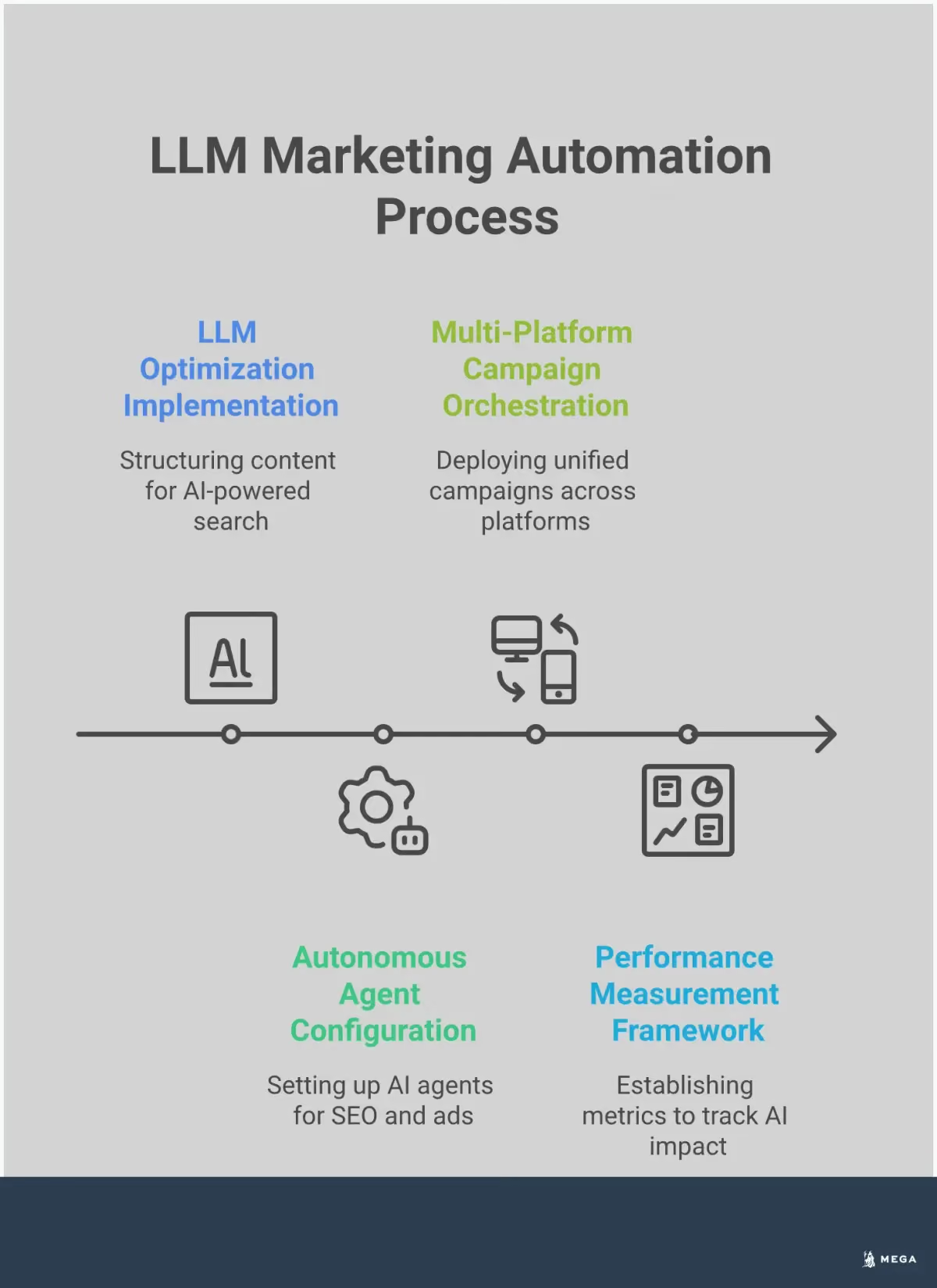
How to Get Started with LLM Marketing Automation
Bringing LLM automation into your marketing doesn’t have to be a complex technical project. With the right platform, it’s a straightforward process designed to get you results quickly. The key is to start with a clear plan and establish a system for monitoring performance from day one. This approach ensures the AI works toward your specific business goals, whether that’s generating more local leads or growing your site’s organic traffic. A well-defined strategy is the foundation for any successful implementation, helping you innovate and improve customer experiences.
Platforms like MEGA AI are built to simplify this transition. Instead of you needing to become an AI expert, our agents, the SEO Agent and Ads Agent, handle the technical execution. They autonomously plan and launch campaigns based on your initial input. Your role is to set the direction and decide how much control you want to maintain. This isn’t about handing over the keys and hoping for the best; it’s about leveraging a powerful tool that you guide. Let’s walk through the practical steps to get your automated marketing engine up and running and producing measurable results.
Follow These Implementation Steps
First, you need to define clear objectives. What do you want to achieve? Are you trying to rank for specific local keywords, increase online sales, or generate qualified leads? Your goals will guide the AI’s strategy. Next, connect your data sources. This involves integrating your website’s CMS, Google Analytics, and ad accounts. Providing the AI with clean, well-managed data is essential for it to make smart decisions. Once connected, you can choose your level of oversight. With MEGA AI, you can use Autopilot Mode for fully autonomous execution or opt for manual approvals to review every task before it goes live.
Set Up Your Monitoring and Optimization Process
Once your campaigns are running, the focus shifts to tracking performance and making improvements. It’s important to measure the ROI of your AI tools by monitoring key metrics like organic traffic, conversion rates, and return on ad spend. Most platforms provide a dashboard where you can see all tasks performed and their impact on your goals. This isn’t a “set it and forget it” system, but rather a process of continuous improvement. The AI agents will optimize on their own, but your feedback helps refine their approach. Regularly review the work being done to ensure it aligns with your brand voice and strategic priorities, making adjustments as needed.