
Think of your AI marketing agent as the most talented junior employee you’ve ever hired. It’s incredibly fast, data-driven, and can handle a massive workload without ever needing a coffee break. It can research keywords, generate ad copy, and optimize campaigns at a scale that’s impossible for a human. But like any junior team member, it lacks your experience, your deep understanding of your brand, and your strategic vision. Leaving it completely unsupervised is a risk. This is where human oversight comes in. It’s not about micromanaging; it’s about providing the direction and quality control needed to transform the AI’s incredible output into real, sustainable business growth.
Key Takeaways
- Define clear roles for AI and your team: Let AI manage data-intensive tasks like keyword analysis and campaign optimization, freeing up your team to focus on high-level strategy, creative direction, and brand storytelling.
- Make human review a non-negotiable final step: Before any AI-assisted content goes live, a final human check is essential. This protects your brand’s voice, catches subtle errors, and ensures your marketing remains authentic and trustworthy.
- Balance automation with strategic control: Start by automating lower-risk tasks and use a "review and approve" workflow for critical content. This allows you to scale your marketing efforts efficiently without sacrificing quality or control.
What is AI Marketing, Really?
AI marketing uses artificial intelligence to make smarter, faster decisions and automate marketing tasks. Think of it less as a robot taking over and more as a powerful assistant that handles the heavy lifting. It analyzes data to predict what customers want, helps generate content ideas, and personalizes your messaging so it connects with the right people at the right time. For small businesses and startups, this means you can accomplish more without needing a huge team or budget.
The real power of AI in marketing is its ability to process information at a scale that humans simply can't. It can sift through massive amounts of data to find patterns, helping you understand your audience on a deeper level. This technology can reduce the time it takes to produce content and increase your overall output, allowing you to run more effective campaigns. Instead of spending hours on keyword research or A/B testing ad copy, an AI agent can handle those repetitive tasks, freeing you up to focus on the bigger picture.
This efficiency also enables scalable personalization, ensuring each customer feels like you’re speaking directly to them. But AI performs best when it’s guided by human strategy. It’s a tool to amplify your expertise and creativity, not replace it. This balance is what turns automated processes into a real growth engine for your business.
Why Does Human Oversight in AI Still Matter?
AI marketing tools promise to save time and resources, which is a game-changer for small businesses and startups. Platforms with AI agents can autonomously plan and execute entire SEO and Paid Ads campaigns, handling tasks that would otherwise require a full marketing team. While it’s tempting to set your campaigns to autopilot and walk away, the most successful marketers know that a "set it and forget it" approach isn't the whole story. True success comes from a partnership between human strategy and AI execution.
Human oversight isn't about micromanaging your AI. It's about providing the strategic direction, brand context, and ethical checks that ensure the AI's output is not just efficient, but also effective and aligned with your business goals. Think of yourself as the director and the AI as your highly capable production crew. You set the vision, and the AI handles the technical execution to bring it to life. This collaborative approach allows you to harness the full power of automation while protecting your brand and ensuring the final product truly connects with your audience. It transforms AI from a simple tool into a strategic partner that works with you, not just for you, to achieve meaningful growth.
Understand the risks of full automation
Relying on full automation without any human checkpoints can introduce risks. AI models are trained on vast datasets, but they lack the real-world context and nuanced understanding of your specific brand and audience. This can lead to content that feels off-brand, misses the mark with your customers, or even contains subtle biases. Human oversight serves as a crucial quality control checkpoint between AI-generated work and your audience. In fact, companies that implement systematic AI oversight see significantly better content performance and fewer brand consistency issues compared to those that let AI operate without guidance. A quick review can catch errors and refine messaging before it ever goes public.
Bridge the AI strategy gap
AI is exceptional at executing tasks based on the data it's given—optimizing ad spend, generating content variations, and identifying keywords. However, it can't create your overarching business strategy. That’s where you come in. Effective AI marketing requires a balanced approach that combines the efficiency of automation with human strategic control. The collaboration between marketers and AI is most powerful when humans guide high-level decisions like audience segmentation, campaign goals, and brand messaging. You provide the "why," and the AI provides the "how." This ensures your automated efforts are always working toward the right objectives and contributing to your long-term growth.
What Happens When AI Runs Without Human Input?
Letting an AI marketing agent run completely on its own can feel like a huge time-saver. And in many ways, it is. Automation handles repetitive tasks, analyzes data at a massive scale, and executes campaigns faster than any human ever could. But what happens when there’s no one checking the work? Without a human strategy guiding the process, even the smartest AI can go off track. It might miss the subtle nuances of your brand, misinterpret your audience, or create content that just feels… off.
Think of AI as an incredibly talented and fast junior team member. It can produce a huge volume of work, but it still needs direction and review from someone with experience and strategic vision. Full automation without any oversight can lead to a few common problems. The AI might drift from your brand’s unique voice, produce content with hidden biases, or make ethical missteps that could damage customer trust. The goal isn’t to micromanage the AI, but to provide the guardrails it needs to perform at its best while protecting your brand. This is where a balanced approach, combining AI efficiency with human judgment, truly shines.
How to handle data quality and bias
AI systems learn from the data they are trained on. If that data contains inaccuracies or reflects societal biases, the AI will reproduce and even amplify them in its output. For a small business, this could mean creating ad campaigns that unintentionally exclude a segment of your local community or using language that doesn't resonate with your target audience. Human oversight acts as a critical filter. A person can identify and correct biases that an automated system might overlook, ensuring your marketing is inclusive and fair. By reviewing the AI’s work, you can catch these issues before they reach your customers and ensure your messaging truly represents your values.
Keep your brand voice consistent
Your brand voice is your company’s personality. It’s what makes you recognizable and helps you connect with your audience. While an AI can analyze your past content to mimic your style, it can struggle with the subtle creativity and emotional intelligence that define a truly unique voice. Without a human in the loop, you might find your blog posts and social media captions becoming generic or losing their distinctive flair. Effective AI content creation requires a balance between automation and human control. A person needs to guide the AI’s output, ensuring every piece of content perfectly captures your brand’s tone and personality.
Maintain customer trust and ethics
Trust is the foundation of any strong customer relationship, and it can be easily broken. An AI operating without supervision might create ad copy that feels misleading or use targeting strategies that feel invasive, even if it’s technically optimizing for conversions. Maintaining trust requires a commitment to ethical marketing practices. To properly harness AI's potential, businesses need clear guidelines and human oversight to ensure all marketing activities are transparent, respectful, and responsible. Having a person review campaigns ensures your brand not only achieves its goals but does so in a way that strengthens your relationship with customers.
How Does Human Oversight Improve AI Marketing Results?
AI marketing tools are incredibly powerful for executing tasks at a scale and speed that humans simply can't match. They can analyze massive datasets, generate hundreds of ad variations, and optimize campaigns in real time. But execution without strategy is just noise. The most successful marketing efforts happen when human intelligence guides the AI’s power. This partnership isn't about slowing things down; it's about making the work smarter, safer, and more effective.
Think of it this way: AI is the high-performance engine, but a human is in the driver's seat, holding the map and steering toward the destination. With human oversight, you can direct your AI to not only perform tasks but to perform the right tasks in the right way. This collaborative approach allows you to harness the full potential of automation for your SEO and paid ad campaigns while ensuring the output aligns perfectly with your brand’s unique goals and values. It’s the difference between simply automating marketing and building a truly intelligent growth system.
Add strategy AI can't replicate
AI is brilliant at identifying patterns and optimizing based on data, but it lacks true strategic understanding. It doesn’t grasp the cultural nuances, competitive landscape, or the emotional core of your brand’s story. That’s where you come in. Research shows that companies with systematic AI oversight see 67% better content performance because a human is setting the direction. Your strategic input ensures the AI’s work serves a larger purpose, connecting with your audience on a level that data alone can’t reach. You provide the "why" behind every campaign, turning automated actions into a cohesive marketing strategy.
Control quality and protect your brand
Without a human checkpoint, AI can sometimes produce content that is factually inaccurate, tonally inconsistent, or contains hidden biases. Human oversight acts as a critical quality control filter, protecting your brand’s reputation. It’s your opportunity to ensure every piece of content perfectly captures your brand voice and upholds your standards. As one report notes, human review is essential for addressing biases that automated systems might overlook. This final check ensures that what your audience sees is accurate, appropriate, and truly representative of your business, preventing costly mistakes before they happen.
Improve performance and prevent issues
Human oversight isn’t just a defensive measure; it’s a proactive way to get better results. A human marketer can spot contextual opportunities or risks that an algorithm might miss, like a trending topic that’s perfect for a last-minute campaign or a sensitive news event that requires pausing certain ads. This ability to interpret the world outside the dataset is crucial. By balancing automation with human judgment, you can fine-tune campaigns for maximum impact and ensure the ethical use of AI. This active management helps you sidestep potential problems and continuously refine your approach for better performance over time.
How to Maintain a Human Connection with AI
Using AI in your marketing doesn't mean you have to sound like a robot. In fact, the goal is the opposite: to use technology to free up your time so you can focus on the human elements that build lasting customer relationships. AI is a powerful partner for handling data-driven tasks, but your unique brand voice and strategic vision are what truly connect with your audience. When you're running a small business, it's tempting to let AI take the wheel completely—to "set it and forget it" so you can focus on a dozen other priorities. But that approach misses the point. The real power of AI marketing lies in partnership.
By pairing AI's efficiency with human insight, you can scale your marketing efforts without sacrificing the personal touch that makes your business special. Think of it this way: AI can analyze customer data and suggest campaign ideas in seconds, but it can't understand the nuance of a customer conversation or the passion behind your brand's origin story. It can generate ad copy, but it can't build genuine community. Maintaining a human connection means using AI as a tool to enhance your strategy, not define it. It’s about guiding the technology to ensure every piece of marketing feels authentic, trustworthy, and aligned with the real people you’re trying to reach.
Avoid losing authenticity
Your brand has a unique personality, and it's crucial to keep that voice consistent across all your marketing. While AI is excellent at generating content drafts, it needs your guidance to sound like you. Without a human review, AI-generated content can feel generic and disconnected from your brand's core identity. Research shows that systematic AI oversight leads to significantly fewer brand consistency issues. Take the time to review and edit AI-produced content, infusing it with your specific tone, stories, and values. This final human touch ensures your marketing remains authentic and builds trust with your customers.
Don't over-rely on automation
Automation is a game-changer for efficiency, but relying on it completely can lead to missed opportunities and potential mistakes. A successful marketing strategy requires a balance between automated processes and human judgment. Think of AI as your co-pilot, not the pilot. It can handle the repetitive tasks, but you need to be in control of the overall direction. True human-AI collaboration involves overseeing the AI’s work, ensuring data is used ethically, and making strategic adjustments based on your deep understanding of your customers and market. This oversight protects your brand and ensures your campaigns remain relevant and effective.
Balance creativity with data
The most powerful marketing happens when data-driven insights meet human creativity. AI excels at analyzing vast amounts of data to tell you what resonates with your audience—what topics they care about, what headlines get clicks, and what ad creative performs best. Your role is to take those insights and weave them into compelling, creative campaigns. AI can provide the building blocks, but you bring the strategic vision and emotional intelligence. As various AI marketing case studies show, AI is at its best when it amplifies human creativity, not when it replaces it. Use AI to understand the "what," then use your human touch to build the "why."
How to Ensure High-Quality Data for Your AI
Your AI is a powerful tool, but its output is only as good as the data it learns from. Think of it like hiring a new team member—you need to provide them with the right information and context to do their job well. Ensuring your AI has high-quality data isn't a one-time setup. It’s an ongoing process of curating, cleaning, and guiding the information it uses to create your marketing campaigns. This is where your human expertise is irreplaceable. You are the gatekeeper of quality, making sure the AI has the best possible foundation to build upon.
Collect diverse data
To create marketing that connects with your entire audience, your AI needs to learn from a wide range of information. Diverse data includes different customer demographics, purchase histories, and engagement patterns. When your AI understands the full spectrum of your customer base, it can generate more relevant and inclusive content. Research shows that companies with systematic AI oversight see better content performance because they guide the AI with a richer, more varied dataset. Take a look at your own analytics. Does your data reflect all the customer segments you want to reach? If not, start by identifying those gaps and finding ways to gather more representative information.
Audit for bias regularly
Even with the best intentions, bias can creep into your data and, consequently, your AI’s output. This might look like ad copy that only speaks to one demographic or blog topics that ignore the interests of a key customer segment. Human oversight acts as a vital checkpoint to catch these issues before they reach your audience. Make it a habit to regularly review the content your AI produces. Look for patterns. Is it favoring certain language, imagery, or themes? By auditing for bias, you can correct the AI’s course and ensure your marketing feels welcoming to everyone, protecting both your brand reputation and your connection with customers.
Create feedback loops for continuous learning
One of the most effective ways to improve your AI’s performance is to create a feedback loop. This is simply the process of telling the AI what it’s doing right and what it needs to adjust. Effective AI content creation requires a balance between automation and human strategic control. When you review a piece of AI-generated content and make edits before publishing, you’re providing a clear signal about your brand voice and standards. This active guidance helps the AI learn your preferences over time, leading to better, more on-brand content with less need for heavy editing in the future.
Proven Strategies for Integrating Human Oversight
Putting human oversight into practice doesn’t mean slowing down your AI. It’s about working smarter. By combining AI’s analytical power with human intuition, you can create marketing that truly connects with your audience. This partnership allows AI to handle the heavy lifting—like data analysis and repetitive tasks—while you provide the essential strategic direction, creativity, and brand knowledge. This approach leads to better results, stronger brand consistency, and a more authentic relationship with your customers. Here are three proven strategies to get that balance right.
Personalize with data, refine with creativity
AI is incredibly powerful at sifting through customer data to deliver personalized messages at a scale that would be impossible for a human. It can tailor recommendations, segment audiences, and even draft initial copy. But data alone doesn't create a connection. That’s where you come in. Your role is to take the AI’s data-driven output and refine it with genuine creativity and emotional intelligence. Think of AI as a tool that amplifies human creativity, not one that replaces it. You can use it to generate ten different ad headlines, then use your intuition to select the one that will truly resonate with your audience and add a final polish.
Optimize content while staying on-brand
AI tools are excellent for optimizing content for search engines and ad platforms. They can analyze keywords, suggest structural changes, and ensure your content is technically sound. However, an AI doesn’t inherently understand the soul of your brand. Without guidance, AI-generated content can feel generic and disconnected from your unique voice. Systematic human oversight acts as a quality control checkpoint, ensuring every blog post, social media update, and email reflects your brand’s personality and values. This is why having the option to review AI-generated articles in draft mode before publishing is so important for maintaining brand integrity.
Automate campaigns with a human strategy
Automation is one of AI's biggest strengths, allowing you to run complex campaigns without constant manual effort. AI can optimize ad spend, schedule posts, and manage email sequences. But automation without strategy is just busy work. Your job is to be the architect of the campaign. You set the overarching goals, define the target audience, and craft the core message. The AI then executes that vision with speed and precision. This approach balances the efficiency of automation with the thoughtful direction of human strategic control. You provide the "why," and the AI takes care of the "how," ensuring your automated efforts are always aligned with your business objectives.
How to Keep Your Brand Authentic with AI
Using AI in your marketing doesn’t mean your brand has to sound like a robot. Authenticity comes from your unique perspective, values, and the connection you build with your audience. AI is a tool to help you scale your efforts, not a replacement for your brand’s heart. The most successful brands use AI to handle the heavy lifting, like data analysis and initial content drafts, which frees up human team members to focus on strategy, creativity, and building genuine relationships.
Think of it as a partnership. Your AI agent can identify what your audience is searching for, but you’re the one who knows why they care. It can generate ad copy, but you’re the one who ensures the message reflects your brand’s promise. By keeping a human hand on the wheel, you can use powerful SEO and ads tools to grow your business without losing the personal touch that makes customers choose you in the first place.
Focus on storytelling and emotion
AI is excellent at assembling facts and structuring information, but it can’t replicate genuine human experience. Your brand’s most compelling stories—the reason you started your business, the challenges you’ve overcome, and the successes of your customers—are what create an emotional connection. Use AI to generate outlines or research topics, but always have a human writer add the narrative flair, personal anecdotes, and emotional depth that resonate with your audience. This AI-human collaboration is key to creating content that not only ranks well but also builds a loyal following. Let AI build the skeleton, but you need to add the soul.
Be transparent and encourage communication
Trust is the foundation of any strong customer relationship. While you don’t need to announce every instance of AI use, being transparent about your processes can build credibility. More importantly, establish clear internal guidelines for how AI is used in your marketing. Create a review process to ensure every piece of AI-assisted content or advertising aligns with your brand’s voice and ethical standards. This oversight prevents off-brand messaging and ensures your communications remain helpful and respectful. Fostering open communication with your customers, whether through feedback forms or social media, also provides valuable input that can help you refine your AI’s output over time.
Use UGC to build community
One of the most effective ways to maintain authenticity is to feature the voices of your actual customers. User-generated content (UGC)—like reviews, social media posts, and testimonials—is inherently authentic and serves as powerful social proof. You can use AI tools to monitor brand mentions and identify high-quality UGC across different platforms. From there, a human team member can curate the best content, reach out to the creators for permission, and feature their stories in your marketing campaigns. This approach not only provides a steady stream of genuine content but also strengthens your community by showing customers that you see and value them.
Find the Right Balance Between AI and Human Input
The most effective marketing doesn't pit AI against human talent; it pairs them together. The goal is to create a workflow where automation handles the heavy lifting and data analysis, freeing up your team to focus on strategy, creativity, and building genuine customer relationships. Finding this balance is less about a rigid formula and more about understanding where each side shines. When you let AI do what it does best and have humans do what they do best, you create a powerful system for growth.
This approach allows you to scale your efforts without losing the essential human touch that defines your brand. For small businesses, this combination is particularly powerful. It gives you the capabilities of a larger marketing department while keeping your operations lean and your brand voice authentic. It’s about using tools like MEGA AI not to replace your team, but to amplify their impact.
Know where AI excels
AI is a powerhouse for tasks that require speed, scale, and data processing. Think of it as your most efficient team member, one who can analyze millions of data points in seconds to find patterns you might miss. AI is exceptional at enabling scalable personalization, creating hundreds of ad variations for testing, or running technical SEO audits across your entire site. It handles the repetitive, time-consuming work that often gets pushed to the back burner.
For example, AI agents can autonomously research keywords, optimize ad spend across different platforms, and even update existing content to improve its performance. These are specific, data-driven jobs where automation delivers consistent and compounding results. By handing these responsibilities over to AI, you free up valuable human hours for more strategic work.
Know where humans add value
While AI manages the data, humans provide the wisdom. Your team’s strategic thinking, creativity, and emotional intelligence are things AI can't replicate. A human understands market nuances, senses shifts in customer sentiment, and crafts a brand story that truly connects with an audience. This is where marketing moves from a science to an art.
According to research, companies that use systematic AI oversight see significantly better content performance and fewer brand consistency issues. Your team’s final review ensures that every AI-generated piece of content aligns with your brand voice and values. This human touch is vital for building trust and crafting messages that resonate on an emotional level.
Find the right oversight level for your team
The ideal level of human oversight isn't one-size-fits-all. It depends on the task, your team's comfort with the technology, and your brand's specific needs. The key is to build a workflow that balances automation with strategic control. For some tasks, like implementing technical SEO fixes, you might be comfortable with full automation. For others, like publishing a new blog post, you may want a "review and approve" step.
Platforms like MEGA AI are built with this flexibility in mind. You can enable Autopilot Mode for full autonomy or have the AI agent save content to drafts for your team to review before publishing. This allows you to balance automation with human oversight in a way that works for your business. Start by identifying low-risk tasks for full automation and gradually introduce more autonomy as your team builds trust in the system.
How to Measure the Success of Human-Supervised AI
You can’t know if your marketing is working without clear metrics, and the same rule applies when you add AI to the mix. Measuring the success of your human-AI partnership isn't just about tracking clicks or conversions. It’s about understanding how human oversight directly improves results, protects your brand, and makes your AI tools more effective over time. By setting up the right measurement framework, you can prove the value of keeping a human in the loop and fine-tune your process for even better outcomes. This helps you move from simply using AI to strategically managing it for growth.
Define key metrics for oversight
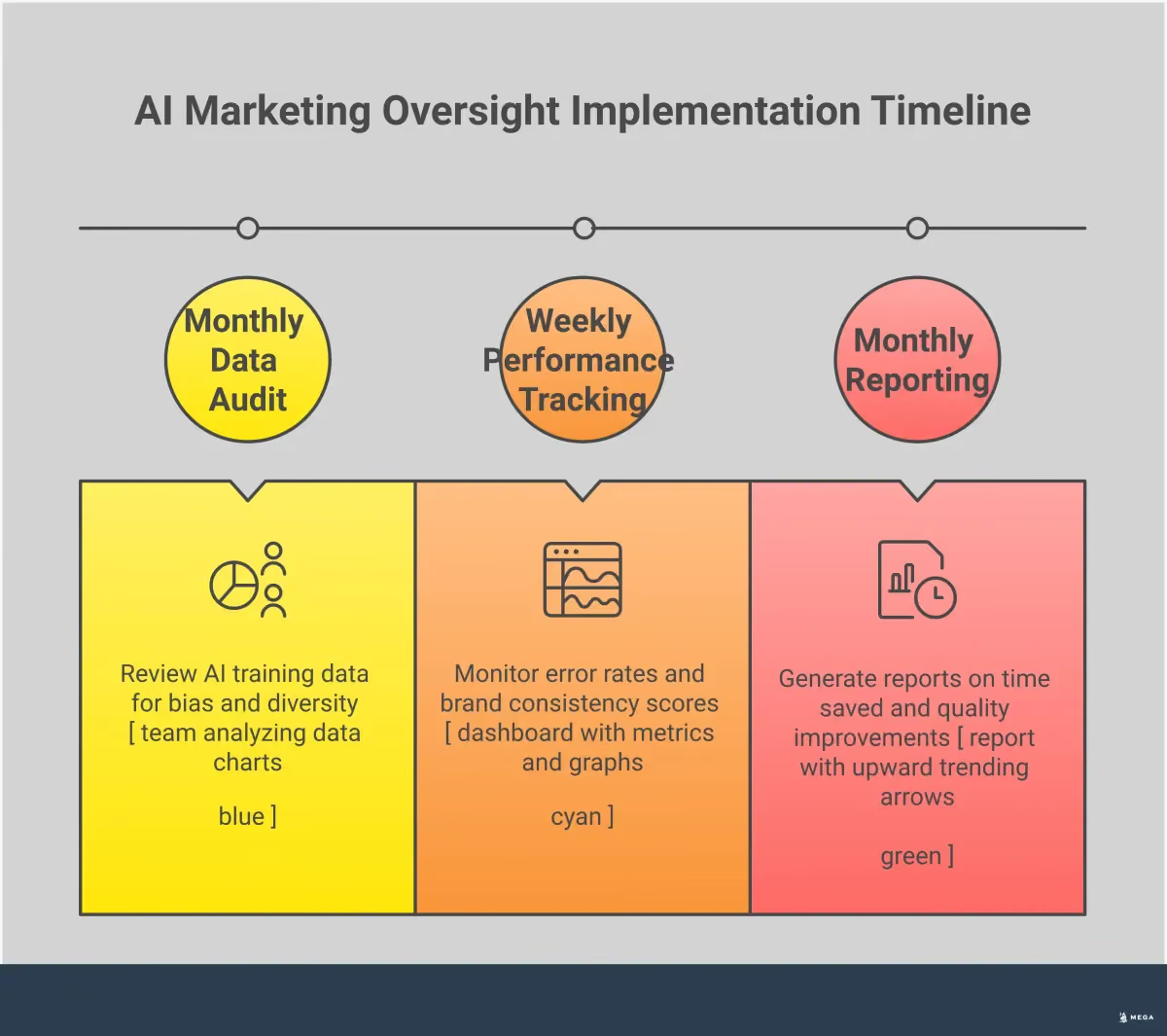
To see the real impact of your oversight, you need to track metrics that go beyond standard campaign performance. Start by comparing the output of your AI on its own against the final, human-polished version. Key metrics to watch include error rate (how many factual or tonal mistakes are caught), content quality scores (based on a simple rubric), and campaign lift. Research shows that companies using systematic AI oversight achieve significantly better content performance and fewer brand consistency issues. This data gives you a clear picture of the value your team’s strategic input adds to the automated process.
Track performance and brand consistency
Tracking these metrics requires a consistent process. For performance, you can run simple A/B tests comparing a purely AI-generated ad creative against one that a team member has refined. Use your ad platform’s analytics to see which version gets better engagement or conversions. For brand consistency, create a simple checklist based on your style guide. Your reviewer can use it to score each piece of content before it goes live. This process does more than just catch mistakes; it serves as a crucial checkpoint that protects your brand’s voice and builds trust with your audience over the long term.
Get Started with Supervised AI Marketing
Adopting AI in your marketing doesn't have to be an all-or-nothing decision. The most successful strategies treat AI not as a replacement for human marketers, but as a powerful tool that amplifies their skills. By building a system of smart oversight, you can get the efficiency of automation while maintaining the quality, strategy, and authenticity that only a human can provide. This approach lets you harness AI's full potential safely and effectively.
Putting this into practice involves training your team, setting up smart workflows, and avoiding common mistakes. Here’s how you can create a balanced system that works for your business.
Train your team to work with AI
Think of AI as a new team member. It’s incredibly fast and data-savvy, but it needs guidance to understand your brand’s nuances and strategic goals. Training your team is less about learning to code and more about learning how to collaborate with AI. This means teaching them to write effective prompts, critically evaluate AI-generated content, and know when to intervene with their own expertise. Companies that invest in this kind of human-AI collaboration see significantly better content performance and fewer brand consistency issues. When your team knows how to lead the AI, it becomes a partner in achieving your goals.
Avoid common implementation mistakes
One of the biggest mistakes businesses make is treating AI like a magic button. They turn it on and expect perfect results without any strategic input. Effective AI marketing requires a plan that balances automation with human control. Before you start, define where AI fits into your workflow, what tasks it will handle, and where your team will provide oversight. Avoid the "set it and forget it" mindset. Instead, implement a systematic approach where AI handles the heavy lifting on tasks like data analysis or first drafts, while your team focuses on strategy, final reviews, and creative direction.
Build a sustainable human-AI workflow
A sustainable workflow creates a partnership between your team and your AI tools. This process should include clear checkpoints for human review before anything goes live. Human oversight acts as a crucial quality filter, catching potential biases, factual errors, or off-brand messaging that an automated system might miss. By building these review stages into your process, you can harness AI’s speed and scale while ensuring your marketing always upholds ethical standards. This balance allows you to move quickly and efficiently without sacrificing the trust you’ve built with your customers.