
Search is changing. Your customers are no longer just typing keywords into a search bar; they're asking AI assistants like ChatGPT and Google for direct answers. If your business isn't the source of those answers, you're becoming invisible. This is where Generative Engine Optimization (GEO) comes in. It’s the strategy for getting your content featured in these AI-generated responses. This guide breaks down exactly how to do generative engine optimization, from understanding user intent to structuring your content. We'll give you a practical framework to ensure your business remains visible and connects with customers at the moment they need you most.
Key Takeaways
- Prioritize answering questions over targeting keywords: GEO is about creating content that directly solves a user's problem, making it the perfect source for AI-generated answers in tools like Google Overviews.
- Organize your content for AI to easily understand: Use clear headings, lists, and structured data (schema) to create a logical outline that helps AI models quickly find and feature your information.
- Lean on automation to stay consistent: GEO requires ongoing content creation and maintenance. For small teams, using an automated tool is the most practical way to manage the workload and keep your content fresh.
What is Generative Engine Optimization (GEO)?
Generative Engine Optimization, or GEO, is the practice of creating and refining your website content to perform well in AI-powered search engines. Think of it as the next step in search optimization. While traditional SEO focuses on getting your site to appear in a list of links, GEO aims to have your content featured directly within the conversational, summary-style answers that generative AI provides. It’s about making your information so clear, helpful, and authoritative that AI models choose it as a primary source to answer a user's question. This shift requires a focus on providing direct, comprehensive answers rather than just targeting keywords.
What Are AI-Powered Search Engines?
AI-powered search engines are platforms that use generative AI to provide direct answers and summaries instead of just a list of links. You’ve likely already seen this with Google’s AI Overviews, which create a snapshot answer at the top of the results page. Other tools like ChatGPT and Perplexity also function this way, allowing users to ask complex questions and receive detailed, conversational responses. These engines are designed to understand the intent behind a search, not just the words used. As a result, they pull information from multiple sources to construct the most helpful and relevant answer for the user.
How GEO Differs from Traditional SEO
Traditional SEO is still fundamental; it focuses on technical health, keywords, and backlinks to help search engines find and rank your pages. GEO builds on that foundation. It’s less about ranking for a specific keyword and more about becoming the definitive answer to a question. While SEO might target "best running shoes," GEO aims to answer "what are the best running shoes for someone with flat feet who runs on trails?" This requires a deeper focus on user intent and creating content that is conversational, well-structured, and demonstrates true expertise on a topic. It’s an added layer, not a replacement for your existing SEO efforts.
Why GEO Matters for Your Small Business
As more people turn to AI for answers, showing up in these generated responses is critical for visibility. Being featured in an AI-generated answer positions your business as a trusted authority, which can lead to more direct website traffic and engagement from highly interested customers. Generative engines demand high-quality, expert content, which can be a challenge for small teams. However, getting ahead of this trend gives you a significant advantage. By optimizing for AI, you ensure your business remains visible and relevant in the new landscape of search, connecting you with customers at the exact moment they need a solution. This is where LLM Placement becomes a key part of your strategy.
What Are the Core Principles of GEO?
Generative Engine Optimization might sound complex, but its foundation is built on principles you may already know from traditional SEO. The key difference is the focus: instead of just ranking on a results page, the goal is to become a trusted source for AI engines to use in their direct answers. Think of it as creating content that is not only helpful for humans but also easily understood and synthesized by models like ChatGPT and Google's AI Overviews.
To succeed, your strategy needs to be intentional. It involves creating high-quality, authoritative content that directly answers user questions in a natural way. It also requires a solid technical website structure so AI crawlers can efficiently find, understand, and process your information. By focusing on these core pillars, you can position your business to be visible where your future customers are looking for answers.
Prioritize Authority and Expertise (E-E-A-T)
AI search engines are designed to provide reliable, accurate answers. To do this, they prioritize content from sources that demonstrate high levels of Experience, Expertise, Authoritativeness, and Trustworthiness (E-E-A-T). Your content must show that you are a credible expert in your field. This means going beyond just stating facts; you need to provide evidence of your firsthand knowledge.
You can build authority by linking to reputable sources, showcasing author credentials, and being transparent about your data. For a local business, this could mean including customer testimonials, case studies, or staff bios that highlight their experience. Consistently producing well-researched, accurate content helps AI models recognize your website as a trustworthy source worth citing in their generated answers.
Use Conversational and Natural Language
People interact with generative AI differently than they do with traditional search bars. They often ask full questions, just like they would in a conversation. Your content strategy should reflect this shift. Focus on identifying the specific questions your audience is asking and create content that answers them directly.
Instead of targeting short keywords, look for longer, more natural-sounding phrases. Structuring your articles in a question-and-answer format can be particularly effective. This approach not only aligns with how users search but also makes it easier for AI to pull your content as a direct answer. Writing in a clear, conversational tone helps both your human readers and the AI systems that process your text.
Build a Strong Technical Foundation
A technically sound website is essential for both SEO and GEO. If an AI engine can’t easily access and understand your site, it won’t use your content. Start with the basics: ensure your site loads quickly, is mobile-friendly, and is secure (using HTTPS). These factors create a good user experience and make your site more appealing to all types of search crawlers.
A crucial element for GEO is structured data, also known as schema markup. This is code you add to your website to give search engines more context about your content. For example, you can use it to label your business hours, product prices, or event dates. This helps AI understand the specific details on your page, increasing the chances it will be featured in relevant, detailed search results.
Optimize for LLM Placement and AI Visibility
The ultimate goal of GEO is to achieve what’s known as LLM Placement. This means your content is selected by a Large Language Model (LLM) to be featured in an AI-generated response, like in Google’s AI Overviews or a ChatGPT answer. To do this, you need to create content that is not only accurate and authoritative but also structured for easy synthesis by an AI.
This involves breaking down complex topics into clear, digestible sections with strong headings. Think about the entire customer journey and create content that addresses questions at each stage. Answering questions comprehensively makes your content a one-stop resource that an LLM is more likely to use. Platforms like MEGA AI offer specialized LLM Placement services that automate this optimization process, helping your content show up in the places that matter most.
How to Research Topics and Questions for GEO
Before you can create content that ranks in AI-powered search, you need to understand what your audience is asking. Generative Engine Optimization research shifts the focus from short keywords to the full questions and conversational phrases people use when talking to AI assistants. The goal is to uncover the specific problems your customers are trying to solve and the language they use to describe them. This foundational step ensures that the content you create directly addresses their needs, making it more likely to be featured in generative results. For small businesses with limited time, this research phase can feel daunting, but it’s a critical part of building a successful GEO strategy. An AI-powered growth agent can automate this discovery process, identifying high-intent questions and topics so you can focus on running your business.
Define User Intent in AI Search
Understanding user intent is about getting to the "why" behind a search query. With GEO, this becomes even more important because AI engines are designed to provide direct, comprehensive answers, not just a list of links. Your content needs to satisfy the user's goal completely. To do this, you must answer their questions thoroughly, using natural language and focusing on longer, question-like keywords. For example, instead of targeting "AI traffic," you would focus on a query like, "how to improve organic traffic using AI." Think about what a user truly wants to accomplish when they ask a question and structure your content to deliver that solution clearly and efficiently.
Find Question-Based Keywords
The best GEO content feels like a natural conversation. To find the right topics, you need to look for longer, more natural-sounding phrases and questions people actually ask. Start by exploring platforms where your audience gathers. Google’s “People Also Ask” section, Quora, and industry-specific forums are excellent sources for discovering real questions. Pay attention to the exact phrasing people use. These question-based keywords are often less competitive and show a clearer intent, making it easier for you to create content that directly addresses a user's needs. This is where an automated tool can provide a significant advantage by analyzing millions of data points to surface the most relevant questions for your business.
Analyze Competitor Content
You don’t have to reinvent the wheel. A great way to inform your GEO strategy is to see which competitors are already showing up in AI search results. Ask ChatGPT, Google’s AI Overviews, and other generative engines questions related to your products or services. When a competitor’s content is featured, analyze it carefully. What makes it a good answer? Look at its structure, depth, and tone. Note the specific questions it answers and how it uses headings and lists to organize information. This process helps you understand what AI engines currently favor and identify gaps in their content that you can fill with a more comprehensive or helpful resource.
Leverage Unique Content Sources
To get ahead, look for insights where your competitors aren't. Platforms like Reddit, YouTube, and niche social media groups are treasure troves of unfiltered customer conversations. People discuss their challenges, ask for advice, and share opinions in their own words. By monitoring these discussions, you can identify emerging trends and pain points before they become mainstream. You can turn these insights into highly relevant, SEO-optimized content that speaks directly to your audience’s needs. This approach helps you create content that is not only valuable but also unique, giving you an edge in both traditional and generative search results.
What Content Formats Work Best for GEO?
Generative engines are designed to find and deliver the most direct, helpful answers to a user's query. The way you structure your content plays a huge role in how easily an AI can understand and recommend it. While high-quality information is the foundation, the right format acts as a clear signpost, guiding the AI to the value within your pages. Focusing on formats that are inherently structured, user-friendly, and answer-oriented will give you a significant advantage. Let's look at the specific content types that perform best in this new search landscape.
Question-and-Answer Structures
This format directly mirrors how users interact with AI assistants. People ask questions, and generative engines look for clear answers. By structuring your content around common questions your audience has, you align perfectly with this conversational model. Think of creating dedicated FAQ pages or weaving Q&A sections into your blog posts and service pages. Use the exact questions as your headings and provide concise, authoritative answers. This not only serves the user but also makes it incredibly easy for an AI to pull your content as a direct response, positioning you as a helpful authority.
Step-by-Step Guides and Tutorials
How-to queries are a cornerstone of search, and this holds true for generative AI. Step-by-step guides are highly effective because they break down complex processes into simple, actionable stages. This structured format is ideal for AI, which can easily parse numbered lists and sequential headings to synthesize a clear set of instructions for the user. When creating a tutorial, focus on clarity and precision. Use headings for each major step and bullet points for smaller actions. This approach provides immense value to your audience and signals to generative engines that your page is a definitive resource for solving a specific problem.
Comprehensive Resource Pages
Generative engines prioritize content that demonstrates deep expertise and authority. A comprehensive resource page, sometimes called a pillar page, does exactly that. It acts as a central hub for a broad topic, covering it in-depth and linking out to more specific sub-topics. For example, a local bakery might create a resource page on "The Ultimate Guide to Sourdough," covering its history, starters, and techniques. This shows generative engines that you are a subject matter expert. Creating this type of cornerstone content requires more effort, but it pays off by establishing your site as a go-to source for reliable information.
Enhanced Content Elements
Beyond the overall format, smaller structural elements help AI engines make sense of your content. The most important of these is structured data, also known as schema markup. Think of it as a vocabulary you add to your website's code to tell search engines exactly what your content is about—whether it's a recipe, an event, or a local business address. Using schema markup helps AI accurately interpret your information and feature it in rich results. Simple elements like bulleted lists, tables, and blockquotes also improve readability for both humans and machines, making your content easier to scan and process.
How to Optimize Content Structure for AI
Once you have your content ideas, the next step is to structure them in a way that AI engines can easily understand. Think of it like creating a clear outline for a presentation. A logical structure helps generative AI quickly grasp the main points of your article, identify key information, and determine if your content is a good source for answering a user's question. When your content is well-organized, you make it simple for AI to pull direct quotes, summaries, or step-by-step instructions from your page and feature them in its responses.
This isn't just about pleasing an algorithm. A strong content structure also creates a better experience for your human readers. People are more likely to stay on a page that is easy to scan and digest. By using clear headings, lists, and other formatting elements, you help users find the information they need without getting lost in a wall of text. This improved user experience sends positive signals to search engines, reinforcing that your content is valuable and authoritative. The following tactics are fundamental for building a solid foundation for your GEO efforts.
Create Clear Headings and a Strong Hierarchy
Organizing your content with a logical hierarchy is one of the most effective ways to make it AI-friendly. Use header tags (H1, H2, H3) to create a clear outline for your article. Your main title should be the H1, followed by H2s for major sections and H3s for sub-points within those sections. This structure acts as a roadmap, guiding both users and AI through your content.
Beyond headings, break up long blocks of text into short, digestible paragraphs. Use bullet points or numbered lists to present information like steps in a process or key features of a product. This makes your content scannable and helps AI easily identify and extract specific pieces of information to use in generated answers. The goal is to present your expertise in a simple, organized format.
Implement Schema Markup
Schema markup, or structured data, is a type of code you can add to your website to help search engines better understand your content. It acts like a set of labels that provide context. For example, you can use schema to tell an AI that a string of numbers is a phone number, a piece of text is a recipe ingredient, or an article is a how-to guide.
This additional context is incredibly valuable for GEO. When an AI understands the specific elements on your page, it can more confidently feature your content in rich results, like review snippets or FAQ sections. While it sounds technical, many tools and plugins can help you add structured data without needing to write code. This simple step gives your content a competitive edge in AI-driven search.
Develop an Internal Linking Strategy
An internal linking strategy involves connecting pages on your own website to one another. When you write a new blog post, look for opportunities to link to other relevant articles you’ve already published. This practice serves two important purposes for GEO. First, it helps AI discover more of your content and understand the relationships between different topics on your site.
Second, it helps establish your topical authority. By creating a web of interconnected content around a central theme, you signal to generative engines that you are a knowledgeable source on that subject. A strong internal linking structure keeps users engaged on your site longer and distributes authority across your pages, making your entire website more visible in search results.
Maintain and Update Your Content
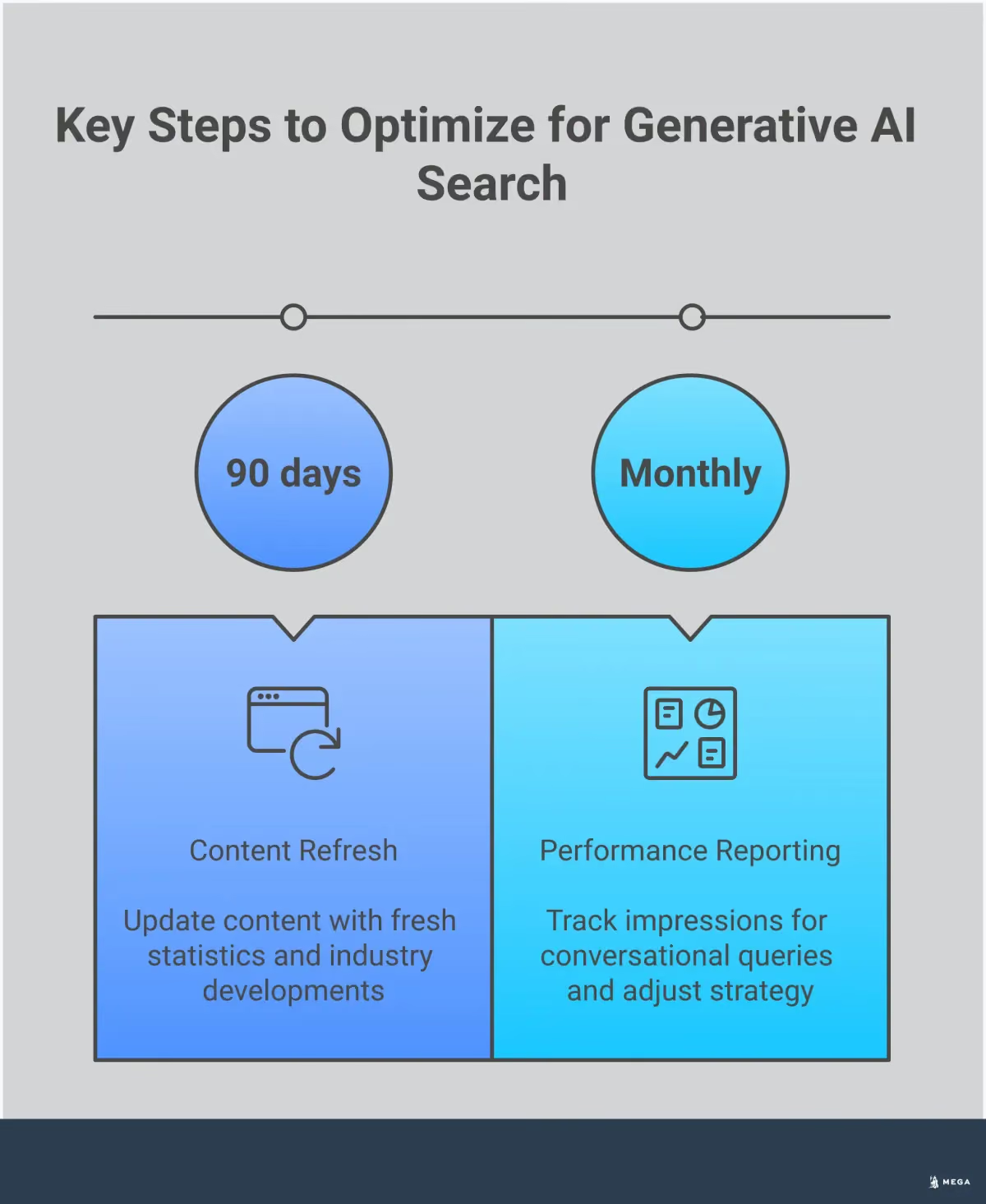
Generative AI prioritizes information that is current, accurate, and relevant. Content that is outdated or contains incorrect information is less likely to be used as a source. That’s why it’s important to regularly review and refresh your existing articles. Schedule time to check for broken links, update statistics, and add new information that reflects the latest developments in your industry.
This process of content maintenance shows AI that you are actively managing your website and are committed to providing high-quality information. For small businesses, this can feel like a lot of work. This is where automated tools can help. For example, MEGA AI’s SEO agent can monitor your content and automatically make updates to keep it fresh, ensuring your best articles continue to perform well in both traditional and generative search.
Common GEO Challenges for Small Businesses
Adapting to generative engine optimization presents a significant opportunity for growth, but it also comes with a unique set of challenges, especially for small businesses and lean teams. Unlike traditional SEO, where the rules have been established over years, GEO requires a renewed focus on signals like conversational language, demonstrable expertise, and technical precision. For a small business owner juggling multiple responsibilities, dedicating the necessary resources to master these areas can feel overwhelming. The main hurdles often fall into four key categories: creating a high volume of quality content, managing complex technical requirements, building brand authority from the ground up, and committing to the ongoing maintenance that keeps your content relevant for AI.
Successfully implementing GEO means thinking less like a marketer trying to rank for keywords and more like a subject matter expert building a library of trusted information. This shift in mindset requires a long-term commitment. It’s not about finding quick hacks; it’s about building a sustainable foundation of high-value content that both humans and AI models will find useful. Understanding these challenges is the first step toward creating a strategy that works with your available resources. By addressing them head-on, you can build a manageable and effective GEO plan that puts your business in a position to be found by the next generation of searchers.
Limited Resources for Content Creation
Generative engines prioritize high-quality, comprehensive, and expertly written content. For a small business, producing this level of content consistently can be a major challenge. It requires significant time and often specialized knowledge to create articles, guides, and resources that are detailed enough to be seen as authoritative by an AI. The demand for more in-depth content can strain already limited budgets and personnel, making it difficult to compete with larger companies that have dedicated content teams. This is where finding efficient content creation workflows becomes essential for scaling your efforts without sacrificing quality.
Technical SEO Complexity
A strong technical foundation is critical for GEO. AI engines need to easily find, crawl, and understand your website's content. This means technical elements like structured data (schema markup), site speed, and mobile-friendliness are more important than ever. For many small business owners, technical SEO can feel complex and intimidating. Implementing schema correctly to define your content for AI or diagnosing site speed issues often requires technical expertise that may not be available in-house. Without these technical signals, even the best content might be overlooked by generative AI tools.
Building Brand Authority and Trust
Generative AI is designed to pull information from sources it considers credible and trustworthy. Building this authority takes time and consistent effort. It’s not just about getting backlinks; it’s about proving your expertise through the depth and accuracy of your content. For a new or small business, establishing this digital footprint and becoming a trusted source in your niche is a gradual process. You need to create content that is not only discoverable by search engines but also trusted by the AI systems that synthesize information and present it to users.
Keeping Content Fresh and Relevant
GEO is not a one-time task. To remain a trusted source, your content must be kept up-to-date and accurate. As information changes and new trends emerge, you need to revisit and refresh your existing articles and pages. This ongoing maintenance ensures your site continues to provide value and signals to AI engines that your content is reliable. For a small team, dedicating time to regularly audit and update content can be a significant drain on resources, pulling focus away from other essential business activities.
What Tools Can Help You Implement GEO?
While GEO might feel like a new frontier, you don’t have to start from scratch. Many familiar SEO tools can be repurposed for this new landscape, and specialized solutions are emerging to handle the specific demands of optimizing for AI. Think of it as building a toolkit where you can select the tools that fit your budget, resources, and business goals. The right combination will help you create authoritative content, maintain a technically sound website, and track your performance in AI-driven search. From content creation aids to comprehensive automated platforms, the right tools make your GEO strategy manageable and effective, even for a small team.
Essential Tools for Content Creation
GEO begins with high-quality content, and several tools can help you produce it. To create articles and guides that AI engines will trust and cite, you need to focus on authority and depth. Platforms like Ahrefs or Semrush are excellent for finding the question-based keywords that people are asking. When it’s time to write, tools like Grammarly ensure your copy is clear and professional. To make your content truly comprehensive, you can use content optimization software to analyze top-ranking pages and identify topics to cover. The main goal is to demonstrate your experience, expertise, authority, and trustworthiness (E-E-A-T), which signals to AI models that your site is a reliable source.
Technical SEO Platforms
A strong technical foundation is critical for GEO. If AI crawlers can't easily access and understand your site, your content won't appear in generative answers. You can start with Google Search Console to monitor your site’s health and indexing status for free. For a deeper analysis, tools like Screaming Frog can crawl your website to find broken links and other errors. Many all-in-one SEO platforms also offer technical audit features that check for site speed and mobile-friendliness. A technically sound website is the bedrock of any successful generative engine optimization strategy, as it ensures both users and AI models can find what they need without friction.
Training and Educational Resources
The world of generative AI is changing quickly, so continuous learning is essential. Set aside time to read top industry publications and follow reputable experts to stay current on the latest trends and best practices. It's also a good idea to regularly check how AI platforms are talking about your brand and industry. You can do this by asking chatbots like ChatGPT questions related to your business. This simple research provides direct insight into your brand’s perception and reveals opportunities to create content that better answers user questions. Understanding the B2B buyer journey in the context of AI search will help you create content that meets customers at every stage.
Automated Solutions for Lean Teams
For small businesses and lean teams, manually managing all the moving parts of GEO can be a significant challenge. This is where automated solutions can make a difference. Instead of juggling multiple tools for content, technical fixes, and link management, an end-to-end platform can handle these tasks for you. MEGA AI's SEO agent, Lindsay, is designed for this exact purpose. It acts as a strategic operator, autonomously handling everything from keyword research and content generation to technical SEO and content updates. Specifically for GEO, Lindsay focuses on LLM Placement to improve how your business appears in ChatGPT, Google Overview, and other AI tools, allowing you to implement a sophisticated strategy without a large team.
How to Measure Your GEO Results
Measuring the impact of your Generative Engine Optimization efforts is different from tracking traditional SEO, but it’s just as important. Since you can’t simply check your “rank” in a chatbot, you’ll need to look at a combination of metrics to understand if your content is gaining traction in AI-powered search. The goal is to see if your content is being used as a source for AI-generated answers and if that visibility is driving meaningful traffic and engagement back to your site.
Think of it as looking for clues. By monitoring specific performance indicators and using the right tools, you can piece together a clear picture of how well your GEO strategy is working. This allows you to find opportunities to refine your approach and make sure your hard work pays off.
Key Performance Metrics to Track
To gauge your GEO success, start by tracking a few core metrics you might already be familiar with. Pay close attention to your performance on long-tail, conversational keywords. An increase in impressions and clicks for these question-based queries is a strong signal that you’re appearing in more complex search results, including AI overviews.
You should also monitor your average ranking position for key topics. While not a direct measure of AI placement, a higher rank increases the likelihood that an AI will use your content as a source. Track the performance of individual content pieces to see which pages are gaining visibility and which might need updates to better align with user questions.
Tools for Monitoring AI Search Visibility
You don't need a huge budget to monitor your GEO performance. Free tools like Google Search Console and Google Analytics 4 are excellent resources. Search Console is particularly useful for seeing the exact queries people use to find your site, helping you identify the conversational questions your audience is asking. Google Analytics can show you which pages are receiving traffic and how users are engaging with them.
While these tools are powerful, they require manual analysis. This is where an automated platform can help. For instance, MEGA AI’s Lindsay agent connects to your data sources and continuously monitors performance, identifying trends and opportunities without you having to dig through the data yourself.
Analyze Your Content's Performance
Once you have the data, the next step is analysis. Regularly review which content is performing well and try to understand why. Does it answer a specific question clearly? Is it structured in a way that’s easy for both users and AI to digest? Use these findings to update existing content and inform your future strategy.
It’s also smart to perform a competitor analysis focused on AI search. See which competitors are showing up in AI-generated answers for your target topics. Study their content structure, the language they use, and how they present information. This can give you valuable insights into what’s working and help you create content that stands out as a definitive source.
How MEGA AI Automates Your GEO Strategy
Understanding the principles of GEO is one thing, but putting them into practice is a significant challenge for small businesses with limited time and resources. Manually creating, optimizing, and maintaining content for multiple AI platforms can feel like a full-time job. This is where automation becomes a strategic advantage. Our AI-powered SEO agent, Lindsay, is built to handle the complexities of GEO, allowing you to focus on running your business while your online presence grows.
Lindsay's LLM Placement Capabilities
The search landscape is no longer just about Google. Your customers are finding information through AI tools like ChatGPT, Gemini, and Google's AI Overviews. Lindsay is designed to secure your visibility across these new platforms. Our agent can generate content specifically optimized for any search engine or LLM, ensuring your business appears in the conversational, answer-driven formats that generative engines prefer. Instead of you having to create separate content for each one, Lindsay analyzes the unique ranking factors for each platform and structures your content accordingly, giving you a competitive edge.
Automated Content Generation and Optimization
Creating high-quality content is just the first step. To capture attention, every element needs to be fine-tuned. Lindsay automates the optimization of crucial components like page titles and meta descriptions to improve your click-through rates. By continuously testing and refining these elements based on performance data, the agent ensures your content is not only visible but also compelling enough to click on. This process works tirelessly in the background, treating every article as a living asset that can be improved over time. This means more qualified traffic to your site without you having to manually A/B test every headline.
Programmatic SEO at Scale
Programmatic SEO involves creating targeted content at a large scale, a strategy that was once only accessible to large corporations. Lindsay makes this powerful approach available to everyone. The agent automatically finds low-competition keywords and content gaps where your business can win. It then ingests the top-ranking results, learns from their structure and content, and generates superior articles designed to outrank them. This allows you to quickly build authority on a wide range of relevant topics, attracting highly specific customer segments. You can see our pricing to understand how this capability fits into your budget.
Continuous Content Maintenance
An article's value can diminish over time if it isn't kept current. GEO requires that your content remains fresh, accurate, and comprehensive. Lindsay acts as your content steward, performing continuous maintenance to protect and enhance your rankings. The agent provides AI-driven updates like adding new research, fixing broken links, and incorporating key takeaways to keep your content strong. This ongoing process ensures your articles maintain their authority and continue to meet the standards of both users and generative engines. If you're ready to see this in action, you can book a demo with our team.