
Search engines are evolving. With AI-powered answers and new ranking factors, the way customers find you is changing. To stay competitive, your SEO strategy needs to adapt. Generative AI SEO offers a forward-thinking solution, using sophisticated AI to create content that performs well in today's search environment. This technology doesn't just write articles; it helps manage your entire online presence, from technical optimization to adapting to algorithm updates. This guide explains how this approach can build a strong foundation for long-term growth and ensure your business remains visible.
Key Takeaways
- Look for end-to-end automation: A true generative AI SEO service does more than write content. It should manage your entire strategy, from keyword research and technical fixes to performance tracking and content updates.
- Make expert SEO accessible for your budget: AI-driven platforms provide a cost-effective alternative to traditional agencies, allowing small businesses to implement a comprehensive SEO strategy without the high monthly retainer.
- Maintain control over your brand voice: The best AI platforms offer a "human-in-the-loop" option, allowing you to review and approve content. This ensures every article aligns with your expertise and brand identity while the AI handles the execution.
What is Generative AI SEO?
Generative AI SEO uses artificial intelligence to handle the tasks traditionally done by an SEO agency or an in-house marketing team. Instead of manually researching keywords, writing every blog post, and optimizing pages one by one, this approach uses AI to automate the entire process. Think of it as a system that not only creates new, search-engine-friendly content but also analyzes data to find growth opportunities you might have missed. It’s designed to function like a strategic partner, identifying what your audience wants and delivering it consistently.
For a small business, this means you can produce relevant, high-quality content at a scale that would otherwise require a dedicated team. The core idea is to use AI to understand what your potential customers are searching for and then automatically create content that directly answers their questions. This moves SEO from a series of manual tasks to a streamlined, strategic operation. A platform like MEGA AI provides an AI-powered SEO service that acts as a dedicated agent, managing your strategy from start to finish. It plans your content calendar, writes the articles, and even handles the technical details, allowing you to focus on other parts of your business.
Defining GEO and AEO
With the rise of AI in search, you may have heard new acronyms like GEO and AEO. These concepts are extensions of traditional SEO, adapted for an environment where AI generates answers directly for users. Understanding them is the first step toward future-proofing your content strategy and ensuring your business remains visible in this new landscape.
What is Generative Engine Optimization (GEO)?
Generative Engine Optimization (GEO) is a strategy for making your content visible in AI-powered search results, like Google's AI Overviews. Instead of just targeting keywords, GEO focuses on creating comprehensive, well-structured content that an AI can easily understand and use to generate a direct answer for a user. It’s about anticipating the deeper questions behind a search query and providing information that is so clear and helpful that the AI chooses your content as a primary source. This means your articles need to be authoritative, factual, and directly address the user's intent, making it simple for generative search engines to feature your insights in their summaries.
What is Answer Engine Optimization (AEO)?
Answer Engine Optimization (AEO) is a closely related concept, and you'll often see it used interchangeably with GEO. At its core, AEO is about structuring your content to provide clear, concise answers to specific questions. While traditional SEO focuses on ranking for keywords, AEO prioritizes becoming the definitive answer for a query. As Google itself notes, these new terms are essentially new names for the fundamental practice of optimizing for search. The goal remains the same: create high-quality, people-first content. The main difference is the emphasis on being the source for the direct answers that search engines are increasingly providing to users.
Why It Matters Now: The Rise of AI Search
The shift toward AI-driven search isn't just a trend; it's a fundamental change in how customers will discover your business. Ignoring this evolution means risking your online visibility. Adapting your strategy now ensures that your content is positioned to be the source for AI-generated answers, keeping you in front of potential customers. For small businesses, this is a critical moment to get ahead of the curve and secure a competitive edge in a changing digital marketplace.
The Shift in User Search Behavior
AI is fundamentally changing how people use search engines. Instead of sifting through a list of blue links, users are now often presented with a single, summarized answer generated by AI. This means your goal is no longer just to rank on the first page, but to become a trusted source for these AI-generated summaries. To do this, your content must directly and thoroughly address user questions. For small businesses, this shift presents a unique opportunity. By creating expert-level content that is optimized for AI, you can compete for visibility in a way that was previously more difficult. This is where automated tools can help you adapt your strategy without needing a large team.
Gaining a First-Mover Advantage
Because GEO is a relatively new discipline, there is a significant opportunity for businesses that adopt it early. Many companies are still focused on traditional SEO tactics, which means the field is less crowded for now. By optimizing your content for generative AI search today, you can establish your brand as an authority in your niche before your competitors catch on. This first-mover advantage can help you secure a strong position in AI-generated answers, building brand recognition and driving traffic. For small and local businesses, this is a chance to level the playing field. Using an end-to-end platform allows you to implement a GEO strategy quickly and efficiently, giving you a head start.
How does it work?
At its heart, generative AI for SEO works by analyzing massive amounts of data to understand patterns in search behavior. The AI looks at search trends, competitor websites, and user engagement to identify the most valuable keywords and topics for your business. It goes beyond just matching words; it seeks to understand the intent behind a search query. For example, it knows that someone searching for "best running shoes for flat feet" is looking for recommendations, not just a list of shoe brands.
Once the AI identifies an opportunity, it generates content tailored to that specific need. This could be a detailed blog post, a helpful FAQ section, or an optimized product description. The system then analyzes how that content performs, tracking its ranking and user engagement. Based on this feedback, it can make further adjustments, ensuring your content stays relevant and continues to perform well over time.
Retrieval-Augmented Generation (RAG) Explained
To create reliable answers, AI search features use a process called Retrieval-Augmented Generation, or RAG. Think of it as an open-book test for the AI. Before generating an answer, the system first "retrieves" information from a trusted knowledge base—in Google's case, its massive index of web pages. It then "augments" its response with facts and data from these sources. According to Google's own guide, its AI features use techniques like RAG to find relevant, up-to-date pages. This prevents the AI from making things up and ensures the information it provides is grounded in real-world content. For your business, this means having high-quality, factual content on your site is more important than ever, as it can become the source material for AI-generated answers.
The Role of Traditional Search Engines
With the rise of AI search, it’s natural to wonder if traditional SEO is still relevant. The answer is a clear yes. AI features like Google's AI Overviews don't operate in a vacuum; they are built on top of the same core systems that rank regular search results. This means all the fundamentals of good SEO—creating helpful content, using relevant keywords, and ensuring your site is technically sound—still apply. The goal is simply expanding. While SEO aims to get clicks from search results, Generative Engine Optimization (GEO) aims to get your content cited directly in AI answers. This shift makes it possible to build visibility by becoming the authoritative source in your niche, establishing brand trust directly within the AI-generated response.
What does an AI-powered SEO strategy include?
A comprehensive AI-powered SEO service covers a wide range of tasks that are essential for improving your search engine rankings. It’s not just about writing articles. These services typically automate keyword research, content creation, and technical optimization. This includes identifying high-potential keywords, generating blog posts, and even updating existing content to keep it fresh and accurate.
Beyond content, these platforms can analyze competitor strategies to find gaps you can fill and predict future search trends. Many also handle technical SEO elements, like optimizing title tags and meta descriptions, to ensure your site is easy for search engines to crawl and understand. The goal is to combine AI-generated insights with a sound content strategy, creating content that is both optimized for search and genuinely valuable to your audience.
Building on Foundational SEO and E-E-A-T
Even with AI, the core principles of good SEO remain the same. Search engines prioritize content that demonstrates Experience, Expertise, Authoritativeness, and Trustworthiness, often called E-E-A-T. This means your content needs to be factual, well-supported, and clearly show you know your subject. AI models are designed to recognize and reward this. To become a trusted source, you should back up your claims with data, original research, and quotes from experts. For a small business, an AI-powered service can systematically create content that incorporates these trust signals, helping you build a reputation for reliability without needing a large research team. This ensures your content meets the high standards that both users and search engines expect.
Creating Content Clusters for Topical Authority
Search engines reward websites that are seen as experts on a specific topic. The best way to demonstrate this expertise is by creating "content clusters." This strategy involves writing a main, comprehensive article on a broad topic (a "pillar page") and supporting it with several smaller, more specific articles that link back to it. This structure shows search engines that you have deep knowledge in a particular area, which helps establish your topical authority. Manually planning and writing an entire content cluster can be a massive undertaking. This is where an AI SEO service becomes invaluable. It can map out the entire cluster, generate all the related articles, and handle the internal linking, allowing you to build authority at a much faster pace.
Optimizing for Conversational Queries
The way people search is changing. Instead of typing short keywords, users are increasingly asking full questions, especially with the rise of voice assistants and AI chatbots. Your content strategy needs to reflect this shift. It's important to move from targeting just short keywords to optimizing for long-tail, question-based phrases like "Who," "What," "Where," "When," and "How." These conversational queries mimic how real users ask for information. An AI SEO platform excels at this because it can analyze search data to identify the exact questions your audience is asking. It can then generate content that provides direct, clear answers, making your site a go-to resource for users seeking specific solutions.
Using Structured Formatting for AI Synthesis
How your content is organized on the page is more important than ever. AI search engines need to quickly understand and pull information from your articles to generate answers. To make this possible, you should break your content into easy-to-digest sections using clear headings (H2s, H3s), bullet points, and numbered lists. Each section should be able to stand on its own as a concise piece of information. This structured formatting makes your content "scannable" for both human readers and AI. Platforms like MEGA AI automatically apply this best-practice formatting to the content they create, ensuring it's optimized for the way modern search engines synthesize information.
Building Off-Site Authority
While an AI SEO service focuses heavily on creating content for your website (on-site SEO), that content also plays a crucial role in building your off-site authority. Off-site authority is essentially your brand's reputation across the web, largely measured by how many other reliable sources link back to your site. To build this authority, you need to encourage other credible websites to talk about and link to your brand. By using an AI service to consistently produce high-quality, data-driven articles, you create valuable assets that other people will naturally want to reference. This high-quality content becomes the foundation for earning valuable backlinks and strengthening your site's overall credibility.
Generative AI SEO or a Traditional Agency: Which Is Better?
Choosing how to manage your SEO often comes down to a decision between a traditional marketing agency and a modern, AI-driven platform. While both aim to improve your search rankings, their approach, speed, and cost structure are fundamentally different. Agencies rely on human teams for strategy and execution, which involves meetings, manual processes, and higher overhead. In contrast, generative AI platforms automate these tasks, offering a more direct and efficient way to manage your online presence. This shift changes the dynamic from hiring a service provider to using a powerful, autonomous tool that works for you around the clock.
The Agency Model vs. AI Platforms
A traditional SEO agency provides a team of specialists—strategists, content writers, and technical experts—to manage your campaign. This model is built on human expertise and relationships, but it can also mean slower communication and execution. An AI platform acts as your dedicated SEO agent, handling tasks like keyword research, content creation, and technical analysis automatically. While agencies package their services with account management, AI platforms give you direct control and transparency. You can see exactly what tasks are being performed and approve them yourself or let the system run on autopilot, combining AI-generated insights with your own strategic oversight.
Comparing Speed and Efficiency
One of the most significant differences is the speed of execution. With an agency, creating a month’s worth of content or implementing technical fixes can take weeks of back-and-forth communication and manual work. Generative AI can accomplish these tasks in a fraction of the time. An AI agent can produce high-quality content at scale, update hundreds of pages with new keywords, or fix site-wide technical issues in hours, not months. This efficiency means your business can adapt to market changes and algorithm updates almost instantly, keeping you ahead of competitors who are still waiting on the next agency report.
A Look at the Investment
For small and local businesses, budget is always a key consideration. Traditional SEO agencies often require retainers that can range from a few thousand to over $20,000 per month, putting them out of reach for many. This cost covers the salaries of their expert team and operational overhead. Generative AI SEO services operate on a software-based model, which dramatically reduces costs. Instead of paying for a team’s time, you pay a subscription for the platform. This allows you to get comprehensive, agency-level SEO management for a much lower and more predictable monthly fee, making powerful SEO accessible without a massive financial commitment.
Key Benefits of Using Generative AI for SEO
Using generative AI for SEO is about gaining a strategic advantage. For small businesses, it levels the playing field by automating the complex, time-consuming tasks that were once only manageable with a large team or an expensive agency. Instead of spending hours on keyword research or trying to understand technical SEO, you can use an AI platform to handle the heavy lifting. This allows you to focus on running your business while your AI agent works in the background to improve your online visibility, attract more customers, and drive growth. It’s about making expert-level SEO accessible and efficient, turning a major operational challenge into a simple, automated process that delivers consistent results.
Automate Your Content Creation and Optimization
One of the most significant benefits of AI is its ability to produce and refine content at scale. An AI-powered SEO service can identify valuable keywords, then generate high-quality, relevant articles, blog posts, and landing pages to target them. But it doesn't stop there. The best platforms also continuously optimize your existing content, updating articles with new information to keep them fresh and improve their rankings. This means your website is always working to attract organic traffic, without you needing to manually manage a content calendar or rewrite posts. For a small business, this automated approach saves an incredible amount of time and resources.
Adapt to Algorithm Changes Instantly
Search engine algorithms are constantly evolving, and a single update from Google can change the ranking rules overnight. Keeping up with these shifts requires constant monitoring and learning, which is a full-time job in itself. Generative AI services can adapt to these changes almost immediately. Because they are trained on massive datasets, they can identify the new patterns and ranking factors that matter most. An AI agent can then automatically re-optimize your content and strategy to align with the latest search engine algorithms, ensuring your site maintains its visibility without any manual intervention from you. This provides stability and protects your SEO investment.
Manage Your Technical SEO Automatically
Technical SEO refers to the behind-the-scenes optimizations that help search engines crawl and index your website effectively. This includes things like site speed, mobile-friendliness, structured data, and fixing broken links. For many business owners, these tasks can feel intimidating and overly complex. An AI SEO platform can automate technical audits and implement fixes directly. It can identify issues that are hurting your site’s performance and resolve them without you needing to write a single line of code. This ensures your website has a strong foundation, allowing your great content to be discovered more easily by search engines and potential customers.
Optimize Your Content for Answer Engines
The way people search for information is changing. Instead of just looking at a list of links, users are getting direct answers from AI-powered features like Google’s AI Overviews and chatbots. To stay visible, your content needs to be optimized for these "answer engines." Generative AI is uniquely suited for this task because it understands how to structure information in a way that other AI systems can easily process and feature. A service with a dedicated SEO agent can format your content to directly answer common questions, increasing your chances of being the source for an AI-generated response and putting your business in front of users at their moment of need.
Addressing Zero-Click Answers and Traffic Quality
With AI becoming a bigger part of search, we're seeing more "zero-click answers." This is when a user gets their answer directly on the results page and doesn't need to visit a website. While this might sound like it means less traffic for you, it's actually a filter. The visitors who do click through are often more qualified and ready to take the next step, which can lead to better engagement and conversions. Your strategy should shift to making your content the source for these AI answers. An AI agent can automatically re-optimize your content, structuring it so answer engines can easily find and feature it. This keeps you visible and attracts the high-intent customers you want.
What to Look For in a Generative AI SEO Service
When you’re ready to explore generative AI for your SEO, it’s important to know what separates a genuinely helpful platform from a simple content spinner. The right service acts as a partner, automating the heavy lifting while keeping you in the driver's seat. Look for a solution that handles the entire SEO lifecycle, from strategy to execution, but still offers you control. Key features to watch for include seamless integration with your existing website and the ability to keep your content fresh and relevant automatically.
Does It Offer Full, End-to-End Automation?
A top-tier generative AI service should do more than just write blog posts. Look for a platform that offers true end-to-end automation, covering every part of your SEO strategy. This means the AI should handle keyword research, create a content plan, write articles, and even manage technical SEO fixes. The goal is to find a service that functions like an autonomous SEO team, capable of executing a complete strategy without constant input. This level of automation frees you up to focus on other areas of your business, confident that your online presence is growing.
Can You Still Have Manual Control?
Automation is powerful, but control is essential. You know your business and your customers best, so the ideal AI SEO service should give you the option to review and approve its work. This "human-in-the-loop" approach ensures the final output aligns with your brand voice and strategic goals. Whether it’s approving a list of blog topics or giving a final read-through on an article, having manual control points builds trust. It allows you to combine AI-generated insights with your own expertise for the best possible results.
How Easily Does It Integrate with Your CMS?
An AI SEO platform is only as effective as its ability to work with your website. Look for a service that offers deep and easy integration with your Content Management System (CMS), whether you use WordPress, Shopify, Webflow, or another popular platform. Without seamless integration, you’ll be stuck manually copying, pasting, and formatting content, which adds friction and slows down the process. The right tool should be able to publish content directly to your site, making the entire workflow effortless. This deep connection allows for a truly automated process, from content creation straight through to publication.
Does It Provide Automatic Content Updates?
SEO is not a one-time task. To maintain and improve your rankings, your content needs to stay current. A key feature of an advanced generative AI service is its ability to perform automatic content updates. The platform should monitor your existing articles and identify opportunities for improvement, such as updating information, adding new keywords, or optimizing for better click-through rates. This ensures your content doesn't become stale and continues to perform well long after it’s first published. It's a proactive way to adapt to algorithm changes and keep your content competitive without constant manual work.
How Platforms Like MEGA AI Keep Content Relevant
Advanced platforms take this a step further by using dedicated agents to manage your existing content library. For example, a service like MEGA AI uses a Maintenance Agent that actively optimizes your published articles. It analyzes performance data to identify posts with declining click-through rates and automatically tests new titles and meta descriptions to improve them. It also identifies opportunities to add new, relevant sections to existing articles, making them more comprehensive and authoritative over time. This process ensures your content not only stays accurate but also continuously adapts to search engine algorithm changes and user behavior, keeping your entire site competitive without you lifting a finger.
Common Hurdles When Adopting AI SEO
Adopting any new technology comes with a learning curve, and generative AI for SEO is no different. While the potential is exciting, it’s completely normal for small business owners to feel hesitant. The landscape is complex, and it can be tough to figure out where to start or what tools to trust. Many of the challenges you might be thinking about are shared by other entrepreneurs trying to find their footing with AI.
From understanding the technical details to making sure the investment pays off, these hurdles are real. Recognizing them is the first step toward finding a solution that fits your business without adding more to your already full plate.
Understanding the Technology
Generative AI comes with its own vocabulary and complexities, from data privacy to the risk of biased outputs. For a small business owner, trying to get a handle on these technical issues can feel like a full-time job. The technology can seem like a "black box," making it difficult to understand how it arrives at its conclusions or why it generates a specific piece of content. This lack of transparency is a common concern, as you want to be sure any AI strategy you implement aligns with your brand’s values and goals without introducing unforeseen risks to your business.
Making It Work on a Limited Budget
As a small business, every dollar in your marketing budget counts. Investing in new AI tools can feel like a gamble, especially when the return on investment isn't immediately clear. Many advanced AI platforms come with high subscription fees, putting them out of reach for businesses with tight financial constraints. The challenge is balancing the need to stay competitive with the practical realities of your budget. This often leads to a difficult choice: risk falling behind by not adopting new technology, or risk overspending on a tool that doesn't deliver the promised results.
How to Maintain High Content Quality
Your content is a direct reflection of your brand. One of the biggest concerns with AI is whether it can produce content that matches the quality, nuance, and unique voice of a human writer. While AI can generate text quickly, it can sometimes lack the creativity and authenticity needed to truly connect with your audience. Maintaining a high standard for your blog posts, product descriptions, and other materials is essential for building trust. The fear is that relying too heavily on automated content could dilute your brand identity and alienate the very customers you’re trying to attract.
Fact-Checking and Avoiding AI Hallucinations
A valid concern with AI is its tendency to "hallucinate," or generate information that sounds plausible but is incorrect. This is why a human-in-the-loop approach is non-negotiable for producing trustworthy content. The AI can handle the initial draft and optimization, but your expertise is needed for the final fact-check. It’s important to remember that Google doesn't penalize content just because it was created with AI. Instead, it prioritizes quality. As long as your content meets Google's E-E-A-T standards (Experience, Expertise, Authoritativeness, Trustworthiness), it can perform well. Your role is to verify the accuracy and add the layer of experience that only a human can provide, ensuring the final product is both helpful and reliable.
Focusing on Unique Insights, Not Commodity Content
The internet is saturated with "commodity content"—generic articles that repeat the same basic information. This type of content rarely stands out or builds a loyal audience. To succeed, you need to create content that is genuinely useful and offers a unique perspective. This is where your personal experience as a business owner becomes your greatest asset. Use AI not as a replacement for your knowledge, but as a tool to structure and scale it. You provide the unique insights, customer stories, and industry-specific advice that no AI can replicate. The AI then helps you optimize those ideas into well-written, search-friendly articles. This partnership allows you to produce content that is both authentic and discoverable.
Keeping Pace with New Technology
The world of SEO is constantly changing, and AI adds another layer of rapid evolution. Search engines are already incorporating AI into their own results, shifting how content is discovered and ranked. For a busy entrepreneur, staying on top of these developments is a significant challenge. You need a strategy that not only works today but can also adapt to future algorithm updates and technological shifts. The pressure to continuously learn and adjust can be overwhelming, taking valuable time away from the core operations of running and growing your business.
How AI Agents Manage Your SEO Strategy
An AI SEO agent manages your entire strategy from start to finish, acting as an autonomous member of your team. It follows a clear, cyclical process: it plans a data-driven strategy, creates and publishes the content, and then continuously tracks and improves performance. This end-to-end management means you don't have to piece together different tools or hire multiple specialists. The agent handles the complete workflow, allowing you to focus on your business while your SEO runs on its own. Instead of just providing recommendations, a true AI agent executes the work, from initial research to hitting the publish button and making updates later on.
Planning Strategy and Discovering Keywords
The first step an AI agent takes is building a solid plan. It analyzes huge datasets, including search trends, competitor strategies, and user behavior, to find the best opportunities for your business. By understanding the intent behind what people are searching for, the agent identifies valuable keywords that you can realistically rank for. This data-driven approach to keyword research goes beyond simple search volume, focusing on topics that will attract the right audience and drive meaningful traffic to your site. The result is a clear, actionable roadmap designed for growth.
Creating and Publishing Your Content
Once the strategy is set, the AI agent gets to work creating content. It generates high-quality, relevant articles and web pages tailored to the keywords it identified. This process includes writing the copy and optimizing all the essential on-page elements, like titles and meta descriptions, to ensure search engines can understand and rank the content. A truly autonomous agent also integrates directly with your content management system (CMS), like WordPress or Shopify. This allows it to publish the finished articles for you, saving you the time and effort of manual uploads and formatting.
The Human-AI Partnership
Using AI for Repetitive Tasks
The most effective way to use AI in your SEO strategy is to let it handle the tasks that consume the most time and effort. Think of it as your most efficient employee, one that can automate the entire process of keyword research, content drafting, and on-page optimization without getting tired. Instead of you spending hours digging through data to find the right topics or writing blog posts from scratch, the AI can manage these repetitive duties. This allows it to produce and refine content at a scale that would be impossible for a small business owner to achieve alone. By offloading this heavy lifting, you free up your own time to concentrate on the parts of the business that require your unique expertise and personal touch.
Reserving Human Oversight for Strategy and Creativity
While AI handles the execution, your role shifts to that of a strategist and editor. You know your business, your customers, and your brand voice better than any algorithm. The best AI SEO platforms are designed with this partnership in mind, offering a "human-in-the-loop" approach where you have the final say. This means you can review the AI's content plan, approve article drafts, and ensure every piece of content aligns with your strategic goals. This oversight is essential for maintaining authenticity and building trust with your audience. A service like MEGA AI's SEO platform acts as your partner, automating the labor-intensive work while keeping you firmly in control of your brand's message and direction.
Tracking Performance and Making Improvements
SEO isn't a "set it and forget it" task, and an AI agent understands that. After publishing content, it continuously monitors performance by tracking keyword rankings, organic traffic, and user engagement. The agent analyzes this data to see what’s working and where improvements are needed. If a page’s performance starts to slip or a search engine algorithm changes, the agent can automatically update and re-optimize the content to protect and improve its ranking. This constant cycle of tracking and refinement ensures your SEO strategy adapts and stays effective over time.
How to Measure the Success of Your AI SEO
Using an AI platform automates the heavy lifting of SEO, but you still need to know if it’s delivering results. Measuring success means connecting your SEO efforts to your business goals. Instead of getting lost in complex data, you can focus on a few key indicators that tell the real story of your growth. These metrics show whether your investment is paying off with more website visitors, better leads, and increased sales. Here are the most important ones for evaluating your AI SEO performance.
Monitor Organic Traffic and Keyword Rankings
The most direct way to see if your SEO is effective is by looking at your organic traffic—visitors who find your website through a search engine, not paid ads. When this number goes up, it means more people are discovering your business. Alongside traffic, watch your keyword rankings, which show your position in search results for relevant terms. An AI-powered SEO agent continuously works to improve these rankings by finding the right keywords and optimizing your content, making your site more visible to potential customers.
Analyze Click-Through Rates and Engagement
Getting a high ranking is only half the battle; you also need people to click on your link. Your click-through rate (CTR) measures this. A strong CTR indicates your page titles and descriptions are compelling enough to earn that click. Once visitors are on your site, you want them to stick around. Key engagement metrics like time on page show whether your content is valuable. AI helps by creating high-quality content that not only attracts clicks but also keeps your audience interested, signaling to search engines that your page is a great result.
Track Conversions and Business Impact
Ultimately, the goal of SEO is to grow your business. That’s where conversions come in. A conversion is any desired action a visitor takes, like buying a product, filling out a contact form, or calling your business. This is the most important metric because it directly ties your SEO efforts to revenue. You can track conversions to see how many new customers your organic traffic is generating. By focusing on this bottom-line impact, you can clearly see the return on your investment and confirm your AI SEO strategy is delivering real business results.
Common Myths About Generative AI SEO
As with any new technology, there’s a lot of noise and confusion surrounding generative AI for SEO. It’s easy to get caught up in the hype or, conversely, to dismiss it based on misinformation. Let's clear up a few common myths so you can make an informed decision for your business.
Myth: AI will replace human experts
One of the biggest fears is that AI will make human expertise obsolete. The reality is that the best AI SEO platforms are designed to work with humans, not replace them. Think of AI as an incredibly powerful assistant. It can analyze massive datasets, conduct keyword research, generate content drafts, and fix technical issues at a scale and speed no human can match. However, it lacks genuine creativity, strategic intuition, and a deep understanding of your specific brand voice and customer. A human-in-the-loop approach combines AI's execution power with human oversight, ensuring the final strategy is smart, on-brand, and effective.
Myth: AI content guarantees a top ranking
Simply generating an article with an AI tool and publishing it is not a ticket to the first page of Google. Search engines are focused on rewarding content that is helpful, reliable, and demonstrates real expertise. AI can create a well-optimized draft, but it can’t fake firsthand experience or build true authority on its own. Your content still needs to satisfy Google’s guidelines for quality, which prioritize the needs of the reader. A successful strategy uses AI to produce a solid foundation that a human then refines for quality, accuracy, and unique insight.
Myth: All AI SEO tools are the same
The market is flooded with AI tools, but they are far from equal. Many basic AI writers are simple applications that produce generic or repetitive content that won't impress search engines or your audience. A true generative AI SEO service is a comprehensive platform that manages the entire workflow. It handles everything from strategic planning and keyword discovery to content creation, technical optimization, and performance tracking. When evaluating options, look for an end-to-end solution that offers full automation and is built on sophisticated models trained on relevant data, not just a simple text generator.
Myth: You Need to Write Like a Robot for AI
There's a common misconception that to rank well with AI-driven search, your content needs to be stiff and packed with keywords. The opposite is true. While AI can generate text quickly, it can sometimes lack the authenticity needed to connect with your audience. Search engines are designed to reward content that is genuinely helpful and trustworthy for human readers. The goal isn't to write for a machine, but to use machines to help you write better for people. Maintaining a high standard for your content is essential for building trust, and a robotic tone will only push readers away. The best approach is to use AI to handle the initial draft or research, then add your unique brand voice, stories, and expertise to make it truly your own.
Myth: AI Detection Tools Are the Main Concern
Many business owners worry that using AI will get their content flagged by detection tools. However, the real problem isn't AI detection, but poor, generic writing. Google has been clear that it rewards high-quality content, regardless of how it's produced. Instead of worrying about whether a tool can spot AI, focus on whether your content is valuable. Does it answer the reader's question? Is it accurate and well-written? You should always check facts, as AI can sometimes make up information. The best strategy is to mix AI-generated drafts with human creativity, ensuring your content is original, engaging, and helpful. Quality is the metric that matters, not the tool used to create it.
Myth: GEO Replaces Traditional SEO
New acronyms like GEO (Generative Engine Optimization) and AEO (Answer Engine Optimization) can make it feel like the rules have completely changed. While it's true that you need to optimize for these new AI-powered answer formats, these terms are just new names for optimizing for search. This is still SEO. The foundational principles of creating high-quality, relevant content and building authority haven't gone away. Think of it as an evolution, not a replacement. The basic rules of Search Engine Optimization still apply; you just have a new layer to consider. A comprehensive AI SEO service handles this for you, adapting your content for both traditional search and new answer engines.
Is Generative AI SEO Right for Your Business?
Deciding whether to adopt a new technology can feel overwhelming, but generative AI SEO is designed to simplify your marketing, not complicate it. Here’s a breakdown of who it’s for, what it costs, and what you need to get started.
Who is it for?
Generative AI SEO is a great fit for businesses that need to produce relevant content at scale without hiring a large team. If you want to consistently publish blog posts, update your website pages, and create content for specific topics in your industry, an AI-powered service can handle the heavy lifting. It’s also ideal for businesses that recognize how search is changing. As more people use AI tools to find information, you need an SEO strategy that adapts to show up in those results. An AI SEO platform helps you stay current with these shifts, ensuring you don't miss out on growth opportunities.
Leveraging Google Business Profile and Merchant Center
If you run a local or e-commerce business, your Google Business Profile and Google Merchant Center are essential tools. Think of your Google Business Profile as your digital storefront. Keeping it current with accurate hours, services, and photos helps you show up in local search and AI-powered map results. Similarly, using Google Merchant Center to manage your product data makes your items visible in AI-generated shopping answers. Both platforms feed information directly to Google, which is crucial for getting your business featured in direct answers. This is a key part of a modern generative engine optimization strategy.
What's the investment?
For many small businesses, the cost of a traditional SEO agency is a major hurdle. Generative AI SEO services offer a more affordable alternative. Instead of a fixed, high-priced retainer, many platforms provide flexible plans that align with your specific needs and budget. Think of it less as a monthly expense and more as an investment in an autonomous system that works to grow your online presence around the clock. You can review our pricing to see how an AI-powered platform compares to the cost of a traditional agency.
What tech do you need to get started?
You don’t need a background in technology or a suite of complex tools to begin with generative AI SEO. The best platforms are designed to act as your autonomous marketing team, handling the technical details for you. They use advanced AI to perform keyword research, audit your site for issues, and create optimized content. Most services, including MEGA AI, integrate directly with popular content management systems like WordPress, Shopify, and Webflow. This means you can connect your website and let the AI agent get to work without any complicated setup. Getting started is often as simple as booking a demo to see how it works.
How to Get Started with Generative AI SEO
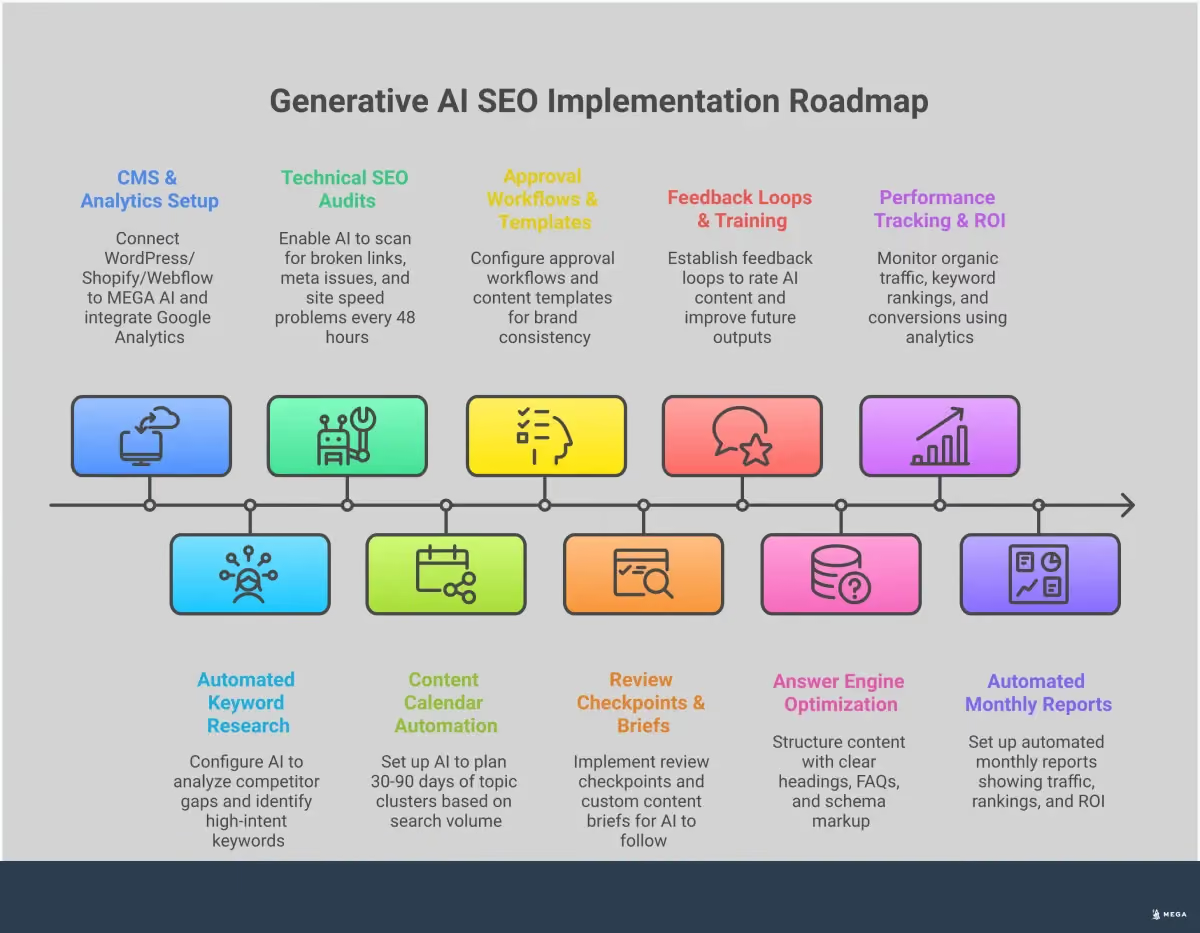
Getting your SEO strategy running with generative AI is more straightforward than you might think. The right platform handles the heavy lifting, from initial research to ongoing optimization. Instead of spending weeks learning complex tools or months searching for a reliable agency, you can set up an AI-powered campaign in a few simple steps. The process usually involves connecting your website, setting your business goals, and then deciding how much control you want over the day-to-day tasks.
Autopilot vs. Manual Control: Which is right for you?
Most generative AI SEO platforms offer two ways to work: fully automated or with manual review. An autopilot mode lets the AI agent plan and execute your entire SEO strategy without needing your approval for every task. This is a great option if you’re short on time and want to trust the system to deliver results. In fact, many businesses find this approach highly effective.
On the other hand, manual control gives you the final say. The AI will suggest content, keywords, and technical fixes, but it won't implement them until you give the green light. This approach works well if you want to maintain a high level of brand oversight or learn more about SEO strategy as you go. Combining AI-generated insights with your own expertise can be a powerful way to ensure your content is both optimized and perfectly aligned with your voice.
Launch Your First AI-Powered Campaign
Once you’ve chosen a platform, launching your first campaign is typically a simple onboarding process. You’ll start by integrating your content management system (CMS), like WordPress or Shopify, and connecting your Google Analytics account. This gives the AI the access it needs to analyze your site and publish new content. From there, you’ll define your core business objectives, such as increasing local traffic or generating more leads for a specific service.
The AI agent takes over from there. It begins with comprehensive keyword research and a competitive analysis to build a content strategy. Then, it starts to produce high-quality content designed to rank for your target terms and resonate with your audience. If you’d like to see how this process works from start to finish, you can book a demo to walk through the setup.
Measure Your Results and ROI
The goal of any SEO effort is to see a tangible return on your investment. A good generative AI service makes this easy by providing clear, data-driven reporting. Instead of getting lost in confusing spreadsheets, you can track your progress through a simple dashboard. Key metrics to watch include organic traffic growth, keyword ranking improvements, and click-through rates from search results.
Beyond traffic, it’s important to connect these metrics to actual business outcomes. Are you getting more phone calls, form submissions, or online sales? By analyzing user engagement and conversion data, the AI can refine its strategy over time to focus on the activities that drive the most value. This allows you to clearly see the impact of your investment and make informed decisions about your marketing budget.