
In most industries, you market to a single buyer. In HealthTech, you’re often speaking to an entire committee. A doctor needs clinical data, a hospital administrator wants to see a clear return on investment, and a patient is looking for empathy and understanding. A one-size-fits-all approach simply doesn't work. This complexity is the central challenge of creating content for Healthtech. Your strategy must be nuanced, with messages tailored to address the unique questions and priorities of each stakeholder. This article will show you how to segment your audience and develop content that builds credibility and resonates with everyone at the decision-making table.
Key Takeaways
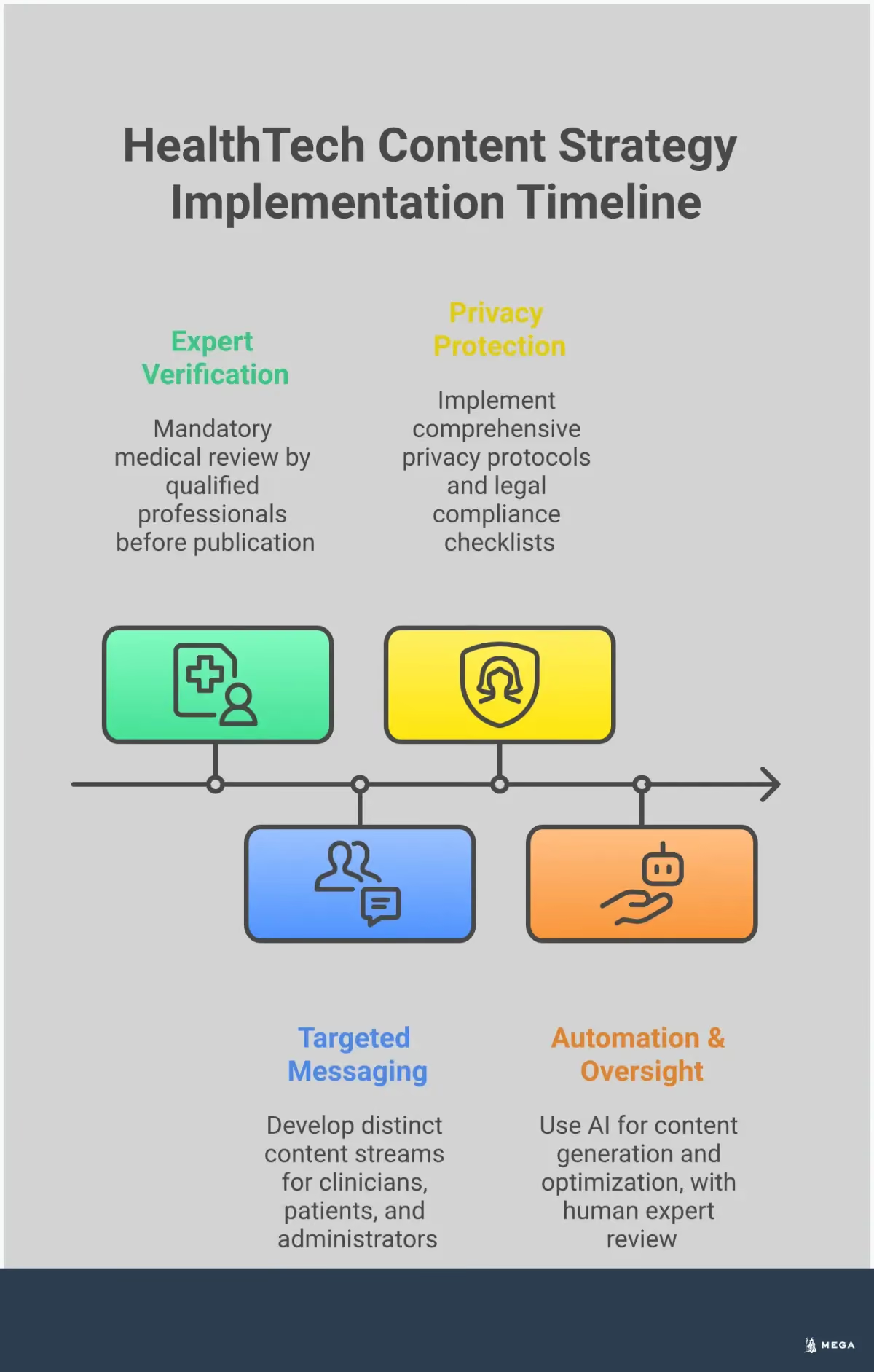
- Establish a non-negotiable review process: Build trust by ensuring every piece of content is vetted by medical and legal experts. This guarantees accuracy, protects your audience, and ensures compliance with regulations like HIPAA.
- Speak directly to each audience segment: Address the unique needs of clinicians, patients, and administrators with targeted content. Use data-driven whitepapers for professionals, empathetic stories for patients, and ROI-focused guides for decision-makers to build credibility across the board.
- Use automation with human oversight to scale: Leverage AI tools to handle keyword research, content drafting, and optimization efficiently. Pair this technology with mandatory expert review to maintain quality and accuracy as you increase your content output.
What Makes HealthTech Content Different?
Creating content in the HealthTech space is unlike marketing in any other industry. It’s not just about selling a product or service; it’s about building a deep foundation of trust with people making critical decisions about health and wellness. The stakes are incredibly high. A single piece of inaccurate information can have serious consequences, and a breach of privacy can erode credibility in an instant. Because of this, your content strategy needs to be built on three core pillars: strict regulatory adherence, communication with diverse audiences, and an unwavering commitment to technical accuracy. Getting these elements right isn't just good marketing—it's essential for protecting your audience and your business.
Adhering to Strict Regulations
The healthcare industry operates under a microscope of legal and ethical rules, and your content is no exception. Marketing in healthcare must follow strict guidelines, most notably the Health Insurance Portability and Accountability Act (HIPAA). This federal law protects sensitive patient health information, and its rules extend to how you use testimonials, case studies, and even images. Any content that includes or is derived from patient data requires explicit consent. Failing to comply can lead to severe penalties and a complete loss of trust. This regulatory environment means every piece of content must be created with a compliance-first mindset, ensuring patient privacy is always the top priority.
Speaking to Multiple Audiences
In HealthTech, the person who uses your product is rarely the only one you need to convince. The buying process is often complex, involving a committee of decision-makers with different priorities. Research shows that nearly 60% of organizations have five or more people involved in a technology purchase. Your content needs to speak to clinical leaders who care about patient outcomes, IT professionals focused on data security and integration, and financial stakeholders who need to see a clear return on investment. A successful content strategy addresses the unique questions and concerns of each of these audiences, translating complex features into tangible benefits for everyone at the table.
Ensuring Technical Accuracy
In health, accuracy is non-negotiable. Every claim you make, every statistic you cite, and every piece of advice you offer must be factually correct and supported by credible evidence. Your audience needs to know they can rely on your information to make informed decisions. This is why it’s critical to use reliable sources and have your content reviewed by subject matter experts before it goes live. Building authority in HealthTech means consistently providing information that is not only helpful but also verifiably true. This commitment to accuracy is the bedrock of a trustworthy brand and is essential for establishing your expertise in a crowded market.
What Are the Challenges of HealthTech Content?
Creating content in the healthtech space comes with a unique set of responsibilities. Unlike marketing a new pair of sneakers, healthtech content directly impacts people's well-being, decisions, and trust in medical technology. The stakes are incredibly high, which means your content strategy needs to be built on a foundation of accuracy, empathy, and strict adherence to industry rules. Navigating these challenges isn't just about avoiding penalties; it's about building a credible brand that both patients and professionals can rely on. From complex privacy laws to the need for crystal-clear communication, every piece of content requires a thoughtful and meticulous approach.
Complying with HIPAA and Privacy Rules
One of the biggest hurdles in healthtech marketing is navigating the web of privacy regulations, most notably the Health Insurance Portability and Accountability Act (HIPAA). These rules are designed to protect sensitive patient health information, and they extend to your marketing activities. This means you cannot use patient stories, images, or data in your content without obtaining explicit, written consent. Beyond testimonials, this also affects how you handle data from contact forms or website analytics. Building trust starts with respecting privacy, so ensuring your content and data collection practices are fully compliant is a non-negotiable first step for any healthtech company.
Making Complex Topics Easy to Understand
Healthtech is an industry built on innovation, which often involves sophisticated science and technology. The challenge is to explain these complex topics in a way that is accessible to your entire audience, from seasoned clinicians to patients who are new to a diagnosis. Using heavy medical jargon or overly technical language can alienate readers and make your content ineffective. The key is to translate complex features into clear benefits. Focus on writing in plain language that breaks down difficult concepts, uses analogies, and always centers on how your technology helps solve a real-world problem for the user.
Avoiding Inaccuracy and Liability
In health and wellness, accuracy is everything. A single piece of misinformation can have serious consequences, damaging your brand's credibility and potentially leading to legal liability. All information you publish must be factually correct, current, and supported by credible evidence. This is especially important for search engine optimization, as Google holds health-related content to a higher standard known as Your Money or Your Life (YMYL). To meet this standard, you need a rigorous review process involving subject matter experts to ensure every claim is vetted before it goes live.
Addressing Long Sales Cycles
Healthtech purchases are rarely impulsive. The sales cycle can often take months or even years, involving multiple decision-makers, from doctors and IT staff to hospital administrators. Your content strategy must be designed to support this long journey. A single blog post won't be enough. You need to create a steady stream of valuable content that nurtures leads over time, building trust and keeping your solution top-of-mind. This involves developing a content marketing funnel with materials tailored to each stage, from initial awareness articles to in-depth case studies and whitepapers that help stakeholders make an informed decision.
Which Content Formats Engage HealthTech Audiences?
Choosing the right format for your HealthTech content is just as important as the information itself. Different audiences—from clinicians to patients to hospital administrators—consume information in different ways. A research paper that impresses a physician might overwhelm a patient, while a patient testimonial that builds trust with consumers might not provide the hard data an administrator needs. By diversifying your content formats, you can meet your audience where they are and build trust across the board. Here are some of the most effective formats for engaging HealthTech audiences.
Educational Blog Posts
Educational blog posts are a cornerstone of HealthTech content marketing. They provide a platform to answer common questions, explain complex medical conditions in simple terms, and share preventative care tips. This format helps you build trust and credibility by offering valuable information without a hard sell. You can also feature patient stories or expert interviews to make the content more relatable. Consistently publishing helpful, well-researched articles positions your brand as a reliable resource for both patients and professionals. An AI-powered SEO agent can help identify the questions your audience is asking and create optimized content to meet their needs.
Demos and Webinars
For B2B HealthTech companies, showing your product in action is critical. Health-tech buyers often want hand-holding, not hype, and demos and webinars deliver just that. A short, clear demo video can explain how your software simplifies a clinical workflow, while a live webinar allows for interactive Q&A with potential customers. These formats cut through the marketing noise and provide tangible proof of your product’s value. They give healthcare professionals the confidence they need to consider adopting a new technology by showing them exactly how it works and how it can solve their specific problems.
In-Depth Whitepapers and Reports
When your audience includes clinicians, researchers, or healthcare executives, you need to provide substantive, data-driven content. In-depth whitepapers and reports are the perfect format for establishing authority. Use them to present original research, analyze industry trends, or detail the clinical evidence supporting your technology. This type of content helps you connect with patients and clients online by demonstrating a deep understanding of the medical landscape. While they require more investment to create, well-researched whitepapers serve as powerful lead-generation tools and can be repurposed into blog posts, webinars, and infographics.
Patient Stories and Testimonials
In healthcare, personal experiences are incredibly powerful. Patient stories and testimonials humanize your technology and build an emotional connection with your audience. Hearing directly from someone whose life was improved by your product is more persuasive than any technical feature list. Word-of-mouth is a major driver in health decisions, and testimonials are its digital equivalent. Whether in video or written format, these stories provide the social proof needed to build trust with prospective patients and demonstrate your solution's real-world impact to clinicians and hospital administrators.
Infographics and Data Visuals
Health information can be dense and overwhelming. Infographics and other data visuals make complex topics accessible and easy to digest. Use them to break down statistics, illustrate a patient journey, or explain a complicated medical procedure. Visuals are a great way to show data and facts in a way that’s easy to understand. Because they are visually appealing and simple to share, infographics can extend the reach of your content on social media and other platforms. They are an effective tool for educating a broad audience, from patients to busy healthcare professionals.
How to Ensure Your HealthTech Content is Accurate and Compliant
In the HealthTech space, content isn't just about marketing; it's about building a foundation of trust with your audience. Unlike other industries, the information you share can directly influence decisions about health and wellness, which means the stakes are incredibly high. Accuracy and compliance aren't optional—they are the cornerstones of a responsible and sustainable content strategy. Every piece of content you publish must be meticulously vetted to protect your audience and your business.
Navigating regulations like HIPAA while translating complex medical topics for different audiences requires a structured and thoughtful approach. This means putting processes in place that guarantee every blog post, whitepaper, and patient story is not only engaging but also factually sound and legally compliant. While AI tools can help you scale content creation, the human element of verification and expert oversight remains essential. Think of it as a system of checks and balances that ensures quality and builds the credibility your brand needs to succeed. The following steps will help you create a framework for producing content you can stand behind.
Establish a Medical Review Process
Before any piece of content goes live, it should be reviewed by a qualified medical professional. This is a non-negotiable step for establishing credibility in the HealthTech industry. A medical reviewer—whether a doctor, nurse, or subject matter expert with relevant credentials—verifies that all clinical information is accurate, up-to-date, and aligned with current medical standards. This process does more than just catch errors. It demonstrates a genuine commitment to your audience's well-being and protects your organization from the serious risks associated with spreading misinformation. Formalizing this review ensures every asset you publish is trustworthy and responsible.
Verify Sources and Fact-Check Everything
The strength of your content depends on the quality of your sources. Every claim, statistic, and recommendation must be backed by information from reputable organizations, such as government health agencies, peer-reviewed scientific journals, and established medical institutions. Make it a standard practice to cite your sources clearly, allowing readers to see the evidence for themselves. This transparency not only builds trust but also strengthens your content's authority. You can even license content from well-known, respected sources to add another layer of credibility to your brand and its resources.
Implement Clear Approval Workflows
A well-defined approval workflow is your best defense against accidental errors and compliance issues. This process should map out every step a piece of content takes, from the initial draft to final publication, and assign clear ownership for each stage. This includes writing, editing, the medical review, a legal check, and final sign-off. Using a content calendar or project management tool can help you track progress and ensure no step is missed. For instance, you can have your AI agent publish articles to drafts within your CMS, allowing your team to conduct all necessary reviews before the content goes live.
Use Legal Compliance Checklists
The healthcare industry is governed by strict rules, and your content must adhere to them. Creating a legal compliance checklist is a practical way to ensure every piece of content meets the necessary requirements. This checklist should cover critical areas like HIPAA regulations to protect patient privacy, ensuring you make no unsubstantiated claims about your products or services, and including necessary disclaimers. A standard disclaimer might clarify that your content is for informational purposes only and does not constitute medical advice. This systematic approach helps you manage risk and operate ethically.
How to Build Trust with HealthTech Content
In the HealthTech industry, trust isn't just a marketing goal; it's a prerequisite. Your audience—whether they are clinicians, patients, or administrators—is making decisions that have real-world health implications. The content you create is often their first point of contact with your brand, and it plays a massive role in establishing your credibility. Building that trust requires a deliberate strategy that goes beyond standard content marketing practices. It’s about demonstrating expertise, showing empathy, and consistently providing accurate, reliable information.
Every piece of content, from a blog post to a whitepaper, is an opportunity to prove that your organization is a trustworthy partner. This means prioritizing accuracy over speed, clarity over jargon, and transparency over salesmanship. By focusing on a few core principles, you can create a content program that not only attracts and engages your audience but also builds the lasting confidence needed to succeed in the health space. The following strategies are fundamental to creating content that resonates with HealthTech audiences and establishes your brand as a credible authority.
Feature Medical Experts
One of the most effective ways to build credibility is to associate your content with recognized medical professionals. When you feature insights from doctors, clinicians, or researchers, you are showing your audience that your information is vetted by people they already trust. This isn't just about name-dropping; it's about integrating their expertise into the core of your content. You can do this by co-authoring articles with a physician, hosting webinars with clinical specialists, or establishing a medical review board to approve your content before it goes live. This approach directly supports the "Expertise" component of Google's E-E-A-T guidelines, signaling to both users and search engines that your content is authoritative.
Be Transparent with Sources
Every claim you make in your HealthTech content should be backed by a reliable source. In an industry where misinformation can have serious consequences, transparency is non-negotiable. Always cite your sources clearly, linking directly to peer-reviewed studies, established medical journals, or official reports from government health organizations like the Centers for Disease Control and Prevention (CDC). This practice not only protects your brand from liability but also empowers your readers to verify the information for themselves. Being open about where your data comes from shows respect for your audience and reinforces your commitment to providing accurate, trustworthy content. It’s a simple but powerful way to build confidence in your brand.
Showcase Social Proof and Testimonials
While expert opinions build authority, real-world stories build connection and relatability. Social proof, such as patient testimonials or case studies from healthcare providers, demonstrates the tangible impact of your product or service. These stories offer a human element that data alone cannot provide. Encourage satisfied clients to share their experiences, whether through written reviews, video interviews, or detailed case studies. Featuring these authentic narratives helps prospective customers see themselves in the success of others, making your solution feel more accessible and trustworthy. This kind of user-generated content is invaluable for bridging the gap between clinical facts and real-life application.
Share Valuable Insights to Build Authority
To truly establish your brand as a leader, your content needs to do more than just state facts; it must provide valuable insights that help your audience solve problems or understand complex topics. This is your chance to become a go-to resource in your niche. Develop content that analyzes emerging industry trends, simplifies complicated regulatory changes, or offers a unique perspective on common challenges. By consistently publishing thoughtful, educational material, you position your brand as an expert. An effective SEO strategy can help identify the questions your audience is asking, allowing you to create content that directly addresses their needs and solidifies your authority in the field.
How to Create Content for Different HealthTech Audiences
In HealthTech, your audience is never just one group of people. You’re often speaking to doctors, patients, hospital administrators, and investors—all at the same time, and each with a completely different set of priorities and concerns. A clinician wants to see clinical data and efficiency gains, while a patient needs clear, empathetic guidance. An administrator is focused on ROI and compliance, and an investor is looking at market potential and thought leadership.
A one-size-fits-all content strategy simply won’t work. To build trust and authority, you need to tailor your message, format, and tone for each specific segment. This means understanding what questions they’re asking, what problems they need to solve, and what proof they need to see before they’ll trust you. Creating distinct content streams for each audience allows you to address their unique needs directly, making your marketing more effective and your brand more credible. The following sections break down how to approach each of these key groups.
For Healthcare Professionals and Clinicians
This audience is analytical, evidence-based, and short on time. They need to see proof that a solution works and can be integrated into their workflow without causing disruption. Vague claims won’t work; you need to back up your content with hard data, clinical studies, and peer-reviewed research. Product demonstrations and case studies are highly effective because they provide tangible evidence of your product’s value. To build credibility, feature healthcare experts in your content. Their insights and endorsements add a layer of trust that is essential when communicating with medical professionals. Your content should be direct, data-driven, and respectful of their expertise.
For Patients and Caregivers
When creating content for patients and caregivers, the focus should shift from data to empathy and clarity. This audience is often seeking answers during a stressful time, so your primary goal is to provide clear, accessible, and reassuring information. It's critical to avoid medical jargon and explain complex topics in simple terms. One of the most powerful ways to build trust is by sharing real-life patient stories and testimonials. User-generated content, especially in video format, creates an authentic connection and shows the real-world impact of your solution. Your content should empower patients with the knowledge they need to make informed decisions about their health.
For Healthcare Administrators
Healthcare administrators are focused on the operational and financial health of their organization. Your content needs to address their core challenges: improving efficiency, ensuring compliance, reducing costs, and demonstrating a clear return on investment. This audience includes people in clinical leadership, IT, and finance, so your content should speak to their different roles and concerns. Instead of creating content randomly, develop a written strategy that maps out topics relevant to their business goals. Formats like whitepapers, ROI calculators, and detailed implementation guides are valuable because they help administrators build a business case for adopting your technology.
For Investors and Stakeholders
Investors and stakeholders are looking at the bigger picture. They want to understand your company’s vision, competitive advantage, and potential for growth. Your content should position your organization as a thought leader and a trusted expert in its niche. Focus on what your organization does best and how it is shaping the future of healthcare. Share high-level insights, market analysis, and forward-looking perspectives that demonstrate your deep industry knowledge. Content marketing for this audience is about building confidence in your brand and its long-term strategy, helping you stand out from the competition and attract the right partners.
What is the Role of SEO in HealthTech?
Search engine optimization (SEO) is the process of making your content more visible to people searching for answers online. In HealthTech, its role is even more critical. SEO connects your solutions, research, and expertise with the patients, clinicians, and healthcare administrators who need them most. It’s not just about ranking first on Google; it’s about establishing your organization as a credible, authoritative source of information in a field where trust is everything.
A strong SEO strategy ensures that when someone searches for a specific medical technology or a solution to a healthcare challenge, your content appears as a helpful and reliable answer. This involves understanding what your different audiences are looking for, creating content that meets their needs, and structuring it in a way that search engines can easily understand and rank. For HealthTech companies, effective SEO builds brand awareness, generates qualified leads, and solidifies your position as a leader in the industry. It’s the foundation for a digital presence that educates, informs, and builds lasting relationships.
Find the Right Medical Keywords
Keyword research is the first step in any successful SEO plan. It’s about finding the specific words and phrases your audience types into search engines. For example, a patient might search for "symptoms of iron deficiency," while a clinician might search for "new treatments for anemia." Your job is to identify both types of keywords and create content that serves each audience.
Think about the intent behind the search. Is the person looking for information, comparing solutions, or ready to make a decision? A solid keyword strategy helps you create articles, guides, and landing pages that directly address the questions your audience is asking. Using these terms naturally within high-quality, educational content is key.
Optimize for E-E-A-T
In the world of health content, Google holds you to a higher standard called E-E-A-T, which stands for Experience, Expertise, Authoritativeness, and Trustworthiness. Because health topics fall under the "Your Money or Your Life" (YMYL) category, search engines are extra careful about the information they promote. To build trust, you need to demonstrate that your content is accurate and created by qualified people.
This means including author bios with credentials for your medical writers and reviewers, citing reputable sources for all claims, and being transparent about your information. Building a reputation for trustworthy content is essential not only for ranking well in search results but also for earning the confidence of your readers, who rely on you for accurate health information.
Optimize for AI Search and LLMs
The way people find information is changing. AI engines like ChatGPT and Google's AI Overviews are becoming go-to sources for answers. This means you need to optimize your content not just for traditional search, but for AI as well. AI optimization involves structuring your content so that large language models (LLMs) can easily read, interpret, and cite it.
To do this, use clear headings to organize your topics, write in short, concise paragraphs, and use bulleted lists to break down complex information. Think about the direct questions your audience might ask and provide clear, straightforward answers. This approach makes your content more digestible for both humans and AI, improving how your business shows up in these new AI-powered search tools.
Use Local SEO for Healthcare Providers
If you are a healthcare provider serving a specific community, local SEO is essential. This practice helps local patients find you when they search for terms like "pediatrician near me" or "urgent care in [Your City]." The foundation of local SEO is a complete and accurate Google Business Profile, which displays your location, hours, and patient reviews in search results and on Google Maps.
Beyond that, focus on creating content that is relevant to your local area. This could be a blog post about managing seasonal allergies in your region or a page about community health events you sponsor. These efforts help you connect with patients in your community and establish your practice as a trusted local resource.
What Tools Can Streamline HealthTech Content Creation?
Creating high-quality, compliant HealthTech content requires a structured approach. The right set of tools can make this process more efficient, helping your team manage complex workflows, maintain accuracy, and measure performance without getting overwhelmed. From generating initial drafts to tracking engagement, these platforms are designed to support the unique demands of the healthcare industry. By integrating these solutions, you can build a scalable content engine that consistently produces trustworthy and effective materials.
AI Content Generation and Optimization Tools
AI-powered platforms can act as a force multiplier for your content team. These tools can help you produce expert-level, research-driven content tailored for any search engine or Large Language Model (LLM). For HealthTech companies that need to publish accurate and up-to-date information at scale, this is a significant advantage. An autonomous SEO agent can handle everything from keyword research to writing on-brand articles, freeing up your experts to focus on review and strategy. This allows you to scale your content efforts while ensuring every piece aligns with your brand's authority and expertise.
Compliance Management Software
Healthcare marketing operates under strict regulations like HIPAA, which protects patient privacy. All published information must be accurate and current. Compliance management software provides a framework for navigating these rules. These platforms help you create and manage legal checklists, track necessary disclosures, and maintain an audit trail for all content approvals. Using a dedicated tool ensures that your marketing materials meet all legal requirements, which helps you build patient trust and avoid serious penalties. It’s a critical investment for maintaining integrity in a highly regulated field.
Collaboration and Approval Tools
HealthTech content often needs review from multiple departments, including clinical, legal, and marketing teams. Collaboration and approval tools centralize this entire process. Instead of managing feedback through endless email chains, these platforms create a single source of truth where stakeholders can leave comments, suggest edits, and provide formal sign-offs. This structured workflow ensures that every piece of content is thoroughly vetted by the right experts before it goes live. It also creates a clear record of approvals, which is essential for accountability and compliance.
Analytics and Performance Trackers
To understand if your content is effective, you need to measure its performance. Analytics tools like Google Analytics show you how your audience interacts with your content, revealing metrics like page views, session duration, and user demographics. This data helps you identify which topics resonate most with your audience. You can also track where your content ranks for important keywords and use these insights to refine your strategy. By regularly reviewing performance data, you can make informed decisions that improve your content's reach and impact over time.
How to Measure Your HealthTech Content's Success
Measuring the impact of your HealthTech content requires looking beyond simple traffic numbers. Because trust and authority are your primary goals, you need to focus on metrics that reflect genuine engagement and demonstrate how your content supports business objectives. Success isn't just about how many people see your content; it's about whether the right people see it, trust it, and take a meaningful next step. This means tracking a mix of engagement, conversion, and long-term relationship metrics to get a complete picture of your performance.
Look Beyond Page Views
While page views can indicate reach, they don’t tell you much about quality or impact. A single, highly engaged reader, like a hospital administrator who reads your entire whitepaper, is far more valuable than a thousand casual visitors who leave after a few seconds. Instead of focusing solely on traffic volume, prioritize key performance indicators (KPIs) that measure audience interest and content quality. Pay attention to metrics like average time on page, pages per session, and scroll depth. These figures show whether your audience finds your content valuable enough to stick around and explore. A low bounce rate is also a positive signal, indicating that your content successfully meets the expectations of your visitors.
Track Key Engagement Metrics
To understand what resonates with your audience, you need to track how they interact with your content. Use tools like Google Analytics to monitor user behavior and identify patterns. Do articles about patient data security get more shares than posts about new medical devices? Does your webinar on regulatory changes have a higher completion rate than your product demos? Answering these questions helps you refine your content strategy. This data-driven approach is fundamental to effective SEO, as it allows you to double down on what works. By analyzing engagement, you can identify content gaps and create more of what your specific audience segments—be they clinicians, patients, or administrators—are looking for.
Use Conversion Tracking and Attribution
Ultimately, your content should contribute to your business goals. In HealthTech, a conversion isn't always a direct sale. It can be a demo request, a whitepaper download, a webinar sign-up, or a contact form submission from a potential partner. It’s essential to set up conversion tracking to understand which articles and resources are driving these valuable actions. This helps you attribute leads and revenue back to your content marketing efforts, proving its value to stakeholders. By connecting content performance to business impact, you can make a strong case for continued investment and focus your resources on the topics and formats that generate the most qualified leads.
Measure Long-Term Relationship Building
HealthTech often involves long sales cycles and decisions based on deep-seated trust. Content marketing is a long-term strategy that builds that trust over time, so you need to measure its cumulative effect. Expect to see meaningful results within six to twelve months, not overnight. Track metrics that indicate a growing relationship with your audience, such as newsletter subscriptions, return visitor rates, and an increase in branded search queries. Each accurate, helpful article you publish strengthens your brand's authority. This sustained effort is what establishes your company as a credible, go-to resource in the industry, paving the way for future growth and customer loyalty.
How to Scale Your HealthTech Content
Scaling your content in the HealthTech space presents a unique challenge. You need to produce more to reach a wider audience and build authority, but you can't afford to let quality, accuracy, or compliance slip. Growing your content program requires a deliberate strategy that balances efficiency with the rigorous standards your industry demands. By focusing on smart workflows, unwavering quality control, and the right technology, you can expand your reach without sacrificing the trust you’ve worked so hard to build.
Build Efficient Content Workflows
To scale effectively, you need a repeatable system. Instead of trying to launch a blog, a video channel, and a webinar series all at once, start small. Perfect your process for one or two key content formats first. Document every step, from initial topic ideation and research to writing, editing, and the essential medical review stage. Creating a clear content workflow establishes a predictable path for every piece of content. This structure minimizes confusion and makes it easier to increase your output over time, ensuring that growth is manageable and not chaotic.
Maintain Quality and Compliance as You Grow
As your content library expands, the risk of publishing inaccurate or non-compliant information increases. In HealthTech, trust is everything, and that trust is built on accuracy. Every piece of information you share must be correct, up-to-date, and properly sourced. As you scale, your quality control measures must scale too. This means formalizing your review process with mandatory checkpoints for medical accuracy and legal compliance. This isn't a step to be skipped when deadlines are tight; it's a fundamental part of a responsible content strategy that protects both your audience and your organization.
Create a Sustainable Content Calendar
Random acts of content won't lead to sustainable growth. A well-planned content calendar is your strategic guide to scaling. It allows you to move from a reactive to a proactive approach, mapping out topics weeks or months in advance. Plan your content around quarterly themes that align with your business objectives and address the core needs of your audience. A detailed content calendar ensures a steady stream of relevant material and gives your team ample time for thorough research, writing, and review. This foresight is key to maintaining high quality as you increase your publishing frequency.
Use Automation with Human Oversight
Relying solely on manual effort makes scaling difficult and expensive, especially for small teams. Automation can be a powerful partner, but it must be used thoughtfully. AI can act as an autonomous SEO team, helping you generate research-driven drafts and optimize articles for search. For instance, MEGA AI’s Maintenance Agent can continuously update existing content to improve its performance by adding new research and fixing broken links. The key is to pair this efficiency with human expertise. Use AI for the heavy lifting, but ensure that a qualified expert always has the final say. This human-in-the-loop model provides the speed of automation with the critical assurance of human verification.