
A top ranking on Google is great, but what if you could get a direct endorsement from a trusted research assistant? That’s the power of a ChatGPT recommendation. When a user asks for a solution and the AI names your business, it’s not just another link; it’s a powerful validation that positions you as the definitive answer. This is a new frontier for getting discovered by customers who are actively looking for what you offer. To earn this placement, your website must be seen as an undeniable authority. This guide will show you how to build that authority, structure your content for AI, and implement the technical SEO needed to get found, understood, and ultimately recommended.
Key Takeaways
- Become a trusted source by building authority: AI models synthesize information from many places, so your goal is to appear as a consistent and credible expert across multiple related queries, not just a single keyword.
- Structure your content to provide direct answers: Optimize for specific, question-based searches and organize your articles into topic clusters to demonstrate deep knowledge on a subject, making it easy for AI to use your information.
- Combine technical SEO with content maintenance: Use structured data and a clear site hierarchy to help AI understand your content, and continuously update your articles to ensure they remain fresh and reliable sources.
What Is a ChatGPT Recommendation and Why Does It Matter?
When we talk about a ChatGPT recommendation, we’re not talking about a simple blue link on a search results page. A recommendation is when your business, product, or content is woven directly into the AI’s generated answer. For example, if a user asks, “What are the best tools for a small local bakery to manage inventory?” and ChatGPT names your software in its response, that’s a powerful endorsement. It positions your brand as a trusted solution, not just another option in a long list.
This matters because ChatGPT doesn’t function like a traditional search engine. It acts more like a research assistant. When it receives a query, it breaks it down into dozens of smaller, specific questions and scours the web for answers. It then performs a process called information synthesis, piecing together data from various sources to form a single, coherent response. It looks for brands and information that appear consistently and favorably across the web.
For a small business, earning a recommendation from an AI model is a significant opportunity. It builds immense credibility, as the suggestion appears to be an objective, data-backed answer. The users asking these detailed questions are often highly motivated and close to making a purchasing decision. This isn't just about getting seen; it's about being presented as the definitive answer at the exact moment a potential customer is looking for it. As more people use AI tools for discovery, securing your place in these conversations is essential for future growth.
Key Statistics on AI Search Adoption
The shift toward AI for discovery isn't a distant trend; it's happening right now. Consider that tools like ChatGPT already have 1 billion active users who submit 2.5 billion prompts every day. This volume is quickly approaching the scale of traditional search engines. More importantly for businesses, this behavior is directly influencing purchasing decisions. Traffic to US retail websites from generative AI sources has jumped by 1200%, showing that consumers are using these platforms to find products and services. This adoption extends beyond just shopping; a 2024 study found that 30% of students and teachers use AI tools for various tasks, signaling a fundamental change in how people find and process information.
AI SEO vs. Traditional SEO: A New Approach
The strategy for getting noticed online is changing. Traditional SEO has always been a game of keywords, where the goal is to rank number one for a specific search term. AI SEO, however, is about becoming a recognized authority on a topic. Instead of focusing on a single keyword, the goal is to build a deep and trustworthy library of information that an AI model can synthesize to answer complex questions. It’s a shift from trying to win a search query to earning a place in a detailed, conversational answer. This new approach requires you to think less like a marketer and more like a subject matter expert, focusing on creating a comprehensive and reliable resource for your audience.
Focusing on Trust and Reputation
AI models like ChatGPT are designed to provide reliable and accurate information, which means they prioritize sources they can trust. Building this trust goes beyond your website’s content. The AI evaluates your entire digital footprint, looking for consistency and credibility across multiple platforms. For local businesses, this means ensuring your name, address, and phone number are identical across your website, Google Business Profile, and other online directories. Inaccurate information can signal to an AI that your business is not a reliable source. Consistently demonstrate your expertise and keep your content current to establish your site as a dependable resource over time.
The Rise of Conversational Content
People interact with AI using natural, conversational language, and the content that performs best in this environment does the same. To get recommended, you need to write like you’re talking to a customer, avoiding industry jargon and complex terms. Structure your content to directly answer the questions your audience is asking. Think about creating dedicated FAQ sections or blog posts that tackle a specific problem from start to finish. This straightforward, question-and-answer format makes it easy for an AI to parse your content and confidently use it to construct a helpful response for a user, positioning you as the go-to expert.
Understanding Answer Engine Optimization (AEO)
Answer Engine Optimization, or AEO, is the practice of optimizing your content to be featured in the responses of AI-powered answer engines like ChatGPT and Google’s Gemini. Unlike traditional SEO, the primary goal of AEO isn’t to earn a click to your website. Instead, the objective is to get your brand, product, or service mentioned directly within the AI’s generated answer. This strategy focuses on building brand awareness and influencing potential customers at the moment they are seeking information. It positions your business as a definitive solution, recommended by an authoritative source, which can be far more impactful than a simple link on a results page.
Moving Beyond Clicks to Citations
In traditional SEO, success is often measured by click-through rates and website traffic. With AEO, the key metric is the citation—a direct mention of your brand. When ChatGPT names your company as a solution, it acts as a powerful third-party endorsement. This mention builds brand recognition and credibility, even if the user doesn’t visit your site right away. The user, now aware of your brand as a trusted option, is more likely to search for you directly later on. A citation is less about immediate traffic and more about influencing the user’s consideration set when they are ready to make a decision, making it a vital long-term play.
How to Choose Questions to "Own"
To succeed with AEO, you need to be strategic about which questions you want your brand to "own." Start by identifying the core problems your product or service solves and frame them as questions. A good strategy involves targeting a mix of question types:
- Must-win questions: These are directly related to your business offerings. If you run a local coffee shop, a must-win question would be, “Where can I find the best espresso in [Your City]?”
- Competitive questions: These questions allow you to highlight your unique value. For example, “What is the difference between cold brew and iced coffee?”
- New, experimental questions: These are broader, informational queries that establish your expertise. An example might be, “How do you make coffee without a coffee maker?”
By creating comprehensive, clear answers to these types of questions, you can build the topical authority needed to become a go-to source for AI models. Tools that help with automated keyword research can simplify the process of finding these high-value questions and structuring your content to answer them effectively.
How Does ChatGPT Find and Recommend Information?
To get your business recommended by ChatGPT, you first need to understand how it thinks. It’s not a simple search engine that just finds and displays a link. Instead, it acts like a research assistant, following a methodical process to find, understand, and present information. When you ask it a question, it doesn't just pull a single answer from a database. It performs a complex, multi-step operation to construct a response from scratch.
This process can be broken down into three key stages: breaking down the initial query, gathering information from a wide range of sources, and then synthesizing that data into a coherent, human-like answer. By understanding each of these stages, you can see where your content fits in and how to position your business as a go-to source for the AI. It’s less about chasing an algorithm and more about becoming a reliable and authoritative voice in your field. The content that succeeds is the content that helps ChatGPT do its job better.
Breaking Down User Queries
When ChatGPT receives a broad request, its first step is to deconstruct it. It doesn't try to answer a big question all at once. Instead, it breaks it down into a series of smaller, more specific sub-queries. For example, a prompt like, "Plan me a 5-day trip to Japan," gets fanned out into dozens of hyperspecific searches for things like "best time to visit Tokyo," "how to use the Japan Rail Pass," and "top-rated sushi restaurants in Kyoto." For your business, this means your content strategy needs to go deep, providing clear answers to the niche questions your potential customers have.
Sourcing Information From Its Training Data
Once ChatGPT has its list of smaller questions, it begins gathering data. It scans the web, pulling information from countless sources to find potential answers. According to Zapier, "ChatGPT chooses its sources based on multiple, precise keywords, search intent, recency, and credibility." This means it’s looking for content that is not only relevant but also up-to-date and trustworthy. Building online credibility is crucial, as the AI prioritizes information from sources that have demonstrated expertise and authority on a given topic. Your content needs to be a strong signal in all these areas to make the cut.
Synthesizing and Prioritizing the Best Answer
The final step is synthesis. ChatGPT doesn't just copy and paste information. It analyzes everything it has gathered, identifies patterns, cross-references facts, and looks for consensus among the most reliable sources. Think of it as a process that turns raw data into a finished report. As research firm InnerView explains, data synthesis is what "transforms raw information into actionable insights." If your website provides comprehensive, accurate, and well-structured information that aligns with other authoritative sources, it has a much higher chance of influencing—or being directly cited in—the final answer.
What Kind of Content Does ChatGPT Prioritize?
To optimize your content for ChatGPT, it helps to first understand what it looks for. Unlike a person, ChatGPT doesn't have opinions or preferences. Instead, it functions as a sophisticated pattern-recognition machine, synthesizing information from the vast amount of data it was trained on and what it can browse on the live web. When it looks for current information, it seeks out signals of authority, reliability, and relevance to provide the most helpful answer to a user's prompt.
Think of it this way: when you ask a group of experts a question, you're more likely to trust an answer that several of them agree on, that comes from a credible source, and that completely addresses your query. ChatGPT operates on a similar principle, just at a massive scale. It cross-references information, weighs the credibility of sources, and pieces together the most comprehensive response possible. The content it recommends consistently excels in four key areas: it shows up consistently across related searches, it comes from an authoritative source, it covers a topic in-depth, and it answers very specific, niche questions.
Consistent Information Across Multiple Sources
When ChatGPT receives a query, especially a broad one, it often breaks it down into dozens of smaller, more specific searches to gather a complete picture. It then analyzes the results to see which brands, websites, or sources appear most consistently and favorably across those searches. If your business is mentioned as a great option for "sourdough starter kits," "baking tools for beginners," and "best online baking supplies," you have a much higher chance of being recommended than a site that only appears for one of those queries. This process rewards brands that have built a strong, multifaceted online presence. The goal is to be a consistent, reliable voice in your field, not just a one-hit-wonder for a single keyword.
Content With Authoritative and Credible Signals
Credibility is a major factor in how ChatGPT chooses its sources. It prioritizes information that is recent, well-supported, and comes from a source with demonstrated expertise. Signals of authority can include backlinks from other reputable websites, positive mentions in articles or reviews, and content that is clearly well-researched. An outdated article from 2015 is far less likely to be sourced than a comprehensive guide that was updated last month. Building your site's E-E-A-T (Experience, Expertise, Authoritativeness, and Trust) isn't just for traditional search engines; it’s a critical component for establishing the trust needed to become a recommended source for AI models.
In-Depth and Comprehensive Topic Coverage
ChatGPT’s primary goal is to provide a complete, satisfying answer. It favors content that demonstrates a deep understanding of a subject by covering it from multiple angles. This is where information synthesis comes into play; the AI gathers information from various points and combines it into a cohesive whole. A single blog post answering one question is good, but a cluster of interlinked articles that cover an entire topic is much better. By creating a resource hub that addresses a main topic and all its related sub-topics, you position your website as the definitive source, making it an ideal place for ChatGPT to pull information from.
A Strong Presence in Niche Search Results
As users become more skilled at writing prompts, their queries become more specific. They aren't just asking for "coffee makers"; they're asking for "quiet coffee makers for a small apartment under $100." ChatGPT needs to find content that directly answers these detailed, long-tail questions. This creates a significant opportunity for small businesses with deep expertise in a particular area. By creating content that addresses these highly specific needs, you can become the go-to source for niche queries. This not only helps you get recommended by AI but also attracts high-intent customers who know exactly what they're looking for.
Building Online Authority for AI Recommendations
Creating great content is only half the battle. To become a source that ChatGPT trusts and recommends, your business needs to build authority. Think of it this way: authority isn't just about what you say about yourself; it's about what the rest of the internet says about you. AI models act like digital researchers, piecing together information from countless sources to determine which businesses are credible, reliable, and well-regarded. They look for external signals of trust that validate the claims you make on your own website.
These signals come in many forms, including customer reviews on third-party sites, mentions in industry articles, and complete listings in local directories. Each positive mention acts as a vote of confidence, reinforcing your reputation as an expert in your field. When an AI model sees your business being praised consistently across different platforms, it learns to trust you as a reliable source. The following strategies focus on building these external signals, which are essential for earning a place in AI-generated answers.
Leverage Online Reviews and Customer Feedback
Customer reviews are one of the most direct and powerful forms of social proof available to your business. For an AI model, reviews are a rich dataset that provides insight into your reputation, customer satisfaction, and overall trustworthiness. It doesn't just see a star rating; it analyzes the volume, recency, and sentiment of the feedback. A steady stream of recent, positive reviews signals that your business is active, consistently delivering quality, and valued by its customers. This makes you a much safer and more reliable option for an AI to recommend to a user looking for a solution.
The Importance of Third-Party Review Sites
Where your reviews live matters just as much as what they say. AI models like ChatGPT are known to pull information from major, established review platforms because they offer structured and credible data. Focus on building a strong presence on sites that are relevant to your industry, such as Google, Yelp, G2, or Trustpilot. A complete and detailed profile on these platforms, filled with a high volume of positive customer feedback, creates a clear and consistent signal of your authority. This makes it easy for an AI to verify your reputation and confidently include your business in its recommendations.
Responding to Good and Bad Reviews
Simply collecting reviews isn't enough; active engagement is key. Make it a practice to respond to all customer feedback. Thanking customers for positive reviews shows appreciation and can encourage others to share their good experiences. More importantly, addressing negative reviews professionally and constructively demonstrates that you are committed to customer satisfaction and value feedback. This public engagement sends a strong signal to both potential customers and AI models that your business is responsive, accountable, and trustworthy, further solidifying your online authority.
Acquire High-Quality Backlinks
Think of a backlink as a vote of confidence from another website. When a reputable site links to yours, it’s essentially telling its audience—and search algorithms—that your content is valuable and trustworthy. AI models recognize these endorsements as a powerful signal of authority. However, quality is far more important than quantity. A single backlink from a well-respected industry blog or a local news outlet carries significantly more weight than dozens of links from low-quality directories. You can earn these valuable links by creating exceptional content that others want to reference, collaborating with local organizations, or getting featured for your expertise.
Optimize Your Google Business Profile for Local SEO
For any local business, your Google Business Profile (GBP) is a foundational piece of your online presence. When an AI model needs to provide a location-specific recommendation, your GBP is often its primary source of truth. It’s critical to ensure your profile is not only claimed but also meticulously optimized. This means your business name, address, and phone number (NAP) are accurate and consistent everywhere online. It also means your hours, services, and categories are filled out completely, and you’ve uploaded high-quality photos. An optimized GBP provides AI with the structured, reliable data it needs to understand exactly what you do and why you’re a great choice for nearby customers.
How to Optimize Your Content for a ChatGPT Recommendation
Optimizing your content so it gets recommended by ChatGPT isn't about learning a new set of secret rules. It’s about doubling down on what already works for good SEO: creating clear, authoritative, and helpful content. Think of ChatGPT as a very discerning researcher. It scans countless sources to find the most reliable and easy-to-digest information to synthesize an answer for its user. Your goal is to make your website the best possible source for that researcher. When an AI model can easily parse your content, verify its accuracy against other sources, and see that you cover a topic in depth, it's more likely to use your information in its responses. This process is often called LLM Placement, and it's becoming a key part of a modern SEO strategy. Getting your business mentioned in an AI-generated answer can put you in front of customers at the exact moment they're looking for a solution. By structuring your content logically and focusing on providing direct answers, you make it easier for AI models to understand, trust, and ultimately recommend your information. The following strategies will help you position your content as a go-to resource for both people and AI.
Use Structured Data and Clear Formatting
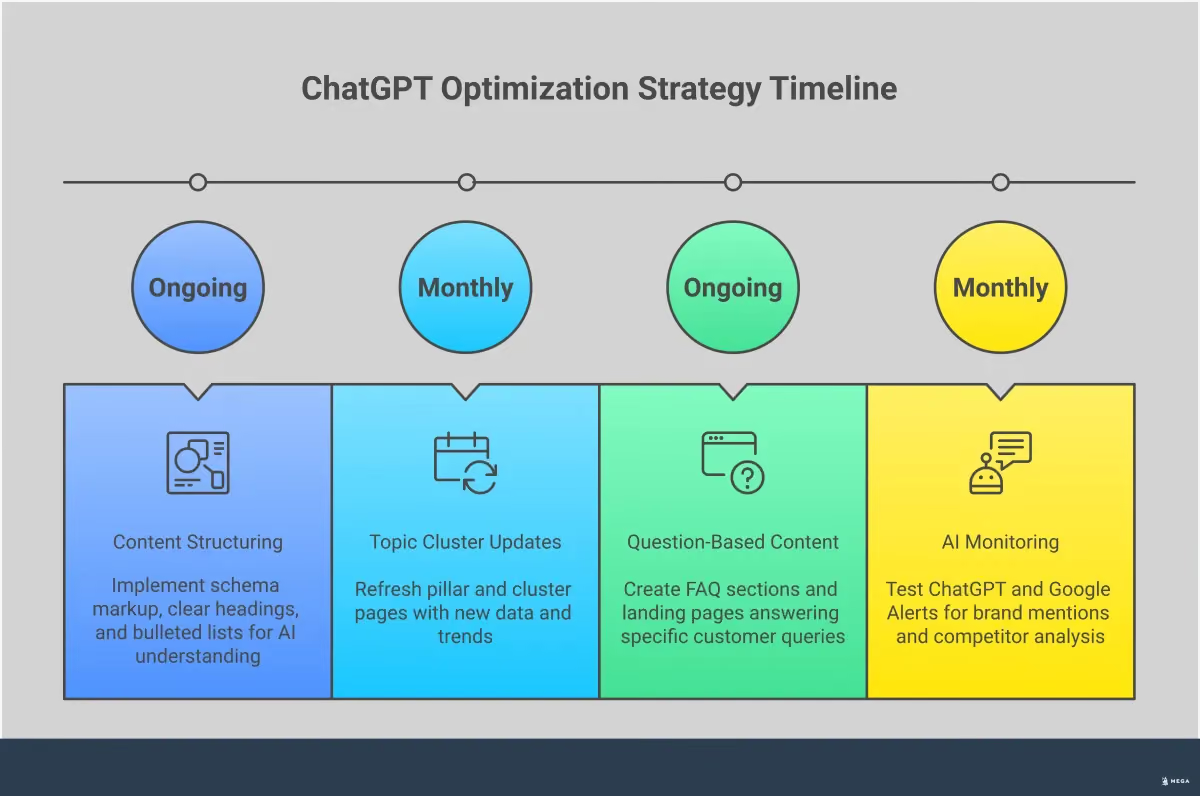
Your content needs to be easy for both humans and machines to read. Clear formatting—like using descriptive headings, short paragraphs, and bulleted lists—breaks up your text and makes key information stand out. This is crucial for AI models that scan for patterns and hierarchy to understand what’s most important. Beyond visual formatting, you can use structured data (also known as schema markup) in your site’s code. This acts like a set of labels that explicitly tells search engines and AI what your content is about, whether it’s a recipe, a product, or an FAQ page. When your information is well-organized, it’s simpler for an AI to process and trust as a reliable source.
Create Content That Directly Answers Questions
ChatGPT’s primary function is to answer questions. To increase your chances of being recommended, your content should provide clear, direct answers to the questions your audience is asking. Frame your articles around common queries, using headings that pose a question and providing the answer immediately after. This approach aligns perfectly with information synthesis, which is how AI models gather data from various sources to form a single, coherent response. When you create content that directly answers a user's need, you’re doing the initial work for the AI. This makes your content a highly efficient and valuable resource for it to pull from, increasing the likelihood that your business will be part of the final answer.
Develop a Comprehensive FAQ Section
A dedicated FAQ page is one of the most effective ways to organize your answers. This format is ideal for AI because it presents information in a simple question-and-answer structure, which mirrors how models like ChatGPT process and deliver information. By grouping related questions together, you create a dense, authoritative resource that covers a topic from multiple angles. This not only helps users find what they need but also signals to AI that your site is a comprehensive source of knowledge. A well-crafted FAQ section can address dozens of niche, long-tail queries in one place, helping you build topical authority and become the go-to source for a specific subject.
Build Topic Clusters to Show Expertise
To establish your site as an authority, you need to demonstrate deep knowledge on a subject. The topic cluster model is an effective way to organize your content to prove this expertise. This strategy involves creating a main "pillar" page that gives a broad overview of a topic, which then links out to multiple "cluster" pages that explore related subtopics in greater detail. For an AI, a well-executed topic cluster signals that your website offers comprehensive coverage. When it synthesizes data to find the best answer, it sees your interconnected content as a rich, reliable source of information. This makes your site a prime candidate for recommendation over sites that only touch on the topic superficially.
Target Question-Based Keywords
People talk to conversational AI just like they talk to another person—they ask questions. Your content strategy should reflect this. Instead of targeting broad keywords, focus on the specific, question-based phrases your potential customers are using. Think "how much does it cost to hire a local plumber" instead of just "local plumber." By optimizing for these long-tail questions, you align your content directly with the queries that users are inputting into ChatGPT. Just as writing effective ChatGPT queries requires specificity, creating content that answers those specific queries makes your site a perfect match for an AI-generated recommendation. You are essentially creating the ideal answer before the question is even asked.
Create Detailed Product and Service Descriptions
Your product and service pages are more than just online sales brochures; they are critical pieces of content that AI models analyze. When ChatGPT looks for a solution to a user's problem, it scans these pages to understand exactly what you offer. A generic description isn't enough. To be seen as a definitive source, your descriptions must be thorough, covering features, benefits, specifications, and ideal use cases. Think of each product page as an opportunity to answer every possible question a customer might have. This approach provides the AI with the comprehensive data it needs to make a confident recommendation, as it favors content that covers a subject from multiple angles.
To do this effectively, go beyond a simple list of features and explain how each one benefits the user. For example, instead of just saying a jacket is "water-resistant," explain that it "keeps you dry during unexpected rain showers on your commute." Address specific customer needs by creating content that answers the detailed, long-tail questions people ask. A well-crafted product description that covers who the product is for, what problems it solves, and how it works positions your offering as a complete solution, making it an easy choice for an AI to recommend.
Which Technical SEO Factors Influence AI Answers?
Technical SEO might sound intimidating, but it’s really about making sure your website is built on a solid foundation. Think of it as the digital equivalent of having good plumbing and electrical wiring in a house. While visitors might not see it, it makes everything run smoothly. For a long time, we focused these efforts on pleasing Google, but the same principles apply to making your content understandable for AI models like ChatGPT. These large language models are becoming a primary way people find information, so ensuring your site is optimized for them is just as important as traditional SEO.
When an LLM scans your site, it’s looking for clear signals of organization, context, and authority. A technically sound website provides these signals. It helps the AI quickly grasp what your content is about, how different pages relate to one another, and why your information is trustworthy. Without this technical structure, even the best content can get lost or misinterpreted. Getting these elements right is a non-negotiable step if you want your business to appear in AI-generated answers. It’s the framework that supports all your great content, ensuring it gets seen and understood by the systems that are shaping how we find information online.
Implement Schema Markup
Schema markup is essentially a vocabulary that you add to your website's code to help search engines and AI models understand your content more effectively. It’s like adding labels to your content that say, "This is a product," "This is a review," or "This is the address for a local business." This structured data removes ambiguity and provides clear context. By using schema, you enable AI models to better interpret the information on your pages. This clarity makes your content a more reliable source, increasing the likelihood that it will be used in a recommendation.
Organize Your Content With a Clear Hierarchy
A well-organized website is easier for everyone to use, including AI. Your content hierarchy is the logical structure of your site, showing how main pages and sub-pages are related. Think of it as an outline, with your homepage at the top, followed by major categories, and then individual blog posts or product pages. This clear structure helps an LLM understand the main topics you cover and how deeply you cover them. When an AI can easily see the relationship between your content, it’s more likely to view your site as an authoritative resource, which is a key part of how ChatGPT finds and cites content.
Use Internal Links to Build Topical Authority
Internal links are hyperlinks that connect one page on your website to another. They are crucial for building a strong site architecture and spreading authority across your pages. When you strategically link to other relevant articles or pages on your site, you’re creating a web of connected information. This does two things: it helps users discover more of your content, and it signals to AI models which pages are most important. The more internal links a page receives, the more significant it appears. This is a powerful signal of relevance and is a factor when an AI decides which sources to cite in its answers.
How to Write Better ChatGPT Prompts
To get your content recommended by ChatGPT, it helps to first understand how it thinks. Learning to write effective prompts is like learning its language. When you see what makes a good query, you start to understand what makes a good answer—and you can structure your own website content to provide those kinds of answers. Think of it as reverse-engineering the process. By mastering how to ask questions, you learn how to create content that is perfectly positioned to be the answer.
This process isn't just for research. It gives you a direct line into how an AI model processes, categorizes, and prioritizes information. The same principles that guide ChatGPT to a great response—clarity, context, and structure—are what it looks for when scanning the web for information to share with users. Getting good at prompting is a practical way to sharpen your intuition for creating AI-friendly content that gets surfaced in search and chat.
Be Specific With Your Requests
Vague prompts lead to generic, unhelpful responses. The more specific and detailed you are with your request, the more tailored and useful the output will be. Instead of asking for broad ideas, provide clear parameters that guide the AI toward the exact information you need. This precision is a key principle in effective prompt engineering.
For example, instead of prompting, “Write a blog post about social media,” try a more detailed request: “Write a 500-word blog post for small bakery owners on how to use Instagram Reels to promote new seasonal products. Include three specific video ideas and a call to action encouraging followers to visit the store.” This level of detail ensures the response is relevant, actionable, and directly suited to your needs.
Provide Relevant Context
Context gives the AI the background information it needs to frame its response appropriately. Without it, ChatGPT has to make assumptions about your goals, audience, and industry. You can provide context by assigning it a role, describing your situation, or defining your target audience. This helps the model understand your world and tailor its answer accordingly.
For instance, start your prompt with a role: “Act as a marketing consultant for a local bookstore.” Then, add your situation: “I want to create a loyalty program to encourage repeat customers. My customers are mostly families and college students.” By providing this background, you’ll get suggestions that are far more relevant than if you had simply asked, “How do I create a loyalty program?” According to OpenAI’s own best practices, giving the model enough context is crucial for getting a high-quality answer.
Use Clear Formatting in Your Prompts
When you have a complex request, clear formatting can help the AI understand and organize its response. Using bullet points, numbered lists, or distinct sections in your prompt breaks down the task into manageable parts. This prevents the model from overlooking key elements of your query and ensures all your instructions are followed.
Imagine you need a content plan. Instead of writing a long paragraph, structure your prompt with clear instructions:
-
Topic: The benefits of professional pet grooming.
-
Target Audience: First-time dog owners.
-
Key Sections:
- Health benefits (skin, coat, nails).
- Early detection of health issues.
- Socialization for puppies.
-
Tone: Friendly, informative, and reassuring.
This structured approach makes your request easy to process and results in a well-organized, comprehensive output that matches your vision.
Iterate and Refine Your Prompts
Your first prompt is rarely your last. Think of interacting with ChatGPT as a conversation, not a one-time command. The initial response is a starting point that you can build on. Use follow-up prompts to ask for adjustments, request more detail, or change the focus. This iterative process is where you can truly fine-tune the output to meet your exact specifications.
If the first draft of a product description is too formal, you can reply, “That’s a good start, but can you make the tone more playful and add a bulleted list of three key features?” This back-and-forth allows you to guide the AI toward the perfect result. This same principle applies to your website content. Tools like MEGA AI’s SEO agent continuously refine your existing articles, ensuring they stay optimized and relevant long after they’re first published.
Common ChatGPT Prompting Mistakes to Avoid
Getting the right answers from ChatGPT often comes down to asking the right questions. While the tool is powerful, it can’t read your mind. The quality of your input directly shapes the quality of the output. If you’re using ChatGPT for business research, content ideas, or marketing copy, avoiding a few common pitfalls can make a significant difference in your results.
Think of it as giving instructions to a new team member. The more specific and contextual your directions are, the better they can execute the task. Vague requests lead to generic work, while clear, focused prompts produce tailored, valuable responses. Learning to communicate effectively with the AI is a skill that helps you get the information you need to grow your business, whether you're trying to understand a new market or find the right keywords for your next blog post. By steering clear of these simple mistakes, you can make ChatGPT a much more effective partner for your business.
Vague or Overly Broad Queries
One of the most frequent mistakes is asking questions that are too general. A prompt like “Tell me about social media marketing” is so broad that ChatGPT can only provide a high-level, generic summary. You won’t get actionable insights you can apply to your business. Instead, treat the AI as a specialist waiting for a specific assignment. Crafting clear, detailed prompts ensures the model returns a more accurate and useful response. For example, a better prompt would be, “Create a 7-day social media content plan for a local bakery launching a new line of gluten-free pastries.” This specificity gives the AI the direction it needs.
Forgetting to Provide Context
ChatGPT doesn’t know your business, your audience, or your goals unless you tell it. Without context, its answers will lack the nuance your business needs. For instance, asking it to “Write an email to customers” is a shot in the dark. An email announcing a sale is very different from an email welcoming a new subscriber. To get better results, always provide the necessary background information. Following a few prompt engineering best practices can help you frame your requests. A more effective prompt would be, “Write a welcome email for new subscribers to my online plant shop. The tone should be warm and friendly, and it should include a 10% discount code for their first purchase.”
Overloading Prompts With Too Much Information
While context is key, asking for too many things at once can confuse the model and dilute the quality of the response. A single prompt that asks for a complete business plan, a marketing strategy, five blog post ideas, and a social media calendar is likely to produce a shallow overview of each. It’s better to break down a complex task into a series of smaller, more focused prompts. Think of it as a conversation. Start by asking for a market analysis for your industry. Based on that response, ask for a list of primary competitors. Then, use that information to request a unique value proposition. This iterative approach keeps the AI focused and delivers more detailed, high-quality output at each step.
What to Avoid When Optimizing for AI Recommendations
As you work to position your business as a go-to source for AI models, it’s just as important to know what not to do. Some traditional digital marketing tactics simply don’t apply here, and certain shortcuts can do more harm than good. The goal is to build genuine, long-term authority, and that means avoiding strategies that undermine trust. AI models are designed to detect and prioritize authentic credibility, so any attempt to game the system is likely to backfire. Focusing on a solid, ethical strategy will always be more effective than looking for loopholes.
Relying on Paid Ads
When it comes to getting recommended by an AI, you can't pay to play. Unlike traditional search engines where paid ads appear at the top of the results, AI models like ChatGPT are designed to synthesize information from organic sources. They are looking for earned authority, not purchased visibility. As the team at Blue Archer notes, "Paying for ads on Google won't make ChatGPT recommend you." The AI's goal is to provide the most helpful, unbiased answer possible, and it does this by analyzing content that has proven its value over time through credibility signals. Your marketing budget is better spent on creating high-quality content that builds your reputation naturally.
Using Black-Hat Tactics like Fake Reviews
Taking shortcuts with unethical tactics like buying followers or posting fake reviews is a fast track to damaging your credibility. These strategies might offer a temporary illusion of popularity, but they erode the very trust you need to build with both customers and AI models. AI systems are becoming increasingly sophisticated at identifying inauthentic patterns, and getting caught can harm your online reputation significantly. As marketing firm Impact Plus puts it, creating fake reviews is "wrong, often gets caught, and can hurt your business." A strong online presence is built on a foundation of authenticity. Focus on earning genuine reviews by providing excellent products and services, as this creates the kind of trustworthy signal that AI models are designed to find and reward.
Attempting to Directly Submit Information
It’s a common misconception that you can simply submit your business information to OpenAI to get included in ChatGPT’s responses. However, that’s not how it works. You cannot directly feed information about your business to the model. Instead, ChatGPT learns about the world by processing vast amounts of public data from the internet. Your focus should be on making your business information widely and consistently available across the web. Your website, your Google Business Profile, industry directories, and media mentions all contribute to the AI's understanding of who you are and what you do. The key is to build a strong, public-facing digital footprint, not to look for a submission form.
Limitations and Criticisms of AI Recommendations
While earning a recommendation from an AI model is a powerful form of social proof, it’s important to recognize that these systems are not perfect. AI-generated answers come with their own set of limitations, from factual errors to inherent biases. Understanding these shortcomings is crucial for any business owner. It helps you set realistic expectations and reminds you that while AI is a valuable tool, it doesn't replace the need for critical thinking and human oversight. These limitations also create an opportunity for businesses that prioritize accuracy and genuine connection to stand out even more.
Potential for Inaccuracy
Large language models can, and do, make mistakes. Sometimes, they present information that is outdated, out of context, or just plain wrong, a phenomenon often referred to as "hallucination." A report from WIRED found that when asked for product recommendations based on the magazine's own reviews, ChatGPT generated answers that were completely incorrect. This highlights a critical limitation: the AI synthesizes information but doesn't truly "understand" it. For your business, this means that maintaining accurate and up-to-date content on your own website is more important than ever. By being a reliable source of truth, you increase the chances that the AI will pull correct information about you.
Understanding Algorithmic Bias
AI models learn from the enormous amount of text and data available on the internet, and that data reflects the biases of the people who created it. This means AI recommendations can sometimes perpetuate existing stereotypes or favor more established, well-documented brands over newer or more niche businesses. Furthermore, an AI-generated recommendation lacks the personal touch and nuanced understanding that comes from a human expert. As one Reddit user noted in a discussion about AI-written letters, these tools can take away the "realness that a recommendation letter should have." While an AI can summarize popular opinion, it can't share a personal experience or make a recommendation based on a deep, values-aligned connection.
Get Your Business Recommended by ChatGPT With MEGA AI
Optimizing your content for a conversational AI like ChatGPT requires a different approach than traditional SEO. It’s not just about ranking for keywords; it’s about becoming a trusted, authoritative source that the AI can use to formulate its answers. This involves creating comprehensive content, ensuring technical precision, and continuously updating your information to stay relevant. For a small business owner, this can feel like a full-time job.
That’s where an autonomous tool can manage the process for you. MEGA AI acts as your dedicated growth agent, specifically designed to handle the complexities of this new landscape. Our platform doesn't just focus on Google's rules. It prepares your content to be found, understood, and recommended by language models. We use proprietary models trained on over 450 million data points to inform a strategy that gets your business visible in AI-driven search. Instead of you having to learn the nuances of Generative Engine Optimization (GEO), our AI agents execute the tasks needed to establish your authority and get your brand recommended.
Optimize Your Content for AI Visibility
Getting recommended by ChatGPT starts with making your content easy for language models to digest and trust. This goes beyond keywords and into the structure and clarity of your information. MEGA AI’s platform includes a specific focus on LLM Placement, a feature designed to improve how your business appears in ChatGPT, Google Overview, and other AI tools. We ensure your content is formatted with clear hierarchies, uses structured data, and directly answers the questions your potential customers are asking. This process turns your website into a reliable knowledge base that an AI is more likely to reference, positioning your brand as a definitive source in its synthesized answers.
Automate Content Generation and Updates
ChatGPT isn't a static search engine; it's a language model that constantly processes new information. Content that is stale or outdated is less likely to be used as a source. Keeping your entire content library fresh is a significant challenge, but automation makes it manageable. MEGA AI’s SEO agent automates content generation and updates, ensuring your articles and site pages remain current and authoritative. Our Maintenance Agent can re-optimize existing content specifically for LLMs, adding new information and refining the language to align with how these models process data. This continuous optimization keeps your content relevant and increases its chances of being featured in AI-generated responses.
Use Programmatic SEO for Comprehensive Coverage
To be seen as an authority, your website needs to cover a topic comprehensively. An AI is more likely to recommend a source that demonstrates deep expertise across a subject. Manually creating hundreds of pages to build this topical authority is impractical for most businesses. MEGA AI uses programmatic SEO to build out these topic clusters at scale. By identifying every related sub-topic and question your audience has, we can automatically generate a network of interconnected content. This strategy establishes your website as a complete resource, signaling to models like ChatGPT that your business is the go-to authority in its niche.
Re-optimize Content for Any Search or AI Engine
The digital landscape is constantly shifting. What works for Google today might not work tomorrow, and the content that performs well in traditional search isn't always what an AI model like ChatGPT will prioritize. This means your content needs to be adaptable. A static article can lose its relevance after a major Google core update or as new AI platforms emerge. MEGA AI’s Maintenance Agent is built for this reality. It can take an existing article and re-optimize it for any platform, whether that’s updating it to align with new search guidelines or restructuring it to be more easily understood by an LLM. This proactive approach ensures your information remains visible and valuable, no matter where your customers are looking for answers.
How to Build a Sustainable ChatGPT Recommendation Strategy
Getting your business recommended by an AI like ChatGPT isn't a one-time task you can check off a list. It’s an ongoing process that requires a clear strategy. Because AI models are constantly learning and user search habits are changing, your approach needs to be flexible. Building a sustainable plan means you’re not just optimizing for today’s AI, but also preparing for tomorrow’s. It involves consistently monitoring your presence, understanding how you appear in AI-generated answers, and adapting your content to stay relevant. This proactive approach ensures your business remains a trusted source that AI models will continue to reference over time.
Focus on One AI Platform to Start
The world of AI is expanding quickly, and trying to optimize for every new model can feel overwhelming. Instead of spreading your efforts thin, concentrate on a single, major platform like ChatGPT to begin. The principles you use to build authority here will serve as a strong foundation for other AI tools. ChatGPT functions like a research assistant, piecing together information from sources it deems credible and comprehensive. By focusing your strategy on what it prioritizes—consistent information, in-depth topic coverage, and clear signals of expertise—you are building the exact kind of online presence that all language models value. Once you establish your business as a go-to source for one AI, adapting your strategy for others becomes much simpler.
Track Brand Mentions in AI-Generated Answers
To understand how you appear in AI recommendations, you first need to track your brand mentions. When a user asks a complex question, ChatGPT doesn't just pull one answer. It performs dozens of smaller, specific searches to gather information. It then synthesizes the results, prioritizing brands and sites that appear consistently and favorably. You should periodically ask ChatGPT questions related to your industry and see if your brand is mentioned. This helps you gauge your current visibility and identify opportunities. Tracking these mentions gives you a baseline to measure the success of your optimization efforts and see how your brand’s authority is perceived by the AI.
Monitor Your Visibility for Key Queries
Just as users get better results with specific prompts, your business needs to monitor its visibility for the specific queries your customers use. Think about the exact questions your target audience would ask ChatGPT. Are you showing up for those queries? This goes beyond traditional keyword tracking; it’s about understanding the conversational nature of AI search. You can craft clear and detailed prompts that mimic customer questions to see which sources ChatGPT relies on. This regular monitoring helps you spot gaps in your content and ensure you’re providing the direct answers that both users and AI are looking for.
Continuously Optimize and Adapt Your Strategy
The world of AI search is always evolving, which means your strategy must, too. This ongoing process is often called Generative Engine Optimization (GEO). The goal of GEO is to make sure your content aligns with how people ask questions in AI interfaces, increasing the chances that an AI will cite your website as a source. This isn't a "set it and forget it" task. You’ll need to regularly review and update your content to keep it fresh, accurate, and formatted for conversational queries. Adapting your plan ensures your business doesn’t just get recommended once but becomes a reliable, long-term resource for AI-driven search engines.