
Trying to outrank big companies on search engines can feel like an uphill battle. But you don't need to outspend them—you just need to outsmart them. The strategy is to become the undeniable expert in your niche through topical authority. By creating a well-organized library of content, you signal to search engines that you're the most credible source on a subject. This guide walks you through the pillar page and topic cluster page model, a proven framework for building that authority, driving qualified traffic, and earning trust with customers actively looking for your expertise.
Key Takeaways
- Organize content into hubs of expertise: Create a comprehensive pillar page for each core topic and support it with a network of detailed cluster articles. This interconnected structure proves your deep knowledge to search engines and helps users find the information they need.
- Dominate a niche to compete effectively: Instead of competing on broad keywords, concentrate on specific topics relevant to your local market or audience. This allows you to build deep credibility and attract qualified customers who are looking for your specific solutions.
- Automate the process to stay consistent: Topical authority requires consistent content creation, updates, and linking. Use AI-powered tools to manage these tasks efficiently, allowing you to scale your content strategy and maintain relevance without manual overload.
What is Topical Authority and Why Does Your Small Business Need It?
Think of topical authority as your website's reputation for being an expert on a specific subject. It’s the digital equivalent of being the go-to person in your community for a particular skill or product. When you consistently publish in-depth, high-quality content that covers a topic from every angle, search engines like Google start to see your site as a credible and trustworthy source of information on that subject. This isn't about stuffing keywords into a single page; it's about building a comprehensive library of content that genuinely helps your audience.
For small and local businesses, building topical authority is a powerful way to compete with larger companies. You may not have the budget to outspend them on ads, but you can outsmart them by owning a niche. When search engines recognize your site as an authority, you are more likely to rank higher in search results, driving more qualified traffic to your site. By focusing on a specific area of expertise, you can attract a targeted audience that is actively looking for the solutions you provide.
This strategy goes beyond just pleasing search algorithms. When a potential customer finds your website and sees a wealth of helpful articles, guides, and answers related to their problem, it builds immense trust. You’re no longer just a business trying to sell something; you’re a valuable resource. This credibility fosters higher engagement and makes it much easier to convert visitors into loyal customers. As search engines become more sophisticated, they are getting better at identifying true expertise, making a strong content strategy essential for long-term growth.
How Pillar Pages and Topic Clusters Build Authority
To establish yourself as an expert in your field, you need to show search engines that you have a deep understanding of a subject. The most effective way to organize your content to do this is with the pillar page and topic cluster model. This approach structures your website's content in a way that's easy for both users and search engines to understand. Think of it as creating a mini-library on your website for each core service or product you offer, with one main guide and several detailed chapters.
What Exactly Is a Pillar Page?
A pillar page is a comprehensive, foundational piece of content that covers a broad topic in its entirety. It acts as the central hub for a specific subject, providing a complete overview while linking out to more detailed articles. For example, a local bakery might create a pillar page titled "The Ultimate Guide to Sourdough Bread." This page would touch on everything from starters and fermentation to baking techniques and storage. The goal is to create the most authoritative resource on that topic, which helps build a strong internal linking strategy and demonstrates your expertise to potential customers and search engines alike.
Hub Page vs. Pillar Page: What's the Difference?
While the terms are often used interchangeably, there's a key difference in their structure. A hub page acts as a table of contents for a broad subject. It provides a brief overview of several subtopics, and its main purpose is to link out to more detailed cluster pages. Think of it as a central navigation point that guides users to the specific information they need within your site's content ecosystem. The hub page itself isn't exhaustive; its value lies in its organization and the pathways it creates to deeper content.
A pillar page, on the other hand, is a single, comprehensive piece of content designed to cover a topic from top to bottom on one URL. The simplest way to think about it is this: if you took a hub page and all of its corresponding cluster articles and combined them into one giant guide, you would have a pillar page. Both approaches organize your content to build authority, but they differ in how they present the information and structure the user's journey through your topic clusters.
How to Structure a Topic Cluster
Topic clusters are groups of related content that explore specific subtopics from your pillar page in greater detail. Each piece of content in the cluster, often a blog post, focuses on a niche long-tail keyword and links back to the main pillar page. Following our bakery example, cluster content for the sourdough pillar page could include articles like "How to Feed a Sourdough Starter," "Best Flours for Sourdough Baking," and "Troubleshooting Common Sourdough Issues." This structure creates an interconnected web of content that encourages visitors to explore more pages and spend more time on your site.
Topic Clusters vs. Content Clusters: A Strategic Distinction
While you might hear the terms "topic cluster" and "content cluster" used interchangeably, there's a key strategic difference. A topic cluster is a specific SEO framework designed to build authority. It consists of a central pillar page providing a broad overview, with multiple cluster pages that delve into specific subtopics. The critical element is the internal linking: every cluster page links back to the pillar, and the pillar links out to each cluster page. This deliberate structure signals to search engines that you have comprehensive expertise. A content cluster, on the other hand, is a more general term for any group of related pages. It might lack a dedicated pillar page or the strict linking required by the topic cluster model. For small businesses aiming to improve search rankings, focusing on the topic cluster model is the more effective approach because it directly addresses how search engines evaluate topical depth.
Connecting Your Pillar Page to Its Topic Cluster
Pillar pages and topic clusters work together to create a cohesive content architecture that signals topical authority. The pillar page acts as the anchor, establishing your broad expertise. The cluster content supports it by providing depth and covering all the related questions your audience might have. The internal links flowing from the cluster pages back to the pillar page (and to each other) pass authority and context to search engines. This tells Google that your website is a reliable source of information on that subject, which can improve your rankings for a wide range of related search queries and create a better user experience.
How Effective Are Topic Clusters? A Look at the Data
The data on topic clusters points to a clear conclusion: they work because they align perfectly with how search engines want to deliver information. Instead of seeing individual pages, search engines see a well-organized library of expertise. This interconnected structure proves your deep knowledge and helps users find the information they need. When Google sees your website as a comprehensive source on a subject, it rewards you. As your content grows and gets links, search engines view your website as a trusted expert. The more high-quality, in-depth content you have, the more effective your topic clusters will be in helping your site grow and attract qualified traffic.
How Google's AI Measures Topical Authority
Google's algorithms have grown far beyond simple keyword matching. Modern search AI aims to understand content quality and expertise in a way that mirrors human evaluation. It analyzes how comprehensively you cover a subject, how your content pieces connect, and whether you provide genuine value to the reader. For a small business, this means that becoming a trusted resource on a specific topic is more important than ever. When Google sees you as an expert, it rewards you with higher visibility, connecting you with customers who are actively seeking your knowledge.
It's no longer about having a single page that ranks for a keyword; it's about owning the entire conversation around that topic. Google's AI assesses the relationships between your pages to determine if you've built a true information hub that satisfies multiple user questions and intents. It looks for signals like logical internal linking, consistent coverage of related subtopics, and content that addresses the nuances of a subject. This holistic evaluation is how Google separates thin, superficial content from authoritative resources that deserve to be at the top of the search results.
Demonstrating E-E-A-T with Topic Clusters
Think of Google's E-E-A-T guidelines—Experience, Expertise, Authoritativeness, and Trustworthiness—as a checklist for proving your credibility. The topic cluster model is designed to help you demonstrate these qualities. When you create a comprehensive pillar page supported by detailed cluster articles, you're showing search engines that you have covered a subject from every possible angle. This proves your expertise and builds authority in a way a single blog post never could. The internal links between your pages create a logical structure that signals to Google that your site is a trustworthy hub of information, not just a random collection of articles, making you a valuable resource for users.
Why In-Depth Content Wins with Google
Gone are the days of stuffing a keyword into your page as many times as possible. Google's AI is now sophisticated enough to recognize true subject matter expertise. It looks for content that explores a topic from multiple angles, answers related questions, and demonstrates a deep understanding of how different ideas connect. A pillar page acts as the foundation, but the topic cluster pages provide the detailed insights that signal true authority. This approach shows search engines that you haven't just written an article; you've created a comprehensive resource that fully satisfies a user's curiosity on a subject.
Leveraging Semantic Search and Context
Google uses semantic search to understand the intent and contextual meaning behind a user's query, not just the literal words they type. It identifies relationships between people, places, and concepts. A well-organized topic cluster naturally supports this by covering a wide range of related subtopics and entities. By building an interconnected web of content around a central theme, you create a rich contextual environment. This structure makes it easy for Google to recognize your site as a definitive source of information for that entire subject area, improving your visibility for a broad spectrum of related searches.
Connect Your Content with Strategic Interlinking
Internal links are the threads that weave your pillar page and topic clusters together into a cohesive structure. For users, these links provide a clear path to explore related information, keeping them on your site longer. For Google's AI, they serve as a map, illustrating the hierarchy and relationship between your content pieces. Each link from a cluster page back to your pillar page reinforces the pillar's importance as the central hub for that topic. Neglecting a logical internal linking strategy can leave your content feeling disconnected, making it difficult for search engines to see the full scope of your expertise.
How to Create a Pillar Page Strategy for Local Audiences
For local and small businesses, a pillar page strategy isn't just about covering a broad topic; it's about becoming the go-to resource for your community. Instead of competing on a national scale, you can build deep authority on subjects that matter to your local customers. This approach helps you connect with people actively searching for services in your area, turning your website into a trusted local hub. By focusing on the specific problems of your neighbors, you create a powerful advantage that larger, generic competitors can't easily cross.
Select Core Topics Your Local Audience Cares About
Start by identifying the main problems you solve for your customers. What are their most common questions? These are your starting points for pillar topics. For a local roofer, a core topic might be "Roof Maintenance for [Your City's] Climate," not just "roofing." This local angle is your advantage. You can build interconnected content around these core topics, creating a helpful experience that keeps visitors on your site. The goal is to select a topic comprehensive enough to support numerous subtopics, establishing you as the definitive local expert.
Creating an Effective Pillar Page Structure
Think of your pillar page as the table of contents for a comprehensive guide. It should provide a broad overview of your core topic and link out to more detailed articles—your cluster pages. Each cluster page should dive deep into one specific subtopic. For example, if your pillar is "The Ultimate Guide to Landscaping in [Your Town]," your cluster pages could cover "Best Native Plants," "Seasonal Lawn Care," and "Local Hardscaping Ideas." This pillar and cluster content strategy requires planning to ensure all the pieces connect logically and cover the topic from every angle.
Choosing Your Pillar Page Format: Guides, Explainers, and Tutorials
The format of your pillar page should align with the topic and your audience's goals. The most common formats are guides, explainers, and tutorials. A "guide" format, such as "The Ultimate Guide to Kitchen Remodeling," is effective for broad topics where you can cover numerous subtopics in one place. An "explainer" format works well for breaking down a complex subject into understandable parts, like an article on "What is Geothermal Heating?" Finally, a "tutorial" or "how-to" format provides clear, step-by-step instructions for a specific task, such as "How to Winterize Your Sprinkler System." Selecting the right format ensures your comprehensive content is easy to follow and solidifies your page as the central hub for that subject.
Practical Tip: Add a Clickable Table of Contents
Pillar pages are naturally long, so a clickable table of contents is a must-have for a good user experience. It lets readers see the page's structure and jump directly to the section they care about most. This simple feature helps people find answers fast, keeping them on your site longer. For search engines, a table of contents with anchor links is like a map, outlining the key sections of your page. This helps Google's AI understand your content's hierarchy and can even lead to jump-to links appearing in search results, making your listing stand out.
Matching Your Content to Local Search Intent
To ensure your content reaches a local audience, you need to optimize it for local search intent. This means naturally including location-specific keywords, like your city or neighborhood, throughout your pages. Your internal linking is also critical. Each cluster page should link back to the main pillar page. This structure signals to search engines that your website has deep information on a subject, helping them recognize your website as a topical authority. This makes it more likely Google will show your pages to local searchers. With an AI-powered tool like MEGA AI, you can automate your SEO strategy to ensure your content is always optimized for the right audience.
Informational Intent
Informational intent is when users are looking for answers. Their searches often start with "how," "what," or "why," indicating they are in a learning phase. By creating content that directly addresses these questions, you build trust and establish your business as a helpful expert. For a local HVAC company, this could be a blog post on "What's the Best Temperature for My Thermostat?" This type of content forms the foundation of your topic clusters, providing the detailed, helpful information that supports your main pillar page and proves your deep knowledge on a subject to both users and search engines.
Navigational Intent
Navigational intent happens when a user already knows your brand and is trying to find your specific website. They might search for your business name directly, like "Main Street Cafe" instead of "coffee shop near me." While this seems straightforward, it's crucial that your website appears as the top result for these searches. This reinforces your brand's online presence and ensures potential customers can easily find you. To capture this intent, make sure your website is technically sound and your brand name is clearly associated with your domain, which helps search engines direct users to the right place without confusion.
Commercial Intent
When users have commercial intent, they are moving from learning to considering a purchase. They are comparing options, reading reviews, and trying to decide on the best solution for their problem. This is your opportunity to show why your product or service is the right choice. Content for this stage could include product comparisons, case studies, or detailed service pages that highlight unique benefits. For a local marketing agency, an article comparing "Facebook Ads vs. Google Ads for Small Businesses" would fit perfectly, helping potential clients make an informed decision while positioning your agency as a knowledgeable partner.
Transactional Intent
Transactional intent signals that a user is ready to make a purchase or take a specific action, like signing up for a service. Their search queries are direct and action-oriented, such as "buy running shoes online" or "schedule a dental cleaning." Your service pages, product pages, and pricing pages should be optimized for this intent. The content needs to be clear, persuasive, and include a straightforward call to action. Make it as easy as possible for customers to complete their desired action, whether that's adding an item to their cart or filling out a contact form to book an appointment.
Local Intent
For small businesses, local intent is one of the most important signals to capture. This is when users are searching for products or services within their geographic area, using queries like "plumber near me" or "best pizza in [Your City]." Creating content that is specifically tailored to your service area is key. This includes creating location-specific service pages and weaving local landmarks or neighborhood names into your content. This strategy shows search engines that you are highly relevant to local customers, giving you a significant advantage over larger, non-local competitors who can't match your community-focused expertise.
How to Create Topic Cluster Pages That Drive Traffic
Once your pillar page is planned, it’s time to build out the topic clusters that will support it. Think of your pillar page as the hub of a wheel and your cluster content as the spokes. Each spoke is a separate piece of content—usually a blog post—that explores a specific subtopic related to your pillar in much greater detail. This is how you prove the depth of your knowledge.
By creating this network of interconnected content, you’re doing more than just chasing keywords. You’re building a resource library that keeps visitors on your site longer, encouraging them to explore different facets of the topic you’re an expert in. This structure makes it incredibly easy for search engines to understand the relationship between your pages, recognize your expertise, and reward you with higher rankings. A well-executed topic cluster strategy signals to both users and Google that you are a definitive source of information on your core subject. This approach transforms your website from a collection of random articles into a structured, authoritative resource that consistently attracts and engages your target audience.
Finding High-Impact Topics for Your Clusters
The first step is to brainstorm all the specific questions and subtopics related to your pillar page. What are the common questions your customers ask? What are the different angles you could take on your main topic? Your goal is to identify topics that are specific enough to be covered in a single blog post but still have enough search interest to attract visitors. You can find these ideas by looking at the "People also ask" section on Google, browsing forums like Reddit or Quora, or using a keyword research tool to find long-tail keywords. Each of these specific topics will become a piece of cluster content that links back to your main pillar page.
How to Map and Organize Your Topic Clusters
With a list of potential cluster topics, your next move is to create a content map. This doesn't have to be complicated; a simple spreadsheet or mind map will work perfectly. Place your pillar page topic in the center and draw lines out to each of your chosen cluster topics. This visual plan helps you see how everything connects and ensures you don't accidentally create overlapping content. This organization is key because it helps search engines see the deliberate structure you've built. A clear map ensures every piece of content has a purpose and directly supports your goal of establishing topical authority.
Keeping Your Topic Clusters Relevant and Up-to-Date
Building topic clusters isn't a one-and-done task. To maintain your authority, you need to keep the connections between your content strong. The most important practice here is internal linking. Every cluster article must link back to the pillar page. It’s also a good idea to link between related cluster articles where it makes sense for the reader. Neglecting your internal linking strategy can leave you with a set of disconnected pages that don't effectively signal your expertise. As you add new content, you continuously strengthen this web, which helps all your related pages rank better over time.
Step 1: Choose a Main Topic
Your first move is to select a broad topic that is central to your business and genuinely important to your audience. Think about the core problems you solve. For a local accountant, a main topic could be "small business tax preparation," not just "accounting." This topic should be substantial enough to break down into at least five to ten smaller articles but not so vast that it becomes unmanageable. The goal is to choose a subject where you can realistically become the go-to expert for your community. This focus allows you to create a deep, interconnected library of content that proves your expertise to both potential customers and search engines.
Step 2: Conduct Keyword Research
Once you have your main topic, it's time to find out what specific words and phrases your audience uses when searching for information about it. This process, known as keyword research, is about understanding your customer's language. You need to look at three main things for each potential keyword: search intent (what the user is trying to accomplish), search volume (how many people are searching for it), and keyword difficulty (how hard it is to rank for). This step is crucial for ensuring the content you create actually matches what people are looking for, so you aren't just writing into the void. It forms the foundation of your entire content strategy.
Analyzing Search Volume and Keyword Difficulty
When you look at keywords, it's easy to get drawn to terms with high search volume, but that's not always the best strategy for a small business. High-volume keywords are often highly competitive. Instead, focus on finding a balance. Look for keywords with reasonable search volume and lower difficulty scores. These are your sweet spots. By targeting less competitive, more specific phrases, you have a much better chance of ranking. As you build authority around these niche terms, search engines will start to see you as an expert, which helps your entire site show up for more related searches over time.
Step 3: Plan Your Pillar and Cluster Pages
With your keyword research complete, you can start mapping out your content. Your pillar page will target the broad, main topic keyword, while each cluster page will target a more specific, long-tail keyword you discovered. Create a simple outline or mind map with your pillar page at the center and your cluster topics branching off it. This visual plan helps you see how all the pieces will connect and ensures you cover the topic comprehensively without creating redundant content. Planning this structure beforehand is essential for building a logical and effective internal linking architecture that search engines can easily understand.
Step 4: Write and Optimize Your Content
Now it's time to start creating the content. Begin with your pillar page, as it serves as the foundation for the entire cluster. This page should be a comprehensive overview of the main topic, touching on all the subtopics you plan to cover in your cluster pages. Once the pillar page is complete, you can start writing the individual cluster articles. Each one should provide an in-depth look at a specific subtopic, offering detailed information and actionable advice. For small business owners short on time, tools like MEGA AI's content generation feature can help create well-structured first drafts, allowing you to focus on adding your unique expertise.
On-Page SEO Tips for Cluster Content
To help search engines understand what each page is about, you need to follow some basic on-page SEO practices. For every cluster article, make sure you include your target keyword in a few key places: the page title, the URL, and within the first paragraph. It's also important to use related keywords and synonyms naturally throughout the text. Use clear headings (like H2s and H3s) to break up your content and make it easy for readers to scan. Finally, don't forget the most important link: every cluster page must link back to your main pillar page to reinforce the connection.
Step 5: Track Performance and Make Adjustments
Building topical authority is an ongoing process, not a one-time project. After you've published your pillar and cluster pages, you need to monitor their performance. Keep an eye on where your pages rank in Google for your target keywords and how much traffic they're bringing to your site. This data will show you what's working and where you might need to make improvements. For instance, you might find that an article needs to be updated with new information to stay relevant. Tools like MEGA AI's Maintenance Agent can automate this process by identifying opportunities to improve existing content, helping you maintain and grow your rankings over time without constant manual effort.
How to Interlink Your Pillar and Topic Cluster Pages
Once you have your pillar and cluster content, the next step is to connect them. Internal linking is the glue that holds your topical authority strategy together. It creates a logical map that shows search engines how your content is related, establishing a clear hierarchy with the pillar page at the center. Think of it as building a mini-website within your main site, all dedicated to one core topic. Each link acts as a pathway, guiding both users and search engine crawlers from the broad overview of your pillar page to the specific details in your cluster articles and back again.
This deliberate structure does more than just organize your content. It signals to Google that you have a deep and comprehensive understanding of a subject. When search engines can easily follow these connections, they recognize the depth of your expertise, which is a critical factor in building authority. Neglecting internal linking can leave you with a collection of disconnected articles that fail to support each other, undermining your SEO efforts. A strong internal linking strategy ensures your content works together as a cohesive unit, improving user experience and demonstrating your credibility on the topic.
Internal Linking Strategies That Work
To create a well-connected topic cluster, follow a few simple rules. First, every cluster article must link up to its corresponding pillar page. This is the most important link, as it reinforces the pillar’s role as the central hub for the topic. Second, your pillar page should link down to every cluster page within its topic. This distributes authority and provides clear pathways for readers who want to learn more about a specific subtopic. Finally, you can link between related cluster pages when it adds value for the reader. For example, an article about "choosing the right coffee beans" could naturally link to one about "different coffee grinding methods." This creates a more robust and helpful user experience.
How to Write Anchor Text for Better SEO
The clickable text you use for a link, known as anchor text, is a powerful signal for search engines. It provides context about the page you're linking to. Avoid generic phrases like "click here" or "read more." Instead, use descriptive, relevant anchor text that accurately reflects the topic of the destination page. For instance, when linking from a cluster article back to your pillar page on content marketing, you might use anchor text like "comprehensive content marketing strategy." This creates a clear signal that helps search engines understand the relationship between the two pages. Varying your anchor text slightly can make your linking profile appear more natural, but always keep it relevant and specific.
Creating a Logical Linking Structure
Your internal links should create a clear and logical structure with the pillar page at the top. This hierarchy helps search engines and users understand the architecture of your content. The pillar page serves as the main entry point to the topic, while the cluster pages offer detailed explorations of its components. By linking from the pillar to the clusters and from every cluster back to the pillar, you create a self-contained ecosystem of information. This structure makes it easy for Google to crawl and index your content, confirming that you are an organized and authoritative source. This is where an AI-powered SEO agent can be invaluable, ensuring your linking structure is consistently and correctly implemented across all your content.
Common Topical Authority Mistakes to Avoid
Building topical authority is a powerful strategy, but it requires careful planning. It’s easy to get lost in the details and make mistakes that can undermine your efforts, wasting precious time and resources. As a small business owner, you can’t afford to spin your wheels on a content strategy that doesn’t deliver results.
The good news is that most of these errors are completely avoidable once you know what to look for. From picking the wrong core topics to creating a confusing web of internal links, these common pitfalls can prevent search engines from recognizing you as an expert in your field. Understanding these mistakes is the first step toward building a robust and effective pillar page strategy that attracts the right audience and establishes your credibility. Let's walk through the three most common issues so you can sidestep them and build your authority with confidence.
Avoiding Common Pitfalls in Topic Selection
One of the most frequent mistakes is choosing a pillar topic that is far too broad. For example, a local coffee shop trying to build authority around the topic "coffee" will struggle to compete with global brands. A better approach is to narrow the focus to something specific and relevant, like "specialty coffee roasting in Brooklyn." This allows you to create deep, valuable content for a defined audience. Conversely, choosing a topic that's too narrow might not have enough related subtopics to build a meaningful cluster, limiting your reach. The key is to find a balance: a topic broad enough to support multiple cluster pages but specific enough to let you dominate a niche.
Fixing Common Internal Linking Errors
Your internal linking structure is the glue that holds your topic clusters together. A common error is neglecting to create a logical and consistent linking hierarchy. Simply adding random links between pages isn’t enough. Each cluster page must link back to the main pillar page, and the pillar page should link out to every piece of content within its cluster. This creates a closed loop that signals a strong relationship between your pages to search engines. Neglecting this structure can leave your content feeling fragmented, making it difficult for Google to understand the topical connection and pass authority effectively. A well-organized internal linking strategy is essential for guiding both users and search engine crawlers through your expertise.
How to Avoid Content Cannibalization and Mismatched user intent
Content cannibalization happens when multiple pages on your site compete for the same keywords and search intent. For instance, if a local gym has separate blog posts for "beginner fitness classes" and "getting started at the gym," they might inadvertently split their SEO authority. Search engines get confused about which page is more relevant, which can hurt the rankings for both. It's better to consolidate similar ideas into one comprehensive article. Similarly, you must ensure each piece of content aligns with a specific user intent. Is the user looking for information, comparing options, or ready to buy? Mismatching your content's purpose with what the user wants can lead to high bounce rates and poor performance.
How to Maintain and Scale Your Topical Authority
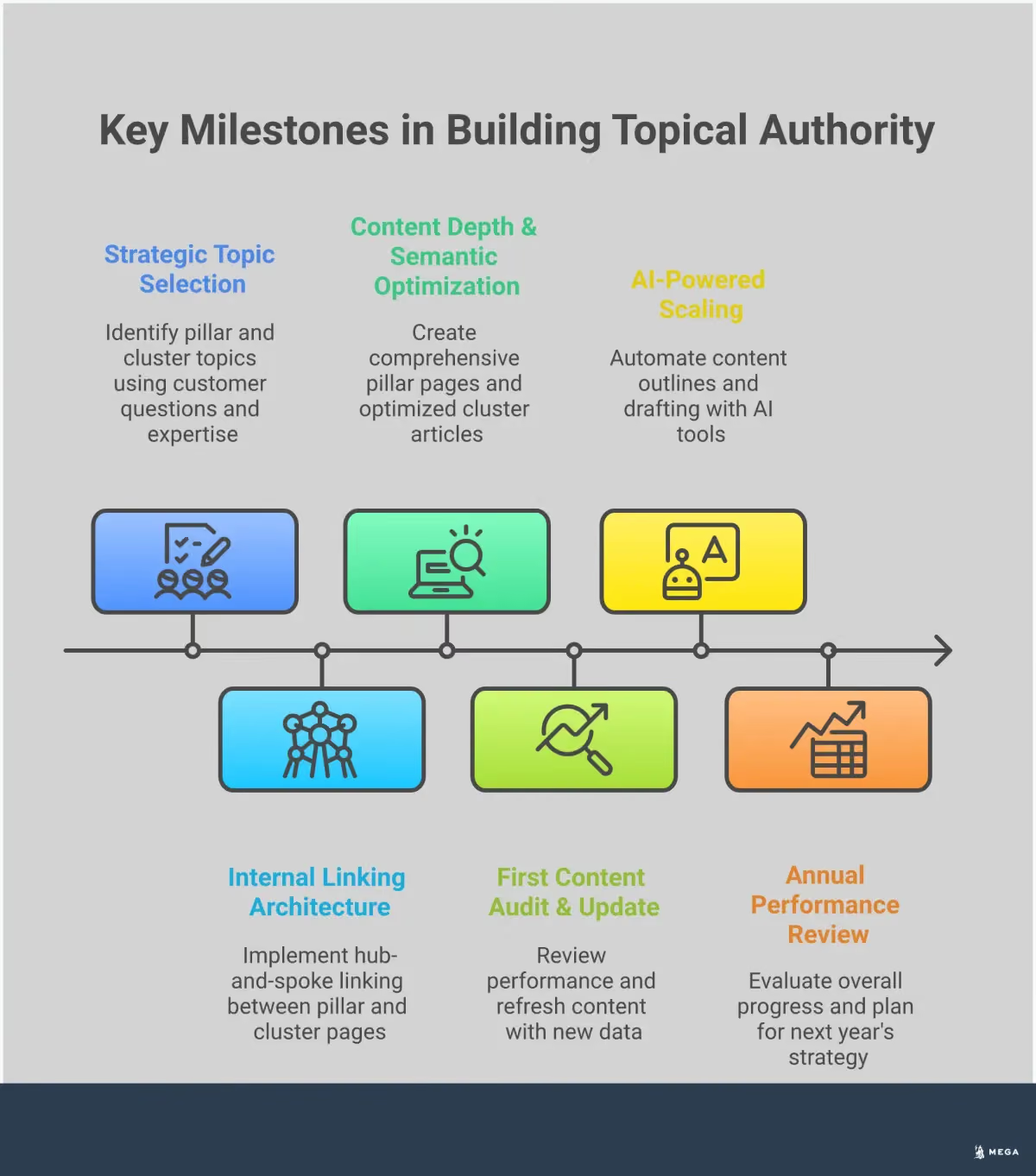
Building topical authority is not a set-it-and-forget-it project. Once you’ve established your pillar pages and topic clusters, the real work of maintaining and growing your influence begins. Search trends shift, new competitors emerge, and your own business goals evolve. Staying on top requires a consistent strategy for auditing your content, keeping it fresh, and scaling your production efficiently.
How to Audit Your Content and Monitor Performance
Regularly checking in on your content's performance is essential for long-term success. Think of it as a routine health check for your website. Start by tracking key metrics in Google Search Console to see which pages are driving traffic and which might be falling behind. You should also perform a periodic content audit to assess your entire cluster. This process helps you identify underperforming articles that could be updated, consolidated with other posts, or removed entirely. This practice, sometimes called content pruning, strengthens your overall topical authority by ensuring every piece of content serves a clear purpose and meets user needs.
Strategies for Keeping Your Content Fresh
Search engines prioritize content that is current and accurate. An article you wrote two years ago might contain outdated statistics or broken links, which can harm both user experience and your rankings. Schedule time every quarter to review your pillar and cluster pages. Look for opportunities to add new information, update examples, and incorporate recent industry developments. Keeping your content fresh signals to Google that you are an active and reliable expert in your field. Each update reinforces your site’s relevance and helps your content rank faster over time.
How to Scale Your Content Creation Efficiently
For a small business, creating enough high-quality content to cover a topic comprehensively can feel like a huge challenge. This is where having a clear plan and the right tools makes all the difference. An effective topic cluster strategy provides a roadmap for what to create next, helping you build authority with each new article. To accelerate this process, you can use AI-powered tools to handle the heavy lifting. For instance, MEGA AI’s SEO agent uses programmatic SEO to automate large-scale content creation, allowing you to build out extensive topic clusters in a fraction of the time it would take manually. This approach helps you scale your expertise without scaling your workload.
Using AI to Automate Your Topical Authority Strategy
Building a comprehensive pillar and cluster model is a significant undertaking. For small businesses and local shops, the time and resources required to plan, write, link, and maintain dozens of articles can feel out of reach. This is where an AI-powered strategy becomes a game-changer. Instead of hiring a full agency or spending your weekends writing blog posts, you can use AI to handle the heavy lifting.
An AI agent acts as your dedicated SEO operator, executing a sophisticated content strategy from start to finish. It can identify the most valuable topics for your audience, generate high-quality content at scale, and manage the intricate web of internal links required to signal authority to search engines. This approach compresses the capabilities of a full-stack growth agency into a single, autonomous system. By automating the most time-consuming parts of the process, you can build topical authority faster and more efficiently, allowing you to focus on running your business.
How MEGA AI Streamlines Topic Cluster Creation
Manually creating a comprehensive topic cluster—from the main pillar page to all its supporting articles—is a massive undertaking. This is where MEGA AI’s SEO agent transforms the process. Instead of you having to research, outline, write, and link each piece of content, the platform handles the entire workflow. It identifies the most valuable subtopics related to your pillar and then uses programmatic SEO to generate all the necessary articles at once. This allows you to build out a complete, interconnected content hub in a fraction of the time, establishing your expertise without the manual grind.
How to Create Programmatic Content at Scale
A strong topic cluster requires volume. You need enough supporting articles to demonstrate comprehensive knowledge of a subject. Creating all that content manually is a slow process, but AI can generate the foundational drafts for your cluster pages in a fraction of the time. Using a programmatic approach, an AI agent can produce a series of interconnected articles based on your core pillar topic. This allows you to quickly build a content library that covers every relevant subtopic, ensuring no gaps in your authority. This speed means you can establish a strong presence for your chosen topics much faster than competitors who rely on manual content creation alone.
Automating Content Updates and Optimization
Topical authority isn't a one-time project. Your content needs to stay fresh and relevant to maintain its rankings. An AI agent can continuously monitor your content's performance, identifying pages with declining traffic or click-through rates. From there, it can automatically update articles with new information, add sections to improve depth, or re-optimize them after a Google algorithm update. This ongoing content maintenance ensures your pillar and cluster pages remain valuable resources for your audience and continue to perform well in search results without requiring constant manual audits and rewrites from your team.
Implement Smart Linking and Automated Content Refreshes
A topic cluster is only as strong as its internal links. These connections are what show search engines how your content is related, creating a logical structure that reinforces your authority. Manually managing these links across dozens or hundreds of pages is tedious and prone to error. An AI agent can handle this intelligently. As it creates new cluster content or updates existing pages, it can automatically insert relevant internal links to your pillar page and other related articles. This ensures your content ecosystem is always logically connected, strengthening your site's authority with every new piece of content you publish.