
The debate over AI in marketing isn't about choosing humans over machines. It's about creating a powerful partnership. A successful marketing plan combines AI automation and human strategy, letting each do what it does best. Let AI handle the massive datasets and repetitive tasks. This frees up your team to focus on big-picture thinking, creative campaigns, and genuine customer connections. This guide offers a clear framework for dividing the work, showing you exactly what to automate and where your team’s expertise is irreplaceable for driving real results.
Key Takeaways
- Divide tasks between AI and your team: Assign repetitive, data-driven work like keyword research and ad optimization to AI, allowing your team to focus on strategy, creative direction, and building customer relationships.
- Guide your AI with a clear strategy: Automation without direction is ineffective. Set clear boundaries by defining your brand voice, budget limits, and business goals to ensure every AI-driven action supports your long-term vision.
- Focus on meaningful metrics to refine performance: Track business outcomes like lead quality and conversion rates, not just clicks. Use this data to create a consistent feedback loop, continuously adjusting the AI’s instructions to improve its alignment with your goals.
How Is AI Automation Changing Marketing?
AI is fundamentally changing how businesses approach marketing. For small and local businesses, it’s no longer a futuristic concept but a practical tool for growth. Instead of spending hours on manual tasks, you can now use AI to handle the heavy lifting, freeing you up to focus on the bigger picture. This shift allows a small team, or even a single person, to execute marketing campaigns that were once only possible for large corporations with big budgets.
The most immediate change is in efficiency. Many marketing leaders now use AI to automate repetitive tasks like keyword research, content generation, and managing ad bids. This means less time spent on spreadsheets and more time thinking about your customers. Beyond simple task management, AI-driven platforms can analyze performance data and adjust campaigns in real time. This allows you to constantly refine your marketing strategy based on what’s actually working, rather than waiting weeks for a report.
However, with so many new tools available, the landscape feels a bit like the wild west. It’s easy to turn on automation and hope for the best, but true success comes from finding the right balance. AI is incredibly powerful for execution, but it still needs human direction to ensure its actions align with your brand’s unique goals and voice. The key is to pair the speed and scale of automation with thoughtful human strategy.
The Business Case for AI Adoption
Adopting AI isn't about replacing your team; it's about making them more effective. Think of AI as a tool that empowers people to be more productive, not a substitute for human expertise. For small businesses, this is a game-changer. AI can automate the tedious, repetitive tasks that eat up valuable time, like analyzing keyword performance or adjusting ad campaign bids. By handing over this data-intensive work to an automated system, you and your team are free to concentrate on the parts of the business that require a human touch: strategy, creativity, and customer engagement.
This shift allows your team to focus on work that machines can't replicate. Jobs that depend on uniquely human capabilities like empathy, critical judgment, and creative problem-solving become the priority. For a local business, that means spending more time understanding your customers' needs, building community relationships, and making strategic decisions that guide your brand's future. The real value of AI adoption is that it creates the space for your team to excel at the work that truly drives growth and builds a loyal customer base.
The Human Side of AI Automation
Redefining Work in the Age of AI
It’s easy to view AI as a replacement for human effort, but that’s a limited perspective. A more accurate way to see it is as a collaborator. AI is a tool designed to make people more efficient and capable, not obsolete. Think of it as an assistant that handles the repetitive, data-intensive parts of your job, like sifting through keyword data or adjusting ad bids. This frees you and your team to concentrate on the work that requires a human touch: developing strategy, brainstorming creative campaigns, and building genuine relationships with your customers. This hybrid approach allows small businesses to achieve more with fewer resources, leveling the playing field and enabling you to focus on growth.
Beyond the Paycheck: AI's Impact on Human Dignity
The conversation about automation often centers on job loss, but the concern runs deeper. For many, work provides a sense of identity, purpose, and community. The real question is how automation affects the meaning we find in our jobs. When AI takes over mundane tasks, it creates an opportunity for roles to evolve into something more fulfilling. Instead of spending hours on tedious administrative work, your team can invest their time in complex problem-solving and creative projects. This shift doesn't diminish human value; it highlights it. By automating the right tasks, you can help your team find greater satisfaction and purpose in their work, which is good for morale and your bottom line.
The Ethical Question: Which Jobs Should Remain Human?
As AI becomes more capable, we have to decide which tasks should always have human oversight. AI excels at processing information and identifying patterns, but it lacks empathy, nuanced judgment, and shared experience. Any job that relies on these distinctly human traits is not only safe from automation but becomes even more valuable. For your business, this means tasks like defining your brand’s voice, making final decisions on creative direction, or handling a sensitive customer issue should remain firmly in human hands. AI can provide the data and insights to inform these decisions, but the ultimate judgment call requires an understanding of context and values that only a person can provide. This ensures your business operates with intention and a human-centric focus.
What Happens When AI Automation Lacks Human Strategy?
AI marketing tools are incredibly powerful, but they are just that—tools. They execute tasks with remarkable speed and efficiency, but they don’t inherently understand your business goals, your brand’s unique voice, or the nuances of your target audience. When you deploy automation without a clear, human-led strategy, you’re essentially handing over the keys without providing a map. The result is often a series of disconnected actions that might look productive on the surface but fail to move your business forward in a meaningful way.
This is where many businesses stumble. They invest in technology hoping for a magic bullet, only to find their campaigns are generic, their messaging is off-target, and their budget is being spent inefficiently. True growth comes from pairing the tactical execution of AI with the strategic oversight of a human. Your strategy provides the "why" behind every action the AI takes, ensuring that every piece of content created and every ad dollar spent is aligned with your long-term objectives. Without that guidance, automation is just motion without direction.
Are You Relying Too Much on AI Automation?
Jumping into AI by trying to automate everything at once can create more problems than it solves. An over-reliance on technology can lead to significant missteps, like targeting the wrong audience or misinterpreting customer feedback. When every brand uses the same tools in the same way, it can also lead to a homogenization of content that makes it difficult to stand out. The goal isn't to replace human input but to augment it. Trying to automate too much too soon often results in a steep learning curve and mismanagement, turning a powerful asset into a source of frustration. A measured approach, where you strategically automate specific tasks, is far more effective.
The Danger of AI Decisions Without Human Context
An AI model operates on data and patterns. It can analyze millions of data points to determine the most statistically likely path to a conversion, but it can't understand the context behind that data. It doesn't know that a recent cultural event makes a certain ad creative insensitive, or that your brand is pivoting its messaging to appeal to a new demographic. Balancing automation with human intervention is crucial because strategy is the key element that automation often misses. Without a human to provide context and set strategic boundaries, AI can make decisions that are technically correct but strategically wrong for your business.
Why Your AI Campaigns Still Need Human Oversight
AI marketing tools are incredibly powerful, but they aren’t a replacement for your expertise. Think of an AI agent as a brilliant, highly efficient new team member. You wouldn't hire someone and let them operate without any direction or goals. The same principle applies here. Your human insight, brand knowledge, and strategic objectives are what guide the AI to do its best work. Without your oversight, the AI is just executing tasks in a vacuum, which can lead to campaigns that feel generic or disconnected from your brand’s unique voice.
For small businesses, this balance is especially important. Your connection with customers is one of your biggest strengths. Balancing automation with human intervention ensures you don't lose that personal touch. The goal is to let AI handle the heavy lifting—the data analysis, repetitive content updates, and budget adjustments—while you focus on high-level strategy, creative direction, and customer relationships. This partnership allows you to scale your marketing efforts without sacrificing the authenticity that makes your business special. Platforms like MEGA AI are built on this principle, offering an "autopilot" mode that still allows for manual approval and human oversight.
How to Set Clear Boundaries for Your AI
Setting clear boundaries for your AI is the first step to a successful partnership. This isn't about limiting the AI's potential; it's about giving it the right framework to operate within. Start by defining what success looks like for your business and what your brand stands for. A lack of clear strategy can lead to poor outcomes, so be specific. Document your brand’s tone of voice, create a list of topics to avoid, and establish clear budget caps for ad campaigns. These rules act as guardrails, ensuring the AI’s automated actions always align with your business objectives and brand identity.
How to Align Your Marketing Strategy with AI Automation
Once you’ve set boundaries, the next step is to actively connect your business strategy to the AI’s tasks. The AI needs to understand the why behind the what. For example, instead of just telling it to "write a blog post," you provide the strategic context: "Write a blog post for local parents about our new kid-friendly menu to drive more family traffic on weekends." This input transforms a simple task into a strategic action. Connecting every touchpoint with a clear, overarching goal ensures that every piece of content and every ad campaign works together to move your business forward.
What Should Humans Control vs. What Should AI Handle?
The most effective marketing strategies treat AI not as a replacement for human marketers, but as a powerful partner. The key is to create a clear division of labor where each side does what it does best. AI excels at processing massive amounts of data, identifying patterns, and executing repetitive tasks at a scale no human team could manage. Humans, on the other hand, provide the strategic direction, creative vision, and emotional intelligence that connects a brand with its audience. This isn't about choosing one over the other; it's about creating a hybrid system that leverages the strengths of both.
For small businesses, this balance is especially important. It means you can assign the time-consuming, measurable tasks to automation while reserving your team’s limited hours for strategic, creative, and relationship-building work. When you let AI handle the tedious parts of SEO and paid ads, you get the efficiency of a large agency without the cost. This allows your team to step back from the day-to-day grind and focus on the bigger picture: understanding your customers, refining your brand message, and exploring new growth opportunities. By assigning the right responsibilities, you create a system where automation handles the heavy lifting, freeing up your team to focus on high-level strategy and growth. This balance ensures your campaigns are not only efficient but also authentic and aligned with your core business goals.
Human Capabilities That Complement AI (The EPOCH Framework)
While AI is a master of execution, it lacks the uniquely human qualities that build a truly resonant brand. Researchers at MIT developed a helpful model called the EPOCH framework to outline the five key capabilities that humans bring to the table. This framework isn’t about finding flaws in AI; it’s about identifying where your human skills are most valuable. Understanding these areas helps you create a partnership where AI handles the repetitive work, freeing you to focus on the strategic and creative tasks that drive real growth and connection with your customers.
Empathy and Emotional Intelligence
AI operates on data and logic, but it can’t truly grasp the nuances of human emotion. It can analyze what customers buy, but it can’t understand why they feel a certain way about your brand. This is where your emotional intelligence becomes a critical asset. You can read between the lines of a customer review, sense the mood of your local community, and create messaging that connects on a personal level. While an AI can generate a response to a customer complaint, only a human can offer genuine empathy that turns a negative experience into a positive one, building loyalty that data alone can't create.
Presence and Networking
Building a successful business, especially a local one, is about relationships. AI can’t shake hands at a community event, build rapport with a local supplier, or create a network of fellow business owners. That requires genuine human presence. These personal connections build trust and a sense of community around your brand that automation can't replicate. Your ability to show up, listen, and build a professional network is an irreplaceable part of your marketing strategy. It’s the foundation of word-of-mouth marketing and establishes your business as a trusted fixture in your community.
Opinion, Judgment, and Ethics
AI can analyze data to suggest a path forward, but it doesn’t have a moral compass. It can’t weigh a decision against your company’s values or consider the long-term ethical implications of a marketing campaign. This is where your judgment is essential. You provide the critical oversight to ensure every action aligns with your brand’s integrity. For example, an AI might identify a controversial topic as a high-traffic keyword, but your strategic judgment is needed to decide if engaging with that topic is appropriate for your brand. This ethical filter protects your reputation and ensures your business grows in a sustainable way.
Creativity and Imagination
AI is excellent at generating variations on existing ideas, but it doesn’t possess true imagination. The spark of a completely new idea—a groundbreaking campaign concept, a unique brand story, or an innovative solution to a customer problem—comes from human creativity. Your ability to think outside the box and connect seemingly unrelated concepts is what makes your brand stand out. You set the creative direction, and the AI acts as your powerful assistant to execute that vision. It can help you write drafts or design ad variations, but the core brand story and creative strategy originate with you.
Hope, Vision, and Leadership
Perhaps the most important human capability is the ability to look toward the future with a clear vision. An AI is programmed to optimize for the goals you give it today; it cannot dream up a new direction for your business tomorrow. As a business owner, your role is to set the long-term vision, inspire your team, and steer the company through changing market conditions. This forward-looking leadership provides the ultimate strategic guidance for every marketing activity, ensuring that both your human and AI-driven efforts are always pulling in the same direction toward a future you define.
Strategic Decisions to Keep in Human Hands
Certain decisions require a level of nuance, empathy, and long-term vision that AI can't replicate. Your team should always be in charge of setting the foundational brand strategy. This includes defining your company’s voice and mission, identifying your ideal customer, and establishing the overall budget and business goals. While an AI can analyze market data, a human needs to make the final call on your brand’s core messaging and positioning. Balancing automation with human intervention is crucial, as an over-reliance on AI can weaken the personal touch that builds lasting customer relationships. Think of it this way: you set the destination, and AI helps you find the most efficient route to get there.
Repetitive Tasks to Hand Off to AI
AI is the perfect tool for repetitive, data-driven, and measurable tasks that consume a significant amount of time. Let automation handle things like initial keyword research, generating hundreds of ad copy variations for testing, and analyzing performance data to optimize ad spend in real time. For example, MEGA AI’s Paid Ads agent can automatically move your budget to the best-performing campaigns. On the SEO side, AI can conduct technical audits, generate content drafts based on your outlines, and even update existing articles to improve their ranking. By offloading these routine tasks to an AI agent, you give your team the bandwidth to focus on more strategic work like campaign planning and creative development.
How to Create a Human-AI Feedback Loop
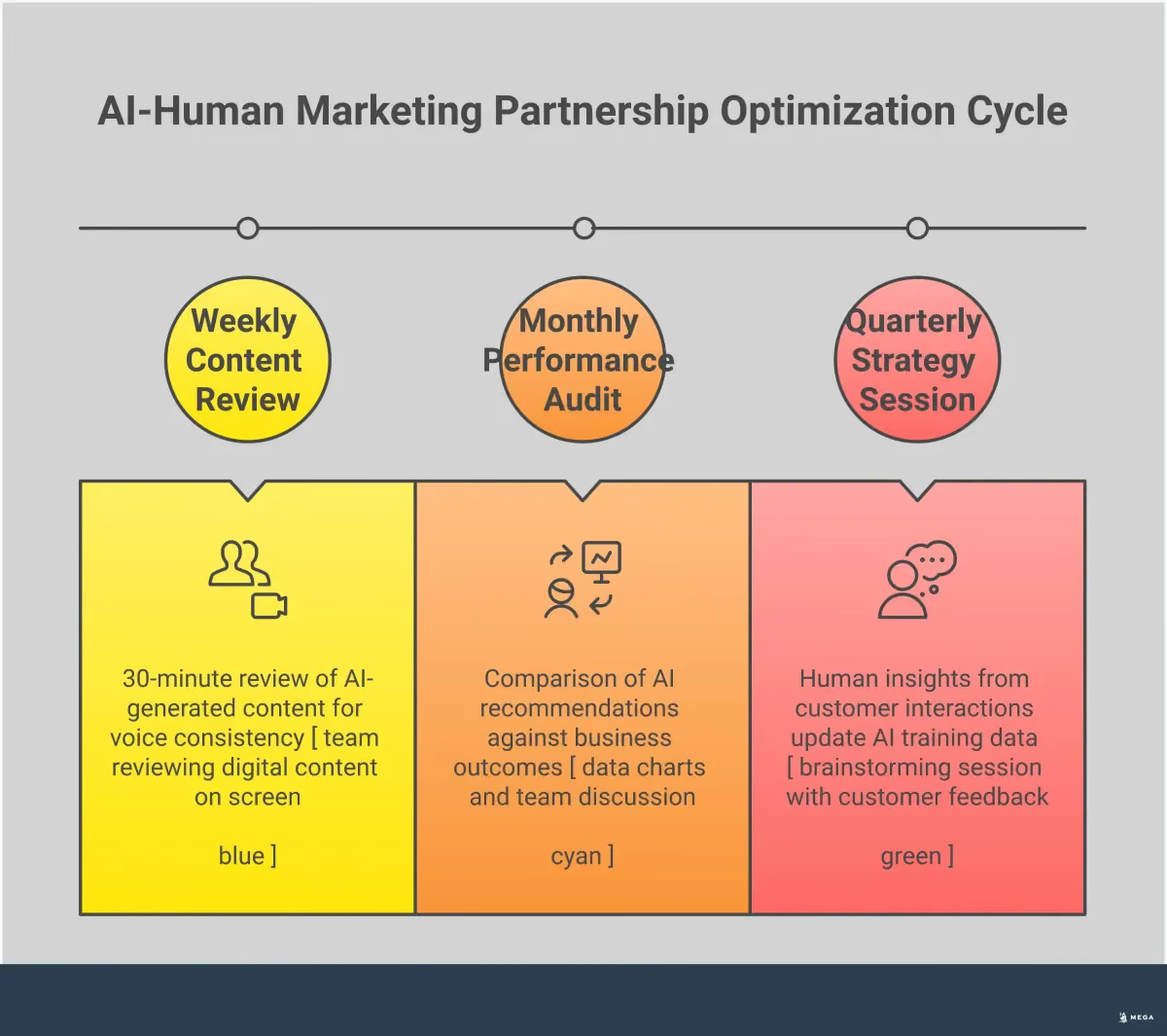
An AI marketing tool is not a "set it and forget it" solution. To get the best results, you need to establish a consistent feedback loop between your team and the AI. This means regularly reviewing the AI’s performance, analyzing its outputs, and providing corrective feedback to refine its actions. This human-in-the-loop approach ensures your automated campaigns remain aligned with your strategic goals and ethical standards. For instance, you might review the content an AI generates to ensure it matches your brand voice or adjust the targeting parameters if an ad campaign isn't reaching the right audience. This continuous process of review and refinement helps the AI learn and improve, making it a smarter and more effective partner over time.
Common AI Automation Mistakes and How to Avoid Them
Adopting AI can feel like a huge step forward, but it's easy to stumble if you're not careful. Many businesses, especially smaller ones, run into the same few problems when they first start using automation. The good news is that these mistakes are avoidable. By understanding the common pitfalls, you can create a process that pairs the power of AI with the strength of your human insight, setting your marketing up for success from day one. It’s not about letting the technology run wild; it’s about guiding it with a clear purpose and realistic expectations.
Ignoring Bad Data and Rushed Setups
The old saying "garbage in, garbage out" is especially true for AI. Your automation is only as good as the data it learns from. If you feed an AI system inaccurate or outdated customer information, it can lead to some serious missteps, like targeting the wrong audience with your ads or completely misinterpreting sales trends. Rushing the setup process often leads to these kinds of integration challenges. Taking the time to clean up your data and properly connect your tools is a critical first step. A thoughtful setup ensures your AI has a solid foundation to work from, which prevents it from making costly errors down the line.
Overlooking Initial Costs and Employee Concerns
It’s easy to focus on the long-term benefits of AI and overlook the immediate hurdles. Beyond the software subscription, there are initial costs in time and resources for proper setup and team training. Just as important is addressing the human side of this transition. Employees may worry about job security when they hear "automation," and these concerns are valid. The most effective way to manage this is to frame AI as a tool for enhancement, not replacement. By focusing your strategy on helping workers do their jobs better, you can show your team that AI is there to handle tedious tasks, freeing them up for more creative and strategic work. Addressing these financial and personal concerns upfront leads to a much smoother integration.
Setting Unrealistic Expectations for AI
It’s easy to get caught up in the hype and start thinking of AI as a magical solution that can do everything. One of the most common mistakes is simply overestimating what AI can do. While AI is incredibly powerful for executing tasks, it can't create your core business strategy or understand the nuances of your brand voice without human guidance. Trying to automate too much too soon often leads to confusion and poor results. Instead of handing over the keys to your entire marketing department, start by automating specific, well-defined tasks. This allows you to learn how the technology works and build a sustainable process that grows with your business.
Forgetting About Privacy and Compliance
When you integrate an AI tool, you're also trusting it with your company and customer data. Overlooking the privacy and security implications can open your business up to significant risks. Many small businesses don't have in-house experts, which can lead to misconfigured systems or even security vulnerabilities. It's essential to understand how your AI partner handles data, where it's stored, and who has access to it. Always choose platforms that are transparent about their processes and prioritize compliance. This protects both your business and the trust you've built with your customers.
How to Tell if Your AI Marketing Is Actually Working
Once you integrate AI into your marketing, you need a clear way to measure its performance. It’s not enough to see an increase in website traffic. True success lies in understanding how automation impacts your bottom line. By tracking the right things, you can see what’s working, identify issues early, and ensure your AI is a valuable partner in your growth, not just a busy tool.
Metrics That Matter More Than Clicks
Vanity metrics like clicks and impressions can be misleading. They show activity, but not if it’s leading to business results. Instead, focus on metrics that demonstrate real impact. To truly evaluate the effectiveness of your AI, track conversion rates, lead quality, and customer engagement. Are more people signing up or making purchases?
Beyond customer-facing results, look at internal efficiency. AI should save you time and resources. Measure improvements in process efficiency and overall cost savings. If an AI agent handles tasks that previously took hours, that’s a significant win showing a true return on investment.
Red Flags That Your AI Strategy Is Off-Track
Even the most advanced AI can go off track without a solid strategy. A major red flag is a decline in lead quality or engagement. If your AI brings in traffic that doesn't convert or creates content that doesn't resonate, it might be working with flawed data. Feeding an AI system inaccurate information can lead to poor outcomes, like targeting the wrong audience.
Another warning sign is a disconnect between your brand voice and the AI-generated content. If the messaging feels generic, the system needs better human guidance. AI is a tool to execute your strategy, not create it.
How to Build a Measurement Framework for Your AI Strategy
A framework to measure AI performance doesn’t have to be complicated. First, define clear goals, like increasing qualified leads by 15%. Next, select KPIs that directly measure progress, such as conversion rates or cost per acquisition. It's important to have a structured approach when you adopt AI solutions.
Schedule regular check-ins to review the data. Platforms like MEGA AI offer a transparent view of all agent tasks, making it easier to monitor progress and make adjustments. This ensures the AI remains aligned with your business objectives.
How to Combine Human Insights with AI Automation
The most effective marketing strategies don’t treat AI as a replacement for human expertise. Instead, they create a partnership where each plays to its strengths. AI can process data and execute repetitive tasks at a scale humans can’t match, which frees up your team to focus on strategy, creativity, and the nuances of your customer relationships. This hybrid approach is where the real growth happens.
Creating Content with a Human-AI Partnership
A balanced approach to content means assigning repetitive, measurable tasks to automation while reserving strategic, creative work for your team. Use AI to handle the heavy lifting of initial research, generating outlines, or creating first drafts. For example, an AI-powered SEO agent can identify keyword gaps and structure an article to rank well. Once the AI provides the foundation, your team steps in to add the human element. This is where you infuse your unique brand voice, share authentic customer stories, and verify that all information is accurate and helpful.
Using Human Expertise to Interpret AI Analytics
AI platforms are incredibly powerful at gathering data and presenting it in dashboards. But data without context is just noise. Your team’s role is to interpret what the numbers mean for your specific business goals. Metrics like ROI and process efficiency show the effectiveness of your AI and automation efforts. If your paid ads platform reports a drop in conversions, the AI flags the problem. A human then investigates the why. Did a competitor launch a major sale? Is there a seasonal shift in customer behavior? Your team provides the strategic insight that AI can’t, turning raw data into actionable business intelligence.
Building a Process for Continuous Optimization
Implementing AI is not a one-time setup. It’s an ongoing process of refinement that requires a strong feedback loop. Over-relying on automation without review can undermine the personal touch that builds customer relationships. It’s important to start with a clear scope and avoid automating too much too soon, which can lead to a steep learning curve. Think of your AI as a new team member that needs guidance. Regularly review the tasks it completes and use your insights to refine its instructions. This continuous optimization ensures the AI’s actions remain aligned with your strategic goals.
How Can Small Businesses Measure Success with a Hybrid AI Strategy?
When you combine AI automation with human strategy, your definition of success changes. It’s no longer just about how many tasks your AI completes or how many hours your team saves. Instead, success is measured by how well the two work together to achieve your core business objectives. A hybrid approach requires a measurement framework that gives you a clear view of the entire picture, from the first AI-driven ad impression to the final sale closed by a person on your team. This integrated perspective helps you understand the true impact of your marketing efforts.
This means looking beyond surface-level data. You need to track how AI is improving the quality of leads your sales team receives, how automation is freeing up your marketing experts to focus on high-level strategy, and how the combination is affecting your bottom line. For small businesses, where every dollar and minute counts, this clarity is invaluable. By setting up the right measurement system, you can see what’s working, identify areas for improvement, and make sure your investment in both technology and people is paying off. This holistic view is essential for building a sustainable and effective marketing engine that drives real growth.
Choosing the Right KPIs for a Hybrid Strategy
To measure the effectiveness of a hybrid strategy, you need to track key performance indicators (KPIs) that reflect both efficiency and quality. While AI can generate a high volume of activity, your human team provides the context for whether that activity is valuable. Start by tracking metrics like lead quality scores, customer lifetime value (CLV), and conversion rates from AI-qualified leads. For example, your AI might identify 100 potential leads, but your sales team can tell you which 10 of those were actually ready to buy. This feedback is crucial. You should also monitor operational improvements. To measure the return on investment (ROI) of AI, track reductions in customer acquisition cost (CAC) and the length of your sales cycle. These metrics show how automation is making your human efforts more effective and profitable.
How to Allocate Your Budget Between People and Platforms
Budgeting for a hybrid model isn’t just about subtracting agency fees and adding a software subscription. It’s about reallocating resources to support a more efficient system. Your budget should cover the cost of AI tools as well as the training and time your team needs to manage them effectively. Think of it as an investment in making your human experts more powerful, not replacing them. Many small businesses lack the infrastructure for complex AI initiatives, so a portion of your budget should go toward setting up clean data collection and management processes. With the right AI marketing tools, you can direct more of your budget toward strategic activities that require a human touch, like building customer relationships and refining your brand voice, while letting automation handle the repetitive, data-heavy tasks.
Selecting an Attribution Model for a Hybrid Approach
Standard attribution models, like last-click, often fail to capture the full value of a hybrid strategy. A customer might first interact with an AI-generated social media ad, then read a blog post optimized by an AI agent, and finally make a purchase after talking to a sales representative. A last-click model would give 100% of the credit to the salesperson, ignoring the crucial role AI played in the earlier stages. To get an accurate picture, consider a multi-touch attribution model that assigns value to each touchpoint along the customer journey. This approach recognizes that both automation and human intervention are critical. It helps you understand how different channels work together and allows you to make smarter decisions about where to invest your time and money. This balance is key, as over-reliance on automation can weaken the personal connection that is often a small business’s greatest strength.
How to Adapt Your Strategy as AI Evolves
The world of AI marketing is not static. The tools, platforms, and best practices that work today will likely be different a year from now. Adapting isn’t about chasing every new trend, but about building a flexible strategy that can evolve alongside the technology. The key is to stay grounded in your core business goals while remaining open to new ways of achieving them. This means treating learning as an ongoing part of your marketing process.
As major platforms like Google and Meta continue to integrate AI more deeply into their systems, your ability to understand and adapt to these shifts will be critical. For small businesses, this can feel like a full-time job. However, the goal isn't to become an AI expert overnight. It's about creating a simple framework for staying current and making smart decisions about which new tools to adopt. This approach allows you to leverage new capabilities without derailing your entire marketing plan. By staying informed about platform changes, preparing for new features, and focusing on your unique human strengths, you can ensure your strategy remains effective and your business stays ahead of the curve. The following steps will help you create a process for continuous improvement.
Understanding the Rise of Hyperautomation
Hyperautomation might sound like a technical buzzword, but it’s a simple idea that’s changing the game for small businesses. It goes beyond automating just one task. Instead, it uses a mix of technologies like AI and machine learning to connect and automate entire workflows. Think of it as creating a system where your automated tasks talk to each other. For example, a platform could run your ads, analyze the leads that come in, and then automatically update your customer list. This end-to-end approach allows you to streamline operations in a way that used to be reserved for large corporations, making your marketing more efficient and connected.
How to Keep Up with AI Platform Changes
Search engines and social media platforms are constantly updating their algorithms, and many of these changes are now driven by AI. This means the rules of the game can change quickly. To stay informed, make it a habit to follow reputable industry publications and the official blogs of the platforms you use most. Understanding these updates helps you adjust your strategy proactively instead of reacting after a drop in performance. More importantly, balancing automation with human intervention is crucial. An AI tool can execute tasks based on the current rules, but a human strategist can understand the why behind a platform change and adjust the brand’s core messaging accordingly.
Preparing Your Team for New AI Features
When a platform announces a new AI-powered feature, the best approach is curiosity and controlled experimentation. Instead of overhauling your entire strategy overnight, dedicate a small portion of your time or budget to testing the new tool. For small businesses, this means assigning repetitive or data-heavy tasks to the new automation while reserving strategic and creative work for your team. For example, you could run an A/B test with an AI ad-copy generator against copy written by a human. This allows you to learn how the feature works and measure its impact on your specific goals before committing to it fully, creating a low-risk environment for innovation.
Using Your Hybrid Strategy to Maintain a Competitive Edge
In an era where every business has access to similar AI tools, your competitive advantage no longer comes from the technology itself. It comes from how you combine that technology with your unique human expertise. AI is excellent at processing data and automating tasks, but it can’t replicate your deep understanding of your customers, your creative vision, or your ability to build genuine relationships. Use AI to handle the operational workload so you can focus more on high-level business decision-making and strategy. Your ability to interpret AI-driven insights and apply them with human wisdom is what will truly set your business apart.
How to Find the Right AI and Human Strategy Balance
Finding the right mix of AI automation and human strategy isn't about following a universal formula. It’s about creating a custom-fit approach that aligns with your business goals, team capacity, and customer expectations. The ideal balance allows you to assign repetitive, data-heavy tasks to technology, freeing up your team to focus on creativity, strategy, and building relationships. This is where the true power of a hybrid model comes to life.
Platforms like MEGA AI are built for this flexibility. While many users appreciate the efficiency of a fully autonomous SEO agent, the system is designed to keep you in the driver's seat. You can let an AI agent manage campaigns from start to finish or step in to approve specific tasks, ensuring every action reflects your brand strategy. The goal is to make AI a strategic partner that executes your vision with precision, not a black box that operates without your input.
Start by Assessing Your Current Automation
Before you can find the right balance, you need a clear picture of where you stand. Start by auditing your current marketing workflow. Make a list of all the tasks your team handles daily, weekly, and monthly. Then, categorize them. Which tasks are repetitive and rule-based, like generating performance reports or updating keyword bids? These are prime candidates for automation. Which tasks require empathy, nuanced communication, or creative thinking, such as writing a brand story or responding to a complex customer inquiry? These should remain firmly in human hands. This simple task audit helps you identify opportunities for efficiency without sacrificing the essential human touch that defines your brand.
Create Strategic Guardrails for Your AI Tools
Giving AI autonomy doesn't mean giving up control. It means setting clear, strategic boundaries to guide its decisions. Over-relying on automation without direction can dilute the personal touch that builds strong customer relationships. Think of guardrails as the strategic framework your AI operates within. This includes setting budget caps for paid ad campaigns, defining brand voice and tone for content generation, and establishing which decisions require manual approval. For example, you might let your AI agent adjust ad spend based on performance but require a human to approve all new ad creative. These rules ensure the AI’s actions are always aligned with your business objectives and brand integrity.
How to Train Your Team to Work with AI
Integrating AI successfully requires a shift in your team's focus. Instead of spending hours on manual execution, your team’s value comes from their strategic oversight and ability to interpret AI-driven data. Invest time in training your employees to work alongside AI tools. This means helping them develop skills in data analysis, strategic planning, and creative problem-solving. Encourage them to ask critical questions about the AI’s recommendations and to use the insights to inform broader marketing strategy. When your team understands how to leverage AI as a partner, they can focus on high-impact activities that automation can’t replicate, leading to more informed decisions and better business outcomes.