
Posting consistently on social media without seeing clear results can be incredibly frustrating. It often feels like you’re just adding to the noise, unsure what content actually connects with your audience. An AI social media assistant helps solve this by turning raw data into actionable insights. It analyzes performance across all your posts, identifies patterns in engagement, and shows you exactly what resonates with your followers. This allows you to build a proactive, data-informed strategy, ensuring your time and effort are invested in content that works.
Key Takeaways
- Use AI as an assistant, not an autopilot: The best approach is to let AI handle repetitive, data-heavy tasks like generating post variations and analyzing metrics, freeing up your team to focus on strategy, creativity, and authentic audience engagement.
- Create a structured workflow for quality control: To maintain your brand's voice and prevent errors, establish a clear process that includes strong brand guidelines, manual approvals for important content, and a final human review before anything goes live.
- Apply AI to tasks involving data, scale, and testing: Direct your AI assistant to generate multiple versions of content for A/B tests, analyze performance data to find what works, and translate posts to reach new audiences efficiently.
What is an AI Social Media Assistant?
An AI social media assistant is a system designed to help you manage, create, and optimize your social media presence. Think of it as an intelligent partner that handles many of the time-consuming tasks involved in running social channels, from drafting posts to analyzing performance data. For small business owners and lean marketing teams, this technology can be a significant advantage, automating repetitive work and providing data-backed insights to inform your strategy. These systems go beyond simple scheduling tools to act as creative partners, streamlining your workflow so you can focus on connecting with your audience.
What Can an AI Assistant Actually Do?
An AI assistant’s primary function is to make content creation faster and more manageable. This includes generating ideas for posts, writing captions, and even producing entire articles or video scripts. Some of the highest-impact AI applications for small businesses fall into this category, turning hours of work into minutes. Beyond text, these assistants can create image variations for ads, translate content for different audiences, and analyze engagement to suggest the best times to post. They can also handle customer interactions by answering common questions, guiding users to products, and scheduling appointments through intelligent chatbots.
AI Assistants vs. Manual Social Media Management
Traditional social media tools are often task-specific. You might use one to schedule posts, another to design graphics, and a third to track analytics. An AI assistant integrates these functions into a more intelligent and automated workflow. While traditional tools require you to do all the strategic thinking, an AI assistant can analyze data to make creative suggestions. It can generate hundreds of content variations automatically, a task that would be incredibly time-consuming to do by hand. The strongest strategies blend AI's efficiency with human oversight. AI excels at consistency and scale, but human-created content often delivers the authenticity and emotional nuance that builds a loyal community.
How AI is Changing Social Media Management
Artificial intelligence is reshaping how businesses approach social media. It moves beyond simple automation to act as a strategic partner, handling repetitive tasks and providing data-driven insights that were once out of reach for small teams. For small business owners and marketing managers, this means spending less time on manual processes and more time on strategy and customer engagement. An AI agent can help you create content, determine the best times to post, and analyze what’s working, all without needing a large team or a significant budget.
This shift allows you to manage your social media presence more effectively. Instead of guessing which content will perform well, you can use AI to make informed decisions based on real performance data. From generating fresh ideas for your content calendar to optimizing your posting schedule for maximum visibility, AI tools are becoming essential for maintaining a competitive edge. They handle the heavy lifting across three key areas: content creation, scheduling, and performance analytics. By integrating AI into these functions, you can build a more efficient and impactful social media strategy that connects with your audience and supports your business goals.
The State of AI Adoption and Its Impact
AI has moved from a buzzword to a practical tool that businesses are actively integrating into their daily operations. For social media management, this adoption is particularly rapid, as teams look for ways to create better content more efficiently. Understanding how marketers are currently using these tools—and how consumers feel about the content they produce—is key to building a strategy that works. It’s not just about adopting new technology; it’s about using it thoughtfully to connect with your audience without losing the human touch that builds trust and loyalty.
How Marketers Are Using AI
Marketers are primarily using AI to save time and scale their content efforts. AI tools are becoming standard for brainstorming ideas, editing posts, and writing ad copy. In fact, recent data shows that 86% of marketers plan to use AI for editing social media posts, and 85% intend to use it for writing social media ads. These assistants help you post more consistently and analyze audience data to understand what content performs best. This allows small businesses to create hundreds of content variations for testing, a task that would be impossible to manage manually, and ensures their message is seen by the right people at the right time.
Consumer Perceptions of AI Content
While marketers are embracing AI, consumers remain cautious. Studies show that 62% of consumers are less likely to engage with content if they know it was created by AI. This highlights a critical point: AI is a powerful tool, but it isn't a replacement for human oversight and creativity. The most successful social media strategies use AI to handle repetitive tasks and data analysis, freeing up marketers to focus on strategy and authentic engagement. Your brand’s unique voice and perspective are what build a genuine connection with your audience, so a final human review is essential to ensure all content feels personal and on-brand.
Automate Your Content Creation
One of the most time-consuming parts of social media is consistently creating fresh content. AI tools can generate social media content in minutes, turning a single idea into multiple posts tailored for different platforms. This allows you to maintain a consistent posting schedule without burning out your creative team. For example, MEGA AI’s agents can remix existing content to create hundreds of variations, which is perfect for testing what resonates with your audience. While AI excels at producing content at scale, it’s important to remember that human oversight provides the authenticity and emotional connection that builds a loyal community.
Automate Your Posting Schedule
Posting content at the right time is critical for maximizing reach and engagement. Instead of relying on generic best practices, AI analyzes your audience’s activity patterns to identify optimal posting times for each platform. Tools like Hootsuite and Buffer use AI to make social media scheduling smarter and more effective. This data-driven approach ensures your content gets in front of the most people when they are most likely to interact with it. Many platforms also offer an autopilot feature, allowing the AI to publish content automatically, though you can always opt for manual approval to maintain full control over your feed.
Track Performance with AI-Powered Analytics
Understanding your social media performance is key to improving your strategy. AI simplifies this process by transforming raw data into actionable insights. It can analyze key social media metrics like engagement rates, click-through rates, and audience sentiment to show you what’s working and what isn’t. While most platforms offer their own analytics, AI tools can dig deeper to identify trends and patterns you might otherwise miss. This helps you make better decisions about your content, budget, and overall strategy, ensuring your efforts are always aligned with your business goals.
Manage Brand Reputation with Sentiment Analysis
Keeping track of every mention, comment, and review across social media is a massive task. AI can help by performing sentiment analysis, which involves scanning online conversations to understand the emotion behind them. This technology tracks what people are saying about your brand and categorizes the sentiment as positive, negative, or neutral. Instead of manually reading through hundreds of comments, you get a clear overview of public perception. This allows you to quickly identify and address customer service issues before they escalate or recognize what content is generating positive feedback so you can create more of it. It turns unstructured data into clear, actionable insights for protecting your brand’s reputation.
Find and Vet Industry Influencers
Finding the right influencer goes beyond looking at follower counts. You need someone whose audience and content align with your brand. AI can streamline this process by analyzing potential influencers on a deeper level. These tools can scan an influencer’s content for relevance, tone, and engagement quality, helping you identify partners who are a genuine fit. AI can also analyze an influencer's followers to check for authenticity and ensure their audience matches your target demographic. This data-driven approach helps you discover influencers who can genuinely connect with potential customers, saving you time and improving the effectiveness of your campaigns.
How to Use AI in Your Social Media Strategy
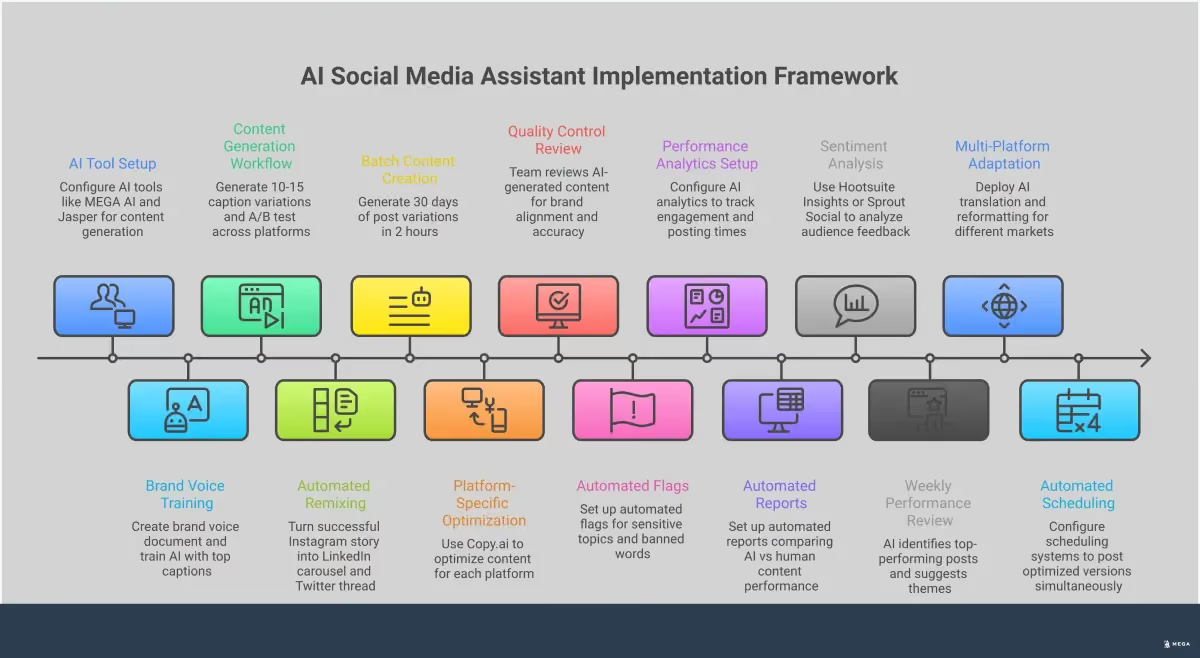
Integrating AI into your social media plan doesn't mean handing over the keys completely. Instead, think of it as adding a highly efficient team member who can handle specific, time-consuming tasks. For a small business, this is a game-changer. AI can help you brainstorm fresh ideas when you feel stuck, adapt your message for different audiences, and figure out what content actually drives results. It moves beyond simple tools by acting as an autonomous agent that can plan and execute campaigns.
The goal is to use AI to handle the repetitive parts of your strategy so you can focus on the bigger picture. An AI agent can take a single concept and turn it into a dozen different posts, test them all, and report back on what worked. This allows you to make smarter, data-backed decisions without spending hours buried in spreadsheets. It’s about working more effectively, not just creating more noise. By automating the right tasks, you free up your time for genuine customer interaction and creative thinking, which are things only a human can truly lead. This strategic partnership between human creativity and AI efficiency is where you'll find the most success.
Use AI to Brainstorm Content
One of the biggest hurdles in social media is constantly coming up with new content. AI tools can act as a powerful brainstorming partner, generating post ideas, writing captions, and even suggesting visual concepts. You can provide a simple prompt about a product launch or a company update, and the AI can produce multiple angles and hooks to work with. This process makes content creation much faster and more manageable. For advertising, AI can take your best-performing creative and automatically remix content into hundreds of variations to test, helping you find the perfect message without manual effort.
Translate and Localize Your Content
If you serve a diverse community or have ambitions to reach new markets, AI can help you speak your audience’s language, literally. AI assistants can translate your captions, video scripts, and ad copy into different languages, making your content more accessible. This goes beyond simple word-for-word translation. AI can also help you localize your message, ensuring it resonates with the cultural context of a specific region. This capability allows even small, local businesses to connect with different customer segments in a more personal and effective way, building stronger community ties.
Optimize Your Posts with A/B Testing
Creating content is only half the battle; you also need to know what works. AI simplifies the process of A/B testing by quickly generating variations of your posts and ads. You can test different headlines, images, or calls to action to see what your audience responds to most. More importantly, AI can analyze the results and identify patterns that might not be obvious to the human eye. Tracking key social media metrics is crucial for making informed decisions, and AI tools can distill this data into clear, actionable insights. This helps you refine your strategy over time and invest your resources in content that delivers real results.
Where an AI-Only Approach Falls Short
AI social media assistants are powerful allies, capable of handling tasks that used to take hours of manual work. They can draft posts, analyze performance, and even create entire campaigns. But relying on AI alone can leave your social media strategy feeling a bit robotic. The most successful brands understand that AI is a tool to support human creativity, not replace it entirely. While an AI agent can execute a strategy flawlessly, the nuance, empathy, and authenticity that build a loyal community still come from you and your team. This is why finding the right balance is key to getting the most out of your tools without losing your brand’s soul.
Don't Lose the Human Connection
AI is excellent at operating at scale and maintaining consistency, but it can struggle to replicate the genuine connection that comes from a human touch. Social media is, at its core, social. Your audience wants to connect with the people behind the brand. While AI-generated content can be optimized for clicks and reach, human-created content often delivers the authenticity, emotion, and cultural relevance that spark meaningful engagement. Think of it this way: an AI can tell you a joke based on a formula, but a human can share a funny, relatable story that makes your audience feel seen and understood. That emotional connection is what turns followers into true fans.
Why AI Struggles with Brand Voice
Your brand voice is your company’s personality. It’s the unique way you communicate with your audience, and it’s built on subtle cues, humor, and a deep understanding of your customers. While you can train an AI on your brand guidelines, it can sometimes miss the mark on nuance. It might not catch the subtle difference between playful sarcasm and a genuine complaint, or know when to break from the script to have a more serious conversation. The best strategies use AI for structure and data-driven insights, then layer in human creativity for storytelling. This combination helps you build trust and stand out in a crowded feed, ensuring your message always lands exactly as you intended.
Staying Authentic and Engaging in Real Time
Authenticity is a major currency on social media. Audiences are savvy and can often spot content that feels generic or disingenuous. Relying too heavily on automated content can risk damaging your brand credibility if it lacks a genuine perspective. Research has even shown that while AI-generated posts might achieve a wider reach, human-created content often generates more comments and discussion. This is because real-time engagement, like responding to comments or jumping into a trending conversation, requires a level of spontaneity and awareness that AI has not quite mastered. These authentic, in-the-moment interactions are where relationships with your audience are truly built and strengthened.
Security Risks and Ethical Considerations
While AI offers incredible efficiency, it's important to be aware of the potential risks. Using these tools without a clear understanding of their security and ethical implications can expose your business to data privacy issues and damage the trust you've built with your audience. A thoughtful approach is necessary to use AI responsibly and protect your brand’s reputation.
Prompt Engineering Attacks and Data Privacy
Many AI tools, especially free ones, can seem harmless but may not be secure. When your team uses unapproved consumer AI tools, you risk exposing sensitive business information. A more direct threat comes from malicious actors who can create deep fakes—AI-generated impersonations of company leaders that are difficult to disprove. Imagine a fake video of you appearing on social media making false promises or offensive statements. Without clear guidelines and secure, approved tools, you leave your brand vulnerable to these kinds of attacks and data breaches.
The Importance of Ethical Disclosures
Authenticity is one of your most valuable assets on social media. Your audience is smart, and they can usually tell when content feels impersonal or automated. If you rely too heavily on AI without a human touch, you risk damaging your brand's credibility. It’s often best to be transparent about your use of AI, especially with chatbots or automated responses. Disclosing that a customer is interacting with a bot manages expectations and builds trust. Hiding it can make your audience feel deceived, which can harm the genuine perspective your followers value.
Technical and Language Limitations
Every AI system is shaped by the data it was trained on. This creates a vulnerability known as data poisoning, where the AI learns from biased, incorrect, or malicious information. If an AI’s training data is flawed, it can generate content that is inaccurate, offensive, or completely off-brand, creating a PR headache for your business. This is a core reason why human oversight is non-negotiable. You need a final check to ensure the content aligns with your values and is factually correct before it goes live.
Beyond technical vulnerabilities, AI also has language limitations. While it excels at producing content at scale, it often misses the emotional and cultural nuances that make communication effective. An AI might not understand sarcasm, local slang, or the subtle context of a trending topic, leading to tone-deaf posts. Human-created content delivers the emotional nuance that builds a real community. Your team’s ability to read the room and engage with empathy is a uniquely human skill that AI can support but not replace.
How to Balance AI with Human Creativity
Adopting an AI social media assistant doesn’t mean firing your marketing team. The most effective strategies treat AI not as a replacement for human talent but as a powerful partner. AI excels at tasks that require speed, data processing, and scale, while humans provide the strategic thinking, emotional intelligence, and creative spark that builds a genuine connection with an audience. By combining the strengths of both, you can create a social media presence that is both efficient and authentic. The key is to build a workflow where technology handles the repetitive work, freeing up your team to focus on what they do best: being creative and connecting with people.
Use AI as an Assistant, Not a Replacement
Think of your AI assistant as a highly capable team member, not the entire department. AI-generated content is great for consistency and optimization, but human-created content delivers the authenticity and cultural relevance that spark meaningful conversations. You can use AI to generate dozens of caption ideas, analyze the best times to post, or create variations of a successful ad. This handles the heavy lifting and gives you a solid foundation to work from. Your role is to then infuse that content with your brand’s unique personality, respond to trends with nuance, and build a real community around your brand. Let AI manage the science of social media so you can focus on the art.
Set Clear Roles for AI and Your Team
To create a seamless partnership, you need to establish clear roles. An effective workflow outlines which tasks are best for AI and which require a human touch. This starts with defining the specific jobs AI can handle, like data analysis and content scheduling, while reserving creative strategy and storytelling for your team. For example, you can have your AI agent draft posts for an upcoming campaign and schedule them. Your social media manager then reviews the drafts, refines the messaging to match the brand voice, and spends their time engaging with comments and messages. This is why platforms like MEGA AI offer both autopilot and manual approval modes for its Paid Ads agent, letting you decide where to apply human oversight.
Why You Still Need a Human Editor
Relying solely on AI can lead to generic content that feels disconnected from your audience. While AI tools are getting smarter, they can miss the subtle nuances of language and culture that make content relatable. Human oversight is essential to ensure everything you post is relevant, engaging, and perfectly aligned with your brand’s voice. Your team should always act as the final filter, reviewing AI-generated content for quality, accuracy, and tone. This final check helps you avoid embarrassing mistakes, maintain your brand credibility, and ensure your social media presence feels authentic and current.
How to Keep AI-Generated Content Engaging
Using an AI assistant for social media doesn’t mean your content has to sound robotic. The key is to treat AI as a collaborator that executes your vision, not as a replacement for your brand’s personality. When you combine the efficiency of AI with your unique human insight, you create content that is both scalable and authentic.
The most engaging AI-assisted content comes from a strong partnership. You provide the strategy, the brand voice, and the creative direction. The AI provides the speed, the variations, and the data processing power to bring it all to life. This approach ensures your social media presence grows without losing the connection you’ve built with your audience. Think of it as giving your AI assistant the perfect playbook to run.
Train Your AI with Clear Brand Guidelines
To get the best results from an AI assistant, you need to give it clear instructions. This starts with establishing strong brand guidelines that define your company’s personality. These guidelines should cover your brand’s voice, tone, and values, ensuring every piece of content feels consistent and true to who you are.
Your guidelines can include specific words to use or avoid, the style of humor you prefer, and how you address your audience. For example, are you formal and professional, or casual and friendly? Providing these details helps the AI generate content that aligns with your brand identity and builds trust with your followers. This consistency is what helps maintain a strong brand presence across all your posts.
Regularly Review Your Content's Performance
Once your AI starts creating content, it’s important to monitor how it performs. Regularly reviewing your posts helps you understand what resonates with your audience. By tracking key social media metrics like engagement rates, reach, and clicks, you can see which topics and formats are most effective.
This data gives you the insights needed to refine your strategy. If you notice that posts with questions get more comments, you can instruct your AI to create more content in that style. This feedback loop allows you to make informed decisions and continuously improve your content, ensuring your AI is always optimized to meet your goals and connect with your audience.
Use Audience Feedback to Refine AI Prompts
Your audience provides valuable clues about what they want to see. Pay attention to comments, direct messages, and mentions to gather direct feedback. At the same time, keep an eye on current trends in your industry and on social media platforms. This is where your human creativity is irreplaceable.
You can then feed these insights back to your AI assistant. For instance, if customers are asking questions about a specific product feature, you can have your AI generate a series of posts answering them. By combining AI-driven insights with real-time human observations, you can create content that is timely, relevant, and genuinely helpful to your followers.
How to Measure the Success of Your AI-Human Team
Once you start blending AI-generated posts with human creativity, you need a clear way to see what’s working. The goal isn’t just to fill your content calendar; it’s to connect with your audience and drive results for your business. Measuring your efforts helps you refine your strategy, ensuring your AI assistant and your team are working together effectively. By tracking the right numbers, you can move beyond guessing and make data-informed decisions about your social media presence.
This process involves looking at how your audience interacts with different types of content, understanding their feelings about your brand, and connecting your social media activity back to your bottom-line business goals.
Focus on Key Engagement Metrics
Start by looking at the fundamental signals your audience sends you. Engagement measures how people interact with your content through likes, comments, shares, and saves. These actions tell you if your posts are capturing attention and resonating with followers.
When you post content created with AI assistance, compare its performance to your purely human-created posts. Does one get more shares while the other gets more comments? A high number of saves might indicate that your AI is helping you create valuable, evergreen content, while a spike in comments could show that your team’s personal touch is sparking conversation. Use these insights to guide where you direct your AI and human efforts.
Monitor Audience Sentiment and Feedback
Beyond the numbers, it’s important to understand the feeling behind the engagement. The comment section is a direct line to your audience, offering feedback and showing how your posts make them feel. Are the comments positive and supportive, or are they confused or critical? This qualitative feedback is a powerful metric for judging the effectiveness of your content.
Many social media platforms have built-in analytics tools that can help you get a sense of audience sentiment. Pay attention to the tone and themes in the comments on both AI-assisted and human-led posts. This helps you catch any missteps in brand voice and ensures your AI-generated content feels authentic to your followers.
Measure the ROI of AI vs. Human-Led Content
Ultimately, your social media efforts need to contribute to your business goals. To measure the return on investment (ROI), you need to compare how different content types perform. AI-generated content is great for consistency and scale, while human-created content often delivers the authenticity and emotion needed to spark meaningful engagement.
Look at which posts drive valuable actions, like clicks to your website, lead form submissions, or product sales. By tracking these conversions, you can see which blend of AI and human creativity produces the best results. This allows you to optimize your workflow, using AI to handle tasks it excels at while freeing up your team to focus on high-impact, creative work that builds trust and turns followers into customers.
How to Build an Effective AI-Human Workflow
Integrating AI into your social media management is not just about flipping a switch. To get the best results, you need a structured process that combines the efficiency of AI with the strategic oversight of your team. An effective AI-human workflow acts as a bridge, ensuring every piece of content is both optimized for performance and true to your brand. This system helps you avoid common pitfalls, like off-brand messaging or factual inaccuracies, by defining clear roles and checkpoints. By creating a repeatable process, you can harness AI's power to scale your efforts while maintaining the quality and authenticity your audience expects. A well-designed workflow makes AI a true partner in your social media strategy, not just a tool.
Autopilot vs. Manual Approval: Which is Right for You?
The first step in building your workflow is deciding how much control you want to retain. Most advanced AI platforms give you the option to run on autopilot or require manual approval for tasks. Autopilot is ideal for high-volume, low-risk activities where speed is a priority. This could include scheduling already-approved posts, running A/B tests on ad creative, or generating initial drafts.
Manual approval, on the other hand, is essential for content that requires nuance and a human touch. Think brand announcements, responses to customer feedback, or posts about sensitive topics. This approach lets you use AI for the heavy lifting while a team member provides the final sign-off. The key is to find a balance. AI-generated content excels at scale and consistency, while human review ensures authenticity and emotional connection.
Establish a Quality Control Checklist
Even the most sophisticated AI can make mistakes. A quality control (QC) process is your safety net, protecting your brand from embarrassing errors and maintaining a high standard for your content. While AI tools can accelerate content creation, they can also introduce quality issues that could harm your credibility if left unchecked. Your QC process doesn’t need to be complicated. It can be a simple checklist that a team member runs through before any AI-generated content goes live.
Your checklist should cover a few key areas: factual accuracy, spelling and grammar, tone of voice, and alignment with your brand guidelines. It’s also a good idea to check that any links are working and that images or videos are appropriate for the post. This review step ensures every piece of content is polished, professional, and ready for your audience.
Integrate Brand Voice into Your Approval Process
For an AI to effectively assist your social media efforts, it needs to understand your brand’s personality. This is where clear brand voice standards become critical. These guidelines serve as a rulebook for the AI, helping it generate content that sounds authentically like you. While AI can learn patterns, it can’t fully grasp the emotional intelligence that defines human communication. Your standards help bridge that gap.
Your brand voice document should include your mission, target audience, and core values. Define your tone with specific adjectives (e.g., "helpful, witty, and direct"). Include a list of words and phrases to use and ones to avoid. Providing examples of on-brand and off-brand posts is also incredibly helpful. A detailed guide empowers both your AI and your human team to create a consistent and recognizable brand presence across all platforms.
Top AI Social Media Tools for Your Team
While a fully autonomous agent can manage your entire social media presence, you might prefer to build a custom toolkit that supports your existing team. Many businesses find success by combining several specialized AI tools to create a workflow that fits their specific needs. This approach allows you to automate certain tasks, like drafting copy or scheduling posts, while keeping your team in full control of strategy and final approval. Think of it as hiring a team of specialist assistants, each one an expert in a different area of social media management.
By selecting tools that handle different parts of the process, you can free up your team to focus on what they do best: connecting with your audience and building your brand. This method gives you the efficiency of AI without sacrificing the human oversight that keeps your content authentic and on-brand. This section explores some of the best AI tools that can complement your human expertise in content creation, scheduling, and testing.
Tools for AI Content and Visual Creation
One of the most time-consuming parts of social media is the constant need for fresh content. AI tools can act as a powerful brainstorming partner and production assistant. Platforms focused on AI for small businesses can generate ideas, write first drafts of captions, and even create entire blog posts from a simple prompt. This helps your team overcome creative blocks and produce a higher volume of content.
Beyond text, AI can also help with visual design. Some tools can generate unique images, graphics, or video clips based on your descriptions. This is incredibly useful for small teams that don't have a dedicated graphic designer. It allows you to create polished, on-brand visuals quickly, ensuring your social media feeds always look professional and engaging.
Flick
Flick is well-regarded for its "AI copilot" feature, which acts as a creative partner for your social media efforts. This tool is designed to help you with brainstorming ideas, drafting posts, and repurposing your content for different social media channels. Instead of starting from a blank page, you can use the copilot to generate fresh concepts and captions that align with your brand. This streamlines the creative process, making it easier to maintain a consistent and engaging presence without spending hours on content creation every week. It’s a practical solution for teams looking to produce more content while keeping their messaging sharp and on-brand.
Predis.ai
Predis.ai stands out for its ability to quickly generate a variety of content formats from minimal input. You can provide a few words or a simple prompt, and the tool can create complete posts, multi-image carousels, and even short videos. This is particularly useful for small businesses that need to produce diverse content but lack the time or resources for extensive production. Additionally, Predis.ai offers competitive analysis features, allowing you to monitor what your competitors are posting. This insight can inform your own content strategy, helping you identify gaps and opportunities in your market.
Publer
Publer is a versatile tool that handles both the text and visual aspects of content creation. Its AI can write post copy and also generates images, making it a strong option for teams without a dedicated graphic designer. This integrated approach saves time by keeping the entire creation process within one platform. Publer also provides insights into trending topics, filtered by country or category. This feature helps you create content that is timely and relevant to your audience’s interests, increasing the likelihood of engagement by tapping into current conversations.
Tools for Scheduling and Performance Analytics
Consistency is key on social media, but finding the perfect time to post can feel like a guessing game. AI-powered scheduling tools remove the uncertainty by analyzing your audience’s activity and identifying peak engagement times. Platforms like Buffer and Hootsuite offer smarter social scheduling that automatically publishes your content when it’s most likely to be seen.
These tools also simplify performance tracking. Instead of manually digging through data, you can use AI to get clear reports on what’s working and what isn’t. The software can highlight your top-performing posts, track key metrics, and offer insights into audience demographics and behavior. This allows your team to make data-driven decisions and continuously refine your social media strategy without needing a background in data science.
FeedHive
FeedHive is a great option if you want to get more mileage out of your existing content. Its system is designed to help you reuse your best-performing posts, ensuring your evergreen content continues to reach new audiences. It also offers conditional posting, which means you can set up rules for when content goes live. For example, you can have it automatically share a follow-up post if a previous one gets high engagement. This feature helps you capitalize on momentum without having to monitor your accounts 24/7. FeedHive also includes an AI writing assistant to help you draft new posts and can even predict how well a post is likely to perform before you publish it.
ContentStudio
If staying on top of industry trends is a priority for your business, ContentStudio is a tool worth exploring. Its main strength is its content discovery feature, which helps you find popular news and trending topics relevant to your audience. This is incredibly useful for curating content and ensuring your brand is part of the current conversation. You can use these insights to inform your own content strategy or share relevant articles with your followers. ContentStudio also provides a suite of automation features to help you plan, schedule, and analyze your posts, making it a solid all-in-one platform for managing your social media presence.
Tools for A/B Testing and Content Translation
A single great idea can be the foundation for dozens of social media posts. AI excels at repurposing and remixing content to extend its reach. You can use AI to generate multiple variations of a caption, headline, or image to A/B test what resonates most with your audience. This process of creating AI-generated captions and variations helps you optimize your content for maximum impact.
AI also breaks down language barriers, allowing you to connect with a global audience. Many tools can translate your content into different languages automatically, adapting your message for new markets. For a small or local business looking to expand its customer base, this is a powerful way to localize content and engage with diverse communities without hiring a team of translators.
StoryChief
StoryChief is a content marketing platform that solves the problem of distributing one piece of content across many channels. Instead of manually creating separate posts for each platform, you can write a blog post within the tool and let it automatically publish that content to your website, social media accounts, and email newsletters. Its AI features help you adapt your message for each channel by rephrasing sentences for different audiences or generating unique social media captions from your main article. This makes it much easier to repurpose your core ideas. For a small business, this approach is a significant time-saver, helping you maintain a consistent brand presence everywhere without getting bogged down in repetitive copy-and-paste work.
What's Next for AI in Social Media?
The role of AI in social media is quickly moving beyond simple task automation. While today’s tools are great for scheduling posts or generating first drafts, the next wave of AI assistants will function more like strategic partners. They will possess more advanced creative and analytical skills and integrate seamlessly with your other marketing channels. This shift means AI will not just execute commands but will also help you make smarter, data-driven decisions about your entire social media presence. For small businesses, this evolution promises to make high-level social media strategy more accessible and manageable than ever before.
Emerging AI Capabilities to Watch
Future AI assistants will handle a wider range of sophisticated tasks. Imagine an agent that doesn't just write a caption but also designs multiple image variations, translates them for different markets, and automatically tests them to find the top performer. The goal is to automate routine tasks so you can focus on strategy and connection. While AI-generated content is great for achieving consistency and scale, human creativity provides the authenticity and emotion that builds community. This is why platforms like MEGA AI are developing agents that act as a true extension of your team, handling the heavy lifting while you guide the creative vision.
How AI Will Integrate with Your Marketing Stack
The most significant change will be how AI connects social media to the rest of your marketing efforts. An AI social media assistant will no longer work in isolation. Instead, it will pull insights from your paid ad campaigns to understand which messages drive conversions and align your social content with your overarching SEO strategy. This creates a unified customer experience. The real power comes when you remain the driver, using AI to connect data points faster than a human ever could. This allows you to build a smarter, more cohesive marketing plan where every channel works together to achieve your business goals.