
What if you could access the strategic power of a full-service marketing agency without the five-figure monthly price tag? That’s the core promise of the new wave of AI-powered SEO platforms. While traditional seo agency services rely on teams of people to manually research keywords, write content, and fix technical issues, AI agents can now handle these tasks autonomously. This shift doesn't just make SEO more affordable; it makes it faster and more scalable for small businesses and startups. We’ll explore the key differences between these two approaches, from pricing and timelines to the level of control you have over the process.
Key Takeaways
- Understand the core operational difference: Traditional agencies rely on manual work from a human team for strategy and execution. AI-powered services use autonomous agents to automate tasks like content creation and technical fixes, focusing on speed and scale.
- Align your budget with the service model: AI platforms offer a cost-effective solution with predictable pricing by reducing manual labor. In contrast, traditional agencies charge higher retainers to cover the cost of their team's dedicated time and hands-on management.
- Choose based on your business needs and resources: AI services are ideal for startups and SMBs that need rapid, scalable execution and have limited time for management. A traditional agency may be a better fit for larger businesses with complex requirements that value a dedicated strategic partnership.
What Are SEO Agency Services?
SEO agency services are a collection of strategies and tasks designed to improve your website's visibility in search engine results. The primary goal is to attract more relevant traffic from platforms like Google, which can lead to more customers and revenue for your business. These services can range from foundational tasks like keyword research to more complex activities like technical site audits and content strategy. As technology has advanced, the way these services are delivered has split into two main paths: the traditional, human-led agency model and the modern, AI-powered service model. Both aim for the same outcome, but their methods, speed, and scalability can be quite different.
Breaking Down Core SEO Services
At their core, most SEO services are built on a few key pillars. An agency will typically start with keyword research to understand what your potential customers are searching for. From there, they handle on-page optimization, which involves refining your website's content and structure to align with those keywords. This often includes creating new blog posts and landing pages. Agencies also manage technical SEO, ensuring your site is fast, secure, and easy for search engines to crawl. Finally, they work on off-page factors like link building to establish your site's authority. These components work together to build a comprehensive SEO strategy.
Traditional vs. AI-Powered SEO Models
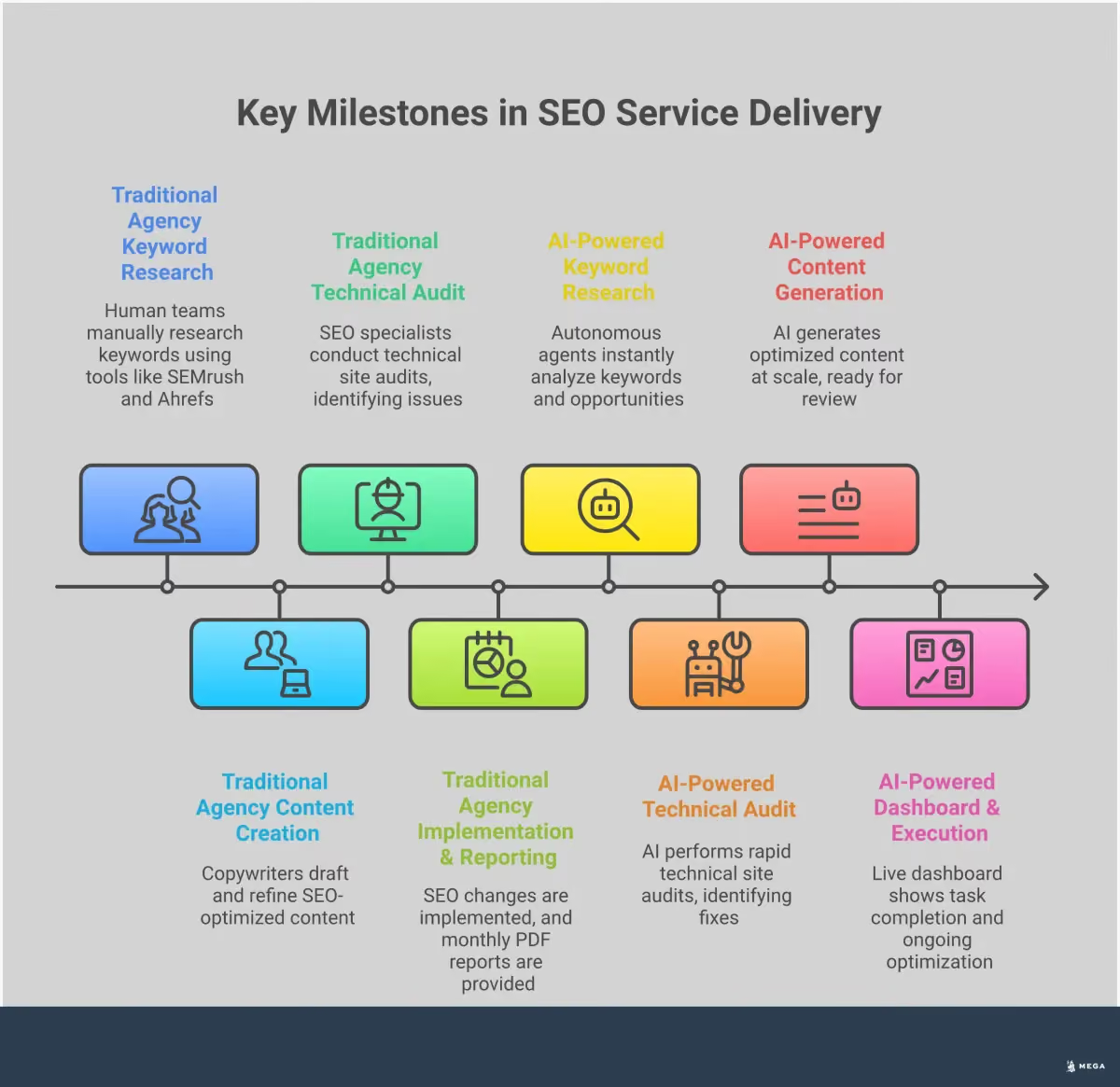
The main difference between SEO models lies in execution. A traditional agency relies on a team of specialists to manually perform research, write content, and make site updates. This approach offers a high-touch, personalized experience. In contrast, AI-powered SEO models use autonomous agents to handle many of these same tasks. These systems can analyze data, generate content, and even fix technical errors with minimal human intervention. This "Service-as-a-Software" approach allows for faster execution and can operate at a much larger scale, making it an efficient option for small businesses that need to see results without the high overhead of a traditional agency.
What Do Traditional SEO Agencies Offer?
When you partner with a traditional SEO agency, you’re hiring a team of human experts to manage different parts of your search strategy. These agencies typically bundle their work into a monthly retainer, covering a set of core services designed to improve your website's visibility in search engine results. The process is hands-on, relying on the team's experience, established workflows, and manual execution.
While effective, this model has its trade-offs. The deep human expertise is valuable, but it can also lead to slower execution and higher costs due to the manual labor involved. Communication usually happens through scheduled calls and monthly reports, which can sometimes feel less transparent than a real-time dashboard. Let's look at the specific services you can typically expect from a traditional SEO agency.
Keyword Research and Strategy
The foundation of any SEO effort is understanding what your potential customers are searching for. A traditional agency starts by conducting in-depth keyword research to identify the terms and phrases relevant to your business. Their team uses specialized tools to analyze search volume, competition, and user intent.
Based on this research, they develop a comprehensive SEO strategy that maps out which keywords to target, what kind of content to create, and how to structure your site to attract the right audience. This strategic plan serves as the roadmap for all subsequent SEO activities, from content creation to technical fixes.
Content Creation and Optimization
Content is the vehicle that delivers your keywords to your audience. Traditional agencies employ writers and SEO specialists to create and optimize content like blog posts, landing pages, and product descriptions. The process involves writing high-quality, informative content that addresses the user's search intent and naturally incorporates target keywords.
Beyond creating new pages, they also optimize your existing content. This might involve rewriting titles and meta descriptions to be more compelling, updating articles with fresh information, or restructuring pages to improve readability and on-page SEO signals. This manual process ensures quality but can be time-consuming to scale.
Technical SEO Audits and Fixes
A website's technical health is critical for search engine performance. Agencies perform regular technical SEO audits to identify issues that could be holding your site back. This includes checking for problems with site speed, mobile-friendliness, crawlability, indexation, and structured data.
Once they identify issues, their team—or yours—works to implement the necessary fixes. This could involve compressing images to improve load times, fixing broken links, resolving duplicate content issues, or implementing schema markup to help search engines better understand your content. Because this often requires developer resources, the process can sometimes be slow.
Link Building and Outreach
Backlinks, or links from other websites to yours, are a powerful signal to search engines that your site is authoritative and trustworthy. Traditional agencies often provide link building services, which involve manually reaching out to other websites, bloggers, and publications to earn high-quality links.
This is a relationship-driven process that requires significant time and effort. An agency's outreach team might pitch guest posts, share valuable content with journalists, or find unlinked mentions of your brand and request a link. Building a strong backlink profile is a long-term play that is central to many traditional SEO strategies.
Local SEO and Google Business Profile Management
For businesses that serve a specific geographic area, local SEO is essential. Agencies help optimize your online presence to attract local customers. A major part of this is managing your Google Business Profile, ensuring your business information is accurate, posting updates, and responding to reviews.
They also work on other local ranking factors, such as building local citations (mentions of your business name, address, and phone number on other sites) and optimizing your website's content with location-specific keywords. This helps you appear in the local map pack and in "near me" searches.
Reporting and Communication
A key service offered by traditional agencies is tracking performance and communicating results. You can typically expect to receive a detailed report each month that outlines key metrics like organic traffic, keyword rankings, and conversions. These reports are usually accompanied by a call or meeting with your account manager to discuss progress and plan next steps.
This structured communication ensures you stay informed about the work being done and the impact it's having. However, the information is often a snapshot in time rather than a real-time view, and you may need to wait for your monthly check-in to get answers to your questions.
How AI-Powered SEO Services Work
AI-powered SEO services use intelligent agents to manage your entire search strategy, moving beyond the manual processes of traditional agencies. Instead of a team of people executing tasks, an AI agent autonomously plans, creates, and optimizes your content and technical SEO. This approach uses automation and predictive analytics to keep your brand visible across search engines and new AI-driven platforms like Google's AI Overviews.
Think of it as compressing the capabilities of a full-stack growth agency into a single, efficient AI system. These aren't just tools that suggest keywords or check for errors. They are strategic operators that identify growth opportunities, write and deploy content, and refine tactics based on performance. This allows for a more dynamic and continuous optimization process than the project-based work common with traditional agencies. Let’s look at how this works in practice.
Autonomous Strategy and Execution
An AI-powered SEO service begins by developing a custom strategy without needing weeks of kickoff meetings. The AI agent connects to your business data, analyzes your goals, and researches competitors to build a unique plan. It identifies high-impact keywords and maps out a content calendar designed to capture search intent.
Once the strategy is set, the system gets to work. Many platforms offer an "autopilot" mode where the AI executes the plan without requiring manual approval for every task. This means the agent can perform technical audits, create content, and make site adjustments on its own. This is a shift from simply using an AI tool to having a dedicated AI agent that comes up with a strategy and executes the tasks needed to hit your goals.
Automated Content Generation and Updates
Content is the core of any SEO strategy, and AI services automate the entire lifecycle. The AI agent can write on-brand blog posts, create landing pages, and generate other marketing copy based on its keyword research. It ensures the content is structured for readability and optimized for search engines from the start.
Beyond creating new articles, the AI continuously works to improve your existing content. It might identify a blog post with declining traffic, rewrite the introduction to improve its click-through rate, or add new sections to make it more comprehensive. The system can also add conversion-focused elements, like calls-to-action, to turn your organic traffic into leads. This ongoing maintenance keeps your content library fresh and competitive.
Real-Time Technical Optimization
Technical SEO forms the foundation of a healthy website, but it’s often treated as a one-time audit by traditional agencies. AI-powered services handle it differently by providing continuous, real-time monitoring and fixes. The AI agent regularly audits your site for issues like slow page speed, crawl errors, broken links, and improper indexing.
When it finds a problem, it can often fix it automatically. For example, the agent might resolve canonical tag issues, add alt tags to hundreds of images, or create and submit an updated sitemap to Google. This proactive approach ensures your site’s technical health is always maintained, preventing small issues from becoming major problems that could hurt your rankings.
Programmatic SEO at Scale
Programmatic SEO is a strategy for creating hundreds or even thousands of optimized pages at scale, and AI makes it accessible for small businesses. This approach is ideal for businesses that need to target many specific, long-tail keywords. For instance, a local plumbing company could automatically generate a unique page for every neighborhood it serves, or an online store could create a page for every color and size variation of a product.
An AI agent can manage this entire process. It identifies the data sets, creates a template, and then dynamically generates the content for each page. This allows you to build a massive footprint on search engines and capture highly specific traffic that would be too time-consuming and expensive to target manually.
Optimizing for LLMs and AI Search
The way people find information is changing with the rise of large language models (LLMs) like ChatGPT and integrated AI search results. AI-powered SEO services are built to optimize for these new platforms, a practice sometimes called Answer Engine Optimization (AEO). This involves structuring your content so it can be easily understood and used as a source for AI-generated answers.
An AI agent can format your content with clear headings, lists, and direct answers to common questions. It also helps implement schema markup, which is structured data that gives search engines more context about your content. This improves how your business shows up in conversational AI tools and Google's AI Overviews, ensuring you remain visible as search technology evolves. You can book a demo to see how this works firsthand.
How Much Do SEO Services Cost?
Understanding the cost of SEO services can feel like trying to hit a moving target. Prices vary widely based on the scope of work, the provider’s experience, and the business model they use. The biggest factor, however, is whether you choose a traditional agency or an AI-powered service.
Traditional agencies build their pricing around human hours and expertise, which often means higher monthly retainers. Their value comes from dedicated account managers and deep strategic planning. In contrast, AI-powered SEO services use automation to handle tasks at scale, which typically results in a more predictable and lower monthly cost. Neither approach is inherently better, but one is likely a better fit for your budget and growth goals. Let's break down what you can expect to pay for each model and how to think about the value you get in return.
Traditional Agency Pricing Models
With a traditional SEO agency, you’re paying for a team of specialists. Their pricing reflects the time and manual effort required for keyword research, content creation, technical fixes, and outreach. Most agencies use a monthly retainer model, with costs typically ranging from $5,000 to over $20,000 per month for comprehensive services. Some may also offer project-based pricing for specific tasks like a one-time technical audit or hourly consulting. This model is built on established processes and human expertise, but the reliance on manual work often leads to higher costs and slower execution times.
AI-Powered SEO Service Pricing
AI-powered SEO services change the cost equation by automating many of the core tasks an agency performs. Instead of paying for manual hours, you’re paying for access to a platform that executes an SEO strategy for you. This efficiency brings the price down significantly. For example, MEGA AI’s SEO agent starts at $799 per month. While pricing for AI SEO services can range up to $3,500 per month, they consistently offer a more affordable alternative to traditional agencies. This model is designed for businesses that need comprehensive SEO management without the high overhead of a full agency team.
Analyzing Value and ROI
When comparing costs, it’s important to look beyond the monthly fee and consider the return on investment (ROI). A traditional agency’s high price tag buys you personalized, hands-on service and strategy. For large enterprises with complex needs, this can be a worthwhile investment. For small businesses and startups, however, the speed and scale of an AI-powered service often provide a better long-term return. By automating content creation and technical fixes, AI platforms can execute tasks faster and more consistently, helping you see results sooner and making your marketing budget go further.
How Long Until You See SEO Results?
Patience is a virtue in SEO, but how much patience you need can depend on the approach you take. Whether you hire a traditional agency or use an AI-powered service, seeing a significant impact on your organic traffic takes time. The key difference lies in how quickly the work gets done and when you start seeing the initial signs of progress.
Typical Timelines for Traditional Agencies
With a traditional SEO agency, the standard timeline to see meaningful results is typically four to six months. This timeframe accounts for the manual processes involved: conducting keyword research, writing and editing content, performing technical audits, and building backlinks. Each step requires human effort and coordination. An agency methodically builds your site's authority over time, and while the long-term rewards can be substantial, the initial ramp-up period is often a slow and steady climb. This pace is standard for building a lasting organic presence from the ground up.
The Speed Advantage of AI SEO
AI-powered SEO services are designed to shorten the time to execution. Instead of waiting weeks for a content calendar or a technical audit, an AI agent can perform these tasks in minutes. MEGA AI, for example, can start implementing its strategy, from keyword research to content creation, almost immediately. While significant organic traffic growth still requires time—most users see results within three to nine months—the initial tasks are completed much faster. With features like Autopilot, where the AI works autonomously, MEGA AI customers often see 2x faster results compared to manual approval workflows, allowing them to gain momentum more quickly.
What Factors Influence Your Timeline?
Your timeline for seeing SEO results depends on more than just your service model. Several factors play a crucial role, including your website's age and authority, the competitiveness of your industry, and your site's technical health. A brand-new website will take longer to rank than an established one. Similarly, ranking for highly competitive keywords requires more time and effort. An effective strategy often combines the strategic oversight of human expertise with the speed and scale of AI tools. An AI-powered platform can quickly address technical issues and scale content, tackling many of these influencing factors at once to build a strong foundation for growth.
Control and Transparency: What’s the Difference?
When you hire a partner to manage your SEO, you want to know what they're doing and how it's working. The way you get this information differs greatly between traditional agencies and AI-powered services. A traditional agency relies on human account managers to communicate progress, while an AI service often provides direct, real-time visibility into its operations. Understanding this difference is key to choosing a partner you can trust and work with effectively. Let's look at how each model handles reporting, task management, and the balance between human input and automated work.
How Traditional Agencies Report Progress
Traditional SEO agencies typically rely on scheduled check-ins and reports to show progress. You might have a weekly call with your account manager or receive a monthly PDF detailing keyword rankings, traffic metrics, and tasks completed. This structure is built on human expertise and established processes, which can provide a strong sense of partnership. However, this reliance on manual reporting can also mean you're waiting for updates instead of seeing them as they happen. The communication is filtered through a person, and there can be a lag between when the work is done and when you hear about it.
Task Tracking and Autopilot in AI Services
AI-powered SEO services flip the script on transparency by offering a live look at the work being done. Instead of waiting for a monthly report, you can often log into a dashboard and see a real-time task list. MEGA AI, for example, provides complete visibility into every task its SEO agent is working on, from fixing technical issues to writing new blog posts. This means you never have to ask, "What did you get done this week?" You also get more control over the workflow. You can choose to review and approve every piece of content or turn on an "Autopilot" mode to let the AI execute its strategy autonomously for faster results.
Human Oversight vs. Autonomous Work
The core difference in control comes down to human oversight versus autonomous work. With a traditional agency, you have a dedicated person or team to talk to, which can create a feeling of direct control. AI services, on the other hand, operate more autonomously. This might sound like you're giving up control, but it’s more of a shift in how you manage the process. Instead of directing a person, you set the strategy and parameters for the AI. With a platform like MEGA AI, you can book a demo to see how you can still maintain oversight, approve tasks, and track progress, ensuring the autonomous work always aligns with your business goals.
How to Choose the Right SEO Service
Selecting the right SEO service isn't about finding a one-size-fits-all solution. The best partner for your business—whether it's a traditional agency or an AI-powered platform—depends entirely on your specific goals, budget, and internal resources. A traditional agency offers a high-touch, human-led strategic partnership, which can be great for complex needs but often comes with higher costs and slower execution. An AI service model, on the other hand, provides speed, efficiency, and cost savings through automation, making it a strong fit for businesses that need to scale quickly.
To make the right choice, you need to look inward first. Are you a startup founder who needs rapid results to meet funding milestones, or a local business owner focused on steady, predictable growth? How much time can you personally dedicate to managing your SEO efforts? Answering these questions will help you weigh the hands-on approach of an agency against the autonomous execution of an AI agent. The following sections break down the key factors to consider so you can find the model that aligns perfectly with your business.
Evaluate Your Business Size and Goals
Your company’s size and primary objectives are the first filter for choosing an SEO service. For many small businesses, the most impactful activities are creating high-quality content and building backlinks. If your goal is to establish a foundational online presence, you need a service that excels at executing these core tasks efficiently. A traditional agency might build a deep, long-term strategy, but an AI service can often generate and publish optimized content at a much faster pace, which is critical in the early stages of growth.
Consider your specific business goals. A startup aiming for rapid market penetration has different needs than a local service business trying to attract more neighborhood clients. If your objective is aggressive growth, the ability to scale content programmatically and quickly test keywords is a major advantage. If you’re focused on local SEO, you’ll want a service that can consistently optimize your Google Business Profile and create location-specific content. Aligning the service model with these distinct goals is key to seeing a meaningful return.
Consider Your Budget and Resources
Budget is often the deciding factor for small businesses. Traditional SEO agencies can be a significant investment, with retainers often starting at several thousand dollars per month. This cost covers their team's time for strategy, execution, and client communication. In contrast, AI-powered services can deliver comprehensive SEO management at a fraction of the price. For example, MEGA AI offers a service that aims to provide the value of a full agency for a flat monthly fee, making professional-grade SEO accessible to startups and SMBs.
Beyond the monthly fee, think about your internal resources—specifically, your time. Working with a traditional agency involves regular meetings, calls, and review cycles. For a busy founder or a small marketing team, this can be a major time commitment. An AI service with an autopilot feature allows you to set the strategy and then let the agent execute tasks autonomously. This frees you up to focus on other parts of your business while still having full transparency into the work being done.
Review Your Technical Requirements
Every website has unique technical needs, and your choice of SEO service should reflect that. Traditional agencies often excel at deep, manual technical audits, which can be necessary for websites with complex structures, custom code, or significant existing issues. This hands-on approach can uncover nuanced problems that automated tools might miss. However, for the majority of businesses using standard platforms like WordPress, Shopify, or Webflow, many technical SEO tasks are straightforward and repeatable.
This is where AI-powered services shine. They can perform automated technical audits to identify and fix common problems like slow page speed, broken links, and crawl errors without manual intervention. An AI agent can ensure your site's technical health is consistently maintained, which is a foundational part of any good SEO strategy. If your website is built on a popular CMS and doesn't have a history of complex technical debt, an automated solution can handle your requirements effectively and efficiently.
Common Mistakes to Avoid When Choosing an SEO Service
Choosing an SEO partner is a significant decision for your business. Whether you opt for a traditional agency or an AI-powered service, the right choice can fuel growth, while the wrong one can waste time and money. To make a confident decision, it helps to know what common mistakes to look out for during your evaluation process. Focusing on clear proposals, understanding the technology, and setting realistic goals from the start will put you on the right path.
Spotting Red Flags in Agency Proposals
When you’re reviewing proposals, certain promises should raise a red flag. Be cautious of any service that guarantees #1 rankings on Google. SEO involves too many variables for anyone to make such a guarantee. A trustworthy partner will focus on a clear strategy and projected growth, not absolutes. Also, look for detailed, actionable plans. If a proposal is filled with vague terms like “keyword optimization” without specifying the process or deliverables, ask for more clarity. A solid proposal should outline a clear return on investment by connecting specific actions to your business goals, ensuring you understand exactly what you’re paying for.
Understand the Limits of AI SEO
AI-powered SEO can execute tasks at a scale and speed that humans can’t match, but it’s important to understand its limitations. Some AI services can feel like a “black box,” where you see the results but have no insight into the work being done. Look for a provider that offers complete transparency, allowing you to track every task the AI performs. While AI can automate content creation and technical fixes, the underlying strategy still requires sophisticated logic. The most effective AI marketing tools are built on massive datasets and expert-led architecture, combining machine efficiency with human strategic oversight to get the job done right.
Set Realistic Expectations for Timelines and Results
One of the most common mistakes in SEO is expecting to see results overnight. SEO is a long-term strategy that builds on itself over time. While AI can accelerate the execution of tasks—writing blog posts, fixing technical errors, or updating content—it doesn’t change the fundamental way search engines work. It still takes time for Google to crawl, index, and rank new content. A credible provider will set clear expectations, typically forecasting initial traffic growth within three to nine months. Remember that the goal is sustainable, long-term growth, not instant rankings. A balanced approach that leverages AI for speed while respecting SEO timelines is the key to success.
Find the Right SEO Model for Your Business
Choosing between a traditional agency and an AI-powered service isn't about which one is universally better, but which one is the right fit for your business right now. Your company's stage, budget, and growth goals all play a role in this decision. Let's look at how different types of businesses can find the model that aligns with their specific needs.
For Startups and Early-Stage Companies
If you're a startup founder, you're likely working with a lean team and a tight budget, but you still need to show rapid growth to hit your next milestone. Traditional agencies can be slow and expensive, draining precious capital before you see a return. An AI-powered SEO service offers a more agile approach. It provides strong long-term returns while keeping upfront costs manageable. Instead of a high monthly retainer, you get an autonomous agent that executes a full SEO strategy—from keyword research to content creation—at a fraction of the cost, helping you build a foundation for organic growth without breaking the bank.
For Small to Medium Businesses
As an SMB, your focus is on efficiency, scale, and a clear return on investment. You've likely moved past the initial startup phase and need a consistent, scalable way to acquire customers. While a traditional firm offers deep human expertise, an AI SEO service provides cutting-edge technology, speed, and the ability to scale content in ways that are difficult to match manually. An AI agent can manage everything from technical audits to programmatic SEO, delivering the comprehensive support of a full-service agency without the corresponding pricing. This allows you to reinvest savings into other growth areas while your SEO runs efficiently in the background.
For Local Service Businesses
For local businesses, winning means showing up in local searches and on maps. Your SEO strategy needs to be hyper-focused on your service area, which requires consistent optimization of your Google Business Profile and the creation of location-specific content. While some find success combining AI tools with traditional methods, an AI-powered platform can automate many of the tedious tasks associated with local SEO. It can generate dozens of pages targeting specific neighborhoods or services, a task that would be time-consuming and costly with a traditional agency. This allows you to dominate your local market with a consistent and highly relevant online presence.