
Building a full business marketing team can feel impossible for a small company. The cost of hiring an SEO specialist, a paid ads manager, and a content writer often forces founders to make difficult choices with a limited budget. But there is a more efficient way. AI agents can now perform the work of an entire team of specialists for a fraction of the price. This article breaks down that financial shift, comparing the traditional costs of marketing execution with the value of an automated, full-funnel approach.
Key Takeaways
- Move beyond siloed specialists: Relying on separate experts for SEO and paid ads is becoming outdated. A unified, full-funnel strategy is essential to guide customers through their complex buying journeys and ensure all marketing efforts work together.
- Let AI handle the tactical work: AI agents can autonomously manage the day-to-day execution of SEO and paid advertising. This frees your team from routine tasks and provides access to powerful marketing capabilities at a lower cost.
- Evolve into a full-funnel strategist: Your role shifts from manual execution to strategic oversight. This involves setting the overall growth plan, managing budgets, and analyzing cross-channel data to make informed decisions that guide your AI agents.
The Traditional Approach: Relying on Marketing Specialists
For years, building a marketing team meant assembling a group of specialists. You had your SEO expert, your paid search manager, your social media guru, and your content writer, each operating in their own area of expertise. This structure became the standard for a simple reason: it worked. The digital world was expanding, and each new platform was a complex ecosystem that required a dedicated guide.
This approach allowed businesses to develop deep knowledge in the channels that were most important to their growth. If you needed to rank on Google, you hired an SEO specialist. If you wanted to run Facebook ads, you found a paid ads expert. This model was a direct and logical response to the complexity of online marketing. However, as customer journeys became less predictable, the very specialization that made teams effective also began to create challenges for a cohesive strategy.
Core Marketing Roles and Functions
To understand the shift away from siloed specialists, it helps to first know what those roles are. Whether you have a team of twenty or you’re a founder doing it all, certain jobs need to get done. These functions typically fall into a few key categories, from high-level strategy to the nitty-gritty of execution. Understanding these core marketing roles helps clarify what your business needs to accomplish, which then allows you to decide whether a person, an agency, or an AI-powered system is the best way to do it.
Leadership and Strategy Roles
At the top, you have roles focused on direction and oversight. A Chief Marketing Officer (CMO) sets the entire marketing strategy, manages the budget, and builds the team. Below the CMO, a Marketing Manager is responsible for carrying out those strategies by running campaigns and supervising smaller teams or projects. Supporting them is the Marketing Operations Manager, who handles the technology, systems, and processes that keep the marketing engine running smoothly. These roles are about seeing the big picture and ensuring all the moving parts work together toward a common goal.
Content and Creative Roles
Content and creative roles are responsible for what your audience actually sees and reads. A Content Strategist plans the creation of blogs, videos, and other media to attract and engage customers. The Graphic Designer then brings these ideas to life with compelling visuals, from social media images to website layouts. Finally, a Copywriter crafts the words for everything from ads and emails to landing pages, writing persuasive text designed to capture interest and drive action. While strategy remains a human endeavor, AI can help generate initial drafts and ideas, speeding up the entire creative process.
Technical and Analytical Roles
This is where marketing gets technical. An SEO Specialist works to improve a website's visibility in search engine results, making it easier for customers to find you on Google. Meanwhile, a Marketing Analyst dives into campaign data to measure what’s working and identify opportunities for improvement. For many small businesses, hiring for these highly specialized and data-intensive positions is out of reach. This is where platforms can step in to automate these functions, using AI to conduct keyword research, optimize content, and analyze performance without the need for a dedicated in-house expert.
Product and Public Relations Roles
Some roles focus on bridging the gap between your company and the outside world. A Product Marketing Manager acts as the link between the product, sales, and marketing departments, responsible for crafting and communicating the product's story to the market. On the other hand, a Public Relations (PR) & Communications Manager shapes the company's public image. They work with the media, manage brand reputation, and handle communications during a crisis. Both roles are crucial for building a strong, positive relationship with customers and the public.
Common Marketing Team Structures
Once you know the key roles, the next question is how to organize them. There isn’t a single right answer; the best structure depends on your company’s size, goals, and the products or services you offer. Most organizations follow one of a few common models. Each has its own strengths and is suited for different business environments. Understanding these structures can help you think more clearly about how your own marketing efforts are, or should be, organized, even if your "team" is just you and an AI assistant.
Functional Structure
The most traditional model is the functional structure, where teams are grouped by their specific skills. In this setup, all the content writers report to a content lead, and all the SEO specialists work together under an SEO manager. This approach is common in larger companies because it allows for deep expertise to develop within each discipline. Team members can learn from one another and perfect their craft. The primary drawback is that it can create silos, where the content team and the paid media team may not communicate effectively, leading to a disjointed customer experience.
Product-Based Structure
For companies that offer several different products or services, a product-based structure is often more effective. In this model, a dedicated marketing team is created for each specific product line. For example, a software company might have one team for its business accounting tool and another for its personal finance app. This ensures that each team has a deep understanding of its product and target audience. It promotes ownership and accountability, as each team is responsible for the success of its own product in the market.
Segmented Structure
A segmented structure organizes marketing teams around different customer types. A business might have one team focused on acquiring small business clients and another dedicated to enterprise-level customers. This approach is powerful because it allows marketers to tailor their messaging, channels, and strategies to the unique needs of each audience segment. By focusing intently on a specific type of customer, teams can build more relevant and effective campaigns that speak directly to the people they want to reach, leading to better engagement and higher conversion rates.
How Team Structure Evolves with Growth
A marketing team's structure is not set in stone. As a business grows from a small startup to a mid-size company and eventually to a large enterprise, its needs change dramatically. The informal, do-it-all approach that works for a two-person team simply won't scale to support a global organization. The way a company organizes its marketing talent must evolve to meet new challenges, from building initial brand awareness to managing a consistent brand identity across international markets. This evolution reflects a journey from generalists to specialists and from scrappy tactics to streamlined systems.
Startups (1-20 Employees)
In the early days, a startup’s marketing team is often just one or two people, frequently including the founder. These individuals are generalists by necessity, handling everything from social media to email campaigns. Many startups rely on freelancers to fill skill gaps. The main goal is to test ideas quickly and find what works. This is where the high cost of specialized talent becomes a major barrier. An AI-powered platform offers a cost-effective alternative, allowing a small team to execute sophisticated SEO and paid ad campaigns that would typically require multiple expensive hires.
Mid-size Companies (20-200 Employees)
As a company finds its footing and begins to scale, it starts to build out a more formal marketing team. This is the stage where dedicated roles emerge, and the business hires its first full-time SEO specialist, content manager, or paid ads expert. The focus shifts from rapid experimentation to building a recognizable brand and creating repeatable processes for customer acquisition. The team structure often becomes more functional, with specialists grouped by their expertise to deepen the company's capabilities in key marketing channels and build a foundation for future growth.
Enterprise Companies (500+ Employees)
At the enterprise level, marketing teams are highly specialized and often organized into complex structures. There may be global teams, regional leaders, and distinct groups for different products or customer segments. The primary focus is on maintaining brand consistency across all markets and running operations with maximum efficiency. These organizations have large budgets and deep benches of talent, with systems in place to coordinate efforts across dozens or even hundreds of marketing professionals. Their challenge is less about acquiring skills and more about managing complexity at a massive scale.
The Demand for Platform-Specific Experts
Mastering a single marketing channel is a full-time job. Each platform, from Google Ads to the latest social media app, has its own set of rules, algorithms, and best practices. To get real results, you needed someone who was completely immersed in that world. An SEO expert could track every Google algorithm update, while a paid ads manager understood the fine art of bidding strategies. You couldn’t be a generalist and expect to compete.
This need for deep knowledge was a barrier for many small businesses. You either had to hire multiple experts, which was expensive, or focus on only one or two channels, which limited your reach. As user attention fragmented across dozens of platforms, the challenge of covering all your bases with specialized talent became even greater.
When Specialization Was the Best Strategy
The specialist model was effective because it provided intense focus when customer journeys were simpler. If you knew most of your customers found you through a Google search, investing heavily in an SEO expert was a clear path to ROI. Teams were often structured around individual channels because success could be measured neatly within those silos. This approach helped businesses build a strong presence on the platforms that mattered most to them.
The problem is that this focus on one part of the customer journey often meant ignoring the whole picture. As marketing experts point out, a common mistake is allocating all resources to just one stage of the marketing funnel. While specialization delivered measurable results in one area, it also built walls between different marketing efforts, making a truly integrated campaign difficult to achieve.
What Changed? The Rise of the Full Funnel
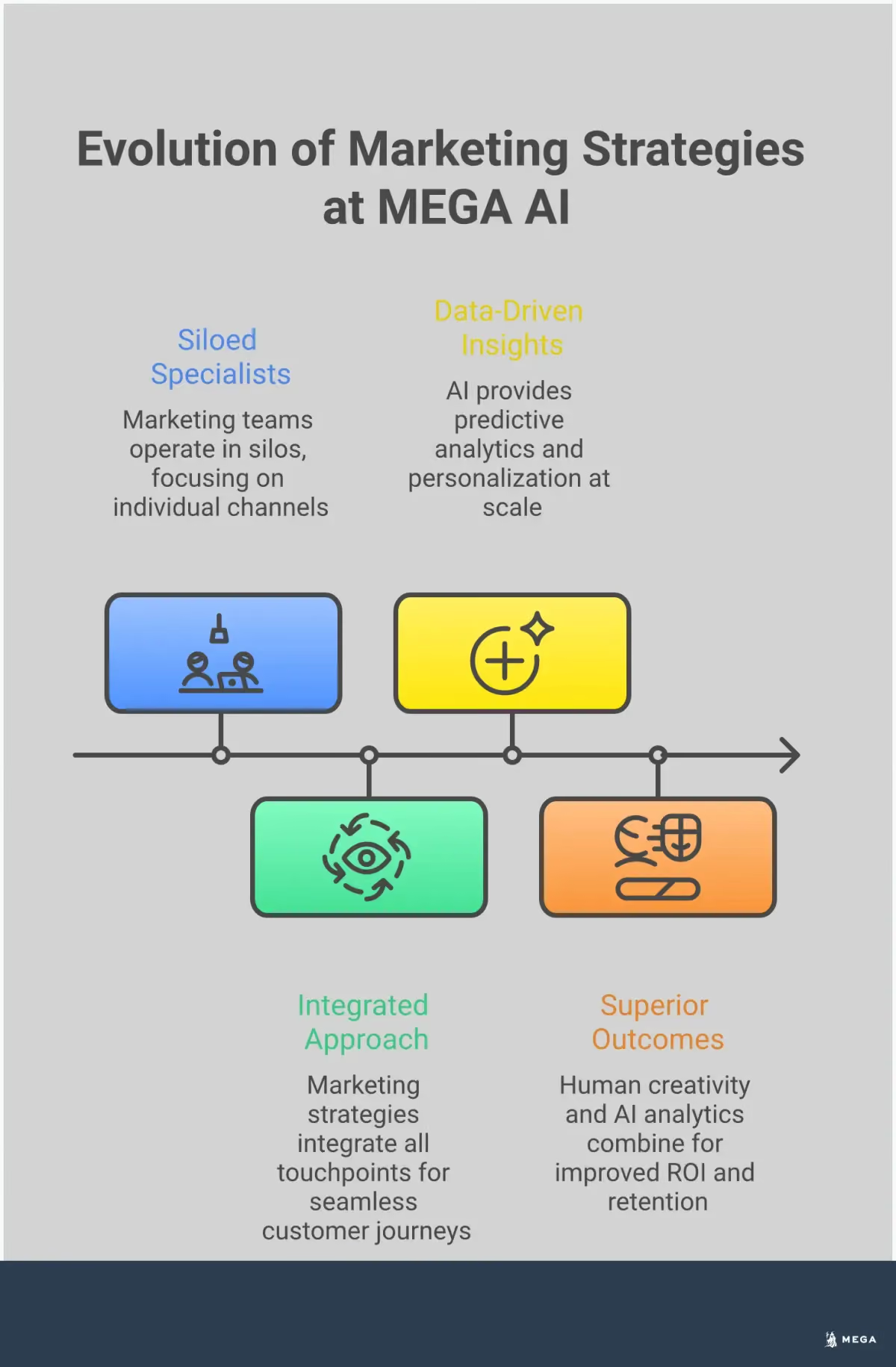
The marketing world didn't shift overnight. For a long time, having a team of specialists was the gold standard. You had your SEO person, your paid ads manager, and your content writer, each mastering their specific domain. This model worked well when customer pathways were more predictable. A person saw an ad, clicked it, and bought something. Simple. But the digital landscape grew, and the lines between channels started to blur.
This evolution brought new challenges that the siloed, specialist approach couldn't solve effectively. Customer behavior became more scattered, making it harder to track results and justify spending. Businesses, especially small and local ones, realized they needed a more unified strategy to connect with customers and grow efficiently. Three major factors drove this change, pushing marketing teams toward a more holistic, full-funnel perspective. It was no longer enough to be an expert in one area; the real value came from understanding how all the pieces worked together to guide a customer from awareness to loyalty.
The Customer Journey Isn't Linear Anymore
Think about the last time you made a significant purchase. You probably didn't just see one ad and click "buy." You might have discovered the brand on social media, searched for reviews on Google, read a few blog posts, and then finally made a purchase after seeing a retargeting ad. This is the new normal. Customer journeys are no longer a straight line from A to B. They are winding paths with multiple touchpoints across various platforms. A full-funnel strategy is designed to address each stage of the customer journey, ensuring a consistent and helpful experience no matter how a customer interacts with your brand. A single-channel specialist simply can't see this entire picture.
Why Is Marketing Attribution So Difficult?
When a customer interacts with your brand across five different channels before converting, which one gets the credit? Was it the initial blog post they found through search, the video ad they watched on Facebook, or the promotional email they opened? This is the attribution puzzle. As journeys became more complex, it grew nearly impossible to assign value to a single touchpoint. Marketers face significant challenges while building a successful campaign when they can't tell what's working. Specialists tend to focus on their channel’s performance, which can create a misleading view of what truly drives business growth. Without a full-funnel view, you risk investing in the wrong areas.
The Pressure to Prove a Higher ROI
For small and local businesses, every marketing dollar counts. With unclear attribution, it became harder to prove the return on investment (ROI) for specific channels. Business owners started asking tougher questions: Are we spending our money in the right places? How do we know this channel is actually contributing to sales? Measuring marketing effectiveness is essential because it shows you which strategies deliver the best results so you can allocate your budget wisely. The pressure to demonstrate clear, positive ROI forced a change. Businesses needed a strategic approach that could optimize the entire marketing budget, not just isolated parts of it. This required a shift from channel-specific tactics to a unified, results-driven strategy.
How AI Agents Take Over Specialist Tasks
The biggest shift in marketing is a new way of working. Instead of hiring specialists for day-to-day tasks, businesses now use AI agents for execution. These agents work autonomously to plan, launch, and optimize campaigns, freeing your team for high-level strategy. This isn't about replacing marketers; it's about giving them superpowers. Gomega's AI agents, Lindsay and Erle, act as your expert operators for SEO and paid ads, handling the tactical work so you can focus on growth. "These are real Agents who come up with a strategy and execute the tasks needed to hit your goals," not just another tool you have to manage. This approach allows small businesses to access enterprise-level capabilities without the high cost of a large, specialized team.
Automating SEO and Content Execution
An SEO specialist's work is never done. From keyword research to technical audits, the task list is endless. Our SEO agent, Lindsay, automates this workflow. She analyzes search engine results in real-time to understand what content ranks, then generates and optimizes articles based on those insights. Instead of spending hours on manual research, your team can direct Lindsay's strategy and focus on the bigger picture. This means you get a steady stream of optimized content without the manual effort, allowing you to scale your SEO much faster than a traditional team ever could.
Managing Paid Media Campaigns
Successful paid ad campaigns require constant adjustment. A specialist spends their days analyzing data, testing creatives, and shifting budgets. Our Paid Ads agent, Erle, handles this for you. He manages campaigns across platforms, automatically tests creative variations, and moves your budget to the best-performing ads in real time. By automating performance analysis, Erle ensures your marketing spend is always working efficiently. This allows your team to focus on campaign strategy and creative direction instead of getting lost in spreadsheets and manual bid adjustments.
The Speed and Scale of Autonomous AI
The main benefit of using AI agents is speed. Marketing tasks that took specialists weeks can now be done in hours. Gomega's agents can run in a fully autonomous 'Autopilot Mode,' executing tasks without needing manual approval for every step. This is how we start delivering new content within 24 hours. This autonomous operation handles complex processes like competitor analysis and campaign setup, saving time and improving accuracy. When you're ready to see how quickly an AI agent can impact your growth, you can book a demo with our team.
How AI is Reshaping Marketing Roles
With AI agents taking over the day-to-day execution, the role of the marketer is evolving. This isn't about making human expertise obsolete; it's about giving marketers superpowers. Instead of spending hours on manual keyword research or adjusting ad bids, your focus shifts to high-level strategy. You become the conductor, setting the direction and defining the goals while your AI agents handle the performance. This transition allows you to concentrate on what truly drives growth: understanding your customers on a deeper level, analyzing cross-channel performance, and refining the overarching brand message. Your value is no longer in the manual tasks you complete, but in the strategic decisions you guide.
Why You Still Need a Human Strategist
While AI agents are incredibly powerful for executing tasks, they don’t replace the need for strategic direction. Think of an AI agent as a highly skilled specialist who can write content, launch ad campaigns, and optimize for keywords at an incredible speed. But it still needs a leader to define the overall mission. This is where the human strategist comes in. Your role shifts from doing the manual work to guiding the overall growth plan.
An AI can tell you which keywords have high volume, but a strategist decides which ones align with the company’s brand and long-term goals. MEGA’s platform is built on this partnership, with human-in-the-loop controls that ensure you have the final say. The AI handles the execution, freeing you up to focus on the bigger picture.
To Set Growth Priorities Across All Channels
Marketing teams are often structured around specific channels, which can lead to silos. The SEO team focuses on organic traffic, while the paid ads team concentrates on conversions, and they may not always work in harmony. A human strategist is the glue that holds these efforts together. Your job is to create a single, integrated marketing plan that ensures all channels are working toward the same business objectives.
You are the one who looks at the entire funnel and decides where to focus. Should you prioritize top-of-funnel awareness to build an audience, or is it time to double down on bottom-of-funnel campaigns to drive sales? A strategist bridges the gaps between different functions, ensuring the AI’s work in one channel complements its work in another.
To Make Strategic Budget Decisions
AI is excellent at optimizing a budget within a specific platform, like moving spend to the best-performing ad creative. However, a human strategist is essential for allocating the total budget across different channels. This requires a deep understanding of the business’s financial goals and overall marketing ROI. You have to decide whether to invest more in long-term SEO growth or in a short-term paid ads push for immediate revenue.
This involves analyzing performance data from every channel to see where your marketing dollars are having the most impact. A strategist makes informed decisions about budget allocation, ensuring resources are directed toward the most effective initiatives that align with the company's growth targets.
To Address Complex Customer Questions
A successful marketing strategy is built on a deep understanding of the customer. While AI can analyze vast amounts of data to identify patterns, a human strategist brings empathy and nuance to the table. Your role is to define and map the customer journey, ensuring the messaging and experience are seamless and supportive at every touchpoint.
You can interpret qualitative feedback, understand subtle customer pain points, and address complex needs that don’t fit neatly into a data model. By defining the goals and success metrics for each stage of the journey, you ensure that the automated campaigns are not just efficient but also genuinely helpful and relevant to your audience.
What Does a Full-Funnel Strategist Do?
With AI agents like Lindsay and Erle handling the day-to-day execution of SEO and paid ads, the role of the human marketer shifts. Instead of getting lost in the details of keyword bidding or content formatting, you get to focus on the big picture. The full-funnel strategist is the conductor of the orchestra, not an individual musician. Their job is to ensure every channel, campaign, and piece of content works together to guide a customer from initial awareness to final purchase and beyond.
This role moves away from siloed expertise and toward holistic oversight. A strategist doesn't need to be the world's foremost expert on Google's latest algorithm update, because their AI agent already is. Instead, they need to understand how a strong SEO presence fuels the pipeline for paid retargeting campaigns. They connect the dots between different marketing activities to build a cohesive growth engine. This means spending less time on manual tasks and more time thinking critically about the business, its customers, and the overall market landscape. It’s a shift from doing to directing, and it’s where marketers can provide the most strategic value.
Orchestrate Multi-Channel Campaigns
A full-funnel strategist ensures a seamless customer experience across every touchpoint. They create a unified plan so that the blog posts generated by your SEO agent align perfectly with the messaging in your social media ads. The goal is to guide a potential customer through their journey without any jarring transitions. For example, the strategist defines the core message for a new product launch. Then, they direct the AI agents to create top-of-funnel educational content, mid-funnel comparison guides, and bottom-of-funnel promotional ads, all reinforcing the same value proposition. They set the strategy, and the agents execute the specifics for each channel.
Analyze Performance Across All Platforms
Instead of just looking at clicks on a single ad or the rank of one keyword, a full-funnel strategist analyzes how all marketing channels work together. They dig into the data to understand the complete customer journey. For instance, they might see that many customers first discover the brand through an organic search, later click a retargeting ad on social media, and finally convert after receiving an email. By understanding this path, the strategist can see the true value of each channel. This allows them to make smarter decisions about where to invest time and resources, ensuring the entire marketing ecosystem is optimized for growth, not just individual campaigns.
Use Data to Make Smarter Decisions
A strategist uses performance data to guide every decision. They focus on the metrics that matter most to the business, such as customer acquisition cost, lifetime value, and overall return on investment. They use these insights to refine the marketing plan and allocate budget effectively. If the data shows that a certain type of content is driving high-value customers, the strategist will direct the AI to produce more of it. If a paid ads campaign is underperforming, they analyze why and adjust the targeting or creative strategy. This continuous loop of analysis and optimization ensures the marketing engine is always running as efficiently as possible.
What to Expect When You Make the Switch
Shifting from a team of specialists to a full-funnel strategy is more than just a change in job titles. It’s a fundamental change in how your marketing operates, collaborates, and measures success. This transition involves breaking old habits and building new, more integrated workflows. Instead of viewing marketing as a series of separate tasks, your team will start to see it as a single, cohesive system designed to guide customers from awareness to purchase and beyond.
This process requires adjustments in three key areas. First, you’ll need to dismantle the invisible walls that often separate different marketing functions. Second, you’ll have to connect your various data sources to get a clear picture of the entire customer journey. Finally, and most importantly, you’ll need to help your team develop a new, holistic mindset focused on overall growth rather than channel-specific metrics. It’s a significant change, but one that aligns your team for more sustainable and impactful results.
Breaking Down Your Marketing Team Silos
In many businesses, marketing teams are organized by function. You might have one person focused on SEO, another on social media, and a third on email campaigns. While this structure allows for deep expertise, it often creates silos that prevent collaboration. When your SEO and paid ads teams don’t communicate, they can end up competing for the same keywords or sending conflicting messages to customers.
Adopting a full-funnel approach requires these walls to come down. It encourages a culture of cross-functional collaboration where insights are shared freely. Your paid ads manager can share performance data to inform the SEO team’s content strategy, and the content team can create assets that support campaigns across every channel. This alignment ensures every marketing activity works together toward the same goals.
Connecting and Integrating Your Data
To manage a full-funnel strategy effectively, you need a unified view of your data. If your website analytics, ad platforms, and customer relationship management (CRM) software don’t communicate, you can’t see the complete customer journey. You might know how many people clicked an ad and how many people read a blog post, but you won’t know if they were the same people or how one action influenced the other.
Connecting your data sources is essential for making informed strategic decisions. When you can track a customer’s path across multiple touchpoints, you can understand what’s truly driving growth. Platforms like MEGA AI are built to simplify this process, integrating with dozens of tools to provide a single source of truth for your marketing performance and helping you see how efforts at the top of the funnel impact the bottom line.
Training Your Team to Think Holistically
The most critical part of this transition is a mental shift. Team members must learn to think beyond their immediate tasks and understand how their work contributes to the bigger picture. An SEO specialist, for example, needs to think not just about ranking for a keyword but about how that keyword fits into the overall customer journey and what the user needs next.
This requires investing in training and development to help your team embrace a full-funnel approach. Encourage them to ask broader questions: How does this campaign support sales? What happens to a lead after they download this ebook? By fostering this strategic mindset, you empower your team to move beyond simple execution and become true growth drivers for the business.
How to Measure Full-Funnel Success
When you shift from specialist roles to a full-funnel strategy, your measurement approach has to change, too. Instead of tracking siloed metrics like keyword rankings or ad click-through rates, the focus moves to understanding how all your marketing activities work together to achieve business goals. A full-funnel strategist connects the dots between awareness, consideration, and conversion to see the complete picture of what drives growth.
This holistic view requires looking at performance through a different lens. You’ll need to adopt new methods for tracking customer journeys, evaluating channel performance, and proving the value of your marketing spend. It’s less about which channel gets the final click and more about how each one contributes to the final sale.
Adopt a Multi-Touch Attribution Model
Customers rarely find your business and make a purchase in one step. Their journey often involves multiple touchpoints, like seeing a social media ad, reading a blog post found through search, and later clicking a retargeting ad. The process of assigning credit to these interactions is called attribution. Using different attribution models helps you understand the impact of each touchpoint, so you can make better decisions about where to invest your time and budget. This prevents you from overvaluing the last click and ignoring the channels that build initial awareness.
Track Performance Across All Channels
A full-funnel strategist needs a unified view of how all marketing channels perform together. Instead of looking at SEO and paid ads reports separately, you analyze the entire customer journey to see how they influence one another. For example, you might find that your SEO content creates initial brand awareness, leading users to search for your company name later and convert through a paid ad. Tracking performance this way helps you identify which combinations of channels are most effective and where you can optimize the customer experience as people move from one platform to another.
Measure ROI Across the Entire Funnel
Ultimately, every marketing effort should contribute to the bottom line. Measuring return on investment (ROI) across the entire funnel is critical for a strategist. This means connecting your marketing spend to actual revenue. By evaluating your marketing effectiveness at each stage, you can identify which campaigns deliver the highest value and which ones are underperforming. This allows you to confidently allocate more resources to the strategies that work and refine or cut those that don’t, ensuring your marketing budget is always working as hard as possible to grow your business.
Key Quantitative Metrics to Track
While you’ll still keep an eye on channel-specific numbers, a full-funnel strategist prioritizes metrics that measure the health of the entire marketing system. Instead of just looking at website visitors, you’ll focus on the ratio of site traffic to leads, which shows how effectively your content turns visitors into potential customers. You’ll also track your Cost Per Lead (CPL), or how much it costs to get one person interested, and your Cost Per Acquisition (CPA), which is the total cost to gain a new customer. These numbers give you a clear view of your marketing efficiency and profitability, helping you measure what truly contributes to business growth.
Important Qualitative Metrics to Consider
Numbers alone don't tell the whole story. A successful marketing strategy is built on a deep understanding of the customer, and that requires looking beyond the data. As a strategist, your job is to interpret qualitative feedback to understand subtle customer pain points and address needs that don't show up in a spreadsheet. By tracking a customer’s path across multiple touchpoints, you can see where they get stuck, what questions they have, and what content truly resonates with them. This qualitative insight helps you refine your messaging and create a more helpful, human-centric experience that builds trust and loyalty.
Comparing the Costs: Specialists vs. AI Automation
One of the biggest hurdles for any small business is the marketing budget. You know you need to invest in growth, but the costs can feel overwhelming. Traditionally, this meant hiring a team of specialists or a full-service agency, where each expert came with a significant price tag. This model often forced founders and marketing managers to make tough choices, like prioritizing SEO over paid ads or vice versa, simply because they could not afford to do both well. The financial commitment to cover multiple salaries or a large agency retainer often meant that strategic, cross-channel campaigns remained out of reach.
The shift toward full-funnel strategy, powered by AI, changes this financial equation. Instead of paying for individual tasks and hours, you can invest in a system that handles execution across multiple channels autonomously. This allows you to reallocate your most valuable resources, your team’s time and your budget, toward high-level planning and strategic decisions that drive real growth. It’s less about cutting costs and more about making a smarter, more efficient investment in your marketing engine. This approach democratizes access to sophisticated marketing, allowing smaller teams to compete on a larger scale.
The Cost of a Traditional Specialist Team
Hiring a traditional marketing agency or freelance specialists often involves steep and unpredictable costs. Many agencies work on a monthly retainer, which can range from a few thousand to over $20,000, depending on the scope of work. If you pay by the hour, you can expect to see rates between $150 and $200. These costs add up quickly, especially when you need multiple experts for SEO, content writing, and ad management. For small businesses and startups, this pricing structure can be a major barrier. It often means you can only afford to focus on one channel at a time, slowing down your growth. Understanding different marketing agency pricing models is helpful, but the bottom line is that specialized human execution comes at a premium.
The Investment in an AI Agent
AI automation platforms offer a more predictable and accessible alternative. Instead of paying for hours or individual projects, you typically pay a flat monthly fee for an AI agent that handles the execution. For example, MEGA AI provides the capabilities of an entire SEO or paid ads team for a fraction of the cost of a single junior hire. Our AI agents can plan strategy, generate content, and optimize campaigns autonomously. This approach gives small businesses access to enterprise-level marketing power without the enterprise-level budget. MEGA AI offers an SEO agent and a Paid Ads agent that deliver what would traditionally amount to $20,000 a month in agency services. This fixed cost makes budgeting simple and allows you to scale your marketing efforts without scaling your headcount.
How to Reallocate Your Resources for Growth
By automating the tactical work, you free up your budget and your team to focus on what matters most: strategy. When an AI agent handles daily content creation and campaign adjustments, your marketing leader can transition into a true full-funnel strategist. Their time is no longer spent on routine tasks but on analyzing performance, understanding the customer journey, and identifying new growth opportunities. This shift allows you to invest in strategic thinking rather than just execution. Your budget can be allocated to bigger creative projects, deeper customer research, or exploring new channels. You’re not just saving money; you’re reallocating it to higher-value activities that humans are uniquely good at. This model lets a small team achieve the impact of a much larger one, creating a more sustainable path to growth.
What Skills Does a Modern Strategist Need?
As AI agents take over daily marketing tasks, the human marketer’s role evolves. Instead of focusing on manual work, your time is freed up for high-level strategy and oversight. A full-funnel strategist directs powerful AI tools to achieve business goals more efficiently. This shift requires a focus on a few core skills: interpreting data, planning cohesive campaigns, and managing the AI tools that get the work done.
Data Analysis and Interpretation
A modern strategist needs to be skilled at tracking and interpreting key performance metrics to understand what’s working. While an AI agent reports on clicks and impressions, a strategist connects those numbers to business outcomes like customer acquisition cost and lifetime value. They analyze data from a unified dashboard and ask the right questions: Which channels drive the most valuable customers? Where are the drop-off points in our funnel? This ability to find actionable insights allows them to refine the strategy and guide the AI toward more profitable activities.
Cross-Channel Campaign Planning
To manage a full-funnel strategy, a strategist must connect awareness, consideration, and conversion efforts across various channels. They see how a blog post from an SEO agent can warm up an audience for a campaign run by a paid ads agent. Their job is to map out a cohesive customer journey, ensuring every touchpoint feels connected. Instead of managing channels in silos, they orchestrate a single, unified marketing plan where each part supports the others, creating a much stronger overall impact.
AI Tool Management and Oversight
With automation on the rise, a strategist must be skilled in leveraging AI tools to execute their vision. This doesn’t require deep technical expertise. Instead, they need to set clear goals, review AI-proposed strategies, and provide feedback to guide performance. Think of it like being a film director. The AI agents are the expert crew, but the strategist holds the creative vision, ensuring every piece tells the right story. They provide the human oversight that makes the technology truly effective.
How to Get Started with AI Marketing
Making the shift from manual execution to automated marketing is a structured process. It involves preparing your data, deploying the right tools, and defining what success looks like from the start. By following a few foundational steps, you can set your business up for a more efficient and effective marketing operation that drives real growth.
Step 1: Connect Your Data Sources
Before you can automate your marketing, you need to give your tools a clear view of your business. This starts with connecting your data sources. When your website analytics, CRM, and ad platforms are integrated, you create a cohesive system where insights from one part of the customer journey can inform actions in another. A unified data strategy ensures that information flows seamlessly, allowing your AI to make smarter decisions. Platforms like MEGA AI are built to integrate with the tools you already use, simplifying this initial step and getting you started faster.
Step 2: Set Up Your First AI Agent
Once your data is connected, you can deploy an AI agent to start handling specific tasks. Think of this agent as a new team member who is an expert in their field. For example, you could start with an SEO agent to handle keyword research and content creation or a paid ads agent to manage campaigns. AI tools are designed to streamline marketing processes, from generating leads to nurturing them through the funnel. The setup process typically involves defining your initial goals and giving the agent access to the right platforms. From there, it can begin executing its strategy, often delivering results within days.
Step 3: Build Your Measurement Framework
Automation without measurement is just busy work. To ensure your efforts are driving real growth, you need a framework for tracking success. This means defining your business goals and the key performance indicators (KPIs) that reflect them. For example, are you focused on lead generation, customer acquisition cost, or lifetime value? Measuring marketing effectiveness helps you identify which strategies deliver the highest return on investment. By establishing these metrics early, you give your full-funnel strategist the data they need to make informed decisions and optimize performance across all channels.