This article is part of our Complete Guide to AI SEO Agents (2026).
Let’s be honest about a common frustration when you hire an SEO agency: things get missed. A task is forgotten, a report is delayed, or your account gets less attention than a bigger client. This is where the conversation about AI vs Human SEO gets interesting. An AI agent doesn’t forget, get sick, or have competing priorities. It executes tasks with perfect consistency. This article moves beyond the hype to give you a practical breakdown. We'll explore how to leverage AI for flawless execution while reserving human experts for the high-level strategy that truly sets your brand apart.
The honest answer is: mostly yes, partly no, and the “partly no” matters more than you think.
We’re not going to give you the AI company answer (“AI replaces everything!”) or the agency answer (“You’ll always need humans!”). Both are self-serving. Instead, here’s what we’ve learned from running an AI SEO agent alongside human SEO work for thousands of businesses.
AI vs. Human SEO: What's the Real Story?
Why It's Not AI vs. Human, But AI + Human
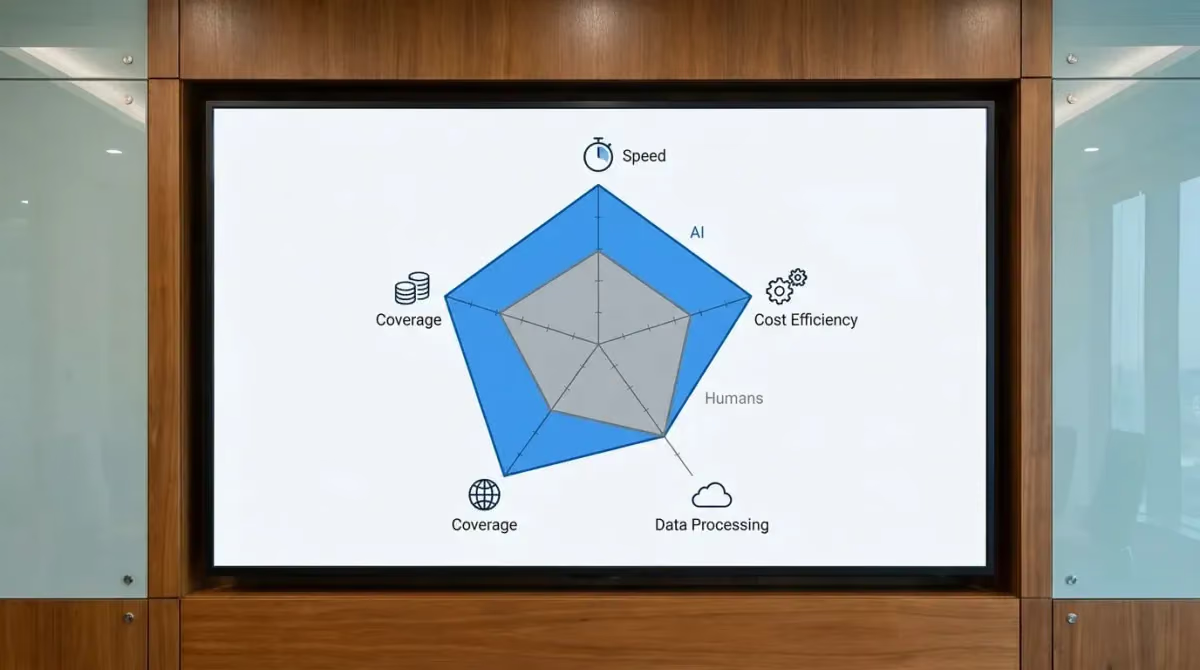
The framing is wrong. “AI vs human SEO” implies you have to pick one. You don’t. The businesses getting the best SEO results in 2026 are using both — they’ve just figured out which tasks to give to which.
The real question isn’t “which is better?” It’s “what should each one do?”
Why Is Everyone Talking About AI SEO Now?
This isn’t a theoretical debate anymore. The numbers tell a clear story:
- 73% of SMBs now use at least one AI tool in their marketing stack (up from 31% in 2023)
- Average agency SEO retainer has increased to $5,500/month while AI SEO agents cost $799-999/month
- SEO task automation has gone from basic reporting to full-strategy execution in under two years
- Agency client churn hit record highs in 2025, with “switching to AI tools” cited as a top-3 reason
The market has spoken. But the market also isn’t always right about the details.
What Exactly Is "AI SEO"?
Let’s be specific. When we say “AI SEO” we don’t mean someone running ChatGPT prompts and calling it a strategy. We mean purpose-built AI SEO agents — systems designed specifically for search engine optimization that connect to your data sources (Search Console, Analytics, CMS) and execute work autonomously. Read our full guide to AI SEO agents →
This is a critical distinction. Generic AI tools applied to SEO are a mixed bag. Purpose-built AI SEO agents are a different category entirely. Learn how AI SEO agents actually work →
Google's Stance on AI-Generated Content
One of the biggest questions small business owners have is whether Google will penalize their site for using AI-generated content. It’s a valid concern, but the answer isn’t a simple yes or no. Google’s official position is that it rewards high-quality content, regardless of how it’s produced. The focus isn't on the tool used—whether it's a human brain, a word processor, or an AI—but on the final product. Does the content meet the user's needs? Is it helpful, reliable, and created for people first, not just to rank in search engines?
This isn't a new philosophy. For years, Google has updated its algorithms to better identify and reward content that genuinely helps users. The introduction of sophisticated AI tools hasn't changed this core principle; it has only changed the conversation around it. The key is to distinguish between using AI to create valuable resources for your audience and using it to automate spammy tactics. As long as your AI-assisted content strategy prioritizes quality and user experience, you are aligning with Google's guidelines, not trying to circumvent them.
Helpful Content is the Goal
Google's main objective is to provide searchers with the best possible answers to their questions. To that end, their ranking systems are designed to prioritize what they call "helpful content." This means content that is reliable, relevant, and demonstrates expertise and trustworthiness. Google doesn't automatically punish websites for using AI. However, the content must meet the same high standards as human-written content. The goal is to create something that truly helps people, not just to produce more articles for the sake of volume.
Think of it this way: if you use an AI tool to write a thoughtful, well-researched article that solves a customer's problem, you're on the right track. If you use it to churn out hundreds of low-quality pages that just rephrase existing information, you're likely to run into trouble with Google's systems. Tools like MEGA AI's Maintenance Agent are built on this principle, focusing on improving existing articles to make them more helpful and comprehensive for readers.
Understanding Google's Spam Policies
So, where does Google draw the line? According to its spam policies, using automation—including AI—with the primary purpose of manipulating search rankings is considered spam. This includes tactics like generating text that makes no sense to a reader but contains keywords, or auto-translating content without human review just to create volume. The intent behind the automation is what matters most.
Using AI to assist in creating original, high-quality content is not a violation. For example, using an AI agent to research topics, generate an outline, or write a first draft that a human then edits and fact-checks is a perfectly acceptable workflow. The ethical use of AI focuses on efficiency and creativity to produce helpful content. As long as the final product is valuable and people-first, you are operating well within Google's guidelines.
Where AI Has the Upper Hand in SEO
Let’s start with what AI does better. And it’s not a short list.
Executing Tasks in Hours, Not Weeks
An AI SEO agent can audit a 10,000-page site, identify priority issues, and begin implementing fixes within hours. A human team? That’s a 2-4 week project before any changes go live.
Keyword research that takes a human analyst a full day — pulling data, analyzing intent, clustering, mapping to content gaps — takes an AI agent minutes. Not because the AI cuts corners, but because processing data at scale is what machines are built for.
This speed advantage compounds. While a human team is still finishing month-one audits, an AI agent has already completed the audit, made fixes, published new content, and started measuring results.
Ensuring No Task Is Ever Missed
Here’s the dirty secret of agency SEO: things get missed. That junior account manager forgot to update the meta descriptions. The technical audit flagged 47 issues but only 12 got fixed before the team moved on. The monthly content calendar slipped because the writer was sick.
AI doesn’t forget. It doesn’t get sick. It doesn’t deprioritize your account because a bigger client needs attention. Every page gets audited. Every opportunity gets flagged. Every scheduled task gets executed.
For businesses that have been burned by inconsistent agency work, this reliability alone justifies the switch.
How AI Lowers Your SEO Costs
The math is straightforward:
| AI SEO Agent | Mid-Tier Agency | Premium Agency | |
|---|---|---|---|
| Monthly cost | $799-999 | $3,000-5,000 | $7,000-15,000 |
| Hours of SEO work delivered | 160+ equivalent | 20-40 | 40-80 |
| Response time | Minutes | Days | Days-weeks |
| Scales with site size | Automatically | Extra cost | Extra cost |
That’s not a marginal difference — it’s an order of magnitude. A business paying $5,000/month for agency SEO can get equivalent (or more) execution from an AI agent at $799/month and redirect $4,200/month to other growth initiatives. See current pricing →
Process Massive Datasets in Seconds
Humans are terrible at processing large datasets. We get fatigued, we develop biases, we miss patterns. An AI agent analyzing 50,000 keyword positions, cross-referenced with traffic data, content gaps, and competitor movements? That’s not tedious — it’s what the technology was designed for.
AI agents catch opportunities that humans miss. A trending long-tail keyword cluster that a human would overlook because they’re focused on head terms. A technical issue affecting 200 pages that’s invisible at the individual page level but obvious in aggregate data. Seasonal patterns across three years of data that no human analyst would have the patience to chart.
Risks and Weaknesses of AI-Generated Content
While AI excels at scale and speed, it’s not a perfect solution. Relying solely on generic AI tools for content creation without human oversight introduces significant risks. Understanding these weaknesses is key to building a resilient SEO strategy where AI assists, rather than dictates, your content. These are the areas where a human strategist or a specialized platform becomes essential for quality control and long-term success.
Factual Inaccuracies and "Hallucinations"
One of the most significant risks with AI content is its tendency to "hallucinate"—a term for when the model confidently states incorrect information. AI tools can invent facts, make up statistics, or cite sources that don’t exist. For a small business, publishing factually inaccurate content can severely damage your credibility with customers and erode trust. Correcting these errors after publication is time-consuming and can harm your site's authority if the incorrect information is flagged by users or search engines. This is why human review and fact-checking are non-negotiable steps when using AI for content that requires accuracy.
Lack of Originality and Depth
AI models learn by analyzing vast amounts of existing text from the internet. As a result, the content they produce can often lack true originality, unique perspectives, or the depth that comes from firsthand experience. AI-generated content often reads like a summary of what's already out there, which makes it difficult to stand out in a crowded market. It struggles to capture a unique brand voice or share compelling stories that build a brand identity. For topics that require deep expertise or a novel point of view, human insight remains irreplaceable for creating content that truly adds value.
Potential for Bias and Ranking Volatility
Because AI learns from human-written text online, it can unintentionally reproduce and even amplify existing biases found in its training data. This can lead to content that is subtly skewed, stereotypical, or fails to resonate with your specific audience. Furthermore, an over-reliance on AI can lead to a portfolio of content that sounds generic and similar to competitors who are also using the same tools. This lack of a distinct content footprint can lead to ranking volatility, as your website fails to establish itself as a unique authority in the eyes of search engines like Google.
Detection by Search Engines
The conversation around AI content often includes the fear of being penalized by Google. However, Google's official stance is not against AI-generated content itself, but against low-quality, unhelpful content created to manipulate search rankings. The focus is on the quality and value of the content, not the method of its creation. Google's helpful content updates are designed to identify and suppress content that offers little value. If you use AI to mass-produce generic, low-effort articles, you risk being negatively impacted. The key is to use AI as a tool to create genuinely helpful, well-researched, and human-refined content that serves the user first.
Where Human SEO Experts Still Win
Now for the honest part that most AI companies skip.
Developing a Unique Brand Voice and Strategy
AI can write content that ranks. It can follow your style guide, match your tone, and hit the right keywords. But can it come up with a genuinely original content angle that differentiates your brand? Can it tell the story of why your product exists in a way that makes people care?
Not yet. And possibly not ever in the way humans can.
Brand strategy — the “why should anyone care about us” question — requires the kind of creative, empathetic, contextual thinking that humans excel at. An AI agent can execute a brilliant content strategy. It’s less equipped to invent one.
Building Real Relationships for Link Building
Link building in 2026 is fundamentally a relationship activity. Getting featured in a journalist’s story, earning a link from an industry publication, building partnerships for co-marketing content — these require human connection, reputation, and trust.
AI can identify link opportunities, draft outreach templates, and track campaigns. But the handshake — literal or figurative — needs to be human. Nobody wants to build a professional relationship with a bot.
Handling Complex and Ambiguous SEO Scenarios
SEO sometimes requires judgment calls that don’t have clear data-driven answers. Should you chase a trending topic that might be a fad? How do you handle a Google algorithm update that seems to contradict itself? What do you do when your CEO wants to rank for a vanity keyword that has no business value?
These situations require understanding context, politics, business goals, and risk tolerance in ways that AI handles poorly. Humans excel at navigating ambiguity. AI excels at executing once the ambiguity is resolved.
Adding Context to Reports and Communication
An AI can generate a comprehensive SEO report with every metric imaginable. What it can’t do as well is sit in a meeting and explain why the traffic dip last month isn’t a crisis, or reassure a nervous CMO that the strategy is working, or push back on a bad idea diplomatically.
The human layer of communication — reading the room, understanding unstated concerns, building confidence — is something AI supports but doesn’t replace.

AI vs. Human Content: A Performance Comparison
Beyond the tasks themselves, the ultimate question is about performance. Does AI-generated content actually rank and convert as well as human-written content? The answer depends on what you’re trying to achieve.
Production Speed vs. Content Depth
The most obvious advantage for AI is speed. It’s not just a little faster; it’s a different league. In tests, AI can produce a first draft five to eight times faster than a human writer. For a small business needing to build a content library from scratch, this is a game-changer. You can go from zero blog posts to dozens in a matter of days, not months. This allows you to quickly target a wide range of keywords and start gathering data on what works. The trade-off, however, comes with content depth. While AI is excellent at summarizing existing information, a human expert can provide original insights, share personal experiences, and connect ideas in a way that AI currently cannot. This depth builds authority and trust with your audience over the long term.
Search Engine Indexing and Ranking
Interestingly, some studies show that AI-generated content can get indexed by Google slightly faster than human-written pieces. When it comes to ranking, the results are more nuanced. Human content, especially from a writer with deep expertise, tends to perform better for highly competitive, broad keywords. However, AI excels at creating content for long-tail and very specific, problem-focused search queries. For a local or small business, this is a massive opportunity. These long-tail keywords often have higher purchase intent and less competition, making them a perfect target for an AI-driven SEO strategy that can produce targeted articles at scale.
User Engagement and Conversion Factors
When a human writer truly understands the topic, their content often sees better engagement metrics, like a longer average time on page and a lower bounce rate. This makes sense; expertise is engaging. But what truly drives conversions isn't just who wrote the content, but how clear its structure and intent are. A well-organized page that directly answers a user's question will convert better, whether it was drafted by a human or an AI. This is where AI shines as a tool. It can build a perfectly structured article focused on user intent, which a human can then infuse with brand voice and unique insights. AI doesn't understand your brand's unique story, but it can build the perfect framework for you to tell it.
The 85/15 Model: A Smarter Way to Do SEO
So if AI handles some things better and humans handle others, what’s the right split?
After working with thousands of businesses, we’ve landed on what we call the 85/15 model. It’s not a marketing number — it’s based on actual task analysis of what goes into successful SEO.
What to Delegate to Your AI SEO Agent
These are the tasks that should be automated:
- Technical SEO audits and fixes — crawling, identifying issues, implementing changes
- Keyword research and opportunity analysis — processing data, finding gaps, tracking positions
- Content creation and optimization — writing SEO-optimized content, updating existing pages
- On-page optimization — title tags, meta descriptions, heading structure, internal links
- Performance monitoring — tracking rankings, traffic, conversions; alerting on changes
- Competitive monitoring — tracking competitor content, rankings, and strategy shifts
- Reporting — generating performance reports with clear metrics
This 85% represents the majority of SEO work — and it’s the work that AI agents do faster, cheaper, and more consistently than humans.
Where to Focus Your Human SEO Experts
These are the tasks that benefit from human involvement:
- Brand strategy and positioning — defining what makes you different
- Creative content angles — original ideas that go beyond optimization
- Relationship-based link building — genuine outreach and partnerships
- Executive communication — explaining SEO value to leadership
- Edge case decisions — handling ambiguous situations that require judgment
- Quality oversight — reviewing AI output for brand alignment
This 15% is where humans add irreplaceable value. It’s also — notably — the strategic work that most SEO professionals prefer doing. The 85/15 model doesn’t just save money. It makes the human work more interesting.
Practical Recommendations for a Hybrid Approach
Putting the 85/15 model into practice means changing how you think about your SEO workflow. It’s less about handing everything over and more about smart delegation. Here’s how to manage the collaboration between your team and your AI agent to get the best results.
Treat AI Like an Intern or Assistant
Think of your AI SEO agent as the most efficient intern you’ve ever had. It’s perfect for the time-consuming, data-heavy tasks that bog down your team. Let the AI handle initial keyword research, run competitive analyses, draft content outlines, and monitor performance data. This frees up your human experts to focus on the strategic work that requires their experience and judgment. Instead of spending a day pulling reports, your team can spend that day analyzing the "why" behind the data and planning the next big move. This division of labor ensures you’re using your most valuable resource—human creativity—on the tasks where it matters most.
Rewrite and Enhance AI Drafts
An AI can produce a technically perfect, SEO-optimized article. But "technically perfect" doesn’t always mean compelling. The best approach is to use AI-generated content as a strong first draft. A human editor should always review and enhance it. This is where you inject your brand’s unique personality, add real-world examples, and ensure the content truly addresses the reader's intent. The final piece should sound like it came from your company, not a machine. This human layer of quality control is what turns a good article that ranks into a great article that converts and builds trust with your audience.
Find and Fill Content Gaps
AI is excellent at analyzing what already exists and is successful. A human expert is excellent at seeing what’s missing. Use your team’s industry knowledge to find unique angles that competitors haven’t covered and perform a content gap analysis. While an AI can identify a topic, a human can add a section on common mistakes, a detailed case study, or a personal story that provides unique value. Encourage your team to ask, "What question isn't being answered here?" This is how you create truly differentiated content that stands out. Let the AI build the foundation, then use human insight to build something remarkable on top of it.
See the 85/15 Model in Action
Mega’s SEO Agent was built around this 85/15 split. It handles the 85% autonomously — technical SEO, content creation, on-page optimization, monitoring, reporting — and surfaces the 15% for human decision-making.
When Mega’s SEO Agent encounters a brand strategy question, an ambiguous situation, or a decision that requires business context, it flags it for review rather than guessing. You get a notification, make the call, and Mega’s SEO Agent executes.
This isn’t AI replacing humans. It’s AI handling the work that shouldn’t require a $150/hour expert, so that expert can focus on work that actually needs their expertise. See the best AI SEO tools for 2026 →
See AI SEO in action: Watch Mega’s SEO Agent work →
Making the Right Choice for Your Business
The AI vs human SEO debate is a false binary. The winners aren’t choosing sides — they’re choosing the right split.
AI SEO agents handle execution, monitoring, and optimization better than humans. Period. They’re faster, cheaper, more consistent, and more thorough.
Humans handle strategy, creativity, relationships, and judgment better than AI. Period. They bring context, empathy, and original thinking that machines can’t replicate.
The 85/15 model isn’t a compromise — it’s an optimization. Let each do what they’re best at, and you get results that neither could achieve alone.
If you’re currently paying an agency $5,000+/month for work that’s mostly execution, you’re overpaying for the 85%. If you’re using AI tools with no human oversight, you’re missing the 15% that separates good SEO from great SEO.
The smart play? Automate the 85% with an AI agent. Invest the savings in the 15% that actually needs human touch.
Ready to see what 85% autopilot SEO looks like? Get Started with Mega’s SEO Agent →
FAQ
Can AI fully replace an SEO agency?
For most SMBs, an AI SEO agent can replace 85% of what an agency does at 80-90% lower cost. The remaining 15% — creative strategy, complex outreach, brand-specific decisions — benefits from human input. /pricing Mega’s SEO Agent is designed for this 85/15 split, handling the execution while surfacing strategic decisions for human review.
Is AI-generated SEO content penalized by Google?
No. Google’s official stance is that content quality matters, not how it was created. AI SEO agents like Mega’s SEO Agent produce high-quality, helpful content that follows Google’s E-E-A-T guidelines. Poor AI content gets filtered the same way poor human content does — the creation method is irrelevant; the value to the reader is what counts. /blog/how-ai-seo-works
How much cheaper is AI SEO than hiring an agency?
An AI SEO agent like Mega’s SEO Agent costs $799-999/month. A typical SEO agency charges $3,000-$10,000/month. That’s 70-90% savings with comparable or better results for standard SEO execution. The savings are even greater when you factor in the consistency — AI agents don’t have bad months, don’t lose key staff, and don’t deprioritize your account. pricing
What SEO tasks can’t AI do yet?
AI is weakest at creative brand strategy, building genuine industry relationships for link building, understanding nuanced brand voice in novel contexts, and navigating highly ambiguous or politically sensitive situations. These areas — roughly 15% of total SEO work — benefit significantly from human expertise.
Should I fire my SEO agency and switch to AI?
It depends on your situation. If you’re an SMB spending $3,000+/month on an agency primarily for execution work (technical fixes, content production, on-page optimization), switching to an AI agent could save 70%+ with equal or better results. If you have complex enterprise needs, highly competitive niches, or rely on your agency for strategic counsel, consider using AI to augment your agency instead — let the agent handle execution while your agency focuses on strategy. /blog/best-ai-seo-tools-2026
This article reflects our honest assessment based on working with thousands of businesses using both AI and human SEO approaches. We build an AI SEO agent, so we have a bias — but we also have the data. Take what’s useful, verify what matters, and make your own call.
Key Takeaways
- Adopt a hybrid SEO model: The best results come from combining AI and human talent. Let AI handle consistent, data-driven tasks like technical audits and on-page optimization, while your team focuses on creative strategy and building relationships.
- Use the 85/15 rule for task delegation: Automate the bulk of your SEO work (about 85%), including keyword research and performance monitoring, with an AI agent. Reserve your team's time for the critical 15% that requires human insight, like brand positioning and complex problem-solving.
- Prioritize helpful content above all else: Google's main concern is the quality and usefulness of your content, not how you created it. Use AI as a tool to produce valuable, people-first articles, and you'll stay aligned with search engine guidelines without risking penalties.