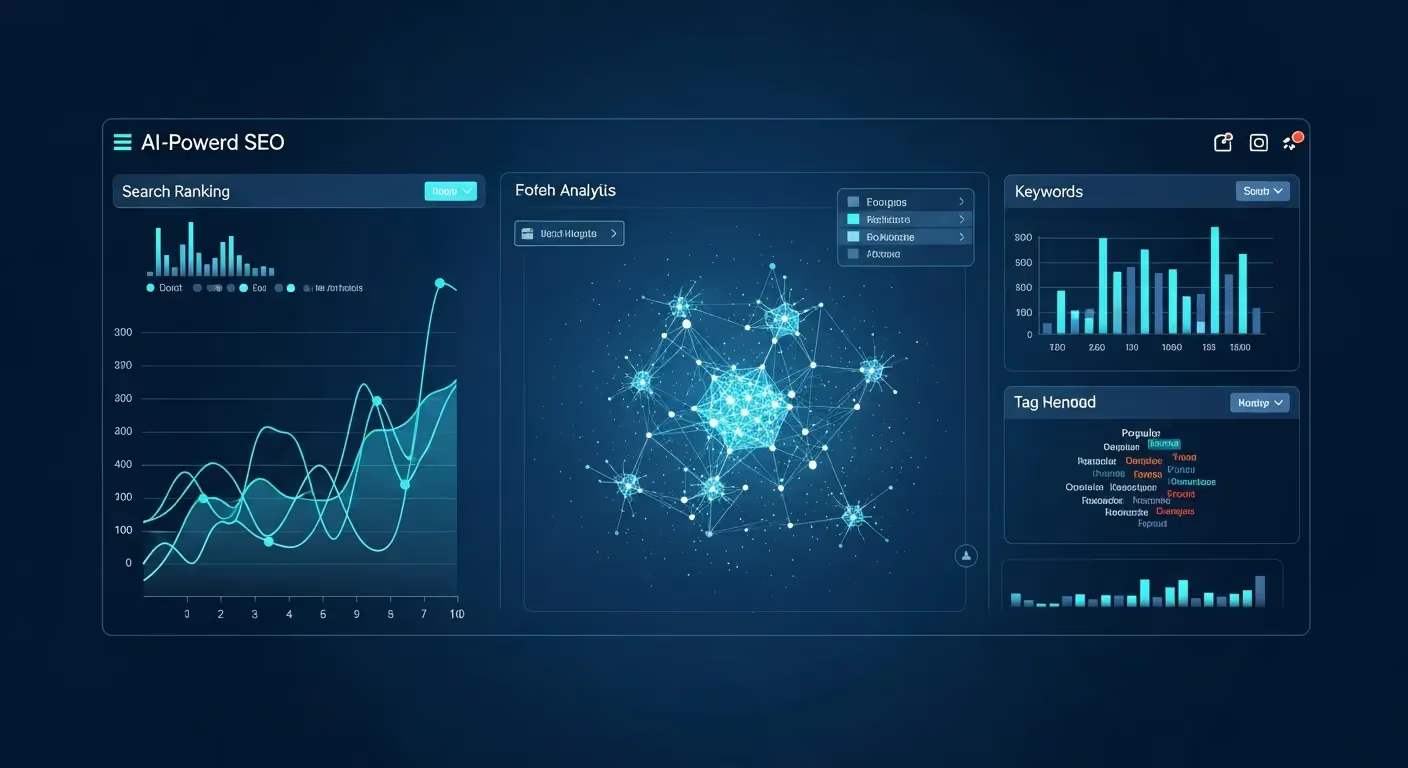
An AI marketing agency uses software agents to research, plan, execute, and improve marketing work, while people set direction and review important decisions. The practical choice is not simply AI versus humans. It is deciding which work belongs with an in-house SEO team, an AI agent, a traditional agency, or a combination of those models. For a startup or small business, the right model should connect useful execution to measurable demand, not just add another dashboard.
What is an AI marketing agency?
Short answer
An AI marketing agency is a managed service that uses AI agents to complete defined marketing work, with human oversight for strategy, quality, and accountability.
An AI marketing agency is a managed marketing service built around AI agents. Instead of giving you a dashboard and asking your team to interpret it, the agent carries out defined work such as keyword research, content updates, technical SEO checks, AI-search optimization, and performance reporting. Human specialists provide strategy, quality control, and accountability.
That definition separates three models that are often bundled together:
- AI-assisted agency: A conventional agency uses AI tools to speed up writing, research, or reporting. The agency team still performs and coordinates most of the work.
- AI-native platform: AI agents perform repeatable marketing work inside a managed system. People guide the strategy, set guardrails, and review higher-impact decisions.
- Self-serve AI tool: Software helps your team complete one task, such as drafting copy or finding keywords. Your team remains responsible for the strategy and execution.
Mega is positioned as an AI-powered growth platform, not a traditional marketing agency with a few AI tools added. Its SEO & GEO Agent is designed to manage search visibility work across Google and AI search, with human oversight where judgment and business context matter.
Is an AI agency just a buzzword?
Sometimes. The label alone does not tell you who does the work. Ask whether the provider can show the workflow from research to implementation and measurement. A credible provider should explain:
- Which tasks the agent actually completes.
- Which decisions require human review.
- What access the system needs to your site and data.
- How you see completed work and results.
- What happens when the agent finds a problem it cannot safely resolve.
If the answer is only that the company uses an AI writing tool, you are evaluating an AI-assisted agency, not an autonomous marketing service.
How does an AI marketing agency work?
Short answer
A managed AI marketing workflow turns business goals and search data into prioritized work, then connects execution, review, and measurement in one operating loop.
A useful workflow usually has five stages:
- Connect context: The provider learns your products, audience, competitors, website, analytics, and approval requirements.
- Find opportunities: The system reviews search demand, existing content, technical signals, and competitor gaps to identify work that can support qualified growth.
- Prioritize a plan: Opportunities are mapped to search intent and business value so new pages do not compete with existing ones.
- Execute and review: Agents handle repeatable tasks such as research, content operations, technical checks, and monitoring. People review sensitive changes, claims, and brand decisions.
- Measure and improve: The workflow reports completed work, rankings, impressions, qualified clicks, conversions, open risks, and the next actions.
This is different from buying an AI writing subscription. The value comes from connecting research to implementation and measurement. A SaaS company, for example, may use the workflow to map product-led topics, comparison pages, technical documentation, and conversion paths instead of publishing disconnected articles around the same keyword.
How does an AI marketing agency compare with an in-house SEO team?
Short answer
An in-house SEO team provides deeper internal context, while an AI SEO agent can add continuous execution without the hiring and management overhead of a full department.
An in-house SEO team gives your company dedicated people who understand your product, customers, and internal priorities. An AI SEO agent gives you continuous execution without hiring and managing a full team of specialists. The right choice depends on the complexity of your strategy, the work you need done, and how much management capacity you have.
| Factor | In-house SEO team | AI SEO agent | Hybrid model |
|---|---|---|---|
| Execution | Employees plan and complete the work | The agent handles repeatable work in a managed workflow | The agent handles volume; people own strategy and judgment |
| Business context | Deep context develops inside the company | Requires strong onboarding, data, and guardrails | Internal experts supply context and approvals |
| Coverage | Expands as you hire specialists | Covers research, content, technical work, and monitoring in one system | Adds human specialists where they have the most leverage |
| Speed | Depends on team capacity and priorities | Can work continuously once connected and configured | Faster execution with internal review |
| Management cost | Hiring, payroll, benefits, tools, and team leadership | Subscription and oversight time | Platform cost plus selected human expertise |
| Best fit | Complex organizations with sustained SEO leadership needs | Lean teams that need execution without building a department | Businesses that want speed without giving up strategic control |
The comparison is not a promise that an agent produces the same result for every company. SEO still depends on the quality of the strategy, the site's technical foundation, the market, the content, and the authority a business earns. The useful question is whether an agent can remove enough execution bottlenecks to make the strategy happen consistently.
What does an in-house SEO team do well?
An in-house team is often the strongest option when SEO is inseparable from product, brand, or regulatory decisions. Internal specialists can work closely with product managers, sales, subject-matter experts, and developers. They can also build institutional knowledge that remains inside the company.
Choose an in-house team when you need several dedicated specialists, have enough work to keep them busy, and can provide the management structure they need. It is also a good fit when your SEO program depends on proprietary research, complex international architecture, or frequent cross-functional decisions.
The tradeoff is coverage. One hire rarely covers technical SEO, content, digital PR, analytics, and AI-search optimization equally well. Building a complete team also means paying for recruitment, benefits, software, management, and continuity when someone leaves.
When does an AI SEO agent make more sense?
An AI SEO agent can be a better fit when your main constraint is execution capacity. If your team knows what it wants to accomplish but cannot consistently research keywords, update pages, fix technical issues, build internal links, and monitor search performance, managed automation can close that gap.
It is especially useful for a small or mid-sized business that wants one accountable workflow rather than several disconnected tools. The strongest case is not that AI eliminates strategy. It is that the agent turns a documented strategy into a steady operating rhythm, while people remain responsible for business priorities and final judgment.
For a deeper framework on choosing and sequencing search work for a software company, see Mega's software as a service SEO strategy. Startups can also use the AI SEO framework for startups to define priorities before selecting tools or services.
What services should you expect from an AI marketing agency?
Short answer
A serious provider should connect strategy, content, technical SEO, AI-search visibility, links, conversion work, and reporting rather than offering isolated AI features.
A serious provider should describe services as outcomes and workflows, not just as a list of AI features. For an SEO-led growth program, look for the following capabilities.
How should an AI agency handle SEO?
The agent should connect research to implementation. That usually includes:
- Keyword research based on search intent, competitor gaps, and business relevance.
- A content plan that maps topics to existing pages and avoids competing pages for the same intent.
- New content and refreshes that match the audience, brand, and stage of the buying journey.
- Technical SEO monitoring for crawl issues, indexing signals, redirects, speed, and structured data.
- Internal-link recommendations and implementation that strengthen the site's architecture.
- Measurement tied to rankings, impressions, qualified clicks, and conversions rather than publishing volume alone.
Mega's SEO & GEO Agent is built around this managed execution model. It covers strategy, content, technical SEO, AI-search visibility, link building, local SEO, and programmatic SEO within the service workflow.
What role should AI play in content and AI search?
AI can help identify the questions buyers ask, organize information, draft useful explanations, and find gaps in existing content. It should not be used to produce repetitive pages or make unsupported promises. A good workflow adds first-party context, checks claims, preserves subject-matter expertise, and revises content when search intent changes.
For AI search, the goal is not to repeat a keyword. It is to make the business easy to understand and cite. Clear definitions, direct answers, useful comparisons, descriptive headings, trustworthy sources, and consistent entity information all help search systems interpret a page.
Does an AI marketing agency also manage paid advertising?
Some platforms manage both organic and paid channels, but those are separate workstreams with separate budgets and measurement. Ask exactly what is included before signing. If your immediate goal is organic growth, make sure the provider can show the SEO scope, approval controls, and reporting without bundling the answer into a vague promise about all-channel marketing.
Mega presents paid acquisition as a separate Paid Ads Agent, so prospects can evaluate organic search and paid media as distinct growth systems.
Is an AI marketing agency a good fit for a small business?
Short answer
An AI marketing agency can fit a small business that needs consistent execution but does not need to build a full internal marketing department.
The strongest fit is a business with a clear offer, a working website, and enough demand to measure progress, but not enough time or hiring capacity to manage specialists across SEO, content, paid acquisition, and conversion. A managed service can turn a documented plan into recurring work while the owner or leadership team keeps control of goals, budget, access, and approvals.
Before choosing a provider, confirm that it can:
- Explain what the agents do and what people review.
- Connect work to qualified leads, sales opportunities, or another business outcome.
- Show the work completed, not only a dashboard of recommendations.
- Keep SEO, paid advertising, and conversion work separate enough to measure.
- Use your business context instead of publishing generic pages at scale.
An AI marketing agency is less suitable when the business has no clear offer, no reliable way to measure leads, or a strategy that requires constant in-person subject-matter decisions. In those cases, clarify the foundation first or use AI to support an internal owner rather than treating it as a replacement for business judgment.
How much does an AI marketing agency cost?
Short answer
AI marketing agency pricing depends on the mix of managed execution, software, strategy, media, onboarding, and human support, so compare the full scope rather than a headline monthly fee.
There is no single standard price because providers include different combinations of software, managed execution, strategy, media management, and human support. A fair comparison should include the full cost of the model, not just the monthly platform fee.
For an in-house SEO team, calculate salary, benefits, recruiting, management time, tools, training, and the cost of specialist gaps. For an agency, review the retainer, contract term, implementation fees, and which deliverables are actually performed. For an AI platform, confirm the plan, onboarding requirements, human support, connected systems, and what happens when work needs approval.
Mega's pricing page presents its current managed growth plans and routes businesses to a plan conversation. Use the current page rather than relying on an old blog price, then ask for a written scope that explains which agent capabilities are included, what your team must provide, and how success will be measured.
Which marketing model fits your business?
Short answer
Choose the model that matches your execution needs, internal expertise, risk tolerance, and ability to manage the work consistently.
Use this decision guide as a starting point:
- Choose an in-house SEO team when SEO is a core internal capability, you need close collaboration across departments, and you can support multiple specialists over time.
- Choose an AI SEO agent when you need more execution, have a lean team, and want continuous work without recruiting a full SEO department.
- Choose a traditional agency when you need high-touch consulting, brand strategy, creative direction, or relationship-led digital PR that requires a dedicated human team.
- Choose a hybrid model when you already have strategic leadership or an agency but need more consistent execution, monitoring, and content operations.
A hybrid model is not a failure to choose. It can be the most practical path when internal experts own the decisions and an AI agent handles the repeatable work that otherwise sits in a backlog.
How should you evaluate an AI marketing agency?
Short answer
Evaluate the provider's actual workflow, controls, reporting, and limitations before comparing brand claims or feature lists.
Before committing, ask for evidence about the work rather than broad claims about automation.
- What does the agent execute? Request a sample workflow from opportunity discovery through implementation and reporting.
- What requires approval? Confirm who reviews sensitive changes, factual claims, brand language, and high-impact technical decisions.
- What data does it use? Look for clear connections to your website, analytics, Search Console, and other relevant systems.
- How is quality checked? Ask how the provider prevents duplicate intent, generic copy, bad links, and unsupported claims.
- How do you see progress? You should be able to inspect completed work, open issues, and meaningful performance changes.
- What happens if it is not a fit? Clarify contract terms, ownership of content and accounts, export options, and how the relationship can end.
- Can the provider explain limitations? Honest boundaries are a stronger trust signal than a promise that AI replaces every marketing decision.
For a broader comparison of an AI SEO agent and a conventional agency, read Mega vs. a marketing agency. If you are exploring alternatives beyond an agency, see the guide to marketing agency alternatives.
Frequently Asked Questions
What is an AI marketing agency?
An AI marketing agency is a managed service that uses AI agents to perform marketing work such as SEO research, content operations, technical monitoring, and reporting. Human specialists set direction, review important decisions, and provide business context.
Is an AI marketing agency the same as an in-house SEO team?
No. An in-house team consists of employees dedicated to your business. An AI marketing agency provides managed software execution and support. An in-house team may provide deeper internal context, while an AI agent can provide broader execution without the hiring and management overhead of a full department.
Can an AI SEO agent replace an in-house SEO team?
It can replace some execution capacity, but not every internal responsibility. An agent may handle research, content updates, technical monitoring, and reporting. Your business may still need people to set priorities, provide subject-matter expertise, make complex decisions, and approve sensitive changes.
How much does an AI marketing agency cost?
Pricing varies by provider and scope. Compare the total cost of managed execution, onboarding, human support, connected systems, and contract terms with the full cost of an in-house team, including benefits, tools, management, and specialist coverage. Mega's pricing page explains the current managed-plan structure.
What should an AI marketing agency report?
It should report completed work and business-relevant outcomes. Useful reporting can include technical fixes, content updates, ranking and impression changes, qualified organic clicks, AI-search visibility, conversions, open risks, and the next prioritized actions.
Does human oversight still matter?
Yes. AI can execute repeatable work at scale, but people supply business context, subject-matter expertise, brand judgment, and accountability. The best arrangement makes the division of responsibility explicit instead of claiming that automation removes the need for strategy.
Is an AI marketing agency right for you?
Short answer
An AI marketing agency is worth considering when you need a consistent search and growth operation but do not want to build a full internal department.
Start with a defined scope, connect the right data, set approval rules, and measure progress against qualified demand and conversions. If your needs are highly strategic or unusually complex, use an AI agent to increase execution capacity while keeping human leadership in the loop.