
What if you could run your marketing, sales, and customer service without hiring a single person? This is the new reality powered by AI agents. These are not just simple tools for small tasks. They are autonomous systems designed to manage entire business functions from start to finish. An AI agent can research your market, create content, and run ad campaigns while you focus on your product. This is the foundation of the modern AI business, where a single founder can achieve a scale that was once unimaginable. We'll show you exactly how these intelligent agents are replacing traditional teams.
Key Takeaways
- Use AI as your primary operational leverage: Technology now allows you to grow your business and increase revenue without the traditional need to expand your team, keeping your operational costs low.
- Delegate entire business functions to AI agents: Move beyond using AI for simple tasks and instead deploy autonomous systems to manage complex, ongoing responsibilities like your complete SEO strategy or paid advertising campaigns.
- Compete with larger companies using accessible AI: Powerful AI platforms are no longer exclusive to large enterprises; small businesses can use these affordable tools to automate key processes, operate more efficiently, and gain a significant competitive advantage.
What Is a One-Person Billion-Dollar Company?
A one-person billion-dollar company is a business where a single founder uses technology to build and run a highly scalable enterprise. This business model generates massive revenue without the need for a traditional workforce. Instead of hiring teams for marketing, sales, operations, and customer support, the solo entrepreneur relies on a sophisticated stack of software, automation, and artificial intelligence to handle these functions.
The key that makes this possible is the rise of powerful and accessible AI. In the past, scaling a business meant scaling your headcount. More customers required more support staff, more products required more developers, and more marketing required a larger team. Today, AI can manage many of these core tasks. Autonomous programs, often called agentic AI, can guide research, produce content, manage ad campaigns, and even handle customer inquiries.
This shift allows a single person to create and deliver value on a scale that once required a large corporation. While reaching a billion-dollar valuation is an ambitious goal, the underlying principle is relevant to any small business owner. By leveraging the right technology, you can automate complex processes, operate with incredible efficiency, and compete with much larger players in your industry. It’s less about the billion-dollar headline and more about the immense operational leverage that AI provides.
The Rise of AI in Business: Market Trends and Statistics
The shift towards AI is no longer a distant forecast; it's happening right now. Businesses are moving beyond simple automation and are integrating intelligent systems into their core operations. This isn't just a trend for large corporations with massive budgets. The accessibility of AI tools means that small and local businesses can now use the same powerful technology to streamline their processes, understand their customers better, and make smarter decisions. The data clearly shows a rapid acceleration in AI adoption, driven by tangible results and a clear return on investment. Companies are not just experimenting with AI; they are making it a central part of their growth strategy for the years ahead.
AI Adoption and Investment
The rate at which businesses are integrating AI is remarkable. In fact, the use of AI in business operations has doubled since 2017. This rapid adoption isn't happening by chance. Companies are seeing firsthand how AI can handle complex and time-consuming tasks, freeing up human teams to focus on strategy and creativity. This shift is driven by a clear understanding that AI provides a significant competitive advantage. It’s about working smarter, not just harder, and using data to guide every decision.
Looking ahead, this trend is only set to continue. A recent survey revealed that 63% of companies are planning to increase their investment in AI technologies over the next three years. This commitment shows a strong belief in AI's long-term value. For small business owners, this signals a critical moment. Waiting on the sidelines is no longer a viable option, as competitors are actively using AI to improve their efficiency and market reach. The question is no longer if you should adopt AI, but how you can integrate it to achieve your specific business goals.
Financial Impact and Future Growth
The financial benefits of integrating AI are a primary driver of its adoption. AI systems are proven to lower operational costs across various industries. For example, in manufacturing, AI can improve quality control and reduce material waste, leading to direct savings. For a small business, this could mean automating marketing efforts to reduce agency fees or using AI to optimize ad spend for a higher return. These efficiencies contribute directly to a healthier bottom line.
The future market projections for AI-related industries are staggering, highlighting the technology's transformative economic power. The hyperautomation market, which includes AI-driven business automation, is projected to reach $249 billion by 2032. This growth reflects the increasing demand for end-to-end automation in functions like marketing and sales. For entrepreneurs, this means that powerful platforms designed to manage entire processes, like your SEO strategy or paid ad campaigns, are becoming more accessible and essential for staying competitive in a rapidly evolving landscape.
The Tech Behind a One-Person Powerhouse
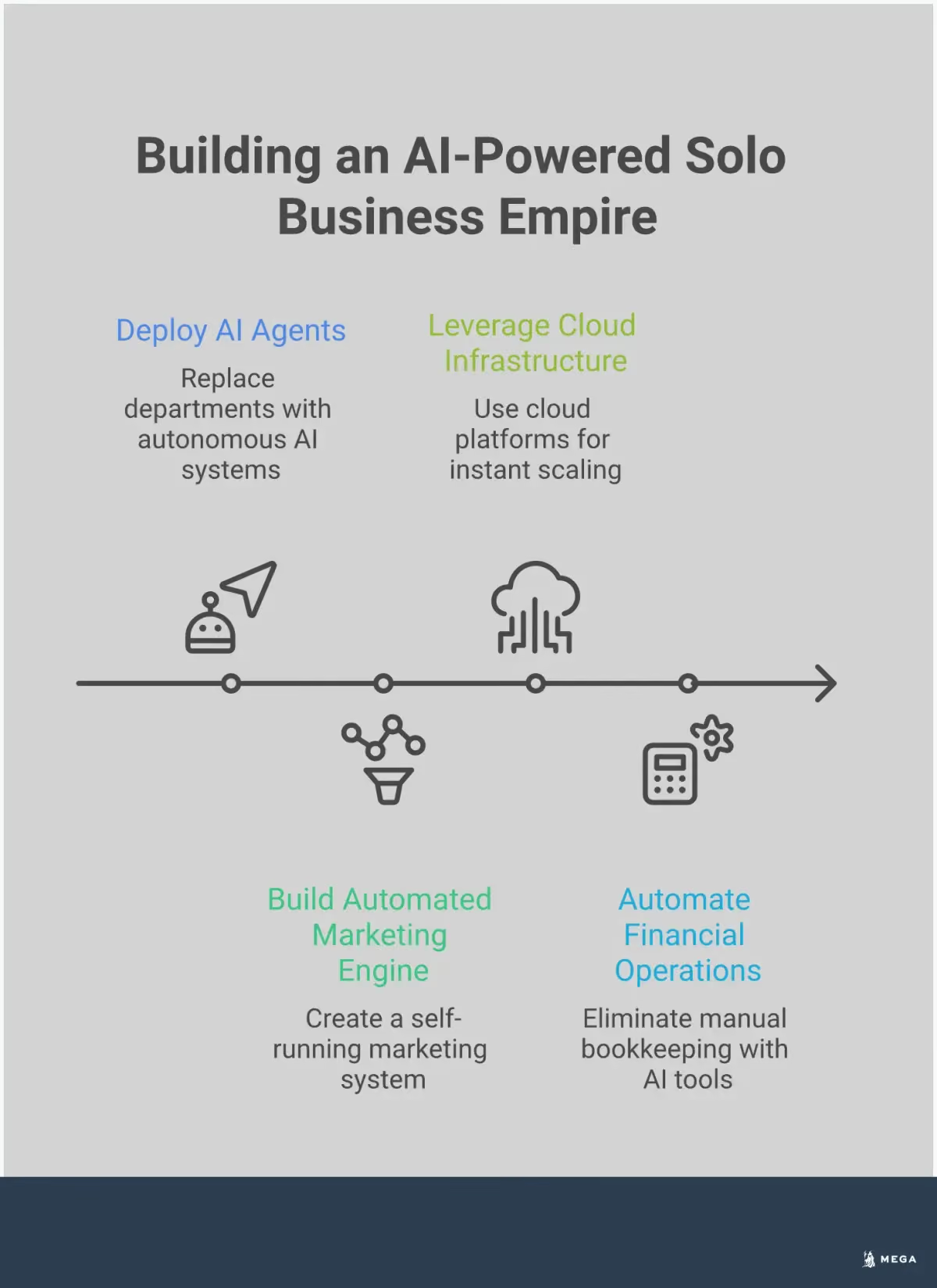
The idea of a single person building a billion-dollar company sounds like science fiction, but it’s becoming a reality. This isn't about one person doing the work of a thousand. It's about one person leveraging powerful technology that does the work of a thousand. Three core pillars make this possible: artificial intelligence, cloud infrastructure, and automation platforms. These tools are no longer reserved for giant corporations with massive budgets. They are now accessible and affordable, allowing solo entrepreneurs and small businesses to compete on a global scale.
Instead of hiring a marketing agency, a founder can use an AI agent to run their entire SEO strategy. Instead of buying expensive servers, they can use cloud services that scale with their traffic. This technological shift fundamentally changes what it means to build a business. It replaces the need for large teams and physical offices with smart, automated systems. By understanding these technologies, you can start implementing them in your own business to operate more efficiently, reach more customers, and grow faster than ever before. The goal is to work smarter, not harder, by letting technology handle the repetitive and complex tasks that used to require significant human capital. This new paradigm allows a founder's vision and strategy to be the main drivers of growth, with technology acting as the execution engine.
Harnessing AI and Machine Learning
At the heart of the solo empire is artificial intelligence. AI and machine learning are the brains of the operation, capable of handling tasks that once required entire departments. Think of AI as your co-founder, your marketing team, and your data analyst all rolled into one. It can generate marketing content, write code, analyze customer data to find trends, and even manage advertising campaigns. For a small business, this means you can execute sophisticated strategies without needing a team of specialists. AI tools can draft blog posts, design ad creatives, and optimize your website to attract more visitors, freeing you to focus on your core product and customer relationships.
Machine Learning (ML) and Deep Learning
Machine Learning gives your business a predictive edge. These algorithms learn from your data to identify patterns and forecast outcomes, like which products will be top sellers next quarter. Deep Learning, a more advanced form of ML, takes this further by automating complex tasks with minimal human input. For a solo entrepreneur, this is like having a data science team on call. It’s the technology that powers recommendation engines and sophisticated fraud detection. It can also be used to continuously optimize your marketing, automatically testing and implementing changes to improve the performance of your content and ads, which is a core function of our SEO tools.
Natural Language Processing (NLP)
Natural Language Processing allows computers to understand and generate human language, both written and spoken. This is the technology behind the chatbots that provide instant customer support and the digital assistants that answer your questions. For a one-person business, NLP is a game-changer for scaling communication. It enables you to automate customer service responses, analyze feedback from reviews, and generate high-quality marketing copy. Instead of spending hours writing blog posts or social media updates, an AI agent can produce content that sounds natural and engaging, helping you build your brand presence without a dedicated content team.
Computer Vision
Computer Vision gives machines the ability to interpret and understand information from images and videos. While it’s used in manufacturing to spot product defects, its applications in marketing are just as powerful. Computer vision can analyze which visual elements in your ads are capturing the most attention or automatically categorize products from images. For a solo business owner, this technology can automate creative production. For example, our Paid Ads platform uses it to take a single video and remix it into hundreds of variations, changing formats and translating text for different audiences and platforms. This gives you the output of a creative agency without the overhead.
The Role of Cloud Infrastructure
Cloud infrastructure is the foundation that allows a one-person business to operate at a massive scale. In the past, growing a business meant buying and managing physical servers, a costly and complex process. Today, cloud platforms provide on-demand computing power, storage, and services. This means you can serve millions of customers without ever touching a piece of hardware. The best part is the pay-as-you-go model. You only pay for the resources you use, which keeps operational overhead incredibly low. This flexibility allows a solo founder to launch a global service from their laptop, knowing their technical infrastructure can handle sudden growth without any manual intervention.
Scaling with Automation Platforms
Automation platforms are the connective tissue that brings all the technology together. These platforms allow you to create workflows that run complex processes automatically, without any human input. For example, you can connect your sales system to your marketing tools so that a new lead automatically receives a personalized email sequence. Platforms like MEGA AI can autonomously manage your paid advertising campaigns, moving budget between platforms to maximize your return. This level of automation eliminates countless hours of manual work and reduces the chance of human error. It allows a single person to manage a complex business ecosystem that is always working, even when they are not.
How AI Agents Can Replace Entire Teams
The idea of a single person running a massive company hinges on delegating entire business functions to technology. AI agents are not just tools that help with a single task; they are systems designed to manage complex, ongoing responsibilities that would normally require a team of people. From finding new customers to keeping existing ones happy, AI can handle the workload, allowing a solo entrepreneur to focus on the big picture. This is where the true power of a lean business model comes to life, replacing payroll and office space with smart, efficient software.
Streamlining Marketing and Sales
Marketing and sales are often the most time-consuming parts of growing a business. An AI agent can take over these functions completely. It can perform market research, identify your ideal customers, and create targeted content to reach them. Instead of you manually setting up campaigns, an AI can plan, launch, and optimize your paid advertising across multiple platforms. It analyzes performance data in real time, shifting budgets to the best-performing ads and refining its strategy without your input. This continuous optimization cycle works around the clock to generate leads and drive sales, acting as your dedicated marketing department.
Streamlining Operations and Workflows
Beyond customer acquisition, a solo founder needs to manage the day-to-day operations of the business. AI agents can serve as a central nervous system for your company. They can handle tasks like scheduling, inventory management, and even basic accounting and legal work through specialized platforms. By automating workflows, these agents ensure that processes run smoothly and efficiently without constant supervision. This means fewer administrative headaches and more time spent on strategic growth. The AI can analyze operational data to find bottlenecks and suggest improvements, effectively acting as your operations manager.
IT Operations (AIOps)
For a solo entrepreneur, technology is the backbone of the business, and any downtime can be costly. This is where AI for IT Operations, or AIOps, comes in. Think of it as your on-call IT department that never sleeps. AI systems can monitor your website, apps, and other digital tools around the clock. They sort through performance data to detect potential problems before they cause a crash. If an error occurs, the AI can often diagnose and fix it automatically, ensuring your business stays online and running smoothly without you needing to become a tech expert.
Supply Chain Management
If your business sells physical products, managing inventory and shipping can quickly become a full-time job. AI can take over your supply chain management by using predictive analytics to forecast demand. This helps you maintain optimal stock levels, so you don't tie up cash in products that aren't selling or run out of your bestsellers. AI can also analyze shipping routes and carrier costs to find the most efficient and affordable options for fulfillment. It automates the entire process, from ordering new inventory to ensuring packages reach your customers on time, acting as your logistics coordinator.
Human Resources and Finance
Administrative tasks are a major drain on a founder's time. AI agents can handle many of the back-office functions that typically fall under HR and finance. These systems can automate repetitive work like data entry, invoicing, and expense tracking, keeping your financial records clean and up-to-date. For customer interactions, AI-powered chatbots can handle common inquiries, freeing you to focus on more complex issues. By taking over these essential but time-consuming responsibilities, AI allows you to manage your business's finances and administrative needs with minimal effort, just as a dedicated office manager would.
Delivering Customer Service and Support
Providing excellent customer service is critical, but it can be a huge drain on a founder's time. AI-powered tools can manage the bulk of customer interactions. Intelligent chatbots can answer common questions, guide users through problems, and escalate complex issues when necessary. These systems learn from every interaction, becoming more effective over time. This allows you to offer 24/7 support without hiring a team. While AI accelerates the process, it works best when paired with human oversight for more nuanced issues, ensuring customers feel heard and valued while you remain focused on high-priority tasks.
Which Industries Will Solo Entrepreneurs Transform?
The rise of the solo entrepreneur is not confined to a single niche. AI-powered tools are dismantling the barriers to entry across a wide range of industries, allowing individuals to build and scale businesses that once required large teams and significant capital. From developing complex software to running a local service business, autonomous agents are handling the heavy lifting of marketing, operations, and customer outreach. This shift allows a founder to focus on their core product or service. Below, we look at a few key sectors where one-person companies are poised to make a significant impact.
Disrupting Software and SaaS
Building a software company used to require a team of developers, designers, and marketers. Now, a solo founder can use AI coding assistants to write and debug code for sophisticated applications. They can deploy their products on scalable cloud infrastructure that manages itself, eliminating the need for a dedicated IT department. Once the product is live, an AI agent can handle the entire growth strategy, from researching keywords and writing blog posts to launching and optimizing paid ad campaigns. This end-to-end automation allows a single person to build, launch, and scale a SaaS business from their laptop.
Reinventing E-commerce and Online Retail
Running a successful online store involves much more than just listing products. A solo e-commerce entrepreneur can now use AI to manage nearly every aspect of the business. AI tools can analyze market trends to identify profitable products, automate inventory management, and create personalized shopping experiences that guide customers to the right purchase. For customer support, AI-powered chatbots can handle inquiries 24/7. Most importantly, AI can run highly targeted advertising campaigns that find new customers and maximize return on ad spend, a task that previously required a dedicated marketing team or agency.
Changing the Game in Content and Media
The creator economy is set for a major transformation as AI empowers individuals to operate like full-scale media companies. A single person can use generative AI to produce a high volume of quality content, including articles, scripts, and social media posts. Autonomous AI programs can then take over the entire workflow, from researching topics and finding sources to distributing the content across platforms. These agents can also manage the SEO strategy, ensuring content ranks well and attracts organic traffic. This allows a solo creator to focus on their unique voice and ideas while the AI handles the production and growth engine.
Modernizing Local Service Businesses
Local businesses, from plumbers to consultants, can also achieve massive scale with a one-person team. While AI cannot replace the hands-on work or the crucial need for customer validation, it can automate nearly everything else. An AI agent can manage appointment scheduling, send invoices, and handle customer follow-ups. It can also run a sophisticated local marketing operation, optimizing the business's website for local search and managing online ads to attract new clients. By offloading these administrative and marketing tasks, the solo business owner can dedicate their time to delivering excellent service and building strong community relationships.
Specific AI Business Ideas You Can Start Today
The shift toward AI-driven business isn't just a trend for large corporations. It's creating practical opportunities for solo entrepreneurs to build profitable companies with minimal overhead. The key is to identify a service that can be almost entirely automated, allowing you to focus on strategy and client relationships while AI handles the execution. These business models are built on efficiency, using technology to deliver high-value services that once required a full team. From marketing to cybersecurity, you can launch a specialized agency from your home office, leveraging AI to do the heavy lifting.
Below are several business ideas that are perfectly suited for a one-person operation. Each one takes a traditionally labor-intensive process and streamlines it with AI, making it possible to serve multiple clients and generate significant revenue without hiring a single employee. These concepts are not just theoretical; they are actionable starting points for building your own lean, tech-powered enterprise. Whether you have a background in marketing, tech, or content creation, there is a model here that you can adapt and make your own.
AI-Powered Virtual Assistance
This isn't your typical virtual assistant role. An AI-powered virtual assistant goes beyond scheduling and email management by using intelligent tools to automate complex workflows for clients. You can offer services like automated market research, lead qualification, and social media management, all powered by AI agents. For example, you could set up systems that automatically analyze competitor strategies or manage a client's entire content calendar. According to the U.S. Small Business Administration, this is a high-growth, low-cost venture where you can act as the strategist who designs and oversees these automated systems, providing immense value without getting bogged down in manual tasks.
AI Content Repurposing Services
Many businesses create great content but lack the time to maximize its reach. As a content repurposing specialist, you can use AI to solve this problem. Your service would take a client's core content—like a webinar, podcast, or long-form blog post—and transform it into dozens of other assets. AI tools can automatically generate video scripts, social media captions, email newsletters, and quote graphics from a single piece of content. This allows your clients to maintain a consistent presence across multiple channels without creating anything new. You provide the strategy and quality control, while AI handles the time-consuming work of adaptation and creation.
AI-Powered E-commerce
A solo entrepreneur can now run a sophisticated e-commerce business that competes with much larger brands. AI can handle nearly every operational aspect, from identifying profitable product niches by analyzing market trends to automating inventory management. You can use AI to write compelling product descriptions, create personalized shopping experiences, and manage customer support with intelligent chatbots. More importantly, an end-to-end platform like MEGA AI can run your entire paid advertising strategy, optimizing campaigns across different channels to attract customers and drive sales, leaving you free to focus on product quality and brand building.
AI Lead Generation Agency
Every business needs a steady flow of new leads, and you can build a company that delivers just that. An AI lead generation agency uses intelligent tools to find, contact, and qualify potential customers for your clients. AI can analyze vast amounts of data to identify ideal customer profiles, automate personalized outreach campaigns, and use chatbots to engage prospects in initial conversations. Your role is to set the strategy and manage the systems that deliver a consistent pipeline of sales-ready opportunities. This model is highly scalable because the AI does the repetitive work, allowing you to serve multiple clients effectively.
Managed Cybersecurity Services
As businesses become more digital, the need for robust cybersecurity grows. Many small and medium-sized companies cannot afford a dedicated security team, creating a perfect opportunity for a managed service provider. Using AI-powered platforms, you can offer 24/7 network monitoring, threat detection, and automated incident response. The AI acts as a vigilant guard, identifying suspicious activity and neutralizing threats before they can cause damage. You become the expert who oversees the system, provides reports, and advises clients on security best practices, offering a critical service without needing a large security operations center.
AI Governance and Compliance Consulting
With the rapid adoption of AI, businesses are facing a new set of legal and ethical challenges. An AI governance and compliance consultant helps companies use AI responsibly. You can advise clients on issues like data privacy, algorithmic bias, and regulatory compliance, ensuring their AI systems are fair, transparent, and lawful. This is a high-value niche for a solo consultant with a background in law, ethics, or technology policy. As AI becomes more integrated into business, the demand for experts who can help companies understand the rules will only continue to grow.
Essential AI Business Tools for Massive Scale
To operate at the scale of a large company, a solo founder needs a powerful tech stack. This isn't about finding a single, magical piece of software. It's about building a digital workforce with specialized AI tools that act as your marketing team, sales department, and operations crew. Think of it as hiring a team of experts who work 24/7 without needing a coffee break. Each tool in your arsenal should handle a specific function, from creating content and managing customer relationships to forecasting sales and handling the books.
The most advanced of these tools are AI agents. They don't just provide data or suggest what to do next; they can take action on your behalf. For example, an SEO agent can research keywords, write a blog post, and publish it to your website autonomously. A paid ads agent can create ad variations, launch campaigns across multiple platforms, and shift your budget to the best-performing ads in real time. By connecting these intelligent systems, you create a self-running business that can grow without you being a bottleneck. This allows you to focus on the big picture: strategy, product, and the vision for your company.
Generative AI for Content and Product Creation
Generative AI is your in-house creative team. These tools create new content from scratch based on your prompts. For a solo entrepreneur, this is a game-changer. Instead of spending hours writing blog posts, designing social media graphics, or drafting ad copy, you can generate high-quality materials in minutes. This technology enables you to build sophisticated applications with AI coding assistants and market them with AI-generated content. It allows a single person to maintain a consistent and professional presence across all channels, producing everything from website copy and email newsletters to video scripts and product descriptions without hiring a single writer or designer.
Making Smarter Decisions with Predictive Analytics
Predictive analytics tools act as your personal business strategist. They analyze historical and real-time data to forecast future trends, customer behavior, and sales outcomes. This helps you move from making decisions based on gut feelings to making them based on data. With these insights, you can anticipate market shifts, identify your most valuable customers, and optimize your pricing strategies. By leveraging AI-powered forecasting, small businesses can improve decision-making, enhance sales performance, and stay ahead of the competition. For a solo founder, this means making smarter, more strategic choices that drive real revenue growth.
Managing Relationships with AI-Powered CRMs
A Customer Relationship Management (CRM) platform is essential for managing contacts, but an AI-powered CRM takes it to another level. These systems automate the tedious tasks that often consume a founder's day. AI can automatically log calls and emails, enrich contact profiles with public data, and score leads to help you prioritize your follow-ups. It also enables personalization at scale, so you can send the right message to the right person at the right time without manual effort. Many modern platforms now offer a range of AI-powered capabilities that help you build and maintain strong customer relationships, even when you're a team of one.
Simplifying Finances with Automation
Managing finances can be one of the most stressful parts of running a business. AI-powered financial tools automate bookkeeping, invoicing, expense tracking, and financial reporting, giving you a clear, real-time view of your company's health. These systems can categorize transactions, predict cash flow, and even help with tax preparation. While these tools are incredibly powerful, it's important to remember they are there to support, not replace, your business acumen. AI can accelerate the financial process, but the founder's judgment and understanding of the market remain essential for long-term success.
What Challenges Do One-Person Companies Face?
While AI technology makes it possible to scale a business with a very small team, it doesn’t remove every obstacle. The founder of a one-person company is still responsible for every part of the business, from high-level strategy to daily execution. Juggling these roles introduces a unique set of challenges that require careful planning and the right technology to overcome. Even with powerful AI, some responsibilities are simply harder to automate than others, demanding the founder's direct attention and expertise.
Overcoming Technical Hurdles
Running a business today means managing a collection of software for your website, marketing, sales, and operations. For a solo founder, the complexity of this business tech stack can quickly become a major hurdle. Each tool comes with its own learning curve, integration quirks, and subscription fee. Ensuring all these systems work together smoothly requires technical know-how and a significant time investment. The challenge isn't just using the tools, but architecting a system where data flows correctly and automations trigger as expected, all without an IT department to call for help.
Building and Maintaining Customer Relationships
Automation is excellent for handling routine inquiries and sending marketing messages, but it can't fully replace the human touch needed to build strong customer relationships. A solo entrepreneur has to find a balance between efficiency and personalization. True billion-dollar outcomes depend on understanding your market and validating ideas with real people. AI can help you analyze customer data, but building a loyal community and gathering deep, qualitative feedback still requires genuine interaction. This becomes a significant challenge when your time is split between a dozen other critical business functions.
Keeping Quality High at Scale
When you are the entire company, you are also the entire quality control department. From the code in your software to the copy on your website, every detail falls on your shoulders. Without a team to provide a second set of eyes, it's easier for small mistakes to slip through, potentially impacting your brand's reputation. This pressure to maintain high standards across all business activities is immense. It requires creating rigorous personal workflows and relying on tools that deliver consistent, high-quality output, because there’s no one else to catch an error before it goes live.
The Importance of Data and Privacy Protection
As a solo founder, you are solely responsible for protecting your customers' sensitive information. This involves more than just choosing software with strong security features; it means understanding and complying with complex data privacy regulations like GDPR. A data breach can be devastating for any business, but for a one-person company, the legal and reputational fallout can be impossible to recover from. This responsibility adds another layer of complexity, requiring you to carefully vet every tool and process to ensure your business is handling customer data ethically and legally.
Navigating Legal and Security Risks
As a solo founder, you are solely responsible for protecting your customers' sensitive information. This involves more than just choosing software with strong security features; it means understanding and complying with complex data privacy regulations like GDPR. A data breach can be devastating for any business, but for a one-person company, the legal and reputational fallout can be impossible to recover from. This responsibility adds another layer of complexity, requiring you to carefully vet every tool and process to ensure your business is handling customer data ethically and legally.
Maintaining Trust and Ethical Standards
Automation is excellent for handling routine inquiries and sending marketing messages, but it can't fully replace the human touch needed to build strong customer relationships. A solo entrepreneur has to find a balance between efficiency and personalization. True billion-dollar outcomes depend on understanding your market and validating ideas with real people. AI can help you analyze customer data, but building a loyal community and gathering deep, qualitative feedback still requires genuine interaction. This means using technology as a tool to enhance your connection with customers, not as a wall to hide behind.
Understanding the Economics of a Lean Business
The traditional path to growing a business involved a simple, linear equation: more revenue required more people, bigger offices, and higher operational costs. AI fundamentally changes this model. It introduces a new kind of leverage, allowing a business to expand its reach and revenue without proportionally increasing its expenses. This economic shift is what makes the idea of a massively successful one-person company a reality.
By automating core functions that once required entire departments, AI allows entrepreneurs to operate with incredible efficiency. The financial structure of the business changes completely. Instead of a budget dominated by payroll, the primary investment becomes technology. This creates a lean, agile operation where resources are directed toward tools that generate growth, not just maintain the status quo. This new economic model is built on three key principles: drastically lower overhead, the ability to scale revenue without scaling staff, and a strategic shift from investing in people to investing in technology.
Keeping Overhead Costs Low
One of the biggest financial hurdles for any business is overhead, the fixed costs of simply operating. This includes salaries, benefits, office rent, and utilities. An AI-powered business minimizes these expenses. With AI handling primary service delivery, a founder can run a global operation from a laptop, eliminating the need for a physical office and the associated costs. Functions like marketing, customer support, and even administrative tasks can be managed by AI agents, reducing the need to hire full-time staff. This lean structure means more of your revenue can be reinvested into growth instead of being consumed by operational overhead.
Scaling Revenue Without Scaling Staff
Historically, if you wanted to double your revenue, you often had to double your team. AI breaks this link. Autonomous AI agents can execute tasks at a scale and speed that a human team simply cannot match. An AI can manage thousands of customer interactions, analyze massive datasets to find sales opportunities, or run complex paid ad campaigns across multiple platforms simultaneously. These agents work 24/7 without burnout or downtime, allowing a single founder to build and manage systems that generate revenue far beyond what one person could traditionally handle. This creates a business model where growth is no longer limited by headcount.
Tech vs. People: Where to Invest Your Money
In a lean, AI-driven company, the budget shifts from payroll to platforms. The capital that would have been spent on salaries is instead invested in sophisticated technology that provides even greater leverage. A strategic investment in the right AI tools can deliver the output of an entire team for a fraction of the cost. Every business function, from accounting to legal services, is being reimagined with AI at its core. For small businesses, this means you can access capabilities that were once only available to large corporations with huge budgets, allowing you to compete on a much larger scale.
How This Trend Reshapes Traditional Business
The rise of the hyper-efficient solo entrepreneur isn't just an interesting headline; it signals a fundamental shift in how businesses operate. This new model challenges long-held beliefs about what it takes to build a successful company. Instead of large teams and complex hierarchies, we're seeing a move toward lean, technology-driven structures. This evolution impacts everything from how companies are organized to the skills required in the modern job market and the kinds of opportunities available to specialists. For small and local businesses, understanding these changes is key to staying competitive.
The Future of Company Structures
Traditional business structures with multiple departments and layers of management are becoming less necessary. Today, a solo founder can direct a team of specialized AI agents to perform tasks that once required entire teams. A single person can use AI to write code, manage cloud infrastructure, and run sophisticated marketing campaigns. This is the core of the new company structure: a human strategist at the center, supported by a scalable, automated workforce. This model allows for incredible agility, letting a business pivot or scale with a speed that larger, more traditional organizations can't match. The company becomes a flexible network of tools and automations, all guided by a single vision.
What This Means for the Job Market
The conversation around AI often centers on job replacement, but the reality is more of a job transformation. While agentic AI can now autonomously handle research, content creation, and analytics, it excels at executing defined tasks. This shift frees up human workers from repetitive duties and allows them to focus on roles that require uniquely human skills. Strategic thinking, creative problem-solving, and building genuine customer relationships become more valuable than ever. AI tools may accelerate processes, but they can't replace the critical thinking and market understanding that drive a business forward. The jobs of the future will involve working alongside AI, using it as a tool to amplify human talent.
Creating New Opportunities for Specialists
This new landscape creates incredible opportunities for specialists and small businesses. Instead of needing to hire a full-time marketing director or SEO expert, a founder can now access that expertise through AI-powered platforms or fractional services. This makes high-level skills more accessible and affordable. For small businesses, this is a game-changer. Investing strategically in AI allows you to achieve efficiency gains and access capabilities that were once reserved for large corporations. It levels the playing field, enabling you to compete on strategy and execution rather than the size of your team or budget.
How Your Small Business Can Use AI to Compete
The idea of a one-person billion-dollar company offers a powerful blueprint for any small business. It shows how technology can level the playing field, allowing smaller teams to compete with established industry giants. By adopting the right AI strategies, you can operate with the efficiency and reach of a much larger organization. It’s not about replacing your team, but about giving your business the tools to punch far above its weight.
How to Implement Strategic Automation
Automation is about more than just saving time on repetitive tasks. It’s about creating systems that execute your core business functions consistently and at scale. For a small business, this means you can run sophisticated marketing campaigns without a dedicated team. An AI agent can handle everything from keyword research and content creation to launching and optimizing paid advertising campaigns. This frees you up to focus on strategy and customer relationships. While AI can accelerate the process, your expertise is still needed to validate ideas and understand your market. The goal is to combine your knowledge with the execution power of AI.
Start with a Strategic Framework
Before you start adopting AI tools, it’s important to have a clear strategy. You need a solid understanding of your own business operations and where AI can make the biggest impact. Instead of chasing the newest shiny tool, take a moment to map out your daily, weekly, and monthly tasks. Identify the biggest bottlenecks and the most time-consuming processes. Is it responding to customer inquiries, creating marketing content, or managing your social media? Once you know your pain points, you can find AI solutions that directly address them. This strategic approach ensures you’re not just using technology for technology's sake, but are making a targeted investment to drive real growth and efficiency in your business.
Identify Simple Tasks to Automate First
The best way to begin is by starting small. Look for simple, repetitive tasks that consume your time but don't require complex strategic thinking. This could include scheduling social media posts, sending appointment reminders, or creating first drafts of blog posts. Automating these everyday activities provides immediate time savings and helps you get comfortable with using AI in your workflow. As you see the benefits, you can gradually move toward automating more complex functions. For example, once you've automated content drafts, the next step could be using a more advanced system to manage your entire SEO strategy, from keyword research to performance optimization. This step-by-step approach makes the transition feel manageable and builds confidence.
Focus on High-Quality Data
AI systems are only as effective as the data they are given. Think of it this way: garbage in, garbage out. Before you implement sophisticated AI, take the time to organize your business data. This means ensuring your customer contact lists are clean and up-to-date, your sales records are accurate, and your website analytics are properly configured. Having strong data governance practices ensures that when you do deploy an AI tool for tasks like predictive analytics or marketing personalization, it has reliable information to work with. This foundational step is crucial for getting accurate insights and making sure your automated systems perform correctly, ultimately leading to better business decisions and outcomes.
Where to Find Cost-Effective AI Tools
Not long ago, advanced marketing and operational software was only accessible to companies with enterprise-level budgets. AI has changed that completely. Today, powerful tools are available that make sophisticated strategies affordable for small businesses. You can find AI platforms that manage customer service, generate video content, and provide deep analytics for a fraction of the cost of traditional methods. This accessibility allows you to invest in growth without taking on massive overhead. Platforms that offer transparent pricing give you the capabilities of an entire agency, helping you manage costs while improving your financial performance.
How to Build a Technological Advantage
Using AI effectively is about more than just adopting a few tools. It’s about building a cohesive technological foundation that becomes a competitive advantage. Instead of juggling multiple disconnected apps, an integrated platform can manage your entire growth strategy. An end-to-end SEO agent, for example, can handle technical audits, content updates, and link building in one place. This creates a system that learns and improves over time, compounding your results. By automating core functions, you reduce operational costs and can reinvest those savings back into your business, creating a cycle of sustainable growth.
What's Next for Entrepreneurship?
The rise of the one-person billion-dollar company signals a major shift in how businesses are built. It’s not just about having access to better tools; it demands a fundamentally different approach to business operations. The focus is moving away from building large teams and toward creating intelligent, automated systems that can run and scale themselves. This change puts the entrepreneur in the role of an architect, designing the business framework and letting AI agents handle the execution.
This new model gives solo founders a level of influence previously reserved for massive corporations. The modern entrepreneur who effectively uses AI agents has the leverage once reserved for Fortune 500 companies. Instead of hiring a full marketing department, a founder can deploy an AI agent to manage their entire SEO strategy. Instead of a sales team, they can use AI to run complex paid ad campaigns across multiple platforms. This frees them to focus on strategy, innovation, and customer needs.
Interestingly, this shift also changes the core motivation for many founders. The goal isn't necessarily to build a massive company but to solve a problem authentically and effectively. AI diminishes the human infrastructure needed for scale, allowing individuals to reach global audiences from day one without the traditional pressures of fundraising and hiring. By automating the operational drag, AI allows a founder’s vision to be the primary driver of the business. For small businesses, this means that making a strategic investment in AI is no longer a luxury but a key competitive advantage.