
When you hear 'AI for business,' you might think of chatbots or content generators—tools that still need you to do the heavy lifting. But what if AI could do more than just assist? What if it could execute? This guide explores a different approach: the AI agent tool. These are not chat interfaces you have to wrestle with. They are autonomous systems that plan, launch, and optimize entire campaigns on their own. We'll cover how these agents handle everything from technical SEO fixes to managing paid ad spend, allowing you to delegate entire marketing functions and focus on growth.
Key Takeaways
- Focus on strategy, not just tasks: Automating repetitive marketing workflows like SEO and paid ads frees your team from manual execution, allowing you to concentrate on high-level planning and business growth.
- Select agents over tools for true automation: Unlike basic AI tools that require constant input, an AI agent autonomously manages entire workflows from strategy to execution, acting as a proactive member of your team.
- Start with a practical implementation plan: Begin by identifying a high-impact area like content optimization, connect your existing platforms, and establish clear KPIs to measure success and track your ROI from the start.
What is AI-Powered Business Process Automation?
Business process automation uses technology to handle repetitive, day-to-day tasks that would otherwise require manual effort. When you add artificial intelligence to the mix, you get a system that doesn’t just follow a set of pre-programmed rules. Instead, it uses AI to learn, analyze data, and make decisions to complete more complex work.
Think of it this way: standard automation is like setting a coffee maker to brew at 7 a.m. every day. It follows a simple command. AI-powered automation is like having a barista who notices you’ve been waking up earlier, checks the weather to see if you might prefer an iced coffee, and adjusts the brew based on the new beans you bought. It adapts. By integrating AI, businesses can streamline operations, reduce human error, and make smarter, data-driven decisions without constant oversight.
For small businesses and startups, this is a game-changer. It means you can offload entire functions that are critical for growth but drain your limited time and resources. Instead of spending your week manually researching keywords, updating blog posts, or tweaking ad campaigns, you can focus on product development, customer relationships, and big-picture strategy. The goal is to free up your team to work on the high-value initiatives that humans do best.
This is exactly where AI Agents come in. An AI agent is designed to manage an entire workflow from start to finish. For example, MEGA AI’s SEO Agent doesn’t just generate content. It performs technical audits, fixes site errors, builds an internal linking strategy, and continuously updates articles to improve their rank. It handles the whole process, autonomously planning and executing the tasks needed to hit your growth targets.
What is an AI Agent, Really?
An AI agent is more than just a tool; it's an autonomous system designed to act on your behalf. Unlike a chatbot that waits for your prompts or a content generator that needs your ideas, an AI agent perceives its digital environment, makes decisions, and takes independent actions to achieve specific goals. Think of it as a proactive team member who doesn't need constant direction or micromanagement. For a small business, this means you can delegate entire workflows, like optimizing your website's SEO or managing a paid ad campaign, to an agent that works around the clock to hit your targets without you needing to oversee every single step.
The Core Qualities of an AI Agent
What truly sets an AI agent apart from standard software are its core qualities. These systems are built to be goal-oriented, proactive, and rational in their decision-making. Two characteristics make them particularly powerful for business automation. First is Autonomy and Adaptability; an agent operates independently to complete its assigned tasks. It can adapt to new information or unexpected changes, like a Google algorithm update, without waiting for human intervention. Second is Continuous Learning and Collaboration. AI agents aren't static. They learn from their experiences to improve performance over time and can collaborate with other systems to handle complex, multi-step processes for better results.
How AI Agents Think: A Look Inside
The "thinking" process of an AI agent is powered by a sophisticated technical architecture. At its core, an agent uses a foundation model (like an LLM) for reasoning, a planning module to strategize actions, a memory module to retain information, and tool integration to execute tasks in other software. This structure allows the agent to function intelligently and autonomously. It also enables the creation of different types of agents suited for specific business needs, from simple ones that react to triggers to advanced learning agents that refine their approach over time. This is how a platform like MEGA AI can offer specialized agents for distinct functions like SEO and Paid Ads, each designed to manage its domain from start to finish.
Why Traditional Processes Are Holding You Back
If you run a small business, you know that time is your most valuable asset. Yet, so much of it gets lost to manual, repetitive tasks, especially in marketing. From researching keywords and updating website content to managing ad campaigns and analyzing performance reports, these traditional workflows feel necessary, but they often create bottlenecks that slow down your growth. While you’re busy with the day-to-day execution, you lose precious hours that could be spent on high-level strategy, building customer relationships, or developing your next great idea.
This isn't just about being busy; it's about a fundamental inefficiency that holds your business back. Relying on manual processes means your marketing efforts can't scale at the same pace as your ambitions. As your business grows, the workload multiplies, but your team and your time don't. This is where the gap between your goals and your capacity widens, putting you at a disadvantage against competitors who have already found a better way to operate. The constant context-switching and operational drag prevent you from focusing on the strategic work that truly moves the needle, leaving you feeling stuck in a cycle of maintenance instead of growth.
Where Manual Workflows Waste Time and Money
Manual marketing workflows are a constant drain on your budget and your team's focus. Every hour spent manually fixing broken links, adjusting ad bids, or pulling data for reports is an hour that isn't dedicated to innovation or customer engagement. For startups and small businesses, this opportunity cost is huge. Instead of developing your core product or refining your brand message, you’re stuck managing operational details. By choosing to automate repetitive tasks, you can reclaim that time and redirect your team’s energy toward activities that generate real value and drive the business forward. This frees up not just time, but also the mental space needed for creativity and strategic thinking.
Why Slow Execution Puts You Behind Competitors
In today's market, speed is a critical advantage. Manual processes are inherently slow, making it difficult to react quickly to market changes, competitor moves, or new opportunities. While you spend a week analyzing campaign data to decide on your next move, an automated system can provide insights in minutes. This delay means you’re always a step behind. Adopting AI-powered automation can give your business a significant competitive edge, allowing you to execute marketing strategies faster, test ideas more rapidly, and optimize performance in real time. It levels the playing field, enabling you to compete with larger companies without needing a massive team or budget.
Why an AI Agent Tool is More Than a Chatbot
When you think of AI, you might picture a chatbot or a content generator—tools that require you to provide constant direction to get the output you want. While helpful, these tools are fundamentally reactive. An AI agent is different. It’s a proactive system designed to understand a goal, create a strategy, and execute the necessary tasks to achieve it, much like a human team member would.
This distinction is crucial for small businesses. You don't just need another tool to manage; you need an effective way to get work done. AI agents that operate autonomously handle entire workflows, from planning to execution, freeing you to focus on running your business. Instead of you wrestling with a chat interface, a real agent takes on the project and delivers results. This isn’t another AI chat interface you need to wrestle with to get the output you want. These are real Agents who come up with a strategy and execute the tasks needed to hit your goals.
Autonomous Agents vs. Basic Chat Interfaces
A chat interface is a conversational partner. You ask it to write an ad, and it writes one. You ask it to suggest keywords, and it provides a list. The process stops there. The responsibility is still on you to take that output and implement it. This back-and-forth requires your constant attention and expertise to guide the tool toward a useful outcome.
In contrast, a real agent is an executor. You assign it a high-level goal, like improving your website's SEO or managing your ad spend. The agent then independently performs the necessary tasks, such as conducting keyword research, writing and publishing blog posts, or fixing technical SEO issues. It’s the difference between getting a list of suggestions and having an expert execute tasks independently.
How Autonomous AI Agents Get Work Done
Autonomous execution is what sets AI agents apart and makes them so powerful for business process automation. Instead of requiring your approval for every small action, an agent can operate on its own to achieve the objectives you’ve set. For instance, MEGA AI’s agents can be set to an "Autopilot Mode," which enables them to make decisions and implement changes without manual intervention. This capability allows for much faster progress, as the agent can optimize campaigns and content in real time.
This level of automation allows you to delegate entire functions of your marketing. An agent can launch and manage your paid advertising campaigns, moving budget to high-performing ads and turning off ones that aren’t working. This continuous, data-driven optimization cycle works around the clock to improve your results without demanding your constant oversight.
How AI Agents Automate Your Business
AI agents are different from the AI tools you might be used to. Instead of giving you suggestions or generating a piece of content that you then have to implement, an AI agent acts as an autonomous team member. It takes on entire business functions, from strategy and planning to execution and optimization. For small businesses, this means you can hand off complex marketing workflows to an agent that works around the clock to hit your growth goals. This isn't about getting help with tasks; it's about delegating the entire process.
Use AI Agents to Automate SEO Workflows
Modern SEO requires a deep understanding of technical details, content quality, and search engine algorithms. An AI agent like MEGA AI’s SEO Agent handles the entire SEO lifecycle. The agent performs technical audits to fix issues like broken links and canonical tags, adds alt tags to images, and implements lazy loading to improve site speed. It also develops a content strategy based on keyword research and generates high-quality articles designed to demonstrate expertise and authority. This consistent, expert-level execution helps your content meet the standards that AI search engines prioritize, allowing you to build organic traffic without needing a dedicated SEO team.
Automated Keyword Research and Content Generation
Finding the right keywords and creating content around them is a full-time job. For a small business, this often means hours spent on research tools and writing, only to guess if you’re on the right track. An AI agent takes over this entire workflow. Instead of just giving you a list of keywords, an agent like MEGA AI’s SEO Agent builds a complete content strategy from the ground up. It identifies what your customers are searching for, generates articles that answer their questions, and even builds an internal linking structure to help search engines understand your site. This isn't just about creating a single blog post; it's about building a comprehensive content plan that establishes your authority and drives organic traffic, all without your constant input.
Ongoing Content Optimization and Maintenance
Publishing an article is just the beginning. Over time, content can become outdated, and its search ranking can drop. This is where ongoing maintenance becomes critical. An AI agent continuously monitors your content's performance and makes improvements to keep it relevant. For example, MEGA AI’s Maintenance Agent can identify which articles need updates to improve their click-through rate (CTR) from search results. It can also find opportunities to add new, relevant information to existing posts, helping them rank more highly for target keywords. This turns your content library into a dynamic asset that consistently performs, rather than a static collection of posts that slowly loses value.
Manage Paid Ad Campaigns with an AI Agent Tool
Successful paid advertising requires constant monitoring, budget adjustments, and creative testing. An AI agent like the Ads Agent manages your campaigns across platforms like Google, Meta, and TikTok. The agent autonomously moves your budget to high-performing campaigns, turns off ads that aren’t delivering results, and tests new ad creatives to find what resonates with your audience. By automating these repetitive tasks, the agent can optimize performance and provide clear insights into customer behavior. This allows you to scale your advertising efforts efficiently and get a better return on your ad spend without getting lost in the day-to-day management.
Cross-Platform Campaign Management
Managing ads on Google, Meta, and LinkedIn can feel like juggling three different jobs. Each platform has its own rules, audience behaviors, and best practices, making it a huge time sink for small teams. An AI agent acts as your central hub for all paid advertising. Instead of manually uploading and tailoring campaigns for each site, you can upload your content once, and the agent handles the distribution. For example, MEGA AI’s Paid Ads Agent can take your creative assets and launch them across multiple platforms simultaneously. This ensures your brand maintains a consistent presence wherever your customers are, without you having to become an expert on every single ad network.
Automatic Budget Allocation and Content Remixing
One of the biggest challenges in paid advertising is knowing where to put your money. An AI agent removes the guesswork by making data-driven decisions in real time. It continuously monitors your campaigns and automatically moves your budget to the ads that are performing best, while turning off the ones that aren't delivering results. This ensures your ad spend is always working as efficiently as possible. Beyond budget management, an agent can also remix your content to create hundreds of variations for testing. It can swap headlines, change images, and even translate voiceovers to find the exact combination that resonates with your audience, running a constant optimization cycle to improve your results.
How AI Agents Integrate with Your Tech Stack
For automation to be effective, it needs to work with the tools you already use. A true AI agent doesn’t force you to change your entire tech stack. Instead, it connects directly to your existing platforms. MEGA AI integrates with over 50 common business tools, including WordPress, Shopify, Google Analytics, and HubSpot. This seamless integration allows the agent to pull data, analyze performance, and execute tasks directly within your environment. This approach makes it simple to get started and ensures the AI has the access it needs to manage your marketing workflows from end to end.
Which Business Processes to Automate First
Deciding where to begin with AI automation can feel overwhelming, but the key is to start smart. You don’t need to overhaul your entire operation overnight. Instead, focus on specific areas where AI can deliver a significant impact with the least amount of disruption. The best candidates for automation are often repetitive, time-consuming tasks that are critical for growth but drain your team's creative energy and focus.
For most small businesses, marketing and sales functions are the perfect place to start. These areas are measurable, directly tied to revenue, and often involve a high volume of manual work. By automating tasks like content creation, ad management, and lead generation, you free up your team to focus on strategy, customer relationships, and closing deals. As AI technology has become more accessible, specialized solutions can handle these complex processes, giving you an immediate competitive edge without a massive upfront investment.
Start with High-Impact, Low-Risk Processes
To find your ideal starting point, look for processes that are both important and inefficient. Think about the daily or weekly tasks that consume hours but could be systemized. Integrating AI into your business isn't just about keeping up; it's about strategically setting the stage for future growth. A great low-risk area is one where an AI agent can work alongside your team without altering core internal workflows. For example, handing over your SEO strategy or paid ad campaigns to an AI agent allows you to see tangible results quickly while your team continues its day-to-day work. This approach lets you test the waters and build confidence in automation.
How to Prioritize Content Creation and Optimization
Content is the engine of modern marketing, but it demands constant attention. From keyword research and drafting articles to updating old posts, the workload is endless. This makes content a prime candidate for automation. By leveraging AI, small businesses can automate these repetitive tasks and gain deeper insights into what resonates with their audience. An AI agent can perform technical SEO audits, generate dozens of blog posts, and even optimize existing content to improve its ranking and click-through rate. This ensures a steady stream of high-quality content that attracts and engages customers, all without burning out your team.
Streamline Customer Service and Lead Qualification
Generating and qualifying leads is another high-impact area where automation shines. AI can manage your entire paid advertising funnel, from launching campaigns on platforms like Google and Meta to optimizing budgets for the best return. As one MEGA AI user noted, their agent is now successfully qualifying incoming leads and is set to "start going after the 18,000 past leads." This is a game-changer for small teams. AI-powered tools can handle initial outreach and analysis, ensuring your sales team spends its time talking to genuinely interested prospects. This dramatically improves efficiency and conversion rates.
What to Expect During AI Implementation
Getting started with an AI agent is more straightforward than you might think. It’s not about overhauling your entire business overnight. Instead, it’s a structured process of connecting your existing tools, deciding how much control you want to maintain, and setting clear expectations for what success looks like. A good AI platform is designed for accessibility, allowing you to integrate it without needing a team of developers.
The implementation phase is where the strategy comes to life. You’ll grant the AI agent access to your marketing and sales platforms, which allows it to analyze data and execute tasks directly within your ecosystem. From there, you’ll choose your level of involvement—whether you want to approve every action or let the agent run autonomously to achieve your goals faster. Understanding this process helps you prepare for the transition and align your team around a realistic timeline for seeing measurable results.
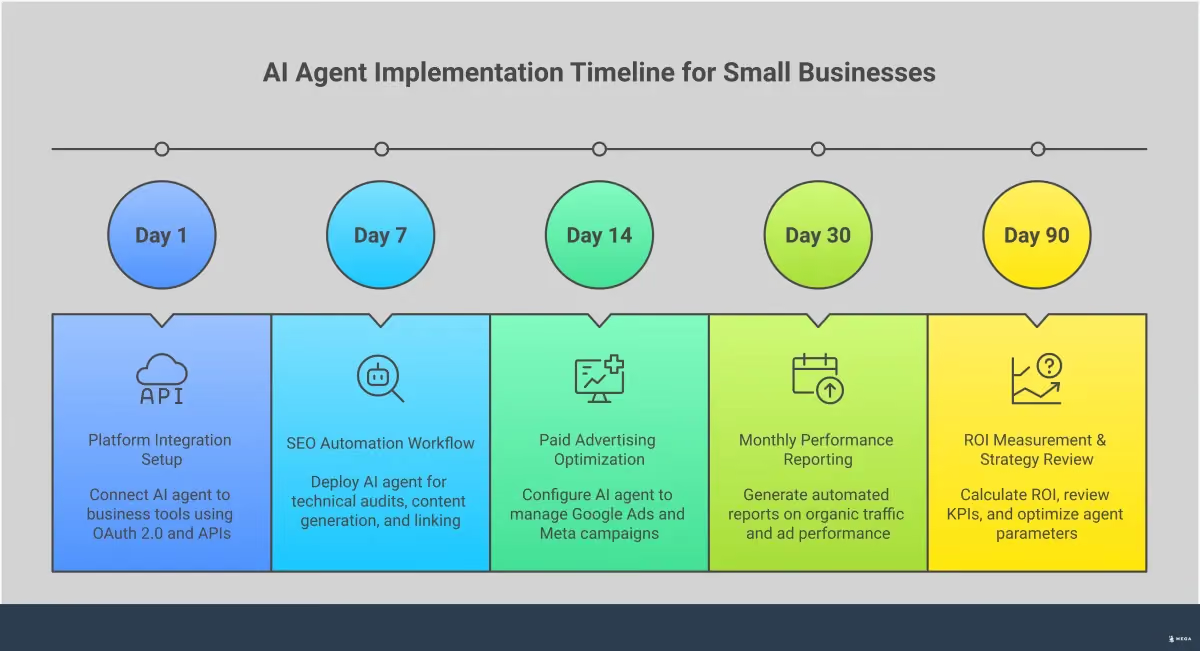
Connecting Your Platforms and Tools
The first step is to connect the AI agent to the tools you already use. For an AI growth agent to be effective, it needs access to your website, analytics, and advertising accounts. MEGA AI, for example, integrates with over 50 platforms, including WordPress, Shopify, Google Ads, and Meta Ads. This connection is secure and typically uses standard authentication methods, so you don’t need deep technical knowledge to get set up. By linking these systems, you provide the agent with the data it needs to understand your business, identify opportunities, and start executing tasks that drive growth.
Autopilot vs. Manual Approval: Which is Right for You?
Once connected, you need to decide how the agent will operate. You can choose a manual approval workflow, where the agent proposes actions and waits for you to give the green light. This approach offers maximum control and is great when you’re first building trust with the system. Alternatively, you can use an Autopilot Mode, which allows the agent to make decisions and execute tasks autonomously. This is how you can truly automate repetitive tasks and accelerate your results. At MEGA AI, 85% of customers use Autopilot and see results twice as fast, letting the agent manage campaigns while they focus on other parts of their business.
How to Set a Realistic Timeline for AI Results
AI can move quickly, but certain goals, like organic traffic growth, still require patience. It’s important to set a realistic timeline based on the channels you’re automating. While paid ad campaigns can show performance changes within days, SEO is a long-term investment. Most businesses using an SEO Agent can expect to see meaningful organic traffic growth within three to nine months. The key is to establish a framework for measuring ROI from the start. By tracking the right metrics, you can monitor progress and see the cumulative impact of the agent’s work over time, ensuring your investment is paying off as planned.
How to Measure Your Automation Success
Once your AI agent is up and running, the next step is to track its impact. Measuring success isn't just about seeing if the tool is "working"; it's about connecting automation to your core business objectives. This process helps you justify the investment, make informed decisions, and ensure your AI strategy is delivering real value. By setting clear metrics from the start, you can see exactly how your automated workflows contribute to growth.
How to Define Your Automation KPIs
Before you can measure success, you need to define what it looks like. Key Performance Indicators (KPIs) are the specific, measurable metrics you'll use to gauge performance. For an SEO Agent, this could be an increase in organic traffic, higher rankings for target keywords, or more leads from your website. If you're automating paid ads, you might track Return on Ad Spend (ROAS) or Cost Per Acquisition (CPA). The key is to choose KPIs that align directly with your business goals, turning abstract data into a clear story of progress and accountability.
Measure Your ROI and Cost Savings
Automation should make financial sense. Calculating the Return on Investment (ROI) helps you see the bottom-line impact. Compare the revenue generated from your AI-driven campaigns against the cost of the service. For example, if an AI agent generates an extra $5,000 in monthly sales, the investment is clearly paying off. Don't forget to factor in soft savings, too. Consider the hours your team saves by not managing campaigns manually or the significant cost difference compared to a traditional agency. These savings contribute directly to your overall ROI.
How to Monitor Ongoing Performance
Measuring success is an ongoing process, not a one-time report. Regularly monitoring your KPIs allows you to see trends, understand what's working, and make strategic adjustments. Most AI platforms provide dashboards that give you visibility into the tasks being performed. Set aside time each month to review these analytics. This continuous feedback loop is essential for long-term success. It ensures your automation strategy remains aligned with your business objectives as they evolve and helps you optimize performance over time, ensuring your AI agent continues to deliver results.
How to Overcome Common AI Implementation
Adopting any new technology comes with a learning curve, and AI is no different. While AI agents are designed to simplify your workflows, it's smart to anticipate a few common hurdles. Planning for these challenges ahead of time ensures a smoother transition and helps you get the most value from your new automation tools from day one. By understanding potential data, team, and security issues, you can create a clear path for successful implementation.
Plan for Data and Integration Challenges
Your business runs on data spread across different platforms—your website CMS, analytics tools, and ad accounts. A primary challenge is getting these systems to talk to each other and feed the AI the right information. AI models rely on large amounts of quality data to work effectively. The good news is that modern AI platforms are built for this. For example, MEGA AI integrates with over 50 platforms like Shopify, WordPress, and Google Ads, which handles the technical heavy lifting. Before you start, map out your key data sources and confirm your chosen AI platform can connect to them seamlessly.
How to Get Your Team Onboard
Bringing AI into your business isn't just a technical change; it's a cultural one. Your team might have questions or concerns about how AI will affect their roles. The most successful companies involve their staff in the process, identifying which tasks are best suited for automation. Frame the AI agent as a new team member that handles tedious, repetitive work, freeing up your human experts for high-level strategy and creative projects. By including your team in the decision-making process, you can build buy-in and ensure everyone understands how the tool will make their jobs easier, not obsolete.
Focus on Augmentation, Not Replacement
The goal of implementing an AI agent isn't to replace your experts; it's to make them more effective. Think of the agent as an autonomous team member that handles the repetitive, data-intensive tasks that consume valuable time. By automating workflows like technical SEO audits, content updates, and ad budget management, you free up your team to concentrate on the work that requires a human touch. This includes high-level strategy, creative brainstorming, building customer relationships, and closing deals. The agent manages the execution, allowing your team to focus on growth and innovation.
Manage Privacy, Security, and Compliance
Handing over access to your business data requires trust. It's essential to address privacy and security from the very beginning. When evaluating an AI platform, look for clear policies on data handling and security protocols. For instance, MEGA AI adheres to the EU-U.S. Data Privacy Framework and uses secure authentication methods like OAuth 2.0 to protect your information. Before committing to a tool, review its privacy policy and ensure it aligns with regulations like GDPR and CCPA. Prioritizing security ensures you can automate processes confidently without putting your company or customer data at risk.
Addressing Technical and Ethical Hurdles
While AI agents offer a powerful way to automate your business, it's important to be aware of the practical challenges that come with the technology. Implementing AI isn't just about software; it involves considering the underlying infrastructure and the ethical implications of handing decisions over to an algorithm. Understanding these hurdles from the start helps you choose the right solution and set realistic expectations for how AI will integrate into your operations. By addressing these issues head-on, you can build a more resilient and responsible automation strategy.
The Cost of Computing Power
AI agents require a great deal of computational power to analyze data, learn from it, and execute tasks effectively. For a small business, the cost of building and maintaining the necessary server infrastructure would be substantial. While AI-driven automation is a strategic way to reduce expenses and improve accuracy over time, the initial investment can be a barrier. This is why using a platform-based solution is often a more practical approach. Companies like MEGA AI handle the backend infrastructure, allowing you to access powerful AI capabilities through a subscription model without the high upfront cost of hardware.
Managing AI Bias and Ensuring Accuracy
An AI system is only as reliable as the data it's trained on. This raises important concerns about fairness and accuracy, as biased data can lead to biased outcomes. AI agents function as intelligent, autonomous systems, but if their training data reflects existing societal biases, their decisions can unintentionally perpetuate them. To counter this, it's critical to implement strong data governance practices, including regular audits and updates to ensure datasets are representative and fair. When choosing an AI partner, ask about their methods for mitigating bias to ensure the tool operates ethically and produces reliable results for your business.
How to Choose the Right AI Agent Tool
Selecting an AI automation platform is more than just buying software; it’s about choosing a partner for your business growth. With so many options available, it’s easy to get distracted by features that don’t deliver tangible results. The right platform should function as an extension of your team, taking ownership of complex processes and executing them efficiently. It should simplify your workflows, not add another layer of complexity.
When evaluating your options, focus on platforms that offer end-to-end automation rather than just isolated tools. Look for a solution that can strategize, execute, and optimize tasks autonomously. This is the key difference between a simple AI assistant and a true growth agent. The goal is to free up your time to focus on other critical areas of your business, confident that your marketing and operational workflows are running smoothly. You can book a demo to see how an AI agent can audit your site and identify opportunities. Consider how each platform aligns with your long-term goals, integrates with your current systems, and provides transparent reporting on its performance.
What to Look for in an AI Agent Tool
A powerful AI automation platform does more than just follow commands. It should be capable of planning and executing entire campaigns. Instead of a chat interface that requires constant prompting, look for autonomous agents that can manage your SEO and paid advertising from start to finish. The platform should automate repetitive tasks, offer strategic insights based on data, and create personalized marketing that resonates with your audience. Essential features include the ability to conduct research, analyze performance, and make data-driven adjustments without needing manual approval for every single step. This level of autonomy is what truly drives efficiency and delivers results.
A Practical Checklist for Selecting a Platform
To help you choose the right platform, focus on its core capabilities rather than flashy features. The goal is to find a system that acts as a true partner, not just another tool you have to manage. Use these points to guide your evaluation:
- Look for end-to-end automation. Can the platform strategize, execute, and optimize an entire campaign on its own? A powerful agent handles the whole workflow, from research to reporting, unlike basic tools that only complete single tasks.
- Confirm seamless integration. The right tool should connect directly to your existing systems, like WordPress, Shopify, and your ad accounts. A true AI agent doesn't force you to change your tech stack; it functions as an extension of it.
- Assess its level of autonomy. A valuable agent can make data-driven adjustments without needing your approval for every small step. This is the key difference that allows you to delegate work confidently and reclaim your time.
Check for Key Security and Compliance Standards
Handing over control of business processes requires a high level of trust. Before committing to a platform, verify its security and compliance measures. A reputable provider will be transparent about how it protects your data. Look for clear documentation on its security protocols, such as the use of OAuth 2.0 for secure third-party connections and encrypted data transmission. It’s also important to ensure the platform adheres to major data privacy regulations. Check for a comprehensive privacy policy that outlines compliance with standards like GDPR and CCPA. These measures are critical for protecting both your business and your customers.
Ensure Your AI Tool Can Integrate and Scale
The most effective AI platform is one that integrates seamlessly with the tools you already use. Check for native integrations with your CMS (like WordPress or Shopify), analytics platforms, and advertising accounts. A well-connected platform saves you from manual data entry and ensures your systems work together cohesively. Beyond current integrations, consider future scalability. Your business will grow, and your automation platform should be able to grow with it. It should be capable of handling an increasing volume of content, larger paid ads budgets, and more complex campaigns without a drop in performance.
Comparing AI Agent Platforms
AI agent platforms come in different forms, generally falling into two main categories: no-code solutions designed for accessibility and developer frameworks built for custom creation. The right choice depends entirely on your team's technical skills, resources, and what you want to achieve. For most small business owners, the goal is to implement a powerful tool that automates complex work without requiring a programming background. You need a solution that lets you focus on strategy and results, not on the technical details of building an agent from scratch. This distinction is crucial because it separates tools that add to your workload from agents that actually reduce it.
No-Code Builders for Easy Automation
No-code platforms are designed for business users, not developers. They allow you to automate workflows and create simple agents using a visual, drag-and-drop interface, meaning you don't need to write a single line of code. These tools are great for connecting different apps and automating straightforward, repetitive tasks. Some platforms take this accessibility a step further by offering pre-built, specialized agents. For example, instead of giving you the pieces to build a marketing agent, a platform like MEGA AI provides a ready-to-deploy agent that can manage your entire SEO strategy or paid ad campaigns from day one. This approach removes the building process entirely, making it one of the fastest ways for a small business to implement AI automation.
Developer Frameworks for Custom Solutions
On the other end of the spectrum are developer frameworks. These are toolkits for programmers who want to build highly customized AI systems from the ground up. Using languages like Python, developers can use frameworks to create sophisticated agents that collaborate on complex tasks, tailored precisely to a company's unique operational needs. While incredibly powerful, this path requires significant technical expertise, development time, and ongoing maintenance. For a small business owner, this is usually overkill. You don't need to build a custom AI system; you need a reliable solution that solves a specific business problem, like generating leads or improving search rankings. These developer tools are for building the engine, whereas a no-code platform gives you the keys to the car.
Your Guide to Starting with AI Automation
Ready to move from theory to practice? Implementing an AI agent is more straightforward than you might think. It doesn’t require a complex technical overhaul or a dedicated IT team. Instead, it’s about making a strategic choice to hand off repetitive, time-consuming tasks so you can focus on growing your business. The key is to start with a clear plan and realistic goals. This roadmap will guide you through the initial steps of implementation and help you set the right expectations for measuring success. Think of it as hiring a new team member—one that works around the clock to execute your growth strategy.
A Step-by-Step AI Implementation Roadmap
Getting started with an AI agent follows a simple, logical path. First, identify the areas where automation will have the biggest impact. For most small businesses, this means marketing workflows like content creation, technical SEO, and ad management. Next, connect your existing tools. MEGA AI integrates with over 50 platforms like WordPress, Shopify, Google Ads, and Meta. From there, you can start small with a single agent for SEO or Paid Ads to learn the process. Finally, choose your level of involvement. You can manually approve every task or use Autopilot Mode, which 85% of our customers use to get results twice as fast.
How to Set Realistic Expectations and Goals
To get the most out of your AI agent, you need to define what success looks like from day one. Start by establishing clear objectives tied to your business goals. Do you want to increase organic traffic, generate more qualified leads, or improve your ad spend efficiency? Next, determine the key performance indicators (KPIs) you’ll use to track progress. This could be anything from keyword rankings and click-through rates to return on ad spend (ROAS). It’s also important to set a realistic timeline. For example, most users see meaningful organic traffic growth within three to nine months. By setting clear goals and understanding the timeline, you can effectively measure your ROI and make informed decisions.