
Your website is meticulously crafted, your content carefully written. But what if an increasing number of users find what they need without ever landing on your pages? This is the challenge posed by zero-click searches, where search engines provide answers directly, often through AI-powered summaries or featured snippets. This shift requires a more nuanced approach to SEO, one that values visibility and authority as much as direct traffic. How do you ensure your brand still makes an impact? This article will delve into strategies for creating content that stands out even on the SERP, building trust, and adapting to a search world where your expertise needs to shine, click or no click.
Key Takeaways
- Rethink SEO success beyond website clicks by aiming for strong brand visibility directly on search results pages. Achieve this by creating content that provides immediate answers, making you a go-to resource even without a click.
- Structure your content to directly answer user questions, making it ideal for featured snippets, AI overviews, and voice search. Focus on using natural language and clear formatting so search engines can easily feature your information.
- Embrace AI tools to refine your SEO strategy and stay current with search trends. This involves using technology for tasks like in-depth keyword research and content optimization, alongside a commitment to continuous learning and adaptation.
What Exactly Are Zero-Click Searches?
You've probably experienced this yourself: you type a question into Google, and the answer appears right there on the results page, no need to click any further. That’s a zero-click search in action. It happens when users find the information they’re looking for directly on the search engine results page (SERP), often through features like featured snippets, knowledge panels, or quick answer boxes. This isn't a fleeting trend; it's a significant shift in how people interact with search engines. As Google and other search platforms continue to refine their ability to provide instant answers, it's important for us to adapt our SEO strategies to keep up.
The Growth of Featured Snippets and Knowledge Panels
Featured snippets – those boxes at the top of the search results offering a concise answer – and knowledge panels, which appear for entities like brands or people, have become much more common. As search expert Neil Patel notes, Google has consistently rolled out algorithm updates that have reshaped how rankings work for many businesses. These SERP features do more than just provide quick information; they play a crucial role in building user trust and establishing brand authority. In fact, studies suggest that having a knowledge panel can nearly double the trust people place in your brand. Optimizing your content to appear in these prominent spots is key to enhancing your online visibility and credibility.
How They Change Traditional SEO Metrics
The rise of zero-click searches means we need to rethink how we measure SEO success. For a long time, click-through rates (CTRs) were a primary indicator of performance. However, as Neil Patel puts it, "SEO is not dead. SEO is changing in which you can't just look at clicks. You got to also look at brand impressions or impressions just in general to see how many times your brand is getting out there." This highlights a shift towards valuing brand visibility and overall presence. Consider this: while organic search might be how 19% of people discover a company, it often accounts for a smaller percentage of direct conversions. This doesn't mean SEO is less valuable; it means we need to broaden our view of success to include overall brand engagement and awareness, not just website traffic.
How to Create Content That Shines in a Zero-Click World
Even when users don't click through to your website, your content can still make a significant impact directly on the search results page. The key is to create content that’s so valuable and well-structured that it stands out. This means focusing on providing immediate answers and establishing your authority at a glance. When your information is compelling enough to satisfy a user's query without needing a click, you're still achieving a valuable touchpoint. Let's look at how you can make your content shine, even if it’s viewed entirely within the search results.
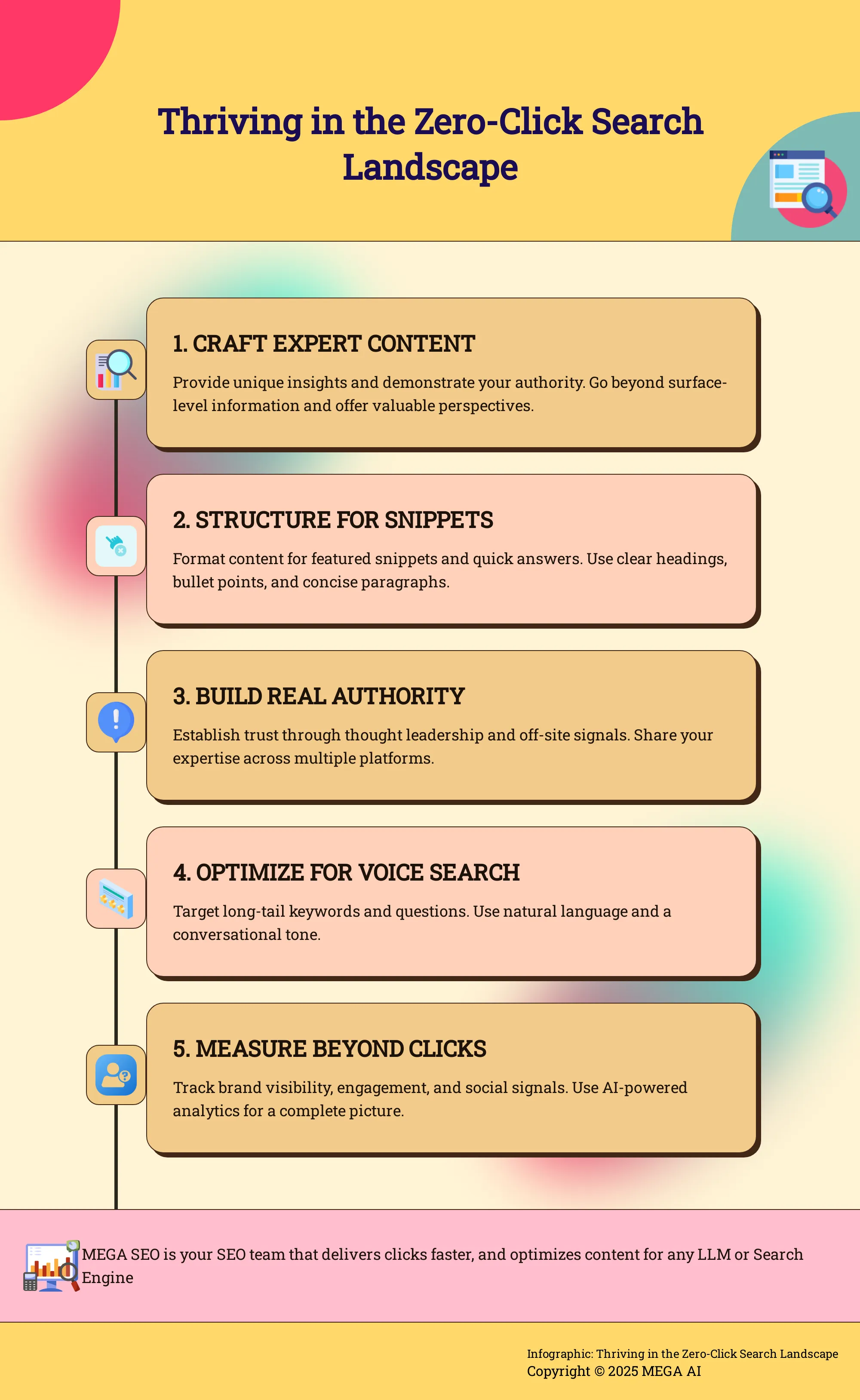
Develop Unique, Authoritative Content
One of the most effective ways to capture attention in a zero-click environment is by establishing yourself as a thought leader. This involves sharing your unique opinions, offering expert advice, and providing industry insights that demonstrate your deep knowledge. When you consistently publish content that is original and authoritative, you build credibility. This signals to both users and search engines that you are a go-to source in your field. Think about the specific expertise your small business or startup has and how you can translate that into valuable, distinct content that answers your audience's most pressing questions. This approach helps build brand recognition even if the user doesn't visit your site immediately.
Structure Content for Featured Snippets and Quick Answers
To increase your chances of appearing in AI Overviews or featured snippets, your content needs to be meticulously structured. This isn't just about publishing on your website; it's about creating deep, focused content that directly addresses user queries. Use clear headings (H2s, H3s), bullet points, numbered lists, and concise paragraphs to make information easily digestible. When your content is formatted for quick answers, search engines can more readily pull it into these prominent positions. Consider using tools that help you identify common questions in your niche so you can tailor your content to provide those direct answers effectively. This makes your information more accessible for both users and search engine crawlers.
Use Schema Markup to Your Advantage
Implementing schema markup is a smart move to help search engines, especially large language models (LLMs), better understand the context and meaning of your content. This structured data provides explicit clues about your information, making it easier for AI to process and feature. You can learn more about the types of schema available and how to implement them at Schema.org. Alongside technical optimizations like schema, always keep E-E-A-T (Experience, Expertise, Authoritativeness, Trustworthiness) at the forefront of your content strategy. Including genuine customer quotes or user testimonials can significantly enhance your content's perceived authenticity, which LLMs tend to favor, further solidifying your content's value in zero-click scenarios.
How to Build Real Authority in Your Niche
Building real authority in your niche isn't just about claiming expertise; it's about consistently demonstrating it in ways that resonate with both your audience and search algorithms. In a landscape increasingly shaped by AI and zero-click searches, establishing your brand as a trusted, go-to source is more critical than ever. This means going beyond surface-level content and focusing on strategies that build deep, recognizable authority. For startups, small businesses, and digital marketing agencies trying to make an impact, this is how you cut through the noise and truly connect with potential customers. When users and search engines alike see you as a credible leader, your visibility naturally improves, even when direct clicks aren't the primary outcome. Think of it as building a strong reputation that precedes you online. It’s about playing the long game, creating a presence that search engines, including sophisticated AI like Google's SGE or ChatGPT, recognize as genuinely valuable because your content consistently delivers. This section will explore practical steps to help you solidify your position as an authority, ensuring your insights reach your target audience effectively and your business gains the recognition it deserves. Let's explore how you can achieve this.
Build Trust with Your Expertise and Thought Leadership
Trust is the foundation of authority, and it's something you earn over time, not something you can simply ask for. One of the most effective ways to cultivate this trust is through genuine thought leadership. This involves consistently sharing your unique opinions, offering expert advice, and providing insightful commentary on industry trends. When you demonstrate a deep understanding of your space, you position your brand as a knowledgeable leader. Think about what unique perspectives or data you can bring to the table. This isn't just about repeating what others are saying; it's about adding your distinct voice and value, helping your audience solve their problems or understand complex topics clearly.
Create Connected Content Across Platforms
To truly establish authority and rank well, especially in AI overviews, your content strategy needs to extend beyond your own website. You can't just publish a blog post and expect it to make waves on its own. Focus on creating deep, focused content and then strategically distribute that content across multiple channels where your audience is active. This multi-platform presence reinforces your expertise and makes your insights more discoverable. Whether it's social media, industry forums, or video platforms, ensure your core messages are consistent yet tailored to each platform's audience. This interconnected web of content signals to search engines that your brand is a comprehensive and authoritative resource in your field.
Optimize for AI Visibility and Key Off-Site Signals
As search evolves, it's important to consider how your content appears not just in traditional search results, but also in AI-generated answers, like those from ChatGPT or Google's SGE. Optimizing for this kind of visibility means creating clear, concise, and authoritative content that directly answers common questions in your niche. Beyond your own content, off-site signals play a huge role in demonstrating authority. When other reputable websites, media outlets, or influencers link to your content or mention your brand, it acts as a powerful endorsement. Even if these mentions don't always result in direct referral traffic, these signals significantly show your reach and credibility within your industry, reinforcing your authoritative status.
Getting Ready for Voice Search and Conversational AI
The digital search landscape is constantly evolving, and one of the most significant shifts we're seeing is the rise of voice search and conversational AI. Think about how often you ask Siri, Alexa, or Google Assistant a question. This isn't just a consumer trend; it's fundamentally changing how people find information and interact with businesses online. Instead of typing short, sometimes awkward keyword phrases into a search bar, users are speaking naturally, asking full questions, and expecting immediate, relevant answers. This move towards more conversational queries has a direct impact on your SEO strategy, especially in a world increasingly characterized by zero-click searches.
Zero-click searches, where the answer is provided directly on the search engine results page (SERP) through featured snippets, knowledge panels, or AI overviews, mean users might not even need to click through to your website. While this might sound alarming, it also presents an opportunity. If your content is optimized to provide these direct answers, your brand can become the go-to source, building authority and visibility even without a click. Voice search often fuels these zero-click scenarios because users speaking to a device typically want a quick, concise answer read back to them.
Understanding and adapting to this change is crucial for startups, small businesses, and digital marketing agencies looking to maintain and grow their online presence. It's no longer enough to just rank for traditional keywords; you need to be the answer. This means focusing on how real people ask for information in their everyday language. To help you navigate this, we'll explore three key strategies: targeting the right kinds of keywords, optimizing your content for natural language, and leveraging local SEO for voice-activated devices. These steps will help you prepare your content to shine in the age of conversational AI.
Target Long-Tail Keywords and Questions
Voice searches are often longer and more specific than typed queries. Think about how you ask a question out loud versus how you might type it into a search bar. Users speaking to their devices tend to use full sentences and ask direct questions. This is where targeting long-tail keywords becomes incredibly important. These longer, more conversational phrases often indicate a higher intent to find specific information or make a purchase.
Research shows that longer queries, especially those phrased as questions starting with "how," "why," or "what," are very likely to trigger AI-generated overviews or featured snippets. To capture this traffic, you'll want to identify the exact questions your audience is asking. Tools that offer automated keyword research can be a great help here, uncovering these valuable long-tail phrases and questions that you can then build content around.
Optimize Your Content for Natural Language
As search queries become more conversational, your content needs to match that natural tone. People are using longer, more specific phrases, and the volume of question-based searches has significantly increased. This means writing for humans first, using language they actually use, is more critical than ever. Your content should directly answer the questions your audience is asking in a clear, concise, and conversational manner.
To achieve this, consider structuring parts of your content in a question-and-answer format, like an FAQ section. This not only helps users find information quickly but also makes it easier for search engines to understand and pull your content for voice search results or featured snippets. Using AI-powered content generation tools can assist in creating well-structured, natural-sounding content that resonates with both users and search algorithms, ensuring your answers are ready for these conversational queries.
Implement Local SEO for Voice-Activated Devices
Many voice searches have a local intent, such as "find a coffee shop near me" or "what are the best Italian restaurants open now." If your business serves a local clientele, optimizing for these types of queries is essential. Voice-activated devices often pull information from local listings to provide immediate answers, so your local SEO efforts directly impact your visibility in voice search.
Make sure your Google Business Profile is complete, accurate, and regularly updated. Consistent NAP (Name, Address, Phone number) information across all online directories is also crucial. Think about the specific local terms and phrases your customers might use when searching by voice and incorporate them naturally into your website content and local listings. Ensuring a strong local SEO presence helps you appear in those "near me" searches, driving foot traffic and calls directly from voice assistants.
How to Measure SEO Success When Clicks Aren't the Whole Story
When Google answers a user's query directly on the search results page, that click you were hoping for might not happen. But this doesn't mean your SEO efforts are without value. It simply means we need to broaden our definition of success and look at a wider range of signals. Clicks are just one piece of the puzzle; true SEO impact often shows up in less direct, but equally important, ways.
Think about it: if someone sees your brand consistently providing answers in featured snippets or knowledge panels, that builds recognition and trust, even without a click. The goal is to become a recognized authority, and that visibility itself is a win. We're shifting from a purely click-driven mindset to one that values overall presence and influence. Let's explore how you can effectively measure your SEO performance in this evolving landscape, ensuring you capture the full scope of your impact.
Track Brand Awareness and Online Visibility
Instead of focusing only on click-through rates, it's time to pay more attention to how your brand is appearing in new ways. Are you showing up in AI-generated answers, like those from chatbots or other AI search tools? This is an emerging frontier for visibility. You also want to look at off-site signals. When other reputable websites link to your content, it signals your authority and reach to search engines. Even if users don't click through from those specific links, that referral traffic still demonstrates your reach and authority. These indicators show that your content is being recognized and valued, which is a crucial aspect of modern SEO success.
Monitor Engagement and Social Signals
Beyond direct website traffic, look at how people are interacting with your brand online. Are you noticing an increase in branded search volume, meaning more people are searching for your company name directly? This is a strong indicator that your brand awareness efforts are paying off. Pay attention to the sentiment around your brand in social media conversations and online reviews. Positive mentions and active engagement on social platforms, like shares and comments, demonstrate that your content is resonating with your audience. These social signals act as indirect endorsements, showing that people are aware of your brand and find your information valuable, even if they aren't clicking through to your site every time.
Use AI-Powered Analytics for a Complete Performance Picture
To truly understand your SEO impact in a zero-click environment, using advanced analytics is key. AI-powered tools can help you see the bigger picture by tracking a wider array of metrics beyond simple clicks. Visibility in AI-driven search results, for instance, isn't a separate strategy but rather an outcome of excellent, comprehensive SEO. If your content is well-structured, authoritative, and answers user questions effectively, it's more likely to be picked up by these AI systems. Platforms like MEGA AI can help you optimize your content and analyze performance across various touchpoints. This gives you a more holistic view of how your SEO efforts are contributing to brand presence and authority, which are vital in today's search landscape.
Improve User Experience for Better Zero-Click Performance
Even when a search query results in a zero-click outcome, your brand still makes an impression. The information displayed in a featured snippet or knowledge panel is a touchpoint. If that snippet is helpful and clear, it reflects positively on you. And on the occasions when users do click through for more details, the experience they have on your website becomes incredibly important. A frustrating user experience can quickly negate any goodwill earned from the search results page, sending users back to Google, possibly to a competitor.
Think of it this way: if your site is slow, confusing, or difficult to use, visitors are likely to leave immediately. This is especially true for traffic that might have been on the fence about clicking in the first place. They've taken a small leap of faith by clicking; don't make them regret it. However, when your website offers a smooth, fast, and intuitive journey, even a small amount of traffic can lead to meaningful engagement or conversions. Investing in user experience isn't just about making things look pretty; it's about building trust and ensuring that every interaction, whether on the SERP or your site, reinforces your brand's value. This focus on a quality user experience is fundamental to thriving in an environment where direct clicks are becoming less common. It’s about making every potential interaction count, ensuring that your digital front door is welcoming and efficient.
Prioritize Site Speed and Mobile-Friendliness
Site speed is a make-or-break factor for user experience. If your website loads slowly or has a clunky layout, people will get frustrated and leave—often before your content even has a chance to appear. This is particularly critical on mobile devices, where users expect quick answers and seamless interactions. When that experience is fast and intuitive, even a small amount of traffic can convert effectively.
Regularly test your site speed and optimize images, code, and server response times. Ensure your design is responsive, meaning it adapts gracefully to different screen sizes. A mobile-friendly site isn't just a recommendation; it's a necessity for reaching users where they are and providing the immediate value they seek from search.
Design Clear Navigation and Information Flow
Once a user lands on your site, can they easily find what they're looking for? Clear navigation and a logical information flow are essential. You want to guide visitors intuitively through your content, making their journey as effortless as possible. If users are confused by your menu structure or can't figure out where to go next, they're likely to abandon your site.
Think about your site from a new visitor's perspective. Are your labels clear? Is there a sensible hierarchy to your pages? A well-thought-out information architecture ensures you're not giving users any reason to feel lost or to give up on finding the information they need. This helps them move forward with you, rather than clicking away in frustration.
Focus on Accessibility and Inclusive Design
Building trust with your audience means ensuring your website is usable by everyone, including people with disabilities. Focusing on accessibility and inclusive design isn't just about compliance; it's about creating a positive experience for all users and demonstrating that you value their engagement. This approach helps to solidify your brand authority and shows that you are a considerate and trustworthy source of information.
Simple steps like providing alt text for images, ensuring good color contrast, and enabling keyboard navigation can make a significant difference. When you design for accessibility, you broaden your reach and build a more inclusive online presence, which ultimately contributes to a stronger, more respected brand.
How to Use AI and Machine Learning to Sharpen Your SEO
Artificial intelligence and machine learning are no longer just concepts for the future; they are practical tools you can use right now to significantly refine your SEO efforts. By integrating these technologies, you can gain deeper insights into search trends, automate complex tasks, and ultimately create content that connects more effectively with your audience and search engines. Let's explore a few key ways you can leverage AI to give your SEO a competitive edge.
Apply Predictive Analytics to Your Content Strategy
Understanding where search trends are heading is essential for staying ahead of the curve. User search behavior is constantly evolving, with an increasing number of people typing in full questions or longer, more specific phrases. Predictive analytics, powered by AI, helps you anticipate these shifts. By analyzing vast amounts of data, these tools can forecast emerging topics and give you a clearer picture of the questions your audience will be asking. This allows you to develop a content strategy that proactively addresses user intent, creating materials that provide direct answers and solutions. Focusing on these anticipated needs means your content is relevant not just for today’s searches, but also for those on the horizon.
Automate Content Optimization and Personalization
Once visitors arrive on your site, providing them with a relevant and engaging experience is crucial for keeping them there and encouraging them to convert. AI can play a significant role in this by automating content optimization and enabling personalization at scale. AI tools can analyze user behavior, preferences, and how people interact with your site. This information can then be used to dynamically adjust and optimize your content, ensuring it meets the specific needs of different audience segments. For example, MEGA AI's Maintenance Agent can help improve the click-through rate of your existing articles and identify new information to add. This keeps your content fresh and highly relevant, which can lead to better engagement and higher conversion rates.
Use AI for Smarter Keyword Research and Trend Spotting
Traditional keyword research methods have their place, but AI can elevate your approach significantly. AI-powered tools can sift through massive datasets to identify emerging trends and uncover long-tail keywords that you might otherwise miss. They are particularly skilled at recognizing the nuances of conversational language, helping you optimize for the "how," "why," and "what" questions that are increasingly common in search queries. As Neil Patel notes in The Zero-Click Future, searches beginning with these interrogative words are more likely to yield AI-generated overviews. By focusing on these types of questions, you can enhance your chances of being featured prominently. Platforms like MEGA AI offer automated keyword research capabilities, simplifying the process of finding these valuable, intent-driven search terms for your business.
Why You Should Diversify Your Content Distribution (And How)
Relying on a single channel for your message is like putting all your eggs in one basket—a risky move in today's digital world. Platforms increasingly keep users within their own space, from Google's instant answers to social media's integrated shopping. This means being strategic about where your content appears is crucial. Diversifying your content distribution is key for steady growth and brand visibility. When you share your content across different channels and formats, you reach more people and become less vulnerable to platform changes. Let's explore how to do this effectively.
Expand Your Reach Across Different Platforms
It's common to think all online journeys start with Google, but that's not the whole story. Other platforms are also competing for user attention. As Neil Patel notes, "Google isn't the only one stealing your clicks. Instagram and TikTok want people to stay on their platforms." This means your audience discovers content on social media, video sites, and even within AI tools. To connect effectively, you need to understand where your target audience spends their time and make your content accessible there. This could mean adapting blog posts for social media or optimizing information for AI discovery.
Utilize Various Multimedia Content Formats
Text is foundational, but visuals and interactive elements can greatly enhance your message and engagement. People often process visuals faster than text, and different formats appeal to varied preferences. "Visuals aren't just helpful; they're powerful search assets," and AI tools "are increasingly citing video content as trusted sources, especially YouTube." Beyond video, consider infographics to simplify data or animations to explain processes. These formats grab attention and contribute to positive engagement signals, like reduced bounce rates, which search engines favor. Integrating diverse media into your content creation process makes your information more accessible.
Build Strategic Partnerships to Amplify Your Content
Getting your content noticed often involves more than just publishing it yourself. Building authority and reaching new audiences can be accelerated through strategic partnerships and digital public relations. Think about "contributing to or building a robust Wikipedia page...getting mentioned in high authority blogs and mainstream media." These off-site signals are strong indicators of credibility. Developing relationships with influencers or relevant publications can lead to guest posts and valuable mentions that increase your online visibility and authority. This outreach helps your content find a broader, relevant audience.
How to Keep Your SEO Strategy Effective for the Long Haul
Ensuring your SEO efforts continue to deliver results over time means staying adaptable and forward-thinking. The digital landscape doesn't sit still, and neither should your strategy. It's about building a resilient approach that can weather algorithm updates and shifts in user behavior. Think of it as tending a garden; consistent care and attention are what lead to sustained growth. By focusing on a few core principles, you can create an SEO strategy that not only works today but also sets you up for success in the years to come. This involves embracing new tools, committing to ongoing education, and knowing when to lean on technology versus human insight. Making smart choices in these areas will help you maintain momentum and keep your content visible to the right audience, no matter how search evolves.
Embrace New and Emerging Technologies
The way people search is constantly changing. We're seeing users type in much longer, more specific phrases, and AI-driven features like rich snippets and knowledge panels are becoming more prominent in search results. If your SEO strategy is still laser-focused on traditional blue links on a search engine results page (SERP), you might be missing out on some really valuable opportunities for visibility. It's time to broaden your view and consider how these newer formats can work for you. For instance, tools that help with automated keyword research can uncover these longer-tail phrases and identify opportunities to appear in AI-powered answer boxes. Staying ahead means understanding and leveraging these technological shifts to meet searchers where they are.
Commit to Continuous Learning and Adapting Your Approach
If there's one constant in SEO, it's change. What worked wonders last year might not be as effective today. That's why a commitment to continuous learning is so important. SEO isn't a "set it and forget it" task; it's an ongoing process of refinement and adaptation. Marketers are increasingly realizing that success isn't just about tracking clicks anymore. It's about understanding your brand's overall visibility and the impressions you're making. This shift requires you to stay curious, keep up with industry news, and be willing to adjust your strategies as the search landscape evolves. Being flexible and open to new methods will keep your approach fresh and effective.
Find the Right Balance Between Automation and Human Expertise
In a world where zero-click searches are common, building trust and authority is more critical than ever. This means prioritizing high-quality content and establishing your brand's credibility. Automation can be a fantastic ally here, handling repetitive tasks and improving efficiency. However, the human touch is irreplaceable when it comes to creating authentic, engaging content that truly connects with your audience. The key is to find that sweet spot where technology supports your efforts without overshadowing the genuine expertise and creativity that only humans can provide. Platforms offering end-to-end automation can free up your time to focus on strategy and crafting that compelling, human-centric content.
Related Articles
- Master Zero-Click Searches to Enhance Your SEO Strategy
- Unlocking Knowledge Panels for Better SEO Results in 2024
- Measuring E-A-T Improvements' Impact on SEO Rankings
- SEO Guide: Optimize Articles & Boost Your Rankings
- Optimizing Your Website for Voice Search: A Comprehensive SEO Guide
Frequently Asked Questions
If people aren't clicking through to my site as much, is my SEO strategy failing? Not necessarily. With zero-click searches, success looks a bit different. It's important to also consider your brand's visibility, how often your business name or information appears in search results, and whether you're establishing authority. Appearing in featured snippets or knowledge panels still builds valuable recognition, even without a direct click.
What's the best way to get my content to show up in featured snippets or quick answers? The key is to structure your content so it directly and clearly answers common questions your audience might have. Use clear headings, consider using lists or numbered steps where appropriate, and write concise paragraphs. Think about providing the most straightforward answer to a query right within your content.
How can I prepare my content for voice search without a major overhaul? A great starting point is to think about how people actually talk when they ask questions. Focus on incorporating longer, more conversational phrases and direct questions into your content. You can do this naturally within your text, or by adding an FAQ section that addresses these spoken queries.
With AI playing a bigger role in search, what should I prioritize to stay visible? Continue to focus on creating high-quality, authoritative content that genuinely helps your audience and demonstrates your expertise. Also, ensure your website offers an excellent user experience, meaning it's fast, easy to use, and mobile-friendly. AI systems tend to favor content that is trustworthy, well-structured, and provides clear value.
Beyond my website, where else should I be focusing my content efforts to build authority? Consider the other platforms where your target audience spends their time. This could include social media channels, video platforms like YouTube, or relevant industry forums. Adapting your core messages and sharing your expertise across these different channels helps you reach more people and reinforces your position as a knowledgeable source.