Ensuring your content gets heard by voice assistants is becoming a critical factor for online visibility. When users ask their devices a question, they typically get one direct answer. If your content isn't optimized to be that answer, you're effectively invisible to a growing segment of searchers who prefer voice. This isn't just about keywords; it's about natural language, clear structure, and technical signals. Many wonder how to use Yoast SEO for voice search optimization? to bridge this gap. This guide will walk you through practical techniques within Yoast SEO to make your content more discoverable and authoritative in voice search results.
Key Takeaways
- Write Like People Talk: Craft your content to answer the natural, spoken questions your audience uses, moving beyond just text-based keywords.
- Leverage Yoast SEO for Voice Readiness: Use Yoast’s readability analysis for clear, conversational text and its schema tools to help search engines accurately present your content in voice results.
- Optimize for Mobile and Evolving Trends: Ensure your website is mobile-friendly, as most voice searches happen on phones, and regularly update your voice search strategy to stay effective.
What is Voice Search and Why Does It Matter for SEO?
Voice search isn't just a futuristic concept anymore; it's a real and rapidly growing way people interact with search engines and find information online. If you're focused on SEO, understanding voice search is becoming essential. It’s changing how users seek information, and consequently, how we need to optimize our content. Let's explore what
Defining Voice Search and Its Growth
Voice search lets users speak queries into devices like smartphones or smart speakers, rather than typing. Imagine asking Siri or Google Assistant a question—that's voice search. It represents a move towards natural, conversational language, not just keyword strings.
Its growth is significant. Billions of voice searches occur monthly, showing it's not a fleeting trend. Many adults use voice search daily, and adoption will likely rise as voice assistants become more common. This growth means businesses and creators must note how people verbally seek information.
How Voice Search Changes User Behavior
Voice search changes how people phrase queries. Instead of "best pizza near me," they might ask, "Hey Google, what's the best pizza place open now near me?" Voice queries are longer, conversational, and often full questions, increasing the importance of long-tail keywords.
Users often turn to voice search for quick answers, especially when mobile or hands-free, like when cooking or driving. This convenience drives its popularity. Unlike text search's list of links, voice search usually gives a single spoken answer, often from a featured snippet. Securing this top spot is therefore vital.
Why Businesses and Creators Should Care About Voice Search
Ignoring voice search optimization means missing a large, growing group of online searchers. For businesses, particularly those aiming for younger audiences comfortable with voice tech, adapting is key for reach. If your content isn't optimized for verbal questions, you might not appear in these valuable results.
Content performing well in voice search often matches Google's featured snippets. Optimizing for snippets can significantly increase your visibility in both voice and traditional text searches. As voice search becomes more integrated into daily life, including it in your SEO strategy is crucial for staying competitive and connecting with your audience.
How Voice Search Differs from Text Search
It's easy to think of voice search as just speaking your query instead of typing it, but the differences run much deeper than that. How people use voice search fundamentally changes the nature of their queries, their expectations for immediate and concise answers, and ultimately, the kind of content that performs well. Understanding these distinctions is the first step in tailoring your SEO strategy to capture this growing audience. When you grasp how voice search operates, you can better optimize your content to be the precise answer someone is looking for when they ask their smart speaker or phone for help. This shift impacts everything from your keyword research approach to how you structure your articles and web pages. For businesses and creators aiming to connect with users through this evolving medium, recognizing these nuances isn't just helpful—it's essential for staying visible and relevant. Users expect a seamless, conversational interaction, and search engines are getting better at delivering just that. The way forward involves adapting your content to meet these new search behaviors head-on, ensuring your message is heard clearly in this audio-first landscape.
Conversational Queries vs. Keywords
One of the most significant distinctions is that voice searches are far more conversational. When people type, they often use shorthand or a string of keywords, like "best pizza near me." But when they speak to a voice assistant like Siri or Alexa, they tend to use natural, full sentences, such as, "Hey Google, what's the best pizza place that delivers near me?" This shift means your content needs to align with how people actually talk. Voice assistants are becoming increasingly sophisticated in their ability to understand complex questions and provide detailed answers, moving beyond simple keyword matching. This means thinking about the actual questions your audience might ask and phrasing your content in a way that naturally answers them.
The Length and Detail of Voice Queries
Following from their conversational nature, voice queries are typically longer and more detailed than their text-based counterparts. These are often referred to as "long-tail keywords." For instance, a typed search might be "Yoast SEO settings," while a voice search could be "How do I configure Yoast SEO settings for a new blog post?" People using voice search are often looking for quick, specific answers, especially when they're on the go. Location-based searches are particularly common, like "Where's the closest coffee shop that's open now?" The result is usually a single spoken answer, not a list of links, making it crucial for your content to be the definitive source that voice assistants choose to relay.
Understanding Intent and Context in Voice Search
With voice search, understanding the user's intent becomes even more critical. Because queries are more specific and conversational, there's often a clearer indication of what the user wants to achieve—whether it's to know something, go somewhere, do something, or buy something. For example, "How do I bake sourdough bread?" has a clear informational intent. Voice search results frequently appear as featured snippets in Google search results, which are those direct answer boxes at the top of the page. Optimizing your content to appear in these snippets can significantly increase your visibility in voice search. Context, such as the user's location or previous search history, also plays a more significant role in how voice assistants interpret queries and deliver results.
How Yoast SEO Helps with Voice Search Optimization
Yoast SEO can be a fantastic ally in making your content more voice-search-friendly. It offers several features that, when used thoughtfully, can help you align your website with how people use voice assistants to find information. Let's look at how this popular plugin can assist your voice search optimization efforts.
What is Yoast SEO? Key Features Overview
If you're using WordPress, you've likely come across Yoast SEO. It's a widely recognized plugin designed to help you improve your website's search engine optimization. Yoast SEO provides a suite of tools directly within your WordPress editor. These include content analysis to check for keyword usage and other on-page factors, along with readability checks to ensure your content is easy for your audience to understand. A key feature is its functionality for implementing schema markup. This structured data helps search engines better comprehend the context of your content, which can enhance your site's visibility in search results and make it more accessible for various search methods.
How Yoast SEO Addresses Voice Search Trends
Voice search is fundamentally changing how people interact with search engines. Queries are becoming more conversational, much like asking a friend a question. To cater to this shift, your content needs to directly provide answers. Yoast SEO assists in this area by guiding you to optimize for long-tail keywords and questions, which are typical of voice queries. Furthermore, Yoast facilitates the use of structured data (Schema.org). This is particularly important because search engines use structured data to better understand your content, and voice assistants often pull answers directly from rich snippets generated from this data, making your information more likely to be selected.
Using Yoast SEO's Readability Analysis for Voice
The clarity of your content is paramount for voice search, and this is where Yoast SEO's readability analysis really helps. Voice assistants tend to favor content that is clear, concise, and easy to understand when delivering answers to user queries. Yoast's tool evaluates various aspects of your writing, such as sentence length, paragraph structure, and the use of transition words. By paying attention to these suggestions, you can refine your content to be more conversational and straightforward. This not only makes it more suitable for voice search delivery but also more appealing to users who prefer scannable, easy-to-digest information on any device.
Optimize Content for Voice Search with Yoast SEO: Best Practices
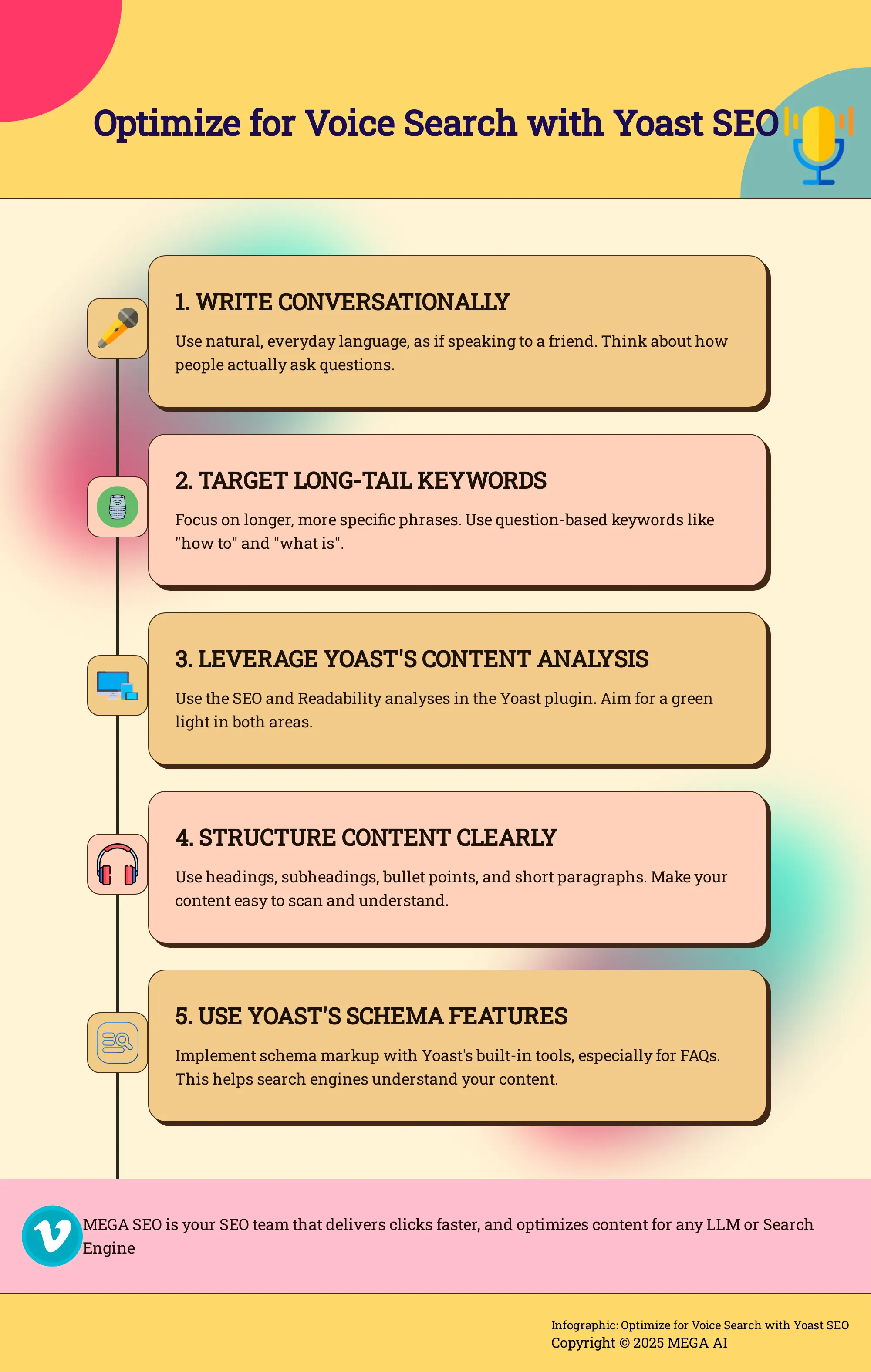
Optimizing for voice search is key, and Yoast SEO has tools to help. Focus on natural language, user intent, and clear structure to make your content accessible to voice searchers. Here are some best practices.
Write in Natural, Conversational Language
Voice searches mimic natural speech, so your content should answer questions conversationally. Focus on human-sounding phrases, not just keywords. Yoast SEO’s readability analysis helps craft clear, accessible language, perfect for voice search and engaging for all readers.
Use Long-Tail Keywords and Questions
Voice queries are often longer, specific questions. To capture this, focus on long-tail keywords – those conversational phrases. Brainstorm common questions and build content around direct answers. Yoast SEO helps optimize for these, and you can refine your strategy with automated keyword research.
Leverage Yoast SEO's Content Analysis
Yoast SEO’s content analysis, in the Yoast box, is a powerful ally. Its SEO, Readability, and Schema tabs help optimize for voice. The Readability check guides you to create clear, digestible content, which voice assistants prefer. This analysis ensures your content is user-friendly.
Optimize Meta Descriptions and Titles for Voice
While answers often come from body content, page titles and meta descriptions still matter. A clear page title is a key ranking factor. For voice, consider how titles sound aloud – keep them concise. Yoast SEO simplifies editing these to clearly signal your page's topic.
Improve Content Readability and Structure
Well-structured, easy-to-read content performs better in voice search. Use clear headings and short paragraphs or lists. This makes content scannable and easier for voice assistants to process. Yoast’s readability checks encourage simple, direct writing. For existing articles, you can also re-optimize content for improved structure.
Use the Yoast SEO FAQ Block for Common Questions
Directly target voice queries with FAQ sections. Yoast SEO’s FAQ block automatically adds Schema markup, helping answers appear in rich snippets and voice results. Provide concise answers to common questions, making it easy for search engines to identify your content as relevant. AI-powered content generation can also assist here.
Use Structured Data and Schema Markup for Voice Search
Beyond crafting conversational content, the technical side of your site plays a big part in voice search. Using structured data and schema markup helps search engines make sense of your content for voice queries. The good news is that Yoast SEO simplifies how you can implement these important elements, making your content more discoverable by voice assistants.
Why Structured Data is Key for Voice Search
Structured data provides clear labels for your website's content, essentially telling search engines what each piece of information is about. This clarity is vital for voice search. When someone asks their smart speaker a question, the search engine needs to rapidly identify the most accurate answer. Cloudways notes, "[u]sing structured data (like schema markup) helps search engines understand your website better." This deeper comprehension allows for more precise voice responses. Properly implementing voice search optimization through structured data means your site is better equipped to meet the demands of voice-activated assistants.
Implement Schema Markup with Yoast SEO
Schema markup is a specific vocabulary of structured data you add to your website. It helps search engines classify your content effectively, whether it's an article, local business listing, or product. While this might sound technical, Yoast SEO simplifies the process. Search Engine Journal explains, you can "[a]dd schema markup: Use structured data to help search engines understand your content better. Yoast SEO makes it easy to implement this markup." The plugin handles many technical aspects by automatically adding relevant schema, offering practical tips for businesses to improve voice search visibility without needing deep coding knowledge.
How Rich Snippets Help Voice Search
A significant advantage of using structured data is earning rich snippets in search results. These are enhanced listings displaying extra details like review ratings or event dates. For voice search, this is impactful. Voice assistants often pull answers directly from these prominent SERP features. According to insights from SEO case studies, "[v]oice search results often come from SERP features like featured snippets, knowledge graphs, and answer boxes." Securing a featured snippet, the direct answer box at the top, is highly beneficial as these are frequently the exact answers voice assistants read aloud.
Yoast SEO's Features for Structured Data
Yoast SEO excels at simplifying structured data implementation. The plugin automatically adds a comprehensive layer of schema markup, covering your organization's details, articles, and FAQ pages (if you use its FAQ block). This built-in functionality means you don't need coding expertise. As Hurrdat Marketing highlights, "Yoast SEO helps you implement structured data easily, ensuring your content is optimized for search engines." This ease of use is a considerable advantage. By leveraging these features, you enhance how search engines interpret your content, significantly improving your visibility in voice search results.
Why Mobile Optimization is Crucial for Voice Search
Making your site mobile-friendly is a big deal for voice search. Most people using voice search are on their phones, so if your site isn’t easy to use on mobile, you’re missing opportunities. Let’s look at why a good mobile experience is so important for voice search and how Yoast SEO can assist.
The Link Between Mobile and Voice Search
Voice search is growing fast—think over a billion searches every month. People love it because it’s convenient and hands-free. A lot of these voice searches happen on smartphones, especially when people are busy or need quick information. This natural fit between mobile ease and voice commands makes smartphones the go-to for voice search. Understanding this link is the first step.
Yoast SEO's Mobile Optimization Tools
Since many voice searches come from smartphones, your website absolutely needs to be mobile-friendly. Yoast SEO helps lay a good foundation for mobile performance. While it’s not a dedicated mobile optimization tool, its features guide you toward a site that works well on any device. Yoast encourages a clean site structure and organized content, which are important for responsive design. Following its advice on readability and technical SEO naturally makes your site more mobile-friendly and better for voice search.
Improve Page Speed and Mobile Responsiveness
How fast your website loads really affects user experience, particularly on mobile. Slow sites can turn users away and hurt your voice search rankings because voice assistants prefer quick answers. Yoast SEO encourages a clear content structure, which can help make your pages lighter and faster. A responsive design, meaning your site adjusts to different screen sizes, is also essential. This ensures your content is easy to access, whether someone is on a desktop or using voice search on their phone. If you need more help with speed, specialized SEO services can offer advanced optimization.
Optimize for Local Voice Searches with Yoast SEO
People often use voice search to find local businesses—think queries like "find a coffee shop near me." These searches usually happen on mobile when users need quick, local info. Yoast SEO’s local SEO features are really helpful for this. You can use Yoast SEO to correctly manage your business's name, address, and phone number (NAP) and set up local business schema. This helps search engines identify your business for these local voice searches, which is key for attracting customers ready to visit.
Measure and Adapt Your Voice Search Strategy
Voice search optimization is an ongoing process of measuring, learning, and adapting. As technology and user behavior change, so should your strategy. Tools like Yoast SEO can help with foundational content quality, crucial for voice visibility. The aim is to make your content easily discoverable by voice assistants.
Track Voice Search Performance with Yoast SEO
To see how well your voice search efforts are performing, you'll want to monitor a few key indicators. Consider how often your content appears as a featured snippet for your target questions – this is valuable real estate for voice answers. Also, observe your visibility for conversational, long-tail queries and any increase in direct search traffic, which might suggest users are finding you through specific voice commands. For local businesses, tracking phone call conversions can be particularly insightful, as many voice searches are for local information. While Yoast SEO helps optimize content that can lead to these results, you'll use analytics tools to track these specific metrics and understand your progress effectively.
Adapt to AI and Natural Language Processing
Voice search is fundamentally shaped by progress in Artificial Intelligence (AI) and Natural Language Processing (NLP). With a significant number of adults using voice search daily, it's clear that businesses need to align their SEO strategies with these technologies. This means creating content that reflects how people actually speak. Think about the conversational phrases and full questions your audience might use, rather than just isolated keywords. Understanding how users naturally phrase their queries allows you to craft content that AI-powered voice assistants can easily comprehend and present as relevant answers. This adaptation is important for remaining competitive in the evolving search landscape.
Continuously Optimize with Yoast SEO Updates
The field of voice search optimization is still growing, and surprisingly, many businesses, including prominent e-commerce brands, haven't fully optimized their sites for voice assistants like Alexa or Google Home. This presents a solid opportunity for those willing to be proactive. Regularly updating your SEO practices is essential. Tools like Yoast SEO frequently update their features to align with current SEO trends, which can help you maintain a strong foundation for your content. By continuously refining your approach and using the guidance from SEO tools, you can position your business effectively in this changing environment and capture traffic that others might overlook.
Prepare Your Content for Future Voice Search Trends
As voice search technology keeps advancing, the best practices for optimizing your content will also change. It's wise to learn from common SEO missteps and adapt your strategies to anticipate what's coming next. For instance, the way voice assistants interpret and deliver information is constantly being improved, making nuanced understanding more critical. By preparing your content for these future trends, you ensure your website remains a relevant and visible source in voice search results. This might involve paying closer attention to semantic search, user intent, and the overall clarity and conciseness of your answers. Staying informed and flexible is your best course of action.
Get Started: Optimize for Voice Search with Yoast SEO
Ready to make your content more voice-search-friendly with Yoast SEO? Let's explore some quick wins, a step-by-step guide, and how to integrate voice search into your broader SEO strategy.
Key Yoast SEO Features for Quick Wins
Yoast SEO offers features for an immediate edge in voice search optimization. Its core strength is helping you optimize your content for readability and SEO. Voice assistants prefer easy-to-understand, logically structured content, similar to human conversation, so clear writing gets picked up.
Another quick win is Yoast SEO's support for structured data. Using structured data, like schema markup, helps search engines better understand your content's context. This is crucial for voice search, enabling precise answers to spoken queries. Yoast SEO simplifies adding certain schema types, making content more accessible to voice assistants.
A Step-by-Step Guide to Voice Search Optimization
Optimizing for voice search involves key practices. First, focus on creating content that answers common questions with natural, conversational language. Think about the "who, what, when, where, why, and how" questions your audience might ask, and use long-tail keywords—longer phrases people actually say.
Next, aim for featured snippets. You can optimize for featured snippets by structuring your content clearly with distinct headings and concise answers (around 30 words). Yoast SEO's readability analysis helps keep sentences short. Lastly, consider an FAQ page. This lets you answer frequently asked questions conversationally, directly addressing voice queries. Yoast SEO’s FAQ block simplifies adding structured FAQ data.
Integrate Voice Search into Your SEO Strategy
Voice search is an integral part of modern SEO, not a separate task. It's vital for reaching younger demographics comfortable with voice technology, and understanding user intent is key, as voice searchers often have specific needs.
Ultimately, a successful voice search strategy requires a strong foundation in traditional SEO, plus specific voice optimizations. Your efforts in quality content, link building, and technical SEO health remain crucial. Voice search optimization then adds layers like conversational language, question-based queries, and structured data, making your great content more accessible to voice assistants.
Related Articles
- Optimizing Your Website for Voice Search: A Comprehensive SEO Guide - MEGA SEO | Blog
- How to Optimize Your Website for Voice Search in 2024
- Emerging SEO Trends: Harnessing AI and Voice Search for Your Blog - MEGA SEO | Blog
- Master Majestic for Voice Search Optimization
- How to Rank Higher with Google Hummingbird in 2024
Frequently Asked Questions
My content is already optimized for typed searches. Why do I need to think differently for voice search? When people use voice search, they tend to speak in full, natural sentences, much like they're asking a friend a question. This is quite different from the shorter keyword phrases we often type. So, your content needs to directly address these conversational queries, providing clear answers to the specific questions your audience is likely to ask aloud.
I keep hearing about "structured data" for voice search. What is it, and how does Yoast SEO help with it? Think of structured data as a way to give search engines extra information about your content, helping them understand what it's about more clearly. Yoast SEO makes it easier to add this type of data, known as schema markup, to your site. This is particularly helpful for things like FAQ pages, as it allows voice assistants to more easily find and relay your answers.
If voice assistants usually give just one spoken answer, what's the best way to increase my chances of being that answer? To become that single, go-to answer, focus on providing very clear and concise responses to common questions your audience might have. Structuring your content with clear headings and using features like Yoast SEO's FAQ block can be very effective. This helps search engines identify your content as a strong candidate for featured snippets, which are often the source for voice search answers.
Most voice searches happen on phones. How does making my site mobile-friendly specifically help with voice search? Since so many voice searches occur on mobile devices, a smooth mobile experience is essential. Users performing voice searches are often looking for quick information, so your site needs to load fast and be easy to use on a smaller screen. Yoast SEO encourages good site structure and readability, which contribute to a better mobile experience and, consequently, better voice search performance.
Is optimizing for voice search something I can set up once and forget, or does it require ongoing attention? Optimizing for voice search is definitely an ongoing effort. The way people use voice search and the technology behind it are always evolving. It's a good practice to regularly review how your content is performing, see what kinds of questions users are asking, and adapt your strategy to keep your information relevant and discoverable.