
Understanding the intricate connections within your website can feel like trying to solve a complex puzzle. Many critical structural elements that impact your SEO and user experience aren't immediately obvious. This is where website structure visualization comes into play, offering a clear view of how your pages are interconnected and how information flows. We'll explore how using a tool like Screaming Frog allows you to effectively "see" your site's architecture, much like an X-ray reveals the skeleton. This visual approach helps uncover hidden issues, from deep-seated content to inefficient linking, enabling you to make targeted improvements for better search engine performance and a more satisfying experience for your visitors.
Key Takeaways
- Map Your Website's Pathways: Visualizing your site structure gives you a clear view of how search engines navigate your content and how visitors experience your site, which is essential for improving both SEO and usability.
- Use Visual Tools to Spot Issues: Leverage tools like Screaming Frog to generate visual representations of your site, making it easier to identify and fix problems like overly deep pages, broken links, or inefficient navigation that impact SEO and user experience.
- Maintain a Healthy Structure Through Regular Checks: Regularly analyze your website's architecture to maintain clear navigation and logical organization, ensuring both people and search engines can efficiently find and understand your key content.
What is Website Structure Visualization?
Think of your website's structure as its internal road map. It’s how all your pages—your homepage, blog posts, product pages, contact information—are organized and connected to each other. Website structure visualization, then, is simply creating a visual map of this road map. It allows you to see, often in a diagram or graph format, how search engine crawlers, like Googlebot, explore your site and how users might journey through your content.
Why is this visual so important? A clear and logical website structure is fundamental for good search engine optimization (SEO). When search engines can easily find, crawl, and understand your content, they are more likely to index it effectively and rank it higher in search results. Visualization helps you step back and see your site from a bird's-eye view. You can spot how information flows, identify potential roadblocks for crawlers (like pages that are too many clicks away from the homepage), and see how link equity might be distributed. It’s about understanding the pathways through your site—where they lead, where they might get complicated, and if there are any dead ends or orphaned pages. This understanding is the first step to making sure both users and search engines have a smooth journey through your website, which ultimately helps your site perform better and improves the overall user experience.
Why Your Website Structure Impacts SEO
Think of your website's structure as the blueprint for a house. If that blueprint is clear and logical, search engine bots—the "builders" in this scenario—can easily find every room, which is your content, and understand its purpose. This clarity is essential because it directly influences how well search engines can crawl and index your site. When search engines can efficiently access and make sense of your content, your chances of ranking higher in search results and gaining more visibility improve quite a bit. A disorganized or confusing structure, on the other hand, can mean important pages are overlooked or not given the importance they deserve by search engines.
But website structure is more than just making things look neat for bots; it’s fundamental to your site’s overall functionality and, crucially, the experience you offer your visitors. Imagine trying to find something in a large store with no signs and items placed randomly—it would be quite frustrating. That’s what a poorly structured website can feel like to a user. A well-organized site helps people find what they're looking for quickly and intuitively. This often leads to lower bounce rates, more time spent on your site, and better conversion rates. This positive user experience also sends strong signals to search engines that your site is valuable and user-friendly. Essentially, a solid website structure forms the backbone of your SEO strategy and user satisfaction, making it a critical area for any startup, small business, or digital marketing agency aiming for online success. It’s the foundation upon which all your content and other SEO efforts are built.
Understanding Crawl Depth's Role
Crawl depth refers to how many clicks it takes to get from your homepage to any other specific page on your site. Ideally, you want search engines like Google to be able to reach every important page—every page you want indexed and to rank well—within a maximum of three, or perhaps four, clicks from your homepage. If your key content is buried too deep, requiring many clicks to access, search engines might consider those pages less important or even struggle to find and index them regularly.
This concept of crawl depth is especially important for larger websites, such as e-commerce sites that often have a vast number of product pages and categories. Maintaining a shallow crawl depth helps ensure that link equity—the value passed from one page to another through internal links—flows more effectively throughout your site. It also allows search engine bots to discover new or updated content more efficiently. Keeping an eye on your site's crawl depth is a key part of maintaining a healthy and effective website structure.
How Search Engines Crawl Your Website
Your website's structure essentially lays out the pathways for search engine bots, like Googlebot, when they visit your site. It dictates where they enter, which pages they can access, the routes they take to discover your content, and how straightforward or complicated this entire exploration process becomes for them. A logical, well-linked structure acts like a clear map, guiding these bots smoothly through all your valuable content.
If the structure is convoluted, perhaps with broken links, orphan pages (pages with no internal links pointing to them), or overly complex URL paths, it can significantly hinder a search engine's ability to crawl your site effectively. This means some of your important content might not get indexed at all, or it might take much longer to appear in search results. Tools like Screaming Frog are very helpful here, as they allow you to see your site much like a bot does, helping you identify these potential roadblocks before they cause major issues.
First Steps: Using Screaming Frog for Structure Analysis
Getting started with website structure analysis might seem a bit daunting, but with the right tools, it becomes much more manageable. Screaming Frog is a fantastic resource for this, acting like a detective for your website by crawling through its pages just like a search engine would. This process helps you see your site from a technical perspective, uncovering how well it’s organized and if there are any hidden roadblocks for search engines or your visitors.
Think of it as getting a blueprint of your website. You wouldn't build a house without one, right? Similarly, understanding your site's structure is fundamental to its online success. By using a tool like Screaming Frog, you can get a detailed overview, which is the first step in identifying areas for improvement. This isn't just about finding errors; it's about understanding the pathways through your site, how your content is linked, and how easily search engines can index your pages. This initial analysis lays the groundwork for a more effective SEO strategy, helping you make informed decisions rather than guessing what might be wrong. Many businesses find that a clear site structure also improves how users interact with their content, leading to a better overall experience.
Key Screaming Frog Features for Visualization
Screaming Frog is a well-known website crawler that offers a detailed analysis of a site's structure. It's particularly good at helping you "see" your website's architecture, which is incredibly important for Search Engine Optimisation. The tool can identify common issues like broken links, which can frustrate users and hurt your SEO, or find duplicate content that might confuse search engines.
It also helps you spot complex URL structures that could be making it harder for search engines to crawl and understand your content. When you run a crawl, Screaming Frog gathers a wealth of data, and its visualization features allow you to interpret this data more intuitively. Instead of just looking at spreadsheets, you can see graphical representations of your site's layout, making it easier to pinpoint problem areas and understand the relationships between different parts of your website. This visual approach helps you analyze your site structure more effectively.
How to Set Up Your Screaming Frog Crawl
Conducting your first crawl with Screaming Frog is an essential step that will allow you to analyze your site in detail and uncover any underlying SEO issues that need attention. To begin, you'll need to download and install the Screaming Frog SEO Spider software. Once it's running, you simply enter your website's URL into the input field at the top and hit 'Start'. The tool will then begin to crawl your website, following links from page to page, just as a search engine bot would.
As it crawls, you'll see data populating in real-time across various tabs. For a basic structure analysis, you'll want to let the crawl complete, especially for smaller sites. For very large sites, you might start by analyzing a specific subfolder. This initial crawl provides the raw data you'll use for visualization and further analysis. Following these actionable steps will help you evaluate and improve your website structure, discovering common pitfalls and how to avoid them.
How to Visualize Your Website Structure with Screaming Frog
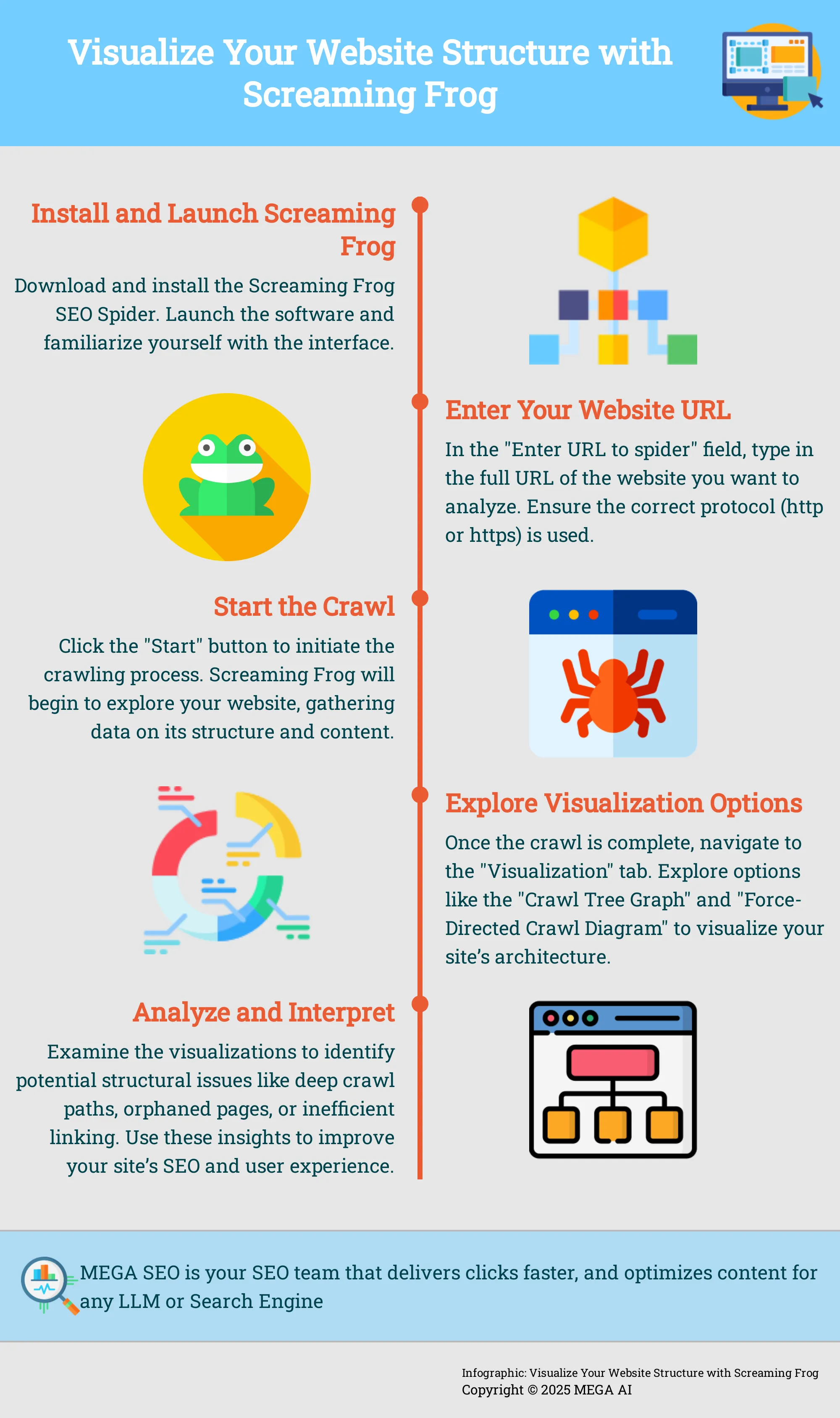
Understanding your website's structure goes beyond simply knowing what pages exist. It’s about clearly seeing how these pages connect, how link equity flows, and ultimately, how search engines perceive this intricate architecture. This is where a tool like Screaming Frog becomes invaluable. As a powerful desktop program, Screaming Frog crawls websites much like a search engine bot, meticulously gathering data. This raw data can then be transformed into various insightful visualizations. Think of these as X-rays for your website, revealing the underlying skeleton and highlighting potential fractures or misalignments that are often invisible when looking at spreadsheets or simple URL lists.
For example, a visualization might starkly show that your most critical service pages are buried many clicks deep from the homepage, diminishing their chances of ranking well. Or, it could uncover that your internal linking strategy isn't effectively distributing authority to the pages that matter most. Visualizing your site structure helps diagnose a range of issues impacting crawlability, indexability, user experience, and overall SEO performance. It allows you to step back, observe the holistic architecture, and more easily pinpoint bottlenecks, orphaned pages, or inefficient pathways. This makes it simpler to develop targeted strategies for SEO improvement. We'll explore a few specific ways Screaming Frog facilitates this, turning complex datasets into clear, actionable visual insights. This process is fundamental for anyone serious about optimizing their online presence, whether you're a startup founder, a digital marketer managing multiple clients, or part of an in-house SEO team.
Use the Crawl Tree Graph for Insights
Screaming Frog’s Crawl Tree Graph offers a clear, hierarchical visual of your website's structure. Imagine it as a family tree for your site, showing parent-child relationships between pages, starting from your homepage and branching out. This perspective is incredibly useful for quickly spotting structural inefficiencies. "The Crawl Tree Graph in Screaming Frog provides a visual representation of your website's structure, allowing you to identify broken links, duplicate content, and complex URL structures that may hinder your SEO efforts," as noted by Linkscout. By examining this graph, you can see how link equity might be flowing (or getting stuck) and identify pages that are too many clicks away from the homepage, which can negatively impact their ability to be crawled and ranked effectively.
Explore the 3D Force-Directed Crawl Diagram
For a more dynamic and arguably more intuitive view, Screaming Frog offers the 3D force-directed crawl diagram. This isn't just a static chart; it’s an interactive visualization. According to one YouTube tutorial on Screaming Frog visualization, "this visualization simulates how Googlebot may perceive your website, illustrating the interconnectedness of your pages and how they relate to one another." Nodes represent pages, and the lines (edges) between them represent links. The 'force-directed' aspect means pages with more links might appear more central or larger, giving you a sense of their importance within the site's architecture. It’s a fantastic way to understand clusters of content, identify isolated pages, and generally get a feel for the overall link landscape of your site from a bot's perspective.
Customize Visualizations: What to Look For
Screaming Frog provides a wealth of data, and its visualizations can reflect this complexity. While it's tempting to try and fix every little anomaly you spot, it's more effective to focus your efforts. As UsePattern highlights, "it’s crucial to focus on the most critical issues first. Prioritize addressing significant problems rather than attempting to fix every minor detail at once." When customizing or interpreting these visualizations, look for major structural flaws: Are key landing pages deeply buried? Are there large sections of the site poorly linked to the rest? Are there unexpected clusters or isolated groups of pages? Use the visualizations to identify these high-impact areas first, creating a targeted plan rather than getting lost in minor details.
Leverage Journey Mapping for Clarity
Visualizing your site structure isn't just an SEO exercise; it’s also about understanding and improving the user journey. How easily can a visitor find what they need? Are the pathways through your site logical and intuitive? A well-organized website structure directly contributes to a positive user experience. As AppLabX points out, "A well-organized website structure not only enhances user experience but also aids search engines in crawling and indexing your content effectively." By using Screaming Frog’s visualizations to map out these journeys, you can identify confusing navigation paths, dead ends, or areas where users might get lost. Clarifying these pathways makes your site more user-friendly and simultaneously helps search engines understand and index your content more efficiently, which can lead to better visibility.
Optimize Crawl Depth: Improve Your SEO
Once you've visualized your website's structure using a tool like Screaming Frog, the next step is to use those insights to make meaningful improvements. A key area to focus on is crawl depth. Think of crawl depth as the number of clicks it takes to get from your homepage to any other specific page on your site. If important pages are buried too deep, search engines might struggle to find and index them efficiently, which can impact your rankings. This is especially critical for larger websites, like e-commerce stores with thousands of product pages. As Olga Zarr mentions in her YouTube tutorial, "for bigger websites, especially e-commerce websites, this is really, really important. Not to mess this up because even with a relatively small e-commerce website, let say 10,000 URLs, or 30,000 URLs, which isn't that much, you can get into serious trouble." Optimizing your crawl depth ensures that search engine bots can easily discover and understand your content, giving your most valuable pages a better chance to shine in search results. Let's look at how you can tackle this.
Identify and Fix Paths That Are Too Deep
The visualizations you generate with Screaming Frog are your best friends here. They'll clearly show you which pages require too many clicks to reach. When you spot these overly deep paths, your goal is to bring those pages closer to the homepage. This might involve rethinking your category structure or improving your internal linking strategy from more prominent pages. Prioritize fixing paths to your most important content first – these are the pages you definitely want search engines to find and index regularly. By making these high-value pages more accessible, you signal their importance to search engines and improve their chances of being crawled more frequently.
Strategies to Create a Flatter Site Structure
A flatter site structure means most of your content is accessible within a few clicks from the homepage. This isn't just good for search engines; it also improves the user experience. As one guide on analyzing website structure notes, "A clear and logical website structure helps search engines crawl and index your content... A well-structured website ensures that users can easily [find information on] your site, while search engines can efficiently understand and prioritize your content." To achieve this, consider adding links to important deeper pages from your main navigation or from relevant, high-authority pages. You might also look at consolidating some categories or subcategories if your hierarchy has become too complex. The aim is to make it straightforward for both users and search engine bots to find what they're looking for without unnecessary clicks.
Eliminate Redundant Links and Content "Rabbit Holes"
During your structural analysis, you'll likely uncover links that are redundant, broken, or lead to "rabbit holes"—paths that take users or bots to low-value content or confusing navigational loops. Tools like Screaming Frog are excellent for this, as they can help identify broken links, duplicate content, and overly complex URL structures. Pruning these unnecessary links is crucial. Each link passes some authority, and you want that authority flowing to your important pages, not getting lost in dead ends or diluted across unimportant ones. Regularly cleaning up your internal links ensures that search engine crawlers can efficiently move through your site, focusing their resources on your most valuable content and improving overall site health. This also helps users by preventing them from getting stuck or frustrated.
Uncover and Resolve Structural Website Issues
Once you have a visual map of your website's structure, you're in a great position to spot and fix issues that could be holding back your site's performance. Think of visualizations as your X-ray goggles for your website; they help you see beneath the surface to the underlying framework. Screaming Frog is a powerful tool that identifies broken links, duplicate content, and complex URL structures that may hinder your SEO efforts. By laying out your site’s architecture visually, you can more easily pinpoint these problem areas that might otherwise go unnoticed in spreadsheets or lists of URLs.
Addressing these structural problems is fundamental to improving how search engines understand and rank your site. It also directly contributes to a much better experience for your visitors. When your site is well-organized, users can find what they need more easily, reducing frustration and bounce rates. Simultaneously, search engine crawlers can efficiently index your content, ensuring that your important pages are discoverable and properly valued. This means your key service pages, product listings, or informative blog posts are more likely to be seen by the right audience. In the following sections, we'll explore some common structural issues that visualizations help uncover and discuss how to prioritize and manage these fixes effectively.
Common Problems Visualizations Help You Find
Visualizing your site structure brings several common SEO headaches to the forefront. For instance, Screaming Frog’s visualizations can quickly highlight areas with broken links (404 errors) or redirect chains that can frustrate users and dilute link equity. You might also spot clusters of duplicate content, which can confuse search engines about which page to rank. Complex URL structures, another common culprit, become much easier to identify when you see them mapped out.
When it comes to Search Engine Optimisation, website architecture is extremely important. Visualizations can also reveal issues with indexability. For example, you might find important pages that are unintentionally set to 'noindex'. It's also common practice to noindex category pages, and seeing this visually helps confirm if your current setup aligns with your SEO strategy or if an error has occurred.
How to Prioritize Pages for Structural Fixes
Screaming Frog will likely present you with a list of potential SEO issues, and it can feel a bit overwhelming at first. The key is to prioritize your fixes based on their potential impact. Not all structural problems carry the same weight. For example, a broken link on a high-traffic page or an issue preventing your most important service pages from being indexed should take precedence over minor issues on less critical pages.
As Screaming Frog identifies various SEO issues on your website, it’s essential to prioritize fixes based on their impact. Start by assessing which problems affect your most valuable content or have the broadest negative impact on user experience and crawlability. Consider factors like page authority, traffic volume, and conversion potential when deciding where to focus your efforts first. A systematic approach ensures you’re channeling your resources effectively.
Manage URL Parameters and Pagination Effectively
URL parameters and pagination are common features, especially on e-commerce sites or blogs with lots of content, but they can create structural challenges if not handled correctly. Parameters used for tracking or filtering can sometimes generate many URLs with duplicate or very similar content, which can dilute your SEO value. Similarly, poorly implemented pagination can make it hard for search engines to find and index older content, or it can create very deep click paths.
To manage this, it's wise to avoid separate mobile URLs. Instead, use a responsive design with a single URL structure for both desktop and mobile users. For parameters, utilize tools like Google Search Console to inform Google how to handle them, and consider using canonical tags to point to the preferred version of a page. For pagination, ensure you’re using rel="next" and rel="prev" attributes correctly, or explore "view all" pages or infinite scroll options, keeping SEO best practices in mind.
Improve Your Website Architecture for SEO Success
A well-planned website architecture is much more than just a tidy arrangement of your pages; it's a core part of your SEO strategy and how users experience your site. You can think of it as the blueprint for your online home. This blueprint determines how easily search engines can find, understand, and ultimately rank your content. Just as importantly, it shapes how people interact with your site. A logical and intuitive structure means your most important content is easy to find, and valuable link equity flows smoothly throughout your pages, signaling what's important to search engines. When people can use your site without a hitch and find what they need quickly, they're more likely to stay longer, explore more, and take action. This kind of positive engagement sends strong signals to search engines, helping to build your site's authority.
On the flip side, if you overlook your site's architecture, it can lead to a number of problems. You might find yourself with orphaned pages that search engines can't discover, poor crawlability that gets in the way of indexing, diluted link equity, and a confusing user journey that leaves visitors frustrated and more likely to leave. All these issues can really hold back your search rankings and overall online performance. Taking the time to carefully plan, build, and refine your website's structure is an investment that truly pays off with better visibility, happier users, and more conversions. Modern platforms that offer end-to-end SEO automation can make the complex job of analyzing and improving your site architecture much simpler. This helps you maintain a strong foundation that supports your wider digital marketing goals and ensures your content effectively reaches the people you want to connect with.
Strengthen Your Internal Linking
Internal links are like the hallways connecting different rooms (pages) in your website. They're really important for a couple of big reasons. First, they help search engines figure out how your content pieces relate to each other and spread "link equity" (that's ranking power) across your site. As one guide on analyzing website structure puts it, "A clear and logical website structure helps search engines crawl and index your content, boosting rankings and visibility." Second, they lead your visitors to other useful information, which makes their visit better and keeps them interested. To make your internal linking stronger, use descriptive anchor text, link to your most important cornerstone content, and be sure to fix any broken internal links you find. Checking on your internal links regularly can really pay off.
Streamline Site Navigation for Users and Bots
Your website's navigation—how people get around your site—should feel natural for your visitors and be easy for search engine crawlers to follow. If people can't quickly find what they need, they're probably going to leave. In the same way, if search engine bots have a tough time crawling your site, your pages might not get indexed correctly. Tools like Screaming Frog are incredibly helpful for this. As Linkscout's guide to website structure notes, "By using Screaming Frog, you can gain an in-depth understanding of your site's structure. It identifies broken links, duplicate content, and complex URL structures that may hinder your SEO efforts." Try to create a simple, clear menu, use breadcrumbs if your site is on the larger side, and make sure your mobile navigation is just as easy to use.
Optimize Your Site's Hierarchy
Your site's hierarchy is basically how your content is organized, usually starting with broad topics that then branch out into more specific subcategories and individual pages. A well-organized hierarchy makes your site much easier for both people and search engines to understand. It clearly shows what's important and how different pieces of content connect. As a step-by-step guide on this topic highlights, "Website structure plays a critical role in search engine optimization (SEO), influencing how search engines crawl, index, and rank your content." To get your hierarchy in good shape, plan out your categories in a way that makes sense, keep your URLs clean and matched to the structure, and make sure your important pages aren't hidden too many clicks deep.
Tackle Structural Challenges on Large Websites
Large websites, with their sheer volume of pages, often bring unique structural hurdles. Keeping everything organized isn't just about a neat appearance; it's fundamental to how search engines discover and value your content, and how users find what they need. As your site expands, maintaining a clear path for both users and search engine crawlers can become quite a task. Using tools like Screaming Frog to visualize your site's architecture helps you identify and address these complexities directly. This ensures your valuable content doesn't get lost in a digital maze, which is a crucial step before you consider automating SEO tasks or scaling your content creation efforts.
A well-thought-out structure means users can find information easily, and search engines can efficiently crawl and index your pages. When a site becomes too sprawling or disorganized, it can lead to issues like orphaned pages (pages with no internal links pointing to them), excessive click depth to reach important content, or confusing navigation pathways. These problems can negatively impact your SEO performance and frustrate your visitors. By visualizing the structure, you gain a bird's-eye view, making it much simpler to spot these problem areas and plan effective solutions. This foundational work paves the way for more advanced optimization strategies.
Manage Complex Site Hierarchies
For any large website, a clear and logical hierarchy is the bedrock of its success. Think of it as the well-organized shelving system in a vast library. As one source aptly puts it, "website structure is more than just aesthetics—it’s the backbone of your site’s functionality, user experience, and search engine optimization (SEO) success." When you have a substantial amount of content, ensuring that pages are organized intuitively helps search engines efficiently crawl and index your site. Screaming Frog visualizations can quickly reveal if your hierarchy has become too convoluted, perhaps with important pages buried too deep or logical connections between related content missing. Addressing these issues makes it easier for search engines to understand the relationships between your pages, which ultimately improves your site's visibility.
Optimize E-commerce Platform Structures
E-commerce sites, in particular, can quickly become structurally complex. With potentially tens of thousands of product pages, category pages, and various filter combinations, the number of unique URLs can grow exponentially. It's been noted that "for larger websites, particularly e-commerce platforms, this is extremely important. Not to mess this up because even with a relatively small e-commerce website, say 10,000 URLs or 30,000 URLs... you can get into serious trouble." Screaming Frog’s visualization tools are invaluable here. They help you spot issues like excessive crawl depth for key product pages or confusing navigation paths that could hinder both users trying to make a purchase and search engine bots attempting to index your inventory. A well-structured e-commerce site ensures your products are easily discoverable.
Handle Dynamic Content Structure
Dynamic content, which is often generated based on user interactions, applied filters, or URL parameters, can create significant structural headaches if not managed with care. These dynamic URLs can sometimes lead to what are known as "rabbit holes" – these might be infinite loops or a vast number of low-value pages that dilute your SEO efforts and consume your crawl budget inefficiently. Screaming Frog allows you to "see whether you have those loopholes... which you should get rid of, to basically make it easier for Google to one, crawl the website and two, to understand the relations between specific pages and which pages really count." By visualizing how your dynamic content is linked and accessed, you can identify areas for improvement, such as implementing canonical tags correctly or refining how your site handles URL parameters. This ensures search engines can focus their attention on your most important, static content.
Implement and Monitor Your Structural Improvements
Okay, you've used Screaming Frog to get a clear picture of your website's structure, and you've identified areas that could be working harder for your SEO. That's a fantastic start. But insight without action is like a map without a journey. The next crucial phase is to translate these findings into tangible improvements and then to keep a watchful eye to ensure your site stays in top shape. Making changes to your site structure can feel a bit daunting, especially if you've uncovered quite a few things to address. The key is to approach it systematically. It’s not about overhauling everything overnight but about making strategic, incremental changes that collectively make a big difference.
Once you've made those improvements, the job isn't quite done. Websites are dynamic; new content gets added, old content gets updated, and search engine algorithms evolve. This means regular check-ins are essential to maintain a healthy, SEO-friendly website structure. Think of it as regular maintenance for your car – it keeps everything running smoothly and prevents bigger problems down the line. This ongoing process ensures your site continues to be easily crawlable, user-friendly, and optimized for search performance. Developing a consistent SEO strategy that includes structural reviews will serve you well in the long run.
Develop Your Action Plan Using Screaming Frog Data
Screaming Frog hands you a wealth of data, and your first step is to turn that data into a clear, actionable roadmap. Screaming Frog is a well-known website crawler that offers a detailed analysis of a site's structure. It identifies broken links, duplicate content, and complex URL structures that may hinder your SEO efforts. Start by exporting the specific reports that highlight the issues you've prioritized, like crawl depth, broken internal links (404s), or redirect chains.
Once you have this information, it's time to organize it. A simple spreadsheet can work wonders here. List the identified issues, the specific URLs affected, and the proposed fix. When using Screaming Frog for on-page SEO, it’s essential to prioritize fixes based on their impact. For instance, fixing broken links on high-authority pages or reducing the crawl depth of important product pages might take precedence over minor issues. This methodical approach ensures you tackle the most critical problems first, making your efforts more effective.
Conduct Regular Audits for Lasting Optimization
After implementing your initial fixes, it's tempting to consider the job done. However, maintaining an optimized website structure is an ongoing commitment. Regular audits are your best friend here, helping you catch new issues before they significantly impact your SEO. Websites evolve, content changes, and technical glitches can occur, so periodic check-ups are vital.
Schedule time – perhaps monthly or quarterly, depending on your site's size and dynamism – to re-crawl your website with Screaming Frog. Compare these new reports with your baseline to spot any regressions or new problems. It's also wise to stay informed about common SEO pitfalls and how to avoid them, as this knowledge can guide your audits. Remember, not every flagged item is a critical error; for example, it's common practice to noindex category pages, and thus this is a valid reason for a non-indexable status in some cases. Regular audits help you understand these nuances and ensure your site structure continuously supports your SEO goals. For ongoing content optimization, tools like MEGA AI's Maintenance Agent can also help by identifying opportunities to update existing articles, complementing your structural reviews.
Balance SEO Goals and User Experience in Site Structure
Getting your website structure right involves a careful balance. You want to create clear pathways for people to easily find what they need, and at the same time, you need a logical organization so search engines can understand and prioritize your content. When user experience and SEO goals work in harmony within your site's architecture, you set the stage for better engagement and improved visibility in search results.
Create an Architecture That's Easy for Users
Think about your website as a physical store; customers should be able to find different aisles and products without feeling lost. A well-structured website ensures that users can move through your site intuitively, making their visit smooth and productive. When people can find information easily, they are more likely to stay longer and interact with your content.
It's important to identify and fix elements that might cause frustration. For instance, Screaming Frog can help you pinpoint issues like broken links or overly complex URL structures. Addressing these problems helps ensure your site offers a positive experience, encouraging users to explore rather than leave due to confusion.
Align Site Structure with Your Most Important Content
While a user-friendly design is crucial, your site's structure also plays a significant role in how search engines perceive your content. A clear and logical framework helps search engines crawl and index your pages more effectively. This efficiency can contribute to better rankings and increased visibility for your website.
Consider your website structure the backbone of its functionality and search performance. By organizing your site thoughtfully, you essentially highlight your most important pages for search engines. This strategic arrangement helps them understand the hierarchy of your content, which is a fundamental aspect of a successful SEO strategy.
Frequently Asked Questions
I'm just starting out with website structure. What's the most important first step if I suspect there's an issue? The best way to begin is by getting a clear picture of your current setup. Using a tool like Screaming Frog to perform an initial crawl of your website will give you a baseline understanding. This initial analysis helps you see how your pages are connected and where potential problems might lie, so you're not just guessing.
Screaming Frog has flagged several potential problems. How do I decide what to tackle first? It's easy to feel a bit swamped by all the data. The key is to focus on what will make the biggest difference. Look for issues that affect your most important pages—like your main service pages or top-performing content—or problems that broadly impact how easily users and search engines can use your site, such as broken links on key pages or pages buried too many clicks deep.
My website has thousands of pages. Are there unique structural aspects I should focus on for such a large site? Absolutely. For larger websites, maintaining a clear hierarchy and ensuring important content isn't too many clicks from the homepage becomes even more critical. You'll also want to pay close attention to how e-commerce categories or dynamic content filters are structured, as these can sometimes create confusing paths or duplicate content issues if not managed carefully.
Is checking my website's structure something I do once, or should it be a regular part of my routine? Think of it like a regular health check-up for your website. While you'll do a deep dive initially, it's wise to conduct periodic audits. Websites change as you add new content or make updates, so revisiting your structure, perhaps quarterly, helps you catch new issues early and ensure everything stays well-organized and efficient for both users and search engines.
Beyond helping with search rankings, how does a good website structure benefit the actual people visiting my site? A well-organized website makes it much easier for your visitors to find what they're looking for quickly and without frustration. When navigation is intuitive and information flows logically, people are more likely to have a positive experience, stay longer on your site, and explore more of what you offer. This ultimately helps them achieve their goals on your site more effectively.