In the complex world of search engine optimization, it's easy to get caught up in technical details and keyword strategies. However, one of the most influential factors in how your site performs is often right in front of you: your website visitors. Every action they take, from the pages they view to the time they spend reading, contributes to a larger picture that search engines analyze. These interactions are direct measures of your content's effectiveness. So, what are the benefits of user engagement increase for better indexation?? They are critical, as strong engagement tells search engines your content is valuable, making it more likely to be indexed thoroughly and ranked favorably. This guide will show you how to leverage user behavior to enhance your SEO.
Key Takeaways
- Enhance Your User Experience to Improve Indexation: Making your site easy to use and providing valuable content tells search engines your pages are worth showing, which helps them get found more easily.
- Track Engagement Metrics to Guide Your SEO Efforts: Paying attention to how users interact with your site, like how long they stay or what they click, gives you clear clues on what to improve for better search visibility.
- Improve User Interaction with Strategic Content and Design: Developing content people find valuable and making your site simple to explore are practical ways to keep users engaged, signaling to search engines that your site is a quality resource.
What is User Engagement and How Does It Affect Indexation?
Understanding user engagement is key for any effective digital strategy. It’s not just about attracting visitors; it’s about what they do once they arrive. When users actively interact with your content, it sends positive signals to both you and search engines. This interaction can significantly influence how your site is perceived and, as a result, how it gets indexed. Better indexation means your content is more likely to be found by your target audience, leading to increased visibility. Let's explore what user engagement truly means and its connection to search engine indexation.
What is user engagement?
User engagement describes how people interact with your website, app, or other digital content. It’s a measure of their active involvement – are they clicking links, reading articles, or watching videos? Are they completing desired actions, like signing up for a newsletter or making a purchase? High user engagement signals that people find value in what you offer and are actively participating. This means your content resonates, and visitors are genuinely connecting with it, not just passively browsing.
Key user engagement metrics
Several key metrics help us understand user interaction. Bounce rate is the percentage of visitors leaving after viewing only one page; a high rate might indicate mismatched expectations. Page views count how many pages an average visitor sees, showing their interest in exploring. Session duration measures the time spent on your site per visit. We also look at total activity (overall interactions) and specific user interactions like clicks or downloads. Finally, conversions, such as a purchase or signup, are powerful metrics demonstrating content effectiveness.
How user engagement connects to search engine indexation
How does this interaction affect your site's indexation by search engines like Google? The connection is direct. When users spend time on your site, view multiple pages, and interact with content, it signals to search engines that your site offers value. High user engagement suggests your content is relevant and effectively answers user queries. Search engines prioritize quality results, and these engagement signals are strong indicators. Consequently, a site with strong user engagement is more likely to be indexed thoroughly and favorably, improving visibility in search results and leading to more organic traffic.
How Does User Engagement Influence Search Engines?
Search engines are constantly working to understand which web pages offer the most value to users. They don't just look at keywords; they also pay close attention to how people interact with your content. This user engagement provides strong clues about your site's quality and relevance. When users have a good experience, search engines take note, and this can significantly influence how easily your content gets found. Understanding this connection is key to improving your site's visibility.
User signals that affect indexation
Google and other search engines use various engagement signals to gauge the overall quality of your webpages. These signals include factors directly impacting the user experience, such as how quickly your page loads and whether the content is genuinely useful or informative. If visitors arrive and quickly find what they're looking for, or spend time absorbing your material, these are positive indicators. Search engines interpret these behaviors as signs of a quality page, making it more likely to be indexed favorably and shown to a wider audience. Essentially, happy users can lead to better visibility in search results.
How user behavior determines content quality
The way users behave on your website offers direct insights into your content's quality and relevance. If visitors land on a page and leave almost immediately (a high bounce rate), it might suggest the content didn't meet their expectations or the user experience was poor. Conversely, if users spend considerable time on a page, click through to other articles, or share your content, these actions signal that they find it valuable. By tracking user engagement, businesses can pinpoint problem areas and make targeted improvements. This not only leads to better customer satisfaction but also helps search engines recognize your site as a high-quality resource.
How engagement metrics become indexation priorities
Improving user engagement isn't a set-it-and-forget-it task; it requires ongoing effort and careful data analysis. As you consistently refine your website to provide a better experience, search engines are more likely to reward your efforts with improved indexation. Effective indexing is crucial because it directly impacts your site's visibility in search results, leading to more organic traffic. When users are engaged, they send positive signals that search algorithms pick up on, prioritizing your content. This creates a beneficial cycle: enhanced engagement leads to better search rankings, which in turn drives more users to your site, further reinforcing its quality. Different strategies will work for different sites, so continuous testing and adaptation are key.
Key User Engagement Metrics for Better Indexation
When we talk about how users interact with your website, it's not just a general feeling; search engines pay close attention to specific user behaviors. These actions, measured by key metrics, send strong signals that can significantly influence how well your pages are discovered and ranked. Understanding these metrics is the first step to improving them, which in turn can lead to better search engine indexation. Think of these metrics as the language search engines use to understand if visitors are finding what they need on your site. If users are sticking around, exploring your pages, and interacting with your content, it tells search engines your site is a valuable resource. Let's explore some of the most critical user engagement metrics that can help your content get noticed and properly indexed. By focusing on these areas, you can create a better experience for your visitors and send all the right signals to search engines, ultimately helping your digital marketing efforts succeed.
Bounce rate: What it means
Bounce rate is defined as "the percentage of visitors who leave a website after viewing only one page." Imagine someone clicks on your page from a search result, takes a quick look, and then immediately hits the back button—that's a bounce. A consistently high bounce rate can be a concern for search engines. It might suggest that your page isn't delivering on the promise of its search listing, or perhaps the user experience has room for improvement. Maybe the content isn't quite what they were looking for, the page loads a bit too slowly, or it's difficult to read on their device. Reducing your bounce rate often involves taking steps to improve the user experience to ensure visitors find what they expect and feel encouraged to explore further.
Time on page and session duration
How long visitors spend on your page and on your site overall are strong indicators of engagement. "Session duration" specifically refers to "the length of time a visitor spends on a website or app." If people are spending more time with your content, it generally means they find it valuable, interesting, and relevant to their needs. This extended engagement signals to search engines that your site offers quality information. Think of it this way: if a visitor quickly skims and leaves, it might suggest they didn't find what they were hoping for. But if they stay to read, watch a video, or interact with elements on the page, it’s a positive vote for your content's ability to captivate an audience.
Page views and site exploration depth
Page views measure "the number of pages viewed during a visit." When a user lands on your site and then proceeds to click through to other pages, it’s a great sign of positive engagement. A higher number of page views per session indicates that users are curious and motivated to explore more of what you offer. This deeper exploration suggests your site has a wealth of relevant information and is well-structured enough to encourage discovery. Search engines may interpret this as a sign of authority and comprehensive coverage of a topic, which can positively influence how your site is indexed. Good internal linking strategies are key to encouraging users to view more pages and discover more of your valuable content.
User interactions: Clicks, shares, and comments
Beyond just viewing content, specific actions taken by users—like clicking on calls-to-action, internal links, sharing your content on social media, or leaving comments—are powerful engagement signals. These interactions show that users are not just passively consuming information but are actively involved and finding value in what you provide. Each click, share, or comment can enhance your content's visibility and reinforce its relevance and quality in the eyes of search engines. Encouraging these interactions, perhaps by asking questions at the end of your posts or making social sharing buttons prominent, can contribute to better indexation and overall SEO performance.
Benefits of Better Indexation Through User Engagement
When you make an effort to understand how people interact with your website, you're doing much more than just aiming for a pleasant user experience. You're actively sending important signals to search engines like Google, indicating that your site offers real value. Think about it: when visitors are genuinely engaged—meaning they spend considerable time on your pages, click through to other articles, watch videos, or leave comments—they're essentially telling search engines, 'Hey, this content is good and relevant.' These positive user signals are incredibly important for how well search engines understand and index your content.
Effective indexation is the bedrock of SEO; if search engines can't find or understand your pages, they can't show them to users. So, when strong user engagement improves this indexation process, it sets off a chain reaction of benefits. Your site becomes more visible, attracts more of the right kind of visitors, and ultimately, this can lead to significant business growth. It’s a smart way to build a sustainable online presence. Many businesses find that focusing on user experience not only pleases their audience but also aligns perfectly with what search engines want to see. This synergy can transform your website's performance, making your content work harder for you. Let's explore some of the key advantages that come from this powerful connection between engaged users and better search engine indexation.
More organic traffic
A clear advantage of better indexation, driven by user engagement, is a noticeable rise in your organic traffic. When search engines can efficiently crawl and interpret your content, largely because users are interacting positively with it, your site naturally becomes more visible in search results. Strong engagement signals—like visitors spending more time on your pages and exploring various sections—tell search engines that your content is valuable. This means search engines are more likely to show your pages to people searching for related information. The result is more visitors finding your site organically, which is fantastic because this traffic comes without the direct cost associated with paid ads. Ensuring effective indexing, as experts point out, can substantially increase your site's visibility and lead to higher traffic.
Higher click-through rates (CTRs)
Improved indexation, supported by strong user engagement, also helps increase your click-through rates (CTRs) from search results. When your content is well-indexed and ranks favorably, it naturally gets seen by more people. Proper indexation is key because it directly impacts your website's search visibility, making it simpler for users to discover your content through search engines. If visitors engage deeply with your content after clicking through, search engines take this as a sign that your page is a great match for that search query. This can further improve your rankings for those specific terms, putting your site in front of even more potential visitors and making it more likely they'll choose your link, especially if your titles and descriptions are compelling.
Better conversion rates and user retention
When people are actively interacting with your content, it clearly shows they find it useful and relevant. This increased interest often leads to better conversion rates, meaning more visitors take the actions you want them to, like buying something or signing up for updates. A positive and engaging experience also makes visitors more likely to come back. It's important to address any barriers to user engagement, especially since studies show many customers can drop off quickly if their initial experience isn't compelling. By prioritizing engagement, you not only draw people in but also foster loyalty. This leads to better user retention and a more consistent customer base, which is vital for steady growth.
Long-term SEO benefits and lower marketing costs
Putting effort into user engagement is a smart long-term strategy. While some SEO methods might give you a quick lift, creating genuine interaction builds a lasting foundation for SEO success. Improving user engagement isn't a one-time task; it's an ongoing process that involves consistent effort and analyzing data to see what works best for your audience. This dedication creates a beneficial cycle: engaged users signal quality, search engines improve your indexation and rankings, and you get more organic traffic. This steady organic growth can lessen your need for paid ads over time, helping to lower your marketing expenses while building a stronger online presence. Tools like MEGA AI's SEO platform can assist with the continuous optimization needed to maintain this momentum.
Strategies to Increase User Engagement for Better Indexation
Improving user engagement is a powerful way to signal to search engines that your website offers value, which can positively influence how your pages are indexed. When visitors spend more time on your site, interact with your content, and explore multiple pages, these actions suggest that your content truly meets their needs. Search engines interpret these positive signals as indicators of quality and relevance, which can lead to better rankings and more consistent indexation. The following strategies are designed to help you create a more engaging experience for your users, ultimately supporting your site's SEO performance. Think of these as foundational elements for building a website that both users and search engines will appreciate. Each approach focuses on a different aspect of the user journey, from the content they consume to how they interact with your site's design and functionality. By implementing these tactics, you can foster a more active and interested audience, laying the groundwork for improved visibility in search results. MEGA AI's SEO tools can also assist in automating and refining many of these processes, helping you focus on strategy while the platform handles some of the detailed work involved in content optimization and technical upkeep.
Create compelling, relevant content
The heart of user engagement lies in the quality and relevance of your content. If it doesn't resonate with your audience or meet their needs, they're unlikely to stick around. As Involve.me points out, "High user engagement is super important for businesses," not just for clicks, but for building strong relationships that lead to better outcomes. Start by deeply understanding your target audience: their pain points, questions, and what information they actively seek.
Create content that directly addresses these needs, whether it's informative blog posts, helpful guides, or engaging videos. Ensure your writing is clear and easy to digest, using headings and visuals. Tools like MEGA AI can assist with content generation, helping you produce optimized articles tailored to search intent and designed to keep users reading.
Optimize site structure and navigation
A well-organized website makes it easy for users to find what they're looking for, improving their experience and encouraging exploration. If users can move through your site effortlessly, they're likely to stay longer and view more pages—positive signals for search engines. According to Webflow, "improving your site's UX is crucial for standing out."
Consider a logical content hierarchy. Your main navigation should be clear, reflecting key site sections. Implement internal linking strategically to guide users to related content and help search crawlers understand page relationships. Features like breadcrumbs also aid orientation. A clear site structure benefits users and helps search engines efficiently crawl and index your content.
Improve site speed and mobile responsiveness
Page load speed and mobile functionality are critical for user engagement. Users expect fast loading; delays often lead to them leaving. A site difficult to use on a smartphone will also frustrate many. As GeeksforGeeks notes, a user experience that performs well requires optimization on all fronts, including performance.
Focus on optimizing images, minifying code, and using browser caching to improve load times. Ensure your website has a responsive design that adapts to various screen sizes. Regularly test your site's speed and mobile-friendliness. MEGA AI's technical SEO capabilities can help identify and address issues slowing your site or affecting mobile performance, ensuring a smoother visitor experience.
Add interactive elements and personalization
Making your website more interactive can transform a passive browsing experience into an active one, significantly increasing engagement. When users can interact with your content, they tend to spend more time on your site and form a stronger connection with your brand. The Manifest suggests to "add Interactive Content. The more someone wants to interact with your web interface, the better their experience."
Consider incorporating elements like quizzes, polls, calculators, or interactive infographics that provide value or entertainment. Personalized content recommendations, based on a user's previous behavior or stated preferences, can also make the experience more relevant and engaging. Even simple features like well-designed call-to-action buttons or comment sections can encourage interaction. These elements not only keep users on your site longer but can also provide valuable data about their preferences and interests.
Measure and Track Engagement and Indexation
Understanding how users interact with your website and how search engines perceive your content is crucial for sustainable SEO success. It’s not enough to simply implement engagement strategies; you also need a solid plan for measuring their impact and tracking changes in your site's indexation. This continuous loop of action, measurement, and refinement allows you to see what’s working, identify areas for improvement, and ultimately demonstrate the value of your efforts. By consistently monitoring key metrics, you can make data-driven decisions that enhance user experience and strengthen your site's standing with search engines.
Think of this process like tending a garden. You plant the seeds of great content and user-friendly design, but ongoing care is essential for growth. You need to regularly check how your audience is responding—are they finding what they need, or are they leaving quickly? Similarly, you must monitor how search engines are 'seeing' and categorizing your site. Are your pages being found and indexed correctly, or are there technical roadblocks hindering your visibility? This proactive approach helps you adapt to changes, address issues before they escalate, and maintain a strong online presence. For businesses looking to optimize their SEO efforts, diligently measuring engagement and indexation isn't just good practice; it's a fundamental component of a winning strategy. It’s about creating a responsive system where user insights directly inform your SEO tactics, leading to more effective and resilient results.
Tools to monitor user engagement
To get a clear view of how users interact with your site, you'll want to use a combination of tools. Web analytics platforms are a great starting point for tracking essential metrics like unique users, page views, time spent on page, and bounce rates. For a deeper understanding of the user journey, consider tools that offer heatmaps, session recordings, and scroll depth analysis. These can visually show you where users click, how far they scroll, and where they might be encountering friction.
Many platforms also allow you to gather user feedback directly through surveys or polls, providing qualitative insights to complement your quantitative data. By combining these different data sources, you can build a comprehensive picture of user behavior and identify specific areas to refine for a better experience. Remember, the goal is to understand what your users find valuable and what might be causing them to leave.
Assess search engine indexation changes
Keeping an eye on how search engines are indexing your site is just as important as tracking user engagement. Your site's indexation status directly affects its visibility in search results. If search engines can't effectively crawl and index your pages, users won't be able to find your content. Tools like Google Search Console are indispensable here, offering insights into which pages are indexed, any crawling errors, and how Google perceives your site.
Regularly checking these reports helps you spot and address indexation issues promptly. For instance, you might discover that important pages aren't being indexed or that there are technical problems preventing crawlers from accessing your content. Understanding and optimizing the indexing process is fundamental to improving your site’s visibility and ensuring your valuable content reaches your target audience.
Link engagement improvements to SEO results
The connection between user engagement and SEO performance is significant. When users spend more time on your site, view multiple pages, and interact with your content, these actions send positive signals to search engines. These engagement signals help search engines determine the quality and relevance of your webpages. Essentially, if users find your content valuable, search engines are more likely to rank it higher.
Improved user engagement often leads to tangible SEO benefits such as better customer retention, higher conversion rates, and increased brand loyalty. For example, a lower bounce rate and longer time on page can indicate that users are finding what they need, which can contribute to improved rankings over time. By focusing on creating a positive user experience, you're also laying a strong foundation for better search engine performance.
Overcome Common User Engagement Challenges
Working to improve user engagement is a worthwhile goal, but it often presents its own set of difficulties. Many businesses find themselves wondering why visitors aren't staying on their site or interacting with content as much as they'd hoped. These aren't minor issues; they can significantly shape how search engines perceive your website's authority and relevance, which directly impacts your indexation and overall search performance. If users frequently leave your site quickly, or if your content doesn't quite connect, search engines might see these as indicators that your site isn't delivering the value users expect.
Recognizing these common challenges is the first step toward making effective improvements. Problems such as high bounce rates, content that falls short in relevance or quality, and a user experience that isn't well-aligned with SEO efforts are frequent hurdles. The encouraging news is that these obstacles are solvable. By identifying the specific areas needing attention, you can implement focused strategies to create a more inviting experience for your visitors. This not only helps users find what they need but also sends positive signals to search engines. Utilizing tools that offer automated SEO analysis can also be very beneficial in pinpointing areas for improvement, allowing you to direct your efforts efficiently. Let's look at some practical ways to address these common engagement challenges.
Address high bounce rates
A high bounce rate typically means visitors land on your page and then leave quickly without taking any further action. As Userlane notes, "if a website's homepage has a high 'bounce rate' (people leaving quickly), it suggests the design or content needs improvement." To tackle this, first ensure your page content accurately reflects the promise of your meta descriptions and aligns with the intent behind the keywords you're targeting. Slow loading times are another significant factor, so optimize your images and use browser caching to help your pages load faster.
Make your value proposition immediately clear when someone arrives on your page. Is it obvious what the page is about and what the visitor stands to gain? Improving readability with clear headings, concise paragraphs, and appealing visuals can also encourage users to stay longer and explore what you have to offer.
Improve content relevance and quality
Content that genuinely connects with your audience is fundamental to strong user engagement. When your content is relevant and high-quality, visitors are more inclined to spend time on your site and interact with it. According to Userpilot, "Engaged users are more likely to complete desired actions, such as making a purchase, subscribing to a newsletter, or filling out a form." This connection encourages repeat visits and helps build loyalty.
To enhance your content, begin by thoroughly understanding your audience's needs and questions through careful keyword research. Develop comprehensive pieces that provide real value and effectively answer those questions. It's also important to regularly update your content to keep it accurate, fresh, and in line with current user interests. Using clear language and incorporating engaging elements like images, videos, and infographics can make your content more accessible and attractive.
Balance user experience (UX) with SEO
A smooth user experience (UX) and effective SEO should complement each other, not compete. While SEO helps attract visitors to your site, UX ensures they have a positive and productive experience once they arrive. As Webflow points out, "Improving your site's UX is crucial for standing out...align customer preferences with your business goals for a more engaging and efficient website." This balance is vital for keeping users engaged and signaling quality to search engines.
Concentrate on creating an intuitive site structure and clear navigation so users can easily find what they need. Ensure your website is fully responsive and loads quickly on all devices, particularly mobile phones. Clear calls-to-action guide users toward your intended goals, while technical SEO elements like fast load times and mobile-friendliness directly contribute to a better user experience.
What's Next for User Engagement and Indexation?
The digital landscape is always shifting, and how users interact with your content plays a huge part in how search engines find and rank you. Looking ahead, a few key areas are shaping the future of user engagement and its direct impact on your site's indexation. Staying informed about these trends will help you keep your SEO strategy effective.
New trends in user behavior analysis
Understanding how people interact with your website is more crucial than ever. It's not just about getting visitors; it's about keeping them interested. When you track engagement, you can spot where users might be getting stuck or losing interest, which directly improves their experience. This focus on the user journey helps build a stronger connection with your audience. Businesses often face challenges in keeping users engaged, but analyzing behavior patterns uncovers valuable insights to refine your approach and make your site more welcoming.
AI and machine learning for engagement
Artificial intelligence and machine learning are becoming game-changers for understanding and improving user engagement. These technologies process vast data to uncover user behavior patterns. Think about delivering hyper-personalized experiences where content and offers are tailored to individual preferences. This level of customization can make a real difference. Using the right tools, some powered by AI, simplifies measuring engagement and making continuous improvements. For instance, platforms like MEGA AI can help optimize existing content by analyzing user interaction signals, ensuring your material stays fresh and relevant.
Prepare for changing search engine algorithms
Search engine algorithms are constantly evolving, with an increasing focus on user satisfaction. How users engage with your site directly influences its visibility. Ensuring your website is effectively indexed is fundamental; strong user engagement signals to search engines that your content is valuable. It's important to adopt a balanced SEO strategy that prioritizes high-quality content meeting user intent, not just technical fixes. As algorithms change, a consistent focus on providing a great user experience will help your site maintain and improve its rankings.
Integrate User Engagement into Your SEO Strategy
Integrating user engagement into your SEO strategy means looking beyond just keywords and backlinks. It’s about crafting an online experience that genuinely connects with your visitors, encouraging them to stay longer, interact more, and find real value in what you offer. When users actively engage with your content—by reading thoroughly, clicking through to other pages, or sharing what they find—it sends strong positive signals to search engines. These signals suggest that your content is not only relevant to their queries but also high quality and trustworthy, which can significantly influence how your pages are indexed and ranked.
Think of it as a partnership: you provide excellent content and a smooth user experience, and your users, through their actions, vouch for your site's quality to search engines. This approach shifts the focus from purely technical SEO to a more holistic view where user satisfaction becomes a direct contributor to your search visibility. By prioritizing how users interact with your site, you're building a more sustainable foundation for SEO success.
Align engagement tactics with SEO goals
When you focus on user engagement, it’s important that your tactics directly support your broader SEO objectives. Strong user engagement is a clear indicator that your marketing is effective. Conversely, low engagement might suggest that you're reaching the wrong audience or that your content isn't meeting user needs. This connection is critical because positive engagement often leads to better business results.
To ensure your efforts are effective, each engagement tactic should have a clear purpose tied to your search goals. For example, if you aim to rank for "easy home gardening tips," your content should encourage interactions that demonstrate user satisfaction, such as watching an embedded video tutorial or downloading a planting calendar. These actions signal to search engines that your page is a valuable resource for that query. Tools like MEGA AI can help you refine your SEO strategy by identifying content gaps and opportunities to better align with user intent, thereby improving engagement.
Balance short-term wins with long-term engagement
It can be tempting to chase quick engagement boosts, like a social media post that drives a temporary surge in traffic. While these can offer momentary advantages, lasting SEO success is built on fostering long-term engagement. This means creating content and experiences that consistently provide value, encouraging users to return to your site over time.
Focusing on genuine, sustained engagement is vital because retaining existing users is generally more cost-effective and beneficial for business growth than constantly trying to acquire new ones. For instance, a comprehensive FAQ page that genuinely helps users solve their problems might not generate sudden viral interest. However, it will consistently engage users seeking answers, which can reduce bounce rates and signal content quality to search engines over the long haul. This steady engagement builds a more robust foundation for your SEO performance than fleeting spikes in attention.
Continuously improve for lasting indexation benefits
Enhancing user engagement for better search engine indexation is an ongoing process, not a one-time task. It starts with a clear strategy and involves consistently optimizing all the digital touchpoints where users interact with your brand. Understanding user engagement is key because it helps businesses refine their digital products and marketing efforts. By tracking engagement metrics, you can identify areas that need improvement and make informed changes to enhance the overall user experience.
This continuous cycle of analysis, adjustment, and improvement is crucial for achieving lasting SEO benefits. For example, if you notice that users frequently leave a particular article at a certain point, it’s a sign to revisit that content. It might need clearer headings, more engaging visuals, or additional information to hold their attention. Platforms like MEGA AI offer features such as the Maintenance Agent, which can help identify opportunities to update existing articles and add relevant content, ensuring your material remains fresh, valuable, and engaging for both users and search engines.
Related Articles
- How to Rank Higher After Google's Helpful Content Update
- Optimizing Content to Match User Search Intent and Improve Engagement Metrics: Advanced On-Page SEO Techniques - MEGA SEO | Blog
- SEO Trends 2024: What’s Changing and How to Stay Ahead
- Create Engaging SEO Content to Boost User Experience
- Smart User Redirection Strategies to Drive Engagement
Frequently Asked Questions
Why should I focus on user engagement if my website already gets visitors? Getting visitors is a great start, but user engagement tells search engines how valuable those visitors find your content. When people stay on your site, explore different pages, and interact with what you offer, it signals that your content is high quality and relevant. Search engines prefer to show valuable content, so strong engagement can lead to better, more thorough indexation, meaning your pages are more likely to be found by the right audience.
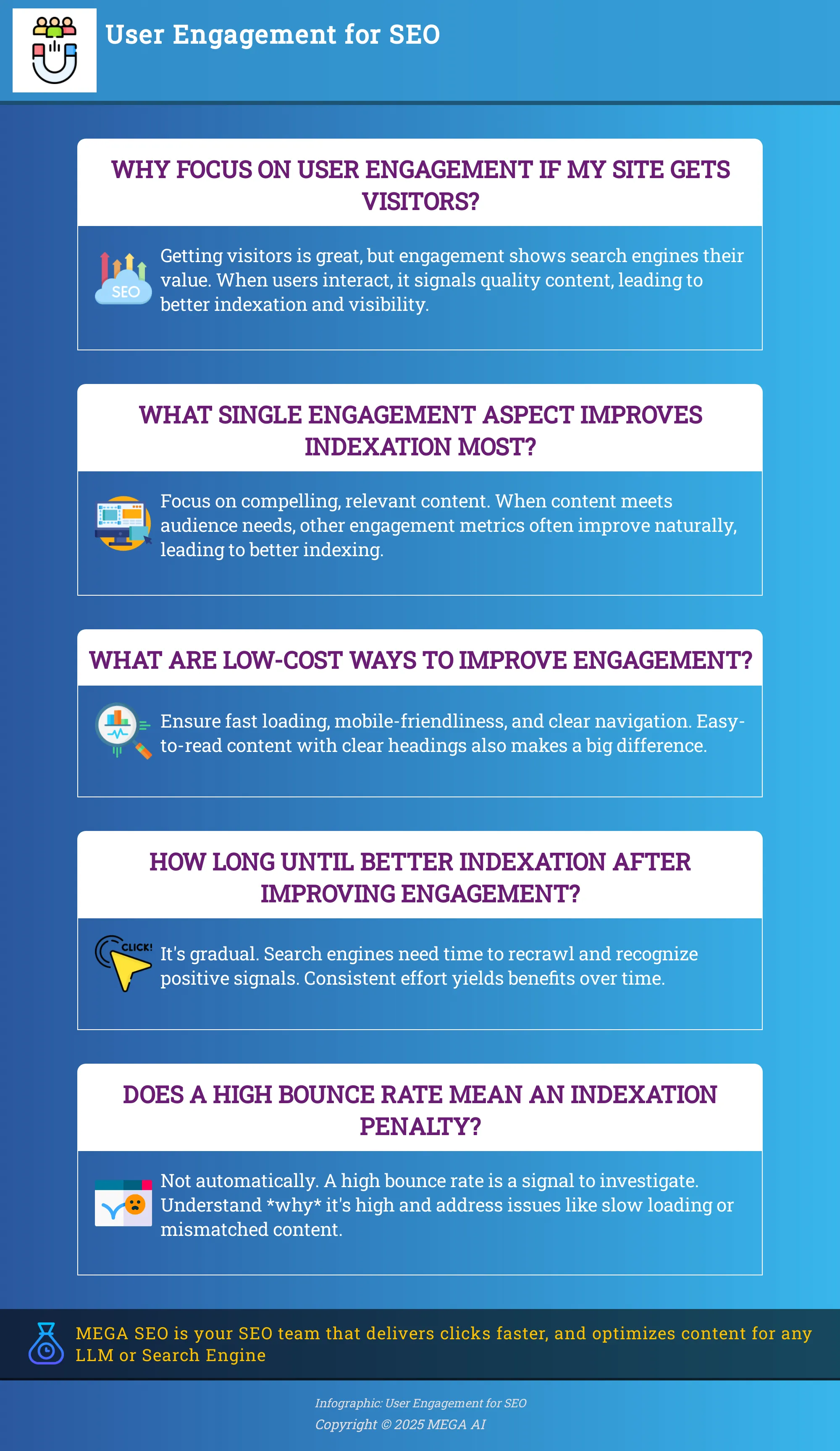
If I can only improve one aspect of user engagement for better indexation, what should it be? If you have to pick one area, concentrate on creating truly compelling and relevant content. When your articles, videos, or other resources genuinely meet your audience's needs and answer their questions effectively, other engagement metrics often improve naturally. People will spend more time on your pages and explore further if the content itself is valuable to them.
Are there simple, low-cost ways to start improving user engagement on my site? Absolutely. You can start by ensuring your website loads quickly and is easy to use on mobile devices, as these are foundational for a good experience. Also, focus on clear site navigation so people can easily find what they're looking for. Making your content easy to read with clear headings and concise paragraphs can also make a big difference without requiring a large budget.
How long does it typically take to see better indexation after improving user engagement? Improving indexation through user engagement is more of a gradual process than an instant fix. After you make changes to enhance user interaction, search engines need time to recrawl your site, recognize these positive signals, and adjust how your pages are indexed. Consistent effort in providing a good user experience will yield benefits over time.
My website has a high bounce rate. Does this automatically mean search engines will penalize my indexation? A high bounce rate isn't automatically a penalty, but it's a signal worth investigating. Search engines look at a variety of factors. Sometimes a high bounce rate is natural, for example, if a user finds exactly what they need on a single page, like a phone number. The key is to understand why your bounce rate might be high for certain pages and address any underlying issues like slow load times, misleading page titles, or content that doesn't match user expectations.