Navigating the complexities of online performance can feel overwhelming, especially for growing businesses and marketing agencies. With so many metrics to track, it's important to focus on those that truly indicate success. User engagement and bounce rate are two such pivotal indicators, offering deep insights into how effectively your website captures and retains visitor attention. Understanding these metrics is the first step. The next is realizing the significant advantages that come from improving them. So, what are the benefits of user engagement increase for reduced bounce rate? This article will clarify these advantages, setting the stage for how strategic improvements can transform your digital outcomes.
Key Takeaways
- Understand that improving engagement directly reduces bounce rate: When visitors find value and interact more with your site, they are less likely to leave prematurely, which is crucial for conversions and SEO.
- Implement targeted strategies to keep users on your pages: Focus on compelling content, intuitive navigation, fast load times, and clear calls to action to encourage deeper site exploration.
- Regularly analyze user behavior and feedback for ongoing refinement: Consistently review your website data and user suggestions to make informed improvements that enhance satisfaction and help achieve your business goals.
What is User Engagement and Why is it Important?
Understanding how users interact with your website is fundamental to your online success. User engagement isn't just a buzzword; it's a measure of how captivating and effective your site truly is. When users are engaged, they're more likely to convert, whether that means making a purchase, signing up for a newsletter, or simply spending more time with your content. This directly impacts your bottom line and your site's visibility. Let's explore what user engagement means and why it's so vital for your website's performance.
What Exactly is User Engagement?
User engagement describes the extent to which people interact with and get involved with your website or application. Think of it as a conversation: is your website talking at your visitors, or with them? You can measure this through several metrics, with engagement rate and bounce rate being key indicators. Google Analytics highlights that "engagement rate and bounce rate are important metrics... that enable you to measure engagement on your website or app." An engaged session, according to Google, is more than just a fleeting visit. It’s defined as a session that lasts longer than 10 seconds, includes at least one key event (like a purchase or watching a video), or involves viewing two or more pages. This shows a deeper level of interest than a quick glance.
Why User Engagement is Crucial for Your Website
So, why should you care deeply about user engagement? It’s crucial because it directly reflects your website's health and effectiveness. A high engagement rate generally means users find value in your content and have a positive experience. Conversely, a low engagement rate can be a red flag, suggesting potential problems like uninteresting content, confusing site navigation, or even technical glitches that frustrate users and send them elsewhere.
Furthermore, high bounce rates—where users leave after viewing only one page—can negatively impact your website's search engine rankings. Search engines might interpret this as a sign that your site isn't relevant to what users are looking for. This is particularly critical because if visitors leave without taking action, like making a purchase or signing up for a demo, it translates to lost opportunities and revenue. A low bounce rate, on the other hand, indicates your website is successfully capturing visitor interest, which is essential for any business aiming to thrive online.
What is Bounce Rate and How Does It Affect Your Site?
Understanding key website metrics is a big part of improving your online performance, and bounce rate is definitely one you’ll want to keep an eye on. It gives you a peek into how visitors interact with your site right from their first impression. If you're aiming to refine your SEO strategy or get more from your paid campaigns, knowing your bounce rate and what influences it is a great starting point. Let's look at what bounce rate means and how it can influence your website's overall success.
Defining Bounce Rate
So, what exactly is bounce rate? Think of it as the percentage of visitors who land on one of your website pages and then leave—or "bounce"—without clicking on anything else or visiting any other page on your site. Essentially, they take a quick look and decide it's not for them, or perhaps they found exactly what they needed instantly. A high bounce rate often means that many people are leaving your site quickly. This can indicate they aren't finding what they're looking for, or maybe the page experience isn't quite right. On the flip side, a low bounce rate is generally a good sign, suggesting visitors are engaging with your content and exploring further.
The Impact of Bounce Rate on Website Success
Now, why should you care about your bounce rate? Well, a high bounce rate can be a red flag, signaling potential issues with your website. It might mean your content isn't hitting the mark for your audience, your site is difficult to use, or your pages aren't compelling enough to keep visitors interested. If people leave quickly, they're not sticking around to become customers, subscribers, or loyal readers.
Moreover, search engines might interpret a high bounce rate as a sign that your site isn't relevant for certain queries, which can affect your search rankings. Ultimately, a high bounce rate often translates to missed opportunities – even if you're getting plenty of traffic, low engagement means fewer conversions and less progress toward your business goals. Understanding this impact is the first step toward making improvements.
The Link: User Engagement and Bounce Rate
Understanding how user engagement and bounce rate are connected is fundamental to improving your website's performance. Think of them as two sides of the same coin. When users are genuinely interested and interacting with your content, they're far less likely to leave your site prematurely. This direct relationship means that efforts to improve one will almost certainly have a positive impact on the other. A well-engaged audience sticks around, explores more, and ultimately, is more likely to convert, whether that means making a purchase, signing up for a newsletter, or contacting your business. This connection is also a key signal to search engines about the quality and relevance of your site.
How Better Engagement Lowers Bounce Rate
When visitors land on your website and find what they're looking for—or even better, discover something unexpectedly valuable—they're more likely to stay. This is the essence of engagement. A high bounce rate often indicates that you're losing potential customers or readers almost as soon as they arrive. Even if your site attracts many visitors, low engagement means few of those visits turn into meaningful actions, representing lost opportunities.
If users aren't interacting much with your site, it could be due to several factors. Perhaps the content isn't resonating, the navigation is confusing, or there are technical hiccups. Search engines can interpret high bounce rates as a sign that your website isn't relevant to what users are searching for, which can negatively affect your rankings. By focusing on creating a more engaging experience, you naturally encourage visitors to spend more time on your site, explore multiple pages, and interact with your calls to action, all of which contribute to a lower bounce rate.
Key Metrics Connecting Engagement and Bounce Rate
To truly grasp the interplay between engagement and bounce rate, it's helpful to look at how these are measured. The primary metric here is the Engagement Rate, which Google defines as the percentage of your website visits that were "engaged sessions." An engaged session is one where the visitor interacts with your site for a certain duration, views multiple pages, or completes a conversion event. Naturally, a high engagement rate is a positive indicator.
Conversely, the Bounce Rate is the percentage of visits that were not engaged sessions. Essentially, it’s the opposite of the engagement rate. A high bounce rate suggests that visitors are leaving your site after viewing only one page without taking any further action. This often signals issues with your website, such as users not finding the information they need or the site itself not being compelling enough to hold their attention. Understanding these GA4 engagement metrics is the first step to diagnosing problems and making improvements.
Benefits: Better Engagement, Lower Bounce Rate
When you focus on improving how users interact with your website and successfully reduce your bounce rate, you're not just adjusting a few metrics; you're actually laying the groundwork for some pretty significant business growth. Think of it this way: every visitor who decides to stick around longer and explore more of what your site offers represents a valuable opportunity. They're more likely to connect with your message, understand the value of your products or services, and ultimately take the action you're hoping for. This isn't about finding quick, temporary fixes; it's about thoughtfully building a better, more intuitive online experience that consistently delivers results across several key areas of your business.
From guiding casual browsers toward becoming loyal customers to making your site more appealing to search engines, the advantages are substantial. An audience that is genuinely engaged is an audience that holds more value. They become more receptive to your marketing efforts, are more inclined to share their positive experiences and become advocates for your brand, and directly contribute to a healthier bottom line. Let's explore some of the specific ways that fostering better engagement and achieving a lower bounce rate can positively influence your online presence and help you achieve your business objectives. These benefits often work in tandem, creating a positive feedback loop that can significantly strengthen your overall digital strategy.
Achieve Higher Conversion Rates
One of the most immediate and impactful benefits of keeping visitors engaged on your site is a noticeable increase in your conversion rates. When users can easily find what they're looking for and genuinely enjoy their experience navigating your website, they are far more inclined to take that crucial next step. This could mean making a purchase, subscribing to your newsletter, or filling out a contact form to learn more. As the team at Technocratiq aptly puts it, "A high bounce rate means fewer sales, subscriptions, or contact form submissions." By actively working to improve user engagement, you naturally guide more visitors along the path to conversion, transforming your website into a more powerful and effective tool for business growth.
Secure Better SEO Rankings
Search engines like Google aim to provide their users with the most relevant, high-quality results for any given query. If visitors frequently land on your site and then quickly leave (or "bounce"), it can send a signal to these search engines that your content might not be meeting user needs or expectations for those particular searches. Conversely, strong engagement metrics, such as a consistently low bounce rate, suggest that your site offers valuable and relevant information. This positive signal can significantly influence your search engine optimization efforts. According to Technocratiq, "High bounce rates signal to search engines that your website isn't relevant, which can negatively impact your rankings." Enhancing user engagement helps to clearly demonstrate your site's relevance and authority, which in turn contributes to improved visibility in search engine results pages.
Build User Satisfaction and Loyalty
A website that successfully keeps its visitors engaged is often one that provides an outstanding user experience from start to finish. When people feel that their needs are understood, and they find your content genuinely helpful, interesting, or entertaining, their overall satisfaction with your brand increases. This positive experience is absolutely key to building trust and encouraging them to return to your site in the future. As Scorpion highlights, "A low bounce rate indicates that your website is effectively engaging visitors, which fosters user satisfaction and encourages repeat visits." This kind of user loyalty is incredibly valuable, as satisfied users are not only more likely to become long-term customers but also to advocate for your brand to their own networks.
Increase Time on Site and Pages Per Visit
When users are genuinely engaged with your website's content, they naturally tend to spend more time on your site and explore a greater number of its pages during their visit. This increased interaction means they have more opportunities to connect with your brand message, understand the full scope of your offerings, and find answers to their questions. Implementing strategies such as "improving content relevance, writing better headlines, and adding clear calls to action can significantly increase the time users spend on your pages," as noted by the experts at Technocratiq. This deeper level of engagement, clearly reflected in important metrics like average session duration and the average number of pages viewed per visit, serves as a strong indicator that your content strategy is resonating effectively with your target audience and successfully reducing bounce rates.
Strategies: Improve Engagement, Lower Bounce Rate
Understanding what makes visitors stick around versus what makes them leave quickly is key to a successful online presence. It’s not just about attracting visitors; it’s about keeping them interested once they arrive. When users find what they need, enjoy the experience, and feel guided, they're more likely to stay, explore, and ultimately convert. This is where specific strategies come into play, transforming casual browsers into engaged prospects. A high bounce rate often signals that something in this initial interaction isn't quite right, whether it's the content, the design, or the overall usability of your site.
By focusing on a few core areas, you can significantly improve how users interact with your site and, as a result, lower that bounce rate. Think of your website as a physical store: you want it to be welcoming, easy to look through, and clear about what you offer and what customers should do next. The following approaches will help you create a more engaging digital environment, encouraging visitors to delve deeper rather than hit the back button. These aren't just quick fixes; they are foundational elements that contribute to a healthier, more effective website. Many businesses find that a thoughtful approach to user experience can make all the difference in retaining visitors and achieving their online goals. Let's explore some practical ways to make your website more inviting and effective.
Create High-Quality, Relevant Content
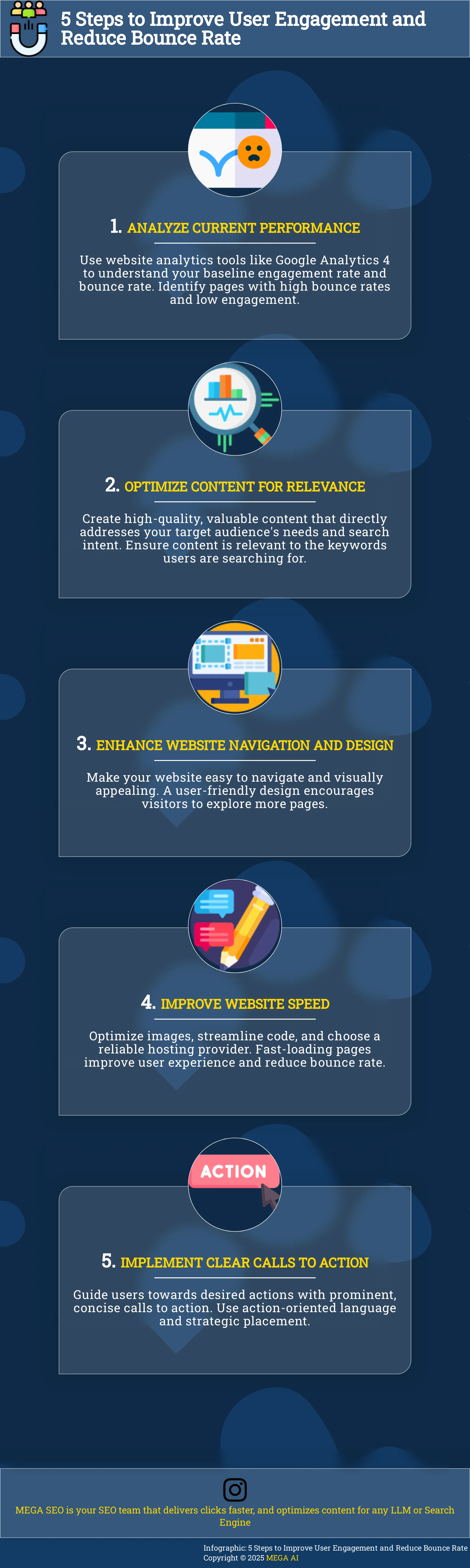
The heart of an engaging website is its content. If visitors land on your page and find information that’s thin, poorly written, or irrelevant to their search, they’re likely to leave. Creating high-quality, relevant content is essential for keeping them on your site. This means understanding your audience deeply: What are their questions? What problems are they trying to solve? Your content should directly address these needs, offering valuable insights, solutions, or entertainment.
Think beyond just text. High-quality content can include well-produced videos, informative infographics, or interactive tools. The key is relevance and value. When your content truly resonates with your visitors and provides what they were looking for, they have a strong reason to stay and explore further. Platforms like MEGA AI can assist in automated keyword research to identify topics your audience cares about, helping you craft content that hits the mark.
Improve Website Design and Navigation
First impressions matter, and your website's design is often the first thing a new visitor experiences. A cluttered, confusing, or outdated design can be an instant turn-off. Your website design plays a crucial role in user engagement. Your site should be visually appealing, professional, and, most importantly, easy to navigate. Users should be able to find what they're looking for intuitively, without having to hunt through complex menus or decipher unclear layouts.
Ensure your navigation is logical and straightforward. Use clear labels for your menu items and organize your content in a way that makes sense to your target audience. A responsive design, which adapts seamlessly to different screen sizes (desktop, tablet, mobile), is also critical. When users can navigate your site effortlessly, they are more likely to stay longer and explore more of what you offer, reducing the chances of a quick bounce.
Optimize Page Load Times
In our fast-paced digital world, patience is thin. If your website takes too long to load, many visitors will simply give up and go elsewhere. How quickly your page loads significantly impacts user experience and, consequently, your bounce rate. Even a delay of a few seconds can lead to a substantial increase in users leaving your site. Common culprits for slow loading include large, unoptimized image files, bulky code, or an underperforming web host.
Regularly test your site’s speed and take steps to optimize it. This might involve compressing images, minifying CSS and JavaScript files, leveraging browser caching, or upgrading your hosting plan. Improving your site's technical health, an area where MEGA AI's SEO services can provide support, often includes optimizations that enhance loading speed, ensuring a smoother experience for your visitors and encouraging them to stay.
Implement Clear Calls to Action (CTAs)
Once visitors are on your site and engaging with your content, what do you want them to do next? Without clear guidance, they might not take the desired step, whether it's signing up for a newsletter, requesting a demo, or making a purchase. Having clear calls to action (CTAs) is vital for guiding visitors and improving engagement. Your CTAs should be prominent, concise, and use action-oriented language.
Make it obvious what you want users to do. For example, instead of a vague "Learn More," try "Download Your Free Guide" or "Start Your Free Trial." Place CTAs strategically throughout your site, especially on pages where a user might be ready to take the next step. Testing different CTA button colors, text, and placements can also help you find what works best for your audience, leading them further into your conversion funnel rather than away from your site.
Personalize the User Experience
Generic experiences rarely captivate. When visitors feel like a website understands their specific needs or interests, they are much more likely to engage. Personalization can greatly enhance user engagement by making the experience more relevant to each individual. This could involve showing content based on their past behavior on your site, their geographic location, or how they arrived at your website.
For instance, an e-commerce site might show product recommendations based on previous purchases, or a blog might highlight articles related to topics a user has read before. Even simple personalization, like addressing a returning user by name, can make a difference. By tailoring the experience, you show visitors that you value their attention and understand their preferences, making them feel more connected and less likely to bounce. Understanding user intent through effective keyword research is a foundational step towards effective personalization.
How to Measure and Analyze Engagement and Bounce Rate
Understanding how users interact with your website is key to improving their experience and your site's performance. Measuring engagement and bounce rate provides concrete data. Let's look at how you can effectively track these metrics and make sense of the numbers.
Tools to Track User Engagement
To understand user interaction, reliable tools are essential. Google Analytics 4 (GA4) is a common choice, helping you measure engagement through metrics like engagement rate. This rate shows the percentage of visits with active user interaction—like staying over ten seconds, converting, or viewing multiple pages. A higher engagement rate usually signals positive user activity.
Analytics platforms often use dashboards to visualize data, simplifying how you see users discover content, their on-site actions, and potential drop-off points. Regularly reviewing these insights helps identify top-performing content and areas needing improvement. Tools like MEGA AI can then assist you in optimizing your content based on these findings.
Analyze Bounce Rate Data Effectively
A high bounce rate often means visitors aren't finding what they expected, or your page isn't engaging enough. If someone lands on your page and leaves quickly without interacting, it contributes to this higher rate. This can indicate issues with content relevance, page load speed, or user experience.
Effective analysis involves looking beyond surface numbers. For example, a blog post might naturally have a higher bounce rate if users find their answer and leave, which isn't always bad. However, a high bounce rate on a key landing page designed for conversions is a clear concern. Addressing underlying problems can lead to more readers and customers. Context is vital when interpreting these figures.
Set Clear Benchmarks and Goals
To know if your bounce rate is good, you need a comparison point. General guidelines suggest a bounce rate between 26% and 40% is excellent, and 41% to 55% is average. However, the ideal figure truly depends on your website's purpose and industry. A content-rich blog will have different expectations than an e-commerce product page.
Start by understanding typical bounce rates for your site type. Then, set realistic, incremental improvement goals rather than aiming for an extremely low number immediately. Track progress over time. If you change your site’s design or content, monitor how these adjustments affect your metrics. This data-informed approach helps refine the user experience.
Tackle Common Challenges in Lowering Bounce Rate
Trying to lower your bounce rate can sometimes feel like you're navigating a tricky maze, but trust me, finding your way through is incredibly rewarding for your website's success. When visitors land on your site only to click away almost immediately, it’s a clear signal that something in their initial experience isn't quite hitting the mark. This quick departure, or 'bounce,' can impact everything from your conversion rates to your search engine rankings. But here’s the good news: a high bounce rate isn't a permanent problem. It's often the result of common, identifiable challenges that, once addressed, can significantly improve how users interact with your content and your brand online.
We're going to look at how to get to the bottom of why visitors might be leaving prematurely, from pinpointing the underlying reasons to smoothing out any technical bumps in the road that could be causing frustration. We'll also explore the crucial balance between creating an enjoyable user experience and achieving your core business objectives. By focusing on these key areas, you can transform your website into a more engaging and effective platform, encouraging visitors to stay longer, explore further, and ultimately take the actions that matter most to your business. Let's get started on making those positive changes.
Identify Root Causes of a High Bounce Rate
So, before you can effectively lower a high bounce rate, it’s key to understand why it’s happening in the first place. It’s a bit like being a detective – you need to look for clues. A high bounce rate often points to lost opportunities, because even with plenty of visitors, if they're not sticking around, it means fewer chances for sales or conversions. When people land on your page and then quickly click away, it’s a strong signal that their expectations weren’t met, or they simply couldn’t find what they were looking for. Digging into your website analytics can offer insights here, showing you which pages have the highest bounce rates. Understanding these root causes is your first big step toward making impactful changes and creating a site that truly connects with your visitors.
Address Technical Website Issues
We’ve all been there – you click on a site, and it takes forever to load. Frustrating, right? Technical issues, especially slow loading pages, can really send visitors running. It's surprising, but even a tiny one-second delay can reduce conversions significantly. Things like overly large images, inefficient website code, or a slow web server are often the culprits behind a sluggish site. Making it a habit to check for these technical snags is so important. A technically smooth website means a better experience for your visitors, making them more likely to stick around and see what you’re all about. Tools that automate technical SEO improvements, like those offered by MEGA AI, can be a huge help in keeping your site in top shape.
Balance User Experience with Business Objectives
It's all about finding that sweet spot: creating a website that your visitors genuinely enjoy using, while also making sure it helps you reach your business goals. A high bounce rate can be a red flag, suggesting your site might not be as engaging as it could be, or that people aren't finding what they expected. To improve this, focus on things like crafting compelling content, making your site easy to get around, and ensuring your ads or social media posts accurately set expectations for what users will find. When you successfully align a great user experience with your business objectives, visitors are much more inclined to stay longer, explore your offerings, and take the actions you want them to. This connection is what helps turn casual visitors into dedicated customers or fans.
Content's Role: Engage Users, Reduce Bounce Rate
Your content is the heart of your website, and it plays a massive part in whether visitors stick around or click away. Think of it as the main conversation starter. If your content isn't engaging, relevant, and easy to digest, users are more likely to leave, which increases your bounce rate. High-quality content that truly speaks to your audience's needs and interests is fundamental to keeping them on your site longer. This is where focusing on what your users want to see and read becomes incredibly important for your site's overall performance.
Write Compelling Headlines and Introductions
You've got just a few seconds to make a first impression. Your headline and introduction are your opening lines, and they need to be captivating. A weak start often means a visitor won't bother reading further, leading to a quick bounce. As Rock Content highlights, "A high bounce rate means lost opportunities. Even with many visitors, low engagement equals few sales." Craft headlines that clearly state the value or answer a question your reader has. Your introduction should then expand on that promise, drawing the reader in and assuring them they're in the right place. For businesses looking to streamline this, tools like MEGA AI can assist in generating content with strong openings that grab attention from the get-go.
Use Multimedia to Keep Users Engaged
Walls of text can be intimidating and, frankly, a bit boring. Breaking up your content with multimedia elements like images, infographics, and videos can make a huge difference in user engagement. Videos, in particular, are powerful tools. According to Rock Content, "Videos are highly engaging and can significantly reduce bounce rates." Multimedia makes your content more visually appealing and easier to process. It can illustrate complex points, showcase products, or simply add a dynamic element that encourages visitors to stay on your page longer and explore what you have to offer. Consider how visuals can support your message and make your information more memorable.
Structure Content for Easy Reading and Scanning
Most people don't read web content word-for-word; they scan. To keep them engaged, you need to make your content easy to navigate and digest. Use clear headings (like H2s and H3s) to break up topics. Bullet points and numbered lists are great for presenting information concisely. Short paragraphs are also easier on the eyes. As Jetpack suggests, you should "Use clear headings, bullet points, and visuals to make your content easy to scan and understand." Beyond structure, ensure you "Write high-quality, interesting content that answers people's questions." When users can quickly find the information they're looking for and find it valuable, they're much less likely to bounce. Platforms like MEGA AI can help optimize existing content to improve its structure and readability, making it more user-friendly.
Mistakes to Avoid for Better User Engagement
Keeping visitors on your site is a common goal. However, some common practices can inadvertently push them away. Let's look at a few missteps that affect user engagement and how to address them.
Not Optimizing for Mobile
With so many people browsing on phones, a non-mobile-friendly website is a significant hurdle. If your site is hard to use on a smartphone, you're likely losing visitors. Technocratiq highlights, "Websites not working well on phones and tablets lose mobile users."
Ensure your design is responsive, text is readable, and buttons are easy to tap. Regularly test your website's mobile performance to find and fix usability issues, ensuring a smooth experience for all users.
Offering Irrelevant or Low-Quality Content
Content matters, but only if it’s relevant and high-quality. If visitors find information that doesn't match their search or is poorly presented, they won't stay. Jetpack notes, "If the main part of the page isn't engaging, people leave quickly."
Understand your audience and their search intent. Create valuable, well-written content that directly meets their needs. MEGA AI can assist with automated keyword research and content generation to ensure your material resonates effectively.
Using Intrusive Ads and Pop-ups
Calls to action are useful, but too many aggressive ads or pop-ups can harm the user experience. "Too many ads or pop-ups make websites unpleasant to use," Jetpack points out. When these elements block content or are hard to close, they cause frustration.
If using pop-ups, ensure they offer real value and are easy to dismiss. Consider less intrusive interaction methods. Learning to effectively engage users without overwhelming them is key for a positive experience.
Having Slow Page Load Times
Online patience is often short. If your website loads slowly, visitors will likely leave. Jetpack states, "Websites that take too long to load frustrate visitors," and Technocratiq adds, "Even a one-second delay can decrease conversions by 7%."
Common culprits include large images or inefficient code. You can improve your page speed by optimizing images and minifying code. Technical SEO tools, like those from MEGA AI, can also help identify and address site speed issues.
Use User Feedback for Continuous Improvement
Listening to your website visitors is one of the most effective ways to understand what’s working and what’s not. User feedback provides a direct line to their experience, offering clear signals on how to refine your site, improve engagement, and ultimately lower your bounce rate. Think of it as having a team of consultants (your users) telling you exactly what they need.
Gather Valuable User Insights
To make meaningful improvements, you first need to understand how people interact with your website. Regularly analyzing your website and making improvements based on data is crucial. By understanding how users interact with your site, you can identify areas that need enhancement, which can lead to a decrease in bounce rates. Consider using tools like surveys, on-page feedback widgets, or even analyzing customer support tickets for common themes. Session recording tools can also show you exactly where users might be struggling or dropping off. These insights are the foundation for data-driven decisions that truly resonate with your audience.
Act on User Suggestions
Collecting feedback is just the first step; the real magic happens when you act on those suggestions. Improving engagement often involves improving website content, making navigation easier, and ensuring your marketing accurately reflects your website's offerings. Listening to user feedback allows you to make informed changes that resonate with your audience. Start by categorizing the feedback you receive. Look for patterns and prioritize changes that will have the biggest impact on user experience. For instance, if multiple users find a certain page confusing, that’s a clear signal to revisit its design or content.
Adapt Strategies for Lasting Success
The digital landscape is always changing, and so are user expectations. Focusing on user engagement is more important than just getting lots of website visits. By continuously adapting your strategies based on user feedback, you can create a more engaging experience that keeps visitors on your site longer. This isn't a one-time fix but an ongoing cycle of listening, learning, and refining. Regularly revisit your feedback channels and analytics to ensure your website continues to meet user needs effectively. This iterative approach helps you build a site that not only attracts visitors but also encourages them to stay and convert.
Related Articles
- The Ultimate Guide to Audience Engagement in 2024
- Site Navigation Benefits: Lower Your Bounce Rate
- Deep Linking SEO: A Complete Guide for 2024
- Boost Content SEO with Effective Multimedia Strategies
- How to Rank Higher After Google's Helpful Content Update
Frequently Asked Questions
What's the main difference between user engagement and bounce rate? Think of user engagement as a measure of how much your visitors interact with your site – like how long they stay, if they click on things, or view multiple pages. Bounce rate, on the other hand, tells you the percentage of visitors who leave your site after viewing only a single page without taking any other action. Essentially, engagement shows interest, while bounce rate can indicate a quick exit.
If my website visitors are leaving quickly, what's one of the first things I should check? If you notice a lot of visitors leaving your site almost immediately, a good starting point is to look at your page load times. People expect websites to load quickly, and even a short delay can cause them to give up and go elsewhere. Also, make sure the content on the page clearly matches what they might have expected from a link or an ad.
How does making my website easier to use actually help with my site's performance in search engines? When your website is easy for people to use and they find what they need without frustration, they tend to stay longer and look at more pages. Search engines notice this positive interaction. They see it as a sign that your site provides a good experience and relevant information, which can contribute to better visibility in search results.
Beyond just writing good articles, what else can I do with my content to keep people on my site longer? Great articles are a fantastic start. To further encourage visitors to stay, think about how your content is presented. Using clear headlines, breaking up text with images or videos, and structuring your information with short paragraphs and subheadings makes it much easier for people to scan and digest. This can make them more likely to explore further.
Is a high bounce rate always a bad sign for my website? Not necessarily. While a high bounce rate often indicates areas for improvement, context is really important. For example, if someone lands on a blog post, finds the specific answer they were looking for, and then leaves, that's a successful visit even if it contributes to the bounce rate. However, a high bounce rate on a page designed to convert visitors, like a product or service page, is usually a cause for concern.