Striving to improve your website's position in search results can feel like a constant effort. You optimize for keywords and build backlinks, but what if a key piece of the puzzle is how users actually experience your site? User engagement—how visitors interact with your pages—is increasingly a deciding factor for search engines. If your site offers a compelling experience, keeping users interested and active, it signals quality. This article dives into how these positive interactions directly influence your visibility. We'll uncover the specific benefits of user engagement increase for higher search rankings and provide actionable strategies to make your website a place users genuinely want to explore.
Key Takeaways
- User Interactions Shape Your SEO: What people do on your site—how long they stay, what they click—shows search engines like Google if your content is good, which affects your ranking.
- Make Your Site a Better Place for Visitors: You can get users to stick around longer by creating truly helpful content, making sure your site is fast, designing it to be easy to use, and ensuring it works well on phones.
- Good Engagement Means More Than High Ranks: When users are happy with your site, you'll see more than just better search positions; you'll build loyalty, see more sales, and grow your organic traffic steadily.
What is User Engagement? (And Why It Matters for SEO)
If you're working on your website's SEO, you've likely heard the term "user engagement" tossed around. But what does it actually mean, and why should it be a priority in your SEO strategy? Simply put,
Defining User Engagement
User engagement essentially describes how people interact with your website and its content. Think of it as a measure of the attention and interest your site captures. When users actively explore your pages, click on links, or spend time reading what you've written, they're engaged. This isn't just about fleeting visits; it’s about meaningful interactions that show your content resonates with them. For businesses, particularly startups and small companies aiming to build a strong online presence, understanding user engagement is key because it reflects how valuable your audience finds your offerings and can be a strong indicator of customer satisfaction and loyalty.
Key Metrics for Measuring User Engagement
To get a clear picture of how users are interacting with your site, you'll want to look at specific user engagement metrics. These numbers tell a story about visitor behavior. Key metrics include the Engagement Rate, which shows the percentage of visitors who meaningfully interact with your site, and Pages per Session, indicating how many pages an average visitor views. Average Session Duration and Time on Page measure how long visitors stay on your site overall and on individual pages, respectively. Don't forget Interactions per Visit, which counts actions like clicks or shares, and the Conversion Rate, which tracks how many visitors complete a desired action, like a signup or purchase. Monitoring these helps you understand what's captivating your audience.
How User Engagement Connects with Search Engine Algorithms
Search engines, especially Google, aim to deliver the most relevant and high-quality results. One way they assess this quality is by looking at how users interact with websites. Google's algorithm considers user engagement as an important signal. When people spend significant time on your site, view multiple pages, and generally show signs of positive interaction, it suggests to search engines that your content is valuable and meets user needs. This positive user behavior can lead to better organic search rankings, making it easier for new customers to find you. So, focusing on a great user experience isn't just good for your visitors; it's a smart approach to improving your SEO.
How User Engagement Impacts Your Search Rankings
Understanding how users interact with your website is more than just a way to gauge content performance; it's a critical component of modern SEO. Search engines, especially Google, are increasingly sophisticated in how they interpret user behavior. When users find your site engaging, it sends strong positive signals that can directly influence where you appear in search results. Let's explore why this connection is so powerful.
Why Google prioritizes user experience
Google's main job is to give people the best, most relevant answers to their questions. To do this well, its search algorithm looks closely at how users engage with websites. This means the way people interact with your content can be just as important as things like keywords or backlinks. When someone lands on your page, finds what they need quickly, and spends time looking around, Google sees this as a good user experience. This tells Google your site is helpful and meets the searcher's needs, making it more likely to show your site higher in search results. A positive user experience directly supports Google's mission, so it's a big deal for their ranking systems.
Behavioral signals: Their role in ranking algorithms
Behavioral signals are the clues search engines gather from how users interact with your website. These include things like your click-through rate (CTR) from search results, how long people stay on your page, your bounce rate, and how many pages they visit during a session. When users engage more with your site, it signals to Google that your content is valuable and relevant for the searches it’s appearing in, which can lead to better organic search rankings. Imagine someone consistently picks your site from the search results and then sticks around to read. That’s a strong sign to Google that your page is a great match for that search term, helping its algorithms understand your content's quality from a real user's point of view.
How engagement metrics affect search visibility
User engagement metrics are really important for your SEO because search engines are designed to put user experience first. These metrics clearly show how well your website meets what users are looking for. High engagement means your content is valuable and that people trust your site. This also makes it more likely they'll do things like buy something or sign up for your newsletter. On the flip side, low engagement often signals problems. Maybe your site loads too slowly, it's hard to find things, or the content just isn't hitting the mark. Fixing these issues to improve how users interact with your site can directly improve your visibility in search results, as search engines prefer to highlight sites that offer a consistently good experience.
Which User Engagement Metrics Really Count for SEO?
When we talk about SEO, it's easy to get lost in keywords and backlinks. But search engines, especially Google, are increasingly focused on how users interact with your website. These interactions, or user engagement, send strong signals about your content's quality and relevance. Understanding which metrics truly matter can help you refine your SEO strategy and improve your rankings. Let's look at the key players.
Understanding bounce rate and its significance
Bounce rate is a term you've likely heard, and it's an important one. It's defined as "the percentage of visitors who leave after viewing only one page." Think of it as someone walking into a store, taking a quick look around, and immediately walking out. A high bounce rate might suggest that visitors didn't find what they were looking for, the page was confusing, or it loaded too slowly. Conversely, experts note that "a lower bounce rate indicates that users find the content engaging and relevant, which can positively influence search rankings." While a high bounce rate isn't always bad (e.g., a contact page where users find a phone number and leave), for content pages, you generally want users to stick around and explore.
Time on site and dwell time: What they tell you
Beyond just staying on your site, how long visitors spend on your pages is also a critical indicator. "Time on Site (Dwell Time)" is the metric that "measures how long visitors stay on a page or website." If someone spends several minutes on your article, it suggests they are actively reading and absorbing the information. Indeed, "a longer dwell time suggests that users are finding the content valuable, which can lead to improved SEO performance." Search engines interpret this as a sign that your page successfully answered the user's query or provided engaging material. This makes sense; if users quickly return to the search results after clicking your link (short dwell time), it signals your page wasn't a good match.
Click-through rate (CTR) from search: Why it's crucial
Your click-through rate, or CTR, is a direct measure of how appealing your search result listing is. This is "the percentage of users who click on a search result after seeing it." Imagine your page ranks on the first page of Google; your title tag and meta description are your ad copy. It's crucial because "a higher CTR indicates that the title and description are compelling, which can enhance visibility and rankings in search results." A strong CTR tells search engines that your snippet effectively matches user intent for that query. Tools and strategies that help you optimize existing content, like refining titles and descriptions, can directly contribute to improving this important metric.
Pages per session and depth of visit
Finally, consider how much of your site a visitor explores. "Pages per Session" is a metric that "reflects the average number of pages a visitor views during a single session." If a user lands on a blog post and then clicks through to related articles, your services page, or an about us page, it shows a deeper level of engagement. A higher number here is generally better, as it "indicates greater user engagement and interest in the content, which can positively impact SEO." This suggests your site offers a rich experience, with clear navigation and compelling internal links that encourage users to continue their journey, signaling to search engines that your site is a valuable resource.
Actionable Strategies to Improve User Engagement
Improving user engagement isn't about quick fixes or trying to trick algorithms; it's about genuinely enhancing the experience for everyone who visits your website. When users find what they need, enjoy their time on your site, and leave feeling satisfied, search engines like Google take notice. These positive interactions translate into signals that can significantly influence your search rankings over time. The strategies we're about to cover are all rooted in this user-first philosophy. They range from the foundational – like the quality of your content and your site's technical performance – to the more nuanced aspects of design and interactivity.
Think of this as building a welcoming, efficient, and valuable online space for your audience. Each improvement, no matter how small it seems, contributes to a larger picture of a user-friendly website. This isn't a one-time task, but rather an ongoing commitment to understanding and serving your users better. As you implement these changes, remember that monitoring your engagement metrics is key to understanding what resonates most with your visitors. This continuous loop of action, measurement, and refinement is what drives sustainable growth in both user satisfaction and search visibility. Many businesses find that leveraging tools for SEO can help streamline these efforts, allowing them to focus on strategy while ensuring consistent optimization. The beauty of focusing on user engagement is that the benefits often compound, leading not just to better rankings, but also to increased brand loyalty and higher conversion rates. Let's explore some concrete actions you can take.
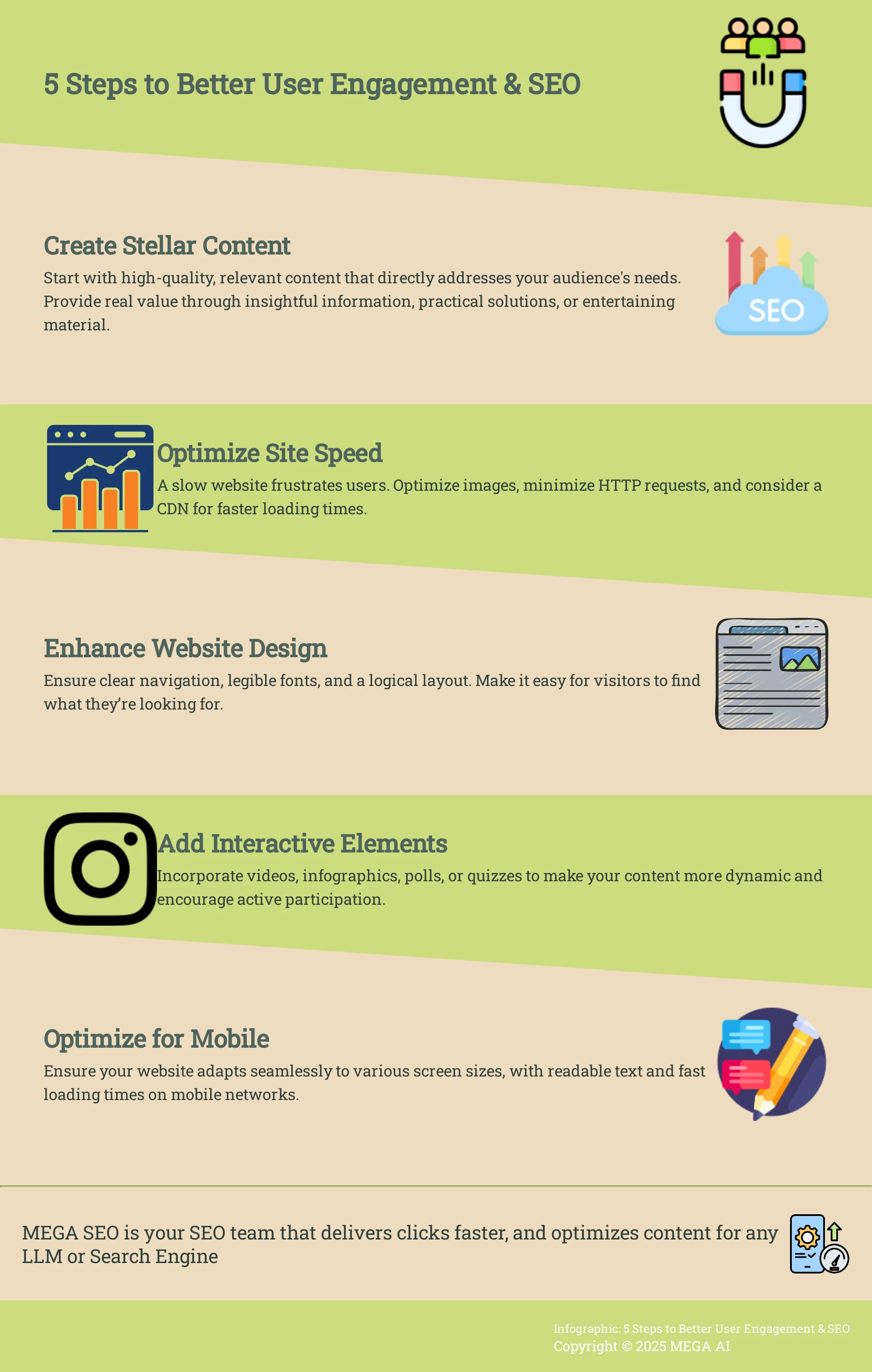
Create high-quality, relevant content
The cornerstone of any successful user engagement strategy is the content itself. As SMA Marketing highlights, "Creating high-quality, safe, and relevant content is crucial for keeping users engaged." This means your content should directly address the needs and questions of your target audience. Focus on providing real value, whether that's through insightful information, practical solutions, or entertaining material. Well-structured articles with clear headings, concise paragraphs, and easy-to-understand language make a big difference. Regularly updating your existing articles to maintain accuracy and relevance also signals to users and search engines that your site is a current and reliable resource. Platforms offering content generation can assist in producing well-researched and structured initial drafts, which you can then refine with your unique insights.
Improve your site speed and performance
Nobody likes a slow website. Site speed is a critical factor for user engagement and, consequently, for SEO. According to Ignite Visibility, a faster site can lead to significantly higher conversion rates. Simple delays can cause users to abandon your site for a competitor's. To combat this, focus on optimizing images to reduce their file size without sacrificing quality, minimize HTTP requests, and consider using a Content Delivery Network (CDN) to serve your content from servers closer to your users. Regularly audit your site's performance and address any bottlenecks. These technical improvements contribute to a smoother, more pleasant browsing experience, encouraging visitors to stay longer and explore more of what you offer.
Enhance website design and user experience (UX)
Your website's design and overall user experience (UX) play a massive role in how visitors interact with your content. A visually appealing, intuitive, and easy-to-use site encourages exploration and engagement. As Ignite Visibility points out, "User engagement metrics are vital for SEO success because search engines prioritize user experience." This means ensuring your site has clear navigation, legible fonts, a logical layout, and a design that aligns with your brand. Think about the user journey from their perspective: Can they easily find what they're looking for? Is the information presented in a digestible way? A positive UX demonstrates that you value your visitors' time and effort, making them more likely to engage deeply with your site.
Implement interactive elements and multimedia
Static pages of text can sometimes feel uninviting. Incorporating interactive elements and multimedia can transform the user experience, making your content more dynamic and memorable. Oktopost suggests "Using tools, games, quizzes, and other interactive elements to keep visitors engaged." Consider adding videos, infographics, polls, calculators, or interactive maps where appropriate. These elements can break up long blocks of text, cater to different learning styles, and encourage active participation rather than passive consumption. Even simple additions like well-placed images and clear calls-to-action can make a significant impact on how users interact with your pages. The goal is to make your content not just informative, but also enjoyable to consume.
Optimize for mobile users
With a significant portion of web traffic coming from mobile devices, optimizing your site for these users is no longer optional—it's essential. Oktopost notes that "Mobile accounts for roughly half of all global web traffic." A seamless mobile experience means your website should adapt gracefully to various screen sizes, with readable text, easily tappable buttons, and fast loading times on mobile networks. Responsive design is the standard approach here, ensuring your site looks and functions well whether viewed on a desktop, tablet, or smartphone. Test your site thoroughly on different mobile devices to identify and fix any usability issues. Prioritizing mobile users ensures you're catering to a large segment of your audience and meeting modern web standards.
How to Measure and Analyze User Engagement for SEO
Understanding how users interact with your site is key to improving your SEO. Let's look at how you can measure, analyze, and use engagement data to inform your strategy.
Tools to track engagement metrics
To get a clear picture of user engagement, you'll need the right tools. Google Analytics is a fantastic starting point and is widely used for tracking website performance. It helps you gather data on key user engagement metrics like engagement rate, pages per session, average session duration, and time on page. These tools don't just collect numbers; they provide insights into how visitors experience your content.
By regularly checking these platforms, you can see which pages keep users interested and where they might be dropping off. This information is invaluable for identifying areas of your site that are performing well and those that might need some attention to better meet user needs. For small businesses and startups, having a clear view of these metrics can make a significant difference in understanding your audience.
Set benchmarks and goals effectively
Once you start tracking metrics, the next step is to set clear benchmarks and goals. What does "good" engagement look like for your specific website and industry? It's important to understand that there's no one-size-fits-all answer. Instead of comparing your site to vastly different ones, focus on your own historical data and aim for continuous improvement.
Start by establishing a baseline for your current engagement levels. From there, set realistic, achievable goals for metrics like increasing average time on page or reducing bounce rate. Regularly monitoring these metrics against your goals will help you see what’s working and where you can make adjustments to your strategy for better results. This proactive approach is especially useful for digital marketing agencies managing multiple client accounts.
Interpret data to shape your SEO strategy
Collecting data is one thing; knowing what to do with it is another. When you see higher user engagement, it’s a strong signal to search engines like Google that your content is valuable and relevant. This, in turn, can lead to better organic search rankings. For instance, if users spend a lot of time on a particular page, it suggests the content is meeting their needs effectively.
Use this data to refine your content and overall site experience. If a page has a high bounce rate, investigate why. Is the content not matching the search intent? Is the page slow to load? Answering these questions helps you make targeted improvements. Platforms like MEGA AI can then assist with tasks like updating content to improve its click-through rate (CTR) or adding new, relevant information to existing articles, ensuring your SEO strategy is always data-driven and optimized for success.
The Knock-On Effect: How Engagement Helps Other SEO Factors
Strong user engagement doesn't just directly signal quality to search engines; it also creates a positive ripple effect that benefits other crucial SEO factors. Think of it as a domino rally – once you get that first piece (user engagement) to fall, it helps topple others in the right direction, leading to better overall search performance. When users are genuinely interacting with your content, it sets off a chain reaction that can significantly improve how search engines perceive your website's value and authority. This isn't just about one metric improving in isolation. Instead, it's about how positive user experiences contribute to a healthier, more authoritative online presence overall. Focusing on your audience's experience is a smart, indirect way to strengthen your entire SEO foundation, making your site more appealing to both users and search algorithms. This holistic approach is key because search engines are increasingly sophisticated, looking at a wide array of signals to determine which content best serves their users. For startups and small businesses especially, understanding this interconnectedness can mean a more efficient and impactful SEO strategy, where efforts in one area naturally support growth in others. Let's explore how this plays out in a few key areas, demonstrating the powerful link between user satisfaction and SEO success.
Its impact on backlinks and social shares
When your content truly resonates with visitors, they're naturally more inclined to share it with their own networks or link back to it from their websites. High engagement is a clear indicator that your content is valuable and that users trust your site. This increased likelihood of organic sharing and backlink acquisition is a powerful endorsement. Think about it: if people are spending time on your page, reading through, and interacting, it signals that you're providing something worthwhile. This perceived value makes your content a more attractive asset for others to reference. These organic backlinks and social shares are like votes of confidence in the eyes of search engines, contributing significantly to your site's authority and search rankings.
How it influences content freshness and updates
High user engagement can also be a great motivator for keeping your content up-to-date. If you notice a piece of content is performing exceptionally well, it’s a good sign to revisit it, expand upon it, or ensure it remains current. Conversely, if engagement metrics show users are dropping off or not interacting, it might signal that the content needs a refresh. Search engines, like Google, tend to favor content that is fresh and relevant. Regularly updating your content based on engagement signals and evolving user needs tells search engines that your site is actively maintained and provides timely information. This is where tools like MEGA AI's Maintenance Agent can be incredibly helpful, by identifying opportunities to add new information to existing articles or re-optimize them to keep them performing well.
Its effect on site authority and trustworthiness
Ultimately, consistent positive user engagement helps build your website's overall authority and trustworthiness. When search engines see users spending significant time on your site, visiting multiple pages, and interacting with your content, it reinforces the idea that your website is a credible source of information that satisfies user needs. This positive user experience contributes to a stronger reputation, both with users and search algorithms. Over time, this accumulated trust and authority can lead to more stable and higher rankings for a wider range of keywords, making your SEO efforts more resilient and effective in the long run.
User Engagement & SEO: Busting Common Myths
It's easy to get caught up in the latest SEO trends, and user engagement is often at the center of these discussions. But with so much information out there, myths can start to overshadow facts. Let's clear up a few common misunderstandings about how user engagement truly connects with your search rankings. Understanding these nuances will help you focus your efforts on what genuinely makes a difference.
Can you really manipulate engagement? Let's see.
There's a persistent idea that user engagement metrics can be easily tricked or artificially inflated. While some tactics might offer a temporary illusion of increased activity, search engines are designed to recognize and prioritize genuine user satisfaction. As Paul Olyslager points out, "website owners and managers often use their own experience and behavioral habits with a website to praise or shoot down the idea," which can lead to focusing on the wrong things. Instead of trying to game the system, the most sustainable approach is to create authentic experiences that genuinely meet user needs. This means providing valuable content, intuitive navigation, and a clear purpose for every page. True engagement stems from real value, not superficial tricks.
Balancing engagement with other SEO practices
User engagement is a significant piece of the SEO puzzle, but it's not the only one. Achieving high search rankings requires a well-rounded strategy. Poor website performance or a confusing user experience can certainly harm engagement. As Open Minds Resources notes, "Complex navigation and poor user experience can have a negative impact on user engagement." They also suggest that "By implementing personalised experiences and customisation options, you can enhance user engagement." While improving these aspects is vital, remember to also focus on technical SEO, building quality backlinks, and consistently publishing relevant, optimized content. A holistic approach, where engagement efforts complement other sound SEO practices, yields the best long-term results.
The true role of social signals in search rankings
The impact of social media likes, shares, and comments on search rankings is a frequent topic of debate. While there isn't strong evidence that search engines use social signals as a direct ranking factor, they can play an influential indirect role. High social media activity can increase your content's visibility, drive more traffic to your site, and potentially lead to more backlinks if your content truly resonates. Poor web design and user experience can kill engagement and reduce the likelihood of shares. Ultimately, content that people find valuable and shareable naturally attracts attention, which can, in turn, send positive signals to search engines about your site's authority and relevance.
Beyond Rankings: Long-Term Wins from Better User Engagement
While better search engine rankings are certainly a welcome outcome of strong user engagement, the real power lies in the advantages that stretch far beyond that initial SERP visibility. When you shift your focus to genuinely creating a positive and engaging experience for everyone who visits your website, you're not just tweaking for algorithms; you're making a strategic investment in the long-term health and sustainable growth of your entire business. Think of it less like a sprint for the top spot and more like building a thriving, loyal community around your brand—a community that trusts your expertise, remembers you, and consistently chooses you over the competition.
This deeper connection isn't just a feel-good metric; it translates directly into tangible business outcomes that resonate through every part of your operations. It means that visitors don't just land on your site and immediately bounce; they stay, they explore, they interact, and they find genuine value in what you offer. This creates a virtuous cycle: satisfied users send positive signals to search engines, yes, but more importantly, they become the bedrock of a resilient business. By prioritizing how users interact with your content and platform, you're setting the stage for benefits that compound over time. These include stronger brand loyalty, increased conversions and revenue, sustained organic traffic growth, and even a reduced reliance on costly paid advertising. Let's look at these crucial long-term advantages more closely.
Build stronger brand loyalty and recognition
When users consistently find your content valuable and easy to interact with, they start to see your brand as a reliable resource. This positive experience is key to building brand loyalty. Think about it: if a visitor lands on your site and quickly finds the answers they need, or enjoys the way information is presented, they're more likely to remember you favorably.
This isn't just about a single visit. Higher engagement often leads to improved customer satisfaction and retention. Users who feel understood and well-served are more likely to return, choose your products or services again, and even recommend you to others. Over time, these positive interactions solidify your brand's reputation and help you stand out in a crowded digital landscape.
Increase conversions and revenue
It stands to reason that if visitors are actively engaging with your website, they're more likely to take the next step you want them to. Engaged users are more inclined to complete desired actions, whether that's making a purchase, signing up for your newsletter, or requesting a demo. When your content resonates and guides them effectively, the path to conversion becomes much smoother.
Consider a visitor who spends significant time on your product pages, watches your demo videos, and reads customer testimonials. Their high level of engagement indicates a strong interest and a greater likelihood of converting compared to someone who bounces off your site quickly. By focusing on creating an engaging journey, you're directly influencing your ability to generate leads and drive sales, ultimately impacting your revenue.
Achieve sustained organic traffic growth
Improving user engagement isn't just a short-term tactic for a quick ranking boost; it's a strategy for long-term organic traffic growth. When users spend more time on your site, visit multiple pages, and interact with your content, search engines like Google take notice. These behaviors signal that your content is valuable and relevant to what people are searching for.
This positive feedback loop can lead to better organic search rankings over time. As your site consistently demonstrates high user engagement, it builds authority and trustworthiness in the eyes of search engines. This means your content is more likely to rank well for relevant keywords and attract a steady stream of organic visitors, creating a sustainable source of traffic that doesn't disappear overnight.
Reduce reliance on paid advertising
Strong user engagement through high-quality content can significantly lessen your dependence on paid advertising channels. When your organic content effectively attracts, engages, and converts visitors, you're building an asset that works for you around the clock without continuous ad spend. Effective content marketing often costs less and can generate more leads than traditional marketing approaches.
By creating valuable resources that naturally draw users in and keep them engaged, you can build a strong organic presence. This means more of your traffic and leads come from unpaid sources, freeing up your marketing budget. While paid ads can still play a role, a foundation of strong organic engagement provides a more cost-effective and sustainable way to grow your business. For businesses looking to optimize their content efforts, exploring SEO services that focus on engagement can be a smart move.
Related Articles
- Optimizing Content to Match User Search Intent and Improve Engagement Metrics: Advanced On-Page SEO Techniques - MEGA SEO | Blog
- Master SEO Strategies: Unlocking User Intent for Engagement
- Create Engaging SEO Content to Boost User Experience
- The Ultimate Guide to Audience Engagement in 2024
- How to Rank Higher After Google's Helpful Content Update
Frequently Asked Questions
If I want to improve user engagement, where's the best place to start? Start by looking at your content. Is it genuinely helpful, interesting, and easy for your audience to understand? High-quality, relevant content is the foundation. After that, check your website's speed and mobile-friendliness. A slow or clunky site can drive visitors away before they even see your great content.
How quickly can I expect to see SEO benefits after improving user engagement on my site? There's no exact timeline, as SEO results can vary. However, when search engines notice users are spending more quality time on your site, interacting positively, and finding value, these signals can start to influence your rankings. Think of it as a gradual improvement rather than an overnight switch. Consistent effort in enhancing user experience tends to yield more sustainable results.
Should I prioritize user engagement over traditional SEO tactics like keyword research? It's not really an either/or situation; they work together. Keyword research helps people find you, and strong user engagement helps convince search engines that your site is a great result for those keywords. Focus on creating a fantastic experience for the users who arrive via those keywords. A balanced approach is always best.
Is a high bounce rate always a red flag for my site's SEO? Not necessarily. While a high bounce rate can indicate issues on some pages, it's important to consider the page's purpose. For example, if a user lands on your contact page, finds your phone number, and leaves, they've achieved their goal. That's a successful visit, even if it results in a bounce. Context matters, so look at bounce rate alongside other metrics like time on page to get the full story.
What's a practical way to use engagement data to make my content better? Look at metrics like "time on page" or "pages per session" for your blog posts or articles. If you see that people are spending very little time on a long article, it might mean the content isn't hitting the mark, is hard to read, or isn't what they expected. You could then revisit that content to make it clearer, add more engaging elements like images or videos, or ensure it better matches the search terms it's ranking for.