
Search engines like Google have one primary objective: to provide their users with the best, most relevant, and highest-quality answers to their search queries. To achieve this, their algorithms look at a multitude of factors, and increasingly, how users interact with a website is a major component of that evaluation. If visitors land on your page and quickly leave, it suggests your content might not be the best match or offer a poor experience. Conversely, if they stay, explore multiple pages, and interact with your content, it signals quality and relevance. This is the core of user engagement's critical role in modern SEO. This article will explain how these interactions directly influence your site's standing in search results. We'll delve into the critical question: what are the benefits of user engagement increase for increased organic traffic?, showing you how aligning with search engine goals through better engagement can significantly improve your rankings.
Key Takeaways
- Understand that positive user interactions directly influence your SEO: When visitors spend more time on your site and view multiple pages, search engines recognize this as a sign of valuable content, often leading to better search rankings.
- Implement practical site enhancements to keep users interested: Improve visitor experiences by creating high-quality content, ensuring your site is fast and easy to use, and adding interactive features to encourage longer stays and more interaction.
- Use analytics and AI to refine your engagement strategy: Regularly check your website data to see how users behave, and consider using AI tools like MEGA AI to help automate content improvements and linking, simplifying how you improve engagement and SEO.
What is User Engagement and Why It Matters for SEO?
User engagement is essentially how people interact with your website once they arrive. It’s about more than just a visitor landing on a page; it’s about the actions they take. This includes things like how long they stay on your site, whether they click through to other pages, if they leave comments, or if they share your content on social media. These types of interactions measure genuine interest and satisfaction with your content, unlike a quick visit that might end in an immediate bounce. When users actively engage, it signals that they find value in what you offer.
So, why is this a big deal for your SEO? Search engines, especially Google, aim to provide users with the most relevant, helpful, and high-quality results for their searches. They look closely at how people interact with websites because these behaviors are strong indicators of a site's quality and relevance. If visitors are spending significant time on your pages, exploring further, and interacting with your content, it tells search engines that your site provides a positive user experience. Consequently, websites demonstrating strong user engagement are often rewarded with higher positions in search results. Google's algorithm increasingly prioritizes user experience, making user engagement a crucial ranking factor for achieving and maintaining SEO success. Focusing on how users connect with your site is fundamental to improving your organic visibility.
How User Engagement Drives Organic Traffic
When someone lands on your website, their actions speak volumes, not just to you, but to search engines as well. How they interact with your content—or user engagement—is a critical factor that search engines like Google consider when deciding where to rank your pages. Think of it this way: if visitors are genuinely engaging with your site, it signals that your content is valuable and relevant to their search. This positive feedback loop can significantly influence your organic traffic by improving your visibility in search results. Understanding which specific interactions matter and how they affect your rankings is the first step to making user engagement work for you.
Key Engagement Metrics Search Engines Value
So, what exactly do we mean by "user engagement" in the eyes of a search engine? It’s essentially a measure of how people interact with your website. This isn't just a vague concept; it's tracked through several specific metrics. Key indicators include how many pages a visitor views (pageviews), how long they spend on your site or a specific page (time on site or dwell time), and the percentage of visitors who leave after viewing only one page (bounce rate). A lower bounce rate is generally better, indicating that visitors found what they were looking for or were intrigued enough to explore further. Similarly, a longer time on site suggests your content is holding their attention. Conversions, such as signing up for a newsletter or making a purchase, are also powerful engagement signals.
How Engagement Influences Your Rankings and Visibility
Search engines aim to provide users with the most relevant and high-quality results for their queries. When visitors spend more time on your site, view multiple pages, and generally show signs of positive interaction, it tells search engines that your site offers a good user experience and valuable content. Consequently, websites that effectively keep visitors on the site and encourage them to return often see a favorable impact on their search rankings. Improving user engagement is a fundamental aspect of SEO because search engines are designed to reward sites that clearly satisfy user intent and provide a positive experience. This means that the more engaged your audience is, the higher your content is likely to appear in search results, leading to increased organic visibility.
6 Key Benefits: How Higher User Engagement Increases Organic Traffic
When visitors genuinely connect with your website content, it sends powerful positive signals to search engines. This isn't just about fleeting visits; it's about meaningful interactions that demonstrate your site's value and relevance. Think of it this way: search engines aim to provide their users with the best possible answers and experiences. If people are spending time on your site, interacting with your content, and not immediately leaving, it tells search engines like Google that you're delivering on that promise.
This positive feedback loop can significantly influence your organic traffic. Higher user engagement often translates into better search rankings, increased visibility in search results, and a greater likelihood of attracting and retaining an audience. It’s a clear indicator that your content resonates, meets user needs, and provides a satisfactory experience. As we explore the specific benefits, you'll see how focusing on your audience's interaction with your site is a fundamental aspect of a successful SEO strategy. Ultimately, a more engaged audience is more likely to convert, share your content, and become loyal followers of your brand.
1. Achieve Higher Search Engine Rankings
One of the most significant advantages of strong user engagement is its impact on your search engine rankings. Search engines are sophisticated, and their algorithms are designed to identify and promote high-quality, relevant content. When users spend more time on your pages, click through to other content, and generally interact positively, these actions serve as strong indicators of your site's value. As industry observers have noted, "[w]ebsites with high user engagement tend to rank higher." This is because search engines like Google interpret these interactions as signs that your site provides a good user experience and fulfills the searcher's intent. By prioritizing user engagement, you're essentially aligning your website with what search engines want to deliver to their users: valuable and satisfying results.
2. Get More Clicks From Search Results
Higher user engagement can lead to more clicks from search engine results pages (SERPs). When your content is engaging, it often means it’s highly relevant to what users are searching for. This relevance is not only good for keeping users on your site but also for attracting them in the first place. If Google sees that users who click on your link stay on your site and interact with it, it can infer that your page is a good match for that query. This can improve your ranking over time, making your listing more visible. Furthermore, compelling titles and meta descriptions, which are part of an effective on-page SEO approach, can entice users to click. As Oktopost highlights, "[f]ocusing on user engagement aligns your website with Google's goal of providing relevant search results." It’s about creating a positive cycle: good engagement leads to better rankings, which leads to more visibility and, consequently, more clicks.
3. Keep Visitors on Your Site Longer
A key indicator of user engagement is the amount of time visitors spend on your site, often referred to as dwell time. When your content is compelling, informative, and easy to consume, visitors are naturally inclined to stay longer. This extended interaction signals to search engines that your site offers substantial value. As one LinkedIn Pulse article puts it, "[l]onger is better. The longer people stay on your site, the better." Longer visit durations suggest that users are finding what they need and are engrossed in your content. This can be achieved through well-structured articles, engaging visuals, internal links to related content, and clear, intuitive website navigation. When users stick around, it positively influences how search engines perceive your site's quality and relevance to specific search queries.
4. Reduce Your Website's Bounce Rate
Bounce rate refers to the percentage of visitors who land on your website and leave without interacting further or visiting any other pages. A high bounce rate can be a concern because it might indicate that your content isn't meeting visitor expectations or that your site is difficult to use. As Gravity Global points out, "[h]igh bounce rates (visitors leaving quickly) and low user engagement are major red flags" for search engines. By focusing on creating engaging content and a positive user experience, you can encourage visitors to explore more of your site, thereby reducing your bounce rate. This might involve improving page load speed, ensuring mobile-friendliness, or making your calls to action clearer. A lower bounce rate signals that your site is relevant and engaging, which can contribute positively to your SEO performance.
5. Earn More Social Shares and Backlinks
Engaging content is inherently shareable. When users find your content valuable, interesting, or entertaining, they are more likely to share it on their social media platforms or link to it from their own websites. These social signals and backlinks are important factors for SEO. As highlighted in discussions about user engagement's role in SEO, "[s]ocial signals: Shares, likes, and comments on social media" contribute to your site's authority. More shares mean increased visibility and brand exposure, driving more traffic to your site. Backlinks, especially from reputable sources, are a strong endorsement of your content's quality and can significantly improve your search engine rankings. Creating content that sparks conversation and provides unique insights is a great way to encourage these valuable interactions.
6. Build Stronger Brand Awareness and Loyalty
When users consistently have positive and engaging experiences with your website, it helps build brand awareness and foster loyalty. Providing content that truly resonates with your target audience makes your brand memorable and positions you as a trusted authority in your niche. As Gravity Global aptly states, "[c]reating relevant and valuable content that matches what people are searching for is key." This consistent delivery of value encourages repeat visits, transforming casual visitors into loyal followers. Loyal users are more likely to engage with future content, recommend your brand to others, and even become customers. This long-term relationship building is invaluable and contributes to sustained organic traffic growth and a stronger overall online presence.
How to Measure and Analyze User Engagement Effectively
Understanding how users interact with your website is the first step to improving their experience and, consequently, your organic traffic. It’s not just about getting visitors; it’s about keeping them interested and active. To do this effectively, you need to know what to look for and how to interpret the data you gather. This involves tracking specific metrics and using the right tools to make sense of it all. When you can accurately measure engagement, you gain clear insights into what your audience values, what captures their attention, and where they might be encountering friction. This data-driven approach allows you to make smarter decisions about your content, design, and overall user journey, ultimately leading to better SEO performance and more meaningful connections with your audience.
Essential Engagement Metrics to Track
To get a clear picture of user engagement, focus on a few key metrics. True user engagement shows how people genuinely interact with your site, going beyond simple page visits which could be accidental. Start with Pageviews, which tell you the total number of pages viewed. While high pageviews can be good, also monitor Bounce Rate – this shows the percentage of visitors who leave your site after viewing only one page. A high bounce rate might indicate that your content isn't meeting visitor expectations or that the page isn't compelling enough.
Another critical metric is Average Time on Page or Session Duration, indicating how long visitors stay and consume your content. Longer times often suggest higher engagement and interest. Finally, track Conversions. These are specific, valuable actions you want users to take, like signing up for a newsletter, downloading a resource, or making a purchase. These metrics together paint a comprehensive picture of how engaging your site truly is and how well it guides users toward your goals.
Tools to Monitor and Interpret Your Engagement Data
Once you know which metrics to track, you need tools to gather and analyze this information. Web analytics platforms, such as Google Analytics, are indispensable for this. These tools collect data on how users find and interact with your website, presenting it in dashboards and reports. Regularly monitoring these analytics helps you understand what’s working and what’s not, providing a foundation for strategic adjustments.
Interpreting this data allows you to identify patterns, such as which content resonates most with your audience or where users might be encountering issues. These insights are crucial for making informed decisions to refine your content strategy and website design. For instance, understanding which pages have low time on site can guide content improvements. Platforms like MEGA AI can then help you take action by assisting with SEO optimization to enhance that existing content for better performance and engagement.
Actionable Strategies to Improve User Engagement and Organic Traffic
Improving user engagement isn't just about making your visitors happy; it's a direct line to better organic traffic. When users find value in your site, stay longer, and interact with your content, search engines take notice. Let's look at some practical ways you can enhance user engagement and, as a result, your search rankings.
Create High-Quality, Relevant Content
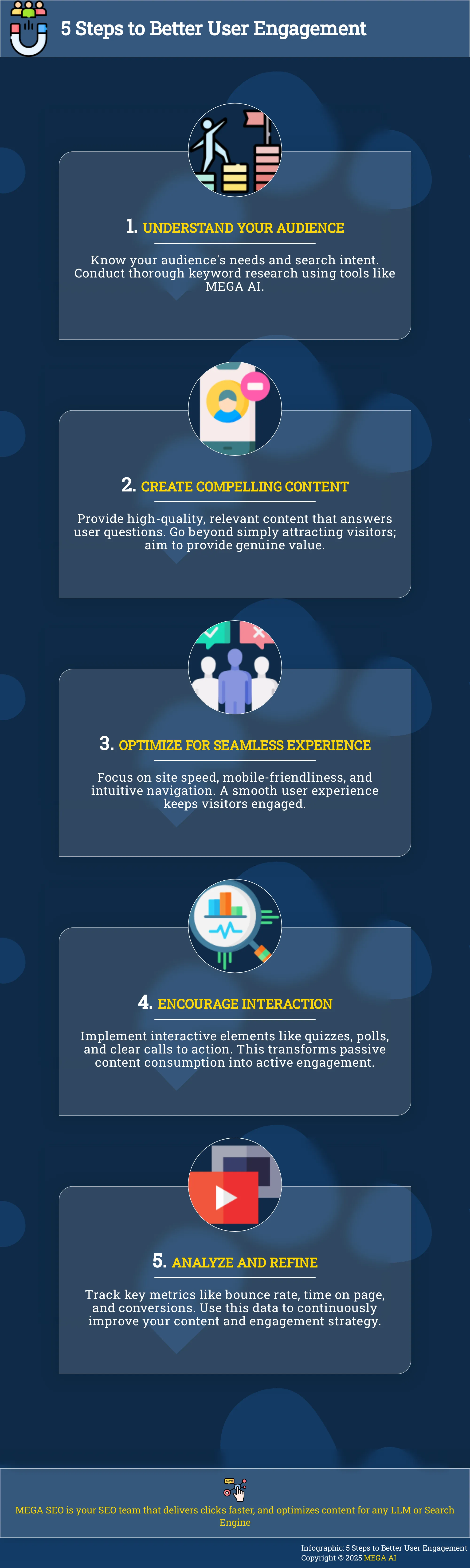
At the heart of user engagement is content that truly speaks to your audience. This means creating relevant and valuable content that directly matches what people are searching for. Start by understanding your audience's needs and pain points. What questions are they asking? What problems are they trying to solve?
Thorough keyword research is your first step here. Tools, including AI-powered platforms like MEGA AI's SEO capabilities, can help you uncover not just popular keywords but also the intent behind them. Once you know what your audience is looking for, craft content that provides clear, comprehensive, and actionable answers. This approach keeps visitors engaged and significantly reduces the chances they'll bounce back to the search results.
Optimize Your Site for Speed and Performance
Imagine walking into a store and having to wait several minutes just to get through the door. You’d probably leave, right? The same applies to your website. Website speed is a critical factor for user experience and, consequently, for SEO. In fact, many consumers expect a website to load in 2 seconds or less.
Slow-loading pages lead to frustration and higher bounce rates. To combat this, focus on optimizing your page load times. This includes compressing images to reduce file sizes, leveraging browser caching, minifying CSS, JavaScript, and HTML, and ensuring your website hosting is up to par. Regular performance audits can help you identify and fix speed-related issues, ensuring a smoother experience for your visitors.
Improve Your Website Navigation and User Experience
A clear and intuitive website structure is fundamental to keeping users engaged. If visitors can't easily find what they're looking for, they're likely to leave. Think of your website navigation as a roadmap for your users. A well-structured site navigation, as Mirza Baig points out, helps users locate information quickly, enhancing their overall experience.
Ensure your main menu is straightforward, use clear labels for your categories, and consider adding a search bar for larger sites. Logical internal linking also plays a role here, guiding users to related content and helping them explore your site more deeply. A positive user experience (UX) signals to search engines that your site is valuable and user-friendly.
Implement Interactive Elements on Your Site
Passive content consumption is becoming less common. Users want to be involved. Implementing interactive elements on your site can be a game-changer for engagement. Think about incorporating tools, calculators, quizzes, polls, or even simple interactive infographics. According to Oktopost, interactive content gets twice the engagement of static content.
These elements not only capture attention but also encourage users to spend more time on your page and interact directly with your brand. This increased interaction is a strong positive signal to search engines, indicating that your content is engaging and valuable to users. Brainstorm what kind of interactive content would resonate with your specific audience and add value to their visit.
Use Personalization and Targeted Content
In a world overflowing with information, personalization helps your content cut through the noise. Tailoring content to individual users or specific user segments can significantly enhance engagement. As Mirza Baig highlights, personalization is key to making users feel understood and valued, which in turn can improve the likelihood of conversions.
This could involve showing different content recommendations based on past behavior, addressing users by name in communications, or creating content that speaks directly to the needs of different customer personas. By delivering more relevant experiences, you encourage users to interact more deeply with your site, fostering a stronger connection and improving engagement metrics.
How AI-Powered Tools Support User Engagement and SEO
If you're working to improve your website's user engagement and search engine optimization (SEO), you understand it can be a demanding job. There are many elements to consider, from finding the right keywords to keeping your content fresh. This is where AI-powered tools are becoming incredibly helpful. Think of them as your super-efficient assistant, ready to handle some of the heavy lifting so you can focus on strategy and connecting with your audience. These tools can analyze vast amounts of data, uncover insights, and automate tasks that used to take hours, if not days. For businesses, especially startups and small teams, this means you can achieve more with your existing resources. Platforms like MEGA AI are designed to simplify these complex processes, making advanced SEO and engagement strategies accessible to everyone. By integrating AI, you can streamline workflows and gain a competitive edge.
Automate Keyword Research and Content Generation
Finding the right keywords and creating content that truly connects with your audience are foundational to good SEO and user engagement. AI-powered tools can make this process much smoother. By analyzing search trends and how users behave online, these tools can pinpoint keywords with high potential that you might not have found otherwise. Beyond just identifying keywords, AI can also assist in generating relevant content that speaks directly to what your audience is looking for. This not only saves a significant amount of time but also helps ensure your content is optimized right from the start, improving its visibility in search results and drawing users in. This allows you to focus on refining the message and ensuring it aligns perfectly with your brand voice.
Optimize Internal and External Linking
A well-structured website with smart linking is key for both users and search engines. Effective internal linking helps users discover more of your valuable content, keeping them on your site longer. External linking to reputable sources can build credibility and provide additional context. AI tools can automate the task of finding relevant internal linking opportunities within your own content. They can also suggest credible external resources, helping you build a more interconnected and informative experience for your visitors. This thoughtful approach to link building not only supports your site’s SEO performance but also keeps users engaged by guiding them to more useful information, creating a richer journey through your site.
Automatically Update Articles for Better CTR and Rankings
Content isn't a "set it and forget it" deal. To keep users engaged and maintain strong search rankings, your content needs to stay fresh and relevant. AI-powered tools can help here by automatically updating your articles. This could involve incorporating new data, fixing broken links, or even adding relevant FAQs based on current search queries. This process of continuous optimization ensures your content remains useful and accurate. As the Search Engine Journal highlights, content freshness is a significant factor for SEO, often leading to higher click-through rates (CTR) from search results and better overall rankings. Services like MEGA AI’s Maintenance Agent can even identify new content sections to add to existing articles, further optimizing them for peak performance.
Address Common User Engagement Challenges
Improving user engagement is vital for organic traffic growth, but several common challenges can stand in your way. If you're not mindful of these potential pitfalls, your efforts might not yield the best results. Recognizing these issues allows you to tackle them head-on, ensuring your strategies lead to genuine audience interaction and stronger SEO performance. Here are some frequent hurdles and how you can effectively manage them.
Avoid Focusing on Vanity Metrics
It's easy to get drawn to numbers that look good on paper, like total page views or social media followers. These figures, often "vanity metrics," don't always accurately represent how users truly interact with your content. As Oktopost highlights, genuine user engagement signifies real interest, not just a fleeting click. To get a clearer picture, shift your focus to metrics reflecting active participation. Consider average time on page, scroll depth, comment volume, or content shares. These metrics offer insights into whether your audience finds your content valuable and spends meaningful time with it, a strong signal for search engines.
Prioritize Mobile Optimization
A significant portion of your audience likely accesses your website via smartphones or tablets. Oktopost notes that "about half of all web traffic comes from mobile devices." Crucially, Google considers mobile-friendliness a key ranking factor, primarily using the mobile version of your site for indexing. If your site performs poorly on mobile—being slow to load, hard to read, or difficult to navigate—users will quickly become frustrated and leave. This creates a negative user experience and directly impacts your SEO. Prioritize ensuring your website is fully responsive, loads fast, and provides a seamless experience across all screen sizes.
Incorporate User Feedback and Preferences
To truly engage your audience, you must understand their needs and preferences, not just rely on assumptions. Designing content or user experiences based on what you think users want can often miss the mark. Gravity Global emphasizes understanding the user journey through methods like surveys and heatmaps. These user research techniques offer direct insight into user behavior. Make it a regular practice to collect and analyze feedback, perhaps through on-site surveys, comment sections, or usability testing. Using these insights to adapt your content and site design shows users you're listening and helps create a more relevant experience.
What's Next for User Engagement and SEO?
The landscape of search engine optimization is continually evolving, and a significant shift is the growing importance of user experience. While foundational SEO strategies are still vital, their application is adapting. Search engines, particularly Google, are increasingly refining their algorithms to prioritize how users interact with your website. This means that sites adept at keeping visitors interested, encouraging them to spend more time and revisit, are more likely to see positive effects on their search result positions.
Consider this: search engines aim to connect users with the most relevant and high-quality information available. One key way they assess this quality is by analyzing user engagement signals. Websites demonstrating strong user interaction are often interpreted as offering greater value. As a result, these sites may achieve higher rankings. This evolution highlights that attracting visitors is just the first step; providing a genuinely positive experience once they arrive is equally critical.
Creating high-quality content forms the bedrock of this user-centric approach. It's no longer sufficient to simply draw organic traffic. Businesses now need to focus on optimizing the entire user journey. This involves ensuring your website loads quickly, that navigation is intuitive, and that you clearly understand and address the needs of your visitors. By concentrating on these facets of user experience, you're not only fostering better engagement but also building a more robust foundation for your overall SEO performance.
Related Articles
- Optimizing Content to Match User Search Intent and Improve Engagement Metrics: Advanced On-Page SEO Techniques - MEGA SEO | Blog
- Master SEO Strategies: Unlocking User Intent for Engagement
- Create Engaging SEO Content to Boost User Experience
- How to Rank Higher After Google's Helpful Content Update
- How to Measure & Improve Your Audience Engagement Value
Frequently Asked Questions
What's the simplest way to think about user engagement? Think of user engagement as what people do once they land on your website. It’s about whether they stick around, click on other pages, leave a comment, or share something they found interesting. It shows they're genuinely connecting with your content, not just passing through.
Why is it so important for my site's SEO if people are interacting with my content? Search engines want to show their users the best, most relevant results. When people spend time on your site and interact with it, it signals to search engines that your website offers value and a good experience. This can lead to your site appearing higher in search results, which means more organic traffic for you.
If I want to start improving user engagement, what are a couple of key areas I should focus on first? A great starting point is to make sure your website loads quickly and is easy for people to find their way around. If your site is slow or confusing, visitors are likely to leave. Also, creating content that directly answers your audience's questions or solves their problems will naturally keep them more engaged.
How can I tell if the changes I'm making are actually improving user engagement? You'll want to look at specific metrics. Pay attention to how long visitors stay on your pages, whether they visit multiple pages during a session, and if your bounce rate—people leaving after seeing only one page—is decreasing. Tools like Google Analytics can help you track these numbers and see what's working.
Can technology like AI really help with something as human-focused as user engagement? Absolutely. AI-powered tools can handle many of the time-consuming tasks involved in SEO and content creation, like finding the best keywords or helping to keep your articles up-to-date. This frees you up to focus on understanding your audience better and crafting the engaging experiences that build those human connections.