
Getting your website noticed is a significant first step, but keeping visitors interested is where the real work begins. User engagement measures how people interact with your content once they land on your site. Are they clicking links, watching videos, or spending time on your pages? These actions are more than just clicks and views; they are vital signs of your website's health and relevance. Search engines use these signals to understand if your site provides a good experience. When users are actively engaged, it suggests your content is valuable and helpful. This positive feedback loop is crucial. Exploring the benefits of user engagement increase for improved site authority? reveals how these interactions directly contribute to higher search rankings and a more trusted brand. We’ll look into strategies to foster this connection.
Key Takeaways
- Make user interactions count: When visitors actively engage with your site—spending time and exploring content—it signals quality to search engines, directly contributing to better authority and higher rankings.
- Track key metrics to guide improvements: Monitor how long people stay, how many pages they visit, and their interaction rates, then use this data to refine your content and user experience for better SEO outcomes.
- Adopt a user-first mindset for sustained success: Consistently creating valuable and positive experiences for your audience builds trust and encourages sharing, which strengthens your site’s reputation and performance over time.
User Engagement: What It Is & How It Impacts Site Authority
Understanding how users interact with your website is more than just a passing interest; it's a cornerstone for building a strong online presence. When people actively engage with your content, it sends clear signals to search engines about your site's quality and relevance. This, in turn, can significantly influence your site's authority and its ability to rank well in search results. Think of it as a conversation: the more engaged your audience is, the more valuable that conversation becomes, not just for them, but for how search engines perceive your site. We'll look into what user engagement truly means, the specific metrics you should keep an eye on, and how these interactions directly contribute to building your website's authority.
What is User Engagement?
At its heart, user engagement encompasses all the ways people interact with your brand's content. It’s not merely about someone landing on your page; it’s about what they do once they arrive. Do they read your articles thoroughly, watch your videos, click on internal links, or share their thoughts in the comments? These actions show that your content is connecting with them. The focus on user engagement now directly impacts SEO, as search engines have evolved to assess the actual value users get from your site, moving beyond simple keyword matching. It's essentially a measure of how captivating and useful your audience finds your online material.
Key Metrics to Measure Engagement
Tracking specific metrics is vital for understanding user engagement because they reveal how well your website satisfies visitor needs—a key factor search engines prioritize. When you understand these numbers, you gain insights into the user experience and can pinpoint areas for improvement. Some of the most important user engagement metrics to monitor, particularly within tools like Google Analytics 4, include Engagement Rate (the percentage of sessions where users actively engaged), Pages per Session (the average number of pages a visitor views), and Average Session Duration (how long they typically stay on your site). Other valuable indicators are Time on Page, Interactions per Visit (such as clicks or downloads), and Conversion Rate, all of which help paint a comprehensive picture of user interaction.
How Engagement Connects to Site Authority
The link between user engagement and site authority is quite direct: higher engagement signals to search engines like Google that your content is valuable and relevant to users. When visitors spend more time on your site, explore multiple pages, and interact meaningfully with your content, it suggests they are finding what they need and having a positive experience. This positive user experience is something search engines aim to reward. Therefore, improving user engagement is crucial for achieving better search engine rankings. It’s not just about attracting visitors; it’s about keeping them interested and encouraging them to return, which ultimately contributes to better organic search visibility and strengthens your site's overall authority.
How Better User Engagement Influences SEO Rankings
Understanding how users interact with your website is more than just a good practice; it's a fundamental part of modern SEO. Search engines are increasingly sophisticated, and they pay close attention to how people engage with your content. When users find your site helpful and stay awhile, it sends strong positive signals that can significantly affect your search engine rankings. Let's explore how this connection works and why it matters for your site's visibility.
How Search Engine Algorithms Work
Search engine algorithms, especially Google's, have evolved quite a bit. It's no longer enough to simply pack your pages with keywords. Today, these algorithms are designed to prioritize user experience. Think of it this way: search engines want to provide their users with the most relevant and satisfying results. If visitors land on your site and quickly leave, or if they don't interact with your content, it signals to the algorithm that your site might not be meeting user needs. Therefore, websites that successfully keep visitors engaged are often rewarded with better rankings. This means your content needs to be not only discoverable but also compelling enough to hold a visitor's attention and encourage interaction.
User Signals: Their Role in Rankings
So, how do search engines figure out if users are happy with your site? They look at "user signals." These are essentially behaviors that indicate how people interact with your website after finding it in the search results. Search engines like Google aim to show users the best websites, and user signals are a key way they assess quality. If users spend a good amount of time on your site, visit multiple pages, and interact with your content by clicking links or watching videos, these positive signals suggest your site is valuable and relevant. Consequently, websites demonstrating high user engagement tend to perform better in search rankings because they appear to satisfy searcher intent effectively.
Engagement Metrics That Directly Impact SEO
To truly understand user engagement, you need to track specific metrics. These user engagement metrics are crucial for SEO success because they provide concrete data on how well your website meets user expectations. When these numbers are strong, they indicate to search engines that your site offers a positive experience, which can directly influence your rankings.
Some key metrics, often tracked in tools like Google Analytics 4, include:
- Engagement Rate: This shows the percentage of sessions where users actively interacted with your site, like staying for a certain duration or viewing multiple pages.
- Pages per Session: This indicates how many pages a visitor views on average during a single visit. More pages can suggest deeper interest.
- Average Session Duration: This measures the average length of time users spend on your site during a visit.
- Time on Page: This tells you how long visitors spend on a specific page, which can indicate content quality and relevance.
- Interactions per Visit: This can include clicks, scrolls, video plays, form submissions, or other defined actions that show active participation.
- Conversion Rate: This tracks how many visitors complete a desired action, like signing up for a newsletter, downloading a resource, or making a purchase.
Direct Benefits: Improved User Engagement for Site Authority
When users genuinely connect with your website, search engines certainly take notice. This positive interaction translates directly into tangible benefits that strengthen your site's authority and overall online presence. Think of it as a positive cycle: happy users can lead to favorable signals for search engines, which in turn can mean more visibility and credibility for your business. Let's explore how this works in practice.
It's important to remember that building a strong online presence is a marathon, not a sprint. Consistently focusing on how users interact with your site lays a solid foundation for long-term success. These direct benefits are often the first positive outcomes you'll see as you prioritize your audience's experience.
Better Search Visibility and Rankings
It's a common goal for most businesses to see their website appear higher in search results. One effective way to work towards this is by focusing on user engagement. Search engines like Google are increasingly sophisticated, prioritizing websites that offer a quality user experience. As Oktopost aptly puts it, "User engagement is more important than ever for SEO. Google's algorithm is increasingly focused on user experience. Simply optimizing for keywords isn't enough; websites need to keep visitors engaged."
This means that when visitors land on your site and interact positively with your content—by reading articles, watching videos, or clicking through to other pages—it signals to search engines that your site is valuable and relevant. This positive feedback can directly contribute to improved search rankings, making it easier for potential customers to find you.
Higher Click-Through Rates, Lower Bounce Rates
Two critical metrics that search engines consider are click-through rates (CTR) and bounce rates. A higher CTR means more people are choosing to click on your website's link when it appears in search results. A lower bounce rate indicates that visitors are finding what they need on your page and aren't immediately leaving. As Mirza Baig highlights, "High engagement signals genuine interest to Google... Lower bounce rate is better."
When users are engaged, they are naturally more inclined to click on your search listings, especially if your titles and meta descriptions are compelling. Once they arrive, engaging content and a clear site structure encourage them to stay, explore, and interact, which helps reduce your bounce rate. These positive signals reinforce to search engines that your site is a quality destination, further supporting your authority.
More Time on Site and More Pages Per Session
The amount of time visitors spend on your site and the number of pages they view per session are strong indicators of engagement. If users are quickly leaving your site, it suggests they didn't find what they were looking for or had a less-than-ideal experience. Conversely, as Ignite Visibility notes, "Longer dwell time is better... The average time spent on your site per visit. Longer times suggest higher engagement."
When your content is captivating and your website is easy to use, visitors are more likely to spend more time exploring what you have to offer. This might involve reading multiple blog posts, checking out different product pages, or learning more about your company. Encouraging this exploration through clear internal linking and well-organized content can significantly increase both time on site and pages per session, signaling to search engines that your site provides substantial value.
Long-Term Wins: User Engagement for Website Performance
Focusing on user engagement is a strategic move yielding long-term benefits for your site's authority and performance. Active user interaction signals value to search engines and builds a stronger foundation for your online presence. These sustained interactions translate into tangible results, shaping your brand's success.
Build Trust, Credibility, and Brand Reputation
When users genuinely engage with your website, they signal its value. This positive experience builds trust. High user engagement often leads to better customer retention, higher conversion rates, and improved customer satisfaction. An engaged audience is more likely to stick around, increasing lifetime value (LTV) and brand loyalty. These loyal users often become advocates, driving word-of-mouth referrals. Additionally, an engaged community provides invaluable feedback, making it easier to refine your products and services. Consistently delivering value through user interaction solidifies your reputation as a credible source.
Generate Natural Backlinks and Social Shares
Engaged users readily share content they find useful, leading to organic social shares that widen your reach. High-quality, engaging content also attracts natural backlinks. For example, creating valuable data pages, like statistics or original research, is a powerful way to attract high-quality backlinks. Journalists and bloggers often need data to support their articles, making your well-researched content a prime candidate for a link. These organic endorsements signal to search engines that your website is a trustworthy authority, improving your domain authority over time.
Improve Overall Site Performance and Conversions
Ultimately, strong user engagement contributes directly to better overall site performance and, crucially, higher conversion rates. Improving user engagement is important for better search engine rankings. It’s not just about attracting visitors; it’s about keeping them on your site and encouraging them to return. Search engines tend to reward websites that provide an excellent user experience, which is often reflected in engagement metrics. When users spend more time on your site, view more pages, and interact with your content, they are also more likely to move through your sales funnel and convert, whether that means making a purchase, signing up for a newsletter, or requesting a demo. Platforms like MEGA AI can assist by helping you create and optimize content that keeps users captivated and guides them towards conversion goals.
Effective Strategies to Improve User Engagement
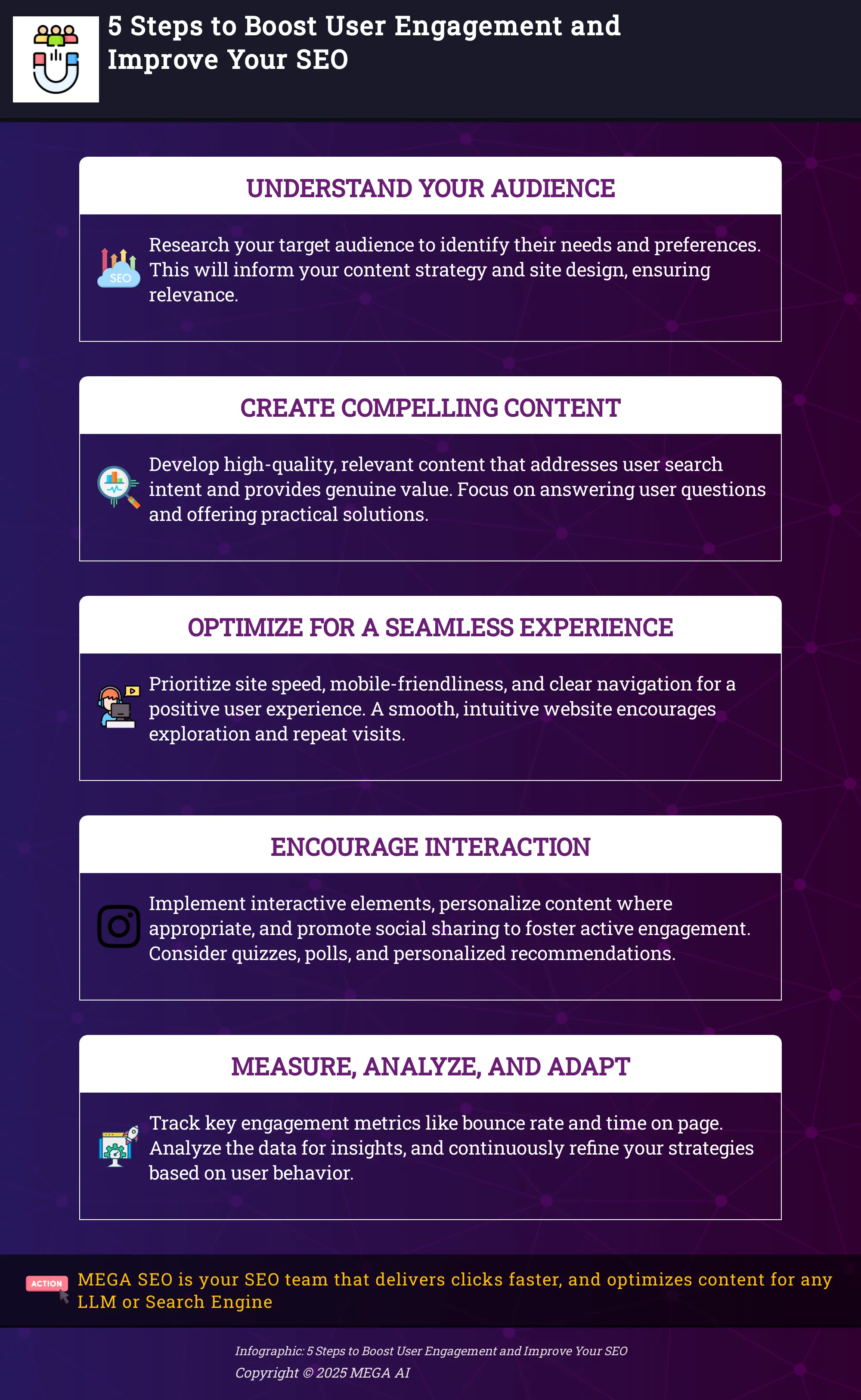
Improving user engagement isn't just about making your website look good; it's about creating an experience that keeps visitors interested and encourages interaction. When users are engaged, they're more likely to return and connect with your brand. Let's explore some practical strategies you can implement.
Create High-Quality, Relevant Content
The heart of any strong engagement strategy is content that genuinely connects with your audience. This means providing real value by understanding their needs. Start with thorough keyword research to align your topics with what people actively seek. Your aim is to produce content that answers questions and comprehensively addresses user pain points. Remember, creating great material is just the first step; effective distribution is also key. Tools like MEGA AI can streamline parts of this, assisting with automated content generation and research.
Optimize Site Speed and User Experience
Think of your website like a store: if it’s slow or confusing, people leave. A clunky website is a major deterrent. Prioritizing site speed is essential, as delays impact satisfaction. You can enhance website speed by optimizing images, reducing HTTP requests, and using a Content Delivery Network (CDN). Beyond speed, focus on the overall user experience (UX). This includes clear site structure for easy navigation, mobile-friendliness, and clear calls-to-action. User testing offers valuable insights into how people interact with your site, helping you refine the experience.
Implement Interactive Elements and Personalization
Static content informs, but interactive elements create an active experience. Consider adding quizzes, polls, or calculators that invite user participation. These features make your site more engaging and can provide useful audience data. For example, an industry-related quiz can be enjoyable for users and offer insights for your content planning. Personalization further improves engagement by tailoring the experience to individual preferences. This makes users feel understood, which can lead to deeper interaction with your brand and its offerings.
Encourage Social Sharing and Interaction
When users find your content valuable, they might want to share it. Make this simple. Adding prominent social media sharing buttons to your articles and key content is an effective tactic. These social signals, like shares and likes, extend your reach and build trust. Beyond sharing, cultivate a community by encouraging comments and discussions on your blog or social media. Responding to comments and participating shows your audience you value their input, significantly deepening their connection with your brand.
Measure and Analyze User Engagement Impact
Understanding how users interact with your website is fundamental to improving its authority and search engine performance. It’s not enough to simply drive traffic; you need to know what visitors do once they arrive. Measuring and analyzing user engagement provides the insights necessary to make informed decisions that enhance user experience and, consequently, your site's standing. This process involves using the right tools, interpreting the data correctly, and setting clear objectives for ongoing improvement. By consistently monitoring these aspects, you can refine your strategies to better meet user needs and achieve your business goals. Let's look at how you can effectively measure this impact and use that information to make meaningful changes.
Tools to Track Engagement Metrics
To get a clear picture of user engagement, you need reliable data. Thankfully, there are many tools available to help you track your website's performance. Web analytics platforms, such as Google Analytics, are a common starting point. These tools can show you metrics like bounce rate, average time on page, pages per session, and conversion rates. Heatmap tools can visually represent where users click and scroll, offering insights into how they interact with specific page layouts. Some platforms also offer session recording features, allowing you to watch anonymized recordings of user journeys. Choosing the right set of tools will depend on your specific needs and the depth of analysis you require for your site.
Analyze Engagement Data for Actionable Insights
Collecting data is just the first step; the real value comes from analyzing it to uncover actionable insights. User engagement metrics are vital for SEO success because they indicate how well your website is meeting visitor expectations. For instance, a high bounce rate on a key landing page might suggest that the content isn't matching what users were searching for, or that the page loads too slowly. Low time on page for your blog posts could mean the content isn't captivating enough or is poorly structured. The goal is to transform raw numbers into a clear understanding of user behavior. Improving user engagement isn't just about attracting visitors; it's about keeping them on your site and encouraging them to explore more. This positive user experience is directly rewarded by search engines. Tools like MEGA AI's Maintenance Agent can then help you act on these insights by identifying areas for content optimization and improvement.
Set Benchmarks and Goals for Continuous Improvement
Once you understand your current engagement levels, the next step is to set clear benchmarks and goals. What does "good" engagement look like for your specific website and industry? It's helpful to look at industry averages, but your own historical data is often the best benchmark. Set realistic, measurable goals for improvement. For example, you might aim to decrease bounce rate by 10% or increase average time on page by 30 seconds over the next quarter. High user engagement signals to Google that your content is valuable and relevant, which can lead to better organic search visibility. Regularly review your progress against these goals and adjust your strategies as needed. This continuous cycle of measurement, analysis, and goal-setting is key to sustainably improving user engagement and, by extension, your site's authority.
Overcome Challenges in Improving User Engagement
Boosting user engagement is a fantastic goal, but it’s not always a straight path. Several hurdles can pop up. With a clear understanding of these challenges and a proactive approach, you can keep your audience captivated. Let's look at how to tackle common obstacles, align engagement with your broader objectives, and stay flexible as user habits change.
Address Common Engagement Obstacles
One of the first steps is to identify what might hinder a great user experience. Common culprits include slow page load times, confusing website navigation, or content that doesn't quite hit the mark for your audience. If users can't find what they need quickly or if your site feels clunky, they're likely to leave. Remember, improving user engagement is key for better search engine rankings because search engines want to direct users to sites that offer a positive experience.
Regularly auditing your website for these issues is smart. Check your site speed, get feedback on usability, and ensure your content is valuable and easy to digest. Tools like MEGA AI can also assist by identifying areas for technical SEO improvements, ensuring your site's foundation is solid.
Balance Engagement with Other Site Goals
While high user engagement is a worthy pursuit, ensure these efforts support your overall business objectives. For instance, a blog post might keep users on the page, which is great for engagement metrics. However, does it also guide them towards a conversion, like a newsletter signup or a demo request? The key is balancing engagement strategies with contributions to your bottom line.
Consider how different content types serve various purposes. Creating in-depth statistical pages or comprehensive guides can be a fantastic way to attract high-quality backlinks and establish authority. These pages engage users with valuable information while improving your site's standing. MEGA AI’s Maintenance Agent can help by optimizing existing content and adding valuable new sections to deepen engagement and support ranking goals.
Adapt to Evolving User Preferences and Behaviors
The digital landscape constantly changes, as do user expectations. What captivated audiences previously might not be as effective today. Users might now prefer video, expect more interactive elements, or demand highly personalized experiences. Staying on top of these shifts is crucial because user engagement metrics are vital for SEO success; search engines consistently prioritize sites delivering an excellent user experience.
To keep pace, regularly analyze website data to understand user interactions. Are they dropping off at certain points? Which content formats are most popular? Use these insights to refine your strategies. Adaptability also means being ready to re-optimize content when search engine algorithms change or for new platforms. Services like MEGA AI can help you update and re-optimize content to ensure it remains effective.
The Future: User Engagement and Site Authority
Looking ahead, the connection between how users interact with your website and your site's overall authority is only going to get stronger. It's clear that focusing on the user experience isn't just a nice-to-have; it's becoming a cornerstone of successful digital strategies. Think of it this way: a highly engaged audience signals to search engines that your site offers real value, which in turn can significantly lift your credibility and search rankings. This isn't just about fleeting visits; it's about creating a digital environment where users feel understood and find what they need efficiently. As technology and search engine priorities continue to shift, keeping user engagement at the forefront will be key to maintaining and growing your online presence. This means understanding how new technologies are shaping interactions and how search engines are adapting their algorithms in response. For businesses, especially startups and small to medium-sized enterprises, adapting to these changes proactively can make a significant difference in visibility and credibility. Ignoring this shift isn't really an option if you want to compete effectively. Platforms like MEGA AI are designed to help you stay ahead by automating and optimizing your content and SEO strategies for this evolving landscape, making it easier to create experiences that captivate your audience and build lasting authority.
How Emerging Technologies Shape Digital Engagement
The way people interact with online content is constantly changing, thanks to new technologies. We're seeing a significant shift towards more dynamic and immersive experiences. For instance, interactive content like quizzes, polls, and calculators can generate substantially more engagement than static pages because they invite participation. Think about how much more involved you feel when you're actively doing something rather than just reading. Augmented Reality (AR) is another exciting area, particularly in sectors like retail, where it allows customers to visualize products in their own space before buying. And let's not forget video; its power to capture attention and convey information quickly makes it incredibly effective. People watch a vast amount of online video, and it often plays a crucial role in their purchasing decisions. These technologies aren't just trends; they're reshaping expectations for digital engagement.
How Search Engine Algorithms and Ranking Factors Evolve
Search engines are becoming increasingly sophisticated in understanding how much users genuinely value a website. It's no longer solely about keywords. User engagement is increasingly recognized as a crucial ranking factor for SEO success. The reason is straightforward: search engines like Google aim to provide users with the best possible results, and a key indicator of a "best" website is how people interact with it. If visitors land on your site and quickly leave, or if they don't explore further, it signals to search engines that your content might not meet their needs. Conversely, websites that keep users engaged—spending more time on pages, visiting multiple pages, and interacting with content—tend to rank higher. Major algorithm updates, such as Google's BERT and the Helpful Content Update, have consistently underscored the importance of user experience, making engagement metrics absolutely vital for achieving and maintaining strong search rankings.
Prepare for User-Centric SEO Strategies
Given these trends, it's clear that future-proofing your SEO means placing the user at the center of your strategy. Improving user engagement is essential for better search engine rankings. It’s no longer enough to simply attract visitors to your website; the real objective is to keep them there, provide genuine value, and encourage them to return. This approach naturally contributes to building greater site authority. Focusing on user engagement metrics is no longer an optional tactic—it's a fundamental component of successful SEO. This involves creating content that truly resonates with your audience, ensuring your website is easy and enjoyable to use, and continuously seeking ways to enhance the user journey. When you prioritize the user, search engines are more likely to prioritize your site as well.
Related Articles
- How to Rank Higher After Google's Helpful Content Update
- SEO Trends 2024: What’s Changing and How to Stay Ahead
- Optimizing Content to Match User Search Intent and Improve Engagement Metrics: Advanced On-Page SEO Techniques
- Create Engaging SEO Content to Boost User Experience
- Smart User Redirection Strategies to Drive Engagement
Frequently Asked Questions
Why should I care so much about how people interact with my website? Think of it this way: when people actively use your site—reading articles, clicking around, or watching videos—it tells search engines that your content is valuable. This positive interaction helps build your site's credibility and can make it more visible in search results over time. It's about showing that real people find your site useful.
What are some practical first steps I can take to get visitors more involved with my content? A great starting point is to ensure your content truly speaks to your audience's needs and questions. Also, take a look at your website's speed and how easy it is for people to find what they're looking for. A smooth, quick experience encourages visitors to explore further rather than giving up.
How can I tell if the changes I'm making are actually making a difference to user engagement? You can monitor certain indicators, like how long visitors tend to stay on your pages or how many different pages they look at during a visit. If you see positive shifts in these areas after making changes, it’s a good sign that your efforts are resonating with your audience.
I get visitors, but they seem to leave quickly. What are some common reasons for this? Several things could cause visitors to leave sooner than you'd like. Sometimes, a page might take too long to load, or the website might be tricky to get around. It's also possible the content they found wasn't quite what they expected based on their search.
If I improve user engagement, will my Google rankings definitely go up? Improving how users interact with your site sends very positive signals to search engines like Google, and this can certainly help your rankings. While it's a significant piece of the puzzle, search rankings are influenced by many factors. Strong user engagement is a powerful way to show your site's quality and relevance.