
Your competitors’ marketing strategies are not a complete mystery. Every keyword they target, every ad they run, and every backlink they earn leaves a digital trail that you can follow. The challenge is knowing where to look and how to interpret what you find. With the right tools, you can peek behind the curtain to see exactly what drives their traffic and conversions. This isn't about unethical spying; it's about smart market research that gives you a clear advantage. This guide breaks down exactly how to use SEMrush for competitor analysis to uncover these critical insights. We'll show you how to analyze their paid search tactics, deconstruct their content strategy, and identify their most valuable traffic sources.
Key Takeaways
- Analyze the full marketing mix, not just keywords: A competitor's success rarely comes from a single channel. Use SEMrush to look at their organic content, paid ads, and backlink profile together to understand their complete strategy.
- Find actionable opportunities with gap analysis: The Keyword Gap and Backlink Gap tools give you a clear roadmap. Use them to build a list of relevant keywords you aren't targeting and websites you can approach for your own link-building efforts.
- Translate competitor data into your action plan: Research is only valuable when it leads to action. Apply your findings to build a data-driven content calendar, refine your ad copy, and focus your SEO efforts on tactics that are already working in your niche.
What is SEMrush?
SEMrush is a powerful digital marketing tool that offers a wide range of features for SEO, keyword research, site audits, and backlink analysis. It simplifies your workflow by serving as a comprehensive digital marketing platform that consolidates different online marketing tasks. Instead of switching between various tools, you can manage multiple aspects of your strategy from one place, giving you a clearer picture of your performance and the competitive landscape.
With SEMrush, you get access to over 55 tools designed for SEO, content creation, PPC, and social media marketing. This extensive suite provides the data needed to make informed decisions. The platform is built to deliver actionable insights, making it easier to conduct a thorough competitor analysis and understand what strategies are working for others in your industry. You can examine everything from a competitor's organic traffic and keyword rankings to their backlink profile and paid ad strategies.
The real strength of SEMrush lies in its ability to turn raw data into a clear action plan. For this guide, we'll focus on how you can use its features to dissect your competitors' online presence. By understanding their keyword strategies, advertising tactics, and traffic sources, you can identify gaps in your own approach and discover new opportunities for growth. This process allows you to build a more effective SEO and paid ads strategy based on proven market data.
Set Up Your SEMrush Account for Research
Before you can start analyzing your competitors, you need a home base within SEMrush. The first step is to create an account. SEMrush offers a free trial, which is a great way to explore its features and see if it’s the right fit for your needs before you commit to a subscription. This trial period gives you access to many of the tools we'll cover, allowing you to follow along and get hands-on experience with the platform.
Once you're logged in, the next crucial step is to set up a Project for your own website. Think of a Project as your central hub for all tracking and analysis. By adding your domain, you can monitor your site’s health, track keyword rankings, and run site audits. This setup is essential because it provides a baseline. All the competitor data you gather will be more meaningful when you can directly compare it against your own performance, making it easier to spot gaps and opportunities.
After creating your project, take a moment to get familiar with the main dashboard. This is your command center, providing a high-level overview of your project and quick access to the entire suite of tools. From here, you can access specific reports for organic research, advertising, and backlink analysis. While manual research in tools like SEMrush is powerful, it's also time-consuming. Platforms like MEGA AI can automate your SEO by handling keyword research, content optimization, and performance tracking, freeing you up to focus on strategy. For now, understanding the layout will help you find the information you need efficiently.
How to Identify and Analyze Competitors in SEMrush
Before you can build a strategy to outperform your competition, you first need a clear picture of who you’re up against. You likely know your main rivals, but your true digital competitors are any businesses vying for the same audience attention and search engine real estate. SEMrush is designed to help you uncover these players and understand their strategies from the inside out.
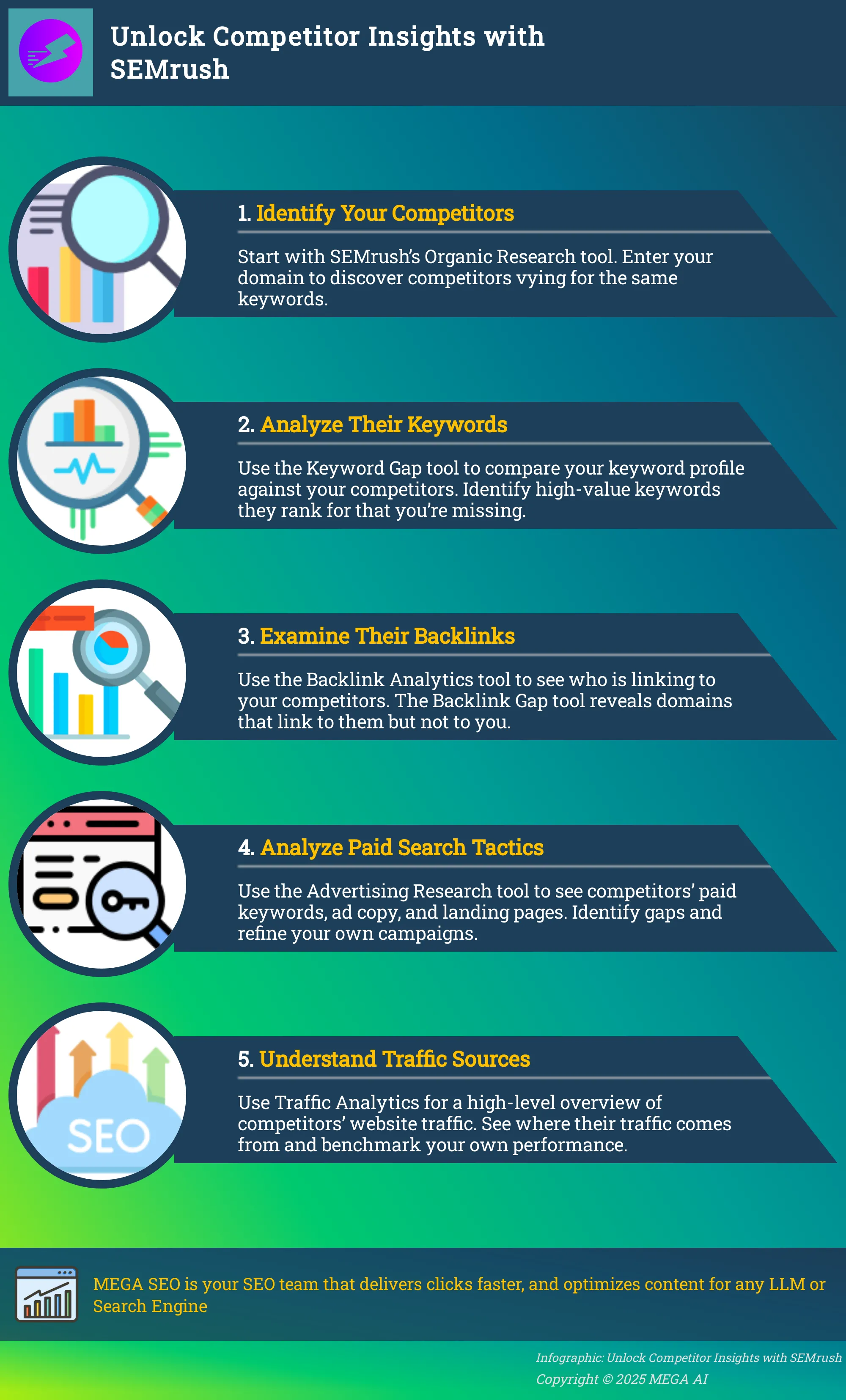
Conducting a thorough competitor analysis with Semrush involves using its powerful suite of tools to identify competitors, find keyword and backlink opportunities, and analyze traffic. The platform helps you move beyond guesswork by providing concrete data on what’s working for others in your space. This process starts with identifying your competitors, then using tools like the Organic Research Competitors Report and Position Tracking Tool to gather data on their search rankings and keyword performance. While this manual research provides a solid foundation, you can also use an SEO automation platform to continuously monitor the competitive landscape and adjust your strategy in real time. This allows you to focus on high-level planning while the system handles the day-to-day analysis and implementation.
Use Organic Research and Traffic Analytics
The best place to start your analysis is with the Organic Research tool. Simply enter your domain, and SEMrush will generate a list of your top organic competitors based on the number of shared keywords you both rank for. This report is invaluable for discovering competitors you may not have been aware of. Once you have your list, you can use the Traffic Analytics tool to get a broader view of their digital footprint. This feature shows you where their website traffic comes from—including direct, referral, social, and paid sources—giving you a more complete understanding of their overall marketing strategy.
Get Quick Insights with Domain Overview
For a fast, high-level look at any competitor, the Domain Overview tool is your go-to resource. Think of it as a digital report card for any website. By simply entering a competitor’s URL, you get an immediate summary of their online presence. The Domain Overview tool provides a comprehensive snapshot of a competitor's online presence, including their traffic sources, top organic keywords, and overall performance metrics. With this feature, you can quickly assess your competitors' strengths and weaknesses, allowing you to make informed decisions about your own strategies without getting lost in the details right away.
Key SEMrush Tools for Competitor Analysis
SEMrush offers a full suite of tools, and knowing which ones to use can help you build a complete picture of your competitor's digital strategy. Think of it as assembling a puzzle. Each tool gives you a different piece—their keywords, their ads, their backlinks, their traffic sources. When you put these pieces together, you get a clear view of what they’re doing well and where you might have an advantage. This holistic perspective is crucial because a competitor’s success rarely comes from just one channel. It’s the interplay between their content, link-building, and advertising that creates momentum.
We’ll focus on four core tools that provide the most critical insights for competitor analysis: Organic Research, Advertising Research, Backlink Analytics, and Traffic Analytics. Using them in combination will give you a solid foundation for your research. This approach helps you move from simply gathering data to understanding the story behind it. For example, you might see a spike in traffic from the Traffic Analytics tool, and by checking the other tools, you can determine if it was caused by a new successful ad campaign, a viral piece of content that earned backlinks, or ranking for a new high-volume keyword. Once you have this information, you can build a more effective SEO and paid media strategy to compete in your market.
Organic Research: Uncover Keyword Strategies
The Organic Research tool is your window into a competitor's SEO performance. It shows you which organic keywords they rank for and the pages that bring in the most traffic. This is where you can start to understand their content strategy. Are they targeting high-volume informational keywords or focusing on commercial terms with high purchase intent?
By analyzing the sites that rank for similar keywords, you can identify your true organic search competitors—they might not be who you think. The real power comes from using the Keyword Gap tool to compare your keyword profile directly against theirs. This analysis reveals keywords they rank for that you’re missing, giving you a clear, actionable list of content opportunities to pursue.
Advertising Research: Analyze Paid Search Tactics
If your competitors are running paid search campaigns, the Advertising Research tool is essential. It lets you peek behind the curtain at their paid strategy, showing you the keywords they bid on, the ad copy they’re testing, and the landing pages they use to convert visitors. This insight is incredibly valuable for refining your own Paid Ads campaigns.
You can analyze their ad history to see how their messaging has evolved and identify which offers they promote most heavily. By understanding their approach, you can find gaps in their strategy, bid on valuable keywords they might be ignoring, and write more compelling ad copy. This research helps you spend your ad budget more effectively instead of learning through expensive trial and error.
Backlink Analytics: Examine Link Profiles
Backlinks are a critical ranking factor, and the Backlink Analytics tool helps you understand who is linking to your competitors and why. A strong backlink profile signals authority to search engines. This tool lets you see the specific websites that link to your competitors, giving you a roadmap for your own link-building efforts.
Similar to the keyword analysis, the Backlink Gap tool is a great feature here. It compares your backlink profile to your competitors' and identifies domains that link to them but not to you. This creates a ready-made outreach list of relevant, high-authority sites that are already interested in your niche. Analyzing their most-linked-to pages also shows you what kind of content attracts links in your industry.
Traffic Analytics: Understand Traffic Sources
While other tools focus on specific channels, Traffic Analytics provides a high-level overview of a competitor's overall website performance. It estimates their total monthly traffic and breaks it down by source: direct, referral, search, social, and paid. This data is perfect for benchmarking your own performance and understanding how your traffic mix compares to others in your space.
You can also see key engagement metrics like average visit duration and bounce rate, which indicate how compelling their website experience is. By looking at their top traffic-driving countries, you can even identify potential new markets. This competitor traffic data helps you set realistic goals and understand the channels that are most effective for reaching your shared target audience.
How to Analyze Competitor Keywords
After identifying your main competitors, the next step is to understand their keyword strategy. This process goes beyond simply listing the terms they rank for. It’s about uncovering the patterns, strengths, and weaknesses in their approach so you can build a smarter, more effective content plan. Analyzing competitor keywords helps you find new content ideas, spot gaps in your own strategy, and understand what it takes to compete for valuable traffic in your niche.
While SEMrush provides the raw data, the real work lies in interpreting it. You’re looking for high-value keywords your competitors rank for that you’ve missed, as well as terms where you could realistically outperform them. This analysis forms the foundation of a strong SEO plan, guiding everything from the topics you write about to how you optimize individual pages. By systematically breaking down what works for others, you can save time and focus your resources on activities that are most likely to produce results.
Find Opportunities with the Keyword Gap Tool
One of the most direct ways to find keyword opportunities is with SEMrush’s Keyword Gap tool. This feature lets you compare your domain against up to four competitors to see exactly where your keyword profiles overlap and differ. As one guide to outsmarting competitors notes, the tool helps you identify keywords your competitors rank for that you do not, allowing you to uncover new opportunities. By filtering for keywords unique to your competitors, you can quickly build a list of topics your audience is searching for that you haven't yet covered. This is a straightforward way to fill content gaps and capture more relevant organic traffic.
Interpret Keyword Data for Strategic Insights
Gathering keyword data is just the first step; the real value comes from interpretation. It’s crucial to look beyond basic metrics and consider the user’s motivation. As one expert puts it, "Understanding why a person is searching for a particular term is just as important as the keyword metrics like search volume and keyword difficulty." Are they looking for information, comparing products, or ready to buy? Answering this question helps you create content that truly meets their needs. A thorough competitor analysis gives you a blueprint of what’s already working, allowing you to adopt successful tactics and improve upon them to gain an edge.
A Step-by-Step Guide to Competitor Analysis in SEMrush
With your competitors identified, it's time to dig into the data. A structured approach to competitor analysis helps you move beyond simple observation to strategic action. It’s about understanding the "why" behind your competitors' performance so you can build a better strategy for your own business. This process involves two key phases: gathering comprehensive data from various SEMrush tools and then translating that data into meaningful insights. By following these steps, you can systematically deconstruct your competitors' strategies and find actionable opportunities to improve your own search engine performance. Let's break down how to do it.
Gather Data from Multiple Tools
To get a complete view, you need to pull information from several places within SEMrush. Start by using the Competitive Research Toolkit to get a high-level overview. From there, you can use specific tools for deeper analysis. For instance, the Keyword Gap tool lets you enter your domain alongside up to four competitors to see which keywords they rank for that you don't. Similarly, the Backlink Gap tool shows you which websites link to your competitors but not to you. Conducting a thorough analysis means leveraging this powerful suite of tools to uncover keyword opportunities, backlink gaps, and traffic patterns. This multi-tool approach ensures you don’t miss critical pieces of the puzzle.
Interpret and Apply Your Findings
Gathering data is only half the battle; interpreting it correctly is what leads to real improvement. The goal is to understand the strategies that are working for your competition so you can adopt and improve upon them. For example, if you find a competitor is getting significant traffic from a specific cluster of keywords, that’s a clear signal to investigate that topic for your own content. While SEMrush provides robust statistics, the real value comes from turning those numbers into an actionable plan. Use these insights to refine your content calendar, adjust your keyword targeting, and build a more effective SEO strategy. This is how raw data becomes a roadmap for growth.
Go Deeper with Advanced SEMrush Features
Once you’ve mastered the basics of pulling keyword and backlink data, you can start using SEMrush’s more advanced features to get a richer understanding of the competitive landscape. These tools help you move from one-off reports to ongoing analysis, giving you a dynamic view of your competitors’ strategies and your own performance over time. Instead of just seeing what your competitors are doing, you can start to understand why they're doing it and how it's working.
This level of analysis is where you can find your true competitive edge. It allows you to spot trends before they become mainstream and react quickly to shifts in the market. For example, you might notice a competitor suddenly gaining traction on a new set of keywords, signaling a pivot in their content strategy. By combining data from multiple sources within SEMrush, you can build a more complete picture and make smarter, more proactive decisions for your own SEO and marketing efforts. This approach helps you see the full marketing mix, not just isolated tactics. It’s about connecting the dots between a competitor’s paid ads, their organic content, and their backlink profile to see the entire strategy at play. Let’s look at a couple of features that help you do just that.
Benchmark Performance with Position Tracking
To effectively conduct a competitor analysis, you need a baseline. The Position Tracking tool lets you monitor your daily rankings for a custom set of target keywords against your competitors’ rankings. This isn’t just a snapshot; it’s a continuous feed of data that shows you who is gaining or losing ground. You can see how your rankings change in response to your SEO efforts or after a major search engine update. By tracking these shifts, you can identify which competitors are making moves and pinpoint the keywords where you have the best chance to gain an advantage. This ongoing benchmark is essential for a proactive SEO strategy.
Compare Domains for a Holistic View
A competitor’s strategy is more than just a list of keywords. To get the full picture, you need a multichannel view of their online presence. SEMrush’s domain comparison tools allow you to see how your website stacks up against others across organic traffic, paid ads, and backlink profiles all at once. This holistic competitor analysis helps you understand how different marketing channels work together for your rivals. You might discover a competitor is weak in organic search but compensates with a strong paid ad campaign. This insight allows you to identify gaps in their strategy that you can exploit and informs your own resource allocation for a more effective marketing plan.
SEMrush Analysis: Best Practices and Common Pitfalls
SEMrush gives you a massive amount of data, which is both a strength and a potential weakness. With so many metrics at your fingertips, it’s easy to get sidetracked or focus on numbers that don’t actually move your business forward. The real skill lies in interpreting this data correctly and turning it into a clear plan. A successful analysis isn't about looking at every single chart and graph; it's about knowing which data points matter most for your specific goals and how they connect to form a complete picture of the competitive landscape. This is where many marketers get stuck—drowning in data without a clear path to action.
To get the most out of your research, you need a framework for what to look for and what to ignore. This means prioritizing trends over isolated numbers and understanding the context behind the metrics. It also means treating the data as a guide, not as an absolute truth. By following a few best practices, you can avoid common analysis mistakes and build a strategy that is grounded in solid, well-rounded insights rather than a few vanity metrics. Let's look at how to approach your analysis to get meaningful results that will actually inform your content and SEO efforts.
Focus on Relevant Metrics and Trends
SEMrush provides essential keyword metrics like search volume and keyword difficulty, but it's crucial to look deeper. Understanding the user intent behind a search term is often more valuable than its volume alone. A high-volume keyword might drive traffic, but if it doesn't align with what your audience is actually looking for, that traffic won't convert. Instead of just collecting keywords, analyze the trends. Is a competitor’s traffic steadily growing? Are certain topics gaining traction in your industry? A thorough competitor analysis focuses on these patterns to uncover real opportunities, not just surface-level data. This approach helps you build a strategy based on where the market is headed.
Avoid Over-relying on a Single Data Point
It’s tempting to find one exciting metric—like a competitor’s high-traffic keyword—and build your entire strategy around it. This is a common pitfall. SEMrush data, while powerful, provides estimates. To get a more accurate view, it's wise to compare these insights with other sources. Cross-reference what you find in SEMrush with your own Google Analytics and Google Search Console data. A single data point rarely tells the whole story. A competitor might rank for a major keyword, but their overall traffic could be declining, or their backlinks might be low quality. A holistic view that combines keyword data, backlink profiles, and traffic sources will always lead to better, more informed decisions for your SEO strategy.
Turn SEMrush Data into an Actionable Strategy
Data without a plan is just noise. After spending time gathering information on your competitors, the next step is to translate those numbers and charts into a clear marketing plan. This is where you connect the dots between what your competitors are doing and what you should be doing. By synthesizing data from different tools and applying it thoughtfully, you can build a strategy that gives you a competitive edge. This process moves you from simply observing the competition to actively outmaneuvering them in the search results.
Combine Data for Better Strategic Decisions
A single metric rarely tells the whole story. To make sound strategic decisions, you need to combine insights from multiple SEMrush tools. For example, the Organic Research tool might show a competitor ranking for a valuable keyword, but Traffic Analytics could reveal they get very little actual traffic from it. Adding Backlink Analytics might show the page has few referring domains, indicating a weakness you can exploit. A thorough competitor analysis involves using this full suite of tools to see the complete picture, not just isolated snapshots. This approach helps you identify genuine opportunities instead of chasing misleading data points.
Apply Insights to Your SEO Strategy
With a holistic view of the competitive landscape, you can start refining your own strategy. Studying your competitors helps you find successful tactics to replicate and weaknesses to target. For instance, if you find a keyword gap where a competitor ranks for terms you don't, you can build content around those topics. If their top-performing articles follow a specific format, test it for your own content. Remember that data goes beyond numbers; understanding user intent is critical. Knowing why someone searches for a term is as important as knowing the search volume. Applying these insights is the core of an effective SEO plan that drives real results.
Related Articles
- Best SEO Tracking Tools to Boost Your Rankings
- SEMrush Keyword Research: 2023 Step-by-Step Guide
- How to Use SEMrush for Content Marketing: The Ultimate Guide
- Boost Your Content Game Using Semrush Marketing Tools
- How to Use Ahrefs for Competitor Analysis: Boost Rankings
Frequently Asked Questions
What's the most important first step when analyzing competitors in SEMrush? Before looking at any competitors, you should set up a Project for your own website. This creates a performance baseline that makes all the competitor data you gather more meaningful. Once that's done, use the Organic Research tool on your own domain to get an initial list of competitors based on shared keywords.
How do I find competitors I don't already know about? The Organic Research tool is the best place to start. When you enter your domain, SEMrush generates a report of other websites that rank for many of the same keywords. This often reveals "search competitors" who are targeting your audience online, even if they aren't your direct business rivals.
Should I focus more on my competitors' keywords or their backlinks? Both are critical, but they inform different parts of your strategy. Analyzing keywords helps you understand the topics your audience is interested in and identify gaps in your own content plan. Analyzing backlinks shows you what kind of content earns authority in your industry and gives you a roadmap for building your own site's credibility.
How often should I be doing this kind of competitor analysis? A deep, comprehensive analysis is valuable to perform quarterly or whenever you are planning a major shift in your marketing strategy. For more regular updates, you can use a feature like the Position Tracking tool to monitor your keyword rankings against competitors on a weekly basis. This helps you spot trends without needing to run a full report each time.
What's the biggest mistake to avoid when analyzing competitor data? A common mistake is focusing on a single metric in isolation, such as one high-volume keyword. A strong strategy comes from combining data from multiple tools to see the complete picture. A competitor might rank for an impressive keyword, but their overall traffic could be low. Always look for trends and cross-reference your findings to build a reliable plan.