
Your competitors are actively working to capture the same audience you are. To gain an edge, you need to understand their playbook—where they get their authority, what content earns them links, and how quickly they are growing. Majestic serves as your digital intelligence tool, providing a clear view of the competitive terrain. Knowing how to use Majestic for competitor analysis is the first step toward creating a strategy that not only competes but wins. This article will walk you through the process of dissecting your rivals' backlink profiles, identifying their strongest assets, and uncovering strategic gaps you can exploit to improve your own search engine visibility.
Key Takeaways
- Prioritize Link Quality Over Quantity: Use Majestic’s Trust Flow to identify authoritative domains. A few strong links from trusted sources will have a greater impact on your rankings than many low-quality ones.
- Deconstruct Competitor Success: Analyze your competitors' most-linked pages and top referring domains. This reveals the exact content topics and link-building tactics that work in your niche, giving you a proven model to follow.
- Target High-Potential Link Gaps: Use the Clique Hunter tool to find domains that link to multiple competitors but not to you. This instantly generates a list of qualified outreach targets that have already shown interest in your industry.
What is Majestic and Why Use It for Competitor Analysis?
Majestic is a powerful SEO tool designed for digital marketers, SEO specialists, and anyone looking to understand the web's link graph. It uses a vast web map to provide critical insights into a website’s authority, backlink profile, and overall online visibility. By tapping into Majestic’s extensive database, you can get a clear picture of your competitors' online strategies and performance.
The primary reason to use Majestic for competitor analysis is its deep focus on backlinks. High-quality backlinks from reputable websites are a cornerstone of good SEO, signaling to search engines that your site is trustworthy and authoritative. A backlink is simply a link from another website to yours, and understanding your competitors' backlink profiles can reveal valuable opportunities for your own link-building efforts.
Majestic offers unique features that allow you to track competitor digital PR campaigns, identify their new and lost links, and analyze the overall health of their link profiles. The platform’s historical data, which spans over 15 years, gives you a comprehensive perspective that can inform both your current and future SEO strategies. The insights you gain from a thorough competitor analysis in Majestic make it an essential tool for anyone serious about improving their search engine rankings.
How to Get Started with Majestic
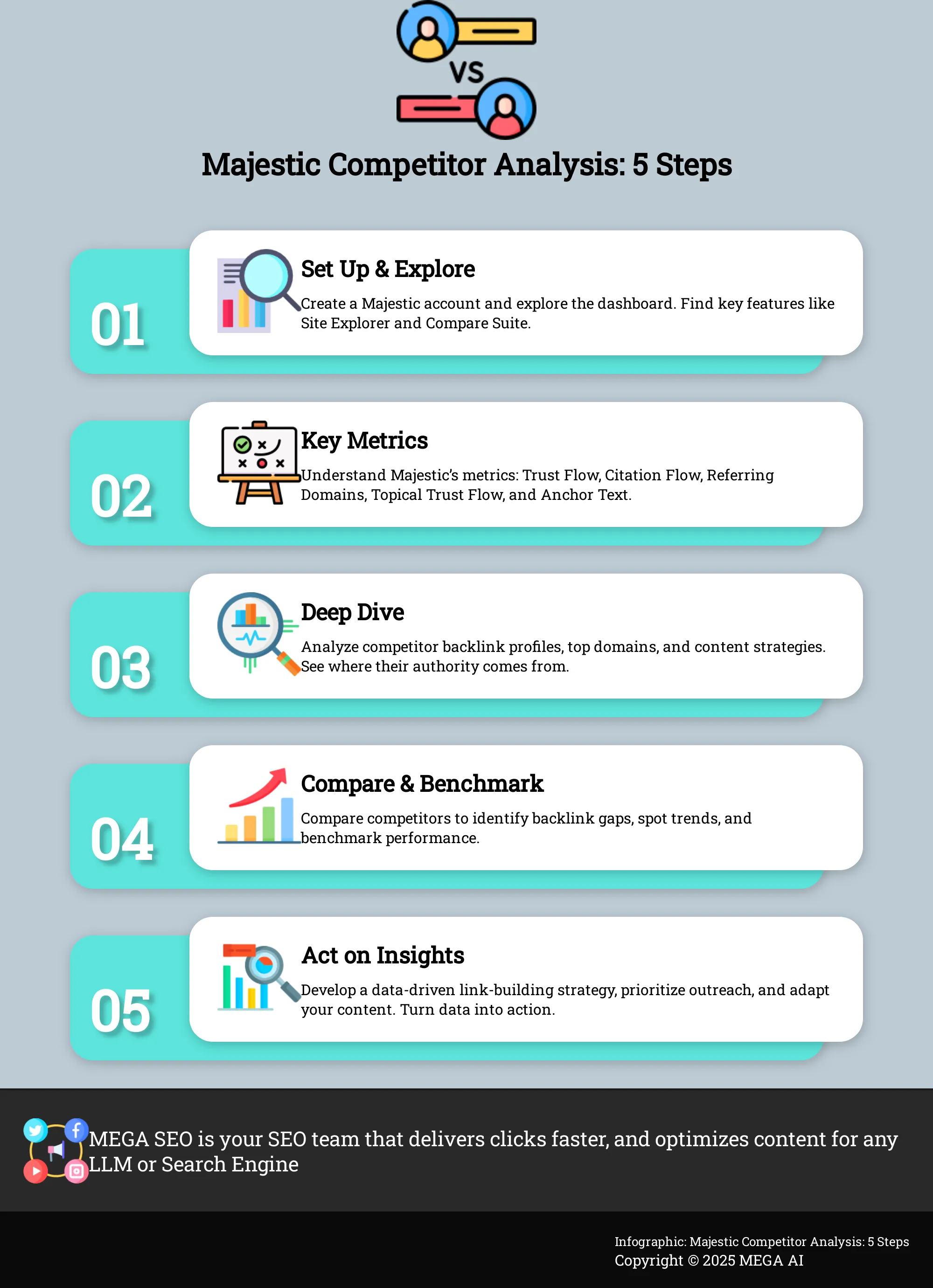
Jumping into a new tool can feel like a lot, but getting set up with Majestic is straightforward. Before you can start digging into competitor data, you’ll need to create an account and get a feel for the main dashboard. Let's walk through these first two steps so you can get to the good stuff—the insights. Taking a few minutes to get oriented will make the entire process of competitor analysis smoother and more effective. Think of it as setting up your workspace before starting a big project. A little preparation now will help you move much faster later.
Set Up Your Account
Your first step is to head over to the Majestic website and create an account. You’ll need to choose from several subscription plans, so take a moment to find one that aligns with your budget and the scale of your analysis needs. Once you’ve signed up, you’ll be prompted to verify ownership of your website. This is a critical step because it unlocks the full range of features for analyzing your own domain, giving you a baseline to compare against your competitors. The verification process is simple and ensures you have complete access to all the data Majestic has on your site, which is essential for a comprehensive strategy.
Find Your Way Around the Dashboard
Once your account is ready, take some time to explore the main dashboard. At its core, Majestic works by mapping the web to create scores that indicate a website's authority and influence. Getting comfortable with the layout will help you use the tool effectively. For example, you’ll find powerful features like the Clique Hunter, which is perfect for competitor analysis. This tool allows you to enter the domains of several competitors and find websites that link to all of them. It’s a quick way to identify high-value link-building opportunities that are already working for others in your niche. Familiarizing yourself with tools like this is key to unlocking actionable insights.
What Are Majestic's Key Metrics?
Before you can pull meaningful insights from Majestic, you need to understand its language. The platform uses a set of proprietary metrics to evaluate a website's authority and link profile. Think of these as the vital signs of a website's health. While there are many data points, focusing on a few key metrics will give you the clearest picture of your competitors' strengths and weaknesses. Understanding these core concepts is the first step toward building a data-driven strategy. We'll walk through the most important ones: Trust Flow, Citation Flow, referring domains, Topical Trust Flow, and anchor text. Each one tells a different part of the story, and together, they provide a comprehensive view of any site's backlink profile.
Trust Flow and Citation Flow
Trust Flow and Citation Flow are Majestic’s signature metrics for evaluating a link profile. Think of Citation Flow as a popularity contest—it measures the quantity of links pointing to a site. A high Citation Flow means a site has a lot of backlinks. Trust Flow, on the other hand, measures quality. It looks at how close a site is to a seed list of manually vetted, trustworthy websites. A high Trust Flow means a site is getting links from authoritative and credible sources. While a high Citation Flow is good, a high Trust Flow is better. The ideal scenario is a healthy balance between the two, indicating both popularity and authority.
Referring Domains and Backlinks
It’s easy to confuse referring domains with backlinks, but the distinction is important. Backlinks are the total number of individual links pointing to a site, while referring domains are the number of unique websites those links come from. For example, 100 backlinks from one website count as one referring domain. It's generally better to have links from many different high-quality domains than many links from just a few. Majestic’s Backlink History Checker is a great tool for tracking the growth of referring domains over time. This allows you to see how your competitors’ link-building strategies have evolved and at what pace they are acquiring new links.
Topical Trust Flow
Topical Trust Flow adds another layer of context by categorizing a website's authority by industry or topic. Instead of just a general trust score, this metric shows you which subjects a website is considered an authority on, based on the topics of the sites linking to it. For example, a site might have a high Topical Trust Flow in "Business / Marketing" but a low one in "Sports / Football." This is incredibly useful for your own strategy. You can use it to find relevant, high-authority websites in your specific niche, giving you a list of powerful link-building opportunities that are directly related to what you do.
Anchor Text
Anchor text is the clickable text in a hyperlink. It’s a small detail with a big impact on SEO. This text gives search engines like Google valuable context about what the linked page is about. For example, a link with the anchor text “AI-powered SEO tools” is much more descriptive than one that just says “click here.” When analyzing competitors, looking at their anchor text distribution shows you what keywords they are being associated with across the web. This provides crucial insight into how they are perceived by other sites and can reveal the core topics that drive their search engine rankings.
How to Use Site Explorer for Competitor Insights
Site Explorer is your starting point for deep-diving into a single competitor. Think of it as a magnifying glass for their website. By plugging in a competitor's URL, you get a comprehensive overview of their online footprint, from their most powerful backlinks to their most successful content. This is where you move from high-level metrics to specific, actionable data that can inform your own SEO strategy. Let's break down how to use it to get a clear picture of what your competitors are doing right.
Analyze Competitor Backlink Profiles
A competitor's backlink profile is the collection of all the websites that link to them. Majestic lets you track their digital PR campaigns and see where their authority comes from. In Site Explorer, you can use the 'New/Lost' report to monitor recent changes in their link profile, which can signal an active campaign or a shift in strategy. The 'Context' and 'Backlinks' reports provide detailed information about inbound links, showing you the anchor text used and the strength of the linking page. By analyzing this, you can understand the quality and nature of their relationships, giving you a blueprint of the types of links that work in your niche.
Identify Top Referring Domains
Not all links carry the same weight. A single link from a trusted, authoritative website can be more valuable than dozens of links from low-quality sites. The 'Referring Domains' tab in Site Explorer lists all the unique websites linking to your competitor, which you can sort by Trust Flow to see the most powerful ones first. These top-tier domains are your high-priority targets. If a reputable site in your industry linked to your competitor, it shows they are interested in the topic. This gives you a warm lead for your own outreach, especially if you can offer a more comprehensive or updated piece of content. Understanding a competitor's link building strategies starts with identifying their best link sources.
Uncover Competitor Content Strategies
The content that attracts links is often a brand's most valuable asset. Examining your competitors' backlinks reveals their most successful techniques and helps you find areas for improvement in your own strategy. Head to the 'Pages' tab in Site Explorer to see which of their URLs have earned the most backlinks. Are they long-form blog posts, data-driven reports, free tools, or in-depth guides? These are their "link magnets." Identifying these patterns helps you understand what resonates with your shared audience and with other sites in your industry. This insight is critical for developing your own content strategy, allowing you to create assets that are designed to attract high-quality links from the start.
How to Use the Compare Suite to Find Opportunities
While Site Explorer is great for a deep dive into a single competitor, the Compare Suite is where you can zoom out and see the entire competitive landscape. This tool lets you analyze multiple domains at once, making it easier to spot high-level patterns and strategic openings. Instead of getting lost in the weeds of one competitor's profile, you can quickly gauge your position in the market and identify the most promising opportunities. Think of it as moving from a one-on-one conversation to listening in on a group discussion. You learn who the dominant voices are, who is getting the most attention, and where you can chime in.
This broader view is essential for building a well-rounded strategy that doesn't just react to one competitor but addresses the market as a whole. Manually gathering and comparing this data across several sites would take days of spreadsheet work. Tools like Majestic streamline the data collection, but acting on the insights is another challenge. For businesses looking to take efficiency a step further, platforms like MEGA AI can automate your SEO from research to execution, turning your competitive analysis into tangible ranking improvements without the manual effort. This allows you to focus on strategy while the system handles the outreach and content adjustments.
Compare Multiple Competitors
Majestic's Compare Suite allows a side-by-side comparison of your website's backlink profile with your competitors. This view places key metrics like Trust Flow, Citation Flow, referring domains, and total backlinks next to each other, giving you an instant snapshot of where you stand. You can add your domain and up to four competitors to see how your authority and link volume stack up against the key players in your space. This isn't just about seeing who has the most links. Look for imbalances. Does one competitor have a much higher Trust Flow despite having fewer referring domains? That suggests they are earning very high-quality links. This feature helps you visualize the different link-building strategies at play and benchmark your own performance against them.
Identify Backlink Gaps
One of the most powerful features within the Compare Suite is the Clique Hunter tool. It’s designed to find websites that link to your competitors but not to you. This is a straightforward way to identify gaps in your backlink profile and build a list of high-potential outreach targets. These domains have already demonstrated an interest in your niche by linking to similar sites, which makes them more likely to be receptive to your content. Think of this as a pre-qualified prospect list for your link-building efforts. Instead of starting from scratch, you have a clear set of domains to investigate. Using Majestic this way saves significant time and focuses your outreach on sites that are already part of your industry's conversation.
Spot Trends in Backlink Growth
A website’s backlink profile is not static. The Backlink History feature tracks how a site’s links have changed over time, showing you the momentum of your competitors. You can see if their link profile is growing, shrinking, or staying flat. A sudden spike in referring domains might point to a successful content marketing campaign or a piece of viral news you can learn from. Slow, steady growth often indicates a consistent, long-term SEO strategy. By analyzing these trends, you can get a better sense of your competitors' tactics and timelines. This insight helps you set realistic goals for your own campaigns. Understanding the history of a website's link profile gives you context that a simple snapshot can't provide.
Advanced Majestic Techniques for Deeper Analysis
Once you are comfortable with the basic metrics, you can use Majestic’s advanced tools to get a real competitive edge. These features move beyond simple data points and help you uncover the specific tactics your competitors are using. This deeper analysis is where you can find high-impact opportunities to inform your own link-building and content efforts.
Find Link Opportunities with Clique Hunter
Clique Hunter is a powerful tool for finding high-value link prospects. It works by identifying domains that link to several of your competitors but not to your site. By analyzing common backlinks among multiple competitors, Clique Hunter shows you potential link-building opportunities that are already working for similar sites in your niche. These domains have already shown they are interested in your topic and are willing to link to sites like yours, which makes them warm prospects for outreach. Simply enter a handful of your top competitors to generate a targeted list for your next link-building campaign.
Check Your Link Neighborhood
The quality of sites linking to you matters. This concept is often called your "link neighborhood." Using Majestic’s Trust Flow and Citation Flow metrics for link quality assessment can help you understand your link neighborhood and the quality of sites linking to you. A strong neighborhood consists of authoritative, relevant websites, which signals trust to search engines. Analyze your competitors' link profiles to see where they are getting their links. If they are earning links from respected industry blogs and news outlets, that sets a quality benchmark for your own efforts and helps you understand what a healthy backlink profile looks like.
Analyze Backlink History
Understanding how a competitor’s backlink profile grew over time provides critical strategic context. Majestic’s Backlink History Checker allows you to track and compare the backlink growth of your site against your competitors, offering insights into their strategies. A sudden spike in backlinks might point to a successful digital PR campaign or a piece of viral content worth investigating. A slow, steady increase suggests a consistent, long-term effort. By looking for these patterns, you can better understand the tactics that work in your industry and build a more effective and sustainable SEO strategy for your own business.
How to Act on Your Majestic Insights
Gathering data is just the first step. The real value comes from turning those numbers and charts into a clear action plan. Once you've analyzed your competitors' profiles using Majestic, you can start making strategic decisions that improve your own SEO performance. Here’s how to translate your findings into tangible results for your business.
Develop Your Link-Building Strategy
Think of your competitors' backlink profiles as a blueprint for what works in your industry. Examining their backlinks reveals their link-building strategies, helping you see which techniques are most successful. Are they earning links from guest posts on industry blogs, features in news articles, or mentions on resource pages? Understanding their approach allows you to refine your own. You can emulate their successes and find gaps they might have missed. This data-driven method takes the guesswork out of building a link-building strategy that gets results.
Prioritize Your Outreach Efforts
Your time is valuable, so your outreach should be as targeted as possible. Majestic helps you focus your efforts on the most promising prospects. For instance, the Clique Hunter tool is designed to find websites that link to your competitors but not to you. This gives you a pre-qualified list of sites that are already interested in your niche and are open to linking to businesses like yours. By starting with these warm leads, you can make your outreach campaigns more efficient and increase your chances of securing high-quality backlinks.
Adapt Your Content Strategy
The insights from Majestic can directly inform what content you should create or update. The 'Pages' report in Site Explorer shows you which of your competitors' pages have earned the most links. This tells you exactly what topics and formats resonate with your target audience and attract authority. You can use this information to create similar, more comprehensive content. For your own site, you can use tools like MEGA AI's SEO automation to automatically update and add new sections to your top-performing articles, keeping them fresh and competitive. This also helps you find and fix broken links to recapture lost traffic and improve user experience.
Common Majestic Challenges (and How to Solve Them)
Majestic is a powerful tool, but its extensive data can sometimes feel like a lot to handle. Like any advanced platform, there's a slight learning curve. Let's walk through some common hurdles users face and the straightforward solutions to overcome them, ensuring you get the most out of your analysis.
How to Handle Data Overload
At first glance, the sheer volume of data in Majestic can be overwhelming. The key is to start with a clear objective. Instead of trying to analyze every single data point, focus on the metrics that align with your specific goal, whether it's finding top-tier link opportunities or understanding a competitor's content strategy. Use the platform's filters to narrow your view to the most relevant information. While it presents a lot of information, the benefits of using Majestic for a thorough competitive analysis make it an essential tool for anyone serious about improving their search rankings.
How to Interpret Complex Metrics
Metrics like Trust Flow and Citation Flow are more than just numbers; they tell a story about a website's authority. A common mistake is to focus on the quantity of backlinks over their quality. A site with thousands of low-quality links is weaker than one with a handful of authoritative ones. Use Trust Flow as your guide to backlink quality. Look at the ratio between Trust Flow and Citation Flow. A high Citation Flow with a disproportionately low Trust Flow can be a red flag for spammy link-building tactics, giving you a more nuanced view of your competitor's profile.
Set Up Regular Competitor Monitoring
Your competitors' strategies aren't static, so your analysis shouldn't be a one-time event. To stay ahead, you need to monitor their backlink profiles regularly. A simple way to do this is by creating a spreadsheet to track key metrics for your top competitors each month. This practice helps you spot new link-building campaigns as they happen and identify trends over time. While this manual tracking is effective, consider automating SEO tasks to save time and ensure you never miss a critical change in a competitor's strategy, freeing you up to focus on execution.
Best Practices for Majestic Competitor Analysis
Pulling data from Majestic is the first step, but turning that data into a winning strategy requires a thoughtful approach. To get the most out of your analysis, it’s important to move beyond surface-level numbers and adopt a few key practices. By focusing on what truly matters, organizing your findings, and keeping an eye on the long game, you can transform raw data into a clear roadmap for outranking your competition.
Focus on Link Quality, Not Quantity
It’s easy to get caught up in the total number of backlinks a competitor has, but this can be misleading. A site with 100 high-quality links will almost always outperform one with 1,000 low-quality links. One common mistake is focusing too narrowly on quantity over quality. Majestic's Trust Flow metric is your best tool to avoid this, as it helps indicate the quality of backlinks by measuring their authoritativeness. When analyzing a competitor’s profile, sort their links by Trust Flow. This immediately shows you their most powerful links—the ones actually driving their search performance. This gives you a realistic picture of their off-page strength and helps you identify high-value link targets.
Organize Your Data Effectively
Majestic provides a wealth of information, which can quickly become overwhelming without a system to manage it. To make sense of it all, you need an organized approach. When you collect data on your competitors, organizing it in a spreadsheet allows you to easily find, analyze, and share your findings. This simple step turns a messy data export into a strategic asset. Create a spreadsheet with columns for each competitor, including their URL, Trust Flow, Citation Flow, and total referring domains. Add a notes column for strategic observations, like "gained many links from tech blogs last month." This creates a clear view of the competitive landscape and makes it easier to spot patterns and opportunities.
Monitor Changes Over Time
Competitor analysis is not a one-and-done task. Your competitors are constantly adjusting their strategies and building new links. To stay ahead, you need to monitor their activity regularly. Using Majestic’s Backlink History Checker, you can track and compare the backlink growth of your site against your competitors, providing insights into their link-building velocity and tactics. Set a recurring reminder to check in monthly or quarterly. Look for sudden spikes in new links, which could signal a successful campaign, or a steady increase that shows a consistent strategy. This ongoing monitoring helps you adapt your own SEO strategy in response to your competitors' moves, ensuring you don't fall behind.
How to Measure the Impact of Your Strategies
Once you’ve put your new link-building and content strategies into action, the work isn’t over. The final step is to measure your results to see what’s working and what isn’t. This is how you turn data into a repeatable process for growth. Start by tracking your own site’s key metrics in Majestic over time. Are your Trust Flow and referring domain count increasing? Consistent growth here is a clear sign that your efforts are paying off.
Beyond your own metrics, the real test is how you stack up against the competition. Continue to run regular comparisons using Majestic’s Compare Suite. This allows you to benchmark your progress directly against the sites you’re trying to outperform. If your backlink growth is outpacing theirs or you’re successfully acquiring links from their top referring domains, you know your strategy is effective. This ongoing analysis helps you discover your competitor's link building strategies and gauge whether your own tactics are giving you a competitive edge and greater visibility.
To get a granular view of your impact, you’ll need to organize and analyze your data. You can export reports from Majestic and process backlink profile data to identify trends in the links you’ve acquired. Are they coming from high-authority sites? Are they topically relevant? Answering these questions helps you refine your outreach and focus on activities that deliver the highest value. This continuous loop of analysis, action, and measurement ensures your strategy evolves and improves. For businesses looking to streamline this process, MEGA AI’s platform can automate content updates and CTR improvements, helping you act on these insights more efficiently.
Related Articles
- Majestic for Local SEO: A Step-by-Step Guide (2023)
- Comprehensive Backlink Audit: A Step-by-Step Guide
- Trust Flow SEO: The Definitive Guide (2024)
- Link Building Strategies: The Complete Guide
- How to Use Ahrefs for Competitor Analysis: Boost Rankings
Frequently Asked Questions
What's the most important Majestic metric to focus on when I'm just starting? If you're feeling overwhelmed by the data, start by focusing on Trust Flow. While metrics like Citation Flow and referring domain count are useful,
I've identified my competitors' best backlinks. What's my next move? Once you've found a high-quality link your competitor has earned, your goal is to understand why they got it and then create an opportunity for yourself. Visit the linking page to see the context. Did your competitor provide a unique statistic, a helpful guide, or an insightful quote? Your next step is to create a resource that is even more thorough, current, or valuable. Then, you can reach out to the editor of that website and introduce your improved resource as a potential addition to their article.
How is Majestic different from other popular SEO tools? Many SEO platforms offer a wide range of features, from keyword research to rank tracking. Majestic's primary strength and specialty is its deep and historical analysis of the web's link graph. Its proprietary metrics, like Trust Flow and Topical Trust Flow, provide a unique perspective on website authority that is based entirely on the quality and relevance of backlinks. Think of it as a specialist tool for understanding link-based authority, which is a core component of SEO.
How often should I be checking my competitors' backlink profiles? Consistency is more important than frequency. A good practice is to perform a quick check-in on your top three competitors once a month. This allows you to spot major changes, like a new digital PR campaign or a significant increase in referring domains. For a more comprehensive analysis and to track long-term trends, a deeper dive every quarter is sufficient. This approach keeps you informed without getting lost in daily fluctuations.
Can I still get value from Majestic if I'm new to SEO? Absolutely. While the tool has advanced features, you can gain powerful insights by sticking to the basics. Start by using the Site Explorer to look up your own domain and a few key competitors. Compare core metrics like Trust Flow and referring domains to benchmark your performance. This simple comparison will give you a clear, data-backed understanding of your position in the market and provide a solid foundation for your first link-building initiatives.