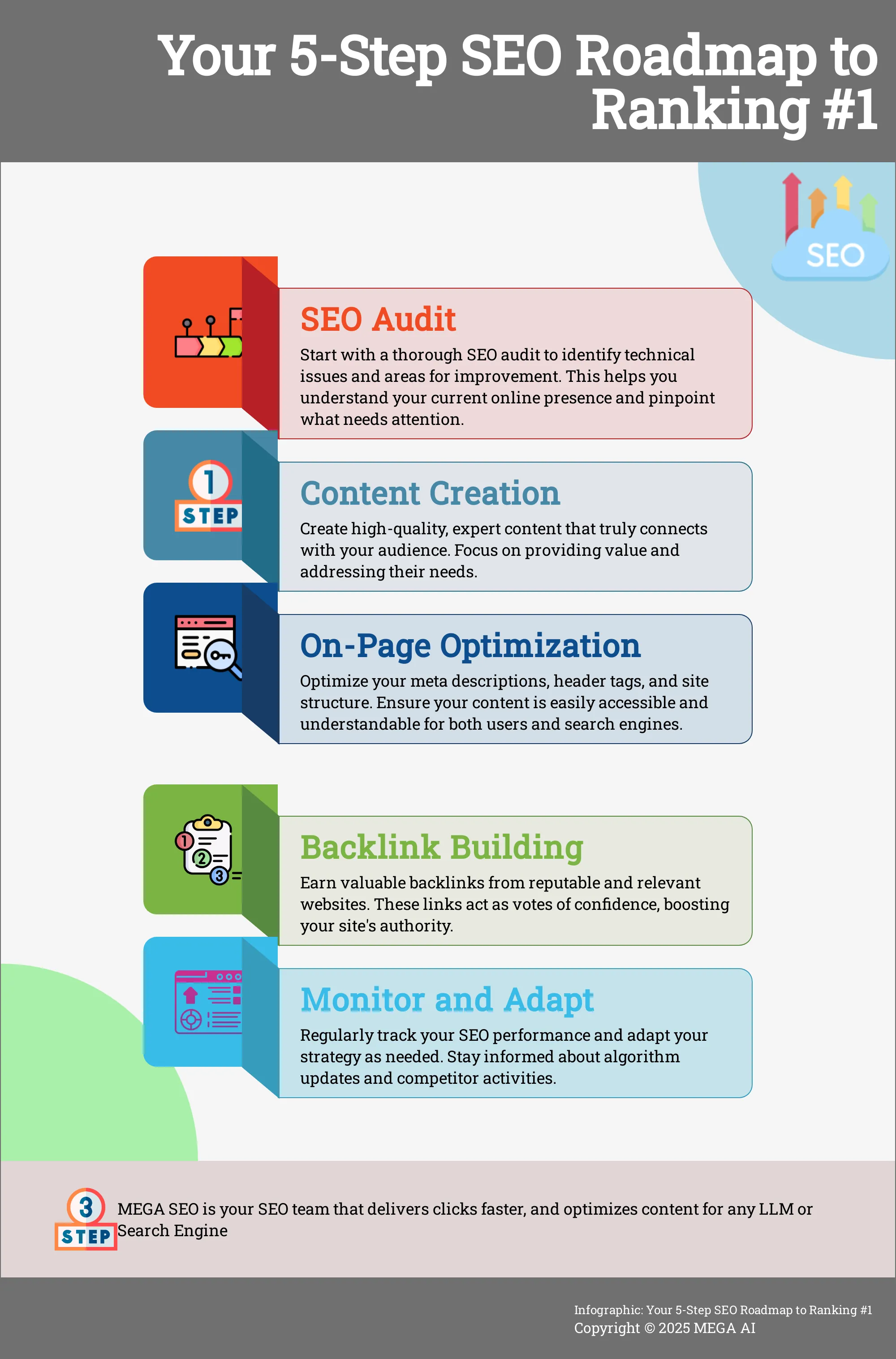
Securing a top spot in Google's search results is a common goal for many businesses and content creators, and for good reason—it means more visibility and more potential customers. But how do you actually get there? It’s not about finding a single magic bullet, but rather about consistently applying a range of effective strategies. This article serves as your roadmap, guiding you through the critical components of modern SEO. We’ll start with understanding your current SEO health, move into crafting compelling content, cover the nuts and bolts of on-page and technical optimization, and discuss how to earn valuable backlinks. Think of this as your guide to building a stronger online presence, step by step.
Key Takeaways
- Understand Google's Ranking Essentials and Audit Your Site: Prioritize E-E-A-T, site speed, and user experience, then conduct a comprehensive technical audit to build a strong SEO foundation.
- Create High-Value Content and Earn Quality Backlinks: Develop expert content that genuinely helps your audience, keep it fresh, and actively pursue relevant, authoritative links to enhance your site's credibility.
- Continuously Monitor, Adapt, and Refine Your SEO Strategy: Regularly track your performance and competitor actions, structure your content effectively, and stay flexible to evolve with search engine updates.
How Does Google Rank Websites (And What's Key in SEO Now)?
Think of Google's ranking process as a highly complex system designed to find the best answers for its users. It uses a sophisticated algorithm with hundreds of factors to decide which websites appear at the top of search results. While the exact formula is a closely guarded secret, we have a strong understanding of the key elements that Google values. Understanding these can really shape your SEO strategy.
At its core, Google wants to reward websites that demonstrate experience, expertise, authority, and trust – often referred to as E-E-A-T. This means creating content that is not only well-researched and accurate but also showcases your unique insights and credibility in your field. Another significant factor is how often people search directly for your brand. These "branded searches" tell Google that your business is recognized and sought after, which can positively influence your rankings.
Keeping your content fresh is also vital. Google tends to favor information that is current and relevant. This doesn't always mean publishing new articles constantly; often, revisiting and updating your existing content can lead to significant gains. On the flip side, having multiple pages covering the exact same topic can be detrimental. This can confuse Google about which page to rank, potentially causing none of them to perform well. It's far better to have one comprehensive, high-quality page on a specific subject. Finally, remember that SEO is a competitive field. It’s not just about optimizing your site in isolation but understanding what the top-ranking sites in your niche are doing and finding ways to provide even more value.
Start with a Thorough SEO Check-Up
Before you aim for that top spot on Google, it’s essential to understand your current standing. Think of it as a health check for your website. A comprehensive SEO audit lays the groundwork for a successful strategy by showing you what’s working, what’s not, and where you can make improvements. This initial review is your roadmap to better rankings, helping you focus your efforts effectively from day one. For businesses looking to enhance their online presence, this step is foundational.
Pinpoint Technical Glitches and Review Content Quality
Your journey to ranking number one often begins with a close look under the hood. An SEO site audit tool can identify critical issues such as broken pages, content with low word counts, duplicate titles, and problems with site speed. As expert Neil Patel notes, "If your site isn't crawlable, your content doesn't matter." Ensuring search engines can easily access and understand your site is fundamental. Platforms offering SEO services can automate the detection of these technical problems and provide clear instructions on how to fix them, allowing your valuable content the opportunity to be seen and ranked. Addressing these foundational elements first prevents future headaches and wasted effort.
Check How Users Interact with Your Site
Understanding how people engage with your website offers valuable clues for your SEO. Google pays attention to user signals, and branded searches—when users type your company name directly into Google—are a significant ranking factor. This indicates that your brand is memorable and actively sought after. Consider how users move through your site, how long they stay on pages, and what actions they take. This insight helps you refine your content and user experience to better meet their needs. Improving user interaction can lead to better engagement metrics, which search engines often interpret as a sign of a quality, relevant website.
See What Top Competitors Are Doing
Effective SEO isn’t just about optimizing your own site in a vacuum; it’s also about understanding the competitive landscape. Take a look at what your top competitors are doing. Which keywords are they ranking for? What kind of content are they producing, and how is their site structured? Analyzing your competition provides insights into strategies that are currently working in your niche. This doesn't mean simply copying them, but rather learning from their successes and identifying opportunities where you can differentiate your approach and perform better. As Neil Patel also mentions, "Good SEO isn't just about your site; it's about beating your competition." Tracking competitor movements allows you to adapt your SEO strategy and make smarter, faster decisions.
Write Content That Truly Connects with People
Creating content that ranks well isn't just about hitting the right keywords; it's about forging a genuine connection with your audience. When your words resonate, people tend to stay on your page longer, interact more with your material, and begin to see you as a reliable source of information. These are all positive signals that search engines like Google take into account.
Blend Expertise with Authority and Easy Reading
Google's algorithm gives preference to content that clearly shows experience, expertise, authority, and trustworthiness, often called E-E-A-T. As marketing expert Neil Patel has mentioned, AI sometimes produces "regurgitated information that everyone already sees on the web." To make your content stand out, it needs to offer unique insights and be presented with a clear, authoritative voice. This means you should aim to provide real value that goes beyond surface-level details. While AI tools can certainly help you draft content, the human touch is essential for infusing it with genuine expertise. Always ensure your final piece is not only informative but also straightforward to read and understand, suiting your audience's familiarity with the topic.
Use Multimedia and Structured Data Smartly
Relying solely on text can sometimes make your content feel dense or overwhelming for readers. By incorporating multimedia elements such as images, videos, and infographics, you can make your articles more engaging and much easier to digest. These visuals are great for breaking up long sections of text and can help clarify complex ideas. Beyond just visuals, using structured data, also known as schema markup, helps search engines get a better grasp of your content's context. This can lead to your pages appearing as richer search results, perhaps with featured snippets or review stars, which makes your listings more appealing to users scrolling through search results.
Refresh Your Content to Keep It Effective
Your existing library of content is a significant asset, but it requires ongoing attention to maintain its relevance and impact. Google tends to favor fresher content, as Neil Patel highlights by noting that "Wikipedia ranks for everything on Google because it's consistently updated." Making it a practice to revisit and update your older posts can lead to noticeable improvements in their search performance. You can use tools like Google Search Console to spot pages that have seen a decline in traffic; these are often excellent candidates for a content refresh. Updating statistics, adding new, pertinent information, or simply improving the clarity of your writing can bring new life to articles that have been around for a while. Platforms like MEGA AI offer tools, such as a Maintenance Agent, which can assist in identifying these opportunities to enhance your existing articles, ensuring your content continues to perform well for your business.
Get Your On-Page and Technical SEO in Order
Once your content strategy is taking shape, it's time to focus on the technical aspects that help search engines understand and favor your website. On-page and technical SEO are the foundations of a well-ranking site. Think of it like building a house: your content is the beautiful interior design, but on-page and
Getting these details right means search engines can easily crawl, interpret, and index your pages. This isn't just about pleasing algorithms; it's about creating a better experience for your users too. When your site is technically sound, it often translates to faster load times, easier navigation, and clearer information hierarchy. These improvements directly contribute to user satisfaction, encouraging visitors to stay longer and engage more deeply with your content, which in turn signals quality to search engines and can lead to better rankings. Many businesses find that automating parts of their technical SEO helps them stay on top of these crucial elements without getting bogged down in complex details. Taking the time to address these areas can make a significant difference in your visibility and how effectively you connect with your audience.
Optimize Meta Details and Header Tags
Your meta details, specifically title tags and meta descriptions, are like the welcome mat and front door sign for each page on your website. They are among the first things search engines see to understand what your page is about, and they're often what users see in search results. Make sure every page has a unique title tag that clearly describes its content and includes your main keyword for that page. Similarly, craft compelling meta descriptions that summarize the page's value and encourage users to click through from the search results page.
Header tags (H1, H2, H3, etc.) structure your content, making it easier for both readers and search engines to digest. Your H1 tag is typically the main title of your page content and should reinforce the topic. Subsequent header tags should organize subtopics logically, creating a clear hierarchy. Using keywords naturally within your headers can also provide additional context to search engines, helping them categorize and rank your content appropriately.
Use Schema Markup and Understand Entity SEO
Schema markup is a type of microdata you can add to your website's HTML to help search engines better understand the specific information on your pages. For example, you can use schema to identify recipes, events, products, or local business information. When search engines have this clearer understanding, they can display your content as "rich snippets" in search results—those more detailed listings that might include ratings, prices, or event dates. These enhanced listings can significantly improve your click-through rates by making your content stand out.
Understanding entity SEO is also becoming increasingly important. This means recognizing that search engines like Google are working to understand topics and the relationships between them (the "entities") rather than just isolated keywords. By structuring your content around entities and clearly defining them, perhaps with the help of structured data, you can improve how search engines perceive your site's authority and relevance on specific subjects.
Improve Site Speed and Mobile Experience
How quickly your website loads is a major factor in both user experience and search engine rankings. People are impatient; if a page takes too long to load, they're likely to leave. Google knows this and prioritizes sites that offer a fast, smooth experience, especially on mobile devices where users are often on the go. You can use tools like Google's PageSpeed Insights to test your site speed and get recommendations for improvement, such as optimizing images or leveraging browser caching.
Equally important is ensuring your website is mobile-friendly. With a majority of searches happening on mobile, Google uses mobile-first indexing, meaning it primarily looks at the mobile version of your site for ranking. Your site should be responsive, adapting its layout to fit any screen size, with easily tappable buttons and readable text without needing to zoom. A seamless mobile experience keeps users engaged and signals to Google that your site is high quality and deserves better visibility.
Build a Solid and Varied Backlink Profile
Backlinks, which are essentially links from other websites pointing to yours, play a crucial role in how search engines like Google perceive your site's authority and relevance. You can think of each quality backlink as a vote of confidence from another site, indicating that your content is valuable and trustworthy. However, it's important to understand that not all backlinks carry the same weight. The quality of a link is often determined by the authority of the linking site, the relevance of its content to yours, and the anchor text used. Your primary objective should be to cultivate a diverse profile of these high-quality, relevant links from reputable and authoritative sources within your industry. This approach signals to Google that your website is a credible resource, which can positively influence your search rankings.
Building such a profile isn't a quick fix; it requires a thoughtful and sustained link-building strategy. The effort you put into acquiring good links can lead to significant improvements in organic traffic and online visibility. Platforms like MEGA AI can support your SEO efforts by helping you identify opportunities and create link-worthy content. Let's explore some actionable steps to help you build a solid and varied backlink profile for your website.
Find Quality Link Opportunities
Identifying the right websites to get links from is the first step. You're looking for sites that are relevant to your industry and have a good reputation. A smart way to start is by looking at who links to your competitors but not to you. As Neil Patel points out in his SEO guide, if a website links to several of your competitors, they're likely open to linking to similar high-quality content, presenting a clear opportunity for you. Tools and SEO platforms can often generate reports that highlight these specific opportunities, saving you significant research time. This allows you to focus your outreach on websites that have already shown an interest in your subject area and are more likely to provide a valuable link.
Learn from Competitor Backlinks
Your competitors' backlink profiles are a goldmine of information. By analyzing where they get their links, you can understand what strategies are working in your industry. Neil Patel notes that effective SEO tools monitor your competitors, tracking their backlinks and fresh content, which allows you to reverse engineer what is working. This isn't about copying them directly, but rather about identifying patterns and understanding the types of content or outreach that attract links in your niche. Are they getting links from guest posts, resource pages, industry blogs, or through digital PR? Understanding these sources can help you refine your own link-building approach and discover new avenues for outreach that you might not have considered. This kind of competitor analysis is invaluable.
Aim for Natural, Authoritative Links
The most valuable backlinks are those that are earned naturally because your content is genuinely excellent. When you consistently produce content that is better, more insightful, or more comprehensive than what your competitors offer, other sites will want to link to you as a credible source. Neil Patel emphasizes that creating better content than your competition increases the likelihood that sites linking to your competitors will also link to you. Focus on providing superior value. This might mean more in-depth research, clearer explanations, or unique perspectives. Platforms like MEGA AI can assist in generating high-quality content that forms the foundation for earning these authoritative links, making your site a go-to resource that others naturally want to reference.
Explore Smarter SEO Strategies
Beyond foundational SEO, staying ahead means adopting nuanced approaches. To make your content work harder, let's explore how organizing information thoughtfully, preparing for new search methods, and understanding AI's role can improve your visibility. These strategies refine your efforts for better results.
Organize Content with Topic Clusters and Pillar Pages
When multiple pages cover similar subjects, Google may struggle to identify the most important, hindering their rank. A clear website structure using topic clusters and pillar pages is key. A pillar page offers a comprehensive overview of a broad topic, like a book's main chapter. Supporting cluster content then explores specific subtopics in detail.
Each cluster article should link back to its pillar page. This internal linking signals to Google your pillar page's authority. As Neil Patel advises, "Google focuses rankings based on topics. You need to cover a topic thoroughly and cover it fully and don't have competing articles." This builds topical authority, clarifying your expertise. MEGA AI's SEO services can help identify core topics and organize your content.
Optimize for Voice Search and Target Featured Snippets
People increasingly use voice search, asking questions aloud to devices. Optimizing for this means using natural, conversational language. Think about how someone speaks their query; long-tail keywords mimicking this are effective.
Another valuable spot is the featured snippet—the box at the top of Google results with quick answers. To increase your chances of appearing in a featured snippet, structure content to directly answer common questions. Use clear headings for questions and provide concise answers, lists, or steps. FAQ sections are also useful for targeting these.
Keep Pace with AI and Machine Learning in Search
Artificial intelligence significantly influences how search engines understand content and is a common tool for creators. Use AI wisely, though. As Neil Patel highlights, "Google's algorithm rewards experience, expertise, authority, and trust, which AI struggles to replicate." AI might produce generic information rather than unique insights.
Consider AI a powerful assistant for tasks like keyword research or initial outlines. MEGA AI's platform simplifies these processes, and its Maintenance Agent can help update existing articles. However, your human expertise and unique perspective build true authority and trust, ensuring your content is genuinely valuable.
Sidestep Common SEO Mistakes and Stick to Best Practices
Getting your website to rank well on Google involves more than just knowing what to do; it's also about understanding what not to do. Many well-intentioned website owners and marketers stumble into common SEO traps that can hinder their progress or even lead to penalties. The good news is that by being aware of these pitfalls and committing to best practices, you can build a more resilient and effective SEO strategy.
Think of SEO best practices as the reliable guardrails on your road to better search visibility. They help you create a positive experience for both users and search engine crawlers. This means focusing on genuine value, technical soundness, and a user-first approach. While SEO trends can shift, the foundational principles of quality, authority, and user experience remain constant. By steering clear of shortcuts and focusing on sustainable tactics, you'll be in a much stronger position to achieve and maintain those coveted top rankings. Let's look at a few key areas where you can refine your approach.
Fix Content Quality and Duplicate Page Problems
One common issue that can really hold back your rankings is having multiple pages on your site covering the exact same topic. When this happens, "Google [is] unsure which one to rank, so none of them perform well." To address this, it's helpful to develop a clear website structure. Think of it like an organized filing system: you need a main page for each core topic, with supporting articles that link back to it, all arranged in a logical hierarchy.
Regularly review your content. Are there pages that are thin, outdated, or no longer relevant to your audience? Consolidating similar articles into one comprehensive piece or removing low-quality content can significantly improve how search engines view your site. This focus on quality and clarity helps Google understand your expertise and directs users to the most valuable information you offer.
Avoid Over-Optimizing Your Pages
It's easy to get carried away with trying to fit keywords into every nook and cranny of your content, but this can backfire. While keywords are important, over-optimizing your pages can make them sound unnatural and can even be flagged by search engines. Google's algorithm is designed to reward content that demonstrates experience, expertise, authority, and trust. While AI tools can be incredibly helpful for generating ideas and outlines, relying on them to write everything without a human touch can miss these crucial signals, as AI can struggle to replicate genuine E-E-A-T.
The best approach is to write for your audience first. Focus on providing valuable, well-written information that genuinely helps them. Then, weave in your keywords naturally where they make sense. Your content should always reflect authentic expertise. AI can assist in the process, but human oversight ensures your content truly resonates and builds trust.
Stay on Top of Core Web Vitals
The technical health of your website plays a significant role in your SEO success. Core Web Vitals are a set of specific factors that Google considers important in a webpage’s overall user experience. These include loading speed (Largest Contentful Paint - LCP), interactivity (Interaction to Next Paint - INP), and visual stability (Cumulative Layout Shift - CLS). If your site is slow to load or elements jump around as the page loads, users are likely to have a frustrating experience, and your rankings can suffer.
Regularly audit your site to identify technical issues such as broken pages, low word counts on important pages, duplicate title tags, and, crucially, site speed problems. Tools can help you pinpoint these issues and often suggest the order in which to tackle them, focusing on fixes that will most positively impact your traffic and user satisfaction. Addressing these technical aspects ensures your great content is easily accessible and enjoyable for visitors.
Track, Analyze, and Sharpen Your SEO Approach
Launching your SEO efforts is a significant first step, but the journey doesn’t end there. Think of it like tending a garden; you can’t just plant seeds and expect a bountiful harvest without ongoing care. The digital landscape, especially search engine algorithms, is constantly evolving. What works today might not be as effective tomorrow. This is why consistently tracking your performance, analyzing the data, and refining your strategy are absolutely essential for sustained SEO success. It's not a 'set it and forget it' task; rather, it's an ongoing commitment to vigilance and improvement.
It’s about creating a feedback loop: you implement, you measure, you learn, and then you adjust. This iterative process allows you to understand what resonates with your audience and search engines, identify areas for improvement, and capitalize on new opportunities. Without this diligent approach, your well-crafted content and technical optimizations might lose their impact over time. By staying proactive, you can ensure your website not only achieves high rankings but also maintains them, continuing to draw in valuable organic traffic. This ongoing commitment to analysis and adaptation is what separates fleeting SEO wins from long-term growth. Platforms offering end-to-end SEO automation can be incredibly helpful here, providing the tools to monitor and adjust your strategy efficiently, taking much of the manual burden off your shoulders so you can focus on the bigger picture.
Set Up Tracking and Analytics Right
To effectively sharpen your SEO approach, you first need accurate data. This starts with correctly setting up your tracking and analytics tools. Google Analytics and Google Search Console are foundational; they provide a wealth of information about how users find and interact with your site. However, as Neil Patel points out, "Good SEO isn't just about your site, though. It's about beating your competition." He adds, "When you create a project within Uber Suggest, it monitors your competitors as well, your rankings, your backlinks, and your fresh content, too. So, you can reverse engineer what's working for you and your competition." This highlights the need for tools that offer a comprehensive view, not just of your own site, but of the competitive landscape. Ensuring these tools are properly configured from day one is crucial for gathering reliable insights that will inform your strategy.
Define Your Key Performance Indicators (KPIs)
Once your tracking is in place, you need to know what to look for. Defining clear Key Performance Indicators (KPIs) helps you measure progress toward your specific SEO goals. Don’t get lost in a sea of data; focus on metrics that truly matter to your business. Neil Patel advises, "Uberess reveals keyword volume, SEO difficulty, and cost per click... The key is to find low keyword difficulty... and high cost per click keywords because that signals money-making opportunities." Beyond keyword metrics, consider tracking organic traffic growth, conversion rates from organic search, bounce rate, and rankings for your most important commercial keywords. Aligning your KPIs with your overall business objectives will help you demonstrate the value of your SEO efforts and make data-driven decisions.
Keep Adapting to Search Engine Changes
The world of SEO is anything but static. Search engines like Google frequently update their algorithms to provide users with the best possible results. This means your SEO strategy must be flexible and adaptable. As Neil Patel emphasizes, "Your old website content isn't dead. It just needs a refresh. I want you to go into Google Search Console and look for declining posts... Google favors fresher content." Regularly reviewing and updating your existing content, addressing technical SEO issues as they arise, and staying informed about major algorithm changes are vital. Tools that help automate content updates can be a game-changer, ensuring your content stays relevant and optimized even as search engine preferences evolve. This proactive stance will help you maintain and improve your rankings over time.
Related Articles
- How Does My Site Rank in Google? The Ultimate Guide
- Google Hummingbird SEO: Your 2025 Guide to Ranking
Frequently Asked Questions
If I only have time to focus on one thing for SEO, what should it be? If your time is limited, concentrate on creating content that genuinely serves your audience. This means writing about topics your audience cares about, showcasing your unique expertise, and ensuring the information is trustworthy and clearly presented. When you provide real value, both your visitors and search engines take notice.
My website has been live for a while, but I've never really done any SEO. What's a good first step? A great starting point is to perform an SEO check-up or audit of your current website. This will help you understand how your site is currently performing, identify any technical issues that might be holding you back, and see where your content could be improved. This initial review gives you a clear picture of what to prioritize.
Is it better to keep publishing new articles or update my old ones for SEO? Both strategies have their place, but don't underestimate the power of refreshing your existing content. Google often appreciates up-to-date information. Revisiting older articles to add new insights, update statistics, or improve clarity can give them a significant performance improvement, sometimes more easily than creating something entirely new.
"Technical SEO" sounds complicated. Are there any simple technical aspects I can check myself? While some technical SEO can get complex, there are a few basics you can review. Check if your website pages load reasonably quickly and ensure your site is easy to use on a mobile phone. Also, make sure each page has a clear, unique title tag and a compelling meta description that accurately describes its content, as these often appear in search results.
Can I rely on AI tools to handle all my content creation for SEO? AI tools can be fantastic assistants for brainstorming ideas, creating outlines, or even drafting initial content. However, for content to truly resonate and build authority, it needs your human expertise and unique perspective. Search engines value content that demonstrates real experience and trustworthiness, which is where your personal touch becomes essential.