
Many know Ubersuggest as a helpful keyword research tool, but its utility for local SEO extends far beyond just finding search terms. To truly make your local business stand out, you need a holistic approach, encompassing technical site health, content relevance, and local authority signals. Ubersuggest provides a suite of features, including site audits to identify technical issues, backlink analysis to find local link opportunities, and content idea generation tailored to local interests. The question then becomes, how to use Ubersuggest for local SEO? by leveraging this full spectrum of capabilities. This article will walk you through using these diverse features to build a comprehensive local SEO strategy that addresses all critical aspects of your online presence.
Key Takeaways
- Target Local Keywords: Use Ubersuggest to find the specific search terms people in your area use, ensuring your content connects with nearby customers.
- Understand Local Competition: Look into what your nearby competitors are doing with Ubersuggest to find ways to refine your own local SEO approach.
- Refine and Monitor Your Strategy: Regularly use Ubersuggest’s features like site audits and rank tracking to keep your local SEO efforts effective and responsive.
What is Ubersuggest & How Can It Help Your Local SEO?
If you're looking to improve how your local business shows up in search engine results, you've likely encountered various tools, and Ubersuggest is a name that frequently appears. Developed by marketing expert Neil Patel, Ubersuggest is a comprehensive SEO tool designed to help you enhance your website's visibility and overall search performance. While it offers a broad range of features, it has some particularly useful applications when it comes to strengthening your local SEO strategy.
So, how exactly can Ubersuggest support your local efforts? One of its primary strengths is its ability to conduct keyword research specific to geographic areas. You can explore Ubersuggest to find the search terms people in your city or region are actually using. This allows you to move beyond generic keywords and concentrate on phrases that will attract customers right in your vicinity. It’s quite effective for identifying terms with consistent local popularity, helping you steer clear of focusing too heavily on seasonal trends that may not yield long-term benefits.
Beyond just discovering keywords, Ubersuggest can also generate content ideas that are relevant to your local audience. Consider it a guide, suggesting topics based on what local searchers are interested in. This enables you to create blog posts, service pages, or FAQs that genuinely connect with your community by addressing their specific needs and questions. Additionally, the tool can perform an SEO audit of your website, identifying technical issues or on-page optimization opportunities that might be holding back your visibility in local search results. By addressing these findings, you can ensure your website is better positioned to be found by potential local customers.
Get Started: Set Up Ubersuggest for Local SEO Research
Before you can really dig into the nitty-gritty of local keyword research or see what your nearby competitors are up to with Ubersuggest, getting your initial setup correct is important. This means telling Ubersuggest exactly where your local business operates and getting comfortable with where to find all the valuable data it offers. Think of it like setting your GPS before a road trip – you need to know your starting point and destination to make the journey effective. Let's walk through how to configure your location and understand the main dashboard.
Pinpoint Your Area: Configure Location Settings
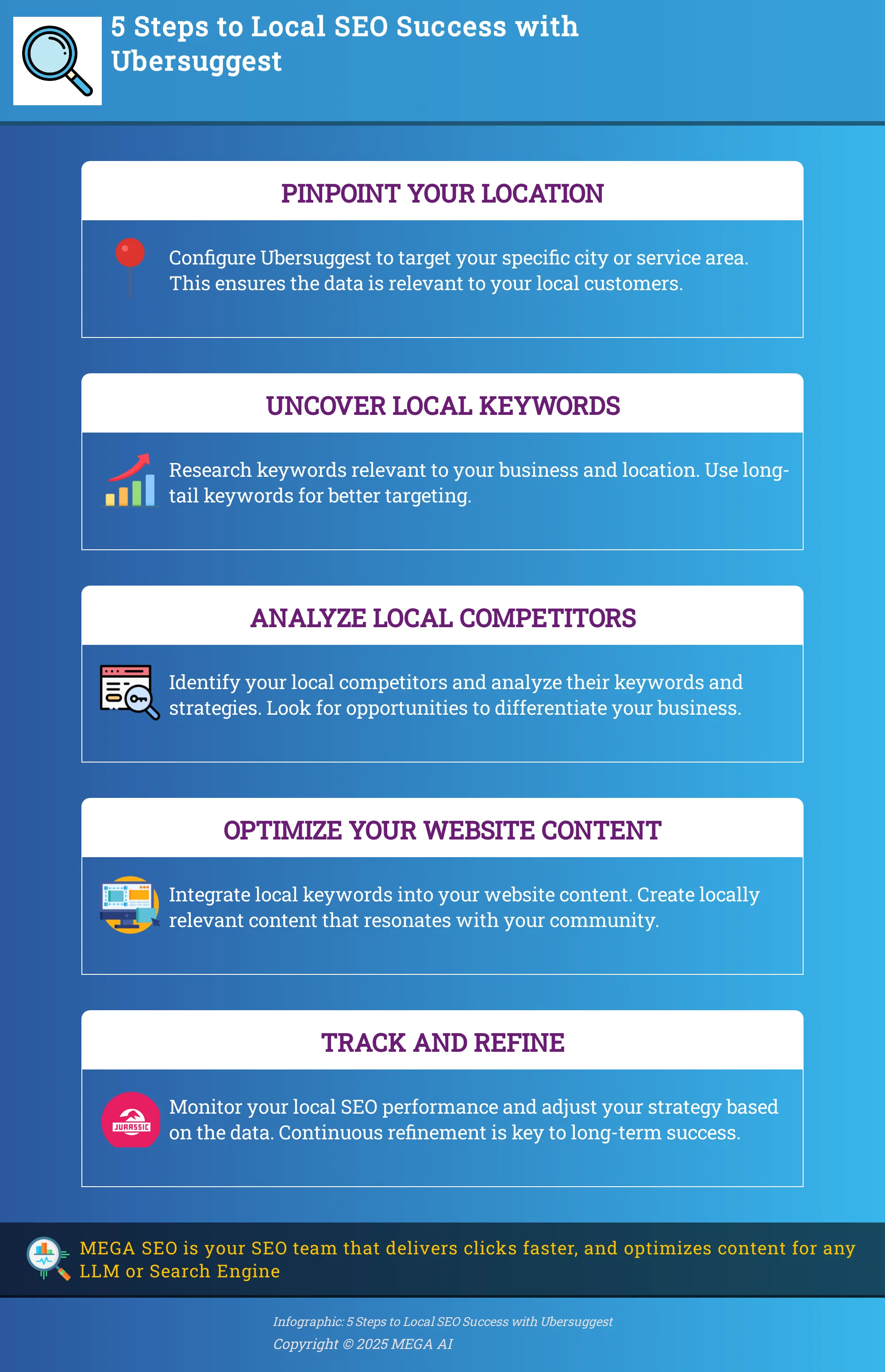
To get the most accurate local insights from Ubersuggest, you'll want to specify your geographic focus right from the start. When you begin your keyword research, remember to include your city or service area. For instance, instead of just searching for "plumber," you would search for "plumber in Austin." This helps Ubersuggest provide more relevant local keyword suggestions. This simple step ensures that the data Ubersuggest pulls—like search volume and keyword ideas—is tailored to the customers you actually want to reach, not a broad national or global audience. It’s all about precision for local success.
Your Command Center: Understand the Ubersuggest Dashboard
Once you've set your location, the Ubersuggest dashboard becomes your main hub for local SEO insights. Ubersuggest is an easy-to-use tool designed to provide insights into search volumes, keyword difficulty, and competitive analysis. The dashboard allows you to track organic traffic, monitor keyword rankings, and analyze links. It provides a comprehensive overview of your keyword performance, including search volume trends and a SERP overview. Familiarizing yourself with these elements will help you quickly assess your local SEO health and identify areas for improvement, making it easier to develop your strategy.
Uncover Local Keywords with Ubersuggest
Finding the right local keywords is a fundamental part of any effective local SEO strategy. Your goal is to connect with customers who are actively looking for your products or services right in your neighborhood or city. Ubersuggest is a practical tool that can make this task much simpler by offering data-backed insights to inform your keyword choices. When you understand the exact terms your local audience uses in search engines, you can adjust your website content, online business listings, and marketing messages to precisely meet their needs.
Think of Ubersuggest as your dedicated assistant for local market research. It helps you move past assumptions and identify the actual phrases people are typing into search bars. This means you can optimize your online presence more effectively, drawing in qualified leads who are more likely to become customers. Whether you run a small local boutique or offer services to a specific community, the ability to find these specific local search terms is incredibly valuable. Let's walk through how you can use Ubersuggest to discover these important keywords.
Tell Ubersuggest About Your Business and Location
The initial step in using Ubersuggest for local keyword research is to provide it with some essential context. When you start your search, it’s not just about the general product or service you offer; it’s critically about where you offer it. As a helpful guide from Pattern notes, "When entering a keyword, consider adding your location. This helps Ubersuggest tailor the results to your specific area, making it easier to find relevant local keywords." For example, instead of merely searching for "pizza," you would input "pizza in Seattle" or "Seattle gluten-free pizza." This simple addition immediately directs the tool's focus to your target market, ensuring the suggestions are geographically relevant and more likely to attract local customers.
Zero In: Filter Results for Local Relevance
After you've provided Ubersuggest with your starting keyword and location, the next step is to refine the results to pinpoint terms that clearly signal local interest. You want to find phrases that people use when they're looking for something nearby. According to Ubersuggest's own support materials, you should "Add location-based keywords such as 'plumber near me,' 'best pizza in [city],' or 'dry cleaner Austin.'" The tool will then show key metrics like search volume and keyword difficulty specifically for these localized terms. It also generates a list of related local keywords, which can be an excellent source for discovering how your community actually searches. This filtering process helps you sift through the broader, non-local search terms and concentrate on phrases that will genuinely drive local traffic to your business.
Gauge Demand: Analyze Local Search Volume and Competition
Choosing which local keywords to target involves looking closely at two main factors: how many people are searching for them (search volume) and how difficult it will be to rank for them (competition or keyword difficulty). Ubersuggest provides these vital pieces of information. As GridHooks explains in their guide, "Ubersuggest provides insights into the search term's volume, competition, and related keywords, allowing you to gauge the demand for specific local keywords and make informed decisions." A high search volume suggests strong interest, but if the competition is also very intense, it might be tough for a smaller business to achieve a high ranking. Ubersuggest helps you identify that ideal balance—keywords with decent search volume and manageable competition.
Find Niche Opportunities: Identify Long-Tail Local Keywords
Don't underestimate the effectiveness of long-tail keywords, particularly for local SEO. These are longer, more specific phrases that people use when they are further along in their decision-making process. Growth Metric advises to "Focus on Local Keywords: Use Ubersuggest to find long-tail keywords that are specific to your area. These keywords often have less competition and can help you attract a more targeted audience." For instance, instead of just "electrician [City]," a long-tail local keyword might be "emergency electrical repair downtown [City]" or "best [City] electrician for smart home installation." While these might have lower individual search volumes, they often lead to higher conversion rates because they match user intent so closely. Ubersuggest can help you discover these specific terms that your competitors might be overlooking.
See What Your Local Competitors Are Doing with Ubersuggest
Understanding what your local competitors are up to is a key part of any solid local SEO strategy. It’s not about simply copying them, but about finding opportunities and getting a clear picture of the local search scene. Ubersuggest can be a fantastic tool for this, helping you peek into their strategies and see what’s working. By looking at their online presence, you can gather valuable information to shape your own approach, identify gaps you can fill, and ultimately, work towards attracting those important local customers. Let's explore how you can use Ubersuggest to get a good look at your local competition.
Spot and Study Your Local Competitors
First, you need to know who you're actually competing against in your local area. Ubersuggest allows you to analyze a competitor's website, offering a wealth of information. Just type in their domain, and you'll see details like their organic keywords, an estimate of their monthly traffic, their domain score, and their backlink profile. Pay close attention to the keywords they rank for, especially those that include your town, city, or specific service area. Take a look at their top-performing pages – what kind of content are they creating that seems to connect well with the local audience? This initial review helps you understand their strengths and weaknesses, giving you a starting point for your own efforts.
Key Local Metrics to Watch
When you're digging into competitor data, certain numbers are especially important for local SEO. As you research keywords, always remember to add your location to see what terms your local audience is actually using in their searches. Ubersuggest will show you the search volume for these local keywords, helping you understand the demand. Beyond just keywords, keep an eye on their local traffic trends. Are they seeing consistent growth, or are there dips and spikes you can learn from? Their domain score and the quality of the websites linking back to them also offer clues about their authority in local search results. Consistently tracking these key metrics will help you understand their position and how you might improve your own.
Turn Data into Action: Interpret Insights for Your Strategy
Collecting data is one step; knowing what to do with it is the next, more crucial one. Ubersuggest is designed to provide actionable insights that can help you refine your website's SEO performance. For example, if you notice a local competitor ranking well for a specific service keyword combined with your city name, and your own content doesn't target this phrase, that’s a clear signal for an action item. You can then use Ubersuggest to further research related local keywords and adjust your content strategy to specifically meet the needs and search habits of your local audience. The main goal is to take the information you've gathered about your competitors and use it to make smarter, more informed decisions for your own local SEO plan.
Optimize Your Website Content Using Ubersuggest's Insights
Once you've gathered a wealth of information about local keywords and your competitive landscape using Ubersuggest, the real work of transforming those insights into tangible results begins. This is where you take that data and actively optimize your website content to genuinely connect with your local audience and significantly improve your visibility in local search results. Effective content optimization, guided by Ubersuggest's findings, moves beyond simply inserting keywords. It’s about crafting an online experience that speaks directly to the needs, interests, and search behaviors of people in your specific geographic area.
Ubersuggest provides the blueprint for several key optimization activities. You can refine your on-page elements by strategically incorporating the local keywords your customers are actually using. This means looking at your page titles, headings, body copy, and even image alt text to ensure they reflect local search intent. Furthermore, the tool helps you identify opportunities to create entirely new content—like blog posts, neighborhood-specific guides, or answers to frequently asked local questions—that will resonate deeply with your community and establish your business as a go-to local resource. Beyond the words on the page, Ubersuggest’s data can also inform how you structure your website, making it easier for search engines to crawl and understand the local relevance of your offerings, and for users to find exactly what they need. This holistic approach ensures that your efforts are not just about ranking, but about providing genuine value, which in turn supports sustained local SEO success. Remember, this isn't a one-time task, but an ongoing process of refinement as local trends and search behaviors evolve.
Weave Local Keywords into Your On-Page Content
The local keywords you've carefully identified with Ubersuggest are the foundational elements for your on-page optimization strategy. Think about the specific phrases and terms people in your community use when searching for the products or services you offer. When you enter a keyword into Ubersuggest, remember that including your location helps tailor these results effectively. Your goal is to naturally integrate these location-specific keywords into critical areas of your website. This includes your page titles, main headings (like H1s and H2s), the body paragraphs of your content, and your meta descriptions. The emphasis here is on 'naturally'—the keywords should enhance the user's understanding and feel like a seamless part of the text, rather than being awkwardly forced in. This careful integration signals to search engines the precise local relevance of your pages.
Create Content That Speaks to Your Local Area
Move beyond your standard service descriptions and product pages by developing content that specifically addresses the interests and needs of your local community. Ubersuggest can be a great source of inspiration here, revealing what topics are currently capturing the attention of local searchers. For example, you might craft blog posts such as 'The Top 5 Dog-Friendly Parks in [Your City]' or 'Preparing Your [Your Service] for [Your Town]'s Annual Festival.' This kind of content not only allows for the organic inclusion of local keywords but also delivers genuine value, helping to position your business as an informed local authority. If you're looking to efficiently produce such localized articles and keep them fresh, MEGA AI’s content generation tools can assist in scaling these efforts.
Strengthen Your Site Structure for Local SEO
A logically organized website significantly helps both your potential customers and search engine crawlers in finding and understanding your local offerings. Use the insights Ubersuggest provides on local search volumes and keyword competitiveness to guide decisions about your site's architecture. If your business serves several distinct neighborhoods or offers specialized services relevant to particular local areas, think about creating dedicated landing pages for each. These pages should be clearly accessible, perhaps linked from your main navigation menu or a specific 'Areas We Serve' section. Implementing strong internal linking between your general service pages and these more specific local pages is also crucial, as it helps distribute page authority and reinforces the local relevance of your content. For ongoing optimization, MEGA AI offers technical SEO improvements that can help ensure your site structure remains sound and effectively supports your local SEO goals.
Tap into Ubersuggest's Other Features for Local SEO
Ubersuggest offers a suite of tools that extend far beyond initial keyword discovery, providing crucial support for your local SEO efforts. Once you've identified the key local terms your potential customers are using, the journey doesn't end there. Several other features within the platform can give your business a significant edge in your specific geographic market. Think of these tools as your comprehensive support system for building a strong and authoritative local online presence. From ensuring your website is technically sound and offers a smooth user experience for local visitors, to finding valuable local link opportunities that can signal relevance to search engines, and brainstorming content that truly addresses your community's unique needs and interests, Ubersuggest provides a well-rounded toolkit.
By strategically using these additional features, you can develop a more holistic local SEO strategy. This approach moves beyond simply inserting keywords into your pages; it’s about creating a genuinely valuable resource for your local customers and demonstrating your commitment to the community. These tools help you understand your site's performance from a technical perspective, uncover how your local competitors are building their online authority, and spark ideas for content that will resonate deeply with your target audience. Ultimately, this leads to more local traffic, increased engagement, and better conversion rates. Let's explore how you can put these powerful features to work for your business and truly connect with your local market.
Check Your Site's Health: Use the Site Audit for Technical Issues
A technically sound website is foundational for good local SEO. Ubersuggest’s Site Audit feature is your first stop for a health check. It thoroughly scans your website to perform an SEO audit, identifying critical errors like duplicate content, warnings such as poorly formatted URLs, and recommendations for improvement. The audit also analyzes your site speed, a key factor for user experience and search rankings. Pay close attention to issues flagged as "critical" first, then move on to warnings. Addressing these technical problems ensures search engines can easily crawl and understand your site, which is vital for appearing in local search results when customers are looking for businesses like yours.
Find Local Link Opportunities: Analyze Backlinks
Backlinks from other local websites act as endorsements for your business, significantly impacting your local search rankings. Ubersuggest’s backlink analysis tool lets you see who is linking to your site and, just as importantly, who is linking to your local competitors. It analyzes backlinks to a website, showing domain authority, link type, anchor text, and when the link was found; it also includes filters to refine results. Look for opportunities like local business directories, community event sponsorships, or local bloggers who have linked to competitors but not to you. Reaching out for these local citations can build your site's authority and relevance in your specific service area.
Brainstorm Content Your Local Audience Wants
Content that speaks directly to your local audience's interests and needs can set you apart. Ubersuggest can be like a personal blog roadmap, helping you come up with ideas to blog on using a few simple reports. Think beyond general topics and consider what’s uniquely relevant to your area. For example, you could create blog posts like 'How to Prevent Pipe Bursts in Austin Winters' or 'Top 5 Pizza Places in Downtown Miami.' This type of locally-focused content not only helps with ranking for specific local queries but also makes the content relevant to the local audience, making your business a valuable resource for the community and fostering connection with potential customers.
Track and Improve Your Local SEO Performance with Ubersuggest
After you've identified promising local keywords and taken a good look at what your competitors are doing, your work isn't finished. In fact, a crucial phase is just beginning: continuously tracking your performance and using that data to make smart adjustments. For local businesses, this ongoing process is vital. Local search results can change frequently, and your customers' behaviors might shift. Staying visible and attracting new clients means you need a clear view of how your SEO efforts are paying off and where you can make improvements. Without consistent monitoring, you're essentially navigating in the dark, unsure if your strategies are hitting the mark or if you're falling behind local competitors.
Ubersuggest provides a comprehensive suite of tools designed to help you keep your finger on the pulse of your local SEO. It’s not just about checking your rank for a keyword once in a while. It’s about understanding the broader picture: how much relevant local traffic is coming to your site, how engaged those visitors are, and how your online presence stacks up against other businesses in your area. The platform translates raw data into actionable insights, empowering you to move beyond guesswork. You can see which specific keywords are driving results, identify pages that resonate most with your local audience, and pinpoint technical issues that might be hindering your visibility. This data-driven approach allows you to adapt proactively, ensuring your local SEO strategy remains effective and continues to support your business growth in your specific community. This continuous loop of tracking, analyzing, and refining is what separates thriving local businesses from those that struggle to gain traction online.
Keep an Eye on Rankings: Set Up Tracking for Local Keywords
To truly understand your local SEO impact, you need to know where you stand for the keywords that matter most to your community. Ubersuggest makes this straightforward. You can add location-based keywords such as "italian restaurant near me" or "best coffee shop in [your city]". The platform will then regularly check your rankings for these terms. This isn't just about seeing your position; Ubersuggest also provides data on search volume and keyword difficulty for these local terms. Regularly reviewing this information helps you see progress, spot declines quickly, and understand the competitive landscape for your specific service area. This consistent tracking is key to adapting your local SEO strategy effectively and ensuring you remain visible to potential customers actively searching for your services.
Measure What Matters: Monitor Local Traffic and Engagement
Beyond just rankings, it's important to see how your local SEO efforts translate into actual website visitors and engagement. Ubersuggest helps you track key metrics related to your local audience. You can monitor organic traffic from your target geographic areas and see how users are interacting with your site. Are they visiting your location-specific pages? Are they spending time on your service pages relevant to local needs, or are they bouncing quickly? Understanding these engagement signals provides insights into whether your content is genuinely resonating with your local customers and meeting their needs. This focus on relevant traffic and interaction helps you gauge the real-world effectiveness of your local SEO, guiding you toward strategies that attract and retain more local customers.
Refine Your Approach with Ubersuggest Data
The data you gather from Ubersuggest—from keyword rankings to traffic patterns and competitor insights—is incredibly valuable for refining your local SEO strategy. For instance, if you notice a particular local keyword is bringing in significant, high-quality traffic, you might decide to create more in-depth content around that topic or ensure your service page for it is fully optimized. If competitor analysis shows a local rival ranking well for a service you also offer, you can examine their content structure, on-page optimization, and even their backlink profile for improvement ideas. By consistently using Ubersuggest for keyword research, content ideas, and competitor analysis, your business can make its website more effective in attracting and converting local customers. This iterative process of tracking, analyzing, and adjusting is what leads to sustained local SEO success.
Make the Most of Ubersuggest for Local SEO: Best Practices
Using a tool like Ubersuggest can significantly sharpen your local SEO strategy, but its true power is unlocked when you combine its data with established best practices. For local businesses, visibility in your specific geographic area is paramount. This means not just attracting any traffic, but attracting traffic from potential customers nearby. Ubersuggest provides a wealth of information, from keyword search volumes to competitor backlinks, but interpreting this data through a local lens is key.
Think of local SEO as building a strong reputation within your digital neighborhood. It involves understanding what your local customers are searching for, ensuring your business information is accurate and consistent across the web, and creating content that speaks directly to their needs and interests. While Ubersuggest can provide valuable data, the strategic application of these insights is what drives results in local search engine optimization. This includes a commitment to ongoing optimization, as local search trends and competitor activities are always evolving. Regularly revisiting your strategy, informed by tools like Ubersuggest, ensures you stay ahead. Remember, even the most powerful tools require a thoughtful approach to yield the best outcomes, especially in the nuanced field of local SEO. It's about being discoverable, credible, and relevant to the community you serve.
Focus Your Keyword Research Locally
When you’re diving into Ubersuggest, your primary goal for local SEO is to uncover the specific terms people in your area are actually typing into search engines. Think beyond general industry keywords and get granular. For instance, instead of just “bakery,” try “bakery [your city]” or “best cupcakes near me.” Ubersuggest can help you analyze search volume for these localized terms, showing you which ones have steady interest throughout the year. This helps you avoid focusing too much on seasonal trends that won’t bring consistent traffic. By adding your city or neighborhood directly into your keyword searches in Ubersuggest, you’ll get a much clearer picture of the local search landscape and find those golden opportunities to connect with nearby customers.
Create Content That Connects with Your Community
Once you have a solid list of local keywords, the next step is to create content that genuinely resonates with your community. Ubersuggest isn't just for finding keywords; its reports can be a goldmine for content ideas. Look at what’s already ranking for your target local terms. What questions are people asking? What kind of content are your local competitors producing? Use these insights to brainstorm blog posts, service pages, or even FAQs that address the specific needs and interests of your local audience. For example, if you’re a plumber in Austin and Ubersuggest shows high interest in “emergency plumbing Austin,” a blog post on “What to Do Before Your Emergency Plumber Arrives in Austin” could be highly effective. This targeted local content strategy makes your content more relevant and valuable.
Strengthen Your Local Online Presence Beyond Your Website
While Ubersuggest helps optimize your website, local SEO success also hinges on your visibility across the web, especially on platforms like Google My Business (GMB). Ensure your GMB profile is meticulously updated with your correct business name, address, and phone number (NAP). This NAP information should be consistent everywhere your business is listed online. Think of it as your digital fingerprint – consistency builds trust with search engines. Furthermore, actively encourage your customers to leave reviews, particularly ones that naturally include keywords and location mentions. Responding to all reviews, positive or negative, also shows engagement and can positively influence your local rankings. While Ubersuggest focuses on keywords and site audits, the keywords you find can inform your GMB posts and how you talk about your services locally.
Continuously Refine Your Approach
Local SEO isn’t a set-it-and-forget-it task. The digital landscape, competitor strategies, and even customer search behavior can change. That’s why it’s important to regularly review your Ubersuggest data and your overall performance. Are your chosen keywords still relevant? Is your content ranking as expected? Are there new local competitors you need to analyze? Don’t be afraid to adjust your strategy based on what the data tells you. Avoiding common mistakes often comes down to this continuous cycle of analysis and refinement. Using Ubersuggest to monitor your rankings and audit your site periodically will help you stay agile and maintain your local search visibility over time.
Ubersuggest vs. Other Local SEO Tools: What to Consider
When you're figuring out the best tools for your local SEO efforts, it's helpful to see how Ubersuggest stacks up against other options. Every business has different needs and budgets, so what works for one might not be the perfect fit for another.
Ubersuggest is often seen as a solid starting point, especially if you're just learning the basics of SEO or working with a tight budget. It offers a good range of features, including keyword research, site audits, and competitor analysis, often at a more accessible price point than some of the industry giants. Many users find it provides significant value, especially with its free features, making it a cost-effective way to get your local SEO off the ground. If you're new to the game, Ubersuggest can be adequate for high-level keyword research and understanding fundamental SEO concepts.
However, as your local SEO strategy becomes more sophisticated, you might find Ubersuggest has some limitations. More advanced tools like Ahrefs, Moz, and SEMrush are frequently cited as superior alternatives for in-depth analysis, though they typically come with higher price tags. These platforms often provide more granular data, extensive backlink analysis capabilities, and more robust tracking features. For businesses that heavily rely on intricate local SEO insights and have the budget, investing in these more comprehensive tools could be beneficial.
Regardless of the tool you choose, remember the importance of focusing on local keywords. When you're entering a keyword for research, always consider adding your specific location. This simple step helps you target local searches much more effectively, which is crucial for attracting customers in your service area. While Ubersuggest can assist with this, specialized local SEO tools might offer more refined features for hyper-local targeting.
Ultimately, the best tool depends on your specific circumstances. Ubersuggest can be a fantastic asset, particularly for beginners or small businesses. Just be sure to track key local SEO metrics, understand its capabilities, and perhaps supplement it with other budget-friendly alternatives or more specialized tools as your needs grow. Being aware of common mistakes, like not localizing your keyword research enough, will also help you get the most out of any tool you use.
Fit Ubersuggest into Your Daily Local SEO Work
Making Ubersuggest a part of your everyday local SEO tasks can significantly sharpen how you connect with your local audience. It's designed to be an easy-to-use tool, so weaving it into your daily schedule won't feel like an added burden. Think of it as your quick-check resource for ongoing improvements.
A good starting point is to make localized keyword research a consistent practice. Whether it's first thing in the morning or during your dedicated SEO time, you can use Ubersuggest for keyword research tailored to your city. This means when you input a keyword, always remember to include your specific location. This simple action ensures your efforts directly address what people in your area are looking for.
Beyond just discovering keywords, Ubersuggest allows you to track key metrics such as local search volume and keyword difficulty. A brief daily or weekly review of these numbers can guide your content decisions and help you identify emerging local trends or opportunities. You can also use it to brainstorm and generate blog topics that you know will appeal to your local customers, making your content planning more targeted. Consistently applying these features will help you build a more robust and visible presence in your local market.
Related Articles
- How to Use Ubersuggest for On-Page Optimization in 2024
- How to Use Ubersuggest for Powerful Keyword Research
- Harnessing Local Keywords for Enhanced SEO Performance: A Comprehensive Guide - MEGA SEO | Blog
- Regional SEO: Dominate Local Search in 2024
- Top SEO Site Audit Tools for 2024: Free & Paid
Frequently Asked Questions
What's the most important first step when using Ubersuggest for my local business? To get the most relevant insights for your local business, always remember to specify your geographic area when you begin your research. For instance, if you're looking into keywords, search for "plumber in Chicago" rather than just "plumber." This ensures the data you see, like search volumes and keyword ideas, is directly applicable to the customers you want to reach in your community.
How does Ubersuggest help me figure out what search terms my local customers are using? Ubersuggest can show you the phrases people in your specific area are typing into search engines. You can input your service or product along with your city or neighborhood, like "best coffee shop downtown Anytown." The tool then provides data on how often these terms are searched and suggests related local keywords, giving you a clear idea of your community's search habits.
Can I use Ubersuggest to see what my nearby competitors are doing for their SEO? Yes, you can. By entering a local competitor's website address into Ubersuggest, you can get a look at the keywords they are ranking for, especially those that include your local area. You can also see which of their pages attract the most local traffic, offering you clues about what content resonates with your shared audience.
I've used Ubersuggest to find some good local keywords. What's the next step for my website? Once you have your list of local keywords, the next step is to thoughtfully incorporate them into your website's content. This means weaving them into your page titles, headings, and the main text of your service pages or blog posts. You can also use these insights to create new content, like articles or guides, that specifically address the interests and questions of people in your local area.
Is Ubersuggest the only tool I'll need for local SEO, or are there other things to consider? Ubersuggest is a very helpful tool for understanding local keywords, analyzing competitors, and checking your site's technical health, especially if you're getting started or have a limited budget. However, a comprehensive local SEO strategy also involves managing your Google My Business profile accurately and ensuring your business information is consistent across all online directories, which are tasks outside of what Ubersuggest directly handles.