Think of your website’s content like a conversation. Are you making a single, isolated point, or are you leading the entire discussion? Building topical authority is about choosing to lead. It means you’re not just answering one question; you’re anticipating and answering all of them. This strategy requires you to create a deep and wide foundation of knowledge, proving to both users and search engines that you have explored a subject thoroughly. When you achieve this, you build a powerful flywheel effect where every new piece of content strengthens the authority of your entire site, leading to more stable rankings and consistent organic traffic across your whole topic cluster.
Key Takeaways
- Build a complete content library: Move beyond targeting single keywords and aim to become the go-to expert on a subject. Use the pillar-cluster model to create a web of interconnected articles that covers your topic from every angle.
- Connect your content with a clear structure: Your site's organization signals your expertise to search engines. Create a topical map to plan your content and use a deliberate internal linking strategy to show how your articles relate to one another.
- Treat authority as an ongoing project: Your work isn't done after you hit publish. Regularly track performance metrics for your topic clusters, keep your content updated, and fill any information gaps to maintain your standing as a trusted source.
What is topical authority?
Think of topical authority as becoming the definitive expert on a subject in the eyes of a search engine. If you write a single, isolated article on a complex topic like "spear fishing," Google might not take you seriously. But if you create a comprehensive library of content covering everything from a "beginner's guide to spear fishing" to "how to choose the right spear gun" and "free diving techniques," search engines start to see you as a credible source.
Topical authority is about building a deep and wide foundation of knowledge on your website. It signals to search engines that you haven't just touched on a subject; you've explored it thoroughly. This involves creating interconnected content that answers every potential question a user might have about your core topic. By covering a subject comprehensively, you build trust with both your audience and search engines, making it more likely that your content will be recommended for relevant queries. This is a core principle behind modern SEO strategy, moving away from targeting individual keywords and toward owning entire conversations.
Why topical authority matters for SEO
Building topical authority is one of the most effective ways to achieve higher and more stable search rankings. When Google recognizes your site as an authority, it's more inclined to rank your content for a broad spectrum of related keywords, not just the primary ones you targeted. A well-structured topical map acts as a blueprint for this process, guiding your content creation to ensure you cover all the necessary subtopics.
This approach creates a powerful flywheel effect. As you publish more in-depth content within a topic cluster, your authority grows, which helps all the related pages rank better. This leads to more consistent organic traffic and establishes your brand as a reliable resource in your niche, which is far more sustainable than relying on a few high-ranking but disconnected articles.
How search engines measure topical authority
Search engines don't use a single score to determine topical authority. Instead, they analyze a collection of signals to understand the depth of your expertise. They look at how your content is interconnected through internal links, how thoroughly you cover a subject, and how users engage with your pages. Key performance indicators are crucial for gauging your progress and refining your strategy.
Some of the core SEO metrics search engines evaluate include your organic traffic for a group of related keywords, the number of keywords you rank for within a specific topic, and the quality of backlinks from other relevant sites. When other experts in your field link to your content, it serves as a strong vote of confidence. Ultimately, search engines are connecting the dots to see if you provide comprehensive, trustworthy answers for their users.
The core elements of topical authority
Topical authority isn't a single metric you can track with one tool. Instead, search engines evaluate it by looking at a combination of signals from your website. Understanding these core elements is the first step to building a strategy that proves your expertise and earns you higher rankings.
Content depth and breadth
Content is the foundation of topical authority. To establish yourself as an expert, you need to cover a subject comprehensively. As the team at seowind.io puts it, "Content is the cornerstone of topical authority. To measure your content coverage, look at three primary aspects: Depth: How thoroughly do you cover each topic?"
Depth means creating detailed, in-depth articles that answer specific questions completely. Breadth means covering all the related subtopics within your main subject area. The goal is to create a complete resource, leaving no stone unturned. When your site addresses every facet of a topic, you signal to search engines that you are the definitive source of information. MEGA AI's SEO tools can help you identify these subtopics and generate the content needed to build both depth and breadth.
Your internal linking strategy
A strong internal linking strategy acts as the connective tissue for your content. It creates a logical pathway that guides both users and search engine crawlers through your site, showing how your different pieces of content relate to one another. This structure helps distribute link equity, or "page authority," across your site.
When you strategically link from high-authority pages to other relevant articles, you reinforce the topical relevance of the entire cluster. This helps improve keyword rankings and organic traffic for a group of related pages, not just one. A well-organized site structure built on internal links makes it easy for search engines to crawl and index your content, solidifying your authority on the subject.
How users interact with your content
Search engines pay close attention to how users engage with your pages. Metrics like click-through rate (CTR), time on page, and bounce rate are powerful indicators of content quality and relevance. When users click on your link in the search results and stay on the page to read, it signals that your content satisfied their query.
As Originality.AI notes, it's important to "learn which key metrics to track, like topic share, AI citations and engagement metrics, to see what's working." High engagement tells search engines that you are an authority worth ranking. Consistently low engagement can signal the opposite. Tools like MEGA AI's Maintenance Agent can help by automatically updating content to improve CTR and keep your pages performing well.
Showcasing your expertise
Expertise is about demonstrating that you are a credible and trustworthy source of information. This goes beyond just publishing content; it involves building a reputation. This is often measured by external signals like backlinks from other reputable websites in your industry.
A practical way to view this is through what some experts call "Topic Share." As one analyst explains, "The easiest way to measure topical authority is the share of traffic a site gets from a topic...This is a very practical approach because it factors in the following: Rank, driven by backlinks, content depth/quality, and user experience." Earning a significant share of traffic for your topic is a clear sign that search engines—and users—recognize your expertise. You can book a demo to see how AI can help you build the high-quality content needed to earn these signals.
How to build a content strategy for topical authority
Building topical authority isn’t about luck; it’s about having a deliberate content strategy. This means moving beyond publishing random blog posts and instead creating a structured library of content that proves your expertise to search engines and users. A thoughtful approach ensures you cover a subject completely, leaving no doubt that you are a go-to resource. The following steps will guide you in creating a content plan that establishes your authority and improves your search rankings.
Create pillar pages and topic clusters
The foundation of a strong topical authority strategy is the pillar-cluster model. A pillar page is a broad, comprehensive piece of content on a core topic—think of it as a definitive guide. Topic clusters are groups of more specific articles that explore related subtopics in detail. Each of these cluster articles links back to the main pillar page. This structure organizes your content logically, making it easy for users to find information. It also signals to search engines that you have covered a topic extensively, which is a key factor in achieving higher SEO rankings.
Build a strong internal linking structure
Internal links are the glue that holds your pillar-cluster model together. By strategically linking your cluster articles back to your main pillar page, and vice versa, you create a connected web of content. This structure does two important things: it helps search engine crawlers understand the relationship between your pages and the hierarchy of your content. It also guides users through your site, encouraging them to explore related topics and spend more time engaging with your content. A well-planned internal linking strategy turns your website into an information hub that search engines reward with better visibility.
Perform in-depth topic research
Before you can build your content library, you need a blueprint. This starts with in-depth topic research to identify what your audience is searching for. To create a topical map, you should begin by identifying your main topic, brainstorming the allied subtopics, and skillfully charting out your content plan. Look at what your competitors are ranking for, browse forums like Reddit and Quora, and use keyword research tools to uncover every possible angle of your core subject. This research will provide the list of ideas for your pillar pages and the individual articles that will make up your topic clusters.
Create a topical map
A topical map is the final output of your research—a visual plan for your content. It outlines your pillar topics, the cluster content that supports them, and the internal linking structure that connects everything. You can figure out all the topics you need to write by generating a topical map to dominate your niche. This can be created in a spreadsheet, a mind mapping tool, or even a simple document. The goal is to have a clear, actionable guide for your content team. This map ensures you cover a subject comprehensively, prevents content gaps, and keeps your SEO efforts organized and focused on building authority.
Topical authority vs. domain authority
When you're working on your SEO strategy, you'll often hear about two key concepts: topical authority and domain authority. While they sound similar, they measure different aspects of your site's strength. Understanding the distinction is key to prioritizing your efforts and achieving long-term ranking success. Both are important, but knowing when to focus on each can make a significant difference in your results.
How they differ and work together
Topical authority is all about expertise. It refers to the depth and breadth of content your website has on a specific subject. When you create a comprehensive library of content that covers a topic from every angle, you signal to search engines that your site is a go-to resource. Think of it as becoming the definitive expert in your niche.
Domain authority, on the other hand, is a broader metric that predicts a website's overall potential to rank. It’s calculated based on factors like the quality and quantity of backlinks pointing to your site. A website can have a high domain authority but low topical authority on a particular subject if it doesn't have much in-depth content about it. The two work together; building strong topical authority can attract quality backlinks, which in turn helps improve your domain authority.
Where to focus your SEO efforts
For the best results, you need a balanced approach that addresses both domain and topical authority. However, if you're a newer or smaller site, starting with topical authority is often the smarter move. By focusing on becoming an expert in a specific niche, you can start winning keyword rankings and attracting organic traffic more quickly. Search engines are increasingly designed to reward content that demonstrates deep expertise and relevance.
Building out topical maps and content clusters allows you to dominate a specific subject area before trying to compete on broader, more difficult terms. This focused strategy creates a strong foundation. As your site gains recognition for its expertise, you'll naturally earn backlinks, which will help your domain authority grow over time. This approach allows you to build momentum and see tangible results sooner.
How to measure and improve topical authority
Building topical authority is a long-term play, so you need a way to know if your efforts are paying off. Simply publishing content and hoping for the best isn’t a strategy. Instead, you need to consistently measure your performance and use that data to refine your approach. This process isn’t about finding a single number that defines your authority; it’s about looking at a collection of indicators that, together, paint a clear picture of your standing in your niche. By tracking the right metrics and using the right tools, you can turn insights into action. The goal is to create a feedback loop: you publish content, measure its impact, learn from the data, and then use those insights to make your next piece of content even better. Once you have your data, you can start making targeted improvements with strategies designed to address the core components of topical authority, from content structure to credibility signals. This iterative process is what separates successful SEO strategies from those that fizzle out. Let’s walk through how to measure your progress and what actions you can take to strengthen your authority over time.
Key metrics to track
To understand your topical authority, you need to look beyond basic traffic numbers. The right metrics help gauge your progress and show you where to focus your energy. Start by tracking organic traffic specifically for your topic clusters. Are you seeing growth in sessions for the group of pages related to your core topic? Also, monitor your keyword rankings for a basket of related terms, not just individual ones. Seeing your site rank for dozens of long-tail keywords within a topic is a strong signal of authority. Another key indicator is what some experts call Topic Share—the percentage of all search traffic for a given topic that lands on your site. Finally, look at engagement metrics like click-through rate (CTR), time on page, and bounce rate. High engagement tells search engines that users find your content valuable.
Tools for assessment and tracking
You can track most of these key metrics with a few essential tools. Google Analytics and Google Search Console are your starting points for monitoring organic traffic, keyword performance, and CTR. They provide a direct look at how users are finding and interacting with your site from Google’s search results. For a deeper analysis of backlinks and competitor performance, you’ll want to use a dedicated SEO platform. To get a more advanced view, you can use AI-powered tools to see the bigger picture. For example, MEGA AI’s Maintenance Agent not only helps you optimize existing content but also improves the click-through rate by automatically updating articles. These tools can also help you track your topic share and engagement more effectively, giving you a clearer path to improvement.
Strategies for improvement
Build comprehensive content hubs
A content hub is your foundation for demonstrating expertise. It consists of a central "pillar" page covering a broad topic, which then links out to several "cluster" pages that dive deep into specific subtopics. This structure makes it easy for both users and search engines to see the depth of your knowledge. To plan this effectively, you should create a topical map that outlines your pillar and cluster content. This blueprint ensures you cover the subject comprehensively and build a strong, interconnected web of content that establishes your site as a go-to resource.
Use user-generated content
Your own content is essential, but user-generated content (UGC) can add another layer of authenticity and depth. Encourage customer reviews, feature testimonials, and allow comments on your blog posts. This adds fresh, relevant text to your pages and can capture long-tail keyword variations you might have missed. You can also repurpose content from other formats. For example, a webinar or Q&A session can be transcribed into a blog post, and key article takeaways can be turned into short videos for social media. This approach broadens your content footprint and shows active engagement within your community.
Collaborate with industry experts
Partnering with recognized experts in your field is a powerful way to build credibility. You can co-author articles, feature expert quotes, or host interviews on your blog or podcast. This not only enhances the quality and trustworthiness of your content but also expands its reach. When an expert contributes to your content, they are likely to share it with their own audience, bringing new, relevant visitors to your site. These collaborations act as strong endorsements, signaling to both users and search engines that your content is authoritative and reliable.
Optimize for semantic search
Modern search engines are incredibly sophisticated; they understand the context and intent behind a search query, not just the keywords used. To optimize for semantic search, you need to think beyond single keywords and focus on covering a topic holistically. This means using related terms, synonyms, and answering common user questions within your content. The goal is to create the most comprehensive resource available on the subject. Tools like MEGA AI’s SEO platform can help by identifying new content to add to existing articles, ensuring your pages fully satisfy user intent and are optimized for how people search today.
Common challenges when building topical authority
Building topical authority is a powerful SEO strategy, but it’s not without its difficulties. Earning trust from search engines and users requires a consistent, long-term effort. Many businesses struggle with the scale and complexity involved, from initial research to ongoing maintenance. Here are some of the most common challenges you might face on your path to becoming a recognized expert in your field.
Find and fix content gaps
To establish authority, your website needs to cover a topic comprehensively, leaving no stone unturned. The first major hurdle is identifying what you’re missing. Manually auditing your site against every possible subtopic and user question is a massive undertaking. Without a clear picture of these content gaps, you risk creating a disjointed user experience and signaling to search engines that your knowledge is incomplete. Understanding the right metrics to track is crucial, as these statistics help gauge your progress and refine your SEO strategy. A thorough content gap analysis is the foundation for a successful topical authority plan.
Keep your content up-to-date
Your work isn’t finished once you publish an article. Information becomes outdated, new trends emerge, and competitors publish better content. Keeping your entire content library fresh and relevant is a significant, ongoing challenge. A piece of content that performed well a year ago could lose its ranking if it’s not updated to reflect the current landscape. This process, often called content refreshing, is essential for maintaining traffic and authority. Manually tracking and updating dozens or even hundreds of articles requires dedicated resources that many small teams simply don’t have.
Compete in crowded markets
In popular niches, you’re not the only one trying to build topical authority. Competing against established websites with massive backlogs of content can feel like an uphill battle. To stand out, you can’t just cover the same ground; you have to do it better, more comprehensively, and with a unique perspective. One way to measure your effectiveness is to track your "Topic Share," which is the share of traffic a site gets from a specific topic. Gaining a significant Topic Share requires a strategic approach, focusing on topic clusters that allow you to dominate a specific area before expanding.
Adapt to algorithm updates
Search engine algorithms are always evolving. An update from Google can change the ranking rules overnight, potentially impacting the effectiveness of your existing content strategy. What worked yesterday might not work tomorrow. This constant change creates uncertainty and requires you to be agile. Adapting involves staying informed about updates, analyzing their impact on your traffic, and re-optimizing your content to align with the new standards. This reactive work can divert focus from creating new content, but it’s a necessary part of maintaining your search visibility and authority. You can book a demo to see how AI can automate this process.
How AI helps build topical authority
Building topical authority requires a significant investment in research, planning, and content creation. AI tools can streamline this entire process, helping you execute a robust content strategy more efficiently. Instead of replacing your expertise, AI acts as a powerful assistant, handling the heavy lifting of data analysis and content production so you can focus on high-level strategy. From identifying topic clusters to generating and optimizing articles, AI makes building authority more accessible for teams of any size.
Use AI for content creation and optimization
To establish authority, you need to publish a comprehensive library of content covering a topic from every angle. AI can accelerate this process significantly. By generating a large volume of articles on specific subtopics, you can demonstrate your expertise to search engines. As one expert notes, creating content for niches like "'beginner's guide to spear fishing' or 'how to choose the right spear gun'" helps Google recognize your authority.
With AI-powered content generation, you can quickly build out your topic clusters with high-quality, relevant articles. Beyond initial creation, AI also helps maintain your content's relevance. Tools like MEGA AI’s Maintenance Agent can update existing articles with new information, re-optimize them after algorithm changes, and improve their overall performance to solidify your authority over time.
Use AI for topic research and analysis
A strong topical authority strategy starts with a solid plan. AI is incredibly effective at topic research, helping you identify all the relevant subtopics and questions your audience is asking. This process is often used to create a topical map, which is a structured outline of all the content you need to cover a subject completely. A topical map serves as the blueprint for your content strategy.
Instead of spending weeks manually brainstorming and researching, you can use AI to generate a comprehensive topical map in minutes. This ensures you don’t miss any critical pieces of the puzzle. By structuring your content plan this way, you can systematically build out your pillar pages and cluster content, creating the dense network of information that search engines reward. This structured approach ensures your SEO efforts are focused and effective from the start.
What's next for topical authority in SEO?
SEO is always changing, but the shift toward rewarding expertise is a constant. Topical authority isn't just a buzzword; it's becoming the foundation of a durable SEO strategy. As search engines get smarter at understanding context and user intent, they're placing more weight on sites that demonstrate a deep, comprehensive knowledge of a specific subject. This means that simply targeting individual keywords is no longer enough. The future of ranking well lies in owning an entire topic, proving to search engines that you are the go-to resource.
Looking ahead, a few key trends are shaping how we'll build and measure topical authority. Concepts like topical maps and topic share are moving from niche SEO discussions to mainstream strategy, offering a more structured way to plan and evaluate your content. At the same time, preparing for algorithm updates means reinforcing the fundamentals: creating high-quality content, tracking performance, and ensuring your work reaches its intended audience. For businesses and marketers, adapting to these changes is essential for long-term success. The good news is that the principles are straightforward. With the right approach, you can build a strategy that not only withstands the test of time but also builds a loyal audience that trusts your brand's expertise.
Key trends to watch
As search engines evolve, so do the methods for proving your expertise. One of the most significant trends is the growing importance of topical maps. Think of a topical map as a blueprint of your subject area, outlining all the related subtopics and entities you need to cover to be seen as an authority. Creating one helps you systematically build out content that covers a topic from every angle. Another key concept to watch is Topic Share, which measures the percentage of traffic a site receives for a given topic. This metric moves beyond individual keyword rankings to show how much of the conversation you truly own.
How to prepare for future algorithm changes
Preparing for algorithm updates doesn't have to feel like guesswork. The best way to future-proof your SEO is to focus on quality and consistency. This starts with content depth. Creating comprehensive, high-quality content that genuinely helps the user is a non-negotiable factor for ranking. Beyond creation, understanding your performance through diligent tracking is crucial. Monitoring metrics like organic traffic by topic, keyword rankings for your clusters, and user engagement will help you refine your strategy. Finally, even the best content needs a push. Developing effective content promotion strategies ensures your authoritative articles reach and resonate with your target audience, signaling relevance to search engines.
Add topical authority to your SEO strategy
Building topical authority isn't a one-time task; it's an ongoing strategy that weaves into your entire SEO approach. By intentionally planning and executing a content plan focused on authority, you create a durable asset that pays dividends in search rankings and user trust. The following steps provide a framework for getting started and maintaining your momentum for long-term success. This process requires a methodical approach, but the results are well worth the effort.
A step-by-step guide to get started
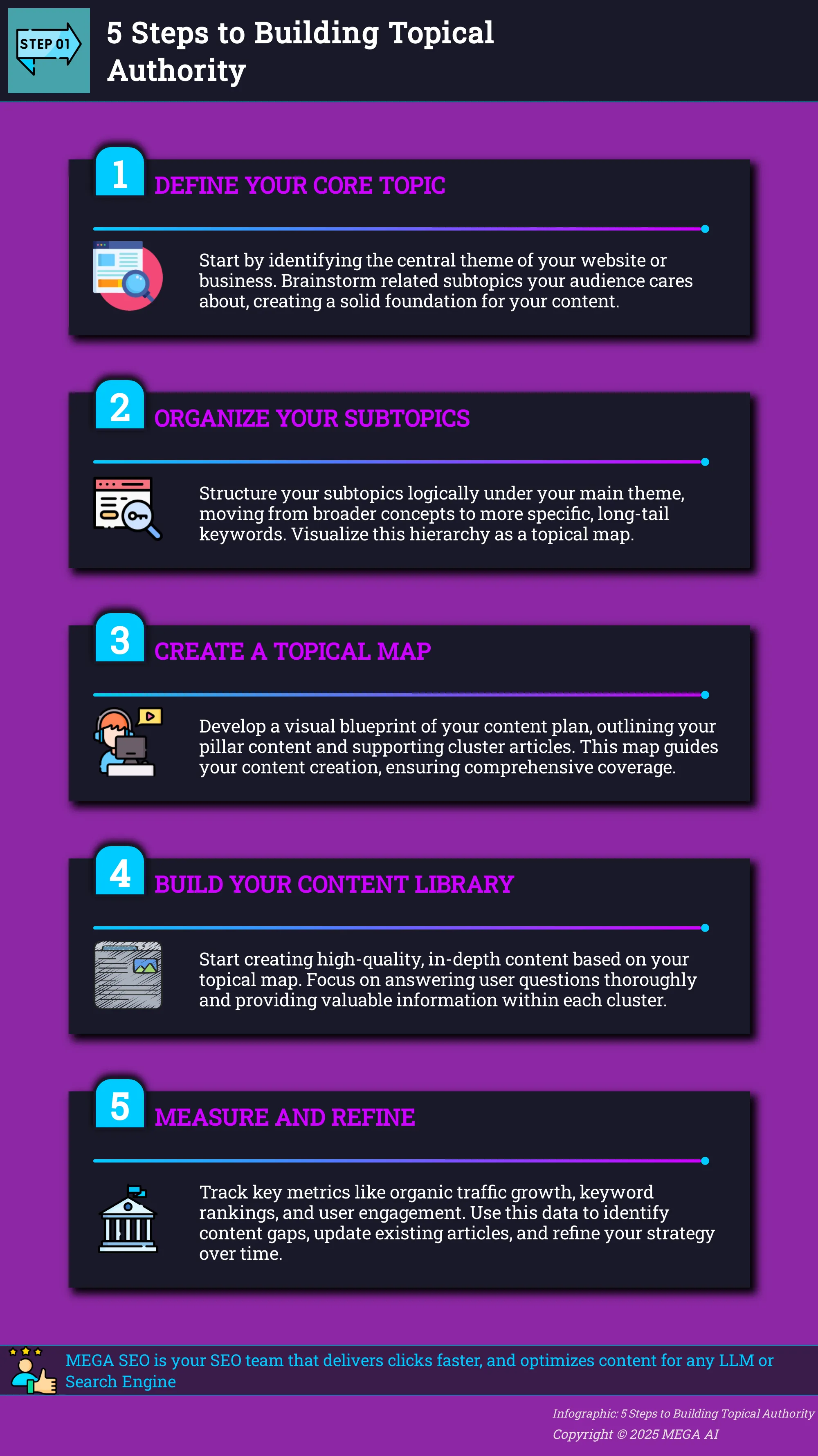
To begin building authority, you need a clear plan. Start by defining the central theme of your website or business. You should identify your main topic and then brainstorm all the related subtopics your audience cares about. Think of this as the foundation of your content house; it needs to be solid and well-defined.
Once you have your list of topics, the next step is organizing your topics into a logical structure. Create a clear hierarchy with your main theme at the top, followed by broader subtopics and then more specific, long-tail concepts. Visualizing this as a topical map can be incredibly helpful. This map becomes your blueprint, guiding your content creation to ensure you cover a subject comprehensively and logically.
Best practices for long-term success
Once your strategy is in motion, you need to measure its impact to refine your approach over time. When it comes to topical authority, understanding the right metrics to track is crucial for gauging your progress. Focus on key performance indicators like growth in organic traffic to your topic cluster, improved keyword rankings for your core terms, and the quality of backlinks you attract.
Consistently producing high-quality, relevant content based on your topical map turns your site into an info hub that search engines reward. Regularly updating existing articles and filling content gaps also signals to search engines that your expertise is current and reliable. This ongoing maintenance reinforces your authority for sustained success.
Related Articles
- Topical Authority: Your Guide to Higher Rankings
- Topical Relevance: The Ultimate Guide to SEO Success
- SEO Without Backlinks: Rank Higher in 2024
- Startup SEO Guide to Rank Higher With Fewer Resource
- SiteFocusScore: Decoding Google's Algorithm Leak
Frequently Asked Questions
How long does it take to build topical authority? Building topical authority is a long-term commitment, not an overnight fix. The timeline can vary based on how competitive your niche is and how quickly you can produce high-quality content. Instead of looking for a specific deadline, focus on consistency. You should start to see positive signals within a few months, but establishing yourself as a true authority can take a year or more of dedicated effort.
Is it better to cover one topic deeply or many topics broadly? For building topical authority, depth will always win over breadth. The entire strategy is about becoming the definitive expert in a specific area. Spreading your efforts too thin across many unrelated topics sends a mixed signal to search engines. It's far more effective to choose one core subject and cover it comprehensively before you consider expanding into other areas.
What’s the difference between a topical map and a simple keyword list? A keyword list is just a collection of search terms you want to rank for. A topical map is a strategic blueprint that shows how those keywords and concepts relate to one another. It organizes your content into pillars and clusters, creating a logical structure that proves your expertise. Think of it as the difference between having a pile of bricks and having an architectural plan for a house.
Can a small website really build topical authority against larger competitors? Absolutely. In fact, topical authority is one of the best ways for smaller sites to compete. Large, established websites often have high domain authority but may only cover your niche at a surface level. By focusing intensely on one subject and creating the most comprehensive resource available, you can outrank bigger players for keywords related to that specific topic.
How do I know if my topical authority strategy is working? You can gauge your progress by looking at a few key indicators beyond just traffic to a single page. Watch for an increase in organic traffic across an entire topic cluster. You should also see your site begin to rank for a growing number of long-tail keywords related to your core subject. When you start owning the search results for dozens of specific questions within your niche, you know your strategy is paying off.