
Many search optimization tactics can provide temporary improvements, but if you're aiming for a strategy that builds enduring value and sustainable organic growth, topical authority is your answer. It involves methodically transforming your website into a recognized hub of expertise on specific subjects relevant to your audience. By creating comprehensive, high-quality content that fully addresses user questions and needs within your niche, you construct a strong foundation that search engines increasingly favor over time. This approach isn't merely about ranking for a handful of terms; it’s about establishing your site as a credible, go-to resource that users trust. We'll walk through how to lay this essential groundwork, create content that effectively showcases your deep knowledge, and measure your progress toward becoming an authoritative voice in your field.
Key Takeaways
- Define Your Expertise Clearly: Pinpoint the core subjects you want to own and meticulously plan the related subtopics to direct your content efforts.
- Create Comprehensive Content Networks: Develop thorough content clusters around your central topics and strategically link them to demonstrate the depth and interconnectedness of your knowledge.
- Measure and Adapt Consistently: Regularly monitor key performance indicators, stay informed on evolving search trends, and update your content to maintain its relevance and effectiveness.
What is Topical Authority and Why Does It Matter for Your SEO?
So, what exactly is topical authority? Think of it as becoming the go-to expert in your specific field, at least in the eyes of search engines and your audience. It’s about demonstrating a deep understanding of certain topics and phrases by providing comprehensive answers and information. When your website consistently offers valuable and thorough content on a particular subject, you start to build this authority. It’s not just about publishing a blog post here and there; it’s about creating a rich, interconnected web of information that covers a topic from multiple angles. This means your site becomes a place where users can find in-depth knowledge, making you a trusted voice in your niche.
Now, why should you care about topical authority for your SEO? Well, it’s a pretty big deal. Search engines like Google want to provide their users with the most reliable and complete answers. When your site establishes topical authority, you're essentially signaling to search engines that you are a credible source for information within your niche. This can significantly influence your search rankings. Building this kind of authority means you’re not just creating content; you’re positioning your website as a comprehensive resource that truly educates your audience. It requires a commitment to creating in-depth, well-researched articles that go beyond surface-level explanations. While it's a long-term game, the payoff in terms of organic traffic and credibility is well worth the effort. Platforms like MEGA AI can help you streamline this process by assisting with automated keyword research and content generation, making it easier to build out the comprehensive content needed to establish authority.
How to Build a Strong Topical Authority Foundation
Building a strong topical authority foundation is your first big step towards search engine optimization (SEO) success. It’s about clearly showing search engines, and your audience, that you’re a knowledgeable and trustworthy source on specific subjects. This isn't a quick fix, but a strategic approach that pays off in the long run with better rankings and more organic traffic. Think of it as laying the groundwork for a skyscraper; the stronger the foundation, the higher you can build. We'll walk through how to map out your strategy, identify your key topics, and create a plan to guide your content creation efforts. This initial planning phase is crucial because it sets the direction for all your subsequent content and SEO activities.
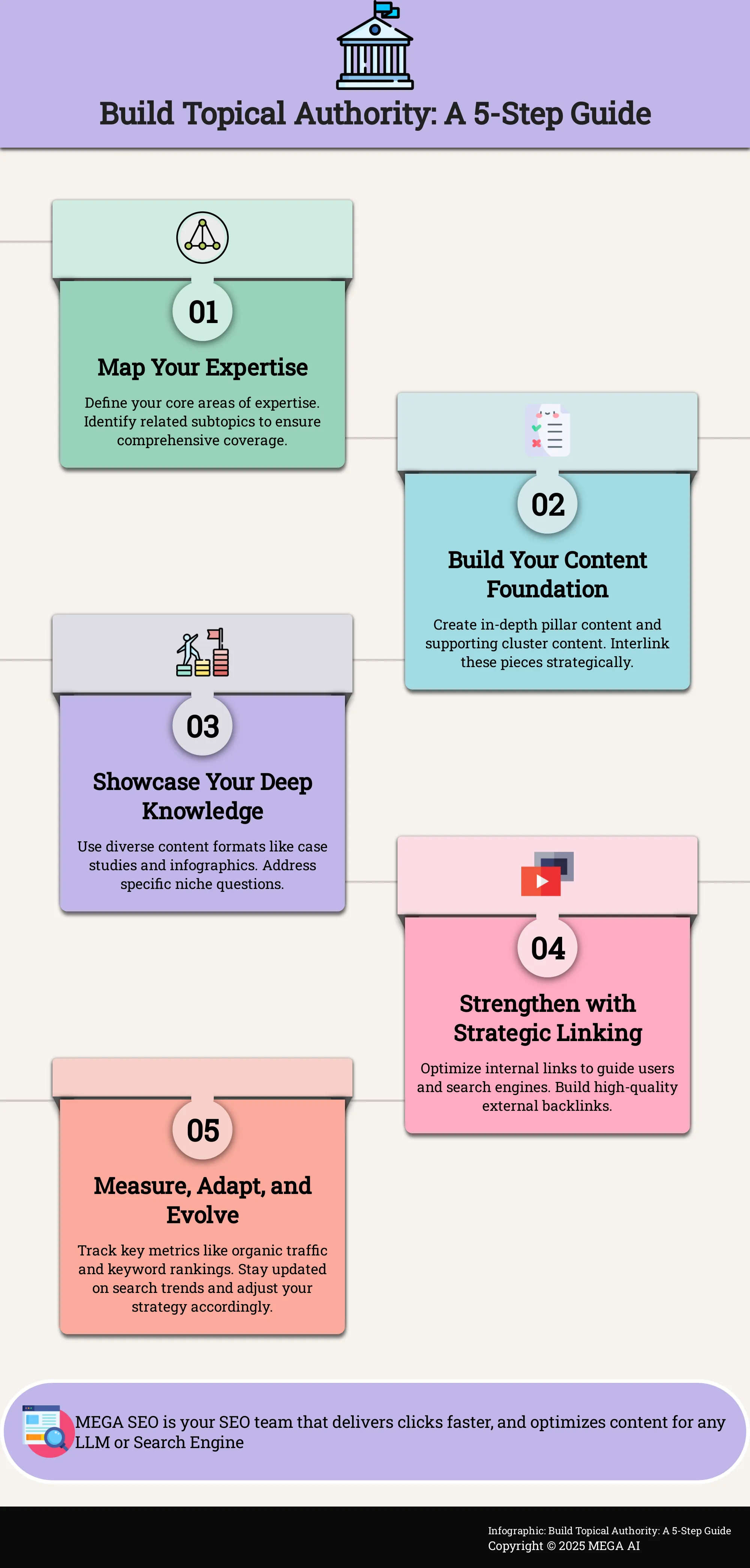
Map Out Your Content Strategy
Think of building topical authority as a journey, not a race. It's a "long-term process that requires effort and dedication," as the experts at Small Business Guide aptly put it. Your content strategy is your roadmap for this journey. It involves defining what you want to be known for and planning the content that will get you there. Start by clearly outlining your expertise and the primary themes you want to dominate in search results.
A well-defined strategy helps you stay focused and consistent, which are key to establishing authority. It also helps you avoid common pitfalls, like creating scattered content that doesn’t build a cohesive picture of your expertise. Consider your target audience’s needs and questions at this stage. What information are they searching for? How can you provide comprehensive answers? Your strategy should aim to cover these areas thoroughly over time, ensuring each piece of content contributes to your overall authority on the chosen topics.
Pinpoint Core Topics and Subtopics
Once you have a broad strategy, it's time to get specific. As Writesonic's insights on topical authority explain, "Achieving topical authority requires more than just writing a single article on a subject. It involves creating multiple related articles that cover various aspects of a topic comprehensively." Start by identifying the main "pillar" topics central to your niche. These are the broad subjects you want to own. For example, if you're a digital marketing agency, a core topic might be "SEO strategy."
From these core topics, branch out into related subtopics. For "SEO strategy," subtopics could include "keyword research for beginners," "on-page optimization techniques," or "link building fundamentals." Brainstorm all the facets of your core topics, thinking about different angles, user questions, and levels of detail. This process helps you create a comprehensive content plan that covers a subject from all sides, signaling to search engines that you have deep knowledge in that area. Platforms like MEGA AI can later assist with automated keyword research to uncover even more relevant subtopics.
Develop and Maintain Your Topical Map
A topical map is your visual guide to how all your content pieces connect and support each other. As described in a LinkedIn discussion on content creation, "a topical map is actually a kind of map that shows how entities are connected to each other... you need to start to choose your entities... and you need to create a kind of clusters for every column." Think of your core topics as major cities and your subtopics as towns and roads connecting them. This map helps you see your content ecosystem at a glance.
To create your map, list your core topics and then list the subtopics that fall under each. You can use a spreadsheet, mind mapping software, or even a simple document. The key is to visualize the relationships and ensure comprehensive coverage. Regularly review and update this map as you create new content or as new trends emerge in your industry. This living document will guide your content creation, ensuring that every new article strengthens your authority and fits logically within your established expertise.
Create Content That Showcases Your Expertise
Once your foundational topics are mapped, the next step is to bring them to life through high-quality content. This involves crafting pieces that demonstrate your deep understanding and establish you as a go-to resource. Here’s how to create content that truly showcases your expertise:
Balance Content Depth and Breadth
To establish strong authority, your content must cover topics comprehensively. This involves creating multiple related articles that explore various facets of a subject, rather than relying on a single piece. Imagine building a complete reference library for your audience. You'll need cornerstone content—those in-depth articles that thoroughly explain complex aspects. Alongside these, develop supporting pieces that cover the breadth of related subtopics, answering common questions and introducing foundational concepts. This balanced approach ensures that users at all levels find valuable information, consistently reinforcing your expertise across the entire subject area.
Use Diverse Perspectives and Formats
Showcasing expertise effectively means making knowledge accessible and engaging. Topical authority is built when you position your website as a comprehensive resource; varying content delivery helps achieve this. Move beyond standard blog posts. Consider case studies for real-world application, detailed guides for practical instruction, or infographics to simplify complex information. Exploring different perspectives, perhaps by citing varied sources or including interviews, can also enrich your content and appeal to a wider audience with diverse learning preferences, solidifying your site as the go-to source.
Optimize Content with AI (Think MEGA AI)
Keeping content fresh and optimized is a significant task. AI tools can be a powerful ally here. Platforms like MEGA AI offer SEO features that automate keyword research and assist with content generation. For showcasing ongoing expertise, MEGA AI’s Maintenance Agent product is particularly useful. It helps maintain and improve existing articles by identifying ways to enhance click-through rates and suggesting new content additions. This means you can easily update content after algorithm changes or re-optimize for different platforms. AI helps scale your efforts, ensuring your expertise is consistently discoverable, allowing you to focus on strategy.
Address Niche Questions and Topics
To truly stand out and establish deep authority, move beyond general overviews. Make it a priority to address the specific, niche questions your audience is actively searching for. Creating in-depth, well-structured articles that educate your readers on these finer points is essential. This demonstrates a genuine commitment to providing comprehensive value and shows you understand their specific challenges. Think about the long-tail keywords related to your core topics, as these often reveal precise problems. By providing clear, expert answers, you cater to users at various stages and solidify your position as a knowledgeable leader.
Strengthen Authority with Strategic Linking
Creating great content is a key step, but how you connect it—internally and externally—is vital for topical authority. Strategic linking shows search engines your site is a comprehensive resource, like a well-organized library where related content is easily found.
Develop and Optimize Content Clusters
To truly establish authority, go beyond single articles. As Writesonic notes, "Achieving topical authority requires more than just writing a single article on a subject. It involves creating multiple related articles that cover various aspects of a topic comprehensively." This is where content clusters shine. A cluster has a central "pillar page" on a broad topic, with "cluster pages" on specific subtopics. For instance, a 'sustainable gardening' pillar could have cluster content on 'composting,' all linking back. This structure shows search engines your knowledge depth. Platforms like MEGA AI can help you identify these crucial subtopics and generate foundational content for complete coverage.
Master Internal Linking
Internal linking connects pages on your website. It’s not just about content creation; as Now Media Group points out, "it's about positioning your website as a comprehensive and reliable resource in your niche by showcasing your expertise." Strategic internal links guide users and search engines, demonstrating content relationships and reinforcing your authority.
Use descriptive anchor text, like 'learn about organic pest control.' Ensure pillar pages link to cluster pages, and those link back. MEGA AI's SEO tools can suggest relevant internal linking opportunities, creating a tightly knit content ecosystem that search engines easily understand.
Distribute Links for Maximum Impact
Internal links build authority on your site, while external links (backlinks) from reputable websites act as endorsements. When authoritative sites link to your content, it signals its value to search engines. Building these links is proactive. As SEOblog suggests, you might "proactively contact industry blogs, news outlets, or collaborators to build relevant links that bolster your authority."
Consider guest blogging or sharing unique research. Focus on quality; a few strong links are better than many weak ones. MEGA AI helps you create compelling content that's inherently link-worthy and can assist in identifying external linking opportunities by analyzing top content in your niche.
Analyze Competitors to Sharpen Your Authority
Understanding what your competitors are doing is a key part of building your own topical authority. It’s not about simply copying their moves, but about smart observation to identify their strengths, pinpoint their weaknesses, and discover the content areas they might have overlooked. By carefully analyzing their strategies, you can refine your own approach, create more impactful content, and firmly position yourself as the go-to expert in your niche. Let's explore how you can effectively dissect competitor efforts.
Examine Competitor Sitemaps
A great starting point for understanding a competitor's content strategy is their sitemap, often found at a URL like domain.com/sitemap.xml. Think of a sitemap as a blueprint of their website's content. By analyzing their sitemaps, you can see how they structure their information, which topics they cover extensively, and how frequently they publish articles on specific subjects. You might notice patterns in how they group related content or the cadence of their publications on key themes. This can give you a clear view of what areas they prioritize and how they’ve built their own authority over time, offering valuable clues for your own content planning.
Find Key Concepts in Top Content
When you look at your competitors' best-performing articles, it’s important to dig deeper than just the main topic. For instance, if you're in the entertainment industry, an article might be broadly "about movies," but the real substance could be in its detailed discussion of independent film financing or a specific director's unique storytelling techniques. When examining top-performing content, try to understand the nuances and differentiate between broad categories and the specific concepts being explored. This detailed analysis helps you understand how to position your own content more effectively and cover subjects with a fresh, authoritative perspective, ensuring you add unique value.
Spot Gaps and Opportunities in Your Niche
Building topical authority means becoming a comprehensive resource for your audience. Your competitors might be producing a lot of content, but it's unlikely they're covering every single angle of your shared niche. Identifying these content gaps is your chance to shine. Look for questions your audience might have that your competitors aren't fully answering, or topics they've only touched upon superficially. These gaps are golden opportunities to create content that fills a void, directly addresses unmet user needs, and helps you establish your authority by being more thorough and helpful than the existing resources.
Use Keyword Tools for Competitive Insights
Keyword research tools are invaluable for getting a clear view of your competitors' strategies. Start by brainstorming questions relevant to your niche, then search for them on Google. Analyze the top-ranking content to see which keywords they target and what kind of information they provide. This process helps you understand what your competitors are doing well and where you can differentiate your approach. Tools, especially AI-powered platforms like MEGA AI, can streamline parts of this research, helping you quickly identify competitor keywords, analyze their content strategies, and find opportunities to create even better, more authoritative content.
How to Measure Your Topical Authority Progress
Building topical authority is a marathon, not a sprint. So, how do you know if you're actually making headway and not just spinning your wheels? It comes down to tracking the right things and being smart about your goals. Let's look at how you can measure your progress effectively.
Key Metrics and Tools to Use
When you're working to establish your site as a go-to resource, you need to look beyond just page views. Think about metrics that truly reflect your site's growing influence in your niche. Key indicators include a steady rise in organic traffic to your topic cluster pages, improved keyword rankings for terms related to your core topics, and an increase in quality backlinks pointing to your authoritative content. These metrics show that search engines, and users, are recognizing your expertise.
To keep an eye on these, tools like Google Analytics are invaluable for tracking traffic patterns and user engagement on your site. For more in-depth keyword tracking and backlink analysis, platforms such as SEMrush or Ahrefs can provide detailed insights. Remember, topical authority isn't built with a single article; it's the result of a collection of comprehensive, interlinked content pieces that thoroughly cover a subject. These tools help you see how that collection is performing as a whole.
Set Clear Benchmarks and Goals
Because building topical authority takes time and consistent effort, setting clear benchmarks is crucial for staying motivated and on track. Without them, it's easy to feel lost. Start by defining what success looks like for your specific niche and website. This could be a target number of high-quality articles published within a topic cluster, a certain percentage increase in organic traffic for that cluster, or achieving top-5 rankings for a set of core keywords.
Using the SMART (Specific, Measurable, Achievable, Relevant, Time-bound) framework can help you create effective goals. For instance, instead of a vague goal like "improve topical authority," a SMART goal might be "Increase organic traffic to our 'digital marketing strategies' topic cluster by 20% within six months by publishing 10 new in-depth articles and acquiring 5 high-quality backlinks." This clarity helps you avoid common pitfalls like not having a focused strategy or failing to measure your authority in a meaningful way.
Adjust Strategies Based on Data
The data you collect isn't just for show; it's your roadmap for refinement. As you monitor your key metrics, you'll start to see what's working and what's not. Perhaps certain subtopics are resonating more with your audience, or maybe a particular content format is driving more engagement. Be prepared to pivot your strategies based on these insights. This could mean doubling down on content types that perform well or exploring new angles for topics that aren't gaining traction.
Regularly review the performance of your content. Are your articles attracting the right audience? Are they leading to conversions or other desired actions? Don't be afraid to update older content with new information or re-optimize it based on current search trends and user feedback. For instance, if you notice a gap in your coverage or identify new, relevant keywords through tools like MEGA AI's automated keyword research, you can create supplementary content or expand existing articles to fill those gaps, further solidifying your authority.
Stay Current: Adapt to Search Trends and User Intent
The SEO landscape is constantly shifting. What brought you success previously might not yield the same results today. Search engine algorithms become more sophisticated, user search behaviors evolve, and new trends emerge regularly. To build and sustain strong topical authority, you can't simply create content and hope for the best. It’s essential to keep a close watch on your industry and understand how people seek information. This involves actively adapting your SEO strategy to current practices. Staying informed means you're always ready to provide the most relevant answers and solutions, which is key to being seen as an authority.
Staying updated is more than just following the latest fads; it’s about ensuring your content consistently meets your audience's needs and aligns with search engine expectations. When you demonstrate an ongoing understanding of your niche's evolving landscape, you strengthen your credibility. This proactive stance helps you maintain your existing authority and uncover new avenues to expand it. Consider it like caring for a garden—consistent attention ensures it flourishes through different seasons. By remaining informed, you can ensure your website continues to be a valuable resource, regardless of changes in search trends. This commitment to relevance also signals to search engines that your site is a dependable source, which can positively influence your rankings over time.
Conduct Regular Keyword and Competitor Research
Keeping pace with trends begins with understanding what your audience is searching for and how your competitors are addressing those queries. Regular keyword research offers a clear view into the changing language your audience uses. It helps you identify emerging search terms, notice shifts in interest, and make sure your content directly addresses current needs. This isn't a one-time task; integrate it as a continuous part of your SEO efforts.
"The easiest way to find new trends is to use a trend discovery tool to do the work for you," and many such tools can simplify this process. Analyzing your competitors' activities is just as crucial. Examine the topics they cover, the keywords for which they rank, and their content structure. The goal isn't to imitate but to find gaps you can fill or areas where your perspective can be more thorough. Platforms like MEGA AI can automate aspects of this research, freeing you up to concentrate on strategic planning.
Analyze SERPs and Update Content
Search Engine Results Pages (SERPs) offer a wealth of actionable insights. Make it a habit to examine what currently ranks for your target keywords. What kinds of content appear most frequently—are they blog posts, videos, product pages, or forum discussions? What questions are featured in the "People Also Ask" sections? This analysis provides direct clues about what search engines, and consequently users, find valuable right now.
"As search engine algorithms continue to evolve, your SEO strategies remain effective. Future-proofed content SEO focuses on providing high-quality, relevant, and authoritative content that resonates with the target." This means your existing content requires periodic reviews. Assess your older articles and pages. Are they still accurate and comprehensive by today's standards? Updating content, perhaps by adding new information or refreshing existing data, keeps it relevant and can significantly improve its performance.
Align Topical Focus with Site Objectives
While adapting to new trends and refreshing your content, always reconnect these efforts to your fundamental site objectives. "Topical authority isn't just about creating content—it's about positioning your website as a comprehensive and reliable resource in your niche by showcasing your expertise." Every piece of content, whether newly created or recently updated, should clearly advance your overall mission and solidify your authority in your specific field.
Avoid letting the pursuit of trends pull you too far from your core subject areas. If a new trend is pertinent to your audience and aligns with your expertise, certainly explore it. However, ensure it integrates naturally within your established topical framework. This strategic alignment guarantees that your efforts to stay current also contribute to building deeper, more recognized authority, positioning your site as the definitive source for your area of knowledge. This focus helps maintain a cohesive user experience and reinforces your brand's specialization.
Tackle Common Challenges in Building Topical Authority
Building topical authority is a powerful way to enhance your SEO, but it's not without its hurdles. Many businesses start with great intentions but find themselves struggling to make real progress. The good news is that by understanding these common challenges, you can proactively address them and set yourself up for success. From standing out in crowded markets to keeping up with content demands, let's look at how you can overcome these obstacles.
Succeed in Competitive Niches
Trying to build authority in a niche that’s already crowded with established players can feel like an uphill battle. How do you make your voice heard when so many others are already shouting? The key is to remember that topical authority isn't just about creating content; it's about positioning your website as a truly comprehensive and reliable resource in your specific area. This means going deeper than your competitors, finding unique angles, and genuinely showcasing your expertise. Instead of trying to cover everything broadly, identify specific sub-niches or underserved questions where you can provide unparalleled value. Think about what unique insights or data you can bring to the table. This focused approach helps you carve out a space where your authority can shine, even among strong competition.
Maintain Consistent Content Production
One of the biggest hurdles in building topical authority is the sheer effort and dedication required over the long haul. It's not a "set it and forget it" strategy. As Small Business Guide points out, "building topical authority is a long-term process" that demands consistent content creation. Life happens, priorities shift, and it's easy for content production to fall by the wayside. To combat this, establish a realistic content calendar and stick to it. Consider batching content creation to make the process more efficient. Leveraging tools, like MEGA AI's automated content generation features, can also be a game-changer, helping you maintain momentum and ensure a steady flow of high-quality, relevant content without burning out your team.
Integrate Topical Authority into Your SEO Strategy
Sometimes, businesses treat topical authority as a separate project, disconnected from their broader SEO efforts. However, to truly make an impact, it needs to be woven into the very fabric of your overall strategy. As Writesonic highlights, "Achieving topical authority requires more than just writing a single article on a subject. It involves creating multiple related articles that cover various aspects of a topic comprehensively." This means your keyword research should inform your topic selection, your content clusters should be strategically planned, and your internal linking must reinforce the relationships between your pieces. Think of topical authority as the framework that gives structure and depth to your existing SEO activities, making every piece of content work harder for you.
Avoid Common Topical Authority Mistakes
It's easy to make missteps when you're focused on building authority, and these can unfortunately hinder your progress. A frequent issue, as noted by No Passive Income, is "failing to create in-depth, well-structured, and thoroughly researched articles that educate your audience." Simply churning out surface-level content won't cut it. Each piece needs to offer genuine value, answer questions comprehensively, and be organized in a way that's easy for both users and search engines to understand. Another common mistake is neglecting the "authority" part – ensure your content is accurate, cites credible sources where appropriate, and clearly demonstrates your expertise. Regularly auditing your content for quality and depth, perhaps with tools like MEGA AI's Maintenance Agent which helps optimize existing articles, can help you catch and correct these mistakes before they derail your efforts.
The Future of Topical Authority in SEO
Looking ahead, topical authority isn't just a passing trend; it's becoming even more central to successful SEO. Understanding where things are headed can help you build a strategy that lasts and keeps you visible. The digital world doesn't stand still, and neither should your approach to establishing expertise.
Emerging Trends and Tech to Watch
The digital landscape is always shifting, and content creation is right there with it. We're seeing that "brands are rethinking how they work with creators, social media is evolving into a search engine powerhouse, and niche content will perform better." This means your deep expertise in specific areas will become even more valuable. Think about how users are searching on platforms beyond traditional search engines. For instance, "digital creators can utilize video content with Meta Stories to reach a wider audience and engage with followers in a more interactive way." Embracing these newer formats and platforms, while maintaining a strong, authoritative voice in your niche, will be key to connecting with your audience where they are.
Prepare for Future Algorithm Updates
Search engine algorithms are constantly being refined. Their goal is "to provide a more accurate, relevant, and personalized search experience for users." While specific algorithm updates can seem unpredictable, the underlying principle remains consistent: search engines want to reward high-quality content. The best way to prepare is to focus on what you can control. As search engines evolve, your "SEO strategies remain effective" if your "content SEO focuses on providing high-quality, relevant, and authoritative content that resonates with the target." Building strong topical authority is a proactive way to align with these core principles, making your site more resilient to algorithm shifts. You can learn more about creating helpful content directly from Google.
Strategies for Long-Term Authority
Building true topical authority isn't a quick win; it's a commitment. "Building topical authority is a long-term process that requires effort and dedication." It’s about consistently demonstrating your expertise over time. Simply publishing one article on a topic isn't enough. "Achieving topical authority requires more than just writing a single article on a subject. It involves creating multiple related articles that cover various aspects of a topic comprehensively." This means developing a robust content plan that allows you to explore your core topics from many angles, answering the questions your audience has and solidifying your position as a go-to resource in your field.
Make Your Topical Authority Efforts Count
Building strong topical authority is a significant undertaking, one that requires both dedication and a strategic mindset. It’s the kind of long-term play that, when done right, can dramatically improve your search engine visibility and cultivate deep trust with your audience. Think of it as constructing a landmark building in your industry's digital city – it needs a solid foundation, careful planning, and high-quality materials. Just producing a lot of content without a clear direction can lead to wasted resources and missed opportunities. To ensure your efforts truly make an impact, every action, from keyword selection to content creation and promotion, must be deliberate and purposeful.
Making your topical authority efforts count means more than just ticking boxes on an SEO checklist. It’s about weaving a cohesive narrative of expertise across your entire website. This involves a multi-faceted approach: aligning your content strategy directly with your business goals to ensure you're attracting the right kind of attention, fostering synergy between your internal teams to cover topics comprehensively, embracing the necessity of continuous learning in the dynamic field of SEO, and consistently striving to offer unique, valuable information that sets your content apart. When these elements work in harmony, your website doesn't just rank; it becomes a recognized and respected voice in your field. Let's explore practical ways to make sure your commitment to topical authority yields the powerful results it's capable of delivering.
Align Authority with Business Goals
Consider topical authority a long-term investment in your brand's expertise. Like any sound investment, it should directly support your main business objectives. Before you begin extensive content creation, pause and clarify what you aim to achieve. Do you want to increase leads for a specific service, drive sales for a new product, or establish your company as the primary resource for a particular industry challenge? Your topical authority strategy should directly mirror these goals. For example, if your main objective is to generate leads for a software solution, your content must thoroughly cover the problems that software addresses, its benefits, and comparisons with other options. This focus ensures the authority you build attracts the right audience and supports your business growth. Building topical authority is a dedicated process; aligning it with clear business outcomes from the outset keeps your efforts targeted and effective.
Collaborate with Teams for Full Coverage
Building comprehensive topical authority is rarely a one-person show. It’s about positioning your website as a complete and reliable resource, and that often requires a team effort. Different team members bring unique perspectives and expertise to the table. Your subject matter experts (SMEs) possess deep knowledge, your writers can translate that knowledge into engaging content, and your SEO specialists understand how to optimize it for search engines. Encourage open communication and collaboration between these teams. For example, SMEs can help identify nuanced subtopics or validate the accuracy of information, while writers ensure the content is accessible and engaging. SEOs can then guide the content structure and keyword focus. This collective approach helps you cover topics more thoroughly, address a wider range of user questions, and ultimately build a more robust and trustworthy presence in your niche.
Commit to Continuous Learning in SEO
The world of SEO is dynamic; search engine algorithms evolve, user search behavior changes, and new competitors emerge. Achieving topical authority isn't a "set it and forget it" task. It demands an ongoing commitment to learning and adaptation. This means regularly creating multiple, related articles that comprehensively cover various facets of your chosen topics. Stay curious and make learning a regular part of your routine. Follow reputable SEO news sources, participate in industry discussions, and don't be afraid to experiment with new approaches. Regularly review your existing content. Are there new questions your audience is asking? Have there been industry updates that make some of your content outdated? Tools like MEGA AI's Maintenance Agent can be invaluable here, helping you identify opportunities to update existing articles with fresh information or re-optimize them to maintain their relevance and ranking. This continuous refinement is key to sustaining your authority over time.
Use Unique Info to Differentiate Content
In a crowded digital landscape, generic content simply won’t cut it if you want to establish true topical authority. Your content needs to offer genuine value and stand out from the competition. This means going beyond surface-level explanations and providing in-depth, well-researched information that truly educates your audience. Seek out unique angles, original data, or expert insights that others in your niche might be overlooking. Could you conduct a small survey and share the results? Can you interview an industry expert for a unique perspective? Perhaps you can synthesize information from multiple sources to create a uniquely comprehensive guide. When you create content that offers distinct value, you not only attract more readers but also signal to search engines that your site is a definitive source on the topic. This commitment to quality and originality is a cornerstone of building lasting authority.
Related Articles
- Topical Authority: Your Guide to Higher Rankings
- Topical Relevance: The Ultimate Guide to SEO Success
- Startup SEO Guide to Rank Higher With Fewer Resources
- On-Page.ai: The Ultimate Guide to AI-Powered SEO
- SiteFocusScore: Decoding Google's Algorithm Leak
Frequently Asked Questions
What's the main difference between just publishing lots of articles and actually building topical authority? Publishing many articles is a start, but topical authority is about creating a deep and interconnected web of content around specific subjects. It means your site becomes a comprehensive resource where each piece of content supports and links to others, thoroughly covering a topic from various angles, rather than just having many standalone posts.
Realistically, how long does it take to see results from building topical authority? Building topical authority is a commitment, not an overnight fix. You might start seeing some positive signals within a few months, like better engagement or rankings for specific long-tail keywords. However, establishing strong authority that significantly impacts broader organic traffic can often take six months to a year, or even longer, depending on your niche's competitiveness and how consistently you create high-quality, comprehensive content.
Can I try to build topical authority for several different subjects at once? While it's tempting, especially if your business covers multiple areas, it's generally more effective to focus your efforts on establishing deep authority in one or two core topics first. Once you've built a strong foundation there, you can then strategically expand to other related areas. Trying to cover too much ground too soon can dilute your efforts.
This sounds like a lot of work. Is building topical authority really achievable for a small business or a solo marketer? It absolutely is. The key is to be strategic and focused. Instead of trying to compete on very broad topics, a smaller business can build significant authority by zeroing in on a specific niche or a set of closely related subtopics where they can truly offer expert insights. Planning your content carefully and using tools to help with research and optimization can make the process much more manageable.
How can a platform like MEGA AI specifically help with building topical authority more efficiently? MEGA AI can assist by streamlining several key parts of the process. For instance, it can help with automated keyword research to uncover all the necessary subtopics you need to cover for comprehensive authority. It can also assist in generating foundational content and, importantly, its Maintenance Agent can help keep your existing articles optimized and identify new information to add, ensuring your content stays fresh and continues to build authority over time.