
Growth is more than just getting bigger. Expansion without a clear purpose can strain your finances, burn out your team, and dilute the quality that made you successful in the first place. Strategic expansion is different. It’s a deliberate process of making calculated moves that align with your long-term vision. Instead of reacting to every new opportunity, you build a roadmap for sustainable growth. This guide provides that roadmap. We’ll walk through the essential steps, from defining your goals and assessing your readiness to finding the right opportunities and securing the capital to make it all happen.
Key Takeaways
- Plan Before You Grow: Successful expansion starts with a solid plan. Assess your financial health and operational capacity, and set clear, measurable goals to ensure your growth is sustainable and purposeful.
- Identify Profitable Growth Avenues: Look beyond your current operations to find new opportunities. This could mean diversifying your products, entering new digital markets, or tapping into emerging ones, all while securing the right funding to support your moves.
- Use Technology to Scale Efficiently: Manual tasks can slow down your growth. Implement scalable systems and use AI-powered tools to automate key functions like SEO and paid ads, allowing you to expand your reach effectively without overwhelming your team.
What is Strategic Small Business Expansion?
Strategic expansion is more than just growing your business—it’s about growing it with purpose. It’s a deliberate process that involves careful planning, research, and a clear understanding of your goals. Instead of reacting to opportunities as they appear, a strategic approach means you are proactively creating a roadmap for sustainable growth. This involves assessing the current market, identifying your best opportunities, and allocating your resources effectively to reach specific, measurable milestones. This isn't about random acts of growth; it's about a cohesive plan where each part supports the others.
For startups and small businesses, this method is particularly important. It helps you make calculated decisions that align with your long-term vision, minimizing the common risks associated with scaling too quickly or in the wrong direction. A well-thought-out strategy ensures that every step you take, from launching a new product to entering a new market, is intentional and contributes to the overall health of your business. By planning ahead, you can avoid common issues like cash flow problems or a decline in quality that can derail an otherwise promising company. The first step in this process is always the most foundational: clarifying exactly what you want to achieve.
Define Your Growth Objectives and Vision
Before you can build a plan, you need a destination. The first step is to clearly define your growth objectives. Think about what success truly looks like for your business. Is it about increasing annual revenue by a certain percentage, expanding your services into new cities, or diversifying your product offerings? Getting specific here is key, as these objectives will guide every decision you make during the expansion process.
Once you have your objectives, the next step is to shape them into a clear and compelling vision. This vision acts as a guiding star for your entire team, ensuring everyone is aligned and working toward the same goals. It’s also critical to make sure your ambitions are realistic. Your objectives should align with your available business resources and capabilities to ensure your goals are achievable without overextending your company.
Is Your Business Ready for Growth?
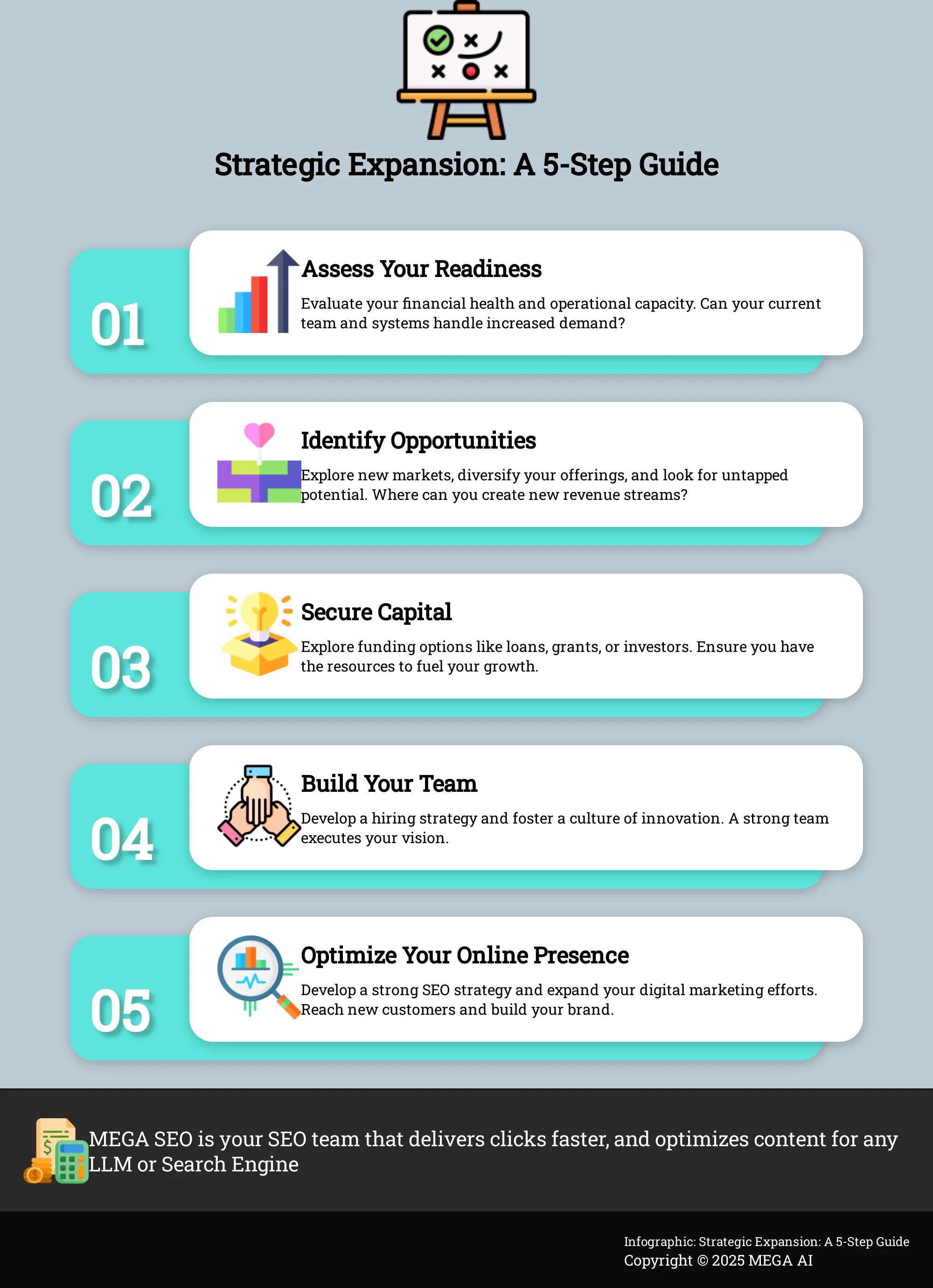
Before you pursue new expansion opportunities, it’s critical to assess whether your business has the foundation to support it. Growth is exciting, but scaling too soon or without the right resources can put your entire operation at risk. A realistic self-assessment helps you move forward with confidence and a clear understanding of what you need to succeed. Taking the time to evaluate your internal capacity and the external market landscape is the first step in any successful expansion strategy.
Check Your Financials and Operational Capacity
Growth requires capital. Before expanding, take a hard look at your financial health. Underestimating the costs of expansion is a common pitfall that can lead to serious cash flow problems and halt your progress. It’s wise to explore flexible financing options early and get a clear picture of your budget. Managing existing debt can also make your business more attractive to lenders. Beyond money, consider your operational capacity. Can your current team, systems, and processes handle an increase in demand without sacrificing quality? Rapid growth can strain your operations, so make sure you have the infrastructure in place to scale smoothly.
Analyze Market Demand and Your Competition
A great product or service is only viable if there’s a market for it. Strong market demand is the engine of sustainable cash flow, yet many businesses struggle with this even when funding is available. You need to confirm that there are customers who want what you’re offering and are willing to pay for it. At the same time, conduct a thorough competitive analysis to understand who you’re up against. What are their strengths and weaknesses? Where are the gaps in the market that your business can fill? This insight is invaluable for positioning your brand and making strategic decisions that set you apart from the crowd.
Find Profitable Expansion Opportunities
Once you've confirmed your business is stable and ready for the next step, it's time to identify where to direct your growth. Expansion isn't just about doing more of the same; it's about strategically finding new avenues for profitability. This means looking at your current offerings, exploring new territories, and keeping an eye on untapped markets where you can build a strong presence.
Diversify Your Products and Services
Relying on a single product can be risky. By diversifying your product and service offerings, you create multiple revenue streams and make your business more resilient to market shifts. Start by listening to your current customers. What related products do they ask for? What problems could you solve with a new service? Adding complementary offerings can increase customer lifetime value and attract new segments. Once you launch a new product, you’ll need an effective way to promote it. An automated SEO platform can help you quickly generate content and build visibility for your new offerings without stretching your team thin.
Enter New Geographic and Digital Markets
Your next customer might be in another city, state, or even another country. Expanding into new geographic and digital markets can open up a much larger customer base. This could mean opening a new physical location or strengthening your digital footprint to reach customers online. A strong digital marketing strategy is essential for this kind of expansion. Tools that automate keyword research and paid ad campaigns can help you target specific locations effectively. Of course, this growth requires capital, so it's wise to explore how to secure small business funding through loans or grants to support your entry into new arenas.
Recognize Potential in Emerging Markets
While established markets are competitive, emerging markets can offer incredible growth potential with less saturation. As one expert noted, "There's just tons and tons of opportunity." Identifying and moving into these areas before your competitors can give you a significant advantage. Entering a new international market requires careful research and adaptation. You'll need to understand the local culture, language, and search behavior. AI-powered tools can simplify this process by helping you research local keywords and automatically translate ad content and voiceovers, making it easier to connect with a global audience and establish a strong presence from day one.
Create Your Expansion Plan
A solid plan is the blueprint for your business's growth. It turns your vision into a series of actionable steps, guiding your decisions and keeping your team aligned. Without a plan, expansion can feel chaotic, straining your resources and pulling you in different directions. This section will walk you through creating a structured plan that covers your goals, resources, and potential risks.
Set Clear Goals and Milestones
Setting clear goals is the first step in a successful expansion. Vague ambitions like "grow the business" aren't enough. You need specific, measurable targets that define what success looks like for your company. This could be entering a new market, launching a product, or hitting a revenue target. Paying down high-interest debts can also be a crucial early goal, as it improves your financial health and makes it easier to secure the necessary funding for bigger projects. Break your main objectives into smaller, manageable milestones to track progress and keep your team motivated along the way.
Allocate Resources and Develop a Timeline
Once your goals are set, you need to determine what it will take to achieve them. Insufficient funding is a common reason expansion plans fail, so creating a detailed budget is critical. Underestimating financial needs can lead to cash flow problems and stalled growth. Beyond money, consider other resources like staff, technology, and inventory. A realistic timeline is just as important. Rapid growth can strain existing operations if you haven't planned for it, leading to delays and a dip in quality. Map out each phase of your expansion, assigning tasks and deadlines to ensure your growth is manageable.
Assess Risks and Plan for Contingencies
Every business venture comes with risks, and expansion is no exception. Taking time to identify potential challenges isn't about pessimism; it's about building resilience. Many small businesses encounter cash flow issues or operational hurdles, even with a solid plan. Think through what could go wrong. What if a key supplier falls through or a new competitor emerges? Recognizing common pitfalls early on allows you to create contingency plans. Having a backup for your most significant risks ensures that a single setback doesn't derail your entire expansion, allowing you to adapt and keep moving forward.
Secure and Manage Capital for Growth
Once you have a solid expansion plan, the next step is securing the capital to bring it to life. Funding is the fuel for your growth engine, but it requires careful planning to acquire and manage. This means not only finding the right sources of money but also ensuring you have the financial discipline to use it effectively without compromising the stability of your business.
Explore Your Funding Options
Finding the right funding is a critical step. There are several paths you can take, from traditional bank loans to more modern alternatives. Banks often provide term loans, lines of credit, and SBA loans that can supply the capital you need for expansion. Beyond banks, you can explore strategies like seeking out investors, applying for grants, or looking into alternative financing. To make your business more appealing to any potential lender or investor, focus on your financial health. Paying down high-interest debts to lower your debt-to-income ratio can significantly improve your chances of securing the capital you need to grow.
Balance Growth with Financial Stability
Securing funds is only half the battle; managing them wisely is what ensures long-term success. Rapid expansion can be exciting, but it also carries risks. Underestimating the financial needs of your growth plan can quickly lead to cash flow issues, while scaling too fast can strain your operations and impact quality control. It's crucial to avoid these common pitfalls by growing at a sustainable pace. This involves creating detailed financial forecasts and monitoring your spending closely. Using efficient tools for core functions like SEO can also help you manage marketing costs effectively, allowing your team to focus on strategic growth initiatives instead of manual tasks.
Build a Team to Drive Expansion
As your business grows, you can't do everything yourself. Your expansion plan is only as strong as the team executing it. Building the right team is one of the most critical investments you'll make. It’s not just about filling seats; it’s about bringing in people who will own their roles, contribute to your vision, and help you manage the complexities of growth. A strong team provides the expertise and bandwidth needed to turn your expansion goals into reality, ensuring you can scale effectively without sacrificing quality or momentum.
Develop Your Hiring Strategy and Leaders
One of the first steps in building your team is to develop a robust hiring strategy. Before you post a single job opening, identify the key leadership roles that will be essential for driving growth. Look for individuals who have a proven track record in your industry and can bring valuable experience to the table. When you surround yourself with strong leadership, you build a foundation that can withstand challenges and make sound decisions. A well-defined hiring process helps you assess not just skills but also a candidate's alignment with your company's long-term vision, ensuring each new hire contributes to your forward momentum.
Foster a Culture of Innovation and Adaptability
To succeed in a competitive market, you need a team that embraces change and new ideas. Foster a culture of innovation by encouraging everyone, from interns to senior leaders, to share their perspectives. The best ideas can come from anywhere, and an open environment allows your business to evolve and improve continuously. Believing in your team's ability to learn and adapt is crucial. This mindset prepares your organization to adopt new technologies and processes, helping you stay agile and responsive as you scale. An adaptable team is better equipped to implement efficient solutions, like the automated SEO and ad management tools that streamline marketing efforts.
Use Technology to Scale Efficiently
As your business grows, the manual processes that once worked can start to feel like they’re holding you back. Technology is your key to scaling efficiently, allowing you to handle increased demand without sacrificing quality or burning out your team. It’s about putting the right tools in place to automate repetitive tasks and gain the insights you need to make smarter decisions.
Implement Scalable Systems and Processes
Before you can scale your marketing or sales, you need a solid operational foundation. This means implementing systems that can grow with your business. Think about the core functions of your company: finance, customer relationship management (CRM), and project management. Relying on spreadsheets and manual data entry creates bottlenecks and increases the risk of errors as your transaction volume and team size increase.
Adopting scalable systems is also critical for your financial health. As you expand, you may need to explore flexible financing options to support your growth. Robust accounting software can help you manage cash flow, track expenses, and maintain a clean balance sheet. This financial discipline makes your business more attractive to lenders and investors, improving your ability to access capital when you need it most.
Use Data Analytics and AI Solutions
Once your foundational systems are in place, you can use data and artificial intelligence to accelerate your growth. A strong online presence is non-negotiable for expansion, and a good SEO strategy is central to that. It builds your authority and drives consistent traffic to your site. However, modern SEO involves complex tasks like keyword research, content creation, and technical optimization that can consume a lot of time.
This is where AI solutions become a game-changer. AI-powered platforms can automate the entire SEO lifecycle, from identifying the right keywords to generating high-quality content and building links. For businesses looking to scale, AI can also maintain and update existing articles, improving their performance over time. Similarly, AI can streamline your Paid Ads by automatically creating ad variations and optimizing your budget across platforms. By leveraging these tools, you can execute powerful SEO strategies and marketing campaigns at a scale that would be impossible to manage manually.
Optimize Your Online Presence and Marketing
As you plan your business expansion, your digital footprint is just as important as your physical one. A strong online presence is your key to reaching new customers, entering different markets, and building a brand that resonates far beyond your local area. It’s how you tell your story, demonstrate your value, and attract the right audience, no matter where they are. Optimizing your digital strategy isn't just about being online; it's about being found by the people who need you most.
This involves two core components that work together: making it easy for customers to discover you organically and actively reaching out to them through targeted marketing. A strong SEO strategy builds your authority and draws in potential customers who are actively searching for solutions like yours. It's the foundation of your long-term visibility. At the same time, a broader digital marketing plan ensures you’re engaging with your audience across multiple channels, building brand awareness, and driving direct action through paid ads and social media. By focusing on both, you create a powerful engine for sustainable growth that supports your expansion goals and turns online visibility into real business results.
Develop a Strong SEO Strategy
A good SEO strategy establishes your authority and drives consistent, high-quality traffic to your site. To get started, you need a clear plan. This begins with understanding where you currently stand by conducting an SEO audit of your website. From there, you can perform keyword research to find what your potential customers are searching for and build a content plan around those topics.
Creating quality content, optimizing your website's speed, and ensuring your site is technically sound are all critical pieces of the puzzle. For small businesses, managing all these moving parts can feel overwhelming. This is where AI-powered tools can make a significant difference, automating complex processes like keyword discovery and technical fixes so you can focus on creating value for your customers.
Expand Your Digital Marketing Efforts
Beyond SEO, a well-rounded digital marketing plan helps you connect with a wider audience. This often includes paid advertising, social media marketing, and email campaigns. To effectively expand these efforts, you need to have your financial house in order. Securing the right funding for your business is a critical first step that gives you the resources to invest in marketing.
With a budget in place, you can explore channels like paid ads to accelerate your reach. The key is to spend wisely. Modern paid ads platforms can help you manage your budget efficiently, automatically allocating funds to the best-performing campaigns and creating numerous ad variations to see what resonates most with your new target markets. This data-driven approach ensures your marketing dollars are working as hard as possible to fuel your expansion.
Overcome Challenges and Ensure Sustainable Growth
Expansion is an exciting milestone, but it’s also a period filled with potential pitfalls. Growth that happens too quickly or without a solid foundation can put your entire business at risk. One of the most common mistakes is to underestimate the financial requirements of expansion, which can quickly lead to cash flow problems and bring your progress to a halt. It’s not just about having the capital to start; it’s about having enough to sustain momentum through unexpected costs and slower-than-projected revenue from new ventures.
Beyond finances, rapid growth can strain your existing operations, leading to team burnout, process inefficiencies, and a dip in product or service quality. The very things that made your customers love you in the first place can suffer if you’re not prepared for an increase in demand. Successfully managing expansion means looking ahead to anticipate these challenges. By building scalable systems, preparing your team for new responsibilities, and focusing on sustainable practices, you can grow your business without sacrificing the quality and stability you’ve worked so hard to build. This proactive approach is what separates businesses that thrive from those that falter during periods of growth.
Maintain Quality Control and Continuously Improve
As your business scales, maintaining the quality of your products or services becomes more complex. What worked for a small team and a handful of customers may not hold up when you’re dealing with higher volumes. Simple issues like unorganized inventory or shipping delays can become major problems that damage your reputation and erode customer trust.
The key is to establish robust quality control processes from the start and commit to continuous improvement. Regularly review your operations to identify bottlenecks and areas for refinement. By taking deliberate steps to optimize your business for expansion, you can ensure that your standards don't slip as your customer base grows. This focus on quality will help you build lasting customer loyalty and a strong foundation for future growth.
Adapt Your Strategies for Long-Term Success
The marketing and operational strategies that brought you initial success may not be enough to support your long-term vision. As you enter new markets or expand your offerings, you need to adapt. A strong online presence is non-negotiable, and a good SEO strategy is central to establishing your authority and attracting customers consistently.
This means going beyond basic keywords. To compete on a larger scale, you need to focus on effective SEO strategies like producing high-quality content and optimizing your site’s technical performance. Using an SEO automation platform can help you manage and scale these efforts, ensuring your online presence grows with your business and continues to drive results for years to come.
Measure and Evaluate Your Expansion's Success
Once your expansion plan is in motion, your work shifts from planning to steering. Success isn’t a one-time destination; it’s a continuous process of measuring, learning, and adjusting. By tracking your performance against clear metrics, you can make informed decisions that keep your growth on track and ensure your efforts are paying off. This is where the data you collect becomes your most valuable asset, guiding your strategy and helping you build on your wins.
Define Key Performance Indicators for Growth
To know if your expansion is successful, you first need to define what success looks like in measurable terms. This is where key performance indicators (KPIs) come in. KPIs are specific, quantifiable metrics that directly reflect your growth objectives. Instead of guessing, you’ll have hard data showing you what’s working. For example, if you’re expanding into a new digital market, you might track website traffic from that region, lead generation numbers, and customer acquisition costs.
Effective SEO strategies rely on KPIs like organic traffic, keyword rankings, and click-through rates (CTR) to gauge performance. By setting clear benchmarks for these metrics, you can see the direct impact of your efforts. Tools that automate tracking can simplify this process, giving you a clear view of your progress without getting lost in spreadsheets.
Iterate and Refine Your Expansion Strategy
The data from your KPIs is the foundation for the next crucial step: iteration. Your initial plan is your best-educated guess, but real-world results will show you where to refine your approach. If a particular marketing channel is underperforming, your data will tell you to reallocate your budget. If a new service is getting great traction, you can double down on promoting it. This cycle of measuring, analyzing, and acting is what turns a good strategy into a great one.
This iterative mindset applies to all parts of your business. Just as you might refine your funding approach based on your financial health, you should constantly refine your marketing. For instance, AI-powered tools can automatically identify which articles need updates to improve their CTR or what new content could make them rank higher. This continuous SEO optimization ensures your online presence is always working as hard as possible to support your growth.
Related Articles
- Legal Basics for Startups: A Comprehensive Guide
- 30-60-90 Day Plan for Startups: A Growth Blueprint
- Scale Your Business Like a Pro: Expert Tips & Strategies
- Writing a Business Plan for a Startup: A Step-by-Step Guide
- Start an Online Business in 2025 With These Easy Steps
Frequently Asked Questions
What is the most common mistake small businesses make when expanding? A frequent misstep is underestimating the true cost and operational strain of growth. It’s easy to focus on the exciting potential for more revenue, but expansion requires significant capital for marketing, inventory, and hiring. It also puts pressure on your existing team and processes. A successful expansion depends on having a realistic budget and ensuring your operations can handle increased demand without sacrificing the quality that your customers expect.
Should I focus on developing new products or finding new markets first? There isn't a single right answer, as the best path depends on your specific business. A good starting point is to listen to your current customers. If they are consistently asking for related products or services, diversifying your offerings could be a natural and lower-risk step. On the other hand, if your current market is saturated but your product is strong, exploring new geographic or digital markets might present a larger opportunity.
How can I be sure my business is financially ready for expansion? Financial readiness goes beyond simply having cash in the bank. It means having a clear understanding of your cash flow, a detailed budget for the expansion, and a solid grasp of your operational costs. You should be able to project how increased sales will affect your expenses and profitability. It's also wise to have contingency funds in place to handle unexpected costs, ensuring that a single setback doesn't jeopardize your financial stability.
My team is small. How can technology help us compete with larger companies during expansion? Technology acts as a force multiplier for small teams. It automates the time-consuming, repetitive tasks that can bog down your staff, such as keyword research, ad creation, and content updates. By implementing the right tools for SEO and marketing, you free up your team to focus on high-impact activities like strategy, customer relationships, and creative development. This allows you to execute sophisticated campaigns and scale your efforts efficiently without needing a large workforce.
How do I know if my expansion strategy is actually working? You can measure the success of your strategy by tracking specific Key Performance Indicators (KPIs) that you define before you begin. These metrics should align directly with your growth objectives. For example, if your goal is to enter a new city, you might track website traffic from that location, leads generated, and customer acquisition cost. Regularly reviewing these KPIs will give you clear, data-driven insights into what is working and where you need to adjust your approach.