
SEO can feel like a full-time job you never signed up for. Between running your business, managing customers, and everything else on your plate, finding the time to research keywords, write content, and fix technical issues seems impossible. The good news is that a modern SEO strategy isn’t about working harder; it’s about working smarter. It moves beyond a simple checklist of tasks and focuses on building an automated growth engine. This guide outlines a step-by-step process for developing a contemporary SEO strategy that uses AI to handle the heavy lifting, making it accessible for small businesses that need to get results without a dedicated marketing team.
Key Takeaways
- Prioritize your technical foundation: Before creating content, connect your data sources like Google Search Console and run a complete technical audit to ensure your website is healthy and accessible to search engines.
- Build content around topics, not just keywords: Group related keywords into clusters to create comprehensive content hubs that establish your expertise and answer user questions from multiple angles.
- Automate your workflow for consistent execution: Use AI to manage the content lifecycle—from planning and writing to performance tracking—to publish consistently and adapt your strategy based on data.
What Does a Modern SEO Strategy Look Like?
A modern SEO strategy is less about chasing algorithms and more about building a system that consistently delivers value to your audience. It’s proactive, data-driven, and deeply integrated with your business goals. While the fundamentals of creating helpful content and a good user experience remain, the tools and speed have changed dramatically.
Today, a winning strategy means using automation and AI to execute tasks that once took entire teams weeks to complete. It involves everything from technical site health and keyword research to content creation and performance analysis. Instead of treating SEO as a checklist of one-off tasks, a contemporary approach sees it as a continuous growth engine that learns and adapts. This is where an AI-powered growth agent comes in, autonomously planning and running campaigns to get the work done without needing a large marketing team.
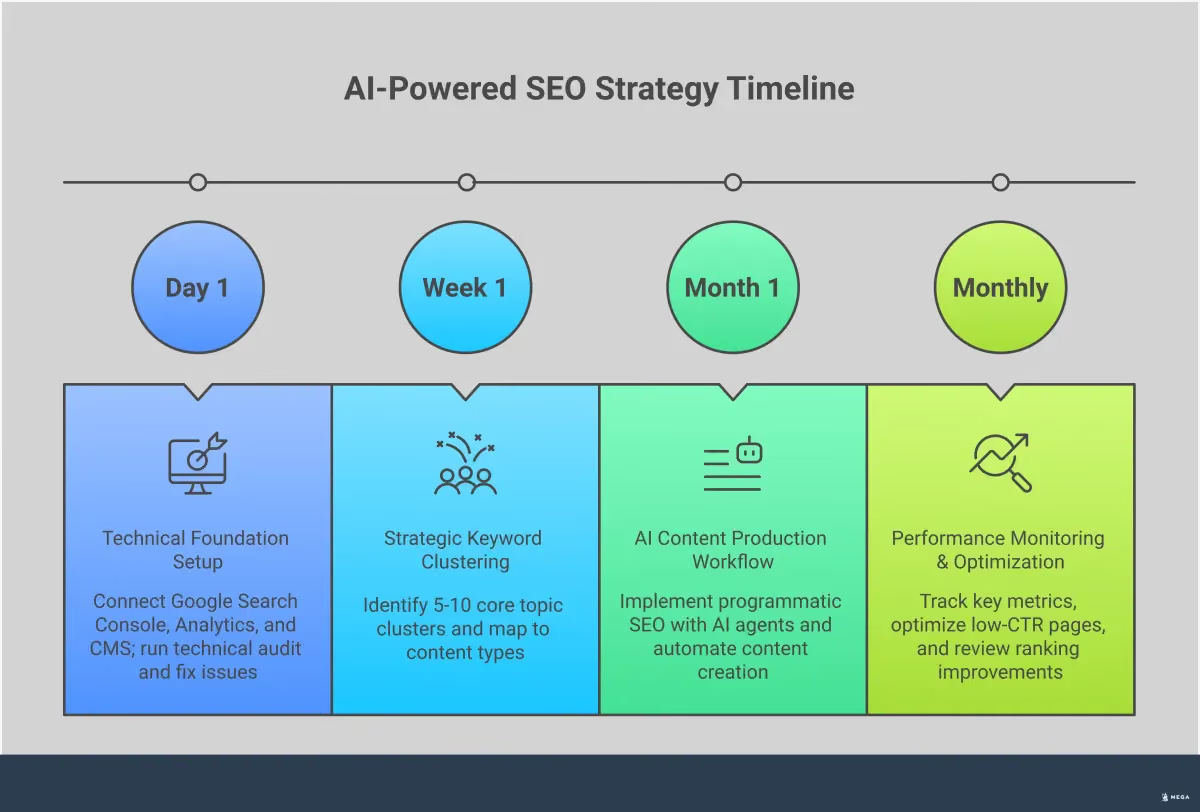
From Traditional to AI-Powered SEO
Not long ago, SEO involved manually pulling keyword lists from different tools, guessing at user intent, and slowly building content piece by piece. The process was time-consuming and often relied on intuition. Now, AI has transformed optimization by automating complex tasks. Modern AI SEO tools can analyze massive datasets to perform keyword research, monitor competitors, and find opportunities in minutes, not days. They can even analyze browsing habits and real-time engagement to help create content that is incredibly relevant to your specific audience. This shift allows you to focus on high-level strategy while the AI handles the tactical execution.
Why Your Current Strategy Needs an Update
Many small businesses struggle to keep up with SEO. Common challenges like limited resources, a lack of in-house expertise, and the constant pressure to create high-quality content can make it feel impossible to compete. Search engine algorithms are always changing, and the competition for top keywords is intense. If your current strategy feels like you’re always one step behind, it’s likely because it wasn’t built for the current digital landscape. An updated, AI-driven approach helps you overcome these common SEO challenges by providing the power of an expert team without the high cost, making sophisticated SEO accessible to everyone.
Step 1: Connect Your Data and Set Your Goals
Before you can build a winning SEO strategy, you need to establish a solid foundation. This first step is all about giving your tools and your team—whether human or AI—the context they need to work effectively. Think of it as the initial briefing. You’re providing access to your website’s performance data, connecting your content platform, and clearly defining what success looks like for your business. Without this groundwork, any SEO effort is just a shot in the dark. A modern strategy starts with connecting the dots between your data, your platform, and your objectives. This ensures every action, from keyword research to content creation, is purposeful and aligned with your growth. For an AI agent like MEGA AI’s SEO Agent, this initial setup is critical for it to learn about your business and start executing tasks.
Integrate Search Console and Analytics
The first order of business is to connect your website to Google Search Console and Google Analytics. These free tools are the source of truth for your website’s performance. Google Analytics tells you who is visiting your site, how they got there, and what they do once they arrive. Google Search Console focuses on your site’s performance in Google Search, showing you which queries bring users to your site, how often your pages are clicked, and if there are any errors preventing Google from crawling and indexing your content. Integrating these tools is non-negotiable because they allow you to connect keyword performance with real business impact. This data provides the baseline for your entire strategy.
Set Up Your CMS Connection
Your Content Management System (CMS) is where your content lives, whether it’s WordPress, Shopify, Webflow, or another platform. Connecting your SEO tools directly to your CMS creates a seamless workflow for publishing and updating content. Instead of manually copying and pasting articles, an integrated system allows for content to be pushed directly to your site, either as a draft for review or for automatic publishing. This is especially important when using AI for content creation, as it removes a major bottleneck in the production process. For small businesses, this automation saves valuable time and ensures that optimizations can be implemented quickly and efficiently.
Define Your Business Goals and Audience
SEO is not just about driving traffic; it’s about driving the right traffic that converts into customers. Before you look at a single keyword, you need to define your business goals. Are you trying to increase online sales, generate leads for a service, or drive foot traffic to a local store? Your goals will determine your entire approach. At the same time, you need a clear picture of your target audience. Who are they, what problems do they have, and what language do they use when searching for solutions? Answering these questions ensures your content resonates with the right people and supports your ultimate business objectives.
Step 2: Run a Technical SEO Audit
Once your data sources are connected, the next step is to perform a technical SEO audit. Think of this as a health check for your website’s foundation. It helps you find and fix any structural issues that could prevent search engines from properly understanding and ranking your content. For small businesses, this step is often overlooked, but it’s essential for building a strategy that lasts. An AI agent like the SEO Agent runs a technical audit to set a baseline, identifying problems with site speed, mobile usability, and indexability before creating any new content. This ensures that all your future SEO efforts are built on solid ground.
Check for Crawl and Indexing Issues
Before your site can rank, search engines need to be able to find (crawl) and save (index) your pages. If a page has a crawl error, Google’s bots can’t access it, making it invisible in search results. Indexing issues happen when a search engine crawls a page but decides not to add it to its database. You can use Google’s URL Inspection Tool within Search Console to check the status of individual pages. This process helps you spot problems like broken links or incorrect “noindex” tags that might be holding your site back. Fixing these issues ensures every important page on your site has a chance to be seen by potential customers.
Analyze Site Speed and Core Web Vitals
How quickly your website loads has a major impact on both user experience and search rankings. A slow site can frustrate visitors and cause them to leave before they even see your products or services. Google uses a set of metrics called Core Web Vitals to measure a page’s loading performance, interactivity, and visual stability. You can use tools like PageSpeed Insights to test your site’s performance. As a general rule, aim for a mobile performance score of at least 70. A fast, responsive website keeps users engaged and signals to search engines that your site offers a quality experience, which can directly influence your rankings.
Review Mobile-Friendliness and UX
More than half of all web traffic comes from mobile devices, so your site must be easy to use on a small screen. Mobile-friendliness goes beyond just having a design that resizes. It’s about the overall user experience (UX). Can visitors easily tap buttons, read text without zooming, and find what they’re looking for? A poor mobile experience can lead to high bounce rates and lost customers. You can use Google’s Mobile-Friendly Test to get a quick analysis of your site. Ensuring your website is seamless and intuitive on all devices is a critical part of any modern SEO strategy.
Step 3: Find the Right Keywords
Once your technical foundation is solid, the next step is to find the right keywords. This process is about understanding the language your customers use when they search for your products or services, and it’s the bedrock of any successful content strategy. A strong keyword strategy ensures the content you create actually reaches the people who need it, rather than getting lost in the noise. It involves more than just picking terms with high search volume; it requires a deep dive into search intent, competitor analysis, and identifying niche opportunities that larger brands might overlook.
While an AI agent like the SEO Agent automates this research by analyzing competitors and mapping search intent, understanding the principles behind it will help you guide your strategy and evaluate its success. The goal is to build a comprehensive list of terms that align with your business goals and what your audience is actively looking for. This includes broad “head” terms that define your industry, specific “long-tail” phrases that capture high-intent users, and local keywords that connect you with customers in your community. By approaching keyword research methodically, you set the stage for creating content that not only ranks but also converts.
Tools for Keyword Discovery
A variety of tools can help you uncover keyword opportunities. Some platforms, like Ahrefs Keywords Explorer, are powerful for analyzing your competition and tracking rankings, while others like KWFinder are known for being user-friendly. There are also free SEO tools that offer lighter versions of professional software, which can be a great starting point for small business owners. These tools provide data on search volume, difficulty, and related terms. An AI agent streamlines this by integrating data from multiple sources to find the best keywords to target without requiring you to manage several subscriptions or learn different interfaces.
Group Keywords by Search Intent
Modern SEO focuses on topics, not just single keywords. Grouping keywords into clusters based on search intent helps you create comprehensive content that answers a user’s core question. When you think in terms of clusters, you’re tackling one core topic from multiple angles. For example, instead of just targeting “local coffee shop,” you might create a topic cluster around it that includes “best espresso near me,” “coffee shop with wifi,” and “where to buy whole bean coffee.” This approach signals to search engines that you are an authority on the subject, helping you attract the right kind of traffic.
Analyze Competitor Keywords
Understanding what’s already working for your competitors is a smart way to find opportunities. You can analyze their websites to see which keywords drive the most traffic and identify pages with clear commercial intent. This doesn’t mean copying their strategy, but rather learning from it to find gaps you can fill. Perhaps they rank well for broad terms, but you can target more specific, long-tail variations. AI tools are particularly good at this, as they can continuously monitor competitor performance and provide actionable insights to help you create more relevant and effective content.
Prioritize Long-Tail and Local Keywords
For small and local businesses, long-tail and local keywords are incredibly valuable. Long-tail keywords are longer, more specific phrases (e.g., “emergency plumber in Brooklyn”) that usually have lower search volume but higher conversion rates. Local SEO focuses on optimizing your online presence to appear in these relevant local searches. By prioritizing these terms, you can attract highly qualified customers who are actively looking for your specific services in your area. This targeted approach helps you compete effectively without needing the budget of a large national brand.
How Do You Identify Your Core Content Topics?
Once you have a list of keywords, the next step is to organize them into a coherent content strategy. Instead of targeting random keywords, a modern approach focuses on building authority around specific subjects. This is done by creating topic clusters—groups of related content that all link back to a central pillar page. This structure signals to search engines that you are an expert on a particular subject, which helps your entire site rank better. It also makes your content more helpful for visitors, guiding them through a topic in a logical way. For small businesses, this method is much more efficient than a scattergun approach, as it concentrates your efforts on the areas most likely to attract the right customers. By grouping content logically, you create a clear path for both users and search engine crawlers, making your site easier to understand and value.
Select 5-10 Topic Clusters
To start, you don’t need to be an expert in everything. Focus your efforts by identifying five to 10 core topics that are central to your business. As SEO expert Nathan Gotch explains, this focus allows you to build a strong foundation and expand your keyword footprint strategically. Think about the main problems your customers face or the primary services you offer. For a local bakery, core topics might be “custom wedding cakes,” “sourdough bread,” and “gluten-free pastries.” Each of these topics becomes a pillar for your content, giving you a clear direction for what to write about next. This targeted approach is more effective than trying to cover too many subjects at once.
Map Keywords to Your Content Plan
With your topic clusters defined, you can now map your keywords to your content plan. Go through your keyword research and assign each term to the most relevant topic cluster. During this process, you’ll need to decide if a keyword can be targeted on an existing page or if it requires a new, dedicated page. For example, “how to store sourdough bread” could be a section on your main sourdough pillar page. However, a keyword like “best sourdough starter recipe” has a different user intent and would likely perform better as its own separate blog post that links back to the main sourdough page. This strategic keyword mapping ensures every piece of content has a clear purpose.
Create Your Content Architecture
Your topic clusters and mapped keywords form your site’s content architecture. This structure helps search engines understand the relationship between your pages and establishes your topical authority. Each cluster should have a main pillar page that covers the core topic broadly, with several supporting pages that go into detail on related subtopics. When deciding whether to create a new page, consider if the search query has a distinctly different intent. If you had to create a landing page for a paid ad, would you make it specific to that query? If the answer is yes, it probably deserves its own page. Planning this architecture helps you create a well-organized and discoverable website.
Step 4: Create an AI-Powered Content Plan
With your keyword map and topic clusters defined, it’s time to build a content plan. A modern content plan is a strategic blueprint that outlines how you’ll create content at scale, optimize it for search, and establish your brand as an authority. This is where AI becomes a powerful partner, helping you plan and execute a content strategy that drives results. Instead of guessing, you can use AI to make data-driven decisions about what content to create and how to structure it for maximum impact.
Use AI for Content Planning and Creation
AI tools transform your content planning from a manual process into an efficient, strategic operation. They analyze search trends and user intent to identify high-opportunity topics. An AI agent like MEGA AI’s SEO Agent can take this further by generating outlines and even writing complete first drafts. This allows you to automate repetitive tasks and focus your energy on refining the content to align with your brand’s voice. By handling the heavy lifting of research and initial creation, AI frees you up to be the editor and strategist.
Optimize Titles and Metas for Your Keywords
Your title tag is a critical on-page SEO element. It’s the first thing a user sees in search results and a direct ranking signal for search engines. A great title is clear, compelling, and includes your primary keyword. While your meta description doesn’t directly affect rankings, it heavily influences your click-through rate (CTR). AI can generate multiple variations of titles and metas for testing. AI agents can also monitor performance and automatically update content to improve CTR, ensuring your pages attract clicks.
Build Topic Authority with In-Depth Content
Search engines reward websites that demonstrate deep expertise. Instead of one-off articles, focus on building topic clusters—a main pillar page covering a broad topic, supported by in-depth articles on related subtopics. This structure helps you build topic authority and signals your expertise. AI is useful here, as it can analyze a topic to identify all the related questions and concepts you need to cover for comprehensive content. It can also identify gaps in your existing articles, suggesting new sections to add that make your content more valuable.
What Role Does AI and LLM Optimization Play?
The way people find information online is changing. Instead of just scanning a list of blue links, they are getting direct answers from AI-powered tools like ChatGPT and Google’s AI Overviews. This shift means your SEO strategy needs to account for Large Language Models (LLMs), the technology behind these tools. Optimizing for LLMs isn’t about replacing your existing SEO efforts; it’s about adding a new layer to ensure your content is visible wherever your audience is searching. It requires creating content that is not only keyword-focused but also structured for easy comprehension by AI.
Optimize Content for AI Search (Like ChatGPT and Google Overview)
Optimizing for AI search means making your content the best possible source for an AI to use when generating an answer. This involves writing clear, concise, and factual content that directly addresses specific questions. Think about structuring your articles with clear headings and using FAQ sections to answer common queries. An AI SEO strategy helps you plan content that is easily digestible for these models, increasing the likelihood that your business will be cited as a source in AI-generated results. This makes your expertise visible within new formats like Google’s AI Overviews, placing your brand directly in front of users.
How AI Search Changes User Behavior
AI is teaching people to search more conversationally. Instead of typing “best pizza near me,” a user might ask, “What’s a good place to get a thin-crust pizza that’s open late on a Tuesday?” This change means your content needs to answer longer, more specific questions. AI tools can analyze these complex queries and browsing habits to help you create highly relevant content that matches this natural language. By understanding and targeting these detailed questions, you can reach users who have a very clear intent, putting your business in a prime position to provide the exact solution they need.
Balance Traditional SEO with AI Optimization
While optimizing for AI is important, it doesn’t replace the fundamentals of traditional SEO. Keyword research, technical site health, quality backlinks, and a good user experience are still the foundation of a strong online presence. The best approach is to integrate AI optimization into your existing framework. Use AI to automate repetitive tasks, predict trends, and gain deeper insights, but continue to build on a solid technical and content foundation. A modern SEO platform should help you manage both, ensuring your site is optimized for traditional search engines while also being prepared for the continued growth of AI-driven search.
Step 5: Set Up Your Content Production Workflow
Once your strategy is in place, it’s time to create the content. A modern SEO strategy depends on a consistent and efficient production workflow. This is where you move from planning to execution, turning your keyword research and content architecture into published articles that attract your audience. For small businesses, this step can feel like the biggest hurdle. Creating high-quality content consistently requires significant time and resources.
This is why automation is no longer a luxury; it’s a core component of a scalable SEO strategy. Instead of manually writing every article, you can use an AI-powered system to handle the heavy lifting. An AI agent like the SEO Agent can autonomously manage the entire process, from drafting articles based on your keyword plan to optimizing them for search engines. This frees you up to focus on running your business while your content engine works for you in the background. You can choose to have articles sent to your CMS as drafts for review or let the AI publish them automatically.
Automate Your Content Creation
Automating content creation means using AI to handle the research, writing, and optimization of your blog posts. Modern AI tools for SEO are designed to analyze search data, understand user intent, and generate content that is both helpful to readers and optimized for search engines. This process saves countless hours compared to manual writing. Instead of spending your week writing one or two articles, an automated system can produce content daily, filling your content pipeline and building topic authority much faster. This allows you to maintain a consistent publishing schedule without sacrificing quality or your own time.
Use Programmatic SEO to Scale Content
Programmatic SEO is a method for creating content at a large scale by using data and templates. It’s especially effective for businesses that need to target thousands of specific, long-tail keywords, such as a local service provider covering multiple neighborhoods or an e-commerce store with a large product catalog. AI accelerates this process by using data-driven insights to generate unique pages for each specific keyword variation. This ensures your content remains relevant and effective as you scale. By automating this approach, you can efficiently build a wide net to capture highly specific search queries, attracting qualified traffic that is closer to converting.
Keep Your Brand Voice Consistent with AI
A common concern with AI-generated content is that it might sound generic or off-brand. However, sophisticated AI systems can be trained to match your unique brand voice. By providing the AI with a brand style guide, examples of your existing content, and information about your company, you can ensure every article it produces sounds like it came directly from you. The AI references these documents first to create content that is on-brand and resonates with your target audience. This capability allows you to get the efficiency of AI without losing the distinct personality that makes your business stand out.
How Do You Monitor Performance and Make Adjustments?
An SEO strategy isn’t something you can set and forget. Search engines are constantly updating, and your competitors are always working to outrank you. This means you need a consistent process for monitoring your performance and making data-driven adjustments. Think of it as a feedback loop: you publish content, measure its impact, and use those insights to refine your approach. For a small business owner, this might sound like another full-time job, but modern tools can automate much of this process.
By connecting platforms like Google Search Console and your CMS, an AI agent can track performance and execute changes for you. This continuous optimization cycle is what separates a static strategy from one that delivers long-term growth. It involves tracking the right metrics, understanding user behavior, and using that information to make your content more effective over time. The goal is to create a system that not only builds your initial rankings but also defends and improves them month after month.
Key SEO Metrics and Tools to Track
To monitor performance, you need to track the right numbers. Start by connecting your website to Google Search Console and Google Analytics. These free tools are the foundation for understanding your organic traffic, keyword rankings, and user behavior. Key metrics to watch include organic sessions, top-performing pages, and the specific keywords driving traffic to your site. While there are many free SEO tools available, the real power comes from integrating this data. An AI-powered platform can connect these fluctuations in keyword performance to real business impact, showing you what’s working and what isn’t.
Analyze CTR and User Engagement
Getting your content to rank on the first page is only half the battle. You also need people to click on it. That’s where click-through rate (CTR) comes in. This metric measures the percentage of people who see your page in the search results and actually click through to your site. A low CTR on a high-ranking page signals a disconnect. Often, the problem is a weak or irrelevant title tag. You can track how changes to your title tags affect CTR directly in Google Search Console. Regularly testing new headlines is a simple way to get more traffic without needing to improve your rankings.
Use Data to Refine Your Strategy
The data you collect from your tools should guide every adjustment you make. If you notice a blog post is ranking for keywords you didn’t originally target, you can update the content to better address that search intent. If a page has a high bounce rate, you might need to improve the introduction or add more engaging visuals. AI tools are particularly good at identifying these opportunities, providing actionable insights to outperform competitors. For example, MEGA AI’s SEO Agent can automatically identify and add new sections to existing articles to help them rank for more keywords and improve their overall performance.
Set Realistic Timelines and Choose Your Workflow
Once your SEO strategy is in place, the final step is to define your expectations and decide how you want to manage the execution. A modern SEO approach isn’t just about what you do; it’s also about how you do it. Understanding the timeline for results and choosing a workflow that fits your business will help you stay consistent and avoid frustration. Whether you prefer hands-on control or want to automate the process, setting these parameters upfront is key to a successful, long-term strategy. This ensures you can focus on running your business while your SEO plan works for you in the background.
What Results to Expect (and When)
SEO is a long-term investment, not an overnight fix. While it’s tempting to look for immediate traffic spikes, it’s important to set realistic timelines. For most small businesses, seeing significant organic traffic growth can take anywhere from three to nine months. This timeframe depends on factors like your industry’s competitiveness, your starting point, and the consistency of your efforts. The first few months are about laying the foundation: fixing technical issues, building topic authority, and letting search engines crawl and understand your new content. Patience is crucial. By tracking leading indicators like keyword ranking improvements and indexing rates, you can monitor progress long before you see a major jump in traffic.
Choose Between Manual Review and Autopilot
Your involvement in day-to-day execution can be as hands-on or as hands-off as you like. A manual review workflow is a great option if you want to approve every piece of content before it goes live. This gives you complete control over your brand voice and messaging. For example, an AI agent like the SEO Agent can write articles and send them to your CMS as drafts for you to review and publish.
Alternatively, an autopilot workflow allows the AI to handle the entire process, from research and writing to publishing. This is ideal for busy founders and small teams who need to streamline their SEO process and focus on other business priorities. At MEGA AI, we find that 85% of our customers use autopilot because it delivers results twice as fast. This approach lets the AI execute the strategy autonomously while you get updates on the tasks being performed.