
Running an e-commerce business is like navigating a crowded marketplace. You need to shout louder than everyone else to get noticed. But what if you could attract customers effortlessly? That's the power of a well-executed SEO strategy for ecommerce websites. SEO is the key to organic growth, attracting customers actively searching for products like yours. This guide will provide a comprehensive roadmap for building an effective e-commerce SEO strategy, covering everything from keyword research and on-page optimization to technical SEO, content marketing, and link building. We'll explore how to overcome common e-commerce SEO challenges, such as duplicate content and out-of-stock products, and how to adapt your strategy for seasonal trends and voice search. Get ready to transform your online store into a customer magnet.
Key Takeaways
- SEO is fundamental for e-commerce: Attract organic traffic, improve brand visibility, and increase conversions with a robust SEO strategy. Focus on both on-page and technical SEO to draw in and convert potential customers.
- Keywords are key: Understand what your customers search for and use relevant keywords, especially long-tail keywords, to target the right audience and rank higher. Competitor keyword analysis can uncover valuable insights.
- Content and links drive growth: Create high-quality content, like product guides, blog posts, and videos, to engage potential customers. Earn backlinks from reputable sites to boost authority and search visibility. Track your SEO performance and adapt your strategy for lasting results.
What is SEO and Why Does it Matter for E-commerce?
For e-commerce businesses, search engine optimization (SEO) is crucial for driving organic traffic and increasing sales. A strong SEO strategy can significantly impact your online store's visibility and profitability. Let's explore what SEO is and why it's essential for e-commerce success.
What is SEO?
SEO, or Search Engine Optimization, is the practice of enhancing your website to improve its visibility on search engines like Google. For e-commerce, this means optimizing product pages, categories, collections, site structure, and content to rank higher in search results. The higher your website ranks, the easier it is for potential customers to find your online store when searching for products you offer. SEO involves various techniques, including keyword research, on-page optimization, technical SEO, content marketing, and link building.
How SEO Impacts E-commerce Success
E-commerce SEO is crucial because it helps your online store attract customers organically, without relying solely on paid advertising. By optimizing your website and product pages with relevant keywords and high-quality content, you can ensure that your store appears prominently when potential customers search for products you offer. This increased visibility translates to more organic traffic, which can lead to higher conversion rates and increased sales. SEO also helps build brand awareness and establish your store as a trusted source for specific products.
Benefits of SEO for Online Stores
Implementing effective e-commerce SEO strategies offers several benefits:
- Increased Brand Visibility: Higher rankings in search results increase your store's visibility to potential customers actively searching for products you sell. This consistent exposure helps build brand awareness and recognition over time.
- Improved Customer Experience: SEO involves optimizing your website's structure and navigation, making it easier for customers to find what they're looking for. A positive user experience can lead to higher customer satisfaction and increased conversions.
- Cost-Effective Traffic Generation: Compared to paid advertising, SEO is a more sustainable and cost-effective way to drive traffic to your online store. While it requires an initial investment of time and effort, organic traffic generated through SEO can continue to flow long after the initial optimization work is done.
- Higher Conversion Rates: SEO attracts customers actively searching for products you offer, meaning they are more likely to convert into paying customers. This targeted approach can lead to a higher return on investment (ROI) for your marketing efforts.
- Sustainable Growth: SEO is a long-term strategy that can provide sustainable growth for your e-commerce business. By consistently optimizing your website and content, you can build a strong online presence that attracts a steady stream of organic traffic over time.
Essential E-commerce SEO Strategies
Effective search engine optimization (SEO) is crucial for any e-commerce business to thrive. A strong SEO strategy drives organic traffic, improves brand visibility, and ultimately increases sales. Let's explore the core elements of a successful e-commerce SEO strategy:
Keyword Research
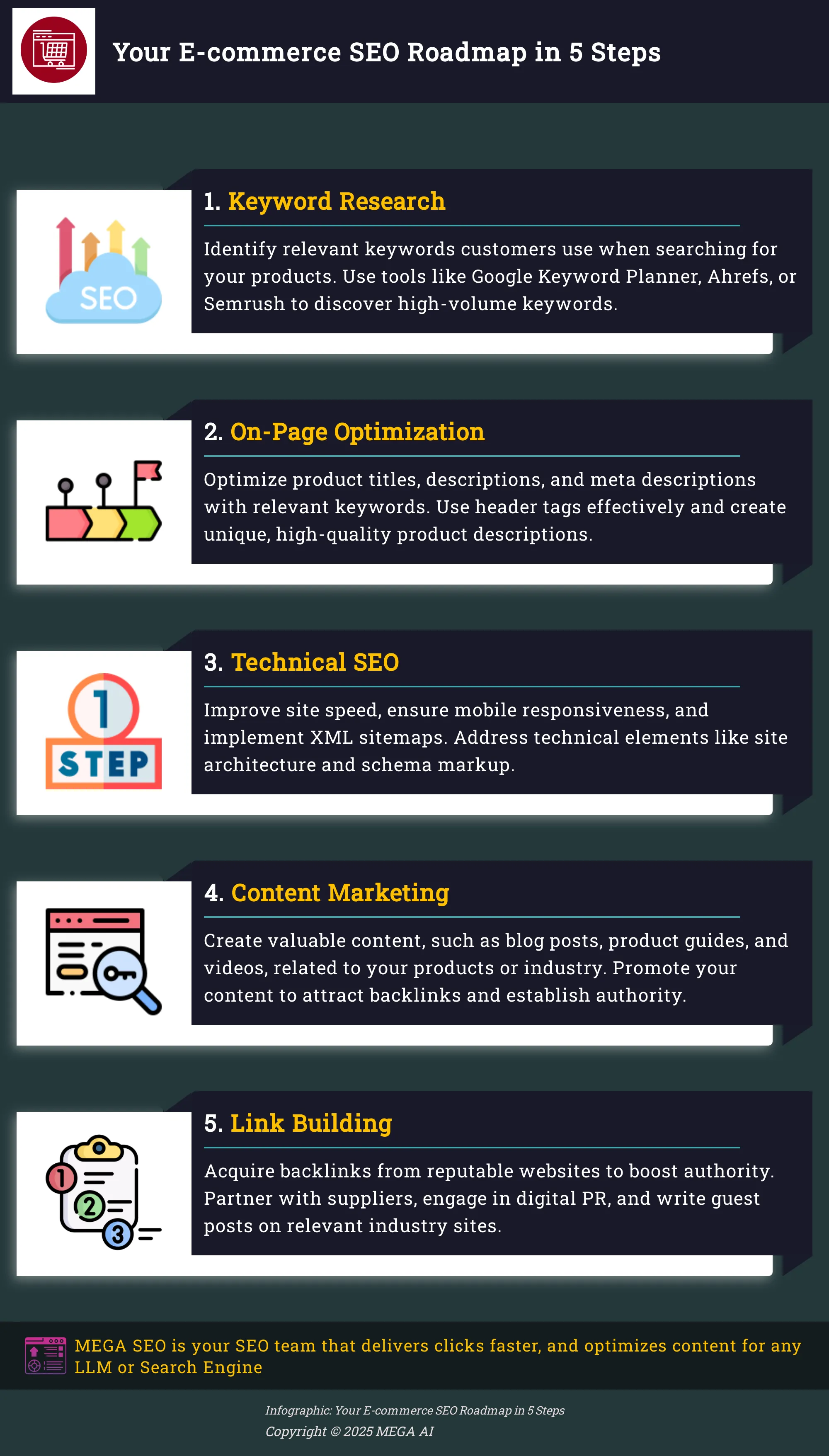
Keyword research forms the foundation of your SEO efforts. It involves identifying the terms customers use when searching for products like yours. Understanding user intent is key. Are they researching, comparing, or ready to buy? Tools like Ahrefs or Semrush (paid) and Google Keyword Planner (free) can help you discover relevant keywords with high search volume and manageable competition. Think about various keyword types: product-focused (e.g., "leather handbag"), transactional (e.g., "buy leather handbag online"), long-tail (e.g., "brown leather tote bag for work"), and those related to subcategories or semantically similar concepts. Learn more about keyword research.
On-Page Optimization
On-page optimization focuses on refining your website's content and structure. This includes optimizing product titles, descriptions, and meta descriptions, and using header tags (H1-H6) effectively. Craft unique, high-quality product descriptions that provide value to your target audience. Use clear calls to action to guide users toward desired actions, like making a purchase. Structure your content logically with headings, subheadings, bullet points, and images to enhance readability. Strategically incorporate relevant keywords, but avoid keyword stuffing, which can harm your rankings.
Technical SEO
Technical SEO involves improving the technical aspects of your website to enhance its crawlability and indexability. Site speed is key. A fast-loading website provides a better user experience and improves search rankings. Ensure your website is mobile-friendly, as more users shop on their smartphones. Submit an XML sitemap to Google Search Console to help search engines understand your site's structure. Address other technical elements like site architecture, schema markup, and resolving duplicate content issues. Learn more about technical SEO.
Content Marketing
Content marketing plays a vital role in attracting and engaging your target audience. Create informative content, such as blog posts, articles, buying guides, and videos, related to your products or industry. This establishes your brand as an authority and drives organic traffic. For example, if you sell hiking gear, you could create blog posts about hiking trails or gear reviews. Regularly refresh your content to ensure it remains up-to-date. Explore content marketing strategies.
Link Building
Link building involves acquiring backlinks from other reputable websites. Backlinks act as votes of confidence, signaling to search engines that your website is trustworthy. Focus on earning high-quality backlinks from relevant sources. There are various ways to build high-quality links, such as guest blogging, reaching out to other websites in your industry, and promoting your content on social media.
Master Keyword Research for E-commerce Products
Keyword research is the foundation of any successful SEO strategy, especially for e-commerce. It's about understanding what your potential customers are searching for and aligning your content to match their needs. This section breaks down how to master keyword research for your e-commerce products.
Understand User Intent in Product Searches
Before diving into keyword tools, consider why people search for products online. Are they looking for information, comparing prices, or ready to buy? E-commerce SEO boils down to improving your online store's visibility in search results, ultimately driving more customers to your site without relying on paid ads. As Coursera explains in their e-commerce SEO guide, the core focus is on boosting your website and product pages higher in search engine rankings when shoppers search for the products you offer. Understanding this "user intent" is crucial. For example, someone searching for "best winter boots for hiking" has a much higher purchase intent than someone searching for "types of boots." Tailor your keywords and content to target users actively looking to make a purchase.
Keyword Research Tools
Once you have a grasp of user intent, it's time to find the right keywords. Several tools can help you uncover valuable search terms. Shopify recommends using tools like Ahrefs (paid) or Google Keyword Planner (free) to identify high-volume, low-competition keywords. Focus on keywords that clearly indicate buying intent. For example, "best running shoes for women" signals a stronger purchase intent than simply "running." Exploring what keywords your competitors are ranking for can provide valuable insights into what's working in your industry. MEGA AI's keyword research features automate this process, providing you with a curated list of high-potential keywords.
Why Use Long-Tail Keywords?
While short, generic keywords might seem appealing, long-tail keywords—longer, more specific phrases—are often more effective for e-commerce. Sana Commerce points out how these highly specific keywords attract highly qualified customers. Think "waterproof hiking boots with ankle support" instead of just "boots." Long-tail keywords typically have lower competition, making it easier to rank higher in search results. Plus, they target users further along in the buying process, leading to higher conversion rates. By using long-tail keywords, you're not just attracting traffic; you're attracting the right traffic—people actively searching for exactly what you sell.
Analyze Competitor Keywords
Keeping an eye on your competition is essential for effective keyword research. Identify your top competitors and analyze the keywords they're targeting. Coursera's article suggests analyzing their content, user experience, and identifying content gaps. This research can reveal opportunities to target keywords they might be missing or areas where you can create even better content. Understanding your competitors' keyword strategy can help you refine your own and gain a competitive edge in search results. MEGA AI simplifies competitor analysis by automatically tracking competitor keywords and identifying opportunities for you to outrank them. Book a demo to see how MEGA AI can transform your e-commerce SEO.
Optimize Your E-commerce Website with On-Page SEO
On-page SEO is the practice of optimizing individual web pages to rank higher and earn more relevant traffic in search engines. For e-commerce sites, this means creating product and category pages that both search engines and users love. Let's explore some key on-page tactics:
Optimize Product Titles and Descriptions
Think of your product title as your first impression. It needs to grab attention and accurately reflect what you're selling. Use relevant keywords that shoppers use when searching for products like yours. Your product descriptions should be detailed and unique, providing all the information a potential buyer needs. High-quality product descriptions improve user experience and help search engines understand your product. For a deeper dive into product page optimization, check out Shopify's e-commerce SEO guide.
Write Compelling Meta Descriptions
Meta descriptions are the short snippets of text that appear under your page title in search results. While they don't directly impact rankings, they significantly influence click-through rates. Think of them as your elevator pitch. You have a limited number of characters (around 160) to convince searchers to click your link instead of a competitor's. Include your target keywords and make sure your description is compelling and accurate. A great meta description can be the difference between a click and a missed opportunity. For more tips on optimizing meta descriptions, explore this e-commerce SEO course.
Use Schema Markup for Rich Snippets
Schema markup is a type of code that helps search engines understand the context of your content. For e-commerce, this can include product details like price, availability, and reviews. Adding schema markup to your product pages can result in rich snippets, which are enhanced search results with additional information displayed directly in the SERP. Rich snippets make your listings more visually appealing and can significantly improve click-through rates. They also help search engines better categorize and understand your products. For more information on schema, review this SEO strategy discussion.
Optimize Images and Alt Text
Images are essential for any e-commerce website, but they also play a role in SEO. Always use high-quality images that accurately represent your products. Just as important is optimizing your image alt text. Alt text is a short description of your image that screen readers use for visually impaired users. It also helps search engines understand your images. Use descriptive alt text that includes relevant keywords, but avoid keyword stuffing. Keep it concise and focused on accurately describing the image. Learn more about image optimization in Shopify's beginner's guide.
Create Internal Linking Strategies
Internal links connect pages within your website. A solid internal linking strategy is crucial for both user experience and SEO. It helps users easily find related products and content, and it helps search engines understand the structure of your website. Make sure to link to important product pages from your main navigation. Use "customers also bought" sections to suggest related products. And don't forget to link your blog articles to relevant product pages using descriptive anchor text. A well-executed internal linking strategy can significantly improve your site's overall SEO performance. For more on internal linking, see this helpful resource on e-commerce SEO.
Improve E-commerce Performance with Technical SEO
Technical SEO can be the difference between a site that ranks well and one that doesn't. It ensures search engines can easily crawl and index your e-commerce website. A technically sound website also provides a better user experience, which is crucial for conversions and rankings.
Optimize Site Speed
Site speed is a critical factor for both user experience and search engine rankings. A slow website can lead to higher bounce rates and lost sales. Make sure your website loads quickly. Test your site speed with tools like Google PageSpeed Insights, which provides specific recommendations for improving your site's performance. Prioritize optimizing images, leveraging browser caching, and minimizing HTTP requests.
Ensure Mobile Responsiveness
Most online shoppers browse and purchase on their mobile devices. A mobile-responsive design ensures your website adapts seamlessly to different screen sizes, providing a positive user experience on any device. Test your website's mobile-friendliness using Google's Mobile-Friendly Test. A mobile-friendly website is essential for reaching a wider audience and improving your search engine rankings.
Implement XML Sitemaps and Robots.txt
XML sitemaps and robots.txt files are essential for guiding search engines through your website. An XML sitemap to Google Search Console to ensure your pages are indexed correctly. This ensures that search engines can efficiently crawl your website.
Define URL Structure and Canonicalization
A well-defined URL structure improves user experience and helps search engines understand the hierarchy and content of your website. Include relevant keywords in URLs (e.g., /products/womens-running-shoes), keep them concise (under 60 characters), and avoid unnecessary words ('a,' 'and,' 'the'). Use canonicalization to address duplicate content issues by specifying the preferred version of a URL. This helps search engines understand which URL to prioritize.
Implement HTTPS
HTTPS is a security protocol that encrypts communication between a user's browser and your website. Implementing HTTPS builds trust with your customers and is a ranking signal for search engines. A secure website protects sensitive user data and improves your website's credibility.
Enhance E-commerce SEO with Content Marketing
Content marketing plays a crucial role in attracting potential customers to your online store. High-quality content helps boost your search engine rankings, driving organic traffic and establishing your brand as a leader in your niche. Let's explore how to leverage content to enhance your e-commerce SEO strategy.
Create Valuable Product Guides and Tutorials
Detailed product guides and tutorials offer immense value to your customers. They empower informed purchasing decisions and serve as valuable resources that attract organic traffic. By creating content that targets specific keywords related to your products, you can improve your site's visibility in search results. For example, if you sell coffee makers, a guide on "How to Choose the Perfect Coffee Maker" could attract users actively searching for that information. This approach not only helps customers but also positions your site as a go-to resource for coffee-related information. Think about the questions your customers ask and create content that provides those answers. Consider offering downloadable guides or checklists to capture leads and nurture customer relationships.
Build an SEO-Friendly Blog
A regularly updated blog is a powerful tool for driving organic traffic to your e-commerce website. Focus on creating high-quality, informative content that addresses customer pain points and interests. Shopify’s guide to e-commerce SEO emphasizes the importance of building a blog to establish authority and improve search engine rankings. By consistently delivering valuable content, you can attract a loyal audience and position your brand as an expert in your industry. This builds trust and encourages customers to return to your site for more information and, ultimately, to make purchases. Promote your blog content across your social media channels and email newsletters to expand its reach.
Leverage User-Generated Content
User-generated content, such as customer reviews and testimonials, is a goldmine for SEO. Authentic reviews build trust with potential customers and provide fresh, relevant content that search engines love. Encourage your satisfied customers to leave reviews on your product pages. Feature positive testimonials on your homepage and other key landing pages. This not only boosts your credibility but also provides valuable social proof that can influence purchasing decisions. Consider incorporating user-generated content into your social media strategy, showcasing positive customer experiences.
Optimize Video Content
Video content is highly engaging and can significantly impact your e-commerce SEO. Videos like product demonstrations and tutorials provide value to customers and can attract more visitors, keeping them engaged with your site. Longer visitor dwell times signal to search engines that your site offers valuable content, which can positively influence your search rankings. Consider creating videos showcasing your products in action or offering helpful tips related to your niche. Host these videos on platforms like YouTube and embed them on your product pages to maximize their reach and SEO benefits. Make sure your videos are optimized for accessibility with closed captions and transcripts. Promote your videos on social media and through email marketing to reach a wider audience.
Build Effective Links for E-commerce Websites
Link building is a cornerstone of off-page SEO. For ecommerce businesses, a strong link-building strategy can significantly impact organic search visibility. Backlinks from reputable websites signal to search engines that your site is trustworthy and authoritative, boosting your rankings and driving more organic traffic. Let's explore some effective link-building tactics specifically tailored for ecommerce websites.
Partner with Suppliers and Manufacturers
Collaborating with your suppliers and manufacturers presents a natural link-building opportunity. Many suppliers are happy to link to retailers who sell their products. Reach out and explore opportunities for partnerships that can lead to mutual linking. This not only helps with SEO but can also strengthen your business relationships. Consider offering to feature your suppliers on your website in exchange for a link back to your store.
Acquire Backlinks with Digital PR
Digital PR focuses on earning high-quality backlinks from authoritative websites through strategic outreach and content promotion. Guest blogging, outreach, and social media promotion can help gain backlinks. By securing placements on industry blogs, news sites, and other relevant platforms, you can build valuable links and increase brand visibility. Tools like HARO (Help a Reporter Out) can connect you with journalists seeking expert sources, providing opportunities to earn media mentions and backlinks. This strategy can be time-consuming, but the payoff in terms of high-quality backlinks can be substantial.
Write Guest Posts on Relevant Industry Sites
Guest posting involves writing and publishing articles on other websites within your industry. This is a great way to reach a new audience, position yourself as an expert, and earn a valuable backlink to your ecommerce store. Identify relevant industry blogs and websites that accept guest contributions. Shopify's guide to ecommerce SEO suggests considering guest posting and reaching out to reporters for press mentions, which can also lead to valuable backlinks. When writing guest posts, focus on providing valuable content to the reader and naturally incorporating a link back to a relevant page on your website. Avoid keyword stuffing or overly promotional language, as this can damage your credibility and harm your SEO efforts.
Leverage Social Media for Link Opportunities
While social media links aren't directly factored into search engine rankings the same way backlinks from other websites are, a strong social media presence can indirectly contribute to your link-building efforts. Active social media engagement can help build high-quality backlinks from reputable sites. Sharing your valuable content on social media platforms increases its visibility, making it more likely that other websites will discover and link to it. Promoting insightful content, engaging with your audience, and participating in industry discussions can establish you as a thought leader and attract attention from potential link partners. Consider using MEGA AI's automated content generation and optimization features to streamline your social media content creation process.
Measure and Analyze E-commerce SEO Performance
After implementing your SEO strategies, consistently measuring and analyzing your performance is crucial. This data-driven approach helps you understand what's working, what's not, and how to refine your approach for better results. Tracking key metrics, using the right SEO tools, and adapting your strategy based on data analysis are all essential components of this process.
Track Key Metrics
Identifying and monitoring the right key performance indicators (KPIs) provides a clear picture of your SEO effectiveness. Some of the most critical metrics for e-commerce SEO include:
- Organic traffic: This metric measures the number of visitors coming to your e-commerce website from search engines. A consistent rise in organic traffic indicates that your SEO efforts are attracting more potential customers.
- Keyword rankings: Tracking your website's ranking for relevant keywords helps you understand your search visibility. If your rankings are improving, it means your site is becoming more prominent for those search terms.
- Organic click-through rate (CTR): CTR measures how often people click your link in search results. A higher CTR suggests that your title tags and meta descriptions are compelling and effectively entice users to visit your site.
- Bounce rate: This metric shows the percentage of visitors who leave your site after viewing only one page. A high bounce rate can indicate issues with site usability, content relevance, or page speed. Improving your site speed can have a significant impact on bounce rate.
- Revenue: Ultimately, the success of your e-commerce SEO is tied to revenue generation. Tracking how much revenue your SEO efforts generate helps you demonstrate the return on investment of your SEO activities. Consider exploring different pricing models to optimize your revenue generation.
Use SEO Analysis and Reporting Tools
Several powerful SEO tools can help you analyze your website's performance and identify areas for improvement. These tools provide valuable data and insights that can inform your SEO strategy.
- Google Analytics: This free tool provides comprehensive data on website traffic, user behavior, and conversions. It's essential for understanding how users interact with your site and identifying areas for optimization.
- Google Search Console: Another free tool from Google, Search Console helps you monitor your website's presence in Google search results. It provides data on keyword rankings, crawl errors, and other technical SEO issues.
- Ahrefs and SEMrush: These paid tools offer in-depth SEO analysis, including keyword research, backlink analysis, and competitor analysis. They are valuable resources for understanding your competitive landscape and identifying opportunities to improve your rankings. Schedule a demo to see how MEGA AI can enhance your SEO analysis.
Regularly auditing your website for technical issues is also crucial. Tools like Screaming Frog can help you identify technical errors that could be hindering your SEO performance.
Refine Your Strategy with Data
SEO is an ongoing process, and your strategy should evolve based on data analysis. Regularly review your SEO performance data and identify areas where you can improve. This might involve adjusting your keyword targeting, optimizing your content, or improving your website's technical SEO. MEGA AI's automated SEO tools can help streamline this process.
Conducting regular SEO audits can help you identify technical issues, content gaps, and backlink opportunities. Analyzing your search engine rankings and website traffic data can help you track your progress and adjust your strategy as needed. By consistently analyzing your data and refining your approach, you can ensure that your e-commerce SEO strategy delivers sustainable results.
Overcome Common E-commerce SEO Challenges
E-commerce SEO has unique hurdles. Let's explore some common challenges and how to address them:
Manage Duplicate Content
Duplicate content plagues many e-commerce sites. Often, product descriptions come directly from the manufacturer, leading to identical content across multiple retailers. Search engines penalize duplicate content, so rewriting product descriptions to be unique is crucial. This not only improves SEO but also creates a better user experience. Consider adding unique details, customer reviews, or videos to further differentiate your product pages.
Manage Out-of-Stock Products
Out-of-stock products create dead ends for customers and hurt your SEO. Instead of letting a 404 error greet your visitors, implement a few strategies. Redirecting users to similar in-stock products keeps them engaged and reduces bounce rate. Alternatively, allow customers to sign up for restock notifications, capturing their email for future marketing efforts. Regularly auditing your site for out-of-stock items and addressing them promptly is key to maintaining a healthy site structure and user experience.
Optimize for Seasonal Trends
Consumer interests shift with the seasons. Adapting your SEO strategy to capitalize on seasonal trends is essential. Refresh your content to reflect current search terms and product relevance. Feature seasonal promotions prominently on your site and update your keyword strategy to include relevant seasonal terms. This proactive approach ensures your products remain visible during peak shopping periods.
Optimize for Voice Search
With the rise of smart speakers and voice assistants, optimizing for voice search is no longer optional. Voice searches tend to be longer and more conversational than typed searches. Focus on long-tail keywords that reflect natural language patterns. Think about how someone would ask a question verbally when searching for a product. Incorporate these long-tail keywords into your product descriptions, blog posts, and other site content. This will help you capture traffic from the growing number of consumers using voice search.
Related Articles
- Unlocking the Power of Shopping Results: A Comprehensive SEO Guide for E-commerce - MEGA SEO | Blog
- Essential Ecommerce SEO Tips for Better Online Visibility
- Step-by-Step SEO Optimization for Big Commerce Stores
- BigCommerce SEO Optimization: Rank Higher in Search
- Jewelry Store SEO: How to Drive More Sales
Frequently Asked Questions
What's the difference between on-page and off-page SEO?
On-page SEO refers to optimizing elements within your website, such as product descriptions, titles, and site structure. Off-page SEO focuses on activities outside your website, like link building and social media promotion, to improve your site's authority and search visibility. Both are essential for a comprehensive SEO strategy.
How long does it take to see results from SEO?
SEO is a long-term strategy, and the timeframe for seeing results varies depending on factors like your industry, competition, and the current state of your website. Generally, you can expect to see noticeable improvements within a few months of consistent effort, but significant results often take six months to a year or more.
Is SEO expensive?
While SEO does require an investment of time and effort, it's generally more cost-effective than paid advertising in the long run. You can leverage many free SEO tools and resources, and even a small budget for premium tools can make a big difference. The key is to focus on implementing effective strategies consistently. MEGA AI offers a range of pricing plans to fit different budgets, making sophisticated SEO automation accessible to businesses of all sizes. Check out our pricing page for more information.
How can I track my SEO progress?
Tracking your SEO progress involves monitoring key metrics like organic traffic, keyword rankings, click-through rates, and bounce rates. Tools like Google Analytics and Google Search Console provide valuable data for measuring your SEO performance. MEGA AI also offers integrated reporting and analytics features to streamline this process. Book a demo to see how MEGA AI can simplify your SEO tracking and reporting.
What if I don't have time for SEO?
We understand that business owners and marketers often have limited time. That's where MEGA AI comes in. Our platform automates many time-consuming SEO tasks, from keyword research and content generation to technical SEO improvements and link building, freeing up your time to focus on other aspects of your business. Visit our SEO page to learn more about how MEGA AI can help you streamline your SEO efforts.