Your pest control expertise is top-notch, but in today's digital-first world, being the best isn't enough if potential customers can't find you. When someone discovers an unwelcome pest, their first move is often a quick online search. If your business isn't showing up prominently, you're missing out on valuable local leads. That's why understanding SEO for Pest Control Services is crucial for growth. It’s the process of making your website more attractive to search engines and, more importantly, to the local clients actively seeking your solutions. We'll explore practical strategies to improve your visibility, connect with more customers, and make your marketing efforts more efficient, especially with automated tools like MEGA AI.
Key Takeaways
- Connect with Local Customers: Make it simple for people in your area to find your pest control services by fine-tuning your Google Business Profile and using the search terms they use for urgent needs.
- Make Your Website a Go-To Resource: Craft clear, helpful content that answers common pest questions, and ensure your site is quick and easy to use on any device to convert visitors into clients.
- Establish Trust and Adapt Your Strategy: Build credibility with quality links from relevant local and industry websites, and regularly review your performance to keep your SEO efforts effective and driving growth.
What is SEO for Pest Control Services?
If you're running a pest control business, you know how important it is to connect with local customers who need your services right now. That's where Search Engine Optimization, or SEO, comes into play. Think of SEO as your digital megaphone, helping your business get found by people actively searching online for solutions to their pest problems. It’s about making sure that when someone in your area types "exterminator near me" or "how to get rid of ants" into Google, your business shows up.
Understanding and implementing SEO can feel like a big task, especially when you're busy managing your day-to-day operations. But the truth is, a solid SEO strategy is no longer a nice-to-have; it's a fundamental part of growing your pest control company in today's digital world. It’s about making your business visible to the right people at the right time.
Defining SEO and Why It Matters for Pest Control
So, what exactly is SEO for pest control companies? At its core, Search Engine Optimization is the process of improving your website so that it ranks higher in search engine results for relevant keywords and phrases. For a pest control business, this means when potential customers in your service area search for terms like "rodent control," "bed bug treatment," or "local pest services," your website appears prominently. This isn't just about getting more website visitors; it's about attracting visitors who are actively looking for the services you provide and are, therefore, more likely to become paying customers.
Why does this matter so much? Because SEO helps you connect with potential customers who are already in the buying cycle. Unlike traditional advertising that casts a wide net, SEO targets individuals who have a specific need and are using search engines to find a solution. This means the leads you generate through SEO are often more qualified and have a higher intent to purchase. Essentially, SEO makes it easier for people who need you to find you, rather than you having to find them.
How SEO Benefits Your Pest Control Business
Investing in SEO for your pest control business offers a range of significant benefits that can directly impact your bottom line. One of the most immediate advantages is increased online visibility. When your website ranks higher in search results, more potential customers see your business, leading to increased brand awareness in your local market. This heightened visibility naturally translates into more website traffic, which is the first step toward acquiring new customers.
Ultimately, the goal of any marketing effort is to drive more leads and sales, and SEO is incredibly effective at this. By targeting the right keywords and providing valuable information, you attract users who are actively seeking pest control solutions, making them more likely to convert. For pest control businesses, a smart strategy often involves a combination of local SEO, to capture nearby customers, and general SEO, to reach a broader audience. Creating high-quality content that answers common customer questions and addresses their pain points is also key. Many businesses find that SEO is more cost-effective than traditional advertising in the long run, providing a sustainable way to grow. Platforms like MEGA AI can further streamline your SEO efforts, helping you automate keyword research and content optimization to attract more customers.
Key Components of a Pest Control SEO Strategy
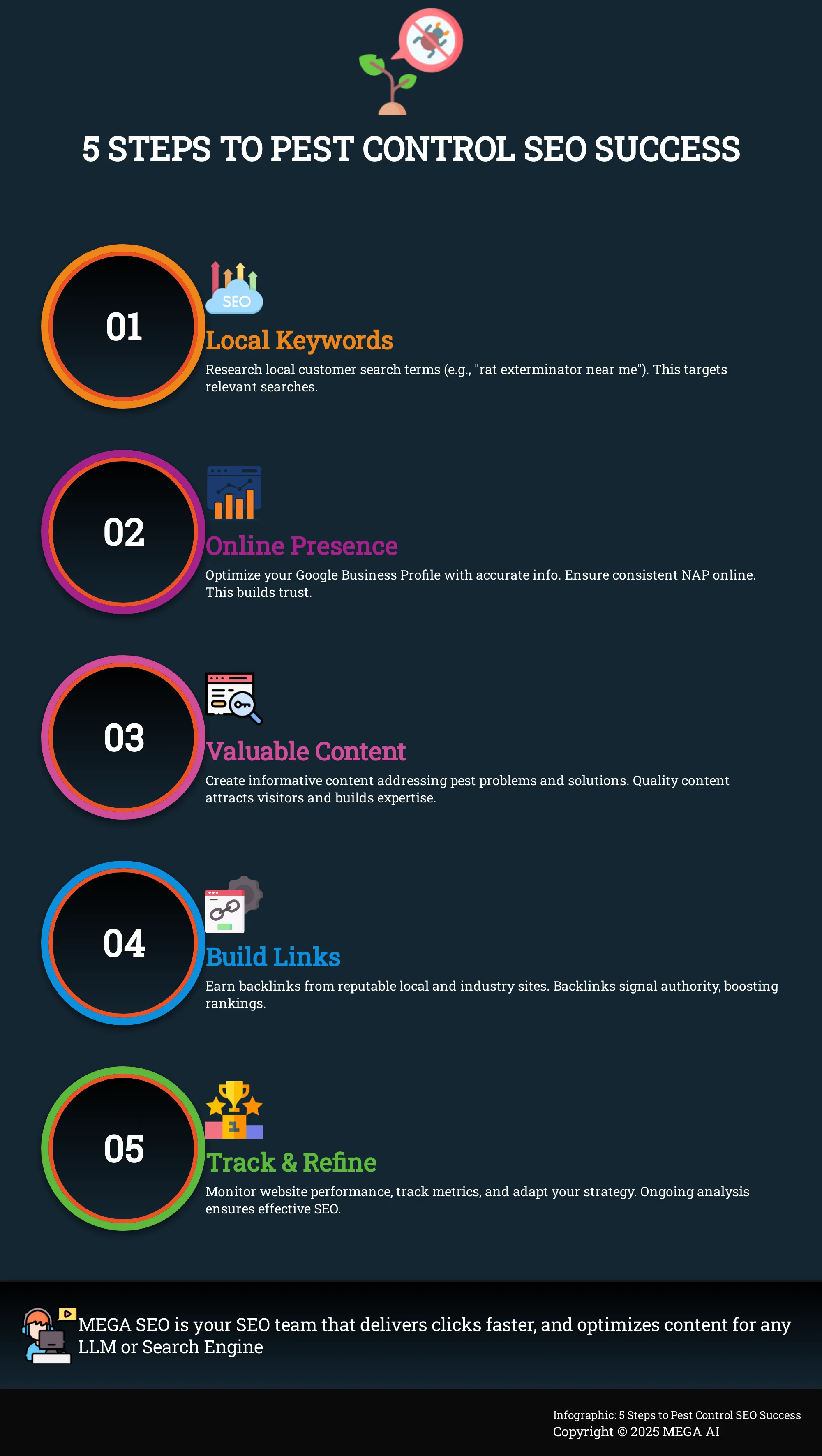
To effectively attract local customers searching for your services, a robust SEO strategy is essential. Think of it as a multi-faceted approach where each component works in harmony to improve your online visibility. For pest control businesses, this means being easily found by people in your service area who are actively looking for solutions to their pest problems. When someone in your town has an unwelcome guest—be it ants, rodents, or something else entirely—you want your business to be one of the first they find online. This isn't just about having a website; it's about making sure that website works hard for you.
Building a strong online presence involves several key areas, from understanding the exact words people use to search for your services, to making sure your website is technically sound and provides a great user experience. It also means establishing your business as a local authority. While it might sound like a lot to manage, breaking it down into these core elements makes the process much more approachable. Plus, platforms like MEGA AI can automate many of these crucial tasks, simplifying your SEO efforts and freeing you up to focus on what you do best: serving your customers and managing your business. Let's explore the core elements that will form the backbone of your pest control SEO success, helping you connect with more local customers.
Research Keywords for Pest Control Services
The first step in any successful SEO plan is understanding what terms your potential customers are typing into search engines. For pest control, this means identifying keywords specific to your services—like "ant exterminator," "rodent removal," or "termite inspection"—and, crucially, your location. Think "bed bug treatment [Your City]" or "emergency pest control near me." Using a keyword research tool can help you discover these terms, see how often they're searched, and gauge how competitive they are. This data allows you to target the right audience effectively. MEGA AI's automated keyword research capabilities can simplify this process, helping you uncover high-intent local keywords that drive qualified leads directly to your business.
Implement On-Page Optimization Techniques
Once you've identified your target keywords, the next step is to weave them naturally into your website's content. This is known as on-page optimization. It involves refining elements like your page titles, meta descriptions (the short snippets that appear under your title in search results), headings, and the actual body text of your pages. Each service page, for example, should be optimized for the specific pest and location it targets. The goal is to make it crystal clear to both search engines and users what each page is about. Effective on-page optimization ensures your website is relevant to the searches you want to attract, making it easier for potential customers to find your solutions.
Develop Local SEO Strategies
For pest control businesses, local SEO isn't just important; it's everything. Your customers are almost always looking for services in their immediate vicinity. A cornerstone of local SEO is optimizing your Google Business Profile (GBP). This free listing can significantly impact your visibility in local search results and on Google Maps, often being the first interaction a potential customer has with your brand online. Beyond GBP, local SEO involves ensuring your business name, address, and phone number (NAP) are consistent across various online directories. Creating content that addresses local pest trends or seasonal issues can also strengthen your local presence, making your business the go-to choice for nearby customers.
Create and Optimize Content
High-quality, informative content is the fuel for your SEO engine. For pest control companies, this means creating service pages that detail your expertise in handling specific pests, blog posts that answer common customer questions (e.g., "How to prevent cockroaches in [Your City]"), and perhaps even FAQ sections. This content should incorporate your researched local keywords naturally. Regularly publishing valuable content not only helps you rank for more terms but also establishes your business as an authority in the field. Tools like MEGA AI’s Maintenance Agent can even help you keep existing content fresh and identify new topics to cover, ensuring your website continuously meets the needs of your audience and search engines.
How to Optimize Your Pest Control Website for Search Engines
Optimizing your pest control website for search engines might seem like a significant undertaking, but when you break it down into focused areas, it becomes much more manageable. When someone in your community discovers a pest problem, your goal is for your business to be the first one they find online. This is precisely where effective website optimization plays a crucial role, helping you connect with local customers who are actively searching for the services you provide. By concentrating on a few key aspects, you can significantly improve your website's visibility and its ability to convert visitors into clients. Let's explore the essential elements that will make your website a powerful tool for attracting business.
Focus on Critical On-Page SEO Elements
Think of on-page SEO as the art of fine-tuning each page of your website so it’s clearly understood by both search engines and your potential customers. A cornerstone of this process is thorough keyword research. For pest control businesses, it's vital to identify the specific terms people use when searching for services in your local area. This means moving beyond broad terms like "pest control" and concentrating on more targeted phrases such as "emergency rodent removal in [Your City]" or "termite inspection [Your County]."
Once you've identified these valuable keywords, the next step is to integrate them naturally into your page titles, headings, meta descriptions, and the main body content. The objective is to clearly signal the topic of each page. Indeed, effective keyword research strategies are crucial for maximizing your online presence. Tools like MEGA AI can streamline this by automating keyword discovery, helping you pinpoint the most relevant terms for your specific services and location.
Optimize for Mobile and Page Speed
A large portion of your potential customers will likely find your website using their smartphones, especially when dealing with an urgent pest situation. This makes having a mobile-friendly website an absolute necessity. Your site needs to not only look appealing but also function flawlessly across all device screen sizes. Beyond aesthetics, page speed is a critical factor. A fast, easy-to-use website keeps visitors engaged and encourages them to learn more about your offerings. Conversely, a slow-loading site will probably send them looking for a competitor.
Google also considers mobile-friendliness and page speed as important ranking signals. You can utilize tools like Google's PageSpeed Insights to assess how quickly your pages load and receive actionable recommendations for improvement. Implementing relatively simple changes, such as optimizing image file sizes and utilizing browser caching, can yield significant improvements in loading times.
Improve User Experience and Website Structure
When a potential customer arrives on your website, they should be able to locate the information they need without frustration. A positive user experience encourages visitors to stay longer, explore your services in more detail, and ultimately contact you. This begins with a clear and logical website structure. Consider how your pages are organized and how users will intuitively move from one section to another. A well-designed navigation menu is fundamental to this.
Creating a network of interconnected pages through internal linking not only assists users in discovering more of your content but also helps search engines understand the relationships between your pages and distribute authority effectively. Furthermore, consistently produce high-quality content that genuinely assists your audience by answering their common questions about pests, prevention methods, and the specifics of your services. This approach builds trust and establishes your business as a knowledgeable authority in the field.
Address Technical SEO Considerations
Technical SEO involves the behind-the-scenes optimizations that enable search engines to efficiently crawl, interpret, and index your website's content. If search engines encounter difficulties accessing your pages, even the most well-researched keywords and excellent user experience won't achieve their full potential. Key aspects include ensuring your website has a clean XML sitemap, a correctly configured robots.txt file to guide search engine crawlers, and uses HTTPS for enhanced security.
It's crucial to ensure your website is technically sound so that Google and other search engines can easily discover and understand your pages. This forms the essential groundwork for your entire online presence. While some technical aspects might seem daunting, many modern content management systems offer built-in tools or plugins to help manage these elements. For businesses looking for comprehensive support, services like MEGA AI provide technical SEO improvements, ensuring your site remains optimized without requiring you to become a technical expert.
Master Local SEO for Your Pest Control Business
For pest control businesses, your local community is your primary customer base. Mastering local SEO means making sure that when someone in your service area searches for "pest control near me," your business shows up. It’s about being visible to the people who are most likely to become your customers. When done right, local SEO can be a significant driver of qualified leads directly to your business. Let's look at some key actions you can take to improve your local search presence and connect with more local homeowners and businesses needing your expertise.
Optimize Your Google Business Profile
Think of your Google Business Profile (GBP) as your digital storefront on Google Search and Maps. It's often the first impression potential customers have. Claiming and fully optimizing your profile is a fundamental step. Ensure all information – business name, address, phone number (NAP), services offered, operating hours, and photos – is complete and accurate. Regularly updating this and actively responding to customer reviews signals to Google that your business is active. This consistent activity can positively influence your local ranking, helping more local customers find you.
Build and Manage Local Citations
Beyond your Google Business Profile, your business information appears on many online directories and platforms. These are local citations. It's crucial that your business name, address, and phone number (NAP) are identical everywhere. Consistent online business information is vital for good Google rankings. You'll want to regularly audit your citations and correct discrepancies. This consistency helps Google trust your business information and improves your chances of ranking well in local searches, making it easier for customers to connect with your services.
Use Customer Reviews to Improve SEO
Customer reviews are a powerful signal to potential customers and search engines. A Google Business Profile with genuine, positive reviews can significantly enhance your local search visibility and build credibility. Encourage satisfied customers to share their experiences by leaving a review. However, do this ethically. Getting reviews is important, but don't offer incentives, as this can lead to unethical practices and may violate platform guidelines. Responding professionally to all reviews, both positive and negative, further demonstrates your commitment to customer satisfaction and can positively influence your online reputation.
Create Valuable Content for Pest Control SEO
Creating valuable content is a cornerstone of any successful SEO strategy, and for pest control services, it’s your opportunity to connect with potential customers by addressing their urgent needs and concerns. High-quality content not only helps you rank higher in search results but also establishes your business as a knowledgeable and trustworthy expert in the field. Think of your website content as your digital front line, ready to provide answers and solutions to people actively searching for help with pest problems. By focusing on informative and engaging material, you can attract more local customers and guide them towards choosing your services. Tools that assist with SEO content creation can be particularly helpful in consistently producing optimized material.
Focusing on topics that address common pest issues and solutions is essential. When you write original content that answers customer questions, you not only build trust but also position your business as an authority in the pest control industry. This approach demonstrates your expertise and experience, making potential customers more comfortable choosing your services. Remember, your content should aim to educate and inform, turning your website into a reliable resource.
Find Effective Blog Post Ideas for Pest Control
Coming up with fresh blog post ideas can feel like a challenge, but your daily experiences in pest control are a goldmine of topics. Focus on creating content that directly addresses common pest issues and offers practical solutions. Writing original articles that answer the questions your customers frequently ask is a fantastic way to build trust and position your business as an authority. For instance, you could write about seasonal pest prevention tips, the signs of a termite infestation, or humane ways to deal with rodents. Leverage your expertise to create informative pieces. Think about the common queries you receive – these are often perfect starting points for blog posts that will resonate with your audience and attract organic traffic.
Develop High-Converting Service Pages
Your service pages are critical digital assets; they are where potential customers often land when they're ready to make a decision. To make these pages effective, create dedicated pages for specific pests, the various services you offer, and the geographic locations you cover. This targeted approach helps people quickly find exactly what they need, improving their experience on your site. High-quality content is absolutely crucial for turning visitors into customers. Ensure your service pages provide helpful, relevant information that clearly addresses customer concerns, details your process, and includes clear calls to action, encouraging them to book an inspection or request a quote. Remember, these pages must provide helpful, relevant information that addresses customer concerns and encourages them to take action.
Use Educational Resources and FAQs for Better SEO
Educational resources like comprehensive FAQ sections or downloadable guides can significantly enhance your SEO efforts and user engagement. By addressing common questions and concerns proactively, you demonstrate expertise and provide immediate value. Think about the questions potential customers are likely to type into search engines when they're looking for pest control services – these are your golden keywords. Answering these questions thoroughly can help you capture valuable long-tail keyword traffic. You can also repurpose this information for your Google Business Profile to ensure consistency and provide helpful content across all platforms where customers might find you. This approach not only builds authority but also helps streamline your customer service.
Effective Link Building Strategies for Pest Control SEO
Link building is a fundamental piece of a strong SEO puzzle, and for pest control services, it’s all about showing search engines that your business is a knowledgeable and trustworthy authority in your local area and the broader industry. Think of high-quality backlinks as endorsements from other websites. When reputable sites link to yours, search engines like Google view your pest control business as a more credible source. This credibility can significantly improve your rankings for the keywords potential customers use when they're urgently searching for solutions to pest problems. It's not just about collecting as many links as possible; the quality and relevance of those links are what truly matter. For a local service like pest control, a focused approach on acquiring links from local sources and industry-specific websites will deliver the most impactful results.
This means looking for opportunities within your community and connecting with other businesses and organizations that align with your services. Creating "authoritative and valuable content marketing," as many SEO professionals advise, is central to attracting these valuable links. When your website offers genuinely helpful information, such as detailed guides on local pest issues or seasonal prevention tips, other sites are more likely to reference and link to your content. This not only helps with search engine rankings but also positions your business as a go-to expert. Effective link building is an ongoing process that involves consistently creating link-worthy content and actively seeking out relevant opportunities. The goal is to build a natural and diverse link profile that signals to search engines that you are a leading pest control provider in your service area.
Identify Local Link Building Opportunities
Since your pest control business primarily serves a specific geographic area, building local links should be a core part of your strategy. These links help reinforce your local relevance to search engines, making it easier for customers in your community to find you when they need you most. Start by thinking about your local environment. Are there community events, such as local fairs or neighborhood gatherings, where your business could become a sponsor? Sponsorships often result in a link from the event’s website, which is a great local signal.
Consider forming relationships with other local businesses that cater to homeowners but aren’t direct competitors. For instance, real estate agents, home inspectors, plumbers, or landscaping companies can be excellent allies. You could offer to write an informative guest post for their blog on a topic like "Essential Pest Prevention Tips for New Homeowners," and in return, receive a link back to your site. Also, don’t overlook local business directories, homeowners' association websites, and even local news outlets that might feature local businesses or expert advice. A quick search for "local business directory [your city]" can often uncover some valuable opportunities.
Use Industry-Specific Link Acquisition Tactics
Beyond general local connections, targeting link opportunities within the pest control or home services industry can significantly enhance your website's authority. As experts often note, "Your blog posts and service pages should contain localized keywords and give insight into common pest issues." This means creating content that is not only optimized for search but is also genuinely useful to your audience. For example, a comprehensive guide on "Identifying and Treating Common Garden Pests in [Your Region]" can become a valuable resource that other relevant websites will want to reference.
Think about developing shareable assets like infographics detailing the lifecycle of common pests or printable checklists for homeowners on seasonal pest-proofing. These types of content are often picked up by home improvement blogs, gardening forums, or even local lifestyle magazines looking for practical information for their readers. You can also explore opportunities for guest blogging on well-regarded industry blogs or home and garden websites, allowing you to share your expertise and gain a valuable backlink from a relevant source.
Build Links Through Partnerships and Associations
Leveraging your professional relationships and affiliations is another intelligent approach to acquiring high-quality backlinks. Begin by investigating pest control industry associations, such as the National Pest Management Association or any state and regional chapters relevant to your business. Membership in these organizations frequently includes a listing in their online directory, complete with a link back to your website. These are highly relevant and authoritative links that can positively impact your SEO.
Consider your suppliers or the manufacturers of the products you use in your pest control services. Some may have partner programs or online directories where they list certified service providers, offering another avenue for a pertinent backlink. Building on the idea of local partnerships, you can also collaborate with complementary businesses on a larger scale. For instance, you might co-host a webinar on "Integrated Pest Management for Homeowners" with a landscaping company or co-author a detailed guide with a home inspection service, with both businesses linking to the shared resource. These mutually beneficial partnerships can become a sustainable source of quality links over time.
Measure and Analyze Your SEO Success
Once you've put your SEO plan into action, the work isn't over; it's an ongoing commitment. Measuring your efforts and analyzing the results are fundamental to understanding what’s effective, what needs adjustment, and how you can continually improve your online presence. Think of it as a continuous feedback loop: you implement, you measure, you learn, and then you refine your strategy for even better outcomes. For pest control businesses, this consistent attention is what translates into more local customers being able to discover your services precisely when they face an urgent pest problem and are actively searching for a solution. Without this analytical step, you're essentially operating in the dark, unsure if your time and resources are yielding the best possible return.
Regularly checking your performance empowers you to make data-driven decisions rather than relying on guesswork or assumptions. It allows you to allocate your budget and team efforts effectively, focusing on activities that genuinely move the needle. Furthermore, it provides a clear way to demonstrate the tangible value of your SEO investment to stakeholders or within your own business planning. With a platform like MEGA AI, many of these analytical processes can be significantly streamlined. Our tools are designed to offer clear, actionable insights without requiring you to become a data scientist overnight. You can even book a demo to see firsthand how our system simplifies tracking, reporting, and ultimately, the optimization of your digital marketing efforts.
Track Key Performance Indicators (KPIs)
Key Performance Indicators, or KPIs, are the specific, measurable metrics you'll use to gauge the success of your SEO efforts. For pest control services, these might include your website's organic traffic (how many visitors arrive from search engines), your rankings for important keywords like "emergency rodent removal [your city]," the click-through rate (CTR) from search results to your site, and conversion rates, which show how many visitors actually contact you or book a service. "By focusing on each aspect and continuously refining your approach, you can ensure long-term success and growth for your business." For instance, a low CTR for a high-ranking page might indicate your title tag or meta description isn't compelling enough to attract clicks. Keeping an eye on these numbers will tell you if your SEO strategy is truly engaging potential customers.
Use Tools to Monitor SEO Performance
To effectively track your KPIs, you'll need the right tools in your arsenal. Google Analytics is a fantastic free resource for understanding website traffic patterns, user behavior on your site, and conversion tracking. For more specific keyword insights, tools like Ahrefs' Keywords Explorer are invaluable. As Ahrefs aptly puts it, "To find pest control-related services and topics people are searching for, you'll need a keyword research tool... These tools pull keyword ideas, estimated monthly search volumes and other SEO metrics."
Many platforms, including MEGA AI's SEO features, integrate these types of monitoring capabilities, offering automated keyword research and performance dashboards. These tools help you see where you stand in search results, identify opportunities for improvement, and understand how users are interacting with your site, making it easier to optimize your content effectively. This data is crucial for making smart decisions about your content strategy and technical SEO adjustments.
Adjust Your Strategy with Data Insights
The data you gather from tracking KPIs and using monitoring tools isn't just for observation; it's a catalyst for action. "Effective keyword research strategies for pest control businesses are crucial in maximizing online visibility," and this inherently involves ongoing analysis and adaptation. If certain keywords aren't performing as expected, or if a particular service page has a high bounce rate (meaning visitors leave quickly), it's time to investigate the cause and adjust your approach.
This might mean refining your keyword targeting to better match user intent, or you might need to update your content to be more comprehensive and answer customer questions more thoroughly. Perhaps the user experience on a specific page needs improvement. MEGA AI can assist by re-optimizing existing content, ensuring it stays fresh, relevant, and performs well, even as search engine algorithms evolve. This iterative process of measuring, analyzing, and adjusting is what leads to sustained SEO success and a stronger online presence for your pest control business.
Avoid These Common SEO Mistakes in Pest Control
Getting your pest control business to show up in search results can feel like a complex puzzle. While working on your strategy, it's easy to hit a few common snags. Knowing what to sidestep can save you time and lead to better results. Let's look at frequent missteps and how to steer clear of them.
Don't Stuff Keywords or Over-Optimize
It's tempting to pack website pages with every pest-related keyword, hoping to catch the search engine's eye. This practice, keyword stuffing, can actually hurt your rankings. Search engines prioritize content that reads naturally and offers genuine value. While thorough keyword research is vital for an effective SEO campaign, the goal is smooth integration. Focus on writing for your customers first, addressing their concerns clearly. When your content is genuinely useful, the right keywords will naturally fit, supporting long-term success.
Don't Neglect Mobile Users and Local Search
Many people search for pest control on smartphones, often needing help quickly. If your website isn't mobile-friendly, you risk losing potential customers. As a local service provider, your community is key. Effective Local SEO for pest control companies uses specific tactics so your business appears in "near me" searches or for "pest control in [Your City]". Ensure your website has a responsive design for all screen sizes and that your local business information is accurate and consistent online.
Don't Ignore Website Security and Technical SEO
Your website's technical health significantly impacts search rankings. Slow load times, broken links, or confusing site structure can frustrate users and signal low quality to search engines. Website security, like an HTTPS certificate, is also vital; it protects user data and builds trust. While creating authoritative and valuable content marketing with localized keywords is important for addressing pest issues, a technically sound website is the foundation for that content's success. Regularly check these technical aspects to ensure your site is accessible and trustworthy.
Future-Proof Your Pest Control SEO Strategy
To ensure your pest control business consistently attracts local customers through search, it's vital to build an SEO strategy that can withstand the test of time. This involves staying agile, informed, and committed to ongoing improvement. Think of it as regularly servicing your marketing engine to keep it running smoothly, no matter what changes come down the pike. By focusing on a resilient approach, you can keep your services visible to potential customers when they need you most.
Adapt to Search Engine Algorithm Updates
Search engines like Google frequently refine their algorithms to provide users with the best possible results. These updates can sometimes shift how websites are ranked. Instead of focusing solely on individual page tweaks, it's more effective to build your website's overall authority. As Go Fish Digital highlights, "Google's algorithms are increasingly sophisticated and consider the overall authority of a website, not just individual pages." This means prioritizing high-quality content, earning valuable backlinks, and fostering positive user engagement. When updates occur, having a strong foundation helps maintain your visibility. Tools that can help re-optimize existing content quickly after an update can also be incredibly valuable for staying current and responsive.
Stay Updated on Pest Control Digital Marketing Trends
The digital marketing landscape is dynamic, and what works well now might be less effective later. For pest control businesses, keeping an eye on current trends is key. This includes leveraging local SEO optimization and ensuring your website is mobile-responsive, as many customers will search for your services on their phones. Creating timely, seasonal content that addresses specific local pest issues—like an increase in ants in the spring or rodents in the fall—can keep your business top-of-mind. Staying informed about these trends allows you to adapt your strategy proactively. Platforms that assist with generating fresh content can help you efficiently address these seasonal demands and local concerns, keeping your message relevant.
Commit to Continuous Learning and Strategy Refinement
SEO isn't a "set it and forget it" task; it requires ongoing attention and adjustment. The pest control industry and search engine best practices evolve, so a commitment to continuous learning is essential for long-term success. Regularly analyze your performance metrics to understand what's working and where improvements can be made. As ARSN Media points out, "By focusing on each aspect of your SEO strategy and continuously refining your approach based on performance metrics and industry changes, you can ensure long-term success." This iterative process of learning, implementing, analyzing, and refining will help you maintain and improve your SEO effectiveness over time, ensuring a steady flow of local customers.
Related Articles
Frequently Asked Questions
I'm new to SEO for my pest control business. Where should I even begin? A great starting point is to understand the exact phrases local customers type into search engines when they need pest control. Think about specific pests combined with your town or service area. Once you have a good idea of these terms, make sure your website clearly communicates the services you offer for those specific needs. Also, ensure your Google Business Profile is claimed and accurately filled out, as this is often the first place local searchers will find you.
My pest control website looks okay on a phone, but is it fast enough? Having a website that adapts well to mobile screens is definitely important, but its loading speed is equally critical. When someone has a pest emergency, they're usually looking for a quick solution, and a slow-loading website can cause them to look elsewhere. Simple improvements, like optimizing image sizes, can often make a noticeable difference in how quickly your pages load for potential customers.
I've set up my Google Business Profile. Is that all I need for local customers to find me? Your Google Business Profile is a powerful tool and a fantastic first step for local visibility, but it works best as part of a broader strategy. Ensuring your business name, address, and phone number are consistent across other online directories helps search engines trust your information. Encouraging satisfied customers to leave reviews on your profile also builds credibility and can improve how prominently you appear in local search results.
I'm a pest control expert, not a writer. How can I create website content that attracts customers? Your deep knowledge of pest control is your most valuable content creation tool. Consider the questions your customers ask you most frequently; these can be excellent topics for blog posts or an FAQ section on your site. Clearly describing your specific services for different types of pests and the areas you serve also helps potential customers understand how you can solve their problems.
How can I tell if all this SEO work for my pest control company is actually paying off? You'll want to keep an eye on a few key indicators to see how your efforts are performing. Track how many visitors are coming to your website from search engines, where your site ranks for important local search terms (like "ant exterminator [your city]"), and whether those visitors are taking the next step, such as calling you or filling out a contact form. This information will help you understand what's effective and identify areas where you might adjust your strategy.