The digital wellness market is crowded. You’re competing with established health institutions, major publications, and venture-backed startups, all vying for the top spots on Google. For a growing brand, it can feel impossible to get noticed. This is where a smart, targeted strategy becomes your greatest advantage. A dedicated approach to SEO for WellnessTech allows you to sidestep the competition by focusing on a specific niche audience that is actively looking for your unique solution. This guide will show you how to find those users, create content that speaks directly to their needs, and build the authority required to stand out.
Key Takeaways
- Prioritize Trust and Authority: Build credibility by creating accurate, expert-reviewed content and maintaining a secure, technically sound website. In the wellness industry, demonstrating expertise is essential for earning the trust of both users and search engines.
- Focus on Niche Keywords to Stand Out: Compete effectively by targeting specific, long-tail keywords that address detailed user questions. This approach helps you connect with a highly motivated audience and carve out a space in a crowded market.
- Track Performance to Refine Your Strategy: Use analytics tools to monitor key metrics like organic traffic, keyword rankings, and click-through rates. This data allows you to understand what’s working and make informed adjustments to improve your results over time.
What is WellnessTech SEO?
Search Engine Optimization (SEO) is the practice of improving your website so it appears higher in search engine results. For WellnessTech companies, this means making sure your app, service, or product shows up when people search for solutions to their health, fitness, and well-being needs. It’s about more than just using the right keywords; it’s about building a credible, authoritative online presence that connects with and helps your target audience.
Because the wellness industry deals directly with people's health, search engines like Google apply higher standards. Your content must be accurate, trustworthy, and provide a good user experience. A solid WellnessTech SEO strategy is critical for earning both user trust and search engine visibility.
How SEO helps WellnessTech companies grow
In a crowded market, SEO is how you stand out. By optimizing your website and content, you can reach a highly motivated audience that is actively looking for wellness solutions. This allows you to connect with potential users and guide them on their wellness journey. A strong approach to SEO helps you build brand authority and become a trusted resource in the industry.
Modern SEO goes beyond keywords to include a range of technical and content-based elements. Improving your site’s user experience, demonstrating expertise and trustworthiness, and using structured data to help search engines understand your content are all part of the process. These efforts not only improve your rankings but also build a better, more reliable experience for your visitors.
Unique SEO challenges in the wellness industry
The wellness space is highly competitive, and gaining visibility is a significant hurdle. In fact, over 90% of web pages get no organic traffic from Google at all. This is partly because health and wellness topics fall under Google’s “Your Money or Your Life” (YMYL) guidelines, which demand a high level of expertise, authoritativeness, and trustworthiness.
To succeed, you must create content that is not only helpful but also scientifically accurate and transparent. Competing with established health institutions and major publications requires a dedicated and sophisticated approach. Many brands find they need specialized expertise to manage their SEO, which can be a challenge for startups and small businesses with limited resources.
How to Build a WellnessTech SEO Strategy
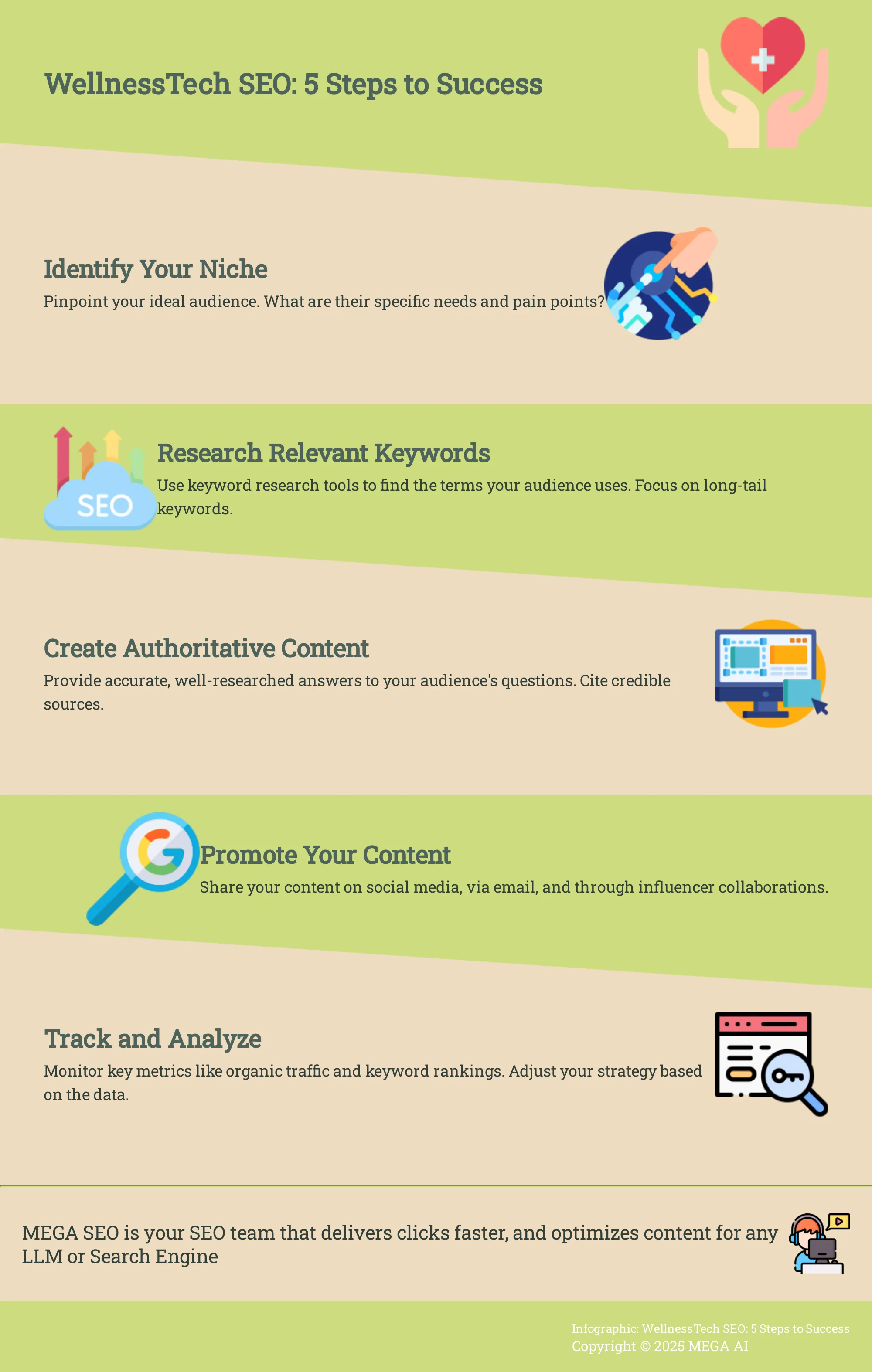
A solid SEO strategy is your roadmap to connecting with the right audience. For WellnessTech, this means building a plan that establishes trust and clearly communicates your value. Your strategy should focus on four key areas: finding the right keywords, creating optimized content, ensuring your site is technically sound, and building authority through backlinks. Approaching these elements thoughtfully will help you stand out in a competitive market and attract users who are actively seeking your solutions.
Find the right wellness keywords
Keyword research is the cornerstone of your entire SEO effort. It’s about understanding the specific language your audience uses when they search for health and wellness solutions. Instead of just targeting broad terms, focus on the specific questions your audience is asking Google. Answering those questions thoroughly on your website is how you can outrank bigger brands. Think about long-tail keywords that capture user intent, like “meditation app for anxiety” instead of just “meditation app.” Using tools for automated keyword research can help you uncover these opportunities and build a content plan that directly addresses user needs, forming the foundation of your strategy.
Optimize your wellness content
Once you have your keywords, the next step is to create and optimize your content. This goes beyond simply placing keywords in your text. Your goal is to produce high-quality, informative content that genuinely helps your audience. A key part of optimization is internal linking, which means adding links to other relevant pages on your own website. This practice helps search engines understand your site’s structure and provides a better experience for your users. You can also share your content on social media and collaborate with influencers to extend its reach and drive more traffic back to your site.
Address technical SEO for your website
Technical SEO ensures your website provides a great user experience and is easy for search engines to crawl and understand. This includes a range of elements, from improving your site’s speed with Core Web Vitals to establishing authority and trust, which is critical in the health space. For WellnessTech, demonstrating expertise and trustworthiness (part of Google's E-A-T guidelines) is non-negotiable. A technically sound website signals to both users and search engines that your brand is credible and professional. Since the wellness market is so competitive, a strong technical foundation is your secret weapon for outshining the competition.
Build links in the wellness space
Building backlinks—links from other websites to yours—is a powerful way to build your site's authority. When a reputable site links to you, it acts as a vote of confidence in your content. Focus on earning links from high-quality sources within your niche, such as respected health and wellness publications, professional directories, or local news outlets. You can achieve this through guest posting, creating shareable research, or collaborating with other brands in the wellness community. A strong backlink profile tells search engines that you are a trusted authority, which can significantly improve your rankings and drive more organic traffic.
How to Approach Local SEO for WellnessTech
If your WellnessTech company has a physical presence, like a clinic, studio, or office, local SEO is non-negotiable. It connects you with people in your community who are actively looking for the services you offer. While a broad SEO strategy targets a national or global audience, a local approach helps you show up for searches like "therapist near me" or "nutritionist in Austin." This is where you can really stand out from the competition and attract high-intent customers who are ready to walk through your door. By focusing on your immediate service area, you make your business visible to the people who are most likely to become clients.
Why local search matters for wellness services
For health and wellness brands with a physical location, local SEO is essential for attracting clients searching for services in your area. Think about it: when someone needs a chiropractor or a yoga class, their first step is usually a quick search on their phone. You want to be the first name they see. The competition for online attention is fierce; over 90% of pages get no organic search traffic from Google at all. This is a stark reminder of the challenge. A strong local SEO strategy helps you cut through the noise and connect directly with potential clients in your neighborhood, giving you a significant advantage over competitors who ignore their local presence.
Optimize your Google Business Profile
Your Google Business Profile (GBP) is one of the most powerful tools for local SEO. It’s the information box that appears in Google Maps and on the side of search results, showing your address, hours, phone number, and reviews. It's crucial to claim and optimize your Google Business Profile by adding high-quality photos, a detailed business description, and a list of your services. Make sure your practice is listed accurately not just on GBP, but also on other directories like Bing Places. Consistent and correct contact information across the web signals to search engines that your business is legitimate and active, which helps improve your local search ranking.
Target local keywords and manage reviews
To show up in local searches, you need to use local keywords. Instead of a broad term like "physical therapy," focus on long-tail keywords such as "sports physical therapy in Denver." Using tools to find relevant keywords with high search volume and low competition can give you a strategic edge. Just as important is managing your online reputation. You should encourage reviews from satisfied clients to build trust and social proof. Positive reviews are a major factor in local search rankings and heavily influence a potential client's decision to choose your services over another. Responding to all reviews—both positive and negative—shows that you are engaged and value client feedback.
Create Content That Builds Authority
In the wellness industry, trust is everything. Your audience is looking for reliable information that can impact their health and well-being, which means search engines like Google place a high value on content that demonstrates experience, expertise, authoritativeness, and trustworthiness (E-E-A-T). Creating high-quality, authoritative content is the most effective way to show both users and search engines that your brand is a credible source of information.
This process involves more than just writing blog posts. It’s about understanding your audience's deepest concerns and questions, crafting content that addresses those needs with accuracy and empathy, and then making sure that content reaches them. By focusing on creating valuable resources, you not only improve your search rankings but also build a loyal community that sees you as a go-to expert in the WellnessTech space. A solid content strategy is your foundation for long-term growth, establishing your brand’s reputation and driving qualified traffic to your site.
How to write valuable wellness content
To stand out, you need to answer the specific questions your audience is asking. Instead of writing broad articles, focus on the detailed queries people type into search engines. The key to outranking larger brands is to address these questions more thoroughly and directly than anyone else. Think about the user’s intent behind their search. Are they looking for information about a symptom, comparing wellness apps, or seeking advice on a specific practice like meditation or nutrition?
Your content should provide clear, actionable, and well-researched answers. Use tools for automated keyword research to uncover these niche questions and then build content around them. This approach ensures your articles are genuinely helpful, which builds credibility and satisfies search intent.
Build trust and authority with your audience
Valuable content is the first step, but building lasting trust requires a consistent commitment to quality and accuracy. Keyword research is the cornerstone here, as it helps you identify the words and phrases your target audience uses when searching for wellness services. This understanding allows you to create content that speaks their language and meets their needs directly.
Always cite credible sources, feature authors with relevant expertise, and clearly display their credentials. It's also critical to keep your information current, as wellness advice and scientific understanding can change. Using a tool to periodically update content ensures your articles remain accurate and relevant, which helps maintain user trust and can improve your search rankings over time.
Distribute content for better reach
Creating authoritative content is only half the battle; you also need to ensure people see it. A proactive distribution strategy gets your content in front of a wider audience, driving traffic back to your website and reinforcing your brand’s authority. Don't just publish an article and hope for the best. Share it across all relevant channels where your audience spends their time.
Engaging with your community on social media platforms, sending articles via an email newsletter, and collaborating with wellness influencers can significantly extend your reach. You can also use Paid Ads to amplify your best-performing content, targeting users who are actively looking for the solutions you provide. This integrated approach ensures your hard work pays off, building brand awareness and fostering community engagement.
Key Technical SEO Factors for WellnessTech
Technical SEO forms the foundation of your website's performance. For WellnessTech companies, getting the technical details right is not just about pleasing search engines; it's about building a trustworthy and accessible platform for your users. A solid technical setup ensures your valuable content can be found, understood, and delivered quickly to the people who need it most. MEGA AI's SEO features can help you monitor and automate these improvements, ensuring your site's foundation is always solid.
Improve mobile performance and page speed
A significant number of users search for health and wellness information on their smartphones. Your website must be mobile-friendly and load quickly to meet their needs. A slow or clunky mobile experience can frustrate users and cause them to leave before they find what they’re looking for. Google’s Core Web Vitals measure a site's loading performance, interactivity, and visual stability, all of which are critical for retaining users and improving rankings. A fast, responsive site signals professionalism and reliability, which is essential for any brand in the wellness space.
Use structured data for wellness content
Structured data, or schema markup, is code you add to your website to help search engines understand the context of your content. Think of it as adding descriptive labels to your information. This helps search engines feature your content in more detailed ways, such as in rich snippets. For a wellness brand, this could mean showing event details, product ratings, or FAQ answers directly in the search results. Using structured data can improve your visibility and click-through rates, making it easier for users to find the specific wellness information they need from you instead of a competitor.
Prioritize website security and user privacy
Trust is the currency of the health and wellness industry. Since users may be sharing sensitive information, securing your site with HTTPS is essential for protecting their privacy and building credibility. An HTTPS protocol encrypts data shared between a user and your site, and it's a confirmed ranking signal for Google. A secure website builds confidence, showing users that you value their privacy. This is especially important in the health sector, where data protection is a major concern. Making your website accessible to everyone, including those with disabilities, further demonstrates your commitment to user well-being and can improve your site's overall SEO performance.
How to Measure Your SEO Performance
Creating a solid SEO strategy is the first step, but tracking your performance is how you refine it for long-term success. Measuring your efforts helps you understand what’s working, what isn’t, and where to focus your resources. It turns guesswork into a data-driven plan for attracting more users to your WellnessTech platform.
Important metrics for WellnessTech SEO
To get a clear picture of your SEO health, you need to track the right metrics. With the sobering reality that over 90% of pages get no organic search traffic from Google, simply having a website isn't enough. You need to focus on metrics that show genuine growth and user engagement. Key performance indicators (KPIs) to watch include organic traffic, keyword rankings for your main terms, click-through rate (CTR) from search results, and conversion rates for sign-ups or appointments. These numbers tell a story about how well you’re connecting with your target audience and turning searchers into active users.
Get insights from Google Analytics and Search Console
Google offers two powerful, free tools that are essential for any SEO strategy: Google Analytics and Google Search Console. Think of them as your foundational measurement toolkit. Google Analytics shows you how users behave once they arrive on your site—which pages they visit, how long they stay, and where they come from. Google Search Console focuses on your site’s performance in Google search, showing you which keywords you rank for, your site’s CTR, and any technical issues that might hold you back. Using them together gives you a complete view of your user journey, from search query to on-site action.
Recommended tools for tracking and analysis
While Google's tools are a great start, specialized SEO analytics tools can provide deeper insights and competitive analysis. For businesses that want to connect measurement directly to action, an end-to-end platform is the most efficient choice. MEGA AI’s SEO services integrate tracking with automated optimization. Our Maintenance Agent, for example, doesn’t just report a low CTR—it actively works to improve it by updating your content. It also identifies new content opportunities within existing articles to help you rank higher, simplifying the entire process of turning data into results.
Address Common SEO Challenges in WellnessTech
The WellnessTech space presents a unique set of SEO hurdles. You’re not just competing for clicks; you’re building trust around deeply personal topics like health and well-being. Getting your strategy right means carefully handling sensitive information, adhering to strict rules, and finding your voice in a crowded market. Let's look at some of the most common challenges and how you can approach them effectively.
Balance scientific accuracy with simple language
Your audience wants credible, evidence-based information, but they probably don’t have a medical degree. The challenge is to translate complex scientific concepts into clear, accessible language without sacrificing accuracy. This is crucial for building the trust and authority that underpins a successful wellness brand. Focus on explaining the why behind your advice in simple terms. Use analogies, define key terms, and always center the content on how it helps the user. This approach makes your content more engaging and helps establish your brand as a reliable source for wellness information.
Stay compliant with health regulations
The wellness industry is watched closely by regulatory bodies. Making unverified health claims can result in serious penalties and destroy the trust you’ve worked hard to build. It's critical to understand and follow all health advertising regulations to ensure your content is compliant. This means avoiding definitive statements about curing or treating diseases unless you have robust scientific evidence. Always work with a legal professional to review your marketing copy. Frame your content around general well-being and lifestyle benefits rather than specific medical outcomes. This protects your business and reinforces your commitment to responsible communication.
Compete with established wellness brands
The wellness market is filled with established brands that have high domain authority. Trying to outrank them on broad keywords like "meditation app" is difficult. Instead of competing head-on, focus on carving out your own niche. Identify a specific audience segment or problem that is underserved by the major players. Use long-tail keywords that reflect their unique needs. MEGA AI's automated keyword research can help you discover these targeted opportunities. By developing a unique value proposition and becoming the go-to resource for a specific niche, you can build a loyal following and grow your authority from the ground up.
What's Next for WellnessTech SEO?
The wellness landscape is constantly changing, and so are the ways people search for health information. Staying ahead means looking at the trends that will shape the future of search. For WellnessTech brands, this involves adapting to new technologies and user behaviors to remain a trusted source of information.
Optimizing for voice search
As more people use smart speakers and voice assistants, optimizing for how people speak—not just how they type—is critical. Voice searches are often longer and more conversational. Think about the direct questions someone might ask their device, like, "What are the symptoms of vitamin D deficiency?" By optimizing your SEO strategies for voice search, your brand can become the go-to source for quick and reliable answers, meeting users in the moments they need information most. Focus on creating content that directly answers these questions in a natural, easy-to-understand way.
The role of AI in SEO
Artificial intelligence is a significant factor in modern SEO, helping brands work more efficiently and effectively. AI can automate time-consuming tasks like keyword research, content analysis, and performance tracking. For WellnessTech, the role of AI also extends to understanding user intent on a deeper level, allowing you to create highly relevant content that resonates with your audience. Using an end-to-end SEO platform can help you generate optimized articles, update existing content to improve its rank, and manage your entire strategy from one place, giving you a competitive edge.
How wearable tech influences search
The rise of wearable technology like smartwatches and fitness trackers has created a more informed and engaged health consumer. People now have access to personal health data, from sleep patterns to heart rate variability. This data drives new search behaviors as users look for information to understand their metrics and find ways to improve their health. Wellness brands can meet these users in the digital space by creating content that addresses these specific, data-driven queries. For example, you could create articles on "how to improve deep sleep" or "best exercises to lower resting heart rate."
Related Articles
- Top 9 SEO Challenges & Solutions for 2024
- Fitness SEO: The Ultimate Guide (2024)
- SEO for Chiropractors: Attract More Patients Online
- Ultimate Guide to Building Brand Authority for Marketers
- Spa SEO Guide to Boost Visibility and Appointment Rates
Frequently Asked Questions
I'm a small wellness startup with a limited budget. Where should I start with SEO? Your best starting point is to focus on a specific niche. Instead of trying to compete on broad terms, use keyword research to find the detailed questions your ideal audience is asking. Create high-quality content that answers those questions better than anyone else. This approach helps you build authority with a targeted group and gain traction without needing a massive budget.
How can I build authority if my writers aren't doctors? You can establish authority by ensuring your content is thoroughly researched, accurate, and transparent. Always cite credible scientific studies and sources. You can also have medical professionals review your content for accuracy and feature their credentials on the page. The goal is to demonstrate a commitment to providing trustworthy information, which builds credibility with both your audience and search engines.
How long will it take to see results from my SEO efforts? SEO is a long-term strategy, not a quick fix. While you might see some minor improvements in a few months, it typically takes six months to a year to see significant results in organic traffic and rankings. Consistency is key. Continuously creating valuable content and addressing technical issues will build momentum over time.
Is it better to focus on creating new content or updating old articles? A balanced approach is best. Creating new content helps you target new keywords and address more of your audience's questions. However, regularly updating your existing articles is just as important, especially in the wellness field. Updating content with new information and data keeps it accurate and relevant, which helps maintain user trust and can improve its search ranking.
My business is an app with no physical location. Do I still need to think about local SEO? While you won't need to optimize a Google Business Profile for a physical address, you can still apply local principles. Consider creating content that targets specific regions or cities if your app's usage or relevance varies by location. For example, you could write about "best running trails in Austin" for a fitness app. This helps you connect with users in a specific community, even without a storefront.