
Running an HVAC company means you're skilled at keeping homes comfortable, but attracting a steady flow of new customers in a competitive local market presents its own set of challenges. You might provide exceptional service, yet if potential clients can't easily find your business online when their air conditioning fails or their furnace needs urgent repair, those valuable skills don't translate into new jobs. This is precisely where understanding SEO for HVAC Technicians becomes a game-changer. It’s about strategically enhancing your online visibility so your business appears when people are actively searching for your specific expertise. This article will guide you through the essential strategies to improve your digital footprint, connect with more local homeowners, and effectively grow your HVAC business.
Key Takeaways
- Connect with Local Customers: Make your Google Business Profile shine and keep your business details consistent online so local homeowners find you first when they search for HVAC help.
- Make Your Website Work Harder: Weave relevant keywords into your site, ensure it’s technically sound and easy to use on phones, and create useful content that answers the questions your customers are asking.
- Keep Your SEO Strategy Current: Check how your website is doing, use data to see what’s effective, and update your methods as search engines and customer search habits change.
What is SEO for HVAC Technicians?
If you're an HVAC technician or manage an HVAC company, connecting with customers in your local service area is a top priority. Search Engine Optimization, often called SEO, is a key method to ensure that when homeowners or businesses search online for heating, ventilation, or air conditioning services, your business is one of the first they see. Think of SEO as increasing your visibility in the digital world, precisely when potential customers are actively looking for your expertise. Understanding and using SEO effectively can greatly influence your ability to attract new clients and expand your business.
Define SEO and Its Importance for Your HVAC Business
So, what exactly is SEO? Simply put, search engine optimization is the ongoing process of improving your website's content and technical setup so it ranks higher in search engine results, like those on Google or Bing. When your website achieves a good ranking, more potential customers will discover your business when they search for terms related to the HVAC services you offer.
For an HVAC business, this visibility is incredibly valuable. A solid SEO strategy is not just an optional extra; it's a fundamental part of succeeding in the current market. When your business appears prominently in search results, it helps build trust and establishes your credibility. Customers are naturally more inclined to choose a business they can find easily and that seems authoritative in the HVAC field. This improved online presence often translates directly into more inquiries and, consequently, more service appointments and installations.
How Effective SEO Attracts Local Customers
Effective SEO is especially vital for attracting local customers, which forms the core business for most HVAC companies. The majority of individuals seeking HVAC services will use search queries that include their geographic location, such as "AC repair in [Your City]" or "furnace installation near me." A well-crafted local SEO strategy ensures your business shows up for these specific, high-intent local searches.
Consider that a very high percentage of consumers turn to the internet to find local services, and many of them will click on one of the top three organic search results. If your HVAC business isn't visible on that crucial first page, you are likely missing out on a substantial number of potential customers. By optimizing your online presence for local search, which includes managing elements like your Google Business Profile, you make it simpler for people in your community to find and contact you. This focus leads to more qualified leads and helps build a strong reputation within your service area.
Key Parts of Your HVAC SEO Strategy
Think of your HVAC SEO strategy like a well-tuned HVAC system itself—it has several essential components that need to work together smoothly for optimal performance. You can’t just focus on one area and expect great results. Instead, a comprehensive approach that covers keyword research, on-page optimization, technical SEO, and content creation will give your business the best chance to attract more local customers. Each of these elements plays a distinct role in how search engines find, understand, and rank your website. By giving attention to these key parts, you're building a solid foundation for your online presence, making it easier for homeowners and businesses in your service area to discover your HVAC services when they need them most.
This means looking beyond just having a website and actively working to make it visible and valuable to both search engines and potential clients. From choosing the right terms people search for, to making sure your site is technically sound and easy to use, every piece matters. We'll explore how to research keywords effectively, apply smart on-page techniques, address the technical nuts and bolts of your site, and create content that truly resonates with your customers. Mastering these areas will help you build a robust online presence that consistently brings in new leads.
Research Keywords for HVAC Services
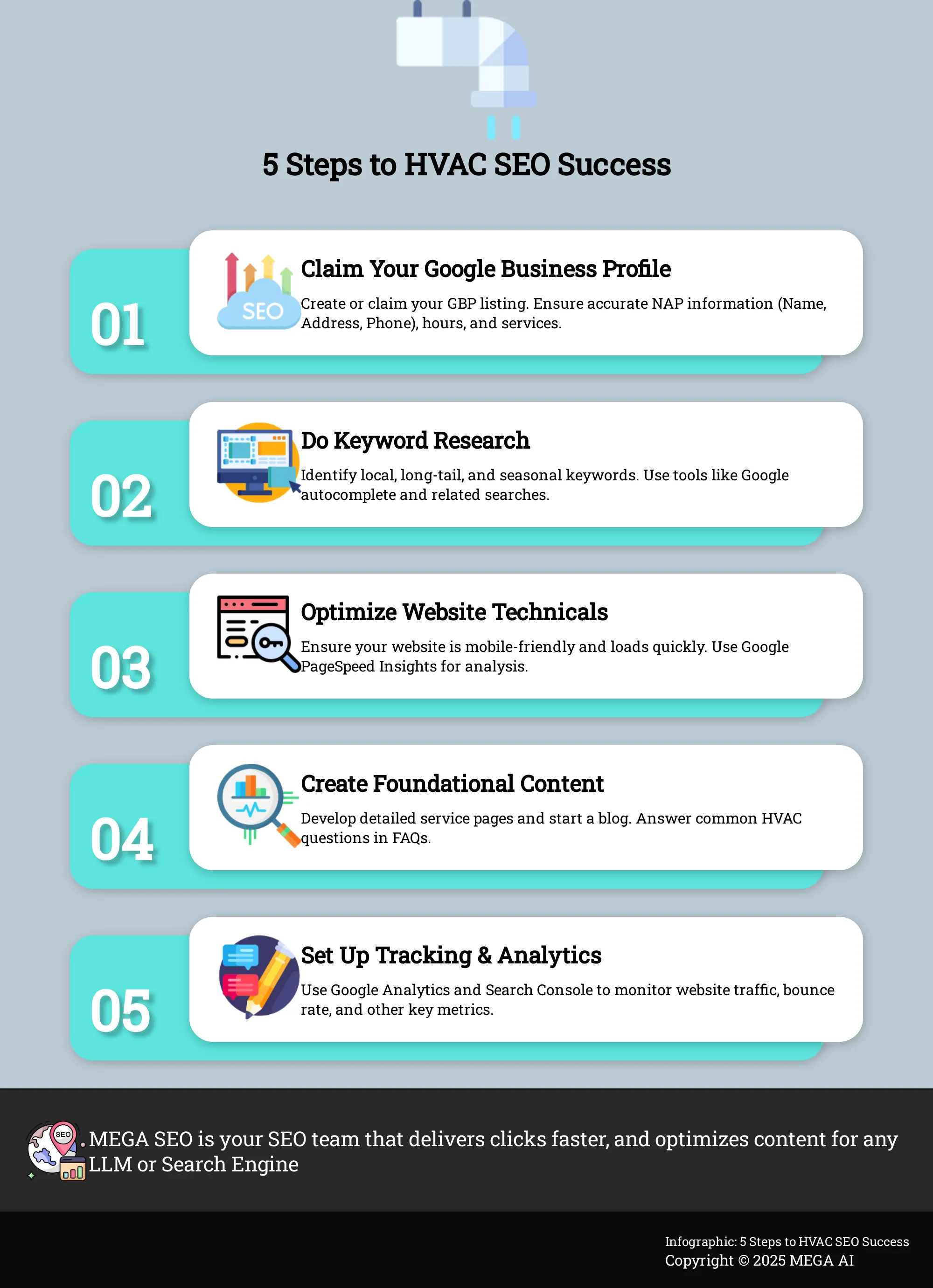
Understanding what your potential customers are searching for is the first step in getting found online. This is where keyword research comes in. You'll want to identify terms like "Denver HVAC repair" or "emergency AC service [your city]". Think about the different ways people might look for your services. Google's autocomplete feature and the "related searches" section at the bottom of the search results page are great starting points. For more in-depth analysis, various SEO tools can provide valuable data on search volume and competition.
It's also important to understand search intent—what someone is trying to accomplish with their search. Are they looking for information (e.g., "how does an air conditioner work?"), ready to hire someone (e.g., "best HVAC contractor near me"), or comparing options? Tailoring your content to match these different intents will make your website more relevant. Aim to create separate, optimized pages on your site for the different services you offer and the primary keywords you want to target for each.
Apply On-Page Optimization Techniques
Once you know which keywords you're targeting, the next step is to make sure your website pages are clearly telling search engines what they're about. This is called on-page optimization. It involves incorporating your chosen keywords naturally into your website's content, especially in headings (like H1s and H2s), page titles, meta descriptions, and even image alt text. Remember, the language should always read naturally for a human visitor; avoid just stuffing keywords in.
A well-structured website is fundamental to good on-page SEO. This means having a clear navigation system, logical page hierarchy, and ensuring each page serves a specific purpose. For HVAC contractors, this might mean dedicated pages for "Air Conditioning Repair," "Furnace Installation," and "Preventative Maintenance." Effective on-page SEO helps search engines understand the relevance of your pages to specific search queries, which can significantly improve your rankings and attract more organic traffic.
Address Technical SEO for Your HVAC Website
Technical SEO refers to the optimizations you make to your website's backend and server to help search engines crawl and index your site more effectively. While it might sound a bit intimidating, getting the basics right can make a big difference. One key aspect is website speed. If your site loads slowly, visitors are more likely to leave, and search engines may rank it lower. You can use tools like Google's PageSpeed Insights to check your site's speed and get recommendations for improvement.
Another important element is ensuring your website is mobile-friendly, as many customers will search for HVAC services on their phones. Also, consider optimizing for voice search queries, which are often longer and more conversational (e.g., "Hey Google, find an HVAC technician near me that offers 24/7 service"). While some aspects of technical SEO can be complex, focusing on site speed, mobile-friendliness, and a clear site structure provides a strong foundation for search engines to better understand your site.
Create Content HVAC Customers Will Read
Consistently publishing fresh, high-quality content is a cornerstone of any successful SEO strategy. For an HVAC business, this could mean writing informative blog posts about common HVAC problems, creating guides on choosing the right system, or offering seasonal maintenance tips. Think about the questions your customers frequently ask and create content that answers them. This not only helps with SEO but also positions you as a knowledgeable expert in your field, building trust with potential clients.
When creating content, try to incorporate long-tail keywords. These are longer, more specific phrases that people search for when they're closer to making a decision, like "cost to replace central air conditioning unit in [your town]." While these terms might have lower search volume individually, they often have higher conversion rates because the searcher's intent is very specific. The goal is to create content that is relevant, genuinely useful, and engaging for your target audience, which can also naturally attract links from other websites over time.
Improve Local SEO for Your HVAC Business
For your HVAC business, local customers are your lifeblood. When someone in your neighborhood faces an urgent AC breakdown or decides it's time for a new furnace installation, their first stop is often an online search. Effective local Search Engine Optimization (SEO) is what makes your business visible at that exact moment of need. It’s about building a strong presence within your community and making it incredibly simple for potential customers to find and choose your services over competitors. Think of it as ensuring your digital welcome mat is always out.
Focusing on local SEO means you're not just casting a wide net; you're fishing in the pond where your most valuable customers are. This targeted approach can significantly impact your lead generation and overall business growth. Let's explore three practical and essential steps you can take to enhance your local online visibility and attract more HVAC customers right in your service area.
Optimize Your Google Business Profile
Your Google Business Profile (GBP) is a powerful, free tool that essentially acts as your digital storefront on Google Search and Google Maps. To make the most of it, ensure every detail is complete and accurate. This includes your precise business name, address, and phone number (often called NAP), along with your current hours of operation and a clear, concise description of the HVAC services you offer. Don't underestimate the power of visuals; upload high-quality photos of your team, your service vehicles, and examples of your completed work. Regularly check and update this information, especially seasonal hours or new services. For an additional competitive edge, you might also explore Google Local Services Ads, which can help you reach your target audience even more directly when they search for HVAC assistance.
Manage Local Listings and Citations
Beyond your Google Business Profile, your HVAC business information appears in numerous other online directories, such as Yelp, HomeAdvisor, and local chamber of commerce sites. These appearances are known as local listings or citations. It is absolutely crucial that your business name, address, and phone number (NAP) are identical across all these platforms. Even small inconsistencies, like "Street" versus "St.", can confuse search engines and potential customers, which can harm your credibility and lower your search rankings. Make it a regular practice to audit your online citations to find and correct any discrepancies. Consistent and accurate listings build trust with both search engines and users, making it easier for local customers to find you when they need heating or cooling services.
Generate and Manage Customer Reviews
Customer reviews are a cornerstone of modern local SEO and significantly influence the decisions of potential clients. When people are looking for an HVAC technician, one of the first things they often do is check online reviews to gauge reliability and service quality. Actively encourage your satisfied customers to share their positive experiences on platforms like Google or Yelp. This can be as simple as a polite request after a service call or a follow-up email with a direct link. It's also important to respond to all reviews, both positive and negative, in a professional and timely manner. This shows you value customer feedback and are committed to service excellence. Using tools to help manage your online reputation can streamline the process of gathering and responding to reviews, ensuring you consistently present the best possible image to your local community.
Develop Keyword Strategies for HVAC
A solid keyword strategy is the foundation of effective HVAC SEO. It’s about understanding the exact words and phrases potential customers use when they need your services. Getting this right means your business appears when they’re actively looking for help. Let's look at how to identify the terms that will bring qualified leads to your HVAC business.
Find High-Value HVAC Keywords
Not all keywords carry the same weight. High-value keywords are those your ideal customers use when they are close to making a decision or urgently need a service, like "emergency AC repair [your city]" or "furnace installation cost." Start by brainstorming your services. Then, use Google's autocomplete or related searches. For deeper analysis, SEO platforms can help you research keywords and understand their search volume. Creating dedicated pages for different service keywords helps search engines rank your content appropriately.
Use Long-Tail and Location-Based Keywords
Long-tail keywords are longer, specific phrases customers use, like "best HVAC for old homes in [neighborhood]." While individual search volume is lower, they often show stronger purchase intent and have less competition. Focus on keywords matching your specific services; if you do residential repairs, avoid terms for large commercial systems. Always include location-based keywords, such as "[your city] HVAC maintenance," to attract local customers who can actually use your services. This targets your marketing to the right local audience.
Find Seasonal HVAC Keyword Opportunities
The HVAC industry is seasonal. AC service demand peaks in summer, while heating queries rise in fall and winter. Adapt your keyword strategy accordingly with terms like "prepare AC for summer" or "winter furnace check-up." Create timely blog posts or videos using these long-tail keywords. Regularly publishing fresh, useful content on seasonal needs keeps your site relevant. Modern SEO tools, sometimes using AI, can help identify seasonal trends and optimize content, keeping your business competitive.
Optimize On-Page and Technical Elements for HVAC Websites
Once you've figured out your keywords, the next step is to make sure your website itself is set up to welcome both search engines and potential customers. This involves fine-tuning what's directly on your pages—known as on-page SEO—and the behind-the-scenes technical aspects that help search engines crawl and understand your site. Think of it as preparing your digital storefront: you want it to be attractive, easy to find things in, and structurally sound. These elements work hand-in-hand; great content won't reach its potential if technical issues prevent search engines from finding it, and a technically perfect site won't convert visitors if the on-page content isn't clear and compelling.
Effective on-page SEO is crucial for HVAC websites looking to improve their search engine rankings and attract more organic traffic. When your website clearly communicates what you do and where you do it, search engines are more likely to show your business to people searching for HVAC services. This means focusing on elements like clear titles, helpful descriptions, and ensuring your site works smoothly on all devices. Addressing these technical and on-page factors helps build a strong foundation for your online presence. Tools like MEGA AI's SEO features can help identify areas for on-page improvement, ensuring your content is optimized to perform its best.
Write Compelling Title Tags and Meta Descriptions
Your title tag and meta description are often the first things a potential customer sees in search results. The title tag is the clickable headline, and the meta description is the short summary underneath. These don't just tell search engines what your page is about; they also act as a mini-advertisement, convincing users to click on your link instead of a competitor's.
To make them compelling, ensure your primary keyword for the page is in the title tag, preferably towards the beginning. Keep it concise, ideally under 60 characters. For meta descriptions, you have a bit more space (around 150-160 characters) to expand on the page's content and include a call to action or highlight what makes your service unique. Well-crafted title tags and meta descriptions can significantly improve your click-through rates from search results, bringing more qualified leads to your site.
Implement Schema Markup for HVAC Services
Schema markup, or structured data, is like a secret code you add to your website to help search engines understand your content on a deeper level. It doesn't change how your page looks to visitors, but it provides context to search engines about the information on your page. For an HVAC business, this is incredibly useful. You can use schema to specify your services, service area, opening hours, and customer reviews.
A well-structured website is the foundation of effective SEO, and implementing schema markup is a key part of that. For example, using "LocalBusiness" schema helps highlight your location and contact information, while "Service" schema can detail specific offerings like "AC repair" or "furnace installation." This can lead to richer search results, like review stars or FAQs appearing directly in the search listings, making your business stand out.
Improve Website Speed and Mobile-Friendliness
How quickly your website loads and how well it works on a smartphone are huge factors for both user experience and SEO. People are impatient; if your site takes too long to load, they'll likely leave. Similarly, if it's difficult to use on a mobile device, you'll frustrate users, especially since many local searches for services like HVAC happen on the go.
Google uses mobile-friendliness and page speed as ranking signals. Ensuring your website has a responsive design (meaning it adapts to any screen size) is essential. You can also improve speed by optimizing images, using fast web hosting, and minimizing unnecessary code. Tools like Google's PageSpeed Insights can help you identify areas for improvement. A fast, mobile-friendly site keeps potential customers engaged and signals to search engines that your site offers a good user experience, which can help you rank higher.
Build a Content Strategy for HVAC SEO
A solid content strategy is the foundation of effective HVAC SEO. It’s about more than just having a website; it’s about populating that site with valuable, informative content that directly answers your customers' questions and establishes your business as a knowledgeable leader in the field. This approach not only helps search engines understand the services you offer but also guides potential customers to your business when they need you most. Let's explore how to construct a content strategy that delivers results.
Create Informative Blog Posts and Service Pages
Regularly publishing fresh, high-quality content is essential for keeping your website relevant and improving its search engine ranking. Consider creating blog posts that offer seasonal maintenance tips, explain complex HVAC concepts in easy-to-understand language, or highlight the benefits of new energy-efficient technologies. Your service pages should clearly and comprehensively detail the services you provide, using specific and descriptive language. It's beneficial to naturally incorporate long-tail keywords—those longer, more specific search phrases that customers often use—into your content. The primary objective is to ensure every piece of content is genuinely useful and engaging for your readers, directly addressing their needs and concerns. This consistent effort demonstrates to both customers and search engines that you are an active and authoritative presence in the HVAC industry.
Develop FAQ Content for Common HVAC Questions
Answering common questions is a straightforward yet powerful way to provide value to your audience and enhance your on-page SEO. You can create a dedicated FAQ page or integrate FAQ sections within your existing service pages and blog posts. Think about the questions you frequently hear from customers, such as "How often should I have my air conditioner serviced?" or "What are the typical signs that my furnace might need repair?". Addressing these queries directly helps attract more organic traffic because your content will align closely with the exact phrases people are typing into search engines. This type of targeted content can significantly improve your visibility in local search results and help you connect with qualified leads who are actively looking for HVAC solutions.
Use Visuals and Video to Increase Engagement
While well-written text is crucial, it isn't always enough to capture and maintain a visitor's attention. Integrating visuals, such as photographs of your team on the job, diagrams that explain how HVAC systems work, or infographics that share energy-saving tips, can make your content significantly more appealing and easier to digest. Videos are particularly effective for engagement; consider producing short video clips that demonstrate simple HVAC maintenance tasks, feature customer testimonials, or provide clear explanations of the different services you offer. Engaging content like this encourages visitors to spend more time on your website, which can positively influence your search engine rankings. Ultimately, using a diverse mix of media helps you create a strong brand identity and positions your business for sustained growth in the competitive HVAC market.
Measure and Analyze Your HVAC SEO
Once you've put your HVAC SEO strategy into action, the work isn't quite done. The digital landscape is always shifting, and so are customer behaviors. That’s why the next crucial step is to consistently measure and analyze how your efforts are performing. Think of it like a regular tune-up for your marketing; it ensures everything is running smoothly and efficiently to bring you the best results. By measuring your SEO, you gain valuable insights into what’s resonating with potential customers—what content they find helpful, which keywords are drawing them in, and how they interact with your website. This understanding allows you to refine your approach, making your marketing more targeted and effective.
This ongoing cycle of analysis and adjustment is fundamental to staying competitive in the HVAC industry. It’s how you ensure your investment in SEO truly pays off by connecting you with more local customers actively searching for your services. Instead of guessing what works, you’ll have concrete data to guide your decisions. This data-driven approach helps you allocate your resources wisely, focusing on activities that deliver tangible outcomes. Platforms like MEGA AI's SEO suite can significantly simplify this process, offering tools that automate tracking and provide clear, actionable insights, even if you're not a data analytics professional.
Track Key Metrics for HVAC SEO Success
To really understand how your SEO efforts are performing, you’ll want to get familiar with a few key metrics. Tools like Google Analytics and Google Search Console are your best friends here; they’re free and provide a wealth of information about your website's visitors. Pay close attention to metrics such as overall website traffic, which shows how many people are finding your site. Also, look at "time on page" and "bounce rate." A longer time on page often suggests visitors find your content valuable and engaging, while a high bounce rate might indicate that people aren't finding what they expected or that the page isn't user-friendly. Regularly monitoring these key performance indicators allows you to spot trends and understand user behavior, guiding you to make informed decisions to improve your website’s effectiveness in converting visitors into leads.
Use Tools to Monitor SEO Performance
Beyond Google's free tools, dedicated SEO software can offer a deeper understanding of your website's performance and competitive landscape. Platforms like Ahrefs or Semrush provide powerful features for keyword research, tracking your search engine rankings for key HVAC terms, and analyzing your backlink profile. These tools can also audit your site’s overall SEO health, highlighting technical issues or areas for improvement. Such insights are invaluable for refining your strategy, like discovering competitor keywords or identifying underperforming pages. While these tools can have a learning curve, the information helps you make data-backed decisions. Integrated platforms like MEGA AI can simplify SEO management by consolidating analytics and even automating content updates.
Adjust Your Strategy with Data Insights
The data you gather from tracking metrics and SEO tools should directly inform your actions. A strong online presence in the HVAC market depends on your ability to adapt. When you identify what’s working, you can do more of it; if something isn’t performing, you can adjust. For instance, if blog posts on "AC maintenance" drive engagement, create more similar content. If a keyword strategy falls flat, it’s time to pivot. Remember, the truest measure of success is an increase in qualified leads and sales, not just website traffic. By focusing on data-driven strategies, you ensure your SEO efforts contribute to business growth. This could involve re-optimizing content, perhaps with a tool like MEGA AI's Maintenance Agent to improve click-through rates, or shifting focus based on performance data.
Avoid These Common HVAC SEO Mistakes
Getting your HVAC SEO strategy right involves more than just implementing new tactics; it's also about sidestepping common errors that can undermine your efforts. Some mistakes can do more than just slow your progress—they can actively harm your website's standing with search engines. Let's look at a few critical areas where HVAC businesses often stumble, so you can keep your SEO efforts on the right track and ensure your hard work pays off.
Avoid Keyword Overuse and Black Hat Tactics
It can be tempting to look for shortcuts to the top of search results, but some methods will do more harm than good. "Black hat" SEO refers to practices that violate search engine guidelines. This includes keyword stuffing—cramming your content with so many keywords that it becomes unnatural to read—as well as tactics like buying links or posting duplicate content across your site or others. While these might seem like quick wins, search engines are smart enough to detect them. Using such techniques can lead to penalties, damage your website's credibility, and ultimately make it harder for customers to find you. The best approach is always to create high-quality content that genuinely serves your audience, using keywords naturally and thoughtfully.
Don't Neglect Mobile Optimization and Site Speed
Think about how often you use your phone to search for local services. Your customers are doing the same. With a significant portion of online searches happening on mobile devices, having a website that looks and works great on smartphones and tablets isn't just a nice-to-have; it's essential. You can use Google's Mobile-Friendly Test to see how your site measures up.
Equally important is your website's loading speed. If your pages take too long to load, visitors are likely to leave before they even see what you offer. This high bounce rate can signal to search engines that your site provides a poor user experience, which can negatively affect your rankings. Tools like Google's PageSpeed Insights can help you identify what's slowing your site down. Common fixes include compressing images, choosing a reliable hosting provider, and enabling browser caching. A fast, mobile-responsive site keeps users happy and search engines satisfied.
Maintain Consistent NAP Information
For an HVAC business, local customers are your lifeblood. A key part of local SEO is ensuring your business's Name, Address, and Phone number (NAP) are consistent everywhere they appear online. This includes your website, your Google Business Profile, and online directories like Yelp, HomeAdvisor, and Angie's List. Inconsistent information can confuse both potential customers and search engines, making it harder for people to find and contact you. When search engines see the same accurate NAP details across multiple reputable sources, it builds trust and reinforces your business's legitimacy and location. Regularly audit your online citations to ensure accuracy and consistency; this simple step can significantly support your local search visibility.
Explore Advanced SEO and Future Trends for HVAC
After you've established a solid foundation with HVAC SEO basics, such as effective keyword research and local optimization, looking forward is your next step. Search engine optimization is a dynamic field. Staying updated on advanced strategies and emerging trends offers your HVAC business a clear path to growth. Consider it like HVAC system maintenance: consistent checks and timely upgrades ensure optimal function. Your SEO strategy requires similar diligence to continuously attract customers and stay ahead of competitors in your local market.
Exploring these advanced areas isn't just about chasing the latest fads. It's about future-proofing your online presence and ensuring your business remains visible as search technologies and user behaviors change. For instance, how people search is shifting, with voice assistants becoming more prevalent and search engines refining their algorithms to better understand user intent. New technologies, including advancements in AI that can help analyze trends and optimize content, are also shaping the future of SEO. By understanding these shifts, you can proactively adjust your approach. This might involve optimizing for different types of search queries, using new platforms to support your SEO efforts, or even exploring how automated SEO tools can streamline complex tasks. We'll look at a few key areas that can help you prepare for what's next in HVAC SEO, ensuring your marketing efforts continue to deliver strong returns and keep your business growing.
Optimize for Voice Search HVAC Queries
Think about how your customers use devices like Alexa, Siri, or Google Assistant. They're likely asking full questions, such as, "Hey Google, what's the best HVAC repair near me?" or "Siri, why is my air conditioner making a weird noise?" This is voice search, and it's a growing trend you shouldn't overlook. To optimize for these queries, focus on natural language and long-tail keywords in your website content, especially in FAQs or blog posts. Instead of just "AC repair Houston," you might target "how much does it cost to repair an AC unit in Houston." Answering these specific, conversational questions directly can help your HVAC business show up in voice search results, making it easier for potential customers to find you when they need you most.
Use Social Media to Support SEO
While social media might not directly impact your search engine rankings in the way a backlink does, it plays a vital supporting role in your overall SEO strategy. Maintaining an active presence on platforms like Facebook, Instagram, or even LinkedIn helps build your brand's visibility and trust within your community. More importantly, it gives you a channel to share the valuable content from your website, like blog posts about energy-saving tips or new service announcements. When your followers engage with and share this content, it can drive more traffic back to your site. This increased traffic and engagement can signal to search engines that your content is valuable, indirectly supporting your SEO efforts and potentially leading to more organic shares and links over time.
Adapt to Algorithm Updates and New Technologies
Search engines like Google are frequently adjusting their algorithms to provide users with the best possible results. What worked well for SEO last year might not be as effective this year. That's why it's so important for HVAC contractors to stay informed about these changes and adapt their strategies accordingly. This means keeping an eye on SEO news and industry best practices. Beyond algorithm updates, new technologies are also emerging that can impact how you approach SEO. For example, AI-powered tools can help with content optimization and identifying new opportunities. A willingness to learn and refine your methods will help you maintain visibility and stay competitive as search technology evolves. You might consider how platforms like MEGA AI can assist you in keeping up with SEO demands without requiring you to become a dedicated SEO specialist.
Implement Your HVAC SEO Strategy: What's Next?
You've learned a lot about HVAC SEO, from understanding keywords to crafting compelling content. Now, the crucial part is turning that knowledge into tangible results for your business. Moving forward involves two key actions: solidifying your plan and committing to ongoing education. SEO isn't a static field; it's always evolving. By creating a concrete plan, you give your efforts clear direction and a roadmap to follow. And by staying informed about the latest trends and algorithm updates, you ensure your HVAC business remains competitive and visible to potential customers actively searching for your services online. This proactive approach will help you not just implement but also sustain a successful SEO strategy. Let's look at how you can tackle these next steps effectively.
Create an Actionable SEO Plan for Your HVAC Business
Alright, you've got the basics of HVAC SEO down. So, what's the game plan now? It's time to put all that knowledge into a clear, actionable SEO plan. Think of your website as the foundation; it needs to be well-structured and optimized for search engines. A significant part of this for HVAC businesses is focusing on local SEO. Make sure your Google Business Profile is polished and accurate, as this is key to attracting local customers in your service area. Your plan should outline how you'll consistently work on these elements to stand out online, bring in more qualified leads, and build a strong, recognizable brand. Tools like MEGA AI can help streamline creating and implementing your SEO strategy, ensuring consistent effort for long-term growth.
Find Resources for Ongoing SEO Learning
SEO isn't a 'set it and forget it' kind of deal. The digital landscape is always shifting, so staying curious and committed to learning is very important. Make it a habit to stay updated with the latest SEO trends and best practices. This means keeping an eye on algorithm changes and new technologies that can impact your rankings. For instance, learning to optimize for voice search queries and understanding how AI-powered SEO applications can streamline your efforts will keep your HVAC business competitive. Platforms like MEGA AI are at the forefront, using AI to simplify complex SEO tasks. Look for reputable blogs, industry webinars, and reports that teach you how to effectively leverage SEO tactics, such as targeting long-tail keywords. Continuous learning helps you refine your strategies and maintain visibility.
Related Articles
- Electrician SEO: The Ultimate Guide to Getting More Clients
- SEO for Tradesmen: Dominate Local Search in 2024
- Local SEO for Plumbers: Your Guide to Getting More Leads
- Plumber SEO: Dominate Search Rankings in 2024
- Optimizing On-Page Elements for Improved SEO Rankings - MEGA SEO | Blog
Frequently Asked Questions
If I'm just starting with SEO for my HVAC business, what's the most important first step? Your most impactful first move is to claim and fully complete your Google Business Profile. This listing is often the first interaction potential local customers have with your business on Google Search and Maps, so ensure your name, address, phone number, hours, and services are accurate and detailed.
How can I figure out the best search terms, or keywords, for my HVAC services? Think like your customer. Consider the phrases they would type into a search engine when they need heating or cooling help, such as "emergency AC repair [your city]" or "new furnace cost." You can also look at what terms your competitors seem to be using and use online tools to discover related phrases people are searching for.
Why is it important to keep my business information the same across different websites? Consistent information, especially your business name, address, and phone number (NAP), across all online directories and your website builds trust with search engines. When search engines see the same correct details everywhere, it confirms your legitimacy and location, which helps you rank better in local search results.
Beyond keywords, what else on my website helps with getting found by local customers? Clear page titles and descriptions for each page act like mini-ads in search results, encouraging clicks. Also, ensuring your website loads quickly and works well on mobile phones is crucial because many customers search for HVAC services on the go, and search engines favor sites that offer a good user experience.
How can creating blog posts or FAQs actually help my HVAC business get more calls? Publishing informative content, like blog posts answering common HVAC questions or detailed service pages, shows search engines that your website is a valuable resource. This can improve your rankings for specific searches, making it easier for potential customers looking for solutions you provide to find your business and contact you.