The FoodTech industry is built on innovation, so your marketing strategy should be just as forward-thinking. Traditional methods are often slow, expensive, and difficult to scale. A smarter approach uses technology to automate complex tasks and deliver faster results. AI-driven SEO for FoodTech changes the game by handling everything from keyword research to content creation and real-time optimization. This allows you to dominate your niche by covering a vast range of specific search terms with minimal manual effort. It’s a more efficient way to build authority, capture highly qualified traffic, and ensure your brand remains visible as search technology evolves.
Key Takeaways
- Master both local and global SEO: Attract nearby customers with a strong Google Business Profile and location-specific keywords, while building brand authority with content on broader industry trends and food innovation.
- Automate your content strategy with AI: Use AI agents to scale content production through programmatic SEO and keep existing articles fresh, ensuring your brand stays relevant without constant manual effort.
- Build your strategy on a solid foundation: Start with a technically healthy, mobile-first website and a fully optimized Google Business Profile to ensure you are visible to your most important local customers.
Why SEO is Essential for FoodTech Brands
In the crowded FoodTech market, a great product isn't enough to guarantee success. You need to connect with customers who are actively searching for new ways to eat, cook, and order food. This is where search engine optimization (SEO) becomes your most valuable marketing tool. It’s the process of making your website more visible to people using search engines like Google to find the solutions you offer.
Modern consumer habits are rooted in online discovery. Since most people use the internet to find new businesses, your online presence is your digital storefront. If your meal delivery service, restaurant tech platform, or sustainable food product doesn’t appear on the first page of search results, you’re missing out on a huge portion of your potential audience. SEO puts your brand directly in front of customers at the exact moment they’re looking for you.
Beyond visibility, SEO builds credibility. A high ranking on Google acts as a powerful signal of trust. For FoodTech companies, where consumers are concerned about quality, safety, and reliability, this trust is essential. When your website consistently appears as a top result for relevant searches, it tells potential customers that you are an authoritative and dependable player in the industry.
Finally, SEO is a cost-effective strategy for long-term growth. While paid ads require a constant budget to maintain visibility, a strong SEO foundation is an asset that appreciates over time. It generates organic traffic 24/7, creating a sustainable pipeline of leads and sales. For startups and small businesses, leveraging AI can help target the right keywords and content strategies efficiently, making it possible to compete with larger players without a massive marketing budget.
What Makes FoodTech SEO Unique?
Search engine optimization for a FoodTech brand isn't quite like SEO for other industries. While the fundamentals of keywords and backlinks still apply, you're dealing with a unique mix of technology, perishable goods, local logistics, and rapidly changing consumer tastes. Your audience might be looking for a quick meal delivery in their neighborhood one minute and researching global food sustainability trends the next. This creates a distinct set of challenges and opportunities.
Success in FoodTech SEO means building trust around health and safety, staying on top of viral food trends, and speaking to both a hyper-local customer base and a broader, brand-aware audience. You have to be a local restaurant, a tech innovator, and a lifestyle brand all at once. It requires a strategy that is both broad in scope and granular in its local execution. Getting this balance right is what separates brands that get found from those that get lost in the crowded digital marketplace. The following points break down the core pillars that make FoodTech SEO a specialized discipline.
Balance Local and Global Audiences
Many FoodTech companies operate on two levels: they serve specific geographic areas while building a national or even global brand. A meal kit service, for instance, needs to appear in local searches like "healthy meal delivery in Brooklyn," but it also wants to rank for broader terms like "sustainable food sourcing." This dual focus is critical. Your local SEO strategy is your ground game. It involves claiming and meticulously optimizing your Google Business Profile for every service area, gathering local reviews, and creating location-specific content. At the same time, your global strategy builds brand authority through high-quality blog posts, articles on food innovation, and partnerships that establish your expertise in the wider industry.
Adapt to Seasonal and Trending Searches
The food world moves fast. From TikTok recipes going viral overnight to seasonal cravings for pumpkin spice everything, your content strategy needs to be agile. A FoodTech brand can’t rely on a static set of keywords. You need to create content that taps into these fleeting moments and seasonal shifts. This could mean publishing a blog post about "easy weeknight dinners" in September as school starts or creating content around "plant-based holiday recipes" in November. Staying relevant requires constantly monitoring food trends and having the ability to produce timely, optimized content that meets search demand as it happens. This shows customers and search engines that your brand has its finger on the pulse of the food world.
Meet Health and Regulatory Content Standards
When it comes to food, trust is not just a brand asset; it's a requirement. Consumers need accurate information about ingredients, allergens, nutritional value, and sourcing. This makes your content subject to a higher level of scrutiny from both users and search engines. Google’s quality guidelines, often referred to as E-E-A-T (Experience, Expertise, Authoritativeness, and Trustworthiness), are especially important here. Your website must provide clear, correct, and easily accessible information. Any health or dietary claims must be well-supported. Inaccurate or misleading content can not only damage customer trust but also negatively impact your search rankings, particularly for topics that Google considers critical to a user's well-being.
How AI-Powered SEO Changes FoodTech Marketing
Artificial intelligence is more than just a trend; it’s a practical tool that reshapes how FoodTech brands approach growth. For small businesses and startups, AI levels the playing field by automating the complex, time-consuming tasks that were once the domain of large marketing agencies. Instead of spending weeks on manual research and analysis, you can use AI to get measurable results in a fraction of the time.
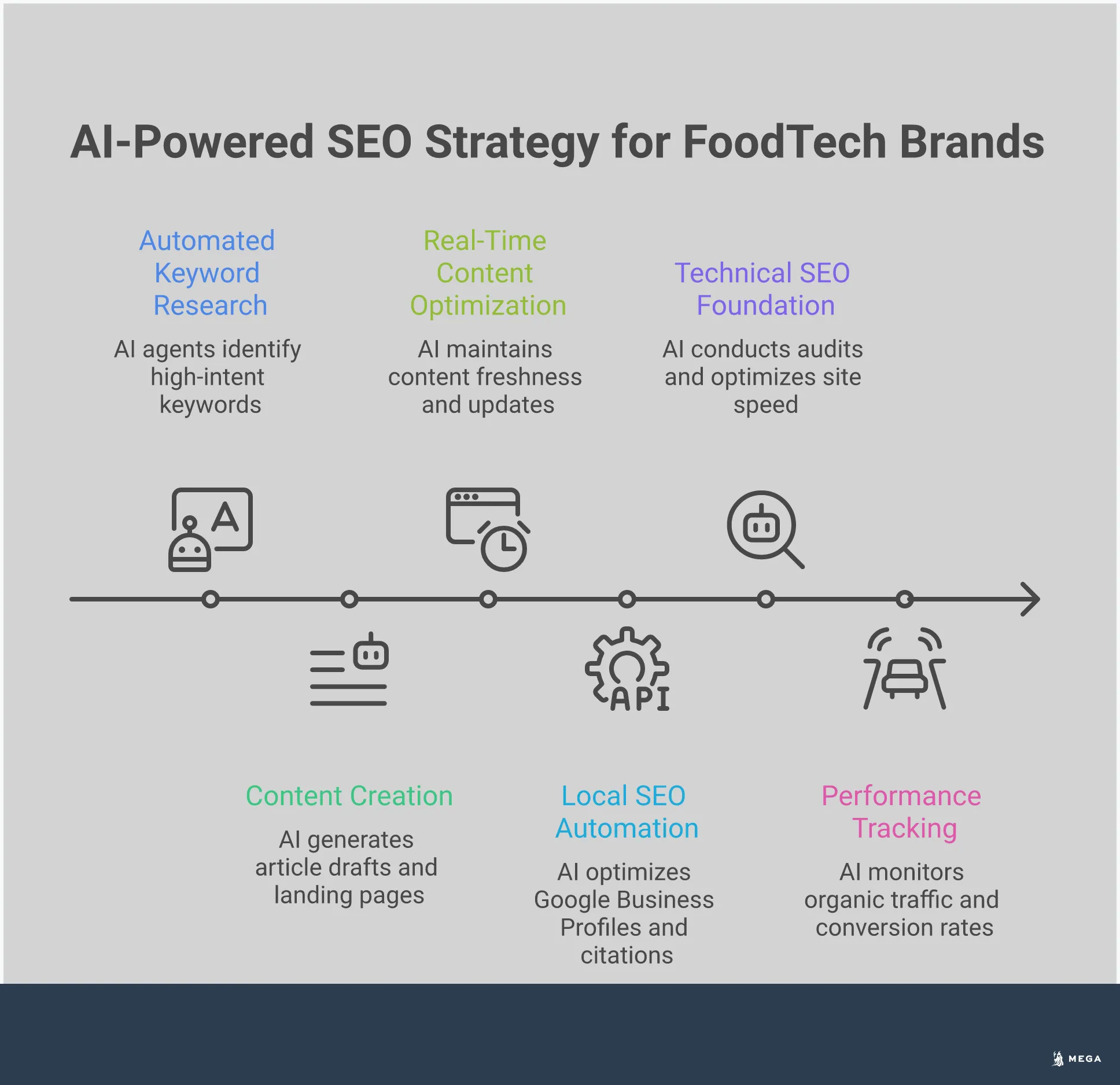
An AI-powered SEO strategy handles the heavy lifting, from discovering what your customers are searching for to creating and updating the content that answers their questions. This allows you to focus on running your business, confident that your online presence is continuously being optimized. AI agents can analyze millions of data points to inform your strategy, ensuring your marketing efforts are precise and effective. This shift allows even the most resource-constrained teams to compete with established players by working smarter, not just harder.
Automate Keyword Research and Content Creation
Effective SEO starts with understanding what your audience is looking for. AI-driven keyword research saves significant time and effort by identifying the most valuable search terms for your niche. Instead of guessing, AI tools analyze search trends, competitor content, and user behavior to pinpoint high-intent keywords. This process helps you target the right audience with precision.
Once you have your keywords, AI can help you build content around them. AI agents research top-ranking articles, forums, and news sources to understand the topic deeply before generating a comprehensive, well-structured draft. This automates the initial creation process, allowing your team to focus on refining the content with your unique brand voice and expertise. It’s a streamlined way to develop a content strategy that consistently meets customer needs.
Optimize and Update Content in Real Time
Publishing an article is just the beginning. To maintain its rank, content needs to stay fresh, accurate, and relevant. AI agents can act as your content maintenance team, working around the clock to keep your articles in top shape. They can automatically fix broken links, add new internal links, and even update articles with new information or FAQs to improve their value to the reader.
This continuous optimization process is key to long-term SEO success. For example, an AI agent can monitor an article's click-through rate (CTR) from search results and test new headlines to improve performance. This ensures your content doesn't just rank but also attracts clicks. By handling these ongoing updates, AI frees you from the manual work of content audits and allows you to focus on creating new, innovative products.
Scale Your Content with Programmatic SEO
Programmatic SEO is a method for creating hundreds or even thousands of targeted pages by using data and templates. For a FoodTech brand, this could mean creating unique landing pages for every city you deliver to or for every specific dietary need you cater to. While this strategy is powerful, it has historically been complex and resource-intensive to implement.
AI changes that by making programmatic SEO accessible to businesses of all sizes. An AI agent can identify data-driven content opportunities, generate the unique copy for each page, and publish them at scale. This allows you to dominate your niche by covering a vast range of specific, long-tail keywords with minimal manual effort. It’s an efficient way to build authority and capture highly qualified traffic.
Get Found in AI Search with LLM Optimization
The way people search for information is evolving. Many users now turn to AI chatbots and generative search engines for answers. To show up in these results, your content needs to be optimized for Large Language Models (LLMs). This means structuring your content in a way that AI can easily understand, process, and cite as a source.
LLM optimization involves using clear headings, providing direct answers to common questions, and incorporating structured data. For a FoodTech company, this could mean ensuring your recipe pages clearly list ingredients and instructions so an AI can pull that information for a user asking for a dinner idea. By preparing your content for this new search paradigm, you ensure your brand remains visible as generative AI continues to shape the digital landscape.
Key SEO Strategies for FoodTech Brands
A successful SEO strategy for your FoodTech brand rests on a few core pillars. It starts with a technically sound website that search engines can easily understand. From there, it’s about creating genuinely useful content that speaks to your audience’s needs, whether they’re looking for a quick recipe or detailed nutritional information. Since many of your customers will find you on their phones while in the kitchen or on the go, a seamless mobile experience is critical. Finally, adapting to new search behaviors, like using voice assistants, will help you stay ahead of the curve. Getting these four elements right will create a powerful foundation for sustainable growth, helping you connect with the right customers at the moment they need you most.
Build a Strong Technical SEO Foundation
Before you can win with creative content, you need to get the technical details right. Technical SEO is the foundation of your website, ensuring search engines can crawl, index, and rank your pages without any issues. For a FoodTech brand, this means ensuring your recipe pages load quickly and your online ordering system is easy for search engine bots to read. Key actions include cleaning up duplicate content, refreshing internal links to guide users and bots through your site, and adding structured data. An AI-powered platform can automate many of these technical SEO improvements, freeing you up to focus on your products and customers.
Create Content That Highlights Food Innovation
Your content is where you can truly connect with your audience and showcase what makes your brand unique. Go beyond product descriptions and create helpful, interesting content that solves a problem for your customer. You can develop proven SEO strategies by publishing recipes, cooking guides, or blog posts about nutrition and food science. Weave relevant keywords into your articles naturally to improve your search visibility. This approach not only attracts organic traffic but also establishes your brand as a trusted authority in the food space, building a loyal community around your products.
Prioritize a Mobile-First Experience
Many of your customers interact with your brand on a mobile device. They might be looking up a recipe in the kitchen, ordering meal delivery from the couch, or checking an ingredient list at the grocery store. Because of this, a mobile-first experience is not optional. Your website must be designed to look great and function perfectly on all screen sizes. More importantly, it needs to load quickly on a mobile connection. Slow load times lead to high bounce rates, signaling to search engines that your site offers a poor user experience and potentially harming your rankings.
Optimize for Voice Search
The way people search for information is changing, especially in the food world. Think about how often someone might ask a smart speaker for a recipe conversion or cooking instructions while their hands are full. To capture this growing traffic, you need to optimize for voice search. Write your content in a natural, conversational tone that directly answers the kinds of questions people ask aloud. Structuring articles with clear questions as headings or adding an FAQ section can be highly effective. This approach improves your chances of being the answer provided by voice assistants like Alexa and Google Assistant.
Local SEO Tactics That Drive Results
For FoodTech brands with delivery services or physical locations, local customers are your core audience. When someone searches for "meal prep in Brooklyn," you need to be the top result. Local SEO is the strategy that gets you there by improving your visibility in local search results and on Google Maps. It involves a set of tactics designed to signal your geographic relevance to search engines, making it easier for nearby customers to find you when they need your services. This is especially important in the food industry, where proximity and convenience are key decision-making factors. A strong local presence builds trust and drives conversions, whether that’s an online order for delivery or a visit to a physical storefront. Managing all the moving parts of a local strategy—from directory listings to review management and location-specific content—can be time-consuming for a small business. An AI agent can manage these local signals for you, ensuring your business appears in front of nearby customers consistently. MEGA AI’s Lindsay agent specializes in local SEO, optimizing for maps and Google Business Profile automatically so you can focus on your product.
Optimize Your Google Business Profile
Your Google Business Profile is your digital storefront on Google and often a customer's first interaction with your brand. Keeping it accurate and engaging is critical. Claim your profile and fill out every section, including your business name, address, phone number, and hours. Upload high-quality photos of your food and packaging, and use the Posts feature to share updates, special offers, or new menu items. A complete profile sends strong signals to Google that your business is legitimate and relevant to local searchers. You can learn more about how to optimize your profile directly from Google’s own resources.
Target Keywords Based on Location
To connect with local customers, your keyword strategy must be location-specific. Think about how people in your area search for your services, likely including a city, neighborhood, or landmark in their query. Incorporate these terms into your website content, page titles, and meta descriptions. For example, instead of "healthy meal delivery," target "healthy meal delivery in Austin." This simple change helps search engines understand your service area and show your business to the right people at the right time. AI-powered tools can automate this research, identifying the exact local phrases your customers are using so you don't have to guess.
Manage Reviews and Build Local Citations
Online reviews and directory listings are powerful trust signals for customers and search engines. Actively encourage satisfied customers to leave reviews on your Google Business Profile and other relevant sites. It's just as important to respond to all reviews, both positive and negative, to show you value customer feedback. Also, ensure your business is listed on popular food directories like Yelp and TripAdvisor. Consistent information—your name, address, and phone number—across all these local citations helps solidify your local authority and improves your ranking. This consistency proves to search engines that your business information is reliable.
Common SEO Mistakes to Avoid
Building a strong SEO strategy is about more than just implementing the right tactics; it's also about sidestepping common errors that can hold your FoodTech brand back. Many businesses, especially startups and small teams, make preventable mistakes that limit their visibility in search results. By understanding these pitfalls, you can create a more resilient and effective online presence.
Focusing on avoiding these key issues will help ensure your hard work translates into meaningful traffic and customer growth. Let's look at four of the most frequent mistakes FoodTech companies make and how you can steer clear of them.
Skipping Keyword Research
Jumping straight into content creation without understanding what your audience is searching for is like cooking without a recipe. You might create something, but it probably won’t be what people want. Keyword research is the foundation of any successful SEO plan. It helps you find the specific terms and phrases your potential customers use, from "vegan meal delivery" to "smart kitchen appliances." Using a keyword research tool is essential to uncover these opportunities and understand search intent. This process ensures the content you create directly answers the questions your audience is asking, making it far more likely to rank and attract the right visitors.
Ignoring Technical Site Health
You could have the most innovative product and the best content in the FoodTech space, but if search engines can't properly crawl and index your website, no one will find it. Technical SEO refers to the health of your site's backend. This includes fixing broken links, removing duplicate content to avoid penalties, and addressing crawl errors. For FoodTech sites with complex recipe databases or e-commerce functions, technical soundness is even more critical. Regularly checking your site's status in tools like Google Search Console helps you identify and fix issues before they impact your rankings, ensuring a smooth experience for both search engines and users.
Overlooking Local SEO
Many FoodTech brands, from meal kit delivery services to restaurant tech providers, have a strong local component. Ignoring local SEO means missing out on a huge segment of your target market. Local SEO involves optimizing your online presence to attract customers in a specific geographic area. A great first step is to claim and fully update your Google Business Profile with your correct address, hours, and photos. Encouraging customer reviews and using location-specific keywords like "ghost kitchen in Austin" also helps you appear in local map packs and search results, connecting you with nearby customers ready to make a purchase.
Publishing Low-Quality Content
In the competitive FoodTech industry, simply having a blog isn't enough. Publishing thin, unhelpful, or generic content can do more harm than good. Your content needs to establish your brand as an authority, whether you're sharing recipes, explaining food science, or highlighting industry trends. Each article should be well-researched, comprehensive, and genuinely useful to your reader. For example, instead of a short post on "healthy eating," create a detailed guide on "meal prepping for a high-protein diet" with recipes and tips. High-quality content not only ranks better but also builds trust with your audience, turning casual visitors into loyal customers.
How to Keep Your FoodTech Content Fresh
Creating great content is the first step, but keeping it relevant drives long-term SEO success. In the fast-moving FoodTech industry, a "set it and forget it" approach falls short as consumer tastes, technology, and search trends shift. An outdated article can quickly lose its ranking and authority. Maintaining your content library ensures it continues to attract traffic and provide value to your audience. Here are three practical ways to keep your FoodTech content fresh and competitive.
Use Automation to Update and Maintain Content
Manually auditing and updating every blog post is a huge time commitment, especially for a small team. This is where automation can make a real difference. AI-powered tools can continuously work in the background to keep your content optimized. For example, an AI agent can analyze existing articles to improve click-through rates by testing new headlines and meta descriptions. It can also identify content gaps, suggesting new sections to add to a post to make it more comprehensive. This lets you focus on your business while your SEO platform handles the routine maintenance.
Monitor Trends and Adapt Your Strategy
The FoodTech space is constantly evolving. From ghost kitchens to plant-based innovations, new topics capture public interest all the time. To stay relevant, you must align your content with what people are actively searching for. Use keyword research tools to discover emerging trends and search terms in your niche, or monitor industry news and social media. Adapting your SEO strategy based on these insights ensures you’re creating content that meets current demand, whether it’s about sustainable packaging or the latest meal-kit service.
Plan Your Content Seasonally
People's food habits are closely tied to the calendar, from New Year's resolutions to summer barbecues and holiday feasts. Planning your content seasonally is a straightforward way to tap into these predictable search patterns. Create a content calendar that maps out topics for the entire year, featuring light recipes in the spring and comforting dishes in the fall. For food bloggers and FoodTech brands, creating posts about what's popular right now is a proven way to attract and engage your audience with timely information that reflects current food culture.
How to Integrate AI SEO Tools Effectively
Adopting AI for your SEO is more than just subscribing to a new tool. To get the most out of your investment, you need a thoughtful approach to integration. The right AI platform should feel like a natural extension of your team, not another complex system to manage. By focusing on compatibility, control, and cost from the start, you can ensure a smooth transition and start seeing results faster. A well-integrated AI tool simplifies your workflow, automates tedious tasks, and gives you the data-driven insights needed to grow your FoodTech brand in a competitive market.
Check for CMS Compatibility
Before you commit to an AI SEO tool, the first thing to verify is whether it connects with your Content Management System (CMS). A seamless integration is what separates a helpful tool from a frustrating one. If your AI platform can’t directly publish to or edit content on your website, you’ll be stuck manually copying and pasting, which defeats the purpose of automation. Look for tools that offer direct integrations with popular platforms like Shopify, WordPress, or Webflow. This connection is what enables powerful features like automatic content updates and programmatic SEO, allowing your AI agent to manage your content strategy with minimal effort on your part.
Balance Automation with Manual Control
AI is incredibly powerful, but it works best when it complements human oversight. While full automation can save a lot of time, you don’t want to lose your brand’s unique voice in the process. The best AI SEO platforms give you the choice between full autonomy and manual review. For example, you might let an AI agent publish technical fixes automatically but send all new blog posts to your drafts folder for a final check. This hybrid approach allows you to maintain quality control while still benefiting from AI’s speed and scale. As you build trust in the system, you can gradually increase the level of automation.
Plan Your Budget for a Small Business
For a small business, every dollar counts. When evaluating AI SEO tools, look for transparent pricing without hidden fees. Some platforms offer different tiers, so you can start with a plan that fits your current needs and scale up as your business grows. Think about the return on investment, not just the monthly cost. An effective AI agent can handle the work of an entire marketing team, from keyword research to content creation and link building. When you consider the cost of hiring for those roles, an AI platform often provides significant value. You can explore different pricing models to find a solution that aligns with your growth goals and budget.
How to Measure SEO Success in FoodTech
Measuring your SEO efforts is the only way to know if your strategy is actually working. It’s not about chasing vanity metrics; it’s about understanding how your search presence translates into tangible business results, like more delivery orders or software demos. A clear measurement plan helps you justify your marketing spend and make smarter decisions. Here’s a straightforward approach to tracking your FoodTech SEO success.
Know Which KPIs to Track
To measure success, you need to focus on the right numbers. While traditional metrics like organic traffic and keyword rankings are still important, the rise of AI in search means you should also watch a few others. Pay close attention to your overall search visibility—how often and how prominently you appear for your target searches. This is increasingly seen as a vital indicator of performance. Also, track citations and brand mentions, which help build authority. For a FoodTech brand, this means tracking how many people visit your site from a search for “vegan meal kits” and, ultimately, how many of them place an order.
Use the Right Analytics Tools
You can’t track what you don’t measure, and for that, you need the right tools. Google Analytics and Google Search Console are the essential starting points for any website. But to get a competitive edge, consider platforms that use AI to streamline the process. Modern AI-driven keyword research tools do more than just report data; they provide actionable insights tailored to your market. An end-to-end platform like MEGA AI goes a step further by not only tracking performance but also using that data to automatically make improvements, saving you valuable time.
Set Up a Framework to Measure ROI
Finally, connect your SEO performance to your bottom line. A simple framework for measuring return on investment (ROI) helps you see the real value of your work. Start by defining your business goals, like increasing online sales by 20%. Then, use your analytics to track how many of those sales came from organic search. By calculating the average value of a customer, you can assign a dollar amount to your SEO-driven conversions. This allows you to clearly see how your investment in SEO is contributing to your company’s growth.
Start Your FoodTech SEO Strategy
Getting started with SEO doesn't have to be complicated. By breaking the process down into manageable steps, you can build a solid strategy that attracts the right customers. The key is to focus on a strong foundation, consistent content, and the right technology to support your growth. These first steps will set the stage for long-term success, helping your FoodTech brand get noticed in a crowded market.
Set Up Your SEO Foundation
A strong SEO foundation rests on a few core pillars. Start by focusing on your on-page SEO, which involves optimizing individual web pages with relevant keywords, clear titles, and descriptive meta descriptions. Next, turn your attention to local SEO to attract customers in your service area. This includes setting up your Google Business Profile and ensuring your contact information is consistent online. Finally, begin building backlinks from reputable food blogs or local news sites to show search engines that your brand is a trusted authority in the FoodTech space.
Create Your Content Calendar
Consistency is crucial for SEO, and a content calendar is your best tool for staying on track. Plan to regularly publish helpful content that your audience is searching for, such as innovative recipes, guides to sustainable food practices, or updates on new product features. A well-planned calendar helps you organize topics, assign deadlines, and ensure a steady flow of fresh content. This not only demonstrates your expertise but also gives search engines more opportunities to rank your website for relevant keywords.
Choose the Right Tools and Platforms
The right tools can make all the difference, especially for a small business. While traditional keyword research tools are essential, AI-powered platforms can streamline your entire workflow. An AI agent can handle everything from finding the right keywords to generating and optimizing content, saving you valuable time. For example, MEGA AI’s SEO agent automates these complex tasks, allowing you to implement a sophisticated strategy without needing a dedicated marketing team. This approach helps you target the right audience and improve your search rankings more efficiently.
Related Articles
- Creating Content for Specialty Food Shops That Sells
- AgriTech SEO: The Complete Guide for Growth
- SEO for RetailTech: The Ultimate 2025 Guide
- Ross Tavendale on SEO: Branding, Entities & Future Trends
- The Future of E-A-T in SEO: Trends and Preparations - MEGA SEO | Blog
Frequently Asked Questions
I'm a small FoodTech startup. What's the most important first step for my SEO? Your first step should be to build a solid technical foundation. This means ensuring your website is fast, mobile-friendly, and easy for search engines to understand. At the same time, claim and completely fill out your Google Business Profile. This single action is one of the most effective ways to start appearing in local search results and on Google Maps, which is critical for connecting with customers in your service area.
How does an AI agent actually help with my content? An AI agent streamlines the entire content process from start to finish. It begins by researching what your audience is searching for and what your competitors are writing about. From there, it can generate well-structured drafts for blog posts or landing pages. After publishing, the agent continues to work by automatically updating articles with new information, fixing broken links, and even testing new headlines to improve performance over time.
My business is local, but my brand is national. Which should I prioritize? You don't have to choose one over the other; you should pursue both with a phased approach. Start by focusing on local SEO to capture customers who are ready to buy in your immediate service area. Once that foundation is strong, you can broaden your strategy by creating high-quality content on topics relevant to the entire FoodTech industry. This builds your national brand authority while your local efforts drive immediate business.
How can I be sure my content is high-quality if an AI is writing it? The best AI tools are designed to work with you, not replace you. They handle the time-consuming research and drafting, but you should always have the final say. A good platform will allow you to review and edit any content before it goes live, ensuring it matches your brand's unique voice and expertise. This balance allows you to benefit from the speed of automation while maintaining complete quality control.
How long should I expect to wait before seeing results from my SEO efforts? SEO is a long-term strategy, not an overnight fix. It typically takes several months to see meaningful growth in organic traffic and rankings as search engines begin to recognize your site's authority. While there's no exact timeline, consistency is key. Using AI can help speed up the process by ensuring you are consistently publishing optimized content and making technical improvements.