Your CleanTech company is dedicated to creating a more sustainable future, offering solutions that genuinely make a difference. But are you effectively reaching the people who are most passionate about and in need of these innovations? In today's digital world, your target audience—be it environmentally conscious consumers, businesses seeking green alternatives, or forward-thinking investors—is actively searching online for answers. SEO for CleanTech is the key to bridging that gap. It’s not just about generic online visibility; it’s about strategically positioning your unique offerings in front of the right eyes at the right time. This article will explore how to tailor your search engine optimization efforts to connect powerfully with your ideal audience and amplify your impact.
Key Takeaways
- Pinpoint Your Audience's Language: Discover the exact search terms your CleanTech audience uses and optimize your website's pages and technical aspects to match their queries.
- Create Content That Connects: Craft clear, valuable content that explains your CleanTech solutions—especially for local audiences—to build authority and connect with potential customers.
- Stay Agile with Your SEO Strategy: Regularly check your SEO performance, adapt to search engine changes, and use helpful tools to continuously enhance your approach and reach your CleanTech objectives.
What is CleanTech SEO and Why Does It Matter for Growth?
If you're in the CleanTech space, you know it's an exciting and rapidly expanding field. But with growth comes competition, and standing out online is more important than ever. That's where a smart SEO strategy comes into play. It’s not just about being found; it’s about connecting with the right audience actively searching for sustainable solutions. For CleanTech companies, SEO isn't just a marketing tactic; it's a fundamental tool for driving growth, establishing authority, and making a bigger impact. Let's explore what CleanTech SEO entails and why it's so critical for your business's success.
Define CleanTech and Its Digital Presence
CleanTech, short for Clean Technology, is a dynamic sector focused on creating and implementing environmentally sound and sustainable technologies. This includes areas like renewable energy, solutions for energy efficiency, water purification systems, methods for waste reduction, and innovations in sustainable transportation. As the global demand for cleaner solutions continues to grow, companies in this space encounter distinct marketing opportunities and challenges.
A robust digital presence is essential. It's how you effectively reach potential customers, attract investors, and build valuable partnerships. Your website, the content you share, and how easily people can discover you online all contribute to your digital footprint and, ultimately, your overall success in the market.
Why SEO is Key for CleanTech Marketing
So, why is Search Engine Optimization (SEO) particularly important for CleanTech companies? Simply put, SEO is one of the most effective ways to increase your online visibility and attract customers who are actively looking for your solutions. When someone searches for "solar panel installers near me" or "sustainable packaging solutions," you want your company to appear prominently in those search results.
Effective SEO begins with understanding what your potential customers are searching for. This involves careful keyword research, focusing on terms relevant to your offerings, possessing adequate search volume, and presenting a manageable level of competition. By creating high-quality content centered around these keywords, SEO helps establish your company as a knowledgeable expert in your specific niche. A well-executed SEO strategy can significantly grow your organic traffic and brand visibility, which directly translates into more leads and sales for your CleanTech business.
Core SEO Strategies for CleanTech Companies
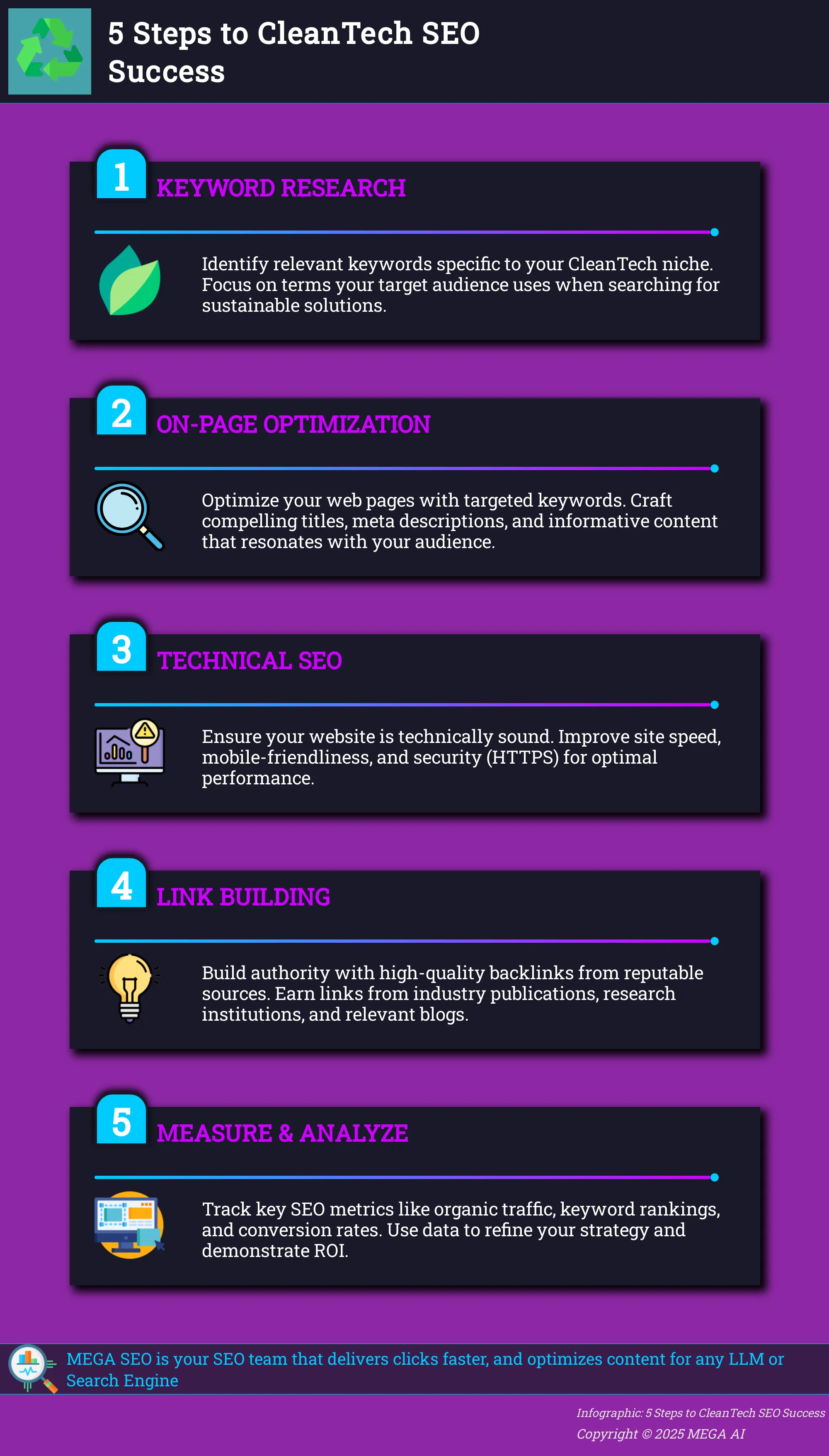
To truly make your mark in the CleanTech sector, your online presence needs to be robust and easily discoverable. This is where a well-crafted Search Engine Optimization (SEO) strategy becomes invaluable. Think of SEO as the mechanism that draws organic, or non-paid, traffic to your website. For CleanTech companies, this translates to connecting with businesses, investors, and consumers who are actively searching for sustainable solutions, innovative technologies, and green products. It’s not merely about being found; it’s about being found by the right people at the precise moment they are looking for what you offer.
Establishing your core SEO strategies correctly is fundamental. This involves understanding the terms your potential customers type into search engines, ensuring your website communicates effectively with both them and search engines, making certain your site operates smoothly and loads quickly, and building your reputation as a trusted authority in the CleanTech industry. These foundational elements work in concert to improve your rankings in search results, attract more relevant visitors, and ultimately, support the growth of your CleanTech company. Let's explore the key pillars you'll want to concentrate on to build a strong online foundation.
Find and Use the Right CleanTech Keywords
Keyword research forms the bedrock of any effective SEO plan, and it’s particularly vital in the specialized CleanTech field. The process centers on identifying the specific terms and phrases your target audience uses when looking for solutions like yours. "Effective keyword research focuses on relevance, search volume, and competition," and as SEO professionals understand, employing various tools and techniques helps pinpoint these optimal keywords. For CleanTech, these could range from general terms like "commercial solar incentives" to more specific phrases such as "bioplastic manufacturing processes" or "grid-scale energy storage solutions."
Once you've compiled a solid list of relevant keywords, you can "use keyword research to develop content ideas and to inform your content calendar and topic clusters," as Loganix outlines. This means thoughtfully incorporating these keywords into your website's content, blog articles, and product descriptions. The aim is to align with the language of your potential customers, making it simpler for them to find you via search engines. Don't overlook long-tail keywords—those longer, more specific phrases—which often face less competition and can attract highly qualified leads.
Optimize Your CleanTech Web Pages
After identifying your target keywords, the subsequent step is to optimize your individual web pages. This practice is known as on-page SEO. It involves ensuring your content is not only valuable to your audience but also clearly structured for search engines to understand. A critical aspect of this is to "refine meta descriptions and optimize titles to better capture search intent and boost CTRs [Click-Through Rates]," a crucial tactic for CleanTech growth strategies. Your page titles and meta descriptions are frequently the first elements people encounter in search results, so they must be compelling and directly relevant to the searcher's query.
Furthermore, Erica Eller highlights that "SEO blogging is one of the best strategies for renewable energy companies to use to market their products and services," and this principle applies broadly across the CleanTech sector. Consistently publishing high-quality, informative blog posts optimized with your target keywords helps attract visitors, establish your expertise, and provide fresh content for search engines to index. Consider creating content that answers common questions, explains complex CleanTech concepts in an accessible way, or showcases your company's innovations and successes.
Improve Site Performance with Technical SEO
Technical SEO provides the structural foundation for your website's capacity to rank effectively. It encompasses optimizing your site's infrastructure to assist search engine crawlers in finding, interpreting, and indexing your content more efficiently. As Gripped.io explains, "Technical SEO is crucial for improving website accessibility and search engine rankings." This means ensuring your website is easy for both users and search engine bots to navigate. A well-organized site with clear navigation allows search engines to discover all your important pages without difficulty.
A significant component of technical SEO is site speed. Users today expect web pages to load almost instantly. Slow-loading sites can result in high bounce rates and consequently, lower search rankings. Therefore, "monitoring and optimizing page load time as an SEO KPI ensure a seamless and efficient user experience," which is vital for keeping potential customers engaged, according to Global Media Insight. Other technical elements include ensuring your site is mobile-friendly, using HTTPS for security, and creating an XML sitemap. Platforms like MEGA AI can assist with automating some of these crucial technical SEO improvements.
Build Authority with CleanTech Link Building
Link building is the practice of acquiring hyperlinks from other websites to your own. You can think of these links as endorsements or votes of confidence from other sites. When reputable and relevant websites link to your CleanTech company's site, it signals to search engines that your content is valuable and trustworthy. This, in turn, can significantly enhance your search rankings. According to Intergrowth, "Building authority (through high-quality content and backlinks from reputable sites) should receive 80% of a small business's SEO effort."
The emphasis here is on quality rather than sheer quantity. As Ahrefs points out, "High-quality backlinks from authoritative websites are vital for ranking higher in search results." For CleanTech companies, this could involve earning links from industry news outlets, research institutions, government energy portals, or respected environmental blogs. Effective strategies for acquiring these valuable links include creating shareable, high-value content (such as industry reports, white papers, or detailed case studies), guest blogging on relevant publications, and fostering partnerships with other organizations within the CleanTech ecosystem.
Win Locally: Local SEO for CleanTech Businesses
For CleanTech companies, especially those involved in community-based projects like solar installations or local energy solutions, a strong local presence is vital. Local SEO helps you connect directly with customers and stakeholders in your service areas. By focusing on local search signals, you make it easier for people nearby to find your innovative solutions when they need them most. This targeted approach can significantly impact your visibility and lead generation within specific geographic regions, ensuring your sustainable technologies reach the communities that can benefit from them.
Think of local SEO as building a bridge between your CleanTech offerings and the specific towns or cities you serve. When someone in your area searches for "rooftop solar panels" or "community wind energy projects," you want your business to be among the top results. This isn't just about being found; it's about being seen as a relevant, accessible, and trusted local provider. A well-executed local SEO strategy can differentiate you from larger, non-local competitors and establish your company as an integral part of the local green economy. It’s about making sure that when your neighbors are ready to adopt cleaner technologies, your business is the first one they think of and can easily find online.
Optimize Your Google Business Profile for Local Searches
Your Google Business Profile (GBP) is a cornerstone for local visibility, particularly for CleanTech firms aiming to engage local communities for projects like wind or solar installations. Begin by claiming and verifying your profile. Then, meticulously complete every section with accurate and current information, including your business name, address, phone number, website, and operating hours. Select the most relevant categories that describe your CleanTech services. Regularly upload high-quality photos of your projects, your team, and the technology you use. Encourage satisfied customers to leave reviews, and make it a practice to respond to all feedback thoughtfully. Utilizing Google Posts to share updates, news, or local events can also keep your profile dynamic and informative.
Use Local Keywords and Content Effectively
To attract a local audience, your content needs to reflect the language they use. This starts with identifying relevant local keywords. You can conduct keyword research to discover terms people in your target areas are searching for, such as "solar panel installers [city name]" or "EV charging stations near [local landmark]". Integrate these keywords naturally into your website content, especially on service pages and any location-specific landing pages you create. Develop content that speaks directly to local interests and needs. This could include blog posts detailing successful projects within the community, case studies featuring local clients, or articles that address regional environmental concerns your CleanTech solutions can help solve. This targeted content not only helps your local search ranking but also builds trust and connection with your community.
Manage Your CleanTech Online Reputation
Your online reputation significantly influences whether local customers decide to work with your CleanTech business. Actively manage your online reviews across platforms like Google, Yelp, and industry-specific review sites. Respond professionally and promptly to all reviews, both positive and negative, to demonstrate that you value customer feedback and are committed to satisfaction. Showcase positive testimonials and detailed case studies on your website to build credibility and social proof. Beyond reviews, engage with your local community online. Consider participating in local social media groups or forums where relevant, sharing valuable information and positioning your business as a helpful local expert. Creating informative content also serves to educate potential customers and highlight your expertise, further strengthening a positive local reputation.
Content Marketing: Power Your CleanTech SEO
Content marketing is the engine that powers your CleanTech SEO efforts. Think of it as the primary way you communicate your value, build meaningful relationships, and ultimately, attract more of the right people to your website. When you consistently create and share valuable content, you’re not just providing search engines with the information they need to understand and rank your site; you’re also establishing your brand as a knowledgeable and trustworthy voice in the CleanTech space. This is particularly important in an industry where innovation, reliability, and credibility are absolutely key.
A well-thought-out content marketing approach helps you connect with your audience on a deeper level, directly addressing their specific questions and concerns about clean technology. Whether it's through insightful blog posts, detailed case studies, or engaging videos, your content serves as a vital bridge between your innovative solutions and your potential customers' pressing needs. By focusing on delivering quality and relevance, you can transform your website into an indispensable resource, drawing in organic traffic and carefully nurturing leads as they move through their decision-making journey. The following sections will explore practical ways to create content that truly resonates, establish your expertise effectively, and use different formats to keep your audience engaged and informed.
Create Content Your CleanTech Audience Loves
To genuinely connect with your audience, you first need to understand what truly matters to them. What are their most significant challenges when it comes to adopting or understanding clean technology? What specific questions are they typing into search engines like Google? A robust content marketing strategy always begins by answering these fundamental questions. It’s about much more than just producing a steady stream of articles; it’s about carefully crafting information that genuinely helps and interests your specific audience segments, whether they are homeowners considering solar panel installations, businesses looking for effective energy efficiency solutions, or investors actively scouting the next groundbreaking innovation in the sector.
SEO blogging, for example, stands out as a highly effective method for renewable energy companies to market their offerings and educate potential customers. By focusing on topics your audience is actively searching for, you can draw them to your site organically. This means dedicating time to identify relevant keywords and then building content around them that is not only informative and accurate but also engaging and easy to understand. This thoughtful approach helps build lasting trust and positions your brand as a helpful, go-to authority in the competitive CleanTech field.
Develop Educational Resources and Thought Leadership
In the rapidly evolving CleanTech sector, knowledge is a powerful currency. By creating valuable and informative content, you achieve more than just attracting visitors to your site; you actively educate potential customers and effectively showcase your deep expertise. Consider developing comprehensive white papers that explore complex technological advancements, hosting webinars that clearly explain the benefits of new green solutions, or publishing in-depth guides that help consumers or businesses make informed CleanTech choices. This type of educational content is essential for building genuine demand for new and exciting clean energy opportunities.
Establishing thought leadership means consistently providing insights that go beyond basic explanations or surface-level commentary. Share your unique perspectives on current industry trends, offer practical solutions to common challenges faced by your audience, or present data-backed analyses that highlight your understanding of the market. When you publish content that positions your company as a forward-thinker and a reliable source of cutting-edge information, you build significant credibility and trust. This not only aids your SEO efforts by attracting valuable links and social shares but also makes your brand the one people naturally turn to when they're ready to learn more or make a significant investment.
Use Multimedia to Improve Engagement
While well-written content like blog posts and articles forms the foundation of your strategy, incorporating multimedia elements can significantly enhance user engagement and make complex CleanTech topics much more digestible and approachable. Think about how compelling case studies can vividly demonstrate the real-world impact and benefits of your solutions, or how well-designed infographics can simplify intricate data sets into easily understandable visuals. Clear and concise technology and vendor comparisons can also be incredibly valuable for users who are trying to make informed decisions in a crowded marketplace. These varied formats cater to different learning preferences and can effectively keep visitors on your site longer, increasing their interaction with your brand.
As CleanTech companies strive to produce a greater volume and variety of content, many are exploring efficient ways to scale their creation efforts. Generative AI, for instance, has emerged as a useful tool that can assist in drafting initial content outlines or repurposing existing materials into different formats. Platforms like MEGA AI can help streamline content generation and optimization, allowing your team to focus more on refining the core message and ensuring the technical accuracy of every piece. By strategically using a mix of text, high-quality images, informative videos, and interactive elements, you can create a richer, more engaging, and ultimately more effective online experience for your CleanTech audience.
Measure and Analyze Your CleanTech SEO Performance
With your CleanTech SEO strategies active, measuring their impact is the next crucial step. Analyzing performance helps refine your approach, demonstrate value, and make data-driven decisions. Here’s how to effectively track and analyze your CleanTech SEO results.
Track Key CleanTech SEO Metrics (KPIs)
To truly understand your SEO success, you need to focus on Key Performance Indicators (KPIs). These are specific metrics directly linked to your business objectives, guiding your strategic decisions. For CleanTech companies, crucial KPIs often include organic traffic, which tells you how many people find your site via search engines. Another is Click-Through Rate (CTR), measuring how often searchers click your listing after seeing it.
Beyond these, monitor keyword rankings for your targeted CleanTech terms, conversion rates (like demo requests or whitepaper downloads), and bounce rate. While many metrics exist, remember that the most effective KPIs are situational and should align with your unique CleanTech business goals. Regularly reviewing these indicators will help you see what’s working and where adjustments are needed.
Tools and Methods for Tracking SEO Results
To effectively track your KPIs, utilize the right tools and maintain consistent methods. Google Analytics is essential for insights into website traffic and user behavior. Alongside it, Google Search Console provides data on how search engines interact with your site, highlighting search queries and potential issues. For more integrated solutions, platforms like MEGA AI offer automated SEO tools that can track keyword rankings and assist in optimizing metrics such as CTR.
Beyond specific tools, establish a consistent tracking rhythm. Regular reporting, perhaps monthly, helps in reviewing your chosen KPIs. Custom dashboards can further aid in visualizing progress. This systematic approach to tracking allows you to make informed decisions, continuously refining your SEO strategy to enhance your CleanTech company's online presence.
Show the ROI of Your SEO Work
Your SEO efforts should demonstrably contribute to your CleanTech company's financial goals. Showing the Return on Investment (ROI) from SEO is vital for securing continued support. Connect your SEO KPIs directly to tangible business outcomes, like qualified leads generated, new customers acquired via organic search, or reduced customer acquisition costs. For example, optimizing user experience factors such as page load speed can directly improve conversion rates and, consequently, revenue.
Calculating ROI involves comparing the value derived from organic search—such as the monetary value of new leads—against your SEO investment. Clearly presenting this data to stakeholders illustrates SEO’s role as a growth driver, not merely an expense. This justification is essential for strategic planning in the CleanTech sector.
Address Common CleanTech SEO Challenges
Working in CleanTech means you're at the forefront of innovation, but it also comes with its own set of marketing puzzles, especially when it comes to search engine optimization. You're not just up against typical SEO hurdles; the CleanTech industry has specific factors that can make things a bit more complex. The good news is that these challenges are entirely manageable with a thoughtful approach. Understanding these specific obstacles allows you to build a strong SEO strategy that helps your CleanTech business connect with the right audience and grow effectively.
Handle Industry-Specific SEO Hurdles
CleanTech companies often find themselves in a unique position. As the "demand for cleaner and more efficient solutions continues to rise," your business is part of a growing and vital sector. However, this also means you must "navigate a competitive landscape that often includes established fossil fuel interests." To make your mark, your SEO strategy needs to be precise. Focus on clearly communicating what makes your CleanTech solutions distinct and superior. Highlight your innovations and the real-world benefits they deliver. Consider the specific problems your ideal customers are trying to solve, and tailor your keywords and content to directly address those needs. This targeted method will help you attract individuals actively searching for what you offer.
Adapt to Search Engine Algorithm Updates
Search engine algorithms are constantly being refined. Google, for example, frequently updates its systems to provide better search results. While this might seem like a moving target, "staying informed and adaptable is crucial for marketers in the CleanTech space to turn potential challenges into competitive advantages." Instead of viewing these updates as obstacles, consider them opportunities to sharpen your strategy. Keep up with reputable SEO news and official announcements from search engines. For CleanTech businesses looking to stay ahead, tools like MEGA AI's Maintenance Agent can be particularly useful. This feature can automatically identify areas for content improvement and re-optimize existing articles, helping ensure your content remains effective even as algorithms change.
Balance Technical Details with User-Friendly Content
CleanTech innovations often involve complex technology and scientific principles. A key challenge is conveying these technical aspects in a manner that is both accessible and engaging for a wider audience, not just industry specialists. "Creating valuable and informative content is essential for cleantech companies looking to establish authority and build trust." To do this effectively, concentrate on the "why it matters" and "how it helps" rather than just the technical specifications. Use clear language, relatable analogies, and visuals to explain complex ideas. Break down intricate topics into smaller, more digestible pieces. Your aim is to educate your audience and demonstrate the value of your solutions without causing confusion with excessive jargon.
Advanced SEO: Take Your CleanTech Site Further
Once you've established a solid foundation with core SEO practices, you can explore more advanced techniques to give your CleanTech website an additional edge. These strategies are designed to help you connect with a broader audience and refine how search engines understand and rank your valuable content, ultimately driving more qualified traffic to your site.
Optimize for CleanTech Voice Searches
The way people search for information is constantly evolving, and voice search is a significant part of this transformation. As the CleanTech Growth Lab points out, "Voice search is becoming increasingly popular, and optimizing for it involves using natural language and question-based keywords that reflect how people speak." For your CleanTech business, this means considering the actual questions potential customers might ask their smart speakers or phones. Think about queries like, "What are the long-term savings of installing heat pumps?" or "How can my business transition to renewable energy sources?"
To effectively optimize for voice search, concentrate on long-tail keywords and conversational phrases. Structuring some of your content in a question-and-answer format, perhaps through a dedicated FAQ page or by using clear headings that pose common questions, can be very effective. This approach not only caters to voice search queries but also enhances the overall user-friendliness and accessibility of your content.
Use Schema Markup for Better Visibility
Schema markup is a powerful, yet often underutilized, tool that helps search engines gain a deeper understanding of the content on your CleanTech website. It's essentially a standardized vocabulary of tags, or microdata, that you can add to your site's HTML to provide rich context. As Search Engine Journal highlights, "Implementing schema markup can enhance your website's visibility in search results by providing search engines with more context about your content." This structured data can lead to "rich snippets"—more detailed and visually appealing listings in search results, which might include information like product ratings, event dates, or article summaries.
For a CleanTech company, you can use schema.org vocabulary for various content types, such as 'Product' for your innovative technologies, 'Article' for your insightful blog posts and educational resources, or 'Organization' to detail your company information. Correctly implementing schema can significantly improve your click-through rates from search results because your listings will stand out and offer more immediate value to users.
Ensure Your CleanTech Site is Mobile-Friendly
In today's digital environment, a substantial portion of web traffic originates from mobile devices. Consequently, ensuring your CleanTech site is mobile-friendly is not just a recommendation; it's a fundamental aspect of modern SEO. Search engines like Google explicitly prioritize mobile usability in their ranking algorithms. According to Global Media Insight, "A mobile-friendly website is crucial for SEO success...Ensuring your site is responsive and loads quickly on mobile devices can significantly improve user experience and search rankings."
This means your website must adapt seamlessly to various screen sizes, load swiftly on mobile networks, and be easy to navigate using a smaller touch interface. You can test your site's mobile-friendliness with tools provided by Google. Focus on implementing a responsive design, optimizing images for faster load times, and ensuring that text is legible without requiring users to zoom. A positive mobile experience keeps users engaged and signals to search engines that your site provides high value.
Create Your Comprehensive CleanTech SEO Strategy
Building a strong online presence for your CleanTech company starts with a solid SEO strategy. It’s about connecting with the right audience and showing them how your innovations shape a greener future. Think of your SEO strategy as the blueprint for your digital growth. Let's walk through how to create a plan that truly works for your CleanTech business.
Align SEO with Your Overall Marketing Objectives
Your SEO efforts shouldn't exist in a vacuum. They need to be a core part of your broader digital marketing strategies, working with your social media, email, and paid advertising. When SEO aligns with your marketing goals, every piece of content and keyword contributes to a unified message. For instance, if your company aims to lead in residential solar, your SEO should focus on content and keywords that establish this expertise.
This alignment helps your company become a knowledgeable expert. By consistently promoting relevant content that answers audience questions, you build trust. This makes it easier for potential customers to find you as their go-to CleanTech resource. Platforms like MEGA AI can assist by automating keyword research, ensuring your SEO activities directly support your marketing objectives.
Develop a Sustainable, Long-Term SEO Plan
SEO is more of a marathon than a sprint. Real value comes from a sustainable, long-term plan that consistently builds your online authority. Your keyword research should be thorough, focusing on relevant terms with good search volume and manageable competition. It's about finding that sweet spot to rank and attract qualified traffic.
Remember, SEO is a long-term investment yielding lasting results. Your keyword strategy must evolve with your business and market trends. Regularly refining keywords keeps you relevant. Tools offering ongoing content optimization, like MEGA AI’s Maintenance Agent, help update articles and keep content fresh. This long-view commitment pays off in consistent organic traffic.
Tailor Strategies for Different CleanTech Niches
The CleanTech sector is diverse, from solar power to sustainable agriculture. A one-size-fits-all SEO strategy won’t work. To connect with your audience, tailor your approach to your specific niche. This means understanding the unique challenges, interests, and language of your target customers in that segment.
A robust content marketing strategy is vital for establishing authority, especially in specialized fields. For example, if you're in EV charging, your content should cover installation and network compatibility. While CleanTech has been slower to adopt SEO, its importance is growing. Targeted content helps you effectively reach and engage customers actively searching for your solutions.
Helpful CleanTech SEO Tools and Resources
Navigating SEO can feel complex, but thankfully, excellent tools and resources exist, especially for the CleanTech sector. The right support significantly impacts how effectively you improve your online presence. Let's explore options to streamline your efforts and stay informed.
Top SEO Platforms for CleanTech Businesses
Choosing the right SEO platform provides a solid foundation. These tools offer functionalities from keyword research to site audits, helping you make data-driven decisions for your CleanTech business.
MEGA AI
MEGA AI offers automated keyword research and content generation, ideal for CleanTech companies to improve online visibility and target niche markets by finding low-competition keywords.
SEMrush
SEMrush provides comprehensive insights for keyword research, site audits, and competitive analysis, essential for CleanTech companies to optimize SEO strategies.
Ahrefs
Ahrefs excels in backlink analysis, keyword research, and content exploration, vital for CleanTech businesses aiming to improve search rankings.
Moz
Moz’s suite helps track rankings, analyze competitors, and optimize websites, improving visibility for your CleanTech solutions in search results.
Google Search Console
This free Google tool helps monitor site performance in search results, offering insights into indexing and traffic-driving search queries.
Find CleanTech Industry Resources and Communities
Beyond general SEO tools, connecting with CleanTech-specific resources and communities provides invaluable context. Understanding your industry's unique aspects is key for creating content that truly resonates with your target audience. Actively engaging with industry forums, publications, and professional groups helps you stay informed about the latest trends, common challenges, and emerging opportunities. Since effective digital marketing strategies, including robust SEO, are vital for CleanTech companies looking to promote their innovative solutions, these specialized communities can offer highly relevant advice and valuable networking connections to help you reach a wider audience.
Keep Up with CleanTech SEO Trends and Updates
The digital landscape, and SEO in particular, is always evolving, so staying current is key for CleanTech companies. This means keeping an eye on general SEO best practices, search engine algorithm updates, and emerging technologies that can impact your strategy. For instance, as CleanTech companies aim to produce more content, some have started to explore Generative AI for faster content creation. By understanding these trends, you can adapt your strategies proactively, ensure your content remains effective, and continue to connect with your audience in meaningful ways.
Related Articles
- SEO for Tech Startups: Drive Growth in 2024
- SEO Strategies for Startups to Boost Growth Quickly
- Top 9 SEO Challenges & Solutions for 2024
- SEO Content for Startups: A Growth Guide (2024)
- How to Do SEO for Tech Support: Drive More Leads
Frequently Asked Questions
I'm just starting with SEO for my CleanTech company. What's the most important first step? The most important first step is to thoroughly understand what terms your potential customers are actually searching for. This involves keyword research specific to your CleanTech niche. Think about the problems your solutions solve and the language your audience uses to find those solutions. This foundation will guide all your subsequent content and optimization efforts.
Is SEO for a CleanTech business really that different from other industries? While core SEO principles apply across the board, CleanTech SEO has unique considerations. You're often dealing with innovative, sometimes complex, technologies that require clear explanation. You might also be targeting very specific audiences, from environmentally conscious consumers to industrial partners or investors. Highlighting your unique value proposition and building trust are particularly crucial in this sector.
How quickly can I expect to see results from my CleanTech SEO efforts? SEO is a long-term strategy, not an overnight fix. While some minor improvements might be visible sooner, significant results like increased organic traffic and higher rankings typically take several months of consistent effort. Factors like your website's current authority, the competitiveness of your keywords, and the quality of your ongoing SEO work all play a role.
Our CleanTech solutions are quite technical. How do we explain them for SEO without losing accuracy? This is a common challenge. The key is to balance technical accuracy with user-friendly language. Focus on the benefits and real-world applications of your technology. You can create detailed resources for those who want a deeper dive, but ensure your primary web pages and blog content explain complex concepts clearly, using analogies or visuals where helpful. Think about addressing the "why it matters" before the "how it works."
Should I focus more on creating brand new content or improving the SEO of my existing CleanTech web pages? Both are important, but a good approach often involves starting with what you have. Optimizing your existing pages—improving titles, meta descriptions, internal linking, and ensuring content aligns with target keywords—can yield quicker wins. Simultaneously, develop a plan for creating new, high-quality content that addresses audience needs and targets additional relevant keywords to expand your reach over time.