
Groundbreaking science isn't enough to guarantee success if it remains undiscovered. In the crowded biotech field, numerous firms are competing for the same funding, partnerships, and talent. Your ability to be found online is a significant competitive advantage. A well-executed strategy for SEO for biotech makes your research, products, and data more accessible than your competitors'. It ensures that when a potential partner evaluates their options, your organization is the one that appears first with clear, authoritative information. This guide will walk you through the essential steps to improve your online visibility and establish your company as a leader in its niche.
Key Takeaways
- Speak Your Audience’s Language: Effective biotech SEO relies on using the precise scientific terminology your target audience—from researchers to investors—uses daily. This ensures you attract highly qualified traffic instead of a general audience.
- Build Trust Through Credibility and Compliance: Establish your firm as an authority by earning backlinks from respected scientific sources and ensuring all online content is rigorously reviewed to meet strict regulatory standards. In biotech, your digital reputation is paramount.
- Combine a Strong Technical Foundation with Expert Content: Your website must be fast, mobile-friendly, and easy to use to support your high-value content. This combination ensures that your white papers, clinical data, and case studies are accessible to your audience and properly valued by search engines.
What is SEO for Biotech Companies?
SEO, or Search Engine Optimization, is the process of making your website more visible in search engine results on platforms like Google. For a biotech company, this isn't just about general visibility. It's about strategically showing up when the right people—like researchers, investors, clinicians, or potential partners—are searching for the specific solutions, technologies, or data you provide. Think of it as the digital equivalent of being published in a top-tier journal, but for a much broader and more commercially focused audience.
SEO is a fundamental part of any modern digital marketing strategy, especially in a specialized field. Since most people use search engines to find information and research companies, a strong online presence is non-negotiable. For biotech firms, SEO helps bridge the gap between your complex scientific work and the audiences that need to find it. It ensures that when someone searches for a specific gene therapy, diagnostic tool, or research chemical, your company is one of the first they see, building credibility and driving qualified traffic to your site.
The process of SEO involves several key activities working together. While we'll cover these in more detail later, the main components include:
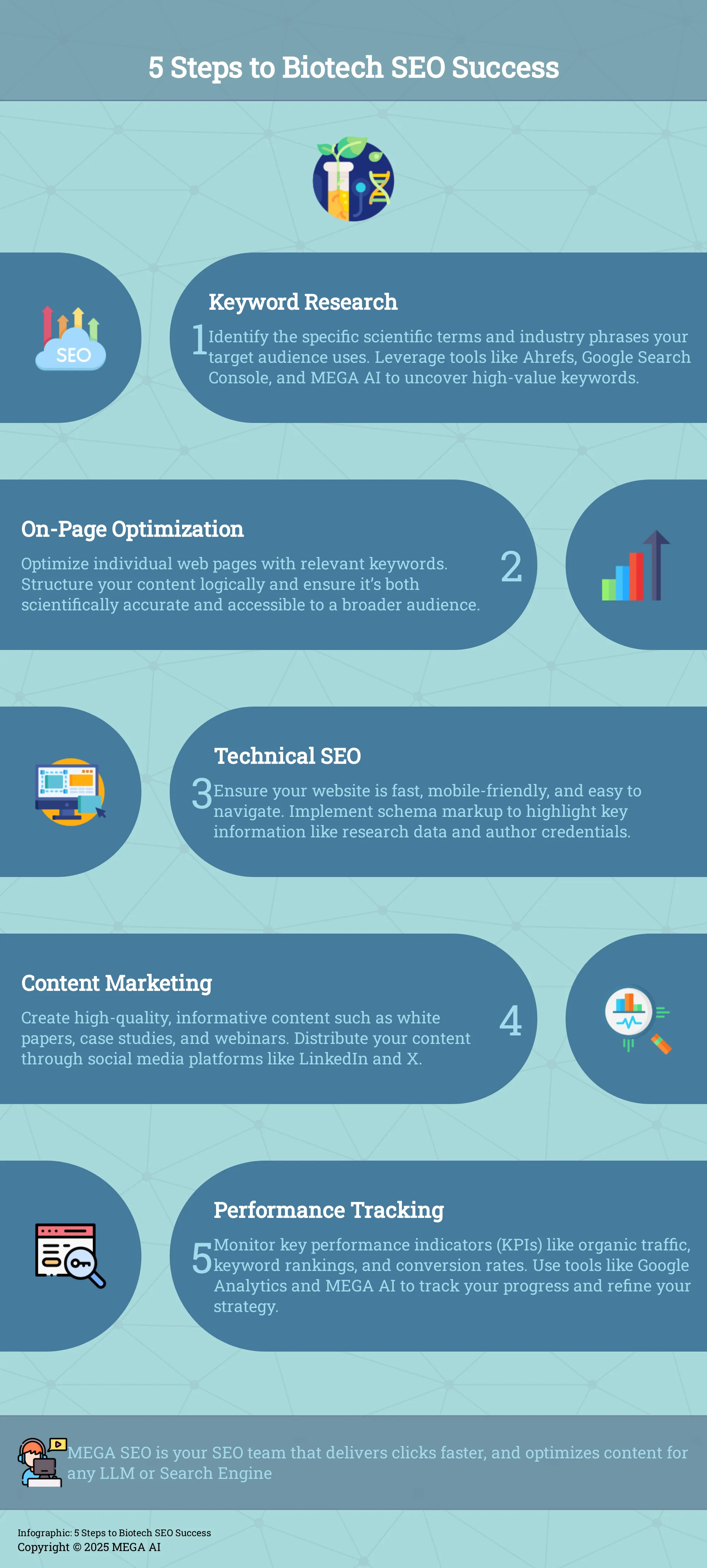
- Keyword Research: Identifying the specific terms and phrases your target audience uses to search.
- On-Page SEO: Optimizing individual web pages, including content and HTML source code, to rank higher.
- Technical SEO: Ensuring your website's technical foundation is solid so search engines can crawl and index it effectively. This includes things like site speed and mobile-friendliness.
- Content Strategy: Creating and distributing valuable, relevant content to attract and engage your audience. A good content strategy is the backbone of any successful SEO effort.
In the competitive biotech landscape, SEO offers a significant advantage. It allows you to stand out efficiently in a market filled with highly specialized players. A well-executed SEO strategy does more than just bring visitors to your site; it establishes your company as an authority in its niche. By consistently appearing in top search results for critical industry terms, you build trust and brand recognition, which can directly influence partnerships, funding opportunities, and sales cycles. It’s a long-term investment in your company's digital growth and market position.
Why is SEO Important for Biotech Firms?
In an industry built on complex science and trust, your digital presence is often the first point of contact for investors, partners, and clinical researchers. Search engine optimization (SEO) is the foundation of that presence. When your firm ranks highly in search results, it does more than just make you visible; it builds credibility. A strong online visibility acts as a digital handshake, signaling to your specialized audience that your organization is a knowledgeable and authoritative player in the field. This initial impression is critical for establishing the trust needed to build meaningful business relationships.
Biotech companies serve a highly specific audience. You might be trying to reach a researcher looking for a particular cell line, a physician investigating new therapeutic options, or an investor searching for the next industry breakthrough. These individuals search with purpose, using precise terminology. Since the vast majority of professionals use search engines to find companies and products, a targeted SEO strategy ensures you appear for the exact scientific and medical queries your audience uses. It allows you to connect directly with the people who are actively seeking the solutions you provide.
The biotech landscape is also intensely competitive, with numerous firms often pursuing similar research or developing comparable technologies. In this context, discoverability provides a significant advantage. A well-executed SEO strategy can help you increase market share simply by making your company’s research, data, and product information more accessible than your competitors'. When a potential partner is evaluating their options, the firm that offers clear, authoritative, and easy-to-find content online will almost always have the upper hand.
Compared to traditional marketing channels like attending major conferences or advertising in scientific journals, SEO offers a more cost-effective and sustainable approach to building awareness. By investing in quality content and technical site health, you create a durable digital asset that consistently attracts organic traffic and qualified leads over time. Managing the technical details of this process can be complex, which is why many firms rely on an end-to-end SEO platform to automate keyword research, content optimization, and performance tracking.
Key SEO Strategies for Biotech Companies
A successful biotech SEO plan requires a thoughtful, multi-layered approach. It’s not just about using the right keywords; it’s about building a credible, authoritative online presence that resonates with a diverse and highly educated audience of scientists, investors, partners, and patients. Your strategy needs to be precise enough to attract niche experts while also being clear enough for stakeholders who may not have a deep scientific background.
To achieve this, you need to focus on several key areas at once. This includes leveraging specific scientific language, ensuring every piece of content adheres to strict industry regulations, and building a strong backlink profile from reputable sources. At the same time, you must consider the user experience, making your site accessible and easy to use for everyone. Balancing these elements is the core challenge and opportunity in biotech SEO. By implementing the following strategies, you can create a powerful digital footprint that drives growth and establishes your firm as a leader in its field.
Optimize for Local Searches
While biotech is a global industry, local connections are incredibly important. Your company likely has physical offices, labs, or clinical trial sites that are relevant to partners, talent, and even local investors. Optimizing for local search helps you appear in results for users in your geographic area. Start by creating and fully optimizing a Google Business Profile for each of your locations. Include your address, phone number, hours, and photos. Encourage reviews from partners and collaborators. Incorporating location-specific keywords, like "gene therapy research in San Diego," into your website content can also attract relevant local traffic and solidify your presence within a specific biotech hub.
Leverage Scientific Terminology
Your audience uses precise language, and your SEO strategy should reflect that. Generic keywords won't attract the right experts. Instead, focus on the specific scientific terms, drug names, research methodologies, and industry phrases that your target audience uses in their own work. Using the correct terminology is vital for establishing credibility and ensuring your content is discovered by the scientists, researchers, and clinicians who need it. Tools that offer automated keyword research can help you uncover these high-value, niche terms and integrate them naturally into your website content, from service pages to blog posts and white papers. This precision ensures you attract highly qualified traffic.
Ensure Compliance with Industry Regulations
The biotech and pharmaceutical industries are governed by strict regulations regarding marketing and health claims. All of your online content must comply with guidelines from bodies like the Food and Drug Administration (FDA). Making unapproved claims about a product's efficacy or intended use can lead to serious legal penalties and damage your company's reputation. Before publishing any content, have it reviewed by your legal and regulatory teams. This includes website copy, blog posts, press releases, and even social media updates. Maintaining compliance in your advertising is non-negotiable and should be a core part of your content workflow.
Build High-Quality Backlinks
Backlinks—links from other websites to yours—are a powerful signal to search engines that your site is credible and authoritative. In biotech, quality trumps quantity. A single link from a respected scientific journal, university research page, or major industry news outlet is far more valuable than dozens of links from low-quality directories. Focus on earning these links organically through digital PR and content creation. Publish original research, create compelling data visualizations, or write expert-level white papers that others in your field will want to cite and share. This approach not only improves your search rankings but also builds your brand's authority.
Balance Technical Content with Accessibility
Your website needs to serve multiple audiences simultaneously. A research scientist will be looking for deep technical data, while an investor or potential patient may need a high-level overview. Your challenge is to cater to both without alienating either. Structure your content to provide layers of information. Start with a clear, concise summary, then allow users to dig deeper into technical specifications, data, and citations. Use visuals, glossaries, and clear navigation to make complex information more digestible. Furthermore, ensure your website is accessible to people with disabilities by following Web Content Accessibility Guidelines (WCAG). An accessible site provides a better experience for everyone and broadens your reach.
How to Find and Use the Right Keywords
Keyword research is the foundation of a successful SEO strategy. It’s about understanding the language your audience uses and aligning your content with their needs. For biotech companies, this means digging into scientific terms, industry-specific phrases, and the questions your potential clients or partners are asking. Getting this right ensures that the right people find you at the right time.
Tools for Biotech Keyword Research
To find the terms your audience is searching for, you need the right set of tools. Platforms like Ahrefs are excellent for analyzing competitors and discovering the keywords that drive traffic to their sites. You should also get familiar with your own data. Google Search Console is a free tool that shows you which queries already bring users to your website, giving you a baseline to work from. Regularly tracking your performance helps you see what’s working and where you need to adjust. For a more streamlined approach, MEGA AI’s SEO platform automates keyword research, saving you time while uncovering high-value opportunities specific to the biotech field.
Align Keywords with Your Products and Services
Once you have a list of potential keywords, the next step is to ensure they connect to your business goals. It’s vital to use the right keywords—including scientific terms and the solutions your audience seeks—throughout your website. Think about searcher intent. Is a researcher looking for a specific protein, or is an investor looking for information on your latest clinical trial? Each audience uses different language. You should map keywords to specific pages on your site, ensuring product pages target commercial-intent terms while blog posts answer informational questions. This alignment makes your content more relevant to users and search engines.
Balance Technical Jargon with Readability
The biotech industry is full of complex, technical language. While you need precise terminology to establish authority, you also need to make your content understandable. The good news is that the specific nature of biotech often means keyword difficulty is lower than in other industries. The key is to create high-quality content that addresses user needs without alienating readers who may not have a PhD. Consider creating a glossary or using parenthetical definitions for complex terms. This approach helps you create content that is both scientifically accurate and accessible, satisfying experts and newcomers alike.
Best Practices for Optimizing Your Biotech Website
Beyond creating great content, the technical health of your website is the foundation of your SEO success. A well-structured, fast, and accessible site makes it easier for both search engines and potential customers to find and understand your work. Focusing on these technical best practices ensures that your content has the best possible chance to rank and convert.
Improve Site Structure and Navigation
A logical website structure is essential for a good user experience and for search engine crawlers. Think of it as creating a clear map of your site. You should organize your content in a way that makes intuitive sense, using your keyword research to guide the names of your menu items and pages. Prioritize your most important pages, like those detailing products, services, or research, by making them easy to find from your main navigation. A clear hierarchy not only helps users find what they need quickly but also helps search engines understand which pages you consider most valuable. This strategic organization can directly influence how easily your key offerings are discovered.
Enhance Mobile Responsiveness
More than half of all internet traffic now comes from mobile devices, so a mobile-friendly website is no longer optional. Your site must function perfectly and look great on any screen, from a desktop monitor to a smartphone. Search engines like Google prioritize mobile-friendly sites in their rankings. A poor mobile experience can lead to high bounce rates and signal to search engines that your site isn't user-friendly. You can use various online tools to test your site’s responsiveness and ensure you’re providing a seamless experience for every visitor, regardless of their device. This is a fundamental step in meeting modern user expectations.
Optimize Page Load Speed
Website speed is a critical ranking factor. A slow-loading site frustrates visitors and can cause them to leave before your content even appears. This high bounce rate can negatively impact your search rankings. Your goal should be to have your pages load as quickly as possible. You can use tools to analyze your site's performance and see how it compares to competitors. Simple fixes like compressing images and leveraging browser caching can make a significant difference. Improving your page load speed creates a better user experience and sends positive signals to search engines about the quality of your site.
Implement Schema Markup for Scientific Content
Schema markup, or structured data, is code you add to your website to help search engines better understand your content. For biotech companies, this is a powerful tool. By implementing schema markup, you can highlight specific information like scientific studies, research data, and author credentials directly in the search results. This can lead to more informative and eye-catching listings, known as rich snippets, which can improve your click-through rate. While it sounds technical, adding structured data is a straightforward way to give your specialized content more visibility and authority in search.
Leverage Content Marketing for Biotech SEO
Content marketing is the engine of any successful biotech SEO strategy. It’s how you demonstrate your expertise, build trust with a highly discerning audience, and give search engines the signals they need to rank your site. For biotech companies, this goes beyond simple blog posts. Your content must educate researchers, inform investors, and comply with strict industry standards, all while being discoverable through search.
A thoughtful content strategy allows you to connect with different segments of your audience at each stage of their journey. Whether a scientist is looking for data on a new molecule or a healthcare provider is researching a new therapy, your content should be there to provide clear, accurate answers. By consistently publishing valuable information, you create a library of assets that attract high-quality backlinks, drive qualified traffic, and establish your organization as a leader in its field. This foundation is critical for long-term growth and visibility in a competitive digital landscape.
Create High-Quality, Informative Content
In the biotech industry, the quality and accuracy of your content are non-negotiable. Your audience consists of experts who demand precision, so every piece of content must be well-researched, factually correct, and helpful. Think of your content as a direct reflection of your company's scientific rigor. It should aim to answer the specific questions your target audience is typing into search engines, from complex technical queries to broader industry inquiries.
To achieve this, focus on creating content that is not only accurate but also presented on a fast, mobile-friendly, and easy-to-use website. This ensures a positive user experience, which is a key ranking factor. While your internal experts should always have the final say, tools that help with content generation can provide a solid starting point, allowing your team to focus on refining and verifying information.
Identify Content Types that Drive Organic Traffic
To effectively reach your audience, you need to move beyond standard blog articles. The right content format depends on your topic and your target reader. For biotech, some of the most effective content types include detailed white papers, summaries of clinical trial results, in-depth case studies, and comprehensive guides on specific technologies or therapeutic areas. These formats allow you to address user needs in a way that aligns with your business goals.
Consider creating explainer videos to simplify complex processes or hosting webinars with your lead scientists. Each piece of content should be a valuable asset that can attract organic traffic and generate leads. By diversifying your content portfolio, you can appeal to different learning styles and search intents, whether your audience is looking for a quick overview or a deep technical analysis.
Establish Authority in the Biotech Space
Trust is the most valuable currency in biotech. Your SEO strategy must actively work to build it. This is where establishing your Experience, Expertise, Authoritativeness, and Trustworthiness (E-E-A-T) comes into play. You can do this by consistently publishing content that showcases your organization's deep knowledge and unique contributions to the field.
One of the most effective ways to do this is by using social proof. Showcasing positive experiences through testimonials and detailed case studies demonstrates the real-world impact of your work. You can also feature profiles of your key scientists, publish original research findings, and create content around your participation in industry events. Every piece of content that highlights your expertise helps solidify your authority with both potential customers and search engines.
Use Social Media for Content Distribution
Creating exceptional content is just the first step; you also need to ensure it reaches the right people. Social media is an essential tool for distributing your content and amplifying its impact. Platforms like LinkedIn are ideal for connecting with investors, partners, and professionals, while X (formerly Twitter) is excellent for engaging with the broader scientific community and sharing timely updates.
Using social media helps your biotech firm reach broader audiences and build meaningful relationships. Share your latest white paper, a video of your CEO speaking at a conference, or a link to a new case study. This not only drives traffic back to your website but also generates social signals that can indirectly support your SEO efforts. To streamline this process, you can use tools that help you manage and optimize content across multiple Paid Ads platforms at once.
How to Measure SEO Success in Biotech
Launching an SEO strategy without a way to measure its impact is like running a clinical trial without collecting data. You need to know what’s working, what isn’t, and where to focus your resources. For biotech companies, success isn’t just about traffic volume; it’s about attracting the right audience of researchers, investors, and potential partners. Tracking the right metrics helps you demonstrate ROI and make informed decisions to refine your approach over time. It allows you to connect your digital marketing efforts directly to business objectives, whether that’s generating leads for a new therapy or building authority in a specific research area.
Key Performance Indicators (KPIs) to Track
To understand your SEO performance, you need to look beyond basic traffic numbers. Focus on KPIs that reflect audience quality and engagement. Start with organic traffic, but quickly move to metrics like keyword rankings for your core scientific terms. Pay close attention to engagement metrics; a high time-on-page suggests your complex, technical content is resonating with the right experts. Most importantly, track conversion rates. A conversion in biotech might be a whitepaper download, a request for a product demo, or a contact form submission from a potential partner. These actions show that your SEO efforts are not just attracting visitors but are turning them into valuable leads.
Tools to Monitor SEO Performance
A solid toolkit is essential for tracking your KPIs effectively. Google Search Console is a foundational tool that shows you which queries bring users to your site and how your pages perform in search results. Google Analytics helps you understand user behavior and track the conversions you’ve defined. For a more automated approach, platforms like MEGA AI can simplify this process. Our SEO tools monitor your keyword rankings and can even update your existing articles to improve click-through rates from search results. Using a comprehensive platform saves time and provides a clearer picture of your overall performance without needing to switch between multiple dashboards.
Analyze Competitor SEO Strategies
Understanding what your competitors are doing can reveal valuable opportunities. Look at the keywords they rank for and the type of content they produce. Are they publishing research papers, case studies, or webinars? This can give you ideas for your own content calendar. Pay attention to technical details, too. For example, many top biotech firms use schema markup to highlight research credentials and clinical trial information directly in search results. Analyzing how competitors structure their sites and build authority can help you identify gaps in their strategy that you can fill, allowing you to capture a valuable share of the market.
Overcome Common SEO Challenges in Biotech
The biotech industry faces a unique set of SEO hurdles, from complex subject matter to strict regulations. Addressing these challenges head-on is key to building a strong online presence that connects with investors, researchers, and potential partners. By understanding these specific obstacles, you can develop a more resilient and effective SEO strategy for your firm.
Stay Updated with Algorithm Changes
SEO is not a set-it-and-forget-it activity. Search engine algorithms are constantly evolving, which means the tactics that work today might be less effective tomorrow. Staying informed about these updates is essential for maintaining and improving your search rankings over time. Manually tracking every change and adjusting your strategy accordingly can feel like a full-time job. This is where automation can be a significant advantage, allowing you to re-optimize existing content to align with new algorithm requirements without constant manual effort. This ensures your content remains relevant and visible, protecting your investment in SEO.
Compete in a Niche Market
The biotech field is highly specialized, which can make competition feel intense. However, this niche focus is also an SEO advantage. It allows you to stand out in a specialised market by targeting very specific keywords and creating high-quality, specialized content. Instead of trying to attract a broad audience, your goal is to reach the right audience—be it researchers, clinicians, or investors. An effective SEO strategy helps improve your visibility within this specialized market. By focusing on the precise terminology your target audience uses, you can attract highly qualified traffic and position your company as a leader in its specific area of expertise.
Manage Regulatory Compliance in Your Content
Biotech and pharmaceutical marketing is governed by strict rules about what you can and cannot claim. This means every piece of content, from a blog post to a product page, must be medically accurate and compliant with industry regulations. This creates a difficult balancing act: you need to provide valuable, compelling information while adhering to legal and ethical standards. Maintaining a positive online reputation is crucial, and any misstep can have serious consequences. While AI tools can assist in drafting content, having a thorough human review process is non-negotiable to ensure regulatory compliance and maintain your company’s credibility.
SEO Tools and Services for Biotech Companies
Choosing the right SEO tools can streamline your strategy and provide the data you need to make informed decisions. In a specialized field like biotechnology, having software that can handle technical terminology and complex market analysis is key. The right platform helps you find keyword opportunities, analyze competitors, and track your performance without requiring a dedicated team of SEO experts. These tools range from comprehensive suites that cover every aspect of SEO to specialized platforms that excel in one particular area. For a biotech firm, this means you can find a solution that fits your specific needs, whether you're looking to dominate a niche scientific topic or build a broad content strategy that appeals to investors and researchers alike.
A good toolset will not only provide data but also offer actionable insights, helping you understand where to focus your efforts for the greatest impact. From uncovering the exact phrases scientists use in their research to monitoring your site's health, these platforms are essential for competing in the digital space. Below, we'll look at some of the top SEO tools and services that can help your biotech company improve its online presence and achieve its growth objectives.
MEGA AI
For biotech companies, finding the right scientific terms and industry phrases to target is a major challenge. MEGA AI is designed to simplify this process. Its automated keyword research is crucial for identifying the specific terms your audience uses, helping you discover low-competition keywords and gaps in your competitors' strategies. This is particularly useful in the niche biotech industry where precision is everything. Beyond research, MEGA AI also automates content creation and optimization, ensuring your articles are always up-to-date with the latest information and search engine standards. This end-to-end automation allows you to focus on your core research and business operations while your SEO runs efficiently in the background.
SEMrush
SEMrush is a comprehensive SEO tool that acts as an all-in-one platform for digital marketing. It provides deep insights into keyword research, performs detailed site audits, and offers robust competitor analysis. For biotech companies, these features are essential for enhancing online visibility and tracking performance against other firms in the field. You can use it to see what keywords your competitors are ranking for, analyze their backlink profiles, and identify technical issues on your own site that might be holding you back. Its broad range of features makes it a powerful asset for any marketing team looking to build a data-driven SEO strategy from the ground up.
Moz
Moz offers a respected suite of SEO tools that help biotech companies with keyword research, link building, and site audits. It’s known for its user-friendly interface and strong educational resources, making it a great choice for teams that are still building their SEO expertise. The platform allows you to effectively optimize your online presence by identifying valuable keywords and tracking your search engine rankings over time. Moz’s tools are particularly strong for managing your link-building campaigns, helping you find opportunities to earn high-quality backlinks that establish your site's authority and credibility within the scientific community.
Ahrefs
Understanding your competitive landscape is vital, and Ahrefs is a powerful tool for tracking backlinks and analyzing competitors. For biotech companies, this insight is critical for understanding market position and refining SEO strategies. You can use Ahrefs to see exactly who is linking to your competitors and why, giving you a roadmap for your own outreach and content efforts. Its extensive backlink index is one of the largest available, providing a clear picture of your site’s authority compared to others in your niche. This data helps you build a stronger backlink profile and improve your domain authority over time.
Google Search Console
Google Search Console is a free and indispensable tool that shows you exactly how your website is performing in search results. It provides direct insights into your search rankings, click-through rates, and the queries users are typing to find you. According to Pivotal Scientific, this makes it an essential tool for biotech companies to benchmark their current performance and track improvements. You can also use it to identify technical errors, submit sitemaps, and ensure Google can properly crawl and index your pages. It’s the most direct source of information from Google itself, making it a foundational tool for any SEO strategy.
Related Articles
- Biword Indexing: Enhance Search & Content in 2024
- Top B2B SEO Tools for Effective Keyword Research
- SEO Strategy: Overcome Invisible Barriers & Drive Growth
- Keyword Research - MEGA
- Tech SEO Checklist: Ultimate Guide for 2024
Frequently Asked Questions
How long does it typically take to see results from an SEO strategy in the biotech field? SEO is a long-term investment, so it’s important to set realistic expectations. While you might see some initial movement from technical fixes, significant results like higher rankings for competitive terms and a steady increase in qualified traffic often take six to twelve months. Building authority in the scientific community takes time, but the consistent effort pays off by creating a durable digital asset for your company.
Our research is extremely niche. Is it still worth investing in SEO? Yes, a niche focus is actually a major advantage in SEO. It allows you to sidestep the competition for broad, generic terms and instead target the very specific scientific language that your ideal audience uses. When a researcher or potential investor searches for that precise terminology, you want your company to be the one providing the answer. This ensures the traffic you attract is highly relevant and valuable.
With such strict regulations, how can we create compelling content without making risky claims? The most effective approach is to focus on education and establishing authority rather than making direct marketing claims. You can create powerful content by publishing original research, explaining complex scientific processes, and showcasing the expertise of your team through white papers and case studies. This strategy builds trust and credibility while staying well within regulatory guidelines. Always have your legal team review content before publication.
My team is small. What's the most important area to focus on first? If your resources are limited, begin with a solid foundation of keyword research to truly understand what your audience is searching for. From there, concentrate on creating a few pieces of exceptionally high-quality content that address those specific needs. A comprehensive guide, a detailed white paper, or an in-depth case study can serve as a cornerstone asset that attracts traffic and earns valuable backlinks over time.
How is SEO for biotech different from SEO for other industries? Biotech SEO is unique because it demands a combination of deep scientific accuracy and strict regulatory compliance. The target audience is highly specialized, so your content must use precise terminology to be credible. Furthermore, earning authority requires backlinks from respected sources like scientific journals and research institutions, which is a different process than in most consumer-facing industries.