
For many small businesses, the high monthly retainers of a traditional SEO digital marketing company are a major barrier to growth. Investing thousands of dollars without a clear, immediate return can feel like a risky bet. This financial reality has left many business owners feeling stuck, unable to afford expert help but lacking the time to manage SEO themselves. This is where AI-powered platforms are creating new possibilities. In this article, we’ll explore how autonomous AI agents can deliver agency-level results for a fraction of the cost, breaking down the pricing, process, and performance differences to help you find a smarter path to growth.
Key Takeaways
- Choose the right SEO model for your business: Traditional agencies provide a dedicated human team but often come with higher costs and slower execution, while AI-powered platforms offer a more affordable and scalable alternative by automating tasks from strategy to implementation.
- Recognize that modern AI is more than just a tool: Advanced AI platforms act as autonomous agents that can develop and execute a complete, data-driven SEO strategy, moving beyond simple task automation to become a true growth partner for your business.
- Demand transparency and realistic expectations: A reliable SEO service will provide clear, upfront pricing and easy-to-understand reporting, focusing on sustainable, long-term growth rather than making unrealistic promises of instant top rankings.
What is an SEO digital marketing company?
An SEO digital marketing company is a partner that helps your business get found online. Their main job is to improve your website's visibility in search engine results on platforms like Google. When potential customers search for products or services you offer, you want your business to appear as high up on the page as possible. An SEO company uses a mix of strategies and technical know-how to make that happen.
Their work goes beyond just getting you to the top of the search results. A great SEO partner focuses on attracting the right kind of visitors—people who are genuinely interested in what you have to offer. They do this by understanding your business, your customers, and the competitive landscape. By optimizing your online presence, they help drive more relevant traffic to your site, which can lead to more leads, sales, and overall business growth. It’s about making your website not just visible, but also valuable to the people searching for solutions you provide. This involves a deep dive into how search engines work and how your customers behave, ensuring every change made to your site is strategic and purposeful.
Core services
At the heart of any SEO strategy are a few key activities. This usually starts with keyword research to understand the exact phrases your audience is using to find businesses like yours. From there, the focus shifts to creating high-quality content that answers those search queries and establishes your expertise. An SEO company also handles the technical side of your website, ensuring it's fast, secure, and easy for search engines to crawl and index. Another piece of the puzzle is link building, which involves earning links from other reputable websites to build your site's authority. These core SEO services work together to create a comprehensive approach to improving your search ranking.
Traditional agencies vs. AI platforms
When you decide to invest in SEO, you generally have two paths: hiring a traditional agency or using an AI-powered platform. Agencies provide a human team of specialists to manage your strategy, which often comes with a high price tag and slower timelines. AI platforms, on the other hand, use technology to automate many of the core SEO tasks. While some early automated tools offered a generic approach, modern AI platforms like MEGA AI are built to act as strategic operators. They use sophisticated models to plan and execute tasks, offering a more accessible and scalable alternative to the traditional agency model.
How an SEO company helps your business grow
Partnering with an SEO service, whether it's a traditional agency or an AI-powered platform, is about delegating the complex and continuous work of search engine optimization. This allows you to focus on running your business while experts handle the technical details of getting you found online. The right SEO partner acts as an extension of your team, driving tangible results that contribute directly to your bottom line. For small businesses, the benefits are especially significant. You gain access to specialized expertise and advanced tools that would be difficult to manage on your own. The primary advantages fall into three main categories: improving your online presence, saving valuable resources, and enabling you to grow your marketing efforts without adding to your headcount.
Improve online visibility and traffic
The main purpose of SEO is to make your website more visible to people searching for your products or services. An SEO company helps your business show up higher in search results on platforms like Google, making it easier for potential customers to find you. By optimizing your site's structure, content, and authority, they help you attract more relevant visitors who are actively looking for what you offer. It's important to remember that effective SEO is a long-term investment. While initial improvements can be seen sooner, it often takes several months to achieve and maintain high rankings that consistently bring in qualified traffic and leads.
Save time and money
For most business owners, time is the most limited resource. SEO involves a wide range of time-consuming tasks, from keyword research and content creation to technical audits and link building. Handling these yourself requires a steep learning curve and takes you away from core business operations. An SEO service takes this work off your plate. Because they are specialists, they can perform these tasks more efficiently and effectively. This approach is often more cost-effective than hiring an in-house marketing manager or risking the costly mistakes that can come from a DIY strategy. You get the benefit of expert knowledge without the overhead of a full-time salary.
Scale your growth without hiring
As your business expands, your marketing needs will become more complex. A dedicated SEO partner provides a scalable solution to meet this growing demand without the need to hire more employees. They can adjust the strategy to target new markets, launch new product lines, or increase content production as your goals evolve. This allows you to scale your digital marketing efforts in lockstep with your business growth. You gain access to a full suite of expertise and resources that can adapt to your needs, ensuring your online presence continues to strengthen as you grow and that your marketing keeps pace with your operational capacity.
Traditional agencies vs. AI platforms: What's the difference?
Choosing the right partner for your search engine optimization is a major decision. The two main paths are hiring a traditional SEO agency or using an AI-powered platform. While both aim to get your business noticed on Google, their methods, costs, and timelines are quite different. Understanding these distinctions will help you decide which approach fits your business goals, budget, and team's capacity. Let's break down the key differences between these two types of SEO digital marketing companies.
Pricing and costs
Traditional SEO agencies often operate on a retainer model, where you pay a fixed monthly fee for a set of services. These projects can range from $1,000 to over $5,000 per month, with long-term contracts being the norm. This cost covers the salaries of strategists, writers, and technical experts. For small businesses and startups, this can be a significant financial commitment.
In contrast, AI platforms typically offer a more predictable and affordable subscription model. For example, MEGA AI provides a dedicated SEO agent for a flat monthly fee, delivering what could amount to thousands of dollars in agency services for a fraction of the price. This transparent pricing makes it easier for businesses to budget for growth without worrying about surprise fees or complex contracts.
How fast you'll see results
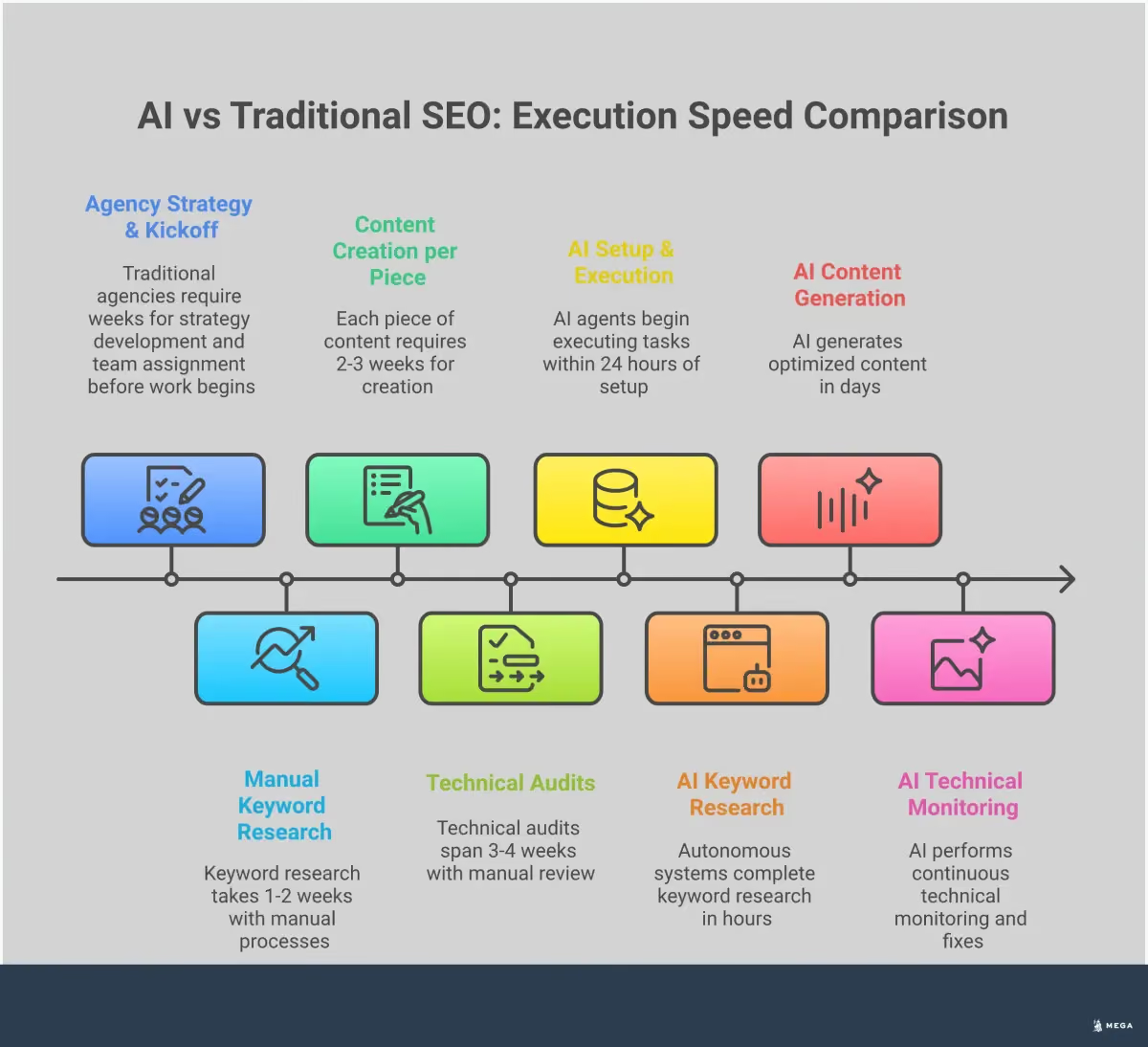
SEO is a long-term strategy, regardless of the approach. With a traditional agency, it can take a while to see a return on your investment. Some industry experts suggest it can take around nine months to break even and up to two years to achieve top rankings. This timeline is often due to manual processes, research, and the back-and-forth communication required between the agency and your team.
AI-powered platforms are built to accelerate this process. By automating tasks like keyword research, content creation, and technical fixes, they can execute an SEO strategy much faster. MEGA AI, for instance, uses autonomous agents that work around the clock to implement optimizations. This means you can often see measurable results and improvements in traffic and rankings more quickly than with traditional methods.
Automation vs. the human touch
A common concern with AI is that it lacks the strategic thinking of a human expert. Some automated tools can produce repetitive content that doesn't resonate with an audience. However, modern AI platforms are far more advanced. They are designed to act as strategic partners, not just simple automation tools.
MEGA AI bridges this gap by offering autonomous agents that handle both strategy and execution. As the platform states, "This isn't another AI chat interface you need to wrestle with... These are real Agents who come up with a strategy and execute the tasks needed to hit your goals." This approach combines the efficiency of automation with the strategic oversight you'd expect from an agency, giving you a powerful and reliable growth engine.
Which option scales with your business?
As your business grows, your marketing needs will change. Scaling with a traditional agency can sometimes be challenging, as it may require renegotiating contracts or increasing your retainer to get more work done. Their capacity is limited by the size of their team and their manual workflows.
AI platforms are inherently scalable. They can handle an increasing workload without a proportional increase in cost or a decrease in performance. Whether you need to generate ten articles or a thousand, an AI agent can manage the task efficiently. This flexibility makes an AI-powered platform an ideal partner for ambitious businesses that plan to grow and adapt over time, without being held back by operational bottlenecks.
What to look for in an SEO company
Choosing the right SEO partner is a critical decision for your business. Whether you opt for a traditional agency or an AI-powered platform, the fundamentals of what makes a good partner remain the same. You need a service that understands your goals, executes a sound strategy, and delivers measurable results. The key is to look past the sales pitch and evaluate their process, transparency, and adaptability. A great SEO company acts as an extension of your team, providing the expertise and execution you need to grow your online presence. As you evaluate your options, focus on their core methods, how they communicate progress, their technical capabilities, and their approach to the ever-changing landscape of search.
Proven expertise and methods
An effective SEO strategy is built on expertise. This doesn't always mean a large team of people; it means a deep, data-backed understanding of how search engines work. A good partner should be able to articulate their approach to keyword research, content creation, and technical SEO. For AI platforms, this expertise is embedded in their algorithms, often trained on millions of data points to identify patterns and opportunities humans might miss. Ask about the strategy behind the tactics. Whether it's a human or an AI agent, the work should be guided by a clear plan designed to attract the right search intent for your business, not just generate clicks.
Clear communication and reporting
You should never be in the dark about the work being done on your behalf. A reliable SEO partner provides transparent, easy-to-understand reporting that connects their activities to your business goals. Look for a provider that offers a clear view of tasks, progress, and key performance indicators like organic traffic, keyword rankings, and conversions. Modern platforms often provide a dashboard where you can see every task an SEO agent is working on in real time. This level of transparency builds trust and allows you to see exactly where your investment is going, eliminating the vague monthly reports that leave you wondering what you paid for.
How it connects with your tools
Your website doesn't exist in a vacuum, and neither should your SEO service. A modern SEO solution must integrate seamlessly with your existing technology stack. This includes your content management system (CMS) like WordPress or Shopify, your analytics platforms, and other marketing tools. Smooth integration ensures that changes can be implemented efficiently and that data is tracked accurately across all your systems. Before committing, verify that the company can work with your current setup. A platform with broad compatibility can save you significant time and technical headaches, allowing your SEO efforts to enhance your existing workflow rather than disrupt it.
Adapting to Google's updates
The world of SEO is in constant motion, with Google regularly updating its algorithms. Your SEO partner must be able to adapt quickly to these changes to protect and improve your rankings. While agencies rely on their teams to stay informed and adjust strategies, AI-powered platforms are built for this environment. They can analyze algorithm updates and re-optimize content at a scale and speed that is difficult to match manually. Look for a service that has a clear process for navigating Google's updates, ensuring your site remains compliant and competitive without missing a beat.
Why AI-powered SEO is becoming the new standard
The world of SEO moves fast. Google updates its algorithm, competitors publish new content, and customer search habits change. For a small business, keeping up can feel like a full-time job. While traditional agencies have long been the go-to solution, AI-powered platforms are quickly setting a new standard for how businesses can effectively manage and scale their search presence.
This shift isn't just about using AI as a simple writing assistant. It’s about leveraging autonomous systems that can strategize, execute, and optimize your entire SEO campaign from start to finish. Modern platforms act as a dedicated agent for your business, handling the complex, data-heavy work so you can focus on what you do best. They offer a level of speed, precision, and continuous improvement that is difficult for human-only teams to match. This makes high-level SEO accessible without the traditional agency price tag. Instead of paying a hefty monthly retainer for a team that divides its attention across many clients, you get a dedicated AI agent focused solely on your growth. This technology bridges the gap between expensive, slow-moving agencies and DIY tools that require too much time and expertise, offering a smarter path to online visibility.
Automated work and constant improvements
A successful SEO strategy involves hundreds of ongoing tasks, from technical site audits to backlink monitoring and rank tracking. AI platforms automate this relentless workload. Instead of waiting for a monthly report from an agency, an AI agent works around the clock, constantly scanning your site for issues and opportunities. It can identify and fix technical problems, discover new keywords, and adjust tactics based on performance data in real time. This means your SEO is always on and always improving. An AI agent doesn’t just follow a static plan; it refines its approach with every new piece of data, creating a powerful feedback loop where your site’s performance gets progressively better.
Automatic content updates
Content is the foundation of SEO, but its value can fade over time. Information becomes outdated, new competitors emerge, and your articles can lose their rankings. AI agents solve this by treating your content as a living asset. They can automatically monitor your existing blog posts and web pages to identify opportunities for improvement. For example, an AI can analyze a post that’s slipping in the rankings and determine what’s missing. It might add a new section to cover a trending topic, update statistics, or rewrite headlines to improve click-through rates. This process of programmatic SEO ensures your content stays fresh, relevant, and competitive without you having to manually review every single article.
Data-driven strategy
Effective SEO is built on data, and AI platforms can process information at a scale that is impossible for humans. Platforms like MEGA AI are built on proprietary models trained on hundreds of millions of data points from search results and ad campaigns. This massive dataset allows the AI to see the bigger picture, identifying patterns and predicting trends with incredible accuracy. This means your strategy isn't based on guesswork or a few keyword tools. It's guided by a deep understanding of what actually works on Google right now. The AI can pinpoint high-intent keywords your competitors have missed and structure content for maximum impact, building a strategic plan that is entirely data-driven.
Full automation from start to finish
One of the biggest misconceptions about AI in SEO is that it’s just a collection of tools that still require a human expert to manage. Modern platforms have moved beyond that, offering true end-to-end automation. An AI agent can develop a complete SEO strategy, create and publish optimized content, build internal links, and manage technical fixes—all on its own. This is what we mean by an autonomous system. You provide the goals, and the AI handles the entire execution. For instance, platforms like MEGA AI feature an "Autopilot" mode that over 85% of customers use to let the agent work independently. This isn't about replacing strategic thinking; it's about entrusting the strategy and its execution to a system designed for peak performance. You can book a demo to see how an agent can manage your entire SEO workflow.
AI or a traditional agency: Which is right for you?
Choosing the right SEO partner depends entirely on your business's specific situation. There isn't a single correct answer, but you can find the best fit by looking at four key areas: your budget, your team's availability, your business goals, and how quickly you need to see movement. Thinking through these factors will help you decide whether a traditional agency or an AI-powered platform is the right path for your growth.
Your budget and what you can spend
Cost is often the first hurdle for small businesses. A traditional SEO agency typically requires a significant monthly retainer, often starting at several thousand dollars. While this is usually less than hiring a full-time in-house expert, it can still be prohibitive. AI-powered platforms present a more accessible alternative. For example, an AI agent can deliver the value of a high-cost agency for a fraction of the price. This opens the door for startups and local businesses to access powerful SEO services that were previously out of reach, allowing you to invest in growth without breaking the bank.
Your team's time and skillset
Consider how much time you or your team can dedicate to managing your marketing. Hiring an agency saves you from doing the work yourself, but it doesn't eliminate your involvement. You’ll still need to attend strategy meetings, review reports, and manage the relationship. An AI platform offers a different approach. Autonomous agents can handle strategy and execution from start to finish, often with an "autopilot" mode that requires minimal oversight. This is ideal for lean teams and business owners who need to focus on their main job while a dedicated agent manages their SEO in the background.
Your business goals and size
Your company's size and objectives play a big role in this decision. Large enterprises with complex marketing needs across many departments might benefit from a full-service agency's "360-degree" approach. However, for most small businesses, startups, and local practices, the goal is more focused: drive targeted traffic and generate leads efficiently. An AI-powered platform is built for this specific purpose. It acts as a specialized operator, executing high-impact SEO tasks without the overhead of a large agency. This streamlined approach ensures your resources are directed squarely at what moves the needle for your business.
How quickly you need results
SEO is a long-term strategy; meaningful results often take several months to materialize. No legitimate service can promise instant top rankings. The difference lies in the speed of execution. A traditional agency has a ramp-up period involving onboarding, team assignments, and manual strategy development. An AI agent, on the other hand, can begin executing tasks like technical audits and content creation almost immediately. This ability to work continuously and at scale can lead to seeing initial traction and measurable results faster. If you want to see how quickly an AI agent can get to work, you can book a demo to see the process in action.
Common myths about modern SEO
As AI becomes more common in digital marketing, it’s easy to get tangled in the hype. Some tools make big promises they can’t keep, which can lead to confusion about what AI can realistically do for your SEO. Let’s clear up a few common myths so you can make an informed decision for your business.
Myth: AI guarantees instant #1 rankings
The idea of an AI tool instantly pushing your website to the top of Google is appealing, but it’s not realistic. SEO is a complex process that involves building authority and relevance over time. While AI can significantly speed up tasks like keyword research, content creation, and technical fixes, it doesn’t bypass the fundamental rules of how search engines work. True search engine optimization requires a consistent, long-term strategy. Think of AI as a powerful engine that helps you execute that strategy faster and more efficiently, not a magic wand for overnight success.
Myth: Automation replaces strategy
One of the biggest misconceptions is that you can just turn on an automated tool and let it run your entire SEO campaign without any thought. This approach often leads to generic, low-quality content that fails to connect with your audience and can even be flagged by Google. As experts at SMA Marketing note, SEO is about improving content for humans first. The best AI platforms don’t just automate tasks; they execute a coherent strategy. They act as a partner, identifying opportunities and carrying out the work needed to achieve specific goals, rather than just churning out content for the sake of it.
Myth: One size fits all
Every business is unique, with different goals, audiences, and competitors. A generic, one-size-fits-all SEO plan will never be as effective as a tailored strategy. Many simplistic AI tools offer a cookie-cutter approach that ignores the specific needs of your business. This often results in repetitive content that doesn’t align with your brand or what your customers are actually searching for. A truly effective AI-powered platform acts more like a strategic agent, developing a customized plan and adapting it based on performance data to ensure your marketing efforts are always aligned with your business objectives.
Red flags to watch for when hiring an SEO service
Choosing an SEO service is a significant step for your business. The right partner can drive sustainable growth, but the wrong one can waste your budget and even damage your site's reputation. To help you make an informed decision, here are a few common red flags to watch for during your search.
Unrealistic promises and guarantees
If a company promises you the top spot on Google overnight, it’s best to walk away. SEO is a long-term investment, and no one can guarantee specific rankings. These promises often rely on a one-size-fits-all approach that cranks out low-quality content. True SEO isn’t just about optimizing for search engines; it’s about creating genuinely helpful content for your audience. A trustworthy provider will set realistic expectations and focus on building a solid foundation for growth over time, aligning with Google’s guidelines on creating valuable content for users.
Hidden fees and vague pricing
Transparency is key. If a company is hesitant to discuss its pricing or provides unclear answers about costs, consider it a major red flag. You should know exactly what you’re paying for and what services are included. Some providers may also suggest using risky "black-hat" tactics, like buying links, which can lead to penalties from search engines. Look for companies that offer clear, upfront pricing. For example, platforms like MEGA AI provide transparent pricing so you know the cost from the start, without any hidden fees or long-term contracts.
Poor communication and reporting
Your SEO provider should be a partner, not a mystery. You should receive regular, easy-to-understand reports that detail the work being done and the progress being made. If a company is difficult to get in touch with or provides reports that are confusing and lack context, it’s a sign of poor service. A good partner will keep you in the loop and make it easy to track your return on investment. Modern platforms often include a dashboard where you can track all tasks and monitor your key performance indicators in one place.
Outdated methods that can hurt your site
The world of SEO is always changing. A provider using outdated methods like keyword stuffing or generating repetitive, low-value articles can do more harm than good. These tactics are ineffective and can get your website penalized by Google. A reliable SEO service stays current with algorithm updates and focuses on sustainable strategies that build your site's authority. They should prioritize quality and align their methods with Google’s emphasis on E-E-A-T (Experience, Expertise, Authoritativeness, and Trustworthiness), ensuring your content is built to last.
How much to budget for SEO services
Setting a budget for SEO is a critical step, but the costs can seem all over the map. The price you pay depends heavily on the service model you choose, the scope of work, and your business goals. Understanding the two main pricing structures—traditional agency retainers and AI platform subscriptions—will help you make an informed decision that fits your budget and growth plans.
Typical agency retainers
Most traditional SEO agencies work on a monthly retainer model. This is a fixed fee you pay each month for a set of agreed-upon services. For small and mid-sized businesses, these retainers typically range from $1,500 to $5,000 per month. Some agencies may offer project-based pricing for one-off tasks, but ongoing SEO requires a continuous effort, which is why the retainer is so common.
This fee covers the agency's overhead, including the salaries of specialists, the cost of analytics tools, and the time spent on research, execution, and reporting. While effective, this model can be a significant expense for small businesses, and the cost often reflects the number of human hours dedicated to your account. You can find more detailed breakdowns of SEO pricing to see how these costs are structured across the industry.
AI platform subscriptions
AI-powered SEO platforms operate on a software-as-a-service (SaaS) subscription model, which is often more predictable and affordable. Instead of paying for billable hours, you pay a flat monthly or annual fee for access to the platform’s technology. For example, MEGA AI’s fully managed SEO agent starts at $799 per month.
This subscription gives you access to an autonomous system that handles tasks like keyword research, content creation, technical fixes, and performance tracking without direct human intervention. Because the work is automated, these platforms can deliver comprehensive services at a fraction of the cost of a traditional agency. This model makes high-level SEO accessible to startups and small businesses that don't have a five-figure monthly marketing budget.
What influences the price and your return
Regardless of the model you choose, the price is ultimately tied to the value you receive. Several factors influence the cost, including the competitiveness of your industry, your starting point, and the aggressiveness of your growth goals. An agency might quote a higher price for a complex ecommerce site than for a local service business because the scope of work is larger.
With an AI platform, the subscription tier often reflects the scale of activity, such as the amount of content created or the number of keywords tracked. The key is to focus on the potential return on investment. A lower price isn't better if it doesn't produce results. Your goal should be to find a solution that not only fits your budget but also provides a clear path to measuring your marketing ROI through increased traffic, leads, and sales.