
Hitting "publish" on a new blog post can feel like a shot in the dark. You’ve spent hours, maybe even days, researching and writing, but once it’s live, you’re left wondering if anyone will ever find it. The truth is, most content never reaches the first page of Google, not because it’s poorly written, but because it’s missing a strategic foundation. Getting to that coveted #1 spot isn’t about luck or some secret trick. It’s about following a repeatable, data-driven process. This guide breaks down that exact process, step by step, so you can stop guessing and start creating content that’s engineered to rank.
Key Takeaways
- Plan your content with data, not guesswork: Before writing, focus on a keyword strategy that balances search volume with realistic competition. Analyze top-ranking pages to create a comprehensive content brief that guides your article's structure and depth.
- Write for people first, then optimize for search engines: Create the most helpful and thorough resource on your topic to satisfy your audience. Then, layer in technical SEO elements like a clear page structure, internal links, and schema markup to help search engines understand and rank your content.
- Treat publishing as the start of the process, not the end: A #1 ranking requires ongoing effort. Regularly track your content's performance, refresh it with updated information, and build authority with quality backlinks to defend and improve your position over time.
What is #1-Ranking SEO Content?
Content that reaches the top of search results does more than just exist. It serves a specific purpose for both the reader and the search engine. It directly answers a person's query, provides genuine value, and is presented in a way that search algorithms can easily crawl, understand, and trust. Think of it as the perfect intersection of human needs and machine readability. This means your article isn't just well-written; it's also well-structured, technically sound, and clearly signals its topic and authority to Google.
Getting to that #1 spot isn't about luck or a single secret trick. It’s about a repeatable process that combines strategic keyword selection, a deep understanding of your audience's intent, and a solid technical foundation. When you get these elements right, you create content that not only attracts visitors but also builds authority and drives your business goals. It’s the kind of content that works for you long after you hit publish, consistently bringing in the right kind of traffic. The rest of this guide will walk you through exactly how to build that process for yourself, step by step, so you can create articles that earn their place at the top.
Key Ingredients of Top-Ranking Content
Top-ranking content is built on a solid foundation of research and strategy. It starts with careful keyword evaluation, where you look at three key factors: search volume, competition, and user intent. Simply choosing a popular keyword isn't enough. Your content must align with your audience's specific needs and search behavior patterns to attract qualified traffic. If your articles aren't showing up on Google, a weak keyword strategy is often the reason. Getting this first step right ensures you’re building your content on solid ground and targeting queries you can realistically win.
Why Most Content Never Reaches Page One
Many businesses create great content that never sees the first page of Google. This usually comes down to a few common mistakes. One of the biggest is targeting keywords that are too broad and competitive. While these terms have high search volume, the chances of outranking established authorities are slim. Another issue is keyword stuffing, an outdated practice of overusing keywords that makes your content unreadable and can lead to search penalties. Finally, many small businesses face technical local SEO challenges, from fixing website errors to implementing the right code, which can hold back even the best content.
Find the Right Keywords for a #1 Spot
Before you write a single word, you need a solid keyword strategy. This is the foundation of any content that aims for the top spot on Google. The goal is to find the perfect intersection of what your audience is searching for, what you can realistically rank for, and what drives your business goals. Many businesses make the mistake of either targeting keywords that are far too competitive or choosing terms that no one is actually looking for. A smart approach avoids these extremes.
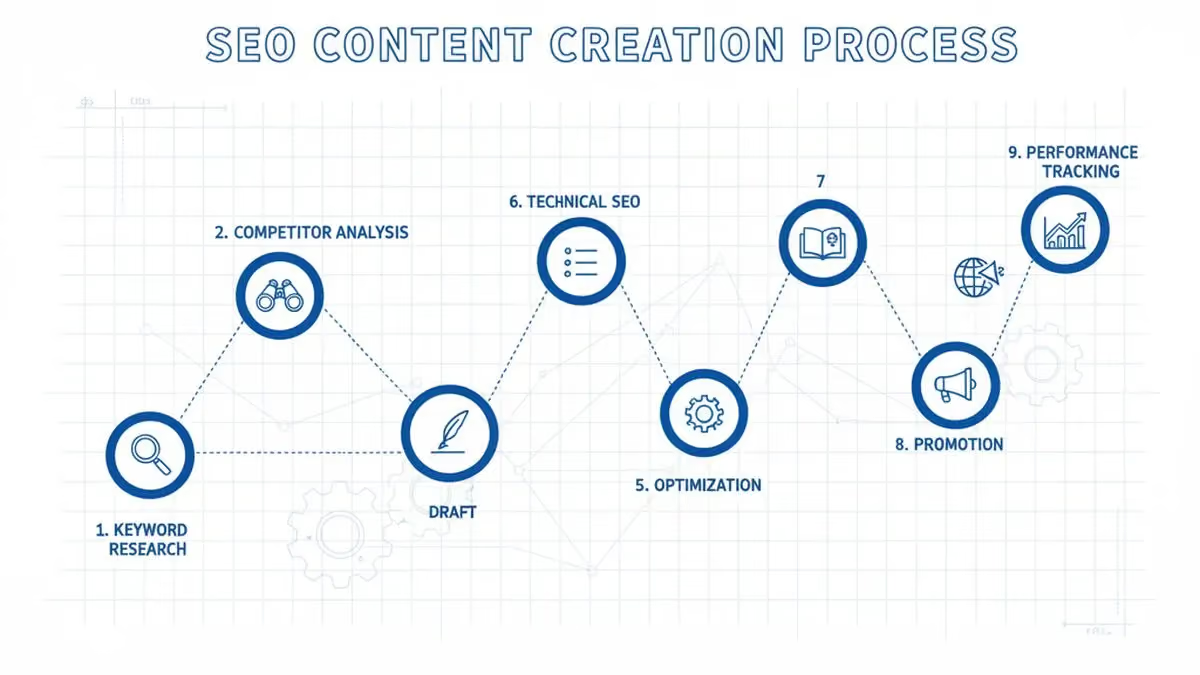
Finding the right keywords involves balancing three core elements: competition, search volume, and user intent. Think of it as a three-legged stool. If one leg is missing, the whole strategy falls apart. You need to analyze how difficult a keyword is to rank for, find a search volume that makes sense for your goals, and deeply understand the "why" behind your audience's search. This research phase is critical, and it’s where an AI-powered tool like MEGA’s SEO agent can save you hours of manual work by analyzing millions of data points to find the best opportunities for your business.
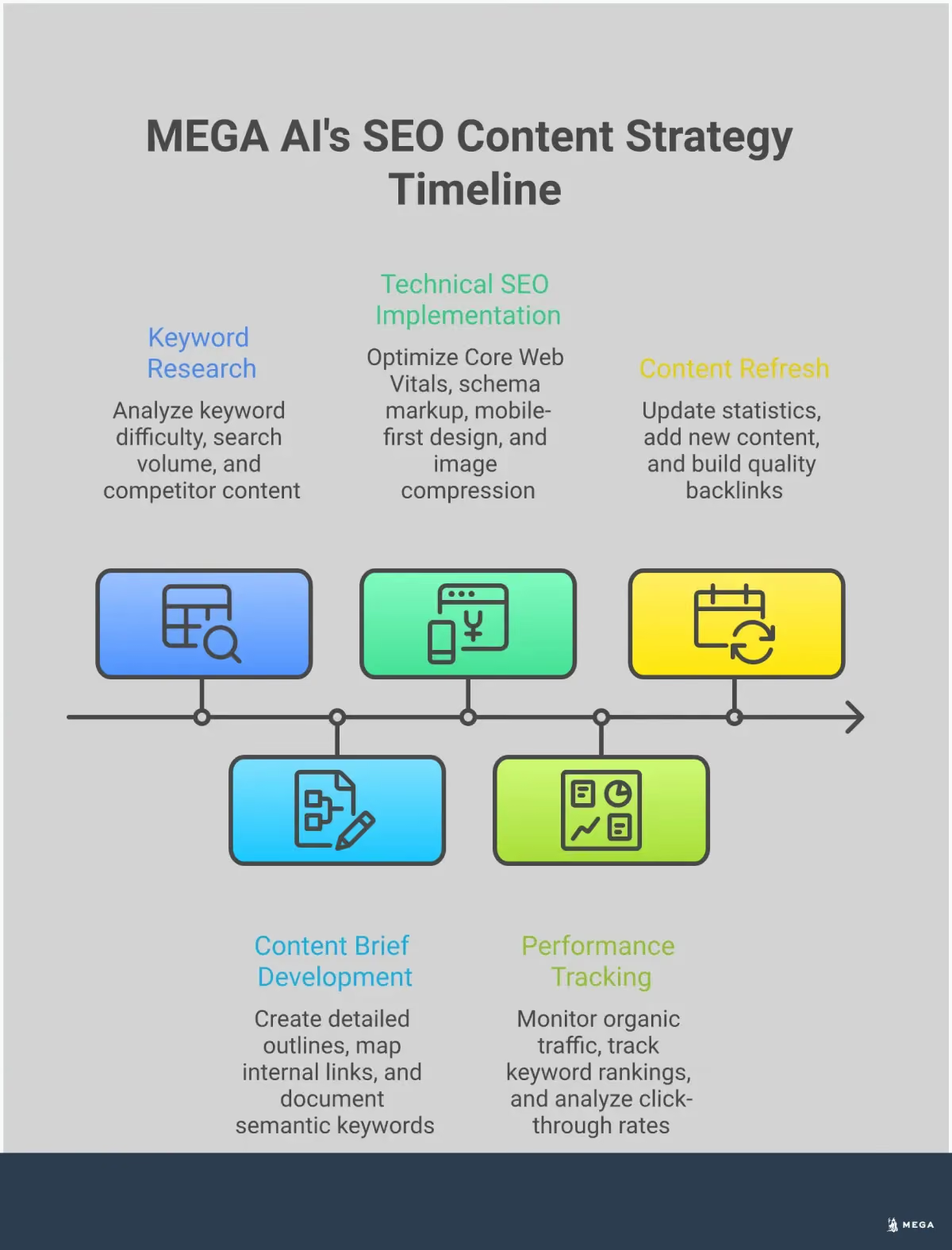
Analyze Keyword Difficulty vs. Opportunity
Keyword difficulty tells you how hard it will be to rank on the first page for a specific term. It’s easy to get excited about broad keywords with massive search volumes, but these are often dominated by large, established brands. For a small or local business, trying to rank for a term like "marketing" is nearly impossible. These keywords are highly competitive, making it difficult to break through the noise.
Instead, focus on finding opportunities where you can win. This usually means targeting long-tail keywords, which are longer and more specific phrases. For example, instead of "marketing," you might target "content marketing strategy for local plumbers." This term has lower competition, and the traffic it brings is far more relevant to your business.
Find the Search Volume Sweet Spot
Search volume is the number of times a keyword is searched for in a given month. While it’s an important metric, it shouldn't be your only focus. A keyword with 100,000 monthly searches might seem ideal, but if it’s too competitive or irrelevant, it won’t help you. The key is finding the sweet spot between volume and opportunity. When evaluating keywords, you need to consider volume alongside competition and intent.
For a local business, a keyword with just 50 searches a month could be incredibly valuable if it has strong local and commercial intent, like "emergency roof repair in Austin." For a national ecommerce store, that number would need to be higher. Don’t chase vanity metrics. Focus on the keywords that will attract qualified traffic that is likely to convert.
Understand What Your Audience is Searching For
Search intent is the "why" behind a search query. Understanding this is arguably the most important part of keyword research. You need to create content that directly addresses your target audience's needs and solves their problems. Is someone looking for information, trying to find a specific website, or ready to make a purchase?
For example, a search for "how to write a blog post" has informational intent. The user wants a guide or a template. A search for "best SEO writing software" shows commercial investigation intent. The user is comparing options before buying. Your content must match the intent of your target keyword. If it doesn't, it won't rank, no matter how well-written it is.
Lay the Groundwork with Solid Research
Before you write a single word, you need a solid plan. The research phase is where you uncover what your audience actually wants, what your competitors are doing right, and what it takes to create a piece of content that truly deserves the top spot. This groundwork ensures that your writing time is spent effectively, creating an article that’s engineered to rank from the start. This step is critical for both human and AI-written content, as it provides the necessary strategic direction.
Research Search Intent Beyond Google
Understanding search intent, or the "why" behind a query, is the foundation of any successful SEO strategy. Keywords give you valuable insights into your audience's needs, but the real magic happens when you look beyond the search results page. To truly grasp what your audience is asking, spend time on platforms like Reddit, Quora, and YouTube. Read the comments and forum threads related to your topic. This is where you'll find the unfiltered questions and pain points that Google doesn't always show you. This deeper understanding of user intent helps you create content that doesn't just answer a question, but solves a real problem for your reader.
Analyze Top-Ranking Competitor Content
To rank number one, you need to know what the current number one looks like. Analyzing the top-ranking pages for your target keyword shows you the standard you need to meet and exceed. This isn't about copying; it's about deconstructing their success. Look at their article structure, the depth of their information, the questions they answer, and how they use images and formatting. A simple way to start is by creating a spreadsheet to track your findings. You can enter your keyword into Google and use a data scraper extension to quickly pull the top 10 results into your sheet for a side-by-side comparison.
Create a Comprehensive Content Brief
A content brief is your blueprint for a high-ranking article. It translates all your research into a clear, actionable plan. This step is critical whether you're writing the content yourself or handing it off to a team member or an AI writer. A strong brief should include your primary keyword, the defined search intent, a description of the target audience, and a list of key topics and subheadings to cover. It should also suggest internal linking opportunities and provide a target word count based on your competitor analysis. This document ensures everyone involved is aligned on the goal, making the writing process faster and far more effective.
Create an Outline That's Built to Rank
Once your research is complete, the next step is to create a detailed outline. Think of this as the blueprint for your content. A well-structured outline ensures you cover all the necessary points from your research, address the user's search intent completely, and organize your ideas in a logical flow. This structure isn't just for you; it helps readers easily find the information they need and allows search engine crawlers to understand the hierarchy and relevance of your content. A solid outline is the difference between a rambling article and a focused, high-value resource that keeps readers engaged.
A great outline is born from analyzing top-ranking competitor content. By seeing how others have successfully structured their pages, you can identify common patterns, find gaps you can fill, and build a framework that is more comprehensive and valuable. This process involves mapping out your main headings (H2s) and subheadings (H3s) to create a clear path for the reader. For busy business owners, this can be a time-consuming step, which is where an AI-powered tool like MEGA AI's Lindsay agent can help. It automates the analysis of search results to generate a data-driven outline designed to compete for the top spot, saving you hours of manual work.
Structure Your Content for Featured Snippets
Featured snippets are the answer boxes that appear at the top of Google's search results, and they are prime real estate. To increase your chances of capturing one, structure your outline to provide clear, direct answers to common questions. Use your subheadings to pose questions that your audience is asking, then immediately follow them with concise, factual answers in the form of a short paragraph, a numbered list, or a bulleted list.
If your target keyword has commercial intent, your page structure should be built to convert. This means strategically planning where to place calls-to-action, product features, or testimonials within your outline. The goal is to guide the reader smoothly from information-gathering to taking a desired action, making the conversion feel like a natural next step.
Weave in Semantic Keywords Naturally
Gone are the days of stuffing your primary keyword into your content as many times as possible. Thanks to natural language processing (NLP), AI-powered search engines like Google now understand meaning, not just exact phrases. Your outline should include plans to incorporate semantic keywords, which are terms and concepts related to your main topic. These related keywords provide context and demonstrate the depth of your expertise.
For example, if your main keyword is "small business accounting," your outline should include sections that touch on related concepts like "bookkeeping," "tax deductions," "invoicing software," and "profit and loss statements." Sprinkling these terms naturally into your headings and body copy helps search engines recognize your content as a comprehensive resource on the topic.
Write for People First, Search Engines Second
Ultimately, you are writing for a human audience. A technically perfect page that is unreadable or unhelpful won't keep visitors engaged, and search engines will notice. Interesting, well-researched articles will not only build trust with your audience but also improve your site’s SEO performance, as search tools recognize and reward valuable, people-first content.
Your outline should prioritize a logical and enjoyable reading experience. Plan to break up long paragraphs, use clear and simple language, and organize your thoughts in a way that is easy to follow. When your content genuinely helps the reader solve a problem or learn something new, you create a positive user experience that both people and search algorithms appreciate.
Write a First Draft That Gets Results
With a solid outline in hand, it’s time to start writing. This is where you transform your research and structure into a piece of content that connects with readers and satisfies search engines. The goal isn’t just to fill the page with words, but to craft a compelling article that answers questions, builds trust, and guides users toward a solution. A great first draft focuses on clarity, depth, and creating a seamless experience for the reader. Getting the core message and flow right at this stage makes the editing and optimization process much smoother.
Craft an Opening That Hooks Readers Instantly
The first few sentences of your article are your most valuable real estate. They determine whether a visitor will stick around to read more or hit the back button. A strong introduction grabs the reader's attention by directly addressing their problem or question and promising a clear, valuable solution. This immediately lowers bounce rates and signals to search engines that your page is a good match for the query. Instead of a vague opening, get straight to the point. Acknowledge the reader's challenge and let them know they’ve come to the right place for an answer. This builds instant rapport and encourages them to keep reading.
Show Your Expertise and Go In-Depth
To rank at the top of search results, your content needs to be more than just accurate; it needs to be comprehensive. Surface-level articles that rehash basic information rarely stand out. Your goal is to provide the most thorough and helpful answer available. This means going deeper than your competitors, offering unique insights, and covering the topic from multiple angles. When you establish authority on a subject, you build trust with your audience and demonstrate your credibility to search engines. This is why our AI agent, Lindsay, researches top articles, forums, and news sites before writing, ensuring every piece is rich with detail and genuinely helpful.
How to Use Internal Links as You Write
As you draft your content, think of your website as a connected web of information. An effective internal linking strategy guides both users and search engine crawlers through that web, making your site easier to understand and explore. While writing, look for natural opportunities to link to other relevant articles on your blog. For example, if you mention a related concept that you’ve already written about, add a link to that post. This helps readers discover more of your valuable content, keeping them on your site longer. It also distributes page authority across your site, which can help improve the rankings of other pages.
Design a Page That Converts Readers into Customers
Getting your content to rank is a huge win, but it’s only half the battle. Once a potential customer lands on your page, the design needs to guide them toward taking action. Many small businesses focus all their energy on writing content but overlook the page design, which is a critical mistake. If a keyword has commercial intent, meaning the searcher is looking to buy or inquire, the page must be built to convert that interest into a lead or sale. A page that ranks but doesn’t convert is just a missed opportunity.
A well-designed page does more than just look good. It creates a clear, intuitive path for the reader, making it easy for them to understand what you offer and what they should do next. This involves thinking strategically about every element, from your headline and images to where you place your contact forms and buttons. The goal is to remove any friction that might cause a visitor to get confused and leave. At MEGA AI, our SEO agent, Lindsay, doesn't just create content; she also helps with conversion optimization to ensure the traffic you earn actually contributes to your business growth.
Key Page Elements That Drive Conversions
To turn visitors into customers, your page needs a few essential elements working together. Start with a clear, compelling headline that confirms the reader is in the right place. Use high-quality images or videos to break up text and show your product or service in action. Structure your content with short paragraphs, subheadings, and bullet points to make it easy to scan. Finally, every page should have a clear call-to-action (CTA) that tells the user exactly what to do next, whether it’s "Buy Now," "Schedule a Consultation," or "Download Our Guide." These landing page fundamentals help create a seamless user experience that encourages action.
Build Trust with Credibility Markers
Before someone decides to buy from you, they need to trust you. You can build that trust directly on the page with credibility markers. Well-researched, helpful content is a great start, as it positions you as an expert in your field. You can go further by adding social proof like customer testimonials, reviews, or case studies. Displaying trust badges, such as security seals for an ecommerce site or industry awards, can also make visitors feel more secure. For local businesses, showing photos of your team or physical location adds a personal touch. These elements reassure visitors that you’re a legitimate and trustworthy business, making them more likely to convert.
Place CTAs Where They'll Get Clicked
Your call-to-action is your page’s most important job, so its placement is a strategic decision. Don't just hide it at the very bottom of the page. Instead, place CTAs in multiple, logical spots: one above the fold so it's immediately visible, another midway through your content, and a final one at the end. For local businesses, this is especially critical. Your Google Business Profile should link to a localized landing page for that specific city or town. This makes the page more relevant to local searchers and your GMB listing. Driving targeted traffic with a tool like MEGA AI's Paid Ads agent to these optimized pages can create a powerful combination for local customer acquisition.
Nail the Technical SEO for a #1 Ranking
Even the most brilliant content can fail to rank if the technical foundation of your website is shaky. Think of it this way: your content is the main act, but technical SEO is the stage, lighting, and sound system. If the stage is broken, no one will see the performance. Technical SEO ensures search engines can find, crawl, and understand your pages without any issues.
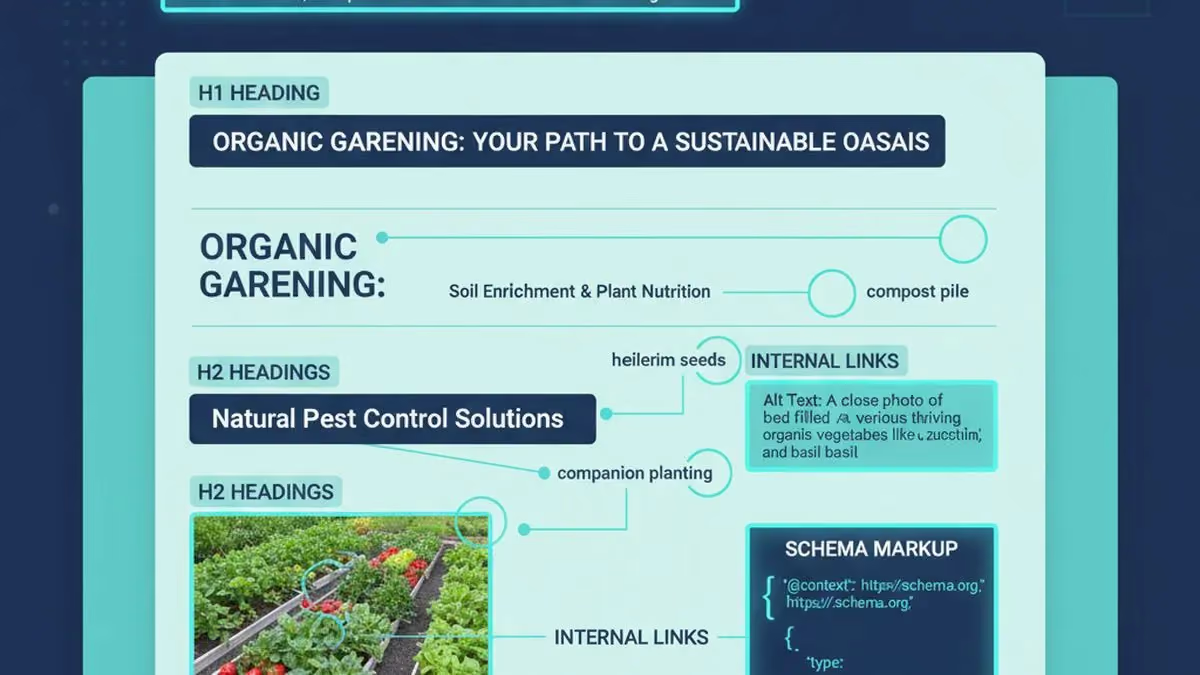
For many business owners, this is the part that feels the most intimidating. But you don’t need to be a developer to get it right. Focusing on a few critical areas can make a significant impact on your rankings. Automated tools can also handle the heavy lifting. For example, MEGA AI’s SEO agent runs technical audits and implements fixes automatically, so you can focus on your business while your site stays in top shape. We’ll cover the three most important elements: page speed, schema markup, and mobile-friendliness.
Optimize for Page Speed and Core Web Vitals
How quickly your page loads is a major factor in both user experience and search rankings. No one likes to wait for a slow website, and Google knows it. That’s why they use a set of metrics called Core Web Vitals to measure a page’s health in terms of loading speed, interactivity, and visual stability. A faster site generally leads to better scores and a better experience for your visitors.
To improve your page speed, start with the basics: compress your images so they are smaller in file size, choose a reliable web host, and limit the number of plugins or scripts running on your site. Getting these elements right will improve your Core Web Vitals and show search engines that your site offers a quality experience.
Implement Schema Markup Correctly
Schema markup is a type of code that acts like a translator for search engines. It gives them extra context about your content, helping them understand not just what your page says, but what it is. For example, you can use schema to tell Google that a string of numbers is a phone number for a local business, that a piece of content is a recipe with specific ingredients, or that a page features a product with a certain price and rating.
When you implement schema correctly, Google may reward your page with rich snippets in the search results. These are the enhanced listings that show star ratings, event dates, or product prices directly on the search page. These snippets make your listing stand out and can significantly improve your click-through rate.
Make Sure Your Page Works Perfectly on Mobile
More searches happen on mobile devices than on desktops. Because of this, Google uses mobile-first indexing, which means it primarily looks at the mobile version of your website to determine its rankings. If your site is difficult to use on a phone, your ranking will suffer, no matter how great it looks on a larger screen.
Your page should be fully responsive, meaning it adapts to any screen size. Text should be easy to read without zooming, buttons should be large enough to tap, and users should never have to scroll horizontally. You can use Google’s Mobile-Friendly Test to quickly check your pages and identify any issues that need fixing. A seamless mobile experience is no longer optional; it’s essential for ranking at the top.
Track Your Performance and Find Ways to Improve
Publishing your content is a huge step, but it’s not the final one. The journey to a #1 ranking involves watching how your content performs and making smart adjustments over time. Think of it as a feedback loop: you publish, you measure, you refine, and you repeat. This ongoing process is what separates content that briefly appears on page one from content that stays there.
By tracking the right data, you can understand what’s working, what isn’t, and where your biggest opportunities are. This isn’t about getting lost in spreadsheets; it’s about making targeted, data-informed decisions that build on your initial hard work. With the right approach, you can systematically improve your content, strengthen its authority, and solidify its position at the top of the search results. This is where many businesses drop the ball, assuming the work is done once an article is live. But the most successful content strategies treat publishing as the starting line, not the finish line. Consistently monitoring and improving your content is how you defend your rankings against competitors and adapt to changes in search engine algorithms. It ensures your investment in content creation continues to pay off for months and even years to come.
Focus on the Metrics That Actually Matter
To track performance effectively, you need to look at the data that directly impacts your business goals. While it's easy to get distracted by dozens of different numbers, a few key metrics tell most of the story. Start with organic traffic to see how many people are finding your page through search. Next, monitor your keyword rankings to see if you’re gaining visibility for your target terms. Finally, pay close attention to your click-through rate (CTR), which shows how many people who see your page in the results actually click on it. A low CTR can signal that your title or meta description isn't compelling enough. If you notice few pages ranking for your keywords, it might mean you need to build more topical authority to show search engines you're an expert.
Know When and How to Refresh Your Content
Even top-ranking content can lose its position over time, a process often called content decay. Search engine algorithms change, competitors publish new articles, and information simply becomes outdated. To stay on top, you need to refresh your content regularly. Set a schedule to review your most important pages every six to 12 months. Look for opportunities to add new information, update statistics, replace broken links, and improve accuracy. This proactive approach keeps your content fresh for both readers and search engines. An AI agent can also handle this automatically, re-optimizing content after major algorithm updates to keep it relevant and competitive.
Use Your Data to Find Internal Linking Opportunities
Internal links are one of the most underutilized tools for improving SEO. They help search engines understand your site structure, pass authority between your pages, and guide users to other relevant content. A great way to find opportunities is to use your own data. You can run a crawl of your website with a tool like Screaming Frog to identify pages that could use more internal links. Look for high-authority pages on your site and link from them to newer or lower-ranking content you want to support. This simple strategy can give your pages a significant push in the search results by sharing your site's existing strength.
Build Authority with Quality Backlinks
Creating great content is the most important part of SEO, but it's not the only piece of the puzzle. To signal to search engines that your site is a credible source, you need authority. The primary way to build this authority is through backlinks, which are links from other websites to yours. Think of each quality backlink as a vote of confidence. The more votes you have from reputable sites, the more trustworthy your own site appears. This doesn't happen by accident. It requires a two-part strategy: creating content that deserves to be linked to and then proactively finding opportunities for other sites to feature it.
Create Content That People Want to Link To
The foundation of any successful link-building effort is content that is genuinely valuable. Before you ask anyone to link to your page, you have to create something worth linking to. This means going beyond generic blog posts. Focus on creating assets like original research, comprehensive guides, or articles that offer a unique perspective on a common problem. Well-researched, interesting content not only builds trust with your audience but also gets recognized by search engines as a valuable resource. When other creators are looking for a source to cite, your in-depth article becomes the obvious choice, earning you organic backlinks without any outreach.
Simple Outreach Strategies to Earn Links
While amazing content can attract links on its own, a little outreach can speed up the process. One effective method is to sign up for services that connect journalists with experts, like Help a Reporter Out (HARO). You can respond to press requests in your area of expertise and earn a backlink if your quote is featured. Another powerful technique is to reverse engineer your competitors. Use an SEO tool to see which websites are linking to their top-ranking pages. This gives you a ready-made list of relevant sites to connect with, as they have already shown interest in your topic.